Within Robot labs
Did A Lab really discover new materials?
The A-Lab dispute shows why automated synthesis is not the same as proving that a machine has discovered new materials.
On this page
- What A Lab claimed to achieve
- Why critics challenged the novelty claims
- What the dispute teaches about AI discovery
Page outline Jump by section
Introduction
The A-Lab project was presented as a glimpse of a future in which AI-guided laboratories could dramatically accelerate scientific discovery. In a 2023 Nature paper, researchers described an autonomous system that generated synthesis recipes, operated laboratory equipment, analysed results and reported the successful production of dozens of inorganic materials in just over two weeks. For supporters of AI-driven science, it looked like evidence that discovery itself might become far faster.[Nature]nature.comAn autonomous laboratory for the accelerated synthesis of…29 Nov 2023 — Here we present the A-Lab, an autonomous laboratory that…
 The dispute began when materials scientists asked a more specific question: were these actually new materials? Critics argued that many of the reported compounds were already known, had previously appeared in scientific databases, or had not been demonstrated with the level of evidence normally required to establish the creation of a genuinely new material. The argument became important far beyond a single paper because it exposed a central problem for autonomous science. Producing candidate results is one thing. Proving discovery is another. Nature[Chemistry World]chemistryworld.comChemistry WorldNew analysis raises doubts over autonomous lab's…16 Jan 2024 — A critique of a paper published in Nature last year, whi…
What A-Lab claimed to achieve
The A-Lab system, developed by researchers associated with Lawrence Berkeley National Laboratory and collaborators, combined machine learning, materials databases, literature-derived synthesis planning, robotics and automated X-ray diffraction analysis. The laboratory was designed to run a closed-loop discovery process with minimal human intervention.[Nature]nature.comRobot chemist sparks row with claim it created new materials12 Dec 2023 — Researchers question whether an AI-controlled lab assista…
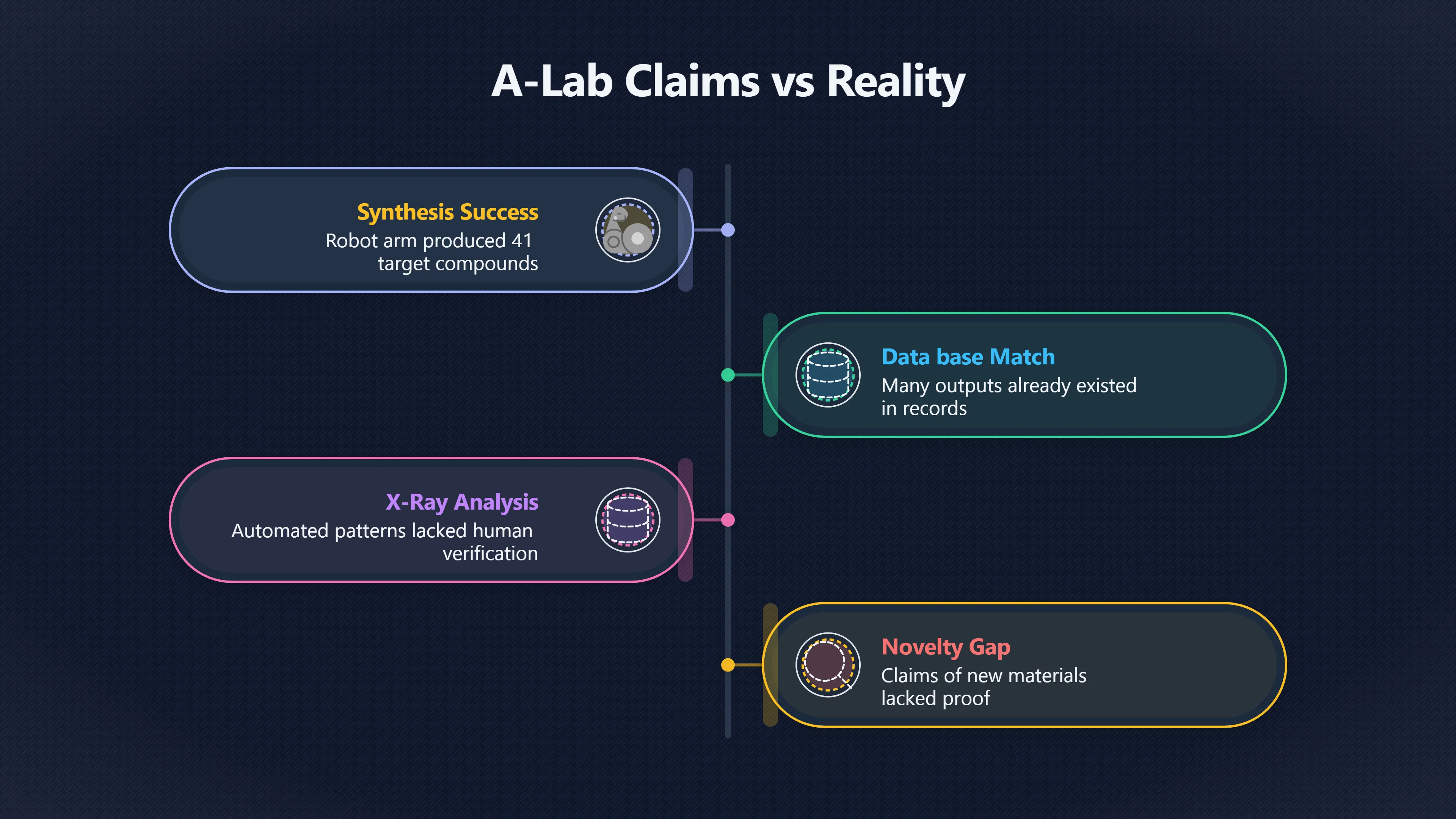
The headline numbers attracted attention. The paper reported that the laboratory operated continuously for 17 days and successfully synthesised 41 target materials from a set of 58 candidates. Many of the targets had been proposed through computational materials discovery efforts connected to the Materials Project and related AI systems.[Nature]nature.comWhile novelty preferences have been well-studied.Read more…
At a time when AI materials projects were making increasingly ambitious claims about discovering huge numbers of potentially useful compounds, A-Lab appeared to solve a major bottleneck. Predicting a material on a computer is much easier than making it in the real world. The project therefore seemed to demonstrate a path from AI prediction to physical realisation.[WIRED]wired.comGoogle Deep Mind's AI Dreamed Up 380,000 New MaterialsThe Next Challenge Is Making ThemGoogle DeepMind developed an AI program, GNoME, which has predicted 380,000 new stable materials, expand…
The public interpretation quickly expanded beyond the paper itself. Headlines and commentary often framed the result as evidence that autonomous systems were beginning to discover entirely new materials with limited human involvement. That framing helped turn A-Lab into a symbol of accelerated AI-driven science.[Nature]nature.comAn autonomous laboratory for the accelerated synthesis of…29 Nov 2023 — Here we present the A-Lab, an autonomous laboratory that…
Why critics challenged the novelty claims
The strongest criticism was not that the robot laboratory failed to run experiments. It was that the language of “novel materials” appeared much stronger than the evidence justified.
Several materials scientists argued that many of the compounds reported by A-Lab were not genuinely new discoveries. Some had already appeared in earlier scientific literature, existing databases or prior synthesis reports. Critics therefore claimed that successful synthesis did not automatically equal discovery. A laboratory can reproduce or optimise a known compound without creating a new one. Nature[Chemistry World]chemistryworld.comChemistry WorldNew analysis raises doubts over autonomous lab's…16 Jan 2024 — A critique of a paper published in Nature last year, whi…
A second criticism concerned verification standards. In materials science, proving that a new compound has been successfully synthesised often requires extensive characterisation. Researchers typically use multiple analytical methods to establish composition, crystal structure, purity and reproducibility. Critics argued that some A-Lab claims relied too heavily on automated interpretation of X-ray diffraction patterns and did not always meet the standards normally expected before declaring a new material established.[PMC]pmc.ncbi.nlm.nih.govPMCArtificial Intelligence Driving Materials Discovery?AK Cheetham · 2024 · Cited by 169 — We examine the claims of this work here, unfortunately finding scant evidence for c…
The dispute became especially visible because some researchers conducted detailed reviews of the reported compounds. According to analyses published after the paper, many of the claimed successes appeared to involve materials that were already known, incompletely characterised or insufficiently demonstrated as distinct new phases. One influential critique concluded that there was little evidence for compounds satisfying the combination of novelty, credibility and usefulness implied by some interpretations of the work.[PMC]pmc.ncbi.nlm.nih.govPMCArtificial Intelligence Driving Materials Discovery?AK Cheetham · 2024 · Cited by 169 — We examine the claims of this work here, unfortunately finding scant evidence for c…
This was not merely a disagreement about wording. The difference between “a robot successfully followed a synthesis pathway” and “a robot discovered a new material” is scientifically significant. Discovery claims carry a higher evidential burden because they imply an expansion of knowledge rather than the automation of an existing process.[Nature]nature.comRobot chemist sparks row with claim it created new materials12 Dec 2023 — Researchers question whether an AI-controlled lab assista…
The deeper disagreement: what counts as discovery?
Part of the controversy emerged because different groups were using different definitions of success.
From the perspective of autonomous laboratory researchers, a major achievement was demonstrating that an AI-guided system could navigate complex synthesis procedures, generate recipes and physically produce target compounds with limited human intervention. Even if some targets were not entirely new, showing that a machine could repeatedly execute this workflow represented technical progress.[Nature]nature.comWhile novelty preferences have been well-studied.Read more…
Many critics accepted that point while challenging a stronger interpretation. Their argument was that laboratory automation and scientific discovery are not identical. A system might automate experimentation effectively while still failing to establish genuinely novel scientific results.[Nature]nature.comWhile novelty preferences have been well-studied.Read more…
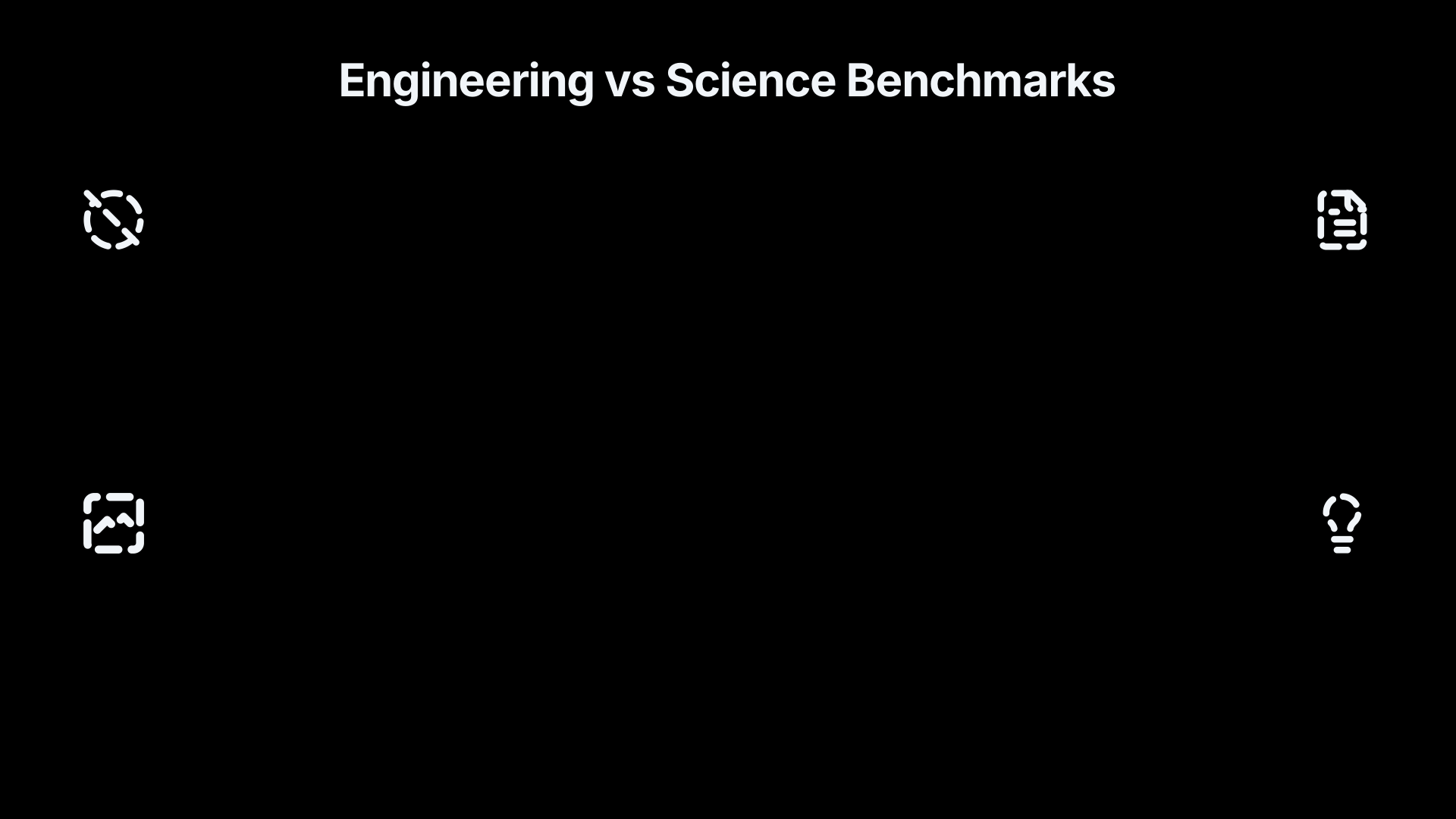
The disagreement therefore reflected two different benchmarks:
- Engineering benchmark: Can an autonomous system run the synthesis process successfully?
- Scientific benchmark: Has the system established the existence of previously unknown materials?
A-Lab appeared more convincing on the first question than on the second.[Chemistry World]chemistryworld.comChemistry WorldNew analysis raises doubts over autonomous lab's…16 Jan 2024 — A critique of a paper published in Nature last year, whi…
Why the argument mattered beyond one paper
The A-Lab dispute arrived during a period of extraordinary optimism about AI-assisted materials science.
Around the same time, Google’s DeepMind and collaborators announced GNoME, a system that predicted hundreds of thousands of potentially stable materials. Such projects fed a broader narrative that AI might radically accelerate scientific progress by exploring enormous search spaces beyond human capacity.[WIRED]wired.comGoogle Deep Mind's AI Dreamed Up 380,000 New MaterialsThe Next Challenge Is Making ThemGoogle DeepMind developed an AI program, GNoME, which has predicted 380,000 new stable materials, expand…
The problem is that materials science contains multiple stages:

- Predicting a potentially stable structure.
- Synthesising the material.
- Verifying that the material actually exists as claimed.
- Measuring useful properties.
- Demonstrating practical value.
The excitement around AI often focuses on the first stage because prediction scales easily with computation. The later stages remain slower, more expensive and experimentally demanding. The A-Lab debate highlighted how easy it is to blur these stages together. A prediction is not a synthesis. A synthesis is not proof. Proof is not usefulness.[WIRED]wired.comGoogle Deep Mind's AI Dreamed Up 380,000 New MaterialsThe Next Challenge Is Making ThemGoogle DeepMind developed an AI program, GNoME, which has predicted 380,000 new stable materials, expand…
For the broader AI bloom discussion, this distinction matters because many forecasts of scientific acceleration assume that increasing intelligence automatically translates into increasing discovery. The A-Lab controversy suggested that physical validation remains a bottleneck even when computational systems improve dramatically.
What the dispute teaches about AI discovery
Scientific proof remains a physical process
One lesson is that science is not only information processing.
AI systems can search enormous spaces of possibilities, identify patterns and generate promising hypotheses. But in fields such as chemistry and materials science, reality ultimately decides whether a proposed discovery exists. Instruments, replication studies and independent verification remain essential.[arXiv]arxiv.orgAutomating the Practice of Science23 Aug 2024 — This article evaluates the scope of automation within scientific practice and assess…
The A-Lab debate showed that automating laboratory work does not remove the need for traditional scientific standards. If anything, those standards become more important when machines can generate large numbers of claims quickly.
Metrics can create misleading impressions
Another lesson concerns incentives and measurement.
Large numbers are attractive. Reporting dozens of synthesised materials or hundreds of thousands of predicted candidates creates a powerful impression of rapid progress. But raw counts can obscure the harder questions:
- How many compounds are genuinely novel?
- How many are independently reproducible?
- How many possess useful properties?
- How many eventually matter technologically?
The controversy pushed researchers to distinguish more carefully between candidate generation, synthesis attempts and validated discoveries.[PMC]pmc.ncbi.nlm.nih.govPMCArtificial Intelligence Driving Materials Discovery?AK Cheetham · 2024 · Cited by 169 — We examine the claims of this work here, unfortunately finding scant evidence for c…
Autonomous labs may still be valuable
Importantly, the criticism did not show that autonomous laboratories are useless.
Many researchers who questioned the novelty claims still viewed laboratory automation as a promising direction. Faster experimentation, continuous operation and machine-guided search could substantially improve research productivity even if early claims proved overstated.[ScienceDirect]sciencedirect.comNavigating self-driving labs in chemical and material…by O Bayley · 2024 · Cited by 83 — Self-driving labs (SDLs) have em…
The debate was therefore less about whether autonomous labs matter and more about how success should be measured. A laboratory that helps scientists eliminate dead ends, optimise synthesis routes or generate higher-quality experimental data may still accelerate science without having independently “discovered” large numbers of new materials.
What A-Lab revealed about the proof problem
The lasting significance of the A-Lab dispute is that it exposed a recurring challenge in AI-driven science: capability can advance faster than validation.
An autonomous system may generate hypotheses, run experiments and produce plausible-looking results at unprecedented speed. Yet scientific knowledge depends on something more demanding than output volume. Claims must survive scrutiny, replication and alternative explanations. The harder the claim, the stronger the evidence required.
That is why the A-Lab argument became a useful case study within debates about scientific acceleration and AI abundance. If advanced AI eventually helps humanity discover new medicines, materials, energy systems or longevity treatments far faster than before, society will still need reliable methods for distinguishing genuine breakthroughs from merely promising signals. The future of automated science may depend not only on building machines that can discover faster, but also on building institutions and verification systems that can prove what has actually been discovered.[arXiv]arxiv.orgAutomating the Practice of Science23 Aug 2024 — This article evaluates the scope of automation within scientific practice and assess…[ScienceDirect]sciencedirect.comNavigating self-driving labs in chemical and material…by O Bayley · 2024 · Cited by 83 — Self-driving labs (SDLs) have em…
Amazon book picks
Further Reading
Books and field guides related to Did A Lab really discover new materials?. Use these as the next step if you want deeper reading beyond the article.
The Structure of Scientific Revolutions
Gives readers a broader framework for contested claims about scientific breakthroughs.
The Knowledge Machine
Directly supports the page’s focus on verification, novelty and reproducibility in science.
The Genesis Machine
Connects automated discovery claims to the wider future of biology and lab automation.
Failure
Useful for understanding why disputed results are a normal and valuable part of science.
eBay marketplace picks
Marketplace Samples
Example marketplace items related to this page. Use the search link to explore similar finds on eBay.

Endnotes
1.
Source: nature.com
Link:https://www.nature.com/articles/s41586-023-06734-w
Source snippet
An autonomous laboratory for the accelerated synthesis of...29 Nov 2023 — Here we present the A-Lab, an autonomous laboratory that...
2.
Source: wired.com
Title: Google Deep Mind’s AI Dreamed Up 380,000 New Materials
Link:https://www.wired.com/story/an-ai-dreamed-up-380000-new-materials-the-next-challenge-is-making-them
Source snippet
The Next Challenge Is Making ThemGoogle DeepMind developed an AI program, GNoME, which has predicted 380,000 new stable materials, expand...
3.
Source: nature.com
Link:https://www.nature.com/articles/d41586-023-03956-w
Source snippet
Robot chemist sparks row with claim it created new materials12 Dec 2023 — Researchers question whether an AI-controlled lab assista...
4.
Source: pmc.ncbi.nlm.nih.gov
Title: PMCArtificial Intelligence Driving Materials Discovery?
Link:https://pmc.ncbi.nlm.nih.gov/articles/PMC11044265/
Source snippet
AK Cheetham · 2024 · Cited by 169 — We examine the claims of this work here, unfortunately finding scant evidence for c...
5.
Source: sciencedirect.com
Link:https://www.sciencedirect.com/science/article/pii/S2590238524003229
Source snippet
Navigating self-driving labs in chemical and material...by O Bayley · 2024 · Cited by 83 — Self-driving labs (SDLs) have em...
6.
Source: arxiv.org
Link:https://arxiv.org/html/2409.05890v1
Source snippet
Automating the Practice of Science23 Aug 2024 — This article evaluates the scope of automation within scientific practice and assess...
7.
Source: nature.com
Link:https://www.nature.com/articles/s41598-023-31953-6
Source snippet
While novelty preferences have been well-studied.Read more...
8.
Source: sciencedirect.com
Link:https://www.sciencedirect.com/science/article/pii/S2444569X24001690
Source snippet
Investigating the impact of generative artificial intelligence...by AS Al-Busaidi · 2024 · Cited by 76 — This study, using a multi-persp...
9.
Source: chemistryworld.com
Link:https://www.chemistryworld.com/news/new-analysis-raises-doubts-over-autonomous-labs-materials-discoveries/4018791.article
Source snippet
Chemistry WorldNew analysis raises doubts over autonomous lab's...16 Jan 2024 — A critique of a paper published in Nature last year, whi...
10.
Source: science.org
Title: whoa now cautionary tales materials science
Link:https://www.science.org/content/blog-post/whoa-now-cautionary-tales-materials-science
Source snippet
Whoa Now: Cautionary Tales from Materials Science22 May 2025 — Here's a paper from a group at Ottawa looking at the metal-organic framewo...
Published: May 2025
11.
Source: facebook.com
Title: last year a paper published in nature reported the discovery of over 40 novel ma
Link:https://www.facebook.com/ChemistryWorld/posts/last-year-a-paper-published-in-nature-reported-the-discovery-of-over-40-novel-ma/779836674188165/
Source snippet
Chemistry World16 Jan 2024 — Last year a paper published in Nature reported the discovery of over 40 novel materials using A-lab, an auto...
12.
Source: natureconservation.pensoft.net
Link:https://natureconservation.pensoft.net/about
Source snippet
Nature Conservation - Pensoft PublishersNature Conservation is a peer-reviewed, open access, rapidly published online journal covering al...
Additional References
13.
Source: researchgate.net
Link:https://www.researchgate.net/publication/399899062_Author_Correction_An_autonomous_laboratory_for_the_accelerated_synthesis_of_inorganic_materials
Source snippet
(PDF) Author Correction: An autonomous laboratory for the...19 Jan 2026 — An autonomous laboratory for the accelerated synthesis of inor...
14.
Source: 404media.co
Title: google says it discovered millions of new materials with ai human researchers
Link:https://www.404media.co/google-says-it-discovered-millions-of-new-materials-with-ai-human-researchers/
Source snippet
Is Google's AI Actually Discovering 'Millions of New...11 Apr 2024 — “AI tool GNoME finds 2.2 million new crystals, including 380,000 st...
15.
Source: youtube.com
Title: Jens Hauch
Link:https://www.youtube.com/watch?v=961VIyGliH4
Source snippet
AI TAKES NO BREAKS: CRAZY WEEK IN AI | Sam Altman Confirms Q*| Musk on AGI [Weekly AI News] AI_Snippets · 1.2K views...
16.
Source: theregister.com
Title: novel ai made materials not actually new study
Link:https://www.theregister.com/offbeat/2024/01/31/novel-ai-made-materials-not-actually-new-study/956058
Source snippet
'Novel' AI-made materials not actually new – study31 Jan 2024 — Over 17 days, according to the published study, the lab's robotic arm mad...
17.
Source: springernature.com
Title: Editorial policies
Link:https://www.springernature.com/gp/policies/editorial-policies
Source snippet
Springer NatureThese policies underpin our commitment as a leading research publisher to editorial independence and supporting research e...
18.
Source: facebook.com
Link:https://www.facebook.com/groups/reviewer2/posts/10161405566865469/
Source snippet
rial that our workplace didn't end up permitting us to use.Read more...
19.
Source: scientificadvice.eu
Title: advanced materials evidence review report
Link:https://scientificadvice.eu/scientific-outputs/advanced-materials-evidence-review-report/
Source snippet
Advanced Materials: Evidence Review Reportby A Weidenkaff · 2026 — The report showcases numerous exciting research areas in biomaterials...
20.
Source: researchgate.net
Link:https://www.researchgate.net/publication/376473501_Robot_chemist_sparks_row_with_claim_it_created_new_materials
Source snippet
Since we raised issues in the paper shortly after...
21.
Source: thebsdetector.substack.com
Title: ai materials and fraud oh my
Link:https://thebsdetector.substack.com/p/ai-materials-and-fraud-oh-my
Source snippet
by Ben - The BS DetectorThe article analyzes data from a randomized trial of over one thousand materials researchers at the R&D lab of a...
22.
Source: pubs.acs.org
Link:https://pubs.acs.org/doi/10.1021/acs.chemmater.4c00643
Source snippet
AK Cheetham · 2024 · Cited by 166 — A Laboratory for the Accelerated Synthesis of Novel Materials. Nature 2023, 624, 86...
Topic Tree