Within Skill Gaps
Can AI spread expert judgement in real time?
The most important workplace effect may be AI's ability to turn high-performer patterns into practical help during the task itself.
On this page
- Why tacit knowledge is hard to teach
- How assistant prompts translate experience into action
- What still requires human mentoring and judgement
Page outline Jump by section
Introduction
One of the most important workplace uses of AI may not be automation at all. It may be coaching.
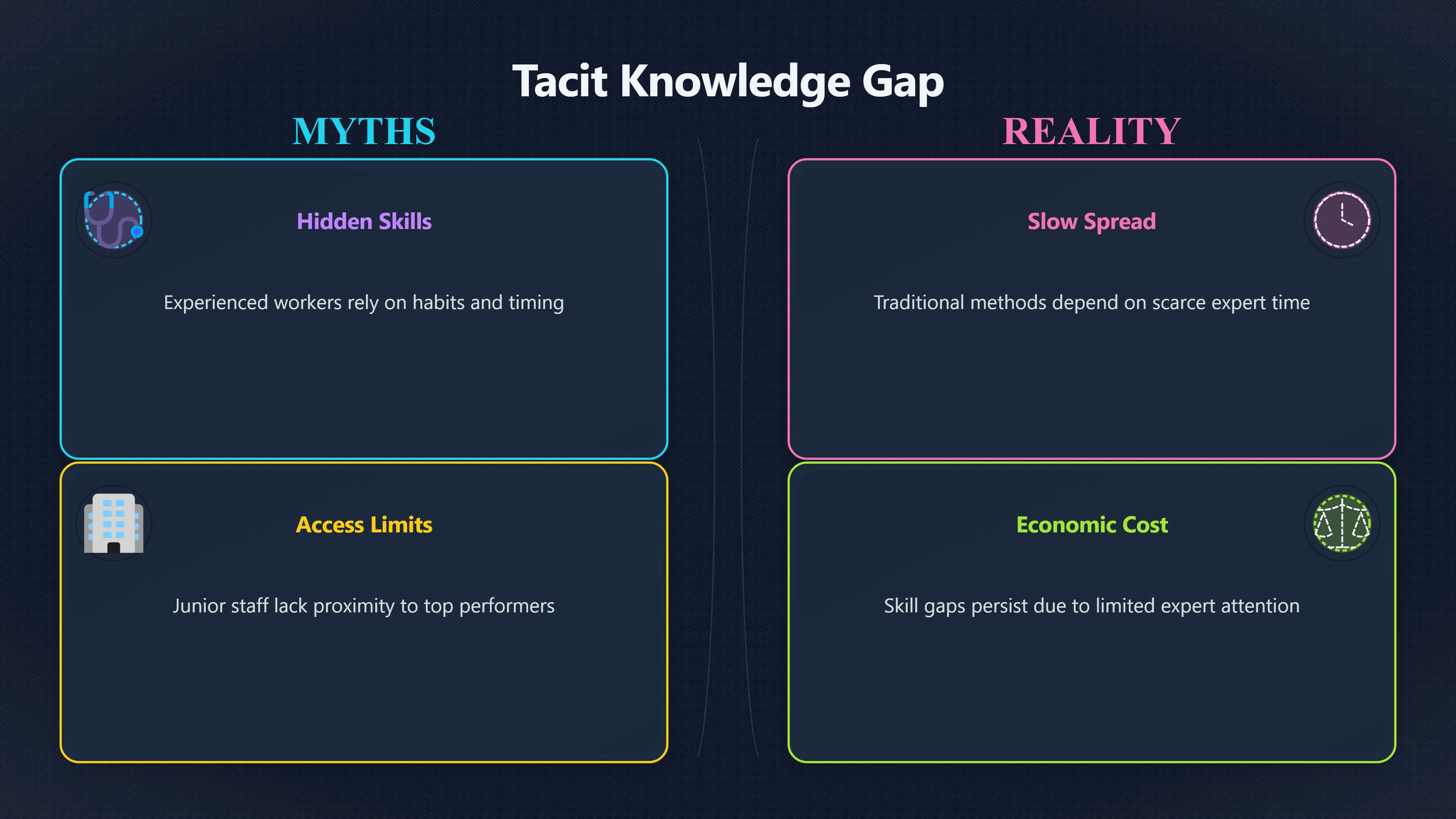
 Many valuable skills are difficult to teach through manuals, training videos or formal procedures. Experienced nurses learn how to spot subtle warning signs in patients. Skilled salespeople learn how to recover a failing conversation. Senior engineers develop instincts about which problems matter most. Much of this knowledge is tacit: it exists in habits, judgement, timing, pattern recognition and accumulated experience rather than explicit rules.
Large language models and workplace assistants create a new possibility. Instead of merely storing information, they can observe large numbers of successful decisions, identify recurring patterns and deliver suggestions while work is actually happening. In effect, they can turn parts of expert behaviour into live guidance. The broader significance for an AI-enabled future is that expertise may become less scarce. Rather than waiting years to absorb knowledge through apprenticeship alone, workers could gain access to fragments of high-level judgement at the moment they need it most. The evidence is still early, and important limits remain, but this mechanism may be one of the clearest ways AI narrows skill gaps.[OUP Academic]academic.oup.comWe study the staggered introduction of a generative AI–based conversational assistant using data from 5172 customer-support agents. Acces…
Why tacit knowledge is hard to teach
Organisations have always struggled with a simple problem: their most valuable knowledge often exists inside people rather than documents.
A company can write down procedures for handling customer complaints, operating machinery or evaluating risks. Yet high performers frequently rely on things they cannot easily explain. They notice unusual patterns. They know which questions to ask first. They sense when a conversation is going badly before obvious warning signs appear.
Management researchers have long described this as tacit knowledge: knowledge that is used successfully but is difficult to formalise. In many professions, the difference between average and exceptional performance comes less from knowing facts than from applying them well under uncertainty.
Traditional organisations spread this knowledge through mechanisms that do not scale easily:
- Apprenticeships and shadowing.
- Informal observation of experienced colleagues.
- Repeated feedback from supervisors.
- Trial and error accumulated over years.
- Internal communities of practice.
These methods work, but they are expensive and slow. They also depend heavily on access to experts. A junior worker in a small firm, a remote office or a developing economy may have far fewer opportunities to learn from top performers than someone inside a prestigious institution.
This scarcity of expert attention is one reason skill gaps persist across organisations and societies. AI assistants matter because they potentially change the economics of expertise distribution rather than merely the economics of information storage.[ScienceDirect]sciencedirect.comHarvesting tacit knowledge for composites workforce…by J Summerscales · 2024 · Cited by 17 — This paper considers the har…
How assistant prompts translate experience into action
The key mechanism is often misunderstood.
Most workplace AI systems do not literally contain an expert’s mind. Instead, they learn statistical patterns from enormous numbers of examples and then generate recommendations that resemble successful behaviour.
In customer support, for example, an AI assistant may have access to millions of past interactions. It can identify which explanations resolved problems fastest, which phrasing reduced customer frustration and which troubleshooting paths succeeded under particular conditions.
When a new employee encounters a similar situation, the system can suggest:
- Questions to ask.
- Troubleshooting sequences.
- Relevant company policies.
- Effective wording.
- Likely next steps.
- Warnings about common mistakes.
The crucial feature is timing. Traditional training happens before the task. AI coaching happens during the task.
That changes learning dynamics. Instead of asking workers to memorise every possible scenario in advance, the assistant supplies guidance when a real decision appears. The worker receives contextual support at the exact point where experience would normally matter most.
Researchers studying generative AI deployment in customer support found evidence consistent with this interpretation. Productivity gains were largest among newer and lower-skilled workers, while top performers gained much less. The researchers argued that the system appeared to disseminate best practices from stronger workers and help newer employees move more quickly down the learning curve.[NBER]nber.orgGenerative AI at Workby E Brynjolfsson · 2023 · Cited by 3271 — In this paper, we study the staggered introduction of a generative AI…[SSRN]papers.ssrn.comAI at Work by Erik Brynjolfsson, Danielle…by E Brynjolfsson · 2023 · Cited by 3302 — We provide suggestive evidence that the AI model…
This is why many economists and technologists became interested in the findings. The most important effect was not simply faster work. It was the possibility that expert habits were becoming reproducible.
What live coaching looks like in practice
The phrase “AI assistant” can sound abstract, but the coaching mechanism is often surprisingly concrete.
Consider a new customer support agent facing an unusual software problem. Traditionally, they might search internal documents, ask a supervisor or place the customer on hold while seeking help.
With an AI assistant, the system can analyse the conversation and suggest:
Customers with this symptom often solved it through setting X rather than setting Y.
Or:
Similar cases escalated when this explanation was used. Consider clarifying the installation sequence first.
The assistant does not merely retrieve documents. It prioritises actions based on patterns observed across previous outcomes.
A similar process is emerging in software development. Coding assistants can suggest implementation approaches, flag likely bugs and remind developers of details they may overlook. Recent research comparing human pair programming with AI coding assistants found similar frequencies of knowledge-transfer episodes in some contexts, although developers often scrutinised AI suggestions less carefully than advice from human partners.[arXiv]arxiv.orgFrom Developer Pairs to AI Copilots: A Comparative Study on Knowledge TransferJune 5, 2025…
In consulting and analytical work, AI systems can also function as temporary competence multipliers. Studies involving Boston Consulting Group consultants found that workers using GPT-4 often completed tasks faster and produced higher-quality outputs, with lower performers frequently benefiting the most. Researchers also found that AI could help workers perform tasks outside their previous areas of expertise.[Harvard Business School]hbs.eduHarvard Business SchoolNavigating the Jagged Technological Frontier: Field…by F Dell'Acqua · 2023 · Cited by 1678 — We introduce and s…[BCG Global]bcg.comgen ai increases productivity and expands capabilitiesBCG GlobalGenAI Increases Productivity & Expands Capabilities5 Sept 2024 — When using GenAI, the consultants in our study were able to in…
Across these examples, the pattern is similar: AI narrows the gap between knowing that expertise exists and being able to use parts of it during real work.

Why weaker performers often benefit most
One striking finding across multiple studies is that AI coaching often produces larger gains for less experienced workers than for experts.
That may seem counterintuitive at first. If AI provides valuable knowledge, why do the best workers not benefit most?
One explanation is that many expert habits are already internalised by experienced workers. A senior employee may already know which questions to ask, which mistakes to avoid and which solution paths are most likely to work.
For a novice, however, those same suggestions can dramatically improve performance.
The effect resembles a navigation system.
An experienced taxi driver may know most routes already. A newcomer benefits far more from turn-by-turn guidance.
This pattern appeared clearly in the customer-support research, where novice workers experienced substantially larger gains than experienced colleagues. Similar patterns appeared in consulting studies, where lower performers often closed part of the gap separating them from stronger peers.[UX Tigers]uxtigers.comai elite user productivityHigher Productivity & Work Quality, Narrower Skills Gap20 Sept 2023 — Summary: In a controlled experiment, consultants at a top-3 company… [3NBER 3arXiv]
If this pattern generalises across more occupations, it could become one of the most important mechanisms through which AI makes expertise more abundant. Instead of requiring everyone to become experts before contributing effectively, organisations may increasingly provide expert-like guidance during the work itself.
What still requires human mentoring and judgement
The strongest interpretations of these results should be treated cautiously.
Tacit knowledge is not identical to expertise.
An AI assistant can often help someone perform better on a specific task. That does not necessarily mean the person develops deep understanding. A worker may learn useful patterns without fully grasping why they work.
Human mentors still provide forms of development that current AI systems struggle to replicate.
Understanding values and trade-offs
Experts often make decisions that involve conflicting goals.
A doctor balances treatment effectiveness against side effects. A manager balances short-term performance against employee morale. An engineer balances safety, cost and speed.
These judgements depend partly on values rather than pattern recognition alone.
AI can surface relevant considerations, but deciding which outcome matters most remains a human responsibility in many contexts.

Recognising when the rules do not apply
One hallmark of expertise is knowing when standard procedures should be ignored.
A junior employee often wants clear instructions. An expert recognises exceptions.
This creates a challenge for AI coaching systems. Models are generally strongest when situations resemble patterns seen before. Novel situations may require deeper reasoning, domain understanding or creativity than the system can reliably provide.
Research on the “jagged technological frontier” of AI capabilities highlights this issue. Systems can perform impressively on some tasks while failing unexpectedly on nearby ones. Workers who follow suggestions uncritically may produce confident errors.[Harvard Business School]hbs.eduHarvard Business SchoolNavigating the Jagged Technological Frontier: Field…by F Dell'Acqua · 2023 · Cited by 1678 — We introduce and s…[Axios]axios.comParticipants were given complex tasks mimicking real-world workflows. Those using GPT-4 with proper guidance performed best, followed by…
Building professional identity
Mentoring is not only about technical performance.
Experienced colleagues teach professional norms, ethical judgement, leadership habits, organisational politics and interpersonal skills. They help workers understand what kind of professional they want to become.
Current AI systems can imitate aspects of these conversations, but they do not replace the social and moral dimensions of human development.
The risk of turning coaching into dependency
The same mechanism that spreads expertise can also create new weaknesses.
If workers increasingly rely on AI suggestions, they may stop developing certain skills independently.
Researchers studying AI-assisted work have repeatedly found that users can become overconfident in machine outputs. In some experiments, participants accepted incorrect AI-generated answers even after being warned that errors were possible.[Axios]axios.comParticipants were given complex tasks mimicking real-world workflows. Those using GPT-4 with proper guidance performed best, followed by…
A workplace that relies heavily on AI coaching therefore faces a balancing problem.
Too little assistance may waste human potential.
Too much assistance may weaken the development of independent judgement.
The most effective systems may be those that explain reasoning, expose uncertainty and encourage reflection rather than simply delivering answers. The goal is not merely to create workers who follow AI instructions efficiently. It is to help workers absorb the underlying patterns and eventually exercise stronger judgement themselves.
This distinction matters because the long-term value of AI-assisted learning depends not only on immediate productivity gains but also on whether people become more capable over time.
Why this mechanism matters for AI bloom
Many discussions of AI focus on automation: machines replacing tasks that humans currently perform.
The coaching mechanism points toward a different possibility.
If AI can capture parts of expert practice and distribute them widely, intelligence itself becomes less scarce. High-quality guidance no longer depends entirely on proximity to elite institutions, senior professionals or rare mentors. Some of the benefits of accumulated human experience can be made available on demand.
That does not eliminate the need for experts. In fact, experts may become even more important as sources of new knowledge, judgement and oversight. But it could change how quickly their insights spread.
The broader AI bloom vision depends partly on this dynamic. Scientific discovery, medicine, engineering, education and governance all suffer from bottlenecks created by limited expert attention. If advanced AI systems can reliably transmit useful fragments of expert reasoning to millions of people simultaneously, societies may gain a powerful new mechanism for accelerating learning and capability.
The evidence so far remains narrow and task-specific. Customer support agents resolving tickets are not the same as surgeons, scientists or statesmen. Yet the early workplace studies suggest a plausible pathway by which AI could make practical expertise more abundant: not by replacing human knowledge, but by turning pieces of it into live coaching available whenever a person encounters a difficult decision.[arXiv]arxiv.orgFrom Developer Pairs to AI Copilots: A Comparative Study on Knowledge TransferJune 5, 2025…[OUP Academic]academic.oup.comWe study the staggered introduction of a generative AI–based conversational assistant using data from 5172 customer-support agents. Acces…[SIEPR]siepr.stanford.eduAuthor(s). Erik Brynjolfsson.Read moreGenerative AI at Work | Stanford Institute for Economic Policy…Our results suggest that access to generative AI can increase prod…
Amazon book picks
Further Reading
Books and field guides related to Can AI spread expert judgement in real time?. Use these as the next step if you want deeper reading beyond the article.
Competing in the Age of AI
Explains how organisations capture and distribute expertise.
eBay marketplace picks
Marketplace Samples
Example marketplace items related to this page. Use the search link to explore similar finds on eBay.


Endnotes
1.
Source: academic.oup.com
Link:https://academic.oup.com/qje/article/140/2/889/7990658
Source snippet
We study the staggered introduction of a generative AI–based conversational assistant using data from 5172 customer-support agents. Acces...
2.
Source: siepr.stanford.edu
Title: Author(s). Erik Brynjolfsson.Read more
Link:https://siepr.stanford.edu/publications/working-paper/generative-ai-work
Source snippet
Generative AI at Work | Stanford Institute for Economic Policy...Our results suggest that access to generative AI can increase prod...
3.
Source: sciencedirect.com
Link:https://www.sciencedirect.com/science/article/pii/S1359835X24003543
Source snippet
Harvesting tacit knowledge for composites workforce...by J Summerscales · 2024 · Cited by 17 — This paper considers the har...
4.
Source: nber.org
Link:https://www.nber.org/papers/w31161
Source snippet
Generative AI at Workby E Brynjolfsson · 2023 · Cited by 3271 — In this paper, we study the staggered introduction of a generative AI...
5.
Source: papers.ssrn.com
Link:https://papers.ssrn.com/sol3/papers.cfm?abstract_id=4426942
Source snippet
AI at Work by Erik Brynjolfsson, Danielle...by E Brynjolfsson · 2023 · Cited by 3302 — We provide suggestive evidence that the AI model...
6.
Source: arxiv.org
Link:https://arxiv.org/abs/2506.04785
Source snippet
From Developer Pairs to AI Copilots: A Comparative Study on Knowledge TransferJune 5, 2025...
Published: June 5, 2025
7.
Source: bcg.com
Title: gen ai increases productivity and expands capabilities
Link:https://www.bcg.com/publications/2024/gen-ai-increases-productivity-and-expands-capabilities
Source snippet
BCG GlobalGenAI Increases Productivity & Expands Capabilities5 Sept 2024 — When using GenAI, the consultants in our study were able to in...
8.
Source: arxiv.org
Title: arXiv Generative AI at Work
Link:https://arxiv.org/abs/2304.11771
Source snippet
[2304.11771] Generative AI at Workby E Brynjolfsson · 2023 · Cited by 3302 — We also find evidence that AI assistance facilitates worker...
9.
Source: axios.com
Link:https://www.axios.com/2023/09/29/ai-mistakes-consulting-bcg-study
Source snippet
Participants were given complex tasks mimicking real-world workflows. Those using GPT-4 with proper guidance performed best, followed by...
10.
Source: bcg.com
Title: (See Exhibit 1.).Read more
Link:https://www.bcg.com/publications/2023/how-people-create-and-destroy-value-with-gen-ai
Source snippet
BCG GlobalHow People Create and Destroy Value with Generative AI21 Sept 2023 — But for business problem solving, using GPT-4 resulted in...
11.
Source: arxiv.org
Link:https://arxiv.org/abs/2605.01401
12.
Source: bcg.com
Title: 5september2024 generative ai knowledge workers consultants
Link:https://www.bcg.com/press/5september2024-generative-ai-knowledge-workers-consultants
Source snippet
Generative AI Instantly Elevates the Aptitude of Knowledge...5 Sept 2024 — New Research by the BCG Henderson Institute Examines Impact o...
13.
Source: nber.org
Title: Erik Brynjolfsson. Stanford
Link:https://www.nber.org/system/files/working_papers/w31161/w31161.pdf
Source snippet
NBER WORKING PAPER SERIES GENERATIVE AI AT...by E Brynjolfsson · 2023 · Cited by 3469 — Our results suggest that access to generative AI...
14.
Source: arxiv.org
Link:https://arxiv.org/pdf/2304.11771
Source snippet
Generative AI at Workby E Brynjolfsson · 2023 · Cited by 3469 — We study the staggered introduction of a generative AI-based conversation...
15.
Source: papers.ssrn.com
Title: papers.cfmabstract id=4573321
Link:https://papers.ssrn.com/sol3/papers.cfmabstract_id%3D4573321
Source snippet
the Jagged Technological Frontier: Field...18 Sept 2023 — In our study conducted with Boston Consulting Group, a global management consu...
16.
Source: papers.ssrn.com
Link:https://papers.ssrn.com/sol3/papers.cfm?abstract_id=4573321
Source snippet
the Jagged Technological Frontier: Field...18 Sept 2023 — We introduce and study the concept of a “jagged technology frontier” to descri...
17.
Source: hbs.edu
Link:https://www.hbs.edu/faculty/Pages/item.aspx?num=64700
Source snippet
Harvard Business SchoolNavigating the Jagged Technological Frontier: Field...by F Dell'Acqua · 2023 · Cited by 1678 — We introduce and s...
18.
Source: uxtigers.com
Title: ai elite user productivity
Link:https://www.uxtigers.com/post/ai-elite-user-productivity
Source snippet
Higher Productivity & Work Quality, Narrower Skills Gap20 Sept 2023 — Summary: In a controlled experiment, consultants at a top-3 company...
19.
Source: digitaleconomy.stanford.edu
Title: generative ai at work
Link:https://digitaleconomy.stanford.edu/publication/generative-ai-at-work/
Source snippet
AI at Work - Stanford Digital Economy LabAccess to AI assistance increases worker productivity, as measured by issues resolved per hour...
20.
Source: mi-3.com.au
Link:https://www.mi-3.com.au/20-09-2023/harvard-business-school-study-bcg-finds-knowledge-workers-using-chat-gpt-outperform
Source snippet
Work 25% faster, 40% better: Harvard study finds...20 Sept 2023 — Work 25% faster, 40% better: Harvard study finds consulting giant BCG'...
21.
Source: thecrimson.com
Title: jagged edge ai bcg
Link:https://www.thecrimson.com/article/2023/10/13/jagged-edge-ai-bcg/
Source snippet
Harvard Business School Partners with BCG on AI...13 Oct 2023 — The study found that, compared to workers without AI access, those who u...
22.
Source: legaldive.com
Title: harvard business school study generative ai boston consulting group
Link:https://www.legaldive.com/news/harvard-business-school-study-generative-ai-boston-consulting-group/693973/
Source snippet
Generative AI provides significant boost to knowledge...18 Sept 2023 — Access to GPT-4 not only improved consultants' productivity but a...
Additional References
23.
Source: linkedin.com
Link:https://www.linkedin.com/posts/henrygalbraith_how-much-of-what-you-do-every-day-can-be-activity-7447996162072154112-aqdg
Source snippet
AI vs Tacit Knowledge in the Workplace | Henry Galbraith...How much of what you do every day can be taught from textbook? And how much o...
24.
Source: isj.id
Link:https://isj.id/insights/ai-evidence/
Source snippet
AI, learning and work: three years of evidence3 days ago — Erik Brynjolfsson and colleagues at Stanford and MIT studied more than five th...
25.
Source: linkedin.com
Link:https://www.linkedin.com/posts/erikbrynjolfsson_great-to-see-generative-ai-at-work-my-activity-7297390624809357312-HX0R
Source snippet
Erik Brynjolfsson's PostInsightful research on AI-driven productivity gains, highlighting how AI bridges skill gaps and reshapes workplac...
26.
Source: aibusiness.com
Link:https://aibusiness.com/nlp/harvard-study-gpt-4-boosts-work-quality-by-over-40-
Source snippet
Harvard Study: GPT-4 Boosts Work Quality by Over 40%According to the paper, consultants of all skill levels were found to have benefited...
27.
Source: linkedin.com
Link:https://www.linkedin.com/pulse/double-edged-sword-ai-professional-services-bcg-gpt-4-holt-nguyen
Source snippet
BCG GPT-4 Findings More Cautionary Than ReportedHarvard Business School researchers reported on their experimental study of GPT-4 use by...
28.
Source: linkedin.com
Link:https://www.linkedin.com/posts/mit-sloan-school-of-management_a-2023-boston-consulting-group-bcg-survey-activity-7260286124982513665-s9qJ
Source snippet
A 2023 Boston Consulting Group (BCG) survey showed...A 2023 Boston Consulting Group (BCG) survey showed that 70% of marketing companies...
29.
Source: businessinsider.com
Title: ai employees lower performers most impact boston consulting group 2023 9
Link:https://www.businessinsider.com/ai-employees-lower-performers-most-impact-boston-consulting-group
Source snippet
Star Employees Not Likely to Benefit the Most From AI18 Sept 2023 — The greatest gains were seen by below-average performers using AI, ac...
30.
Source: mitsloan.mit.edu
Title: how generative ai can boost highly skilled workers productivity
Link:https://mitsloan.mit.edu/ideas-made-to-matter/how-generative-ai-can-boost-highly-skilled-workers-productivity
Source snippet
generative AI can boost highly skilled workers'...19 Oct 2023 — The study was conducted in collaboration with Boston Consulting Group an...
31.
Source: shelf.io
Title: ai productivity unleashed study confirms greater efficiency
Link:https://shelf.io/blog/ai-productivity-unleashed-study-confirms-greater-efficiency/
Source snippet
AI Productivity Study: GenAI Promises Greater Productivity18 Sept 2023 — A recent AI productivity study from Harvard and BCG may be the c...
32.
Source: fortune.com
Title: openai gpt productivity business problem bcg research
Link:https://fortune.com/2023/09/25/openai-gpt-productivity-business-problem-bcg-research/
Source snippet
OpenAI GPT-4 users performed worse on business problems25 Sept 2023 — In the BCG study, participants using OpenAI's GPT-4 for solving bus...
Topic Tree