Within GNo ME materials
Why stable materials are not enough
GNoME widened the search for stable crystals, but usefulness still depends on cost, performance, safety and durability.
On this page
- What GNo ME actually predicted
- The properties that decide real world value
- How useful materials survive the discovery funnel
Page outline Jump by section
Introduction
GNoME’s most important achievement was not that it found hundreds of thousands of revolutionary new materials. It was that it dramatically expanded the map of materials that scientists can explore.
 That distinction matters. When Google DeepMind reported roughly 381,000 predicted stable materials among more than 2 million candidate crystal structures, many headlines implied that a vast new catalogue of batteries, superconductors and clean-energy technologies had effectively been discovered. In reality, “stable” is only one filter in a long process that determines whether a material becomes useful. A crystal can be thermodynamically stable and still be impossible to manufacture at scale, too expensive to use, unsafe, fragile, inefficient or simply worse than existing alternatives. Nature[Google DeepMind]deepmind.googlemillions of new materials discovered with deep learningGoogle DeepMindMillions of new materials discovered with deep learning29 Nov 2023 — AI tool GNoME finds 2.2 million new crystals, includi…
For the wider AI bloom argument, this is a useful reality check. AI may greatly accelerate scientific search, but many of civilisation’s bottlenecks sit beyond prediction. The path from a promising computational result to a technology that changes everyday life still runs through synthesis, testing, engineering, economics and deployment.
What GNoME actually predicted
The central misunderstanding is that GNoME predicted usefulness. It did not.
GNoME was trained to predict whether proposed crystal structures are likely to be thermodynamically stable. In materials science, stability usually means that a particular arrangement of atoms is unlikely to spontaneously decompose into a more energetically favourable combination of substances. Researchers often describe this using the “convex hull” of stable phases. Materials that lie on or near that hull are considered promising candidates for existence in the real world.[docs.materialsproject.org]docs.materialsproject.orgglossary of terms18 Aug 2025 — A measure of a material's thermodynamic stability…. A material which lies "on the convex hull" is predicted to be thermo…[2bartel.cems.umn.edu]bartel.cems.umn.edut lie above the DEf = 0 (or equivalent reference state) are neces- sarily unstable.Read more…
The achievement was impressive because the search space is enormous. GNoME identified roughly 381,000 structures predicted to be stable, expanding the known catalogue of stable inorganic materials by roughly an order of magnitude. Hundreds have already been experimentally realised, providing evidence that the system is finding genuine possibilities rather than random noise. Nature PubMed But stability is a narrow criterion.[newscenter.lbl.gov]newscenter.lbl.govgoogle deepmind new compounds materials projectBerkeley Lab News CenterGoogle DeepMind Adds Nearly 400000 New Compounds to…29 Nov 2023 — GNoME researchers ultimately produced 2.2 mi…
A useful analogy is drug discovery. Imagine an AI that could generate millions of molecules unlikely to fall apart chemically. That would be valuable, but it would not mean millions of medicines had been discovered. The molecules would still need to prove effective, safe, manufacturable and commercially viable. Materials discovery faces a similar problem.
A stable crystal is essentially a candidate. It is not yet a technology.
The properties that decide real-world value
The history of materials science is full of substances that worked in theory but failed in practice.
For a material to matter outside a database, researchers must usually answer several additional questions:
- Does it have the desired electrical, magnetic, optical or mechanical properties?
- Can it be manufactured reproducibly?
- Can it survive years of real-world use?
- Are the necessary ingredients abundant and affordable?
- Is production environmentally acceptable?
- Can it outperform existing materials strongly enough to justify switching?
These filters eliminate enormous numbers of candidates.
A battery material, for example, is not valuable simply because it forms a stable crystal. It may also need high energy density, fast ion transport, low degradation rates, compatibility with manufacturing processes and acceptable cost. A solar-cell material needs the right electronic structure, strong light absorption and long-term durability. A catalyst may need to remain active through millions of reaction cycles without poisoning or breakdown.
Many predicted materials never satisfy these requirements simultaneously.
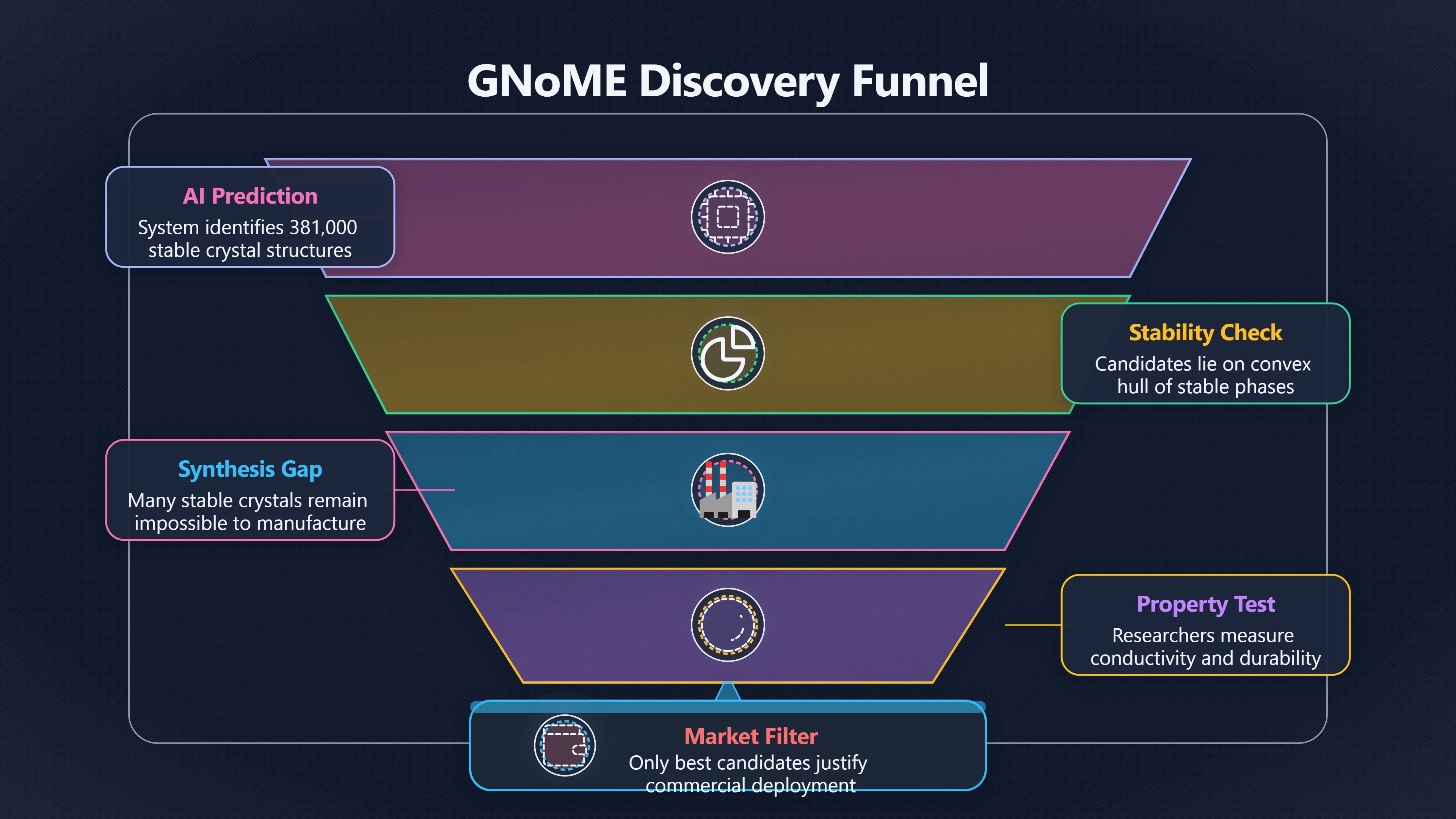
This is why researchers often describe materials discovery as a funnel rather than a single breakthrough event. Vast numbers of possibilities enter at the top. Only a tiny fraction emerge as commercially important technologies.
Stability does not guarantee synthesizability
One of the biggest gaps between prediction and reality is synthesis.
A material can appear stable in calculations yet remain extremely difficult to make in practice. Theoretical stability often assumes ideal conditions that may be hard to reproduce in laboratories or factories. Some compounds require unusual temperatures, pressures, precursor chemicals or growth processes. Others may form unwanted competing phases during production.[WIRED]wired.comGoogle Deep Mind's AI Dreamed Up 380,000 New MaterialsThe Next Challenge Is Making ThemNovember 29, 2023 — Google DeepMind developed an AI program, GNoME, which has predicted 380,000 new stab…
Researchers in the field increasingly distinguish between stability and synthesizability — the probability that a material can actually be created reliably. Recent work has focused specifically on developing AI systems that estimate synthesizability because stability predictions alone are not enough to identify realistic targets.[arXiv]arxiv.orgarXiv Generalized convex hull construction for materials discoveryarXiv Generalized convex hull construction for materials discovery
The challenge becomes even larger when moving from laboratory-scale production to industrial manufacturing.
A material that can be produced in milligram quantities under tightly controlled conditions may still be useless for batteries, semiconductors or energy infrastructure if production cannot be scaled economically.
This is one reason the experimental validation numbers, although impressive, remain much smaller than the total catalogue. Hundreds of successful syntheses are meaningful evidence. They are not evidence that hundreds of thousands of practical materials are ready for deployment.[Nature]nature.comScaling deep learning for materials discoveryby A Merchant · 2023 · Cited by 1611 — b, Exploration enabled by GNoME has led to 381…
The hidden bottleneck: property testing
Even after synthesis, another bottleneck appears.
Scientists must determine what a material actually does.
A newly created crystal might have interesting conductivity, magnetic behaviour or catalytic activity. Or it might not. Discovering those properties requires experiments, specialised equipment and often years of follow-up work.
This is where the comparison with AlphaFold becomes imperfect.
Protein structure prediction solved a specific scientific problem that biologists had struggled with for decades. But knowing a protein structure is often directly useful for further biological investigation.
Materials science is more multidimensional. A crystal’s usefulness depends on many interacting properties. Stability is only one of them. Researchers still need to measure conductivity, strength, thermal behaviour, corrosion resistance, toxicity, manufacturability and many other factors before understanding whether a candidate matters.[Science]science.orgMaterials-predicting AI from DeepMind could revolutionize…29 Nov 2023 — External benchmarks suggest GNoME's success rate at pre…
As a result, the number of potentially valuable materials can remain very large long after stability has been established.
The search problem has been reduced, not eliminated.

Existing materials are often hard to beat
Another reason many stable materials never become breakthroughs is that they must compete against technologies that already work.
Lithium-ion batteries, silicon semiconductors, aluminium alloys and industrial catalysts have benefited from decades of optimisation. Existing supply chains, manufacturing expertise and infrastructure create powerful advantages.
A new material therefore needs to be not merely functional but significantly better.
Consider a hypothetical battery material discovered through AI:
- If it improves energy density by 2%, manufacturers may ignore it.
- If it requires scarce elements, costs may outweigh benefits.
- If it performs well in the laboratory but degrades after repeated charging cycles, it may fail commercially.
- If it requires entirely new factory processes, adoption costs may be prohibitive.
This means that the practical threshold for success is often much higher than scientific novelty.
Many materials that would count as legitimate scientific discoveries never become meaningful technologies.
AI can widen search faster than humans can validate results
GNoME highlights a broader pattern likely to appear throughout AI-enabled science.
Prediction is becoming cheaper faster than validation.
Machine-learning systems can now generate enormous numbers of hypotheses in fields ranging from biology to chemistry to materials science. But experimental testing remains constrained by physical reality. Laboratories require equipment, materials, energy, time and skilled researchers.[Nature]nature.comGoogle AI and robots join forces to build new materials29 Nov 2023 — Tool from Google DeepMind predicts nearly 400000 stable substa…
This creates a new imbalance.
Instead of scientists struggling to find promising candidates, they increasingly struggle to evaluate the flood of possibilities produced by computational systems.
Some researchers argue that the next major challenge is therefore not generating more candidates but improving the entire downstream pipeline: robotic laboratories, automated synthesis, high-throughput testing and better methods for identifying which predictions deserve attention first. Nature[Chemistry World]chemistryworld.comRobotic chemistry lab joins forces with Google AI to predict…30 Nov 2023 — They showed that, by improving the Gnome algorithm through…
In that sense, GNoME may have shifted the bottleneck rather than removed it.

How useful materials survive the discovery funnel
The most realistic way to think about GNoME is as the first stage of a much larger process.
A candidate material typically passes through several filters:
- Prediction: AI systems propose potentially stable structures.
- Verification: Physics calculations confirm plausibility.
- Synthesis: Researchers determine whether the material can actually be created.
- Characterisation: Physical properties are measured.
- Optimisation: Promising candidates are refined and improved.
- Engineering integration: The material is incorporated into devices or industrial processes.
- Commercial deployment: Manufacturing, supply chains and economics are proven.
Failure can occur at every stage.
The overwhelming majority of candidates will never reach the end of this funnel. That is normal. The value of systems like GNoME comes from increasing the number of potentially promising starting points and reducing the time spent searching blindly. Nature[Google DeepMind]deepmind.googlemillions of new materials discovered with deep learningGoogle DeepMindMillions of new materials discovered with deep learning29 Nov 2023 — AI tool GNoME finds 2.2 million new crystals, includi…
For advocates of AI-driven scientific acceleration, this remains significant. If future systems can generate better candidates, predict more useful properties, guide synthesis and automate experimentation, the entire discovery pipeline could speed up. But the key word is could. GNoME demonstrates an expansion of possibility space, not the immediate arrival of material abundance.
The deeper lesson is that scientific discovery is not a single bottleneck. AI may dramatically improve humanity’s ability to search for solutions, yet the path from prediction to prosperity still depends on many other forms of knowledge, infrastructure and experimentation. The promise of an AI-enabled bloom lies not in one database of stable crystals, but in whether intelligence can eventually help accelerate every stage of that chain.
Amazon book picks
Further Reading
Books and field guides related to Why stable materials are not enough. Use these as the next step if you want deeper reading beyond the article.
Stuff Matters
Explains why physical properties, usability and context matter beyond basic stability.
The Alchemy of Us
Shows how useful materials become valuable only when they change real systems.
How Innovation Works
Helps explain why discovery is only one step before deployment and impact.
The Knowledge Machine
Reinforces the distinction between plausible prediction and useful confirmed knowledge.
eBay marketplace picks
Marketplace Samples
Example marketplace items related to this page. Use the search link to explore similar finds on eBay.

Endnotes
1.
Source: nature.com
Link:https://www.nature.com/articles/s41586-023-06735-9
Source snippet
Scaling deep learning for materials discoveryby A Merchant · 2023 · Cited by 1611 — b, Exploration enabled by GNoME has led to 381...
2.
Source: deepmind.google
Title: millions of new materials discovered with deep learning
Link:https://deepmind.google/blog/millions-of-new-materials-discovered-with-deep-learning/
Source snippet
Google DeepMindMillions of new materials discovered with deep learning29 Nov 2023 — AI tool GNoME finds 2.2 million new crystals, includi...
3.
Source: docs.materialsproject.org
Title: glossary of terms
Link:https://docs.materialsproject.org/frequently-asked-questions/glossary-of-terms
Source snippet
18 Aug 2025 — A measure of a material's thermodynamic stability.... A material which lies "on the convex hull" is predicted to be thermo...
4.
Source: bartel.cems.umn.edu
Link:https://bartel.cems.umn.edu/sites/bartel.cems.umn.edu/files/2022-07/bartel.bartel_2022-j.mater_.sci_.pdf
Source snippet
t lie above the DEf = 0 (or equivalent reference state) are neces- sarily unstable.Read more...
5.
Source: time.com
Title: deepmind gnome ai materials
Link:https://time.com/6340681/deepmind-gnome-ai-materials/
Source snippet
DeepMind AI Breakthrough Could Help Battery and Chip...Nov 29, 2023 — Google DeepMind took the 381,000 materials that are most likely to...
6.
Source: wired.com
Title: Google Deep Mind’s AI Dreamed Up 380,000 New Materials
Link:https://www.wired.com/story/an-ai-dreamed-up-380000-new-materials-the-next-challenge-is-making-them
Source snippet
The Next Challenge Is Making ThemNovember 29, 2023 — Google DeepMind developed an AI program, GNoME, which has predicted 380,000 new stab...
Published: November 29, 2023
7.
Source: arxiv.org
Title: arXiv Generalized convex hull construction for materials discovery
Link:https://arxiv.org/abs/1803.01932
8.
Source: arxiv.org
Title: arXiv A Synthesizability-Guided Pipeline for Materials Discovery
Link:https://arxiv.org/abs/2511.01790
Source snippet
A Synthesizability-Guided Pipeline for Materials DiscoveryNovember 3, 2025...
Published: November 3, 2025
9.
Source: nature.com
Link:https://www.nature.com/articles/d41586-023-03745-5
Source snippet
Google AI and robots join forces to build new materials29 Nov 2023 — Tool from Google DeepMind predicts nearly 400000 stable substa...
10.
Source: nature.com
Link:https://www.nature.com/articles/s42256-025-01055-1
Source snippet
A framework to evaluate machine learning crystal stability...by J Riebesell · 2025 · Cited by 164 — This energy is then used to make a p...
11.
Source: next-gen.materialsproject.org
Title: mp 29104
Link:https://next-gen.materialsproject.org/materials/mp-29104/
Source snippet
ExplorerContributed computational or experimental data can be uploaded and shared with other users of Materials Project via the MPContrib...
13.
Source: newscenter.lbl.gov
Title: google deepmind new compounds materials project
Link:https://newscenter.lbl.gov/2023/11/29/google-deepmind-new-compounds-materials-project/
Source snippet
Berkeley Lab News CenterGoogle DeepMind Adds Nearly 400000 New Compounds to...29 Nov 2023 — GNoME researchers ultimately produced 2.2 mi...
14.
Source: pubmed.ncbi.nlm.nih.gov
Link:https://pubmed.ncbi.nlm.nih.gov/38030720/
Source snippet
Scaling deep learning for materials discoveryby A Merchant · 2023 · Cited by 1900 — Of the stable structures, 736 have already been...
15.
Source: science.org
Link:https://www.science.org/content/article/materials-predicting-ai-deepmind-could-revolutionize-electronics-batteries-and-solar
Source snippet
Materials-predicting AI from DeepMind could revolutionize...29 Nov 2023 — External benchmarks suggest GNoME's success rate at pre...
16.
Source: chemistryworld.com
Link:https://www.chemistryworld.com/news/robotic-chemistry-lab-joins-forces-with-google-ai-to-predict-then-make-new-inorganic-materials/4018575.article
Source snippet
Robotic chemistry lab joins forces with Google AI to predict...30 Nov 2023 — They showed that, by improving the Gnome algorithm through...
17.
Source: github.com
Link:https://github.com/google-deepmind/materials_discovery
Source snippet
GNoMEWith results recently published, this repository serves to share the discovery of 381,000 novel stable materials with the wider mate...
Additional References
18.
Source: reddit.com
Link:https://www.reddit.com/r/Futurology/comments/186y2ny/deepminds_gnome_discovering_over_2_million_new/
Source snippet
DeepMind's GNoME: Discovering Over 2 Million New...DeepMind's GNoME: Discovering Over 2 Million New Materials Including 380,000 Stable C...
19.
Source: medium.com
Link:https://medium.com/%40shibilahammad/how-ai-is-supercharging-materials-science-inside-deepminds-breakthrough-materials-discovery-a4515395be88
Source snippet
Inside DeepMind's Breakthrough Materials Discovery Engine.In a paper published in Nature, DeepMind researchers revealed that GNoME discov...
20.
Source: facebook.com
Link:https://www.facebook.com/physorg/posts/crystallographic-[disorder
Source snippet
Limitations of AI-based material predictionCrystallographic disorder poses a significant challenge for AI-based material prediction, ofte...
21.
Source: pepr-diadem.fr
Link:https://www.pepr-diadem.fr/2023/12/01/gnome-artificial-intelligence-and-the-autonomous-a-lab-laboratory-combine-to-discover-new-crystals/
Source snippet
GNoME artificial intelligence and the autonomous A-lab...1 Dec 2023 — GNoME uses a combination of two deep learning models to predict th...
22.
Source: matsci.org
Link:https://matsci.org/t/the-theory-calculation-behind-energy-above-hull-how-to-calculate-for-quarternary-structures/59743
Source snippet
Materials Science Community DiscourseThe theory/calculation behind energy-above-hull19 Dec 2024 — The convex hull algorithm calculates th...
23.
Source: reddit.com
Link:https://www.reddit.com/r/singularity/comments/18dcgal/what_are_the_first_realworld_effects_well_see/
24.
Source: indico.cern.ch
Link:https://indico.cern.ch/event/1364455/contributions/6126740/attachments/2924189/5132928/Novick_Hull_Poster.pdf
Source snippet
Convex Hulls into Active LearningStability prediction is accelerated by treating the convex hull as a probabilistic object, allowing for...
25.
Source: youtube.com
Link:https://www.youtube.com/watch?v=YPo_5jdCPxo
Source snippet
Convex Hull Analysis: Evaluating Materials StabilityThe goal of stable materials is to be a material that can actually be synthesizable s...
26.
Source: arstechnica.com
Title: googles deepmind finds 2 2m crystal structures in materials science win
Link:https://arstechnica.com/ai/2023/11/googles-deepmind-finds-2-2m-crystal-structures-in-materials-science-win/
Source snippet
Google's DeepMind finds 2.2M crystal structures in...29 Nov 2023 — The researchers plan to make 381,000 of the most promising structures...
27.
Source: researchgate.net
Link:https://www.researchgate.net/figure/a-Calculated-band-structure-of-Fe-2-O-3-from-the-Materials-Project-b-a-schematic-of_fig2_299417226
Source snippet
mited by persistent characterization bottlenecks in materials discovery, where...Read more...
Topic Tree