Within AI Bloom
Could Everyone Have a World Class Personal Tutor?
Adaptive tutors could widen access to excellent teaching and advice, but they work best as support for learners and educators rather than replacements.
On this page
- Personalised teaching at global scale
- Learning, retraining and accessibility across life
- Evidence limits and the continuing role of teachers
Page outline Jump by section
Introduction
A world-class personal tutor for everyone is one of the most credible routes from advanced AI to broad human flourishing. A well-designed AI tutor could explain the same idea in several ways, diagnose a misconception, generate practice at the right level, translate material, accommodate a disability and remain available whenever a learner is ready. Unlike conventional online courses, it could respond to the individual rather than merely delivering the same lesson to millions.
The promise is larger than improving school test scores. Cheap, patient cognitive assistance could help adults retrain repeatedly, enable people to explore subjects beyond formal qualifications and give more of humanity access to the accumulated knowledge of civilisation. Yet conversational fluency is not the same as sound teaching. Current systems can invent facts, encourage shortcuts, mishandle sensitive data and confidently reinforce a learner’s mistakes. The strongest case is therefore not for replacing teachers, but for combining abundant machine guidance with human judgement, relationships and accountability.
Personalised teaching at global scale
Individual tutoring has long been treated as a premium educational service because expert attention is scarce. A teacher responsible for a full class cannot continuously identify every pupil’s misconceptions, adjust every explanation and provide immediate feedback on every attempt. AI changes the economics of that attention: once a tutoring system has been developed, versions of it can potentially support many learners simultaneously.
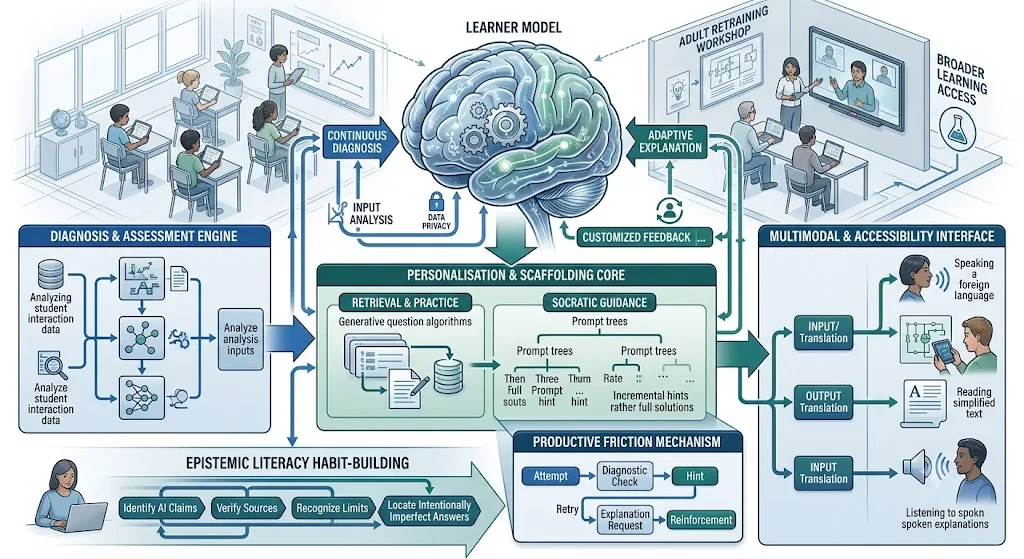
The useful unit is not simply “an answer from a chatbot”. A genuine tutor should maintain a model of what the learner understands, choose an appropriate next task, ask questions rather than prematurely revealing solutions and revisit material before it is forgotten. It should also distinguish between a careless error and a deeper conceptual gap. This is closer to guided practice than automated homework completion.
A 2025 randomised controlled trial at Harvard offers an important, though narrow, proof point. In an undergraduate physics course, students using a purpose-built AI tutor learned more in less time than students receiving an active-learning classroom lesson, while also reporting greater engagement and motivation. The system was not an unrestricted general chatbot: its designers supplied course content, step-by-step solutions and explicit pedagogical instructions, including guidance to break problems down and avoid simply giving away answers. The result therefore supports carefully engineered AI tutoring, not the claim that any conversational model is automatically a superior teacher.[nature.com]nature.comOpen source on nature.com.
Broader research on intelligent tutoring systems is promising but less dramatic. A 2025 systematic review of systems used in primary and secondary education found generally positive effects, while emphasising wide variation in subjects, designs, comparison groups and research quality. It also found that the advantage can shrink when AI tutors are compared with other well-designed digital tutoring rather than ordinary instruction.[nature.com]nature.comMay 14, 2025…
This distinction matters for the larger AI-bloom argument. The breakthrough is not that software occasionally outperforms a lecture. It is that increasingly capable systems might make several effective teaching practices available together and at low marginal cost:
- Continuous diagnosis: noticing patterns across a learner’s answers instead of waiting for an examination.
- Adaptive explanation: changing the vocabulary, pace, example or representation when the first explanation fails.
- Retrieval and practice: generating questions and revisiting material at useful intervals.
- Socratic guidance: prompting the learner to reason through a problem rather than supplying a finished response.
- Immediate feedback: correcting an error while the learner still remembers how it arose.
- Curriculum navigation: connecting a long-term goal to the concepts and exercises needed to reach it.
At its best, such a system would provide what might be called cognitive scaffolding: enough support to make a difficult task achievable, followed by a gradual withdrawal of help as competence grows. Reviews of generative AI in education increasingly describe this role, alongside uses such as feedback, concept mapping and reflective questioning. They also show that human teachers and parents commonly remain the people who select tasks, interpret feedback and decide when the system is helping or hindering.[MDPI]mdpi.comPowered by large-scale deep learning models, these systems can generate text, images, audio, code, and other moda…
Learning throughout life
Formal education remains concentrated near the beginning of life, even though people may now work across several occupations and encounter repeated technological change. Traditional retraining is often poorly matched to adult reality: courses run at fixed times, assume common starting knowledge and require learners to commit before they know whether the material suits them.
A personal AI tutor could make lifelong learning more continuous. Someone moving from retail into healthcare administration might receive a diagnostic assessment, a tailored sequence in numeracy and medical terminology, role-play exercises and feedback on weak areas. A technician learning a new industrial system could ask questions while carrying out a simulated procedure. A retired adult could study astronomy, music theory or local history without needing a credential or a full course timetable.
A systematic review of 78 studies on AI-personalised learning paths found substantial interest in adaptive sequencing, automated assessment and individualised learning goals. It also identified major limitations: the research is geographically concentrated, adult learning is less studied than school and university education, and many claims about long-term personalisation remain ahead of robust evidence.[Frontiers]frontiersin.orgBecause of its abiliFrontiersCrafting personalized learning paths with AI for lifelong learning: a systematic literature reviewmodels, AI has reached new hei…
The long-term potential nevertheless differs from an ordinary training portal in several ways. A tutor could remember a person’s prior learning—with consent—relate new concepts to their occupation and interests, and move between explanation, demonstration, simulation and assessment. As systems become multimodal, learners may be able to show the tutor a circuit, speak a foreign language, annotate a diagram or practise a professional conversation rather than interact only through typed text.
This could also widen access to intellectual life outside employment. Cognitive empowerment is not merely labour-market adjustment. It includes the freedom to understand public policy, engage with science, develop artistic skills, investigate personal questions and participate more confidently in civic life. In a genuine human bloom, advanced knowledge would become easier to approach without being reduced to superficial summaries.
There is an important paradox, however. AI may accelerate changes in work while also becoming the main tool people use to adapt to those changes. That makes access to reliable tutoring part of the distributional question surrounding AI abundance. Workers whose employers provide excellent, occupation-specific tutors may advance rapidly; those left with unreliable free chatbots may receive weaker guidance or train for opportunities that do not exist. Public libraries, colleges, trade unions and employment services could therefore become important providers or certifiers of trusted systems rather than leaving lifelong learning entirely to consumer subscriptions.
Crossing language, disability and income barriers
Personal tutoring could be especially valuable where education is constrained less by a lack of ambition than by language, disability, geography or shortages of specialist support.
Conversational systems can already simplify text, generate examples, translate explanations, transcribe speech and convert between spoken and written formats. For a learner with dyslexia, a tutor might read material aloud, divide instructions into manageable steps and allow spoken responses. For someone with impaired hearing, it might provide live captions and written summaries. A learner studying in a second language could request explanations at different levels of complexity without the embarrassment of repeatedly stopping a class.
These functions can increase independence, but accessibility must be designed rather than assumed. An interface may generate clear text yet remain unusable with a screen reader. Speech recognition may perform poorly for particular accents or speech impairments. A tutoring model trained mainly on dominant languages may offer less accurate explanations in languages spoken by smaller populations. Evidence reviews report positive outcomes from adaptive and assistive systems, particularly for some learners with sensory or learning disabilities, while warning that long-term evidence and research from lower-resource settings remain limited.[AMJ Medical Education]amjmedu.comRecent advances in Artificial Intelligence (AI) and Machine Learning (ML) have introduced new opportunities to address diverse learner ne…
The World Bank’s recent examination of AI education projects in lower- and middle-income countries illustrates a more grounded route to scale than simply distributing the largest available chatbot. Examples in India include mother-tongue literacy systems, oral-reading assessment, regional-language support, low-bandwidth delivery and tools that give teachers diagnostic information. Several are designed for basic phones, inexpensive tablets or intermittent connectivity.[World Bank]documents1.worldbank.orgTheir flexibility often allows applicationWorld BankCase Study 1: Exploring AIs Disruptive Promise for Education Systems in Low- and Middle-Income Countries“out of the box” with…
Such cases show why implementation conditions are central. A theoretically capable tutor is of little use where learners lack electricity, connectivity, an appropriate device or a quiet place to study. The World Bank also notes that AI introduces continuing cloud, data and usage costs, rather than only the one-off hardware costs associated with older educational technology. Infrastructure investment remains necessary, but it is not sufficient without teacher development, local content, sustainable budgets and governance.[World Bank]documents1.worldbank.orgOpen source on worldbank.org.
Broad access may therefore require public intervention in at least four areas: connectivity and devices; support for underserved languages; accessibility standards and testing; and procurement arrangements that prevent the poorest institutions from receiving the least reliable systems. Without those measures, personal tutoring could deepen the very inequalities it appears capable of reducing.
When assistance becomes cognitive surrender
The central educational risk is not simply that an AI gives the wrong answer. It is that the learner stops doing the mental work through which understanding is built.
An AI can draft an essay, solve a problem or summarise a book so smoothly that the user experiences the appearance of competence without acquiring the underlying skill. This is a form of cognitive offloading: transferring part of a thinking task to an external tool. Offloading is not inherently harmful. Calculators, notebooks and search engines all allow people to reserve attention for higher-level work. The danger arises when the tool removes the reasoning that the activity was meant to develop.
Current evidence is not yet strong enough to support sweeping claims that AI is making an entire generation less intelligent. Research is young, definitions vary and many studies measure attitudes or short-term performance rather than durable understanding. A 2026 review of critical thinking in AI-supported learning found a fragmented evidence base and called for better ways to distinguish productive assistance from the substitution of machine output for human reasoning.[Springer]link.springer.comOpen source on springer.com.
Nonetheless, the failure mode is plausible and already visible in educational practice. Students may use models to produce finished assignments, accept summaries instead of reading primary material or repeatedly ask for solutions without attempting a problem. A systematic review of empirical studies on large language models in education identified risks including superficial understanding, over-reliance, reduced learner agency, hallucinations and privacy problems.[arXiv]arxiv.orgOpen source on arxiv.org.
The design goal should therefore be productive friction. A strong tutor might:
- ask the learner to attempt an answer before offering help;
- provide hints in stages rather than revealing the complete solution;
- require the learner to explain why an answer is correct;
- revisit concepts later without assistance;
- separate practice mode from assessment mode;
- show uncertainty and request source checking;
- measure whether skills transfer to unaided tasks.
This produces a useful test for any AI education product: does it improve what the learner can subsequently do alone? A system can appear helpful because its feedback is friendly and pedagogically worded, yet fail to change behaviour. Research based on more than 10,000 programming submissions has argued that evaluation should therefore examine whether students act on tutoring feedback correctly, not merely whether the feedback sounds good.[arXiv]arxiv.orgOpen source on arxiv.org.
Why fluent tutors can still teach falsehoods
Large language models generate plausible sequences of words; they do not possess an infallible internal reference book. They can fabricate citations, confuse similar concepts, follow a learner’s mistaken premise or give an overconfident answer where evidence is disputed.
This is especially dangerous in tutoring because the system occupies a position of apparent authority. An adult expert may notice that an explanation is subtly wrong, but a beginner often lacks the knowledge needed to challenge it. In a 2025 study of 211 business-school students, only one fifth successfully identified a deliberately inserted AI hallucination; stronger interpretation and writing skills, higher academic performance and greater scepticism were associated with better detection.[arXiv]arxiv.orgOpen source on arxiv.org.
Educational tutors therefore need stronger grounding than general-purpose conversation. Depending on the subject, that may include restricted curriculum materials, verified worked solutions, retrieval from approved sources, calculations performed by specialised tools and escalation to a human when confidence is low. Systems should distinguish between settled facts, interpretive questions and genuine scientific uncertainty rather than presenting all three in the same confident voice.
Learners also need epistemic literacy: the ability to judge how knowledge claims are produced and checked. That means understanding that a model can sound certain without being correct, verifying important claims against independent sources and recognising that asking the same system twice is not equivalent to obtaining a second opinion. University students surveyed about hallucinations reported fabricated references, persistent errors and misleading confidence, while some held inaccurate mental models of how the technology worked.[arXiv]arxiv.orgarXiv AI Hallucination from Students' Perspective: A Thematic AnalysisarXiv AI Hallucination from Students' Perspective: A Thematic Analysis
A mature AI tutor should help teach these habits rather than conceal its own limitations. It might attach sources, invite comparison between accounts, explain why evidence is weak or ask the learner to locate the flaw in an intentionally imperfect answer. Used this way, the model becomes a laboratory for critical judgement. Used as an unquestioned oracle, it weakens that judgement.
Teachers remain the human centre
The most plausible educational future is not a choice between one teacher and one machine. It is a different allocation of attention.
AI can handle some repetitive explanation, practice generation and first-pass feedback. That may give teachers more time for the tasks that depend on human presence: motivating a disengaged pupil, noticing distress, managing group dynamics, resolving conflict, judging when pressure is helpful, connecting learning to a child’s circumstances and creating a community in which people learn from one another.
Teachers also determine educational purpose. A tutor can optimise progress towards a specified target, but it cannot legitimately decide on its own which history should be taught, what intellectual habits a society should cultivate or how competing values should be balanced. Those are curricular and democratic choices, not merely technical ones.
The OECD argues that effective educational AI requires a trustworthy digital ecosystem, teacher capability, clear objectives, evidence of usefulness and safeguards for equity. It cautions against treating technology acquisition as educational transformation in itself.[oecd.org]oecd.orgOpen source on oecd.org. UNESCO’s guidance likewise places human agency, inclusion, validation and protection of learners at the centre of generative-AI policy rather than assuming that deployment is automatically beneficial.[UNESCO Docs]unesdoc.unesco.orgattach import eac0f406 0548 426d b1f9 8158c22906bcattach import eac0f406 0548 426d b1f9 8158c22906bc
The balance will vary by context. An adult revising basic algebra at midnight may need little human supervision. A young child, a learner in distress or a pupil making a high-stakes educational choice requires substantially more. The tutor should therefore be capable of handing responsibility back to a teacher, counsellor, parent or specialist instead of trying to sustain every interaction itself.
There is also a social reason to retain human education. Schools and colleges are not only information-delivery systems. They are places where people encounter difference, practise cooperation, form friendships, learn public norms and receive recognition from other human beings. A perfectly personalised private curriculum could paradoxically narrow shared culture if learners rarely study common material or deliberate with peers.
The conditions for a genuine education bloom
The optimistic case for personal AI tutors becomes credible only when it is translated into institutions, standards and public choices. The objective should be universal access to trustworthy cognitive support, not maximum chatbot use.
Several conditions stand out.
Learning gains must be independently demonstrated. Evaluation should measure retention, transfer, reasoning and unaided performance, not merely satisfaction, usage or completion. Trials should include different ages, languages, disabilities and income groups, and should examine effects over months or years.
Tutors should be pedagogically constrained. Systems designed to produce answers are not automatically suited to producing learning. Education-specific versions need curriculum grounding, staged hints, diagnostic assessment, age-appropriate interaction and clear boundaries around sensitive advice.
Children’s data need stronger protection. A tutor may collect unusually intimate information: ability levels, mistakes, voice recordings, emotional disclosures and behavioural patterns. UNICEF’s 2025 guidance calls for child-centred regulation, privacy protection, non-discrimination, transparency, safety and meaningful inclusion of children in decisions about AI systems that affect them.[UNICEF]unicef.orgUNICEF Innocenti Guidance on AI and ChildrenUNICEF Innocenti Guidance on AI and Children Such records should not quietly become advertising profiles, disciplinary evidence or permanent judgements about a child’s potential.
Teachers and learners need real control. They should be able to inspect what the system is trying to teach, correct its assumptions, limit data retention and choose when AI is inappropriate. Automated recommendations should remain contestable, particularly when they influence subject access, ability grouping or career pathways.
Public systems must prevent a two-tier model. Wealthier learners should not receive accurate, private, curriculum-aligned tutors while everyone else receives advertising-supported systems with weaker safeguards. Governments may need to fund common infrastructure, local-language resources, accessibility work and independent evaluation, while allowing schools and educators to choose among approved approaches.
Education should cultivate agency, not dependence. The final measure of cognitive empowerment is whether people become more capable of setting goals, evaluating evidence, solving unfamiliar problems and participating in society. A tutor that makes users permanently reliant on its presence has provided convenience, not full empowerment.
Could everyone really have a world-class tutor?
Technically, the prospect is becoming plausible; educationally and politically, it remains unfinished.
Current research shows that carefully designed AI tutoring can improve learning in particular settings, and existing tools already widen access to explanation, translation, practice and assistive support. The potential grows as models become more reliable, multimodal and able to maintain a coherent learning plan over time. In the strongest version of the AI-bloom vision, people would no longer be limited to the expertise available in their school, town, language or stage of life. Billions could gain a patient guide into mathematics, science, crafts, literature, citizenship and new occupations.
But “world-class” cannot mean merely articulate and always available. It must mean accurate, pedagogically sound, accessible, privacy-preserving, culturally capable and connected to human support. It must help learners acquire durable abilities rather than borrowing the machine’s abilities for a moment.
Personal AI tutors could make intelligence more abundant in one of the most humane senses: not by making machines impressive, but by enabling more people to understand, choose, create and contribute. Whether they do so will depend less on the novelty of the interface than on the learning science, public infrastructure and human values built around it.
Amazon book picks
Further Reading
Books and field guides related to Could Everyone Have a World Class Personal Tutor?. Use these as the next step if you want deeper reading beyond the article.
Mindstorms: Children, Computers, and Powerful Ideas
Mindstorms has two central themes: that children can learn to use computers in a masterful way and that learning to use computers can cha...
The End of Education: Redefining the Value of School
Postman suggests that the current crisis in our educational system derives from its failure to supply students with a translucent, unifyi...
The Smartest Kids in the World: And How They Got That Way
Following three teenagers who chose to spend one school year living in Finland, South Korea, and Poland, a literary journalist recounts h...
The Learning Revolution
The UK edition of Jeanette Vos and Gordon Dryden's book, first published in 1993. They have collected even more exclusive data and resear...
eBay marketplace picks
Marketplace Samples
Live-tested eBay searches with available results related to this page.
Selected fromteacher mug oneBay.co.uk.

Current eBay listing
Personalized Teacher Mug: Custom Name Gift, End of Year Appreciation



Current eBay listing
Wholesale Pack Of 10 ‘Best teacher Ever’ Mugs End If Term Gift
Endnotes
1.
Source: nature.com
Link:https://www.nature.com/articles/s41598-025-97652-6
2.
Source: nature.com
Link:https://www.nature.com/articles/s41539-025-00320-7
Source snippet
May 14, 2025...
Published: May 14, 2025
3.
Source: mdpi.com
Link:https://www.mdpi.com/2079-8954/13/10/840
Source snippet
Powered by large-scale deep learning models, these systems can generate text, images, audio, code, and other moda...
4.
Source: link.springer.com
Link:https://link.springer.com/content/pdf/10.1007/s10212-026-01089-y.pdf
5.
Source: arxiv.org
Link:https://arxiv.org/abs/2509.21972
6.
Source: arxiv.org
Link:https://arxiv.org/abs/2605.05648
7.
Source: arxiv.org
Link:https://arxiv.org/abs/2506.00050
8.
Source: arxiv.org
Title: arXiv AI Hallucination from Students’ Perspective: A Thematic Analysis
Link:https://arxiv.org/abs/2602.17671
9.
Source: oecd.org
Link:https://www.oecd.org/en/publications/oecd-digital-education-outlook-2023_c74f03de-en/full-report/opportunities-guidelines-and-guardrails-for-effective-and-equitable-use-of-ai-in-education_2f0862dc.html
10.
Source: oecd.org
Title: digital teaching and learning resources 5651654d
Link:https://www.oecd.org/en/publications/oecd-digital-education-outlook-2023_c74f03de-en/full-report/digital-teaching-and-learning-resources_5651654d.html
11.
Source: unesdoc.unesco.org
Title: attach import eac0f406 0548 426d b1f9 8158c22906bc
Link:https://unesdoc.unesco.org/in/rest/annotationSVC/DownloadWatermarkedAttachment/attach_import_eac0f406-0548-426d-b1f9-8158c22906bc?_=386693eng.pdf&from=1&to=48
12.
Source: unicef.org
Title: UNICEF Innocenti Guidance on AI and Children 3 2025
Link:https://www.unicef.org/innocenti/media/11991/file/UNICEF-Innocenti-Guidance-on-AI-and-Children-3-2025.pdf
13.
Source: unicef.org
Link:https://www.unicef.org/innocenti/reports/policy-guidance-ai-children
14.
Source: link.springer.com
Link:https://link.springer.com/article/10.1007/s10648-026-10201-z
15.
Source: nature.com
Title: Why using AI as a learning coach can improve education | Nature Human Behaviour
Link:https://www.nature.com/articles/s41562-026-02524-2
16.
Source: link.springer.com
Link:https://link.springer.com/chapter/10.1007/978
17.
Source: mdpi.com
Link:https://www.mdpi.com/2227-7102/16/6/816
18.
Source: knowledge.unicef.org
Title: joint statement artificial intelligence and rights child
Link:https://knowledge.unicef.org/knowledge-management/resource/joint-statement-artificial-intelligence-and-rights-child
19.
Source: ai-tutor.ai
Title: A I Tutoring Benefits Backed by Research: A Guide for Higher Education
Link:https://ai-tutor.ai/blog/benefits-of-ai-tutoring/
20.
Source: ar5iv.labs.arxiv.org
Link:https://ar5iv.labs.arxiv.org/html/2602.17671
21.
Source: mdpi.com
Link:https://www.mdpi.com/1999-4893/19/3/179
22.
Source: arxiv.org
Link:https://arxiv.org/abs/2512.23633
23.
Source: arxiv.org
Link:https://arxiv.org/abs/2512.23633v1
24.
Source: arxiv.org
Link:https://arxiv.org/abs/2512.04109
25.
Source: mdpi.com
Link:https://www.mdpi.com/2076-3417/15/23/12624
26.
Source: link.springer.com
Link:https://link.springer.com/article/10.1007/s44163-025-00598-x
27.
Source: arxiv.org
Link:https://arxiv.org/html/2509.21972v2
28.
Source: mdpi.com
Link:https://www.mdpi.com/2071-1050/17/21/9793
29.
Source: mdpi.com
Link:https://www.mdpi.com/2306-5729/10/11/172
30.
Source: link.springer.com
Link:https://link.springer.com/article/10.1007/s44217-025-00908-6
31.
Source: news.harvard.edu
Title: what if ai could help students learn not just do assignments for them
Link:https://news.harvard.edu/gazette/story/2025/10/what-if-ai-could-help-students-learn-not-just-do-assignments-for-them/
32.
Source: link.springer.com
Link:https://link.springer.com/article/10.1007/s11423-025-10549-z
33.
Source: link.springer.com
Link:https://link.springer.com/article/10.1007/s43681-025-00824-3
34.
Source: mdpi.com
Link:https://www.mdpi.com/2076-3417/15/17/9352
35.
Source: mdpi.com
Link:https://www.mdpi.com/2076-3425/15/8/806
36.
Source: link.springer.com
Link:https://link.springer.com/article/10.1007/s10758-025-09853-7
37.
Source: mdpi.com
Link:https://www.mdpi.com/2076-0760/14/5/288
38.
Source: link.springer.com
Link:https://link.springer.com/article/10.1007/s00146-025-02356-0
39.
Source: mdpi.com
Link:https://www.mdpi.com/2227-7102/15/5/554
40.
Source: mdpi.com
Link:https://www.mdpi.com/2227-7102/15/5/539
41.
Source: mdpi.com
Link:https://www.mdpi.com/2227-7102/15/3/393
42.
Source: link.springer.com
Link:https://link.springer.com/article/10.1007/s10639-025-13420-z
43.
Source: link.springer.com
Link:https://link.springer.com/article/10.1007/s44366
44.
Source: oecd.org
Link:https://www.oecd.org/en/about/news/press-releases/2023/12/system-wide-approaches-are-needed-to-leverage-the-potential-of-digital-education-technologies-to-improve-learning-outcomes.html
45.
Source: one.oecd.org
Link:https://one.oecd.org/document/EDU/EDPC%282023%2911/en/pdf
46.
Source: one.oecd.org
Link:https://one.oecd.org/document/EDU/EDPC/SR%282023%292/ANN1/en/pdf
47.
Source: link.springer.com
Link:https://link.springer.com/content/pdf/10.1007/s10758-025-09853-7.pdf
48.
Source: link.springer.com
Link:https://link.springer.com/content/pdf/10.1007/s40797-025-00354-1.pdf
49.
Source: link.springer.com
Link:https://link.springer.com/content/pdf/10.1007/978-3-032-29791
50.
Source: link.springer.com
Link:https://link.springer.com/content/pdf/10.1186/s40561-026-00440-6.pdf
51.
Source: link.springer.com
Link:https://link.springer.com/content/pdf/10.1007/s12528-025-09463-3.pdf
52.
Source: oecd.org
Title: full report
Link:https://www.oecd.org/en/publications/oecd-digital-education-outlook-2023_c74f03de-en/full-report.html
53.
Source: oecd.org
Link:https://www.oecd.org/en/publications/oecd-digital-education-outlook-2023_c74f03de-en/full-report/towards-a-digital-transformation-of-education-distance-travelled-and-journey-ahead_84a6abf5.html
54.
Source: oecd.org
Title: digital strategies providing a common vision for the future 726a3c8c
Link:https://www.oecd.org/en/publications/oecd-digital-education-outlook-2023_c74f03de-en/full-report/digital-strategies-providing-a-common-vision-for-the-future_726a3c8c.html
55.
Source: oecd.org
Link:https://www.oecd.org/en/publications/shaping-digital-education_bac4dc9f-en/full-report.html
56.
Source: oecd.org
Title: full report
Link:https://www.oecd.org/fr/publications/perspectives-de-l-ocde-sur-l-education-numerique-2023_78afb124-fr/full-report.html
57.
Source: oecd.org
Title: oecd digital education outlook 2023 c74f03de en
Link:https://www.oecd.org/en/publications/oecd-digital-education-outlook-2023_c74f03de-en.html
58.
Source: oecd.org
Link:https://www.oecd.org/en/publications/country-digital-education-ecosystems-and-governance_906134d4-en.html
59.
Source: unicef.org
Title: UNICEF Innocenti Guidance on AI and Children 3 2025
Link:https://www.unicef.org/innocenti/media/11991/file/UNICEF-Innocenti-Guidance-on-AI-and-Children-3-2025.pdf?amp%3Butm_source=twitter
60.
Source: unicef.org
Title: UNICEF Innocenti Guidance on AI and Children 3 2025
Link:https://www.unicef.org/innocenti/media/11991/file/UNICEF%20Innocenti%20Guidance%20on%20AI%20and%20Children%203%202025.pdf
61.
Source: unicef.org
Title: UNICEF Innocenti Guidance on AI and Children 3 Checklist 2025
Link:https://www.unicef.org/innocenti/media/11996/file/UNICEF-Innocenti-Guidance-on-AI-and-Children-3-Checklist-2025.pdf
62.
Source: unicef.org
Link:https://www.unicef.org/innocenti/media/1341/file/UNICEF-Global-Insight-policy-guidance-AI-children-2.0-2021.pdf
63.
Source: unicef.org
Title: unicef ai strategy 2025 2030 ai every child
Link:https://www.unicef.org/digitalimpact/unicef-ai-strategy-2025-2030-ai-every-child
64.
Source: knowledge.unicef.org
Link:https://knowledge.unicef.org/resource/joint-statement-artificial-intelligence-and-rights-child/revisions/60416/view
65.
Source: unicef.org
Link:https://www.unicef.org/innocenti/media/11621/file/UNICEF-Innocenti-Data-Governance-Education-Technology-Policy_Recommendations-2025.pdf
66.
Source: unicef.org
Title: UNICEF Global Insight tools to operationalize AI policy guidance 2020
Link:https://www.unicef.org/innocenti/fr/media/1401/file/UNICEF-Global-Insight-tools-to-operationalize-AI-policy-guidance-2020.pdf
67.
Source: unicef.org
Link:https://www.unicef.org/india/documents/responsible-ai-children-and-young-people
68.
Source: unesdoc.unesco.org
Title: attach import 59752630 3c8b 464e 8f23 013d99a9dd67
Link:https://unesdoc.unesco.org/in/rest/annotationSVC/DownloadWatermarkedAttachment/attach_import_59752630-3c8b-464e-8f23-013d99a9dd67?_=386693eng.pdf&from=1&to=48
69.
Source: unesdoc.unesco.org
Link:https://unesdoc.unesco.org/in/rest/annotationSVC/DownloadWatermarkedAttachment/attach_import_d4cbd94b-e183-448f-90a9-ea9bb3b74db2?_=386693eng.pdf&from=1&to=48
70.
Source: unesdoc.unesco.org
Link:https://unesdoc.unesco.org/ark%3A/48223/pf0000386693.pdf
71.
Source: unesdoc.unesco.org
Title: attach import d4cbd94b e183 448f 90a9 ea9bb3b74db2
Link:https://unesdoc.unesco.org/in/rest/annotationSVC/DownloadWatermarkedAttachment/attach_import_d4cbd94b-e183-448f-90a9-ea9bb3b74db2?_=386693eng.pdf
72.
Source: unesdoc.unesco.org
Link:https://unesdoc.unesco.org/ark%3A/48223/pf0000386693.locale%3Dru
73.
Source: neqmap.bangkok.unesco.org
Title: Guidance and AI frameworks
Link:https://neqmap.bangkok.unesco.org/wp-content/uploads/2023/09/UNESCO-Guidance-and-AI-frameworks.pdf
74.
Source: unesdoc.unesco.org
Link:https://unesdoc.unesco.org/ark%3A/48223/pf0000389351
75.
Source: unesdoc.unesco.org
Link:https://unesdoc.unesco.org/ark%3A/48223/pf0000391104
76.
Source: nature.com
Link:https://www.nature.com/articles/s41598-025-97652-6.pdf
77.
Source: arxiv.org
Link:https://arxiv.org/pdf/2512.23633
78.
Source: arxiv.org
Link:https://arxiv.org/html/2509.21972v1
79.
Source: serl.fas.harvard.edu
Link:https://serl.fas.harvard.edu/publication/ai-tutoring-outperforms-class-active-learning-rct-introducing-novel-research-based
80.
Source: frontiersin.org
Title: Because of its abili
Link:https://www.frontiersin.org/journals/education/articles/10.3389/feduc.2024.1424386/pdf
Source snippet
FrontiersCrafting personalized learning paths with AI for lifelong learning: a systematic literature reviewmodels, AI has reached new hei...
81.
Source: amjmedu.com
Link:https://amjmedu.com/article/10.11648/j.mededu.20260201.11
Source snippet
Recent advances in Artificial Intelligence (AI) and Machine Learning (ML) have introduced new opportunities to address diverse learner ne...
82.
Source: documents1.worldbank.org
Title: Their flexibility often allows application
Link:https://documents1.worldbank.org/curated/en/099112525160560758/pdf/P505350-ce2f2c3e-15bb-4212-ab1e-8b936e151fa0.pdf
Source snippet
World BankCase Study 1: Exploring AIs Disruptive Promise for Education Systems in Low- and Middle-Income Countries“out of the box” with...
83.
Source: openknowledge.worldbank.org
Link:https://openknowledge.worldbank.org/bitstreams/bfdeb3d3-09d5-420a-aa9f-c7e157705306/download
84.
Source: documents1.worldbank.org
Link:https://documents1.worldbank.org/curated/en/099317007132640857/pdf/IDU-1709a634-79e8-45b6-8f67-1e1c901644d7.pdf
85.
Source: worldbank.org
Title: Artificial Intelligence in Action in Latin America’s Schools: Evidence from Peru
Link:https://www.worldbank.org/en/results/2026/07/02/artificial-intelligence-in-action-in-latin-america-s-schools-evidence-from-peru
86.
Source: frontiersin.org
Link:https://www.frontiersin.org/journals/education/articles/10.3389/feduc.2026.1779383/full
87.
Source: article.sciencepublishinggroup.com
Link:https://article.sciencepublishinggroup.com/pdf/j.mededu.20260201.11
88.
Source: blogs.worldbank.org
Link:https://blogs.worldbank.org/en/education/the-future-is-africa–shaping-ai-enabled-edtech-for-skilling-the
89.
Source: frontiersin.org
Link:https://www.frontiersin.org/journals/education/articles/10.3389/feduc.2025.1697554/full
90.
Source: blogs.worldbank.org
Title: people centered ai in education five lessons from the global so
Link:https://blogs.worldbank.org/en/education/people-centered-ai-in-education–five-lessons-from-the-global-so
91.
Source: worldbank.org
Title: A I in Schools: Opportunities, Challenges & Realities for the Future of Learning
Link:https://www.worldbank.org/en/programs/vienna-development-knowledge-center/brief/ai-in-schools-opportunities-challenges-realities-for-the-future-of-learning
92.
Source: frontiersin.org
Link:https://www.frontiersin.org/journals/psychology/articles/10.3389/fpsyg.2025.1550621/full
93.
Source: public-pages-files-2025.frontiersin.org
Link:https://public-pages-files-2025.frontiersin.org/journals/education/articles/10.3389/feduc.2024.1424386/pdf
94.
Source: frontiersin.org
Link:https://www.frontiersin.org/journals/education/articles/10.3389/feduc.2024.1424386/full
95.
Source: public-pages-files-2025.frontiersin.org
Link:https://public-pages-files-2025.frontiersin.org/journals/education/articles/10.3389/feduc.2025.1647573/pdf
96.
Source: openknowledge.worldbank.org
Link:https://openknowledge.worldbank.org/bitstreams/12a720f5-428d-48c1-9ce7-c6d8c1bd091e/download
97.
Source: documents1.worldbank.org
Link:https://documents1.worldbank.org/curated/en/099734306182493324/txt/IDU152823b13109c514ebd19c241a289470b6902.txt
98.
Source: worldbank.org
Link:https://www.worldbank.org/ext/en/topic/education/digital-technologies-in-education
99.
Source: worldbank.org
Link:https://www.worldbank.org/en/topic/edutech/brief/[frontier
100.
Source: documents1.worldbank.org
Link:https://documents1.worldbank.org/curated/en/099734306182493324/pdf/IDU152823b13109c514ebd19c241a289470b6902.pdf
Additional References
101.
Source: sciencepg.com
Link:https://www.sciencepg.com/article/10.11648/j.mededu.20260201.11
Source snippet
Guided by PRISMA 2020 standards, a comprehensive...... learning materials, inflexible curricula, limited individualized su...
102.
Source: youtube.com
Title: How Khan Academy’s “Khanmigo” Uses Open AI’s GPT to Teach Millions
Link:https://www.youtube.com/watch?v=EUSZZMHx8a8
Source snippet
Sal Khan's TED Talk directly explores how personal AI tutors can deliver scalable, one-on-one cognitive guidance to foster lifelong learn...
103.
Source: youtube.com
Link:https://www.youtube.com/watch?v=yjdovkJQRwk
Source snippet
How Khan Academy's “Khanmigo” Uses OpenAI's GPT to Teach Millions...
104.
Source: youtube.com
Link:https://www.youtube.com/watch?v=MS_hO-L0dNM
Source snippet
The future of work & education with AI (Wharton professor Ethan Mollick) | Pioneers of AI...
105.
Source: youtube.com
Title: How AI Could Save (Not Destroy) Education | Sal Khan | TED
Link:https://www.youtube.com/watch?v=hJP5GqnTrNo
Source snippet
Education & AI: Harvard ChatBot Use Case...
106.
Source: structural-learning.com
Link:https://www.structural-learning.com/post/ai-classroom-human-led-teacher-guide
107.
Source: sciencedirect.com
Link:https://www.sciencedirect.com/science/article/pii/S2666920X26000329
108.
Source: sciencedirect.com
Link:https://www.sciencedirect.com/science/article/pii/S2590291125008447
109.
Source: sciencedirect.com
Link:https://www.sciencedirect.com/science/article/pii/S1871187125003530
110.
Source: sciencedirect.com
Link:https://www.sciencedirect.com/science/article/pii/S0001691825010388