Within Skill Gaps
Why beginners may gain most from AI help
AI assistants may help newer workers close performance gaps by giving timely guidance that used to require years of informal coaching.
On this page
- What the customer support evidence shows
- How real time suggestions shorten the learning curve
- Where productivity gains stop short of expertise
Page outline Jump by section
Introduction
One of the most striking findings from early workplace AI deployments is that beginners often gain more than experts. In several studies, the largest productivity improvements have appeared among newer, less experienced, or lower-performing workers rather than among top performers. That does not mean AI turns novices into masters overnight. It does suggest that AI assistants can compress part of the learning curve by providing guidance that previously depended on mentoring, accumulated experience, or access to particularly skilled colleagues.
 This matters well beyond customer support centres. If advanced AI makes practical knowledge easier to access, one effect could be a reduction in the scarcity of expertise. Workers who start with less experience may spend less time stuck, less time waiting for help, and less time learning through costly trial and error. In the broader AI bloom vision, this raises a larger possibility: intelligence becoming more widely available as a service, allowing more people to participate in complex work, learning, and problem-solving. The evidence remains early and task-specific, but it offers a concrete example of how AI might distribute capabilities that were once concentrated in small groups.
What the customer support evidence shows
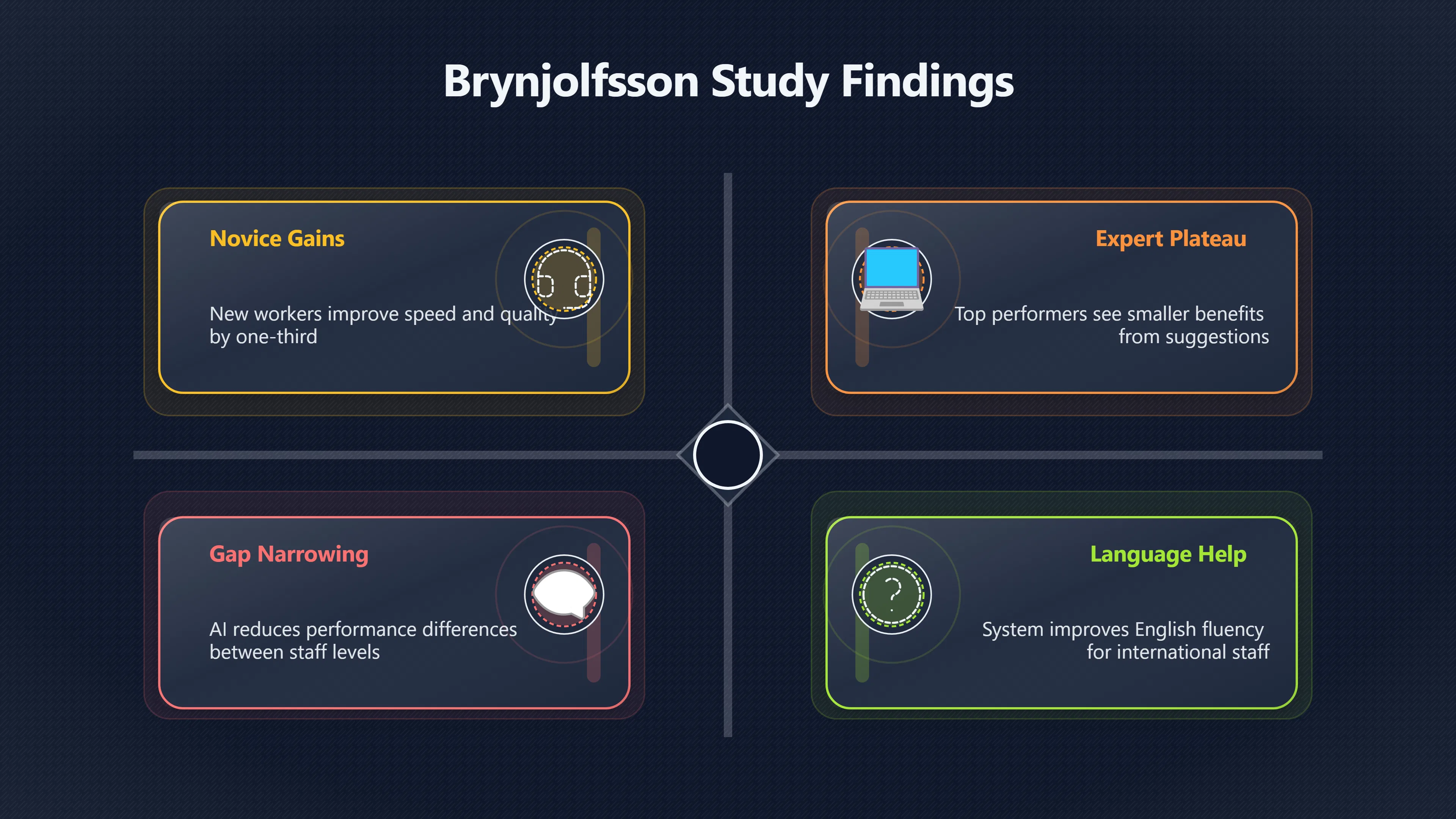
The strongest evidence comes from a widely discussed study by Erik Brynjolfsson, Danielle Li and Lindsey Raymond, who analysed the introduction of a generative AI assistant across more than 5,000 customer-support agents at a Fortune 500 software company. The system provided real-time suggestions during customer interactions. Researchers found that access to the assistant increased productivity by roughly 14–15% on average. More importantly, the gains were highly uneven. Novice and lower-skilled workers improved by about one-third, while experienced and highly skilled workers saw much smaller benefits.[OUP Academic]academic.oup.comOUP AcademicGenerative AI at Work* | The Quarterly Journal of Economicsby E Brynjolfsson · 2025 · Cited by 3397 — We study the effect of…[NBER]nber.orgGenerative AI at Workby E Brynjolfsson · 2023 · Cited by 3397 — In this paper, we study the staggered introduction of a generative AI…
The pattern was not simply a matter of working faster. The study found that less experienced workers often improved both speed and quality. Customer satisfaction remained stable or improved, and workers became better at handling difficult interactions. The researchers also found evidence that AI assistance improved English fluency and communication, especially for international employees.[arXiv]arxiv.orgarXiv Generative AI at WorkarXiv Generative AI at Work[Stanford Graduate]gsb.stanford.eduStanford Graduate School of BusinessGenerative AI at Work - Stanford Graduate School of BusinessWe also find evidence that AI assistance… School of Business
The central finding was that AI narrowed performance gaps. Instead of amplifying differences between the strongest and weakest workers, the tool appeared to reduce them. In economic terms, that is notable because many previous technologies have been described as “skill-biased”, meaning they reward workers who already possess scarce expertise. This deployment often looked more like skill diffusion.[SIEPR]siepr.stanford.eduGenerative AI at Work | Stanford Institute for Economic Policy…In this paper, we study the staggered introduction of a generative…[MIT Sloan]mitsloan.mit.edugenerative ai and worker productivityMIT SloanGenerative AI and Worker Productivity16 Apr 2024 — Access to the new tool increased worker productivity by about 14% on average…
How real-time suggestions shorten the learning curve
The most plausible explanation is not that the AI became smarter than expert workers. Rather, it helped beginners borrow expertise that had already been accumulated elsewhere in the organisation.
In traditional workplaces, much valuable knowledge is tacit. High performers often know how to phrase a difficult response, calm an angry customer, diagnose an unusual problem, or recognise subtle patterns, but they may struggle to explain exactly how they do it. New employees usually acquire those skills slowly through observation, feedback, and repeated mistakes.
Generative AI systems can sometimes extract patterns from huge numbers of past interactions and surface them in real time. Instead of waiting for a supervisor to review their work days later, a novice worker receives immediate suggestions while the task is happening. Brynjolfsson described this as capturing forms of tacit knowledge that had never been formally written down.[Time]time.comHow to Make AI Work for You, at WorkShe pursued this interest by taking the Elements of AI, an online course by MinnaLearn and the University of Helsinki, which enhanced her…
Several mechanisms help explain why the gains are concentrated among beginners:
- Reduced search costs. New workers spend large amounts of time looking for information, procedures, and examples. AI can surface relevant knowledge instantly.
- Continuous coaching. Instead of periodic feedback sessions, workers receive guidance during the task itself.
- Pattern recognition at scale. The system can draw on thousands or millions of previous cases, far beyond what a single mentor remembers.
- Language assistance. Workers operating in a second language can receive help with phrasing, tone, and clarity.
- Confidence support. New staff often hesitate because they are unsure whether they are making the right decision. AI suggestions can reduce uncertainty and speed execution.
The result is that beginners move down the experience curve more quickly. Researchers associated with the study explicitly argued that the technology helped newer workers acquire capabilities that would otherwise have taken longer to develop.[MIT Sloan]mitsloan.mit.edugenerative ai and worker productivityMIT SloanGenerative AI and Worker Productivity16 Apr 2024 — Access to the new tool increased worker productivity by about 14% on average…
Why experts often benefit less
The same mechanism that helps beginners can limit gains for experts.
If the AI has learned from historical examples, many of its recommendations may already resemble the methods used by top performers. An experienced worker therefore receives advice that is often close to what they would have done anyway. The gap between their existing performance and the AI’s suggestions is small.
In some cases, experts may even find generic recommendations mildly constraining. The customer-support study found small declines in quality among the highest-skilled workers despite modest speed gains. One interpretation is that experts possess contextual judgement that standardised suggestions cannot fully replicate.[arXiv]arxiv.orgarXiv Generative AI at WorkarXiv Generative AI at Work
This points to an important distinction. AI can help transfer established best practices, but expertise is not only the application of known rules. Experts often:
- Recognise unusual situations.
- Understand organisational politics and customer relationships.
- Know when standard procedures should be ignored.
- Combine insights from multiple domains.
- Develop genuinely new approaches rather than repeating successful ones.
Those capabilities are harder to compress into a suggestion engine.
The finding therefore does not imply that expertise becomes irrelevant. It suggests that part of what organisations call expertise consists of accumulated procedural knowledge that can increasingly be shared rather than hoarded.
Where productivity gains stop short of expertise
A common misunderstanding is that narrowing performance gaps means eliminating them.
Most workplace studies measure outputs such as issues resolved per hour, task completion rates, coding performance, writing quality scores, or customer satisfaction metrics. These are useful indicators, but they are not the same as measuring deep professional competence.
A novice customer-support agent who receives AI guidance may perform more like a competent colleague during a particular interaction. That does not mean they understand the underlying systems as thoroughly. If the AI fails, the beginner may still lack the conceptual framework needed to solve unusual problems independently.
Researchers reviewing broader evidence on AI and work have noted that novice gains are most consistently observed in relatively structured tasks. As tasks become more complex, the evidence becomes less clear. Some studies still find larger gains among weaker workers, while others show benefits spread more evenly across skill levels.[arXiv]arxiv.orgarXiv Generative AI at WorkarXiv Generative AI at Work
This creates a tension that many organisations are beginning to confront. If AI makes workers more productive without requiring them to develop underlying expertise, companies may become more dependent on the tool itself. The immediate productivity gains are real, but long-term skill formation may become more complicated.
The risk of creating capable beginners but fewer masters
The optimistic interpretation is that AI democratises knowledge. The more cautious interpretation is that it may sometimes substitute for learning rather than accelerate it.
Historically, junior workers often learned by performing simpler versions of tasks later handled independently. If AI performs part of that scaffolding function, organisations may need new ways to ensure workers still develop deep understanding.
This concern appears in emerging research on AI and work transformation. Workers increasingly delegate routine elements of jobs to AI while taking on new responsibilities focused on checking, correcting, and managing outputs. That can improve efficiency, but it also changes how expertise develops.[arXiv]arxiv.orgarXiv Generative AI at WorkarXiv Generative AI at Work
The question is especially important in professions that rely on apprenticeship models. Law, software engineering, medicine, consulting, and scientific research all depend partly on newcomers learning from gradual exposure to increasingly difficult work. If AI handles much of the routine training ground, organisations may need deliberate strategies to prevent the erosion of future expertise.
The evidence today is too limited to resolve this question. Most studies track months rather than decades. They reveal how AI changes immediate performance, not how entire professions evolve.

Why this matters for a larger AI bloom future
The beginner-versus-expert pattern offers an early glimpse of a broader possibility in the AI bloom framework.
For most of human history, access to expertise has been constrained by geography, wealth, institutions, and the limited time of skilled people. Teachers can only teach so many students. Managers can only mentor so many employees. Specialists can only answer so many questions.
AI assistants hint at a world in which some forms of guidance become dramatically more abundant. The customer-support studies suggest that a portion of valuable know-how can be captured, reproduced, and delivered at scale.[NBER]nber.orgNBER WORKING PAPER SERIES GENERATIVE AI AT…by E Brynjolfsson · 2023 · Cited by 3306 — We find that access to AI assistance increases t…
If similar patterns extend into education, healthcare, engineering, science, entrepreneurship, and public services, the implications could be much larger than a modest productivity increase. People who currently lack access to elite training or expert support could gain tools that help them perform closer to the level of experienced practitioners.
That does not automatically produce equality, nor does it eliminate the need for human judgement. Access, governance, incentives, training quality, and concentration of power remain crucial questions. The same systems that spread expertise could also concentrate control if only a small number of organisations own the most capable models.
Even so, the novice-worker evidence matters because it provides a concrete example of a larger claim often made by advocates of AI abundance: that one of AI’s most important effects may be making useful intelligence less scarce. The strongest early workplace studies do not show everyone becoming an expert. They do suggest that many people can become competent much faster than before, and that may be one of the first visible steps toward a world where access to knowledge is far less limited by who already possesses it.
eBay marketplace picks
Marketplace Samples
Example marketplace items related to this page. Use the search link to explore similar finds on eBay.


Endnotes
1.
Source: academic.oup.com
Link:https://academic.oup.com/qje/article/140/2/889/7990658
Source snippet
OUP AcademicGenerative AI at Work* | The Quarterly Journal of Economicsby E Brynjolfsson · 2025 · Cited by 3397 — We study the effect of...
2.
Source: nber.org
Link:https://www.nber.org/papers/w31161
Source snippet
Generative AI at Workby E Brynjolfsson · 2023 · Cited by 3397 — In this paper, we study the staggered introduction of a generative AI...
3.
Source: arxiv.org
Title: arXiv Generative AI at Work
Link:https://arxiv.org/abs/2304.11771
4.
Source: gsb.stanford.edu
Link:https://www.gsb.stanford.edu/faculty-research/publications/generative-ai-work
Source snippet
Stanford Graduate School of BusinessGenerative AI at Work - Stanford Graduate School of BusinessWe also find evidence that AI assistance...
5.
Source: danielle.li
Title: GENERATIVE AI AT WORK˚
Link:https://danielle.li/assets/docs/GenerativeAIatWork.pdf
Source snippet
by E Brynjolfsson · 2024 · Cited by 2808 — We also find evidence that AI assistance facilitates worker learning and improves E...
6.
Source: siepr.stanford.edu
Link:https://siepr.stanford.edu/publications/working-paper/generative-ai-work
Source snippet
Generative AI at Work | Stanford Institute for Economic Policy...In this paper, we study the staggered introduction of a generative...
7.
Source: mitsloan.mit.edu
Title: generative ai and worker productivity
Link:https://mitsloan.mit.edu/centers-initiatives/institute-work-and-employment-research/generative-ai-and-worker-productivity
Source snippet
MIT SloanGenerative AI and Worker Productivity16 Apr 2024 — Access to the new tool increased worker productivity by about 14% on average...
8.
Source: time.com
Title: How to Make AI Work for You, at Work
Link:https://time.com/6302984/ai-jobs-career/
Source snippet
She pursued this interest by taking the Elements of AI, an online course by MinnaLearn and the University of Helsinki, which enhanced her...
9.
Source: digitaleconomy.stanford.edu
Title: Digital Economy Lab Generative AI at Work
Link:https://digitaleconomy.stanford.edu/publication/generative-ai-at-work/
Source snippet
Stanford Digital Economy LabGenerative AI at Work - Stanford Digital Economy LabLess experienced and lower-skilled workers improve both t...
10.
Source: arxiv.org
Title: arXiv AI and jobs. A review of theory, estimates, and evidence
Link:https://arxiv.org/abs/2509.15265
Source snippet
AI and jobs. A review of theory, estimates, and evidenceSeptember 18, 2025...
Published: September 18, 2025
11.
Source: arxiv.org
Link:https://arxiv.org/abs/2502.08854
Source snippet
Generative AI & Changing Work: Systematic Review of Practitioner-led Work Transformations through the Lens of Job CraftingFebruary 1...
12.
Source: nber.org
Link:https://www.nber.org/system/files/working_papers/w31161/w31161.pdf
Source snippet
NBER WORKING PAPER SERIES GENERATIVE AI AT...by E Brynjolfsson · 2023 · Cited by 3306 — We find that access to AI assistance increases t...
13.
Source: nber.org
Title: measuring productivity impact generative ai
Link:https://www.nber.org/digest/20236/measuring-productivity-impact-generative-ai
Source snippet
Measuring the Productivity Impact of Generative AIJun 1, 2023 — Customer support agents using an AI tool to guide their conversations saw...
14.
Source: nber.org
Link:https://www.nber.org/digest/202412/workplace-adoption-generative-ai
Source snippet
Workplace Adoption of Generative AIDec 1, 2024 — The researchers found that 39.4 percent of respondents had used generative AI...
15.
Source: nber.org
Title: Erik Brynjolfsson The Economics of Transformative AI. Book
Link:https://www.nber.org/people/erik_brynjolfsson
Source snippet
Erik BrynjolfssonThe Economics of Transformative AI. Book - Conference Volume. editors - Ajay K. Agrawal, Erik Brynjolfsson & Anton Korin...
16.
Source: brynjolfsson.com
Link:https://www.brynjolfsson.com/
Source snippet
Erik BrynjolfssonErik Brynjolfsson is the Jerry Yang and Akiko Yamazaki Professor and Senior Fellow at the Stanford Institute for Human-C...
17.
Source: ideas.repec.org
Link:https://ideas.repec.org/p/ecl/stabus/4141.html
Source snippet
AI at Workby E Brynjolfsson · 2023 · Cited by 3397 — In this paper, we study the staggered introduction of a generative AI-based conversa...
18.
Source: economics.stanford.edu
Title: erik brynjolfsson
Link:https://economics.stanford.edu/people/erik-brynjolfsson
Source snippet
is the Jerry Yang and Akiko Yamazaki Professor and Senior Fellow at the Stanford Institute for Human-Centered AI (HAI), and Director of...
19.
Source: gsb.stanford.edu
Title: generative ai work
Link:https://www.gsb.stanford.edu/faculty-research/working-papers/generative-ai-work
Source snippet
AI at Work - Stanford Graduate School of BusinessAccess to the tool increases productivity, as measured by issues resolved per hour, by 1...
20.
Source: arxiv.org
Link:https://arxiv.org/pdf/2304.11771
Source snippet
Generative AI at Workby E Brynjolfsson · 2023 · Cited by 2856 — Access to AI assistance increases worker productivity, as measured by iss...
21.
Source: Wikipedia
Title: Erik Brynjolfsson
Link:https://en.wikipedia.org/wiki/Erik_Brynjolfsson
Source snippet
Erik BrynjolfssonErik Brynjolfsson is an American academic, author and inventor. He is the Jerry Yang and Akiko Yamazaki Professor and...
22.
Source: linkedin.com
Title: Erik Brynjolfsson
Link:https://www.linkedin.com/in/erikbrynjolfsson
Source snippet
Professor, Writer, Speaker, InventorErik Brynjolfsson is the Jerry Yang and Akiko Yamazaki Professor and Senior Fellow at the Stanford In...
Additional References
23.
Source: bitter-sweet.ai
Link:https://www.bitter-sweet.ai/articles/generative-ai-at-work-brynjolfsson-2023/
Source snippet
14% Productivity Boost for Customer Service AgentsThe gains were largest for novice and low-skilled workers (34% improvement) — AI effect...
24.
Source: sternstrategy.com
Link:https://sternstrategy.com/speakers/erik-brynjolfsson/
Source snippet
Erik Brynjolfsson AI and Economist SpeakerErik Brynjolfsson, an optimistic economist, explores how technological advances, like AI, impac...
25.
Source: analysisgroup.com
Link:https://www.analysisgroup.com/people/affiliated-experts/erik-brynjolfsson/
26.
Source: linkedin.com
Link:https://www.linkedin.com/posts/erikbrynjolfsson_great-to-see-generative-ai-at-work-my-activity-7297390624809357312-HX0R
Source snippet
Erik Brynjolfsson's PostGreat to see "Generative AI at Work", my paper with Lindsey Raymond and Danielle Li published in the Quarterly Jo...
27.
Source: merriam-webster.com
Link:https://www.merriam-webster.com/dictionary/generative
Source snippet
GENERATIVE Definition & Meaning6 days ago —: having the power or function of generating, originating, producing, or reproducing; Elizabe...
28.
Source: linkedin.com
Link:https://www.linkedin.com/posts/dejan-kovacevic1_w31161pdf-activity-7362723477138677760-MypQ
Source snippet
NBER paper on generative AI boosts productivity by 14%... AI at Work by Erik Brynjolfsson It studied the rollout of a generative AI assis...
29.
Source: itif.org
Link:https://itif.org/publications/2023/07/10/customer-support-agents-using-ai-gpt-tool-saw-nearly-14-percent-increase-in-productivity/
Source snippet
Fact of the Week: Customer Support Agents Using an AI...10 Jul 2023 — They found that customer support agents using the AI tool to guide...
30.
Source: linkedin.com
Link:https://www.linkedin.com/posts/joemckendrick_great-analysis-of-the-nber-working-paper-activity-7056978668945842177-6AWv
Source snippet
Joe McKendrick's Post26 Apr 2023 — ✓ High-skill workers have less to gain from AI assistance because AI recommendations are based on thei...
31.
Source: laweconcenter.org
Title: ai productivity and labor markets a review of the empirical evidence
Link:https://laweconcenter.org/resources/ai-productivity-and-labor-markets-a-review-of-the-empirical-evidence/
Source snippet
AI, Productivity, and Labor Markets: A Review of the...5 Feb 2026 — One view holds that AI delivers modest aggregate gains even after di...
32.
Source: cfodive.com
Title: ai boosts productivity nber case study generative workforce
Link:https://www.cfodive.com/news/ai-boosts-productivity-nber-case-study-generative-workforce/649110/
Source snippet
AI boosts productivity 14%: NBER case study1 May 2023 — Generative artificial intelligence boosted worker productivity 13.8% at a Fortune...
Published: May 2023
Topic Tree