Within Drug trials
Can AI fix the trial bottleneck itself
AI could matter most if it helps trials recruit the right patients, detect useful signals earlier and reduce wasted clinical effort.
On this page
- Patient selection with biomarkers and health records
- Earlier signals before expensive late stage trials
- Risks of biased data and overconfident trial design
Page outline Jump by section
Introduction
The biggest prize in AI-driven medicine may not be designing new drugs. It may be improving the way drugs are tested in people.
 Modern clinical trials are slow, expensive and failure-prone. Recruiting patients can take years. Researchers often struggle to identify which patients are most likely to benefit from a treatment. Many medicines reach large late-stage trials only to fail after enormous costs. AI offers a different possibility: smarter trials that find the right participants faster, detect useful signals earlier and reduce wasted effort before billions are spent on phase 3 studies.
If AI can help solve these bottlenecks, the implications reach beyond pharmaceutical profits. Faster, more reliable trials could accelerate the arrival of treatments for cancer, neurodegenerative disease, rare disorders and age-related illness. In the broader AI bloom vision, this matters because medical abundance depends not only on generating scientific ideas, but on proving which ideas actually improve human health.
Why clinical trials are the real bottleneck
The pharmaceutical industry already generates huge numbers of drug candidates. The harder task is establishing whether those candidates are safe and effective in diverse groups of patients.
A major reason for failure is biological variation. Two people with the same diagnosis may have very different genetic profiles, disease mechanisms, immune responses and rates of progression. A treatment that works extremely well for one subgroup can appear ineffective when tested across a broad population.
Traditional trial design often treats diseases as larger and more uniform categories than they really are. AI systems offer a way to identify hidden patterns inside these populations and create more targeted studies.
This shift is especially important for precision medicine, where therapies are increasingly designed for specific molecular characteristics rather than broad disease labels. Researchers and regulators have increasingly explored AI and machine learning tools as ways to improve recruitment, stratification and trial design rather than simply analysing results after the fact. U.S. Food and Drug Administration[PMC]pmc.ncbi.nlm.nih.govby C Fang · 2025 · Cited by 7 — First, AI enhances patient stratification and recruitment—crucial steps in trial initiation. Natural l…
Finding the right patients instead of searching blindly
One of the most immediate uses of AI is helping researchers identify eligible participants.
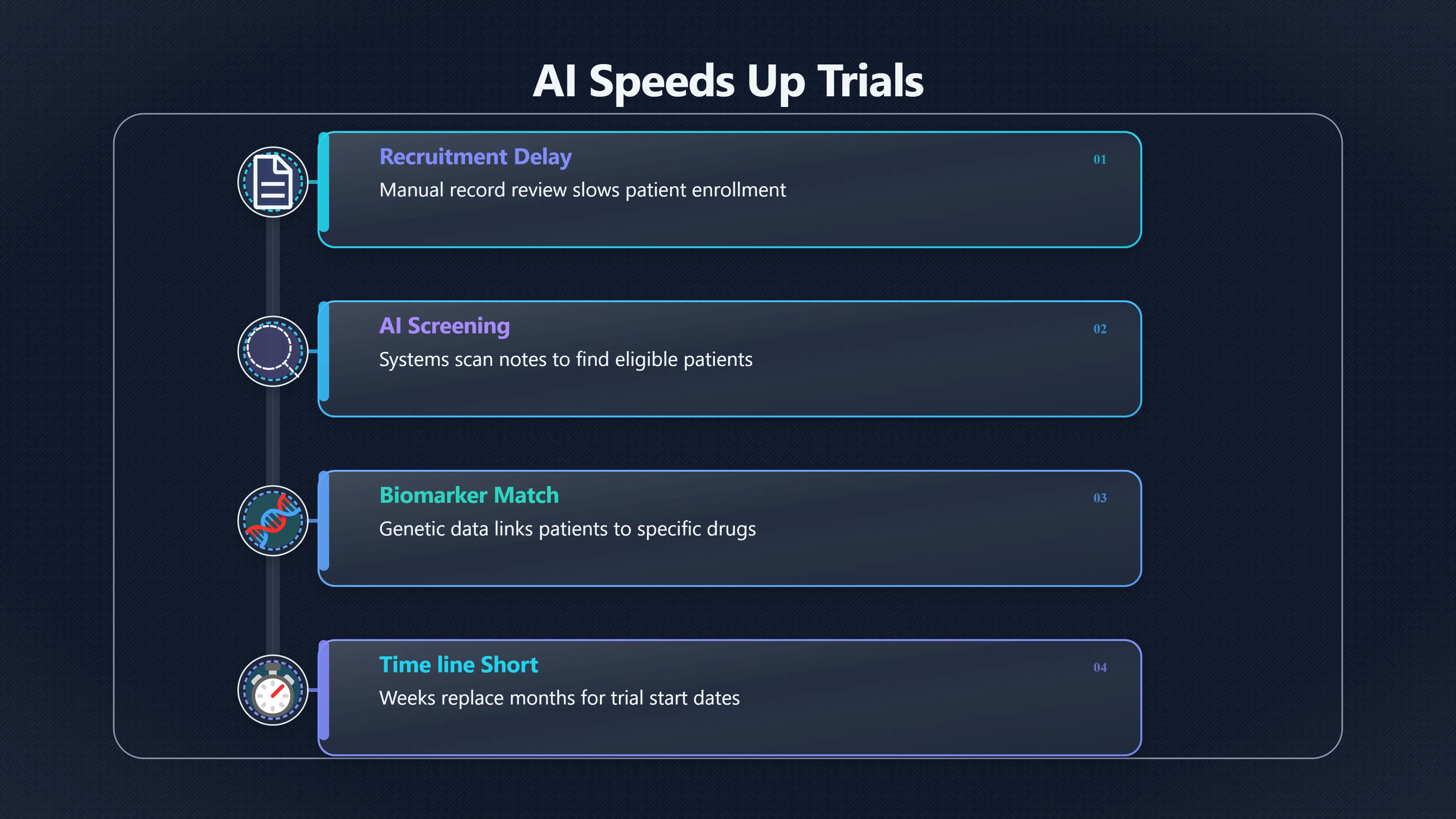
Clinical trial recruitment remains one of the largest causes of delay. Many studies fail to enrol enough people, while others take years to reach targets. A large part of the problem is that eligibility criteria have become increasingly complex. Researchers may need patients with specific genetic mutations, biomarkers, treatment histories or disease stages.
Traditionally, this often requires manual review of medical records. AI systems can scan electronic health records, physician notes, pathology reports and genomic data far more quickly.
Matching patients to trials
In oncology, where targeted therapies increasingly depend on genetic biomarkers, AI-based matching systems are already being tested.
Researchers have reported systems that automatically analyse structured medical records and unstructured clinical notes to identify eligible trial participants. Several studies have shown high accuracy rates when AI is used as a screening aid, allowing staff to focus on promising candidates rather than reviewing thousands of records manually.[PMC]pmc.ncbi.nlm.nih.govby C Fang · 2025 · Cited by 7 — First, AI enhances patient stratification and recruitment—crucial steps in trial initiation. Natural l…[PMC]pmc.ncbi.nlm.nih.govby C Fang · 2025 · Cited by 7 — First, AI enhances patient stratification and recruitment—crucial steps in trial initiation. Natural l…
Recent systems such as TrialMatchAI and MatchMiner-AI combine large language models with clinical databases and trial eligibility rules. Rather than replacing clinicians, these tools are designed to narrow vast search spaces and explain why particular patients appear eligible. In reported evaluations, they showed strong performance in biomarker-driven cancer trial matching.[Nature]nature.comTrialMatchAI: an end-to-end AI-powered clinical trial…by M Abdallah · 2026 · Cited by 5 — We present TrialMatchAI, an AI-powered…[arXiv]arxiv.orgOpen source on arxiv.org.
The practical significance is easy to miss. If a potentially life-saving trial can identify eligible patients in weeks rather than months, the entire development timeline may shorten. Patients may also gain access to experimental therapies that would otherwise remain hidden inside fragmented healthcare systems.
Turning health records into research infrastructure
The larger opportunity is that healthcare systems already contain enormous amounts of relevant information.
Electronic health records contain laboratory results, imaging scans, diagnoses, medication histories and physician observations. Much of this information sits in formats that are difficult to search efficiently.
Natural language processing, a branch of AI focused on extracting meaning from text, can help convert clinical notes into searchable research data. This could make trial recruitment more continuous and proactive rather than relying on researchers manually searching for participants after a study launches.[PMC]pmc.ncbi.nlm.nih.govby C Fang · 2025 · Cited by 7 — First, AI enhances patient stratification and recruitment—crucial steps in trial initiation. Natural l…[Oncology Central]oncology-central.comHow is artificial intelligence changing clinical trial feasibility…7 Jan 2020 — Deep 6 as the name suggests uses AI on clinical data t…
If successful, this could gradually transform healthcare systems into much more responsive research networks.
Can AI spot success or failure earlier?
Recruitment is only part of the problem. Another major challenge is waiting years to discover whether a treatment works.
Many diseases progress slowly. Researchers often need large patient groups and long follow-up periods before enough evidence accumulates to judge effectiveness.
AI could help by identifying subtle signals that appear much earlier.
Digital biomarkers and continuous monitoring
A biomarker is a measurable indicator of disease or treatment response. Traditional biomarkers often rely on blood tests, scans or clinical examinations performed periodically during a study.
Digital biomarkers extend this idea using wearable devices, smartphones, sensors and software systems that continuously collect information about movement, speech, cognition, sleep patterns or physiological changes.
Machine learning models can analyse these large streams of data and potentially detect changes that humans might miss. Researchers are particularly interested in neurological diseases, where progression can be gradual and difficult to measure using conventional methods.[PMC]pmc.ncbi.nlm.nih.govby C Fang · 2025 · Cited by 7 — First, AI enhances patient stratification and recruitment—crucial steps in trial initiation. Natural l…[ScienceDirect If digital biomarkers prove reliable]sciencedirect.comThe convergence of traditional and digital biomarkers…by SS Arya · 2023 · Cited by 187 — This review brings together conventional and…, smaller proof-of-concept studies may reveal whether a treatment is affecting disease progression long before traditional endpoints become visible.
That could allow companies to abandon weak candidates earlier while advancing promising ones more quickly.
Detecting disease before symptoms become obvious
Another possibility is identifying disease at earlier stages, allowing trials to test interventions before major damage occurs.
This is particularly important in conditions such as Alzheimer’s disease, Parkinson’s disease and some cancers, where irreversible biological changes may occur years before diagnosis.
Researchers have reported AI-assisted approaches that identify potential disease signals long before conventional detection. Examples include AI-enhanced blood tests for Parkinson’s disease risk prediction and imaging models designed to identify pancreatic cancer-associated abnormalities before clinicians typically recognise them. These systems remain under validation, but they illustrate a broader shift: AI may increasingly help define who enters trials and when interventions are tested.[The Guardian]theguardian.comThe Guardian AI-enhanced blood test may detect Parkinson's years before onsetThis predictive test, if validated in larger populations, could become accessible within two years using existing NHS laboratory equipmen…
For diseases where treatments work best before extensive damage occurs, earlier identification could be as important as discovering new drugs themselves.
Why smarter trials matter for longevity and medical abundance
The long-term significance goes beyond efficiency.
Many proposed therapies for ageing, neurodegeneration and chronic disease struggle because measuring success takes so long. Researchers may need to wait years to observe whether a treatment slows decline, prevents disease or extends healthy lifespan.
If AI can improve patient selection and identify reliable early indicators of success, entirely new classes of interventions become more testable.
This is one reason clinical trial innovation occupies a central place in optimistic visions of scientific acceleration. Discovering candidate drugs is valuable. Building faster ways to evaluate them may be even more important.
A world where researchers can run more experiments, learn more quickly from failures and identify effective therapies sooner would have a much larger capacity for medical progress. In that sense, smarter trials could act as a multiplier on many other advances in biotechnology and AI-assisted discovery.
The danger of biased data and misleading certainty
The optimistic story has significant limits.
AI systems learn from historical data. If those data are incomplete, biased or unrepresentative, the resulting models can inherit those weaknesses.
Historical inequalities can become future exclusions
Clinical research has often underrepresented women, ethnic minorities, older patients and people with multiple health conditions.
If AI models are trained primarily on populations already overrepresented in historical datasets, they may become less accurate for other groups.
A recruitment system that appears efficient could unintentionally worsen disparities by repeatedly selecting the easiest-to-identify patients rather than the most representative populations.
This is particularly important because the entire purpose of clinical trials is to generate evidence that applies broadly to future patients. A trial that becomes statistically cleaner but socially narrower may not actually improve medical knowledge.
Correlation is not understanding
A second problem is overconfidence.
Machine learning systems can detect patterns without understanding underlying biological causes. Sometimes these patterns reflect genuine disease signals. Sometimes they reflect quirks of data collection, hospital practices or demographic factors.
An AI model may appear highly predictive during development but fail when applied in a different hospital, country or patient population.
Regulators have repeatedly emphasised transparency, validation, reliability and human oversight for AI systems used in drug development and regulatory decision-making. The concern is not merely technical accuracy but whether researchers can understand why a model reached a conclusion and whether that conclusion remains valid in real-world settings. U.S. Food and Drug Administration[RealTime]realtime-eclinical.comThe FDA's Draft Guidance for AI in Clinical TrialsFeb 6, 2025 — The guidance addresses how AI can improve trial design, streamline regula…
Better optimisation can optimise the wrong thing
There is also a deeper risk.
AI can optimise trials around measurable outcomes, but not every important outcome is easily measurable.
A system designed to maximise the probability of regulatory approval might favour patient populations most likely to produce clear results. A system designed to minimise costs might discourage more ambitious studies involving complex patients or longer-term outcomes.
The challenge is ensuring that smarter trials remain aligned with the broader goal: improving human health rather than merely improving trial statistics.
Human judgement may become more important, not less
The strongest versions of these systems are unlikely to replace clinicians, trial investigators or regulators.
Instead, many emerging approaches use AI as a screening and decision-support layer.
Recent trial-matching systems increasingly provide explanations, evidence traces and human-review workflows rather than making fully automated decisions. In several studies, the best performance came from hybrid systems where AI rapidly narrowed possibilities and human experts made final eligibility assessments.[PMC]pmc.ncbi.nlm.nih.govby C Fang · 2025 · Cited by 7 — First, AI enhances patient stratification and recruitment—crucial steps in trial initiation. Natural l…
This hybrid model may prove more durable than visions of fully automated clinical research.
Medicine is filled with unusual cases, incomplete information and ethical trade-offs. AI may excel at processing enormous quantities of data, while humans remain responsible for judgement, accountability and patient trust.
The larger implication
The future of AI-enabled medicine depends on more than discovering molecules.
Even dramatic advances in protein prediction, generative chemistry and biological modelling cannot create health abundance if promising treatments remain trapped inside slow and inefficient testing systems.
Smarter clinical trials offer a different route to acceleration. By helping researchers find appropriate patients, identify meaningful signals earlier and learn faster from both successes and failures, AI could increase the rate at which medical knowledge accumulates.
That does not guarantee a future of radical longevity or disease-free ageing. Biology remains extraordinarily complex, and many proposed breakthroughs will still fail. But if AI improves the machinery that separates effective treatments from ineffective ones, it could strengthen one of the weakest links in modern medicine.
For the broader AI bloom argument, that may be one of the most consequential possibilities. A civilisation that learns faster about human health gains more than efficiency. It gains a greater ability to reduce suffering, extend healthy life and turn scientific possibility into lived reality.
Amazon book picks
Further Reading
Books and field guides related to Can AI fix the trial bottleneck itself. Use these as the next step if you want deeper reading beyond the article.
Deep Medicine
Covers AI's potential to improve diagnosis, decision support and healthcare workflows including evidence generation.
Bad Pharma
Explains trial distortions and why better evidence systems matter as much as better molecules.
The Drug Hunters
Shows where AI-assisted clinical trial improvements fit in the larger drug-development pipeline.
The Patient Will See You Now
Explores data-rich medicine and patient selection, both central to smarter trial design.
eBay marketplace picks
Marketplace Samples
Example marketplace items related to this page. Use the search link to explore similar finds on eBay.


Endnotes
1.
Source: fda.gov
Link:https://www.fda.gov/media/167973/download
Source snippet
Food and Drug AdministrationUsing Artificial [Intelligence]({{ 'intelligence/' | relative_url }}) & Machine Learning in the...participant's clinical outcome based on baseline c...
2.
Source: pmc.ncbi.nlm.nih.gov
Link:https://pmc.ncbi.nlm.nih.gov/articles/PMC10493153/
Source snippet
Coming of Age of AI/ML in Drug Discovery, Development...by SK Niazi · 2023 · Cited by 186 — AI/ML gathers data from previous clinical tr...
3.
Source: pmc.ncbi.nlm.nih.gov
Link:https://pmc.ncbi.nlm.nih.gov/articles/PMC7382632/
Source snippet
Evaluation of an artificial intelligence clinical trial matching...by M Alexander · 2020 · Cited by 90 — The AI-based clinical trial...
4.
Source: pmc.ncbi.nlm.nih.gov
Link:https://pmc.ncbi.nlm.nih.gov/articles/PMC12711520/
Source snippet
by C Fang · 2025 · Cited by 7 — First, AI enhances patient stratification and recruitment—crucial steps in trial initiation. Natural l...
5.
Source: pmc.ncbi.nlm.nih.gov
Link:https://pmc.ncbi.nlm.nih.gov/articles/PMC11491624/
Source snippet
intelligence for optimizing recruitment and retention in...by X Lu · 2024 · Cited by 62 — Applying AI to recruitment in clinical trials...
6.
Source: nature.com
Link:https://www.nature.com/articles/s41467-026-70509-w
Source snippet
TrialMatchAI: an end-to-end AI-powered clinical trial...by M Abdallah · 2026 · Cited by 5 — We present TrialMatchAI, an AI-powered...
7.
Source: arxiv.org
Link:https://arxiv.org/abs/2505.08508
8.
Source: arxiv.org
Title: arXiv Match Miner-AI: An Open-Source Solution for Cancer Clinical Trial Matching
Link:https://arxiv.org/abs/2412.17228
9.
Source: oncology-central.com
Link:https://www.oncology-central.com/podcasts/how-is-artificial-intelligence-changing-clinical-trial-feasibility-and-recruitment/
Source snippet
How is artificial intelligence changing clinical trial feasibility...7 Jan 2020 — Deep 6 as the name suggests uses AI on clinical data t...
10.
Source: pmc.ncbi.nlm.nih.gov
Link:https://pmc.ncbi.nlm.nih.gov/articles/PMC10934426/
Source snippet
Machine Learning and Digital Biomarkers Can Detect Early...by A Chudzik · 2024 · Cited by 134 — This review explores “digital biomark...
11.
Source: sciencedirect.com
Link:https://www.sciencedirect.com/science/article/pii/S0956566323003299
Source snippet
The convergence of traditional and digital biomarkers...by SS Arya · 2023 · Cited by 187 — This review brings together conventional and...
12.
Source: fda.gov
Title: artificial intelligence software medical device
Link:https://www.fda.gov/medical-devices/software-medical-device-samd/artificial-intelligence-software-medical-device
Source snippet
Food and Drug AdministrationArtificial Intelligence in Software as a Medical DeviceMar 25, 2025 — AI/ML technologies have the potential t...
13.
Source: arxiv.org
Link:https://arxiv.org/abs/2511.05696
14.
Source: sciencedirect.com
Link:https://www.sciencedirect.com/science/article/pii/S1386505625003582
Source snippet
Artificial intelligence in clinical trials: A comprehensive...by DB Olawade · 2025 · Cited by 11 — Analysis of relevant studies demonstr...
15.
Source: sciencedirect.com
Link:https://www.sciencedirect.com/science/article/pii/S1386505625001170
Source snippet
Electronic Health Record based recruitment support systemsby M Vaterkowski · 2025 · Cited by 5 — This scoping review focused on articles...
16.
Source: nature.com
Link:https://www.nature.com/articles/s41746-023-00767-1
Source snippet
Evidence from ClinicalTrials.gov on the growth of Digital...by L Masanneck · 2023 · Cited by 95 — This study analyzed the recent evoluti...
17.
Source: arxiv.org
Link:https://arxiv.org/html/2503.00863v1
Source snippet
Systematic Literature Review on Clinical Trial Eligibility...2 Mar 2025 — The capability of NLP methods to parse and interpret eligibili...
18.
Source: theguardian.com
Title: The Guardian AI-enhanced blood test may detect Parkinson’s years before onset
Link:https://www.theguardian.com/society/article/2024/jun/18/ai-enhanced-blood-test-may-detect-parkinsons-years-before-onset
Source snippet
This predictive test, if validated in larger populations, could become accessible within two years using existing NHS laboratory equipmen...
19.
Source: realtime-eclinical.com
Link:https://realtime-eclinical.com/2025/02/06/the-fdas-draft-guidance-for-ai-in-clinical-trials-implications-for-sites-and-amcs/
Source snippet
The FDA's Draft Guidance for AI in Clinical TrialsFeb 6, 2025 — The guidance addresses how AI can improve trial design, streamline regula...
20.
Source: fda.gov
Link:https://www.fda.gov/medical-devices/software-medical-device-samd/artificial-intelligence-enabled-medical-devices
Source snippet
Artificial Intelligence-Enabled Medical DevicesThe AI-Enabled Medical Device List is a resource intended to identify AI-enabled medical d...
21.
Source: fda.gov
Title: role artificial intelligence clinical trial design and research dr elzarrad
Link:https://www.fda.gov/drugs/news-events-human-drugs/role-artificial-intelligence-clinical-trial-design-and-research-dr-elzarrad
Source snippet
The Role of Artificial Intelligence in Clinical Trial Design...30 May 2024 — AI has been explored already and used in part of a clinical...
Published: May 2024
Additional References
22.
Source: smartbridge.com
Link:https://smartbridge.com/ai-in-clinical-trials-accelerating-drug-development/
Source snippet
AI in Clinical Trials: Accelerating Drug Development2 days ago — Learn how pharma teams use AI in clinical trials to speed enrollment, op...
23.
Source: scribd.com
Link:https://www.scribd.com/document/893501663/Transforming-Cancer-Clinical-Trials-The-Integral-Role-of-Artificial-Intelligence-in-Electronic-Health-Records-for-Efficient-Patient-Recruitment
Source snippet
AI in EHRs for Cancer Trial Recruitment | PDFAI's ability to quickly process and interpret EHR data significantly accelerates the timelin...
24.
Source: linkedin.com
Link:https://www.linkedin.com/posts/amanda-martin-ba-cssgb-acrp-gcp-b1090341_digital-biomarkers-are-reshaping-how-evidence-activity-7361906536614445056-mc4Y
Source snippet
How AI and digital biomarkers are changing clinical trialsFor healthcare and pharma: New AI-powered screening centres to boost early dete...
25.
Source: livescience.com
Link:https://www.livescience.com/health/cancer/new-ai-model-spots-pancreatic-cancer-up-to-3-years-earlier-than-human-doctors-in-test
Source snippet
Researchers tested REDMOD on almost 2,000 CT scans previously deemed "normal," and the AI successfully identified structural abnormalitie...
26.
Source: veranahealth.com
Link:https://veranahealth.com/clinical-research-solutions/patient-recruitment/
Source snippet
Verana Health's Patient Recruitment SolutionsOur AI algorithms predict which patient populations and regions are most likely to participa...
27.
Source: trialx.com
Link:https://trialx.com/how-trialx-ai-powered-clinical-trial-matching-leverages-ehr-data-to-identify-eligible-patients-efficiently/
Source snippet
How TrialX AI-Powered Clinical Trial Matching Leverages...9 Apr 2026 — These research shows how EHR data and AI are being used in real-w...
28.
Source: pathai.com
Link:https://www.pathai.com/news/pathais-aim-mash-ai-assist-becomes-first-ai-powered-pathology-tool-to-receive-fda-qualification-for-mash-clinical-trials
Source snippet
PathAI's AIM-MASH AI Assist Becomes First AI-Powered...Dec 9, 2025 — PathAI's AIM-MASH AI Assist1 Becomes First AI-Powered Pathology Too...
29.
Source: hoganlovells.com
Link:https://www.hoganlovells.com/en/publications/fdas-evolving-regulatory-framework-for-ai-use-in-drug-device-clinical-trials-and-research
Source snippet
FDA's evolving regulatory framework for AI use in drug &...13 Jan 2025 — FDA previously discussed digital twins in its May 2023 discussi...
Published: May 2023
30.
Source: gmdpacademy.org
Title: fda recognizes ai mls role in advancing drug development and clinical trials
Link:https://gmdpacademy.org/news/fda-recognizes-ai-mls-role-in-advancing-drug-development-and-clinical-trials/
Source snippet
AI/ML in Drug Development: FDA Recognizes Role...10 Sept 2024 — By improving patient selection, AI/ML models can help ensure that clinic...
31.
Source: ovid.com
Title: jama.2024.21451~fda perspective on the regulation of artificial intelligence
Link:https://www.ovid.com/journals/jama/pdf/10.1001/jama.2024.21451~fda-perspective-on-the-regulation-of-artificial-intelligence
Source snippet
FDA Perspective on the Regulation of Artificial Intelligence...by HJ Warraich · 2025 · Cited by 279 — • Predict an individual participan...
Topic Tree