Within Access gap
Who gets missed by medical AI?
AI screening can fail the patients least represented in training data, turning uneven records into unequal diagnosis.
On this page
- Why healthcare records underrepresent some groups
- Chest X ray AI as a warning case
- How fairness testing can reveal hidden failure
Page outline Jump by section
Introduction
Artificial intelligence in medicine is often presented as a way to make diagnosis faster, cheaper, and more accurate. In the most optimistic versions of the AI abundance story, advanced systems could help detect disease earlier, personalise treatment, and extend healthy life for billions of people. But there is a quieter problem underneath many medical AI systems: they learn from healthcare records that already reflect unequal access to care.
 If some populations are underrepresented in training data, receive fewer tests, or have less complete medical histories, AI systems can inherit those gaps. The result is not necessarily dramatic failure. More often, it is something subtler and potentially more dangerous: certain groups are missed more often, diagnosed later, or classified as lower risk than they really are. In a future where AI-guided healthcare becomes increasingly important, those errors could compound existing inequalities in life expectancy and healthy lifespan rather than reduce them.
Why healthcare records underrepresent some groups
Medical AI depends on data. Electronic health records, medical images, insurance claims, laboratory results, and genomic databases provide the raw material from which algorithms learn patterns. The problem is that these datasets are not neutral snapshots of human health.
Many healthcare datasets are built from large hospitals, academic medical centres, insured populations, or regions with stronger healthcare infrastructure. People who struggle to access care often generate fewer records in the first place. Those records may also be less complete because diagnoses occur later, follow-up visits are less frequent, and preventive screening is less common. Researchers have repeatedly warned that these patterns can make machine-learning systems less reliable for underrepresented populations.[PMC]pmc.ncbi.nlm.nih.govPMCAddressing bias in big data and AI for health careThis can result in misdiagnosing certain…Read more…[PMC]pmc.ncbi.nlm.nih.govPMCSources of bias in artificial intelligence that perpetuateby LA Celi · 2022 · Cited by 610 — The lack of diverse digital datasets for ML algorithms can amplify systematic underrepresentation o…
The bias can emerge through several pathways:
- Selection bias: some groups appear less often in the data used for training.
- Measurement bias: health conditions may be recorded differently across populations.
- Label bias: the “ground truth” used to train models can reflect past clinical decisions that were themselves uneven.
- Access bias: people who receive more tests create richer datasets, making it easier for algorithms to learn from them.
- Historical bias: datasets inherit inequalities that already exist in healthcare systems.[PMC]pmc.ncbi.nlm.nih.govBias in medical AI: Implications for clinical decision-makingby JL Cross · 2024 · Cited by 535 — We discuss potential biases that can…
This means a model can achieve impressive average accuracy while still performing substantially worse for specific groups.
That distinction matters because healthcare is not like a recommendation system or advertising platform. Missing a diagnosis can delay treatment, increase complications, and shorten lives.
The chest X-ray warning case
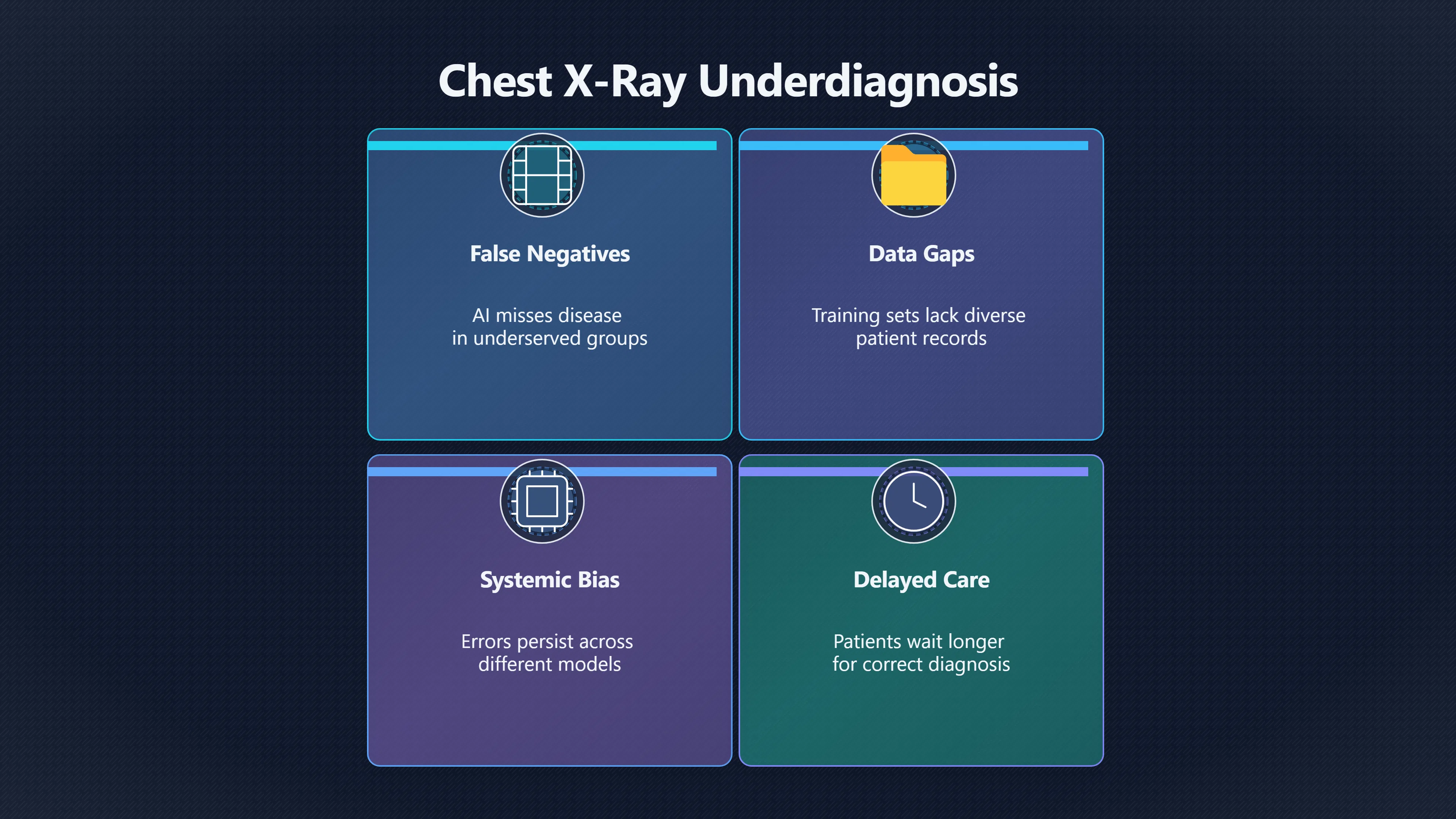
One of the most influential demonstrations of this problem came from research on AI systems used to analyse chest radiographs.
In 2021, researchers examined multiple chest X-ray classification models across several major datasets. They focused on a particularly important failure mode: underdiagnosis. Instead of asking whether overall accuracy was high, they asked which patients were most likely to have disease incorrectly labelled as absent.[Nature]nature.comUnderdiagnosis bias of artificial intelligence algorithms…by L Seyyed-Kalantari · 2021 · Cited by 1052 — Here, we examine algori…
The results were troubling.
Across different datasets and institutions, the researchers found systematic underdiagnosis for historically underserved populations. Certain groups were more likely to receive false-negative results, meaning the AI system was more likely to classify a sick patient as healthy. The disparities appeared across multiple pathologies and persisted even when researchers examined different datasets and modelling approaches.[Nature]nature.comNat. Med. 27…Read more…
The significance of the study was not merely that bias existed. Researchers already suspected that. The striking finding was that the problem remained visible across different datasets and models, suggesting that unequal performance was deeply connected to the structure of the underlying data rather than a single defective algorithm.
For patients, false negatives can be especially damaging. A false positive may trigger extra testing. A false negative can delay diagnosis entirely.
In practical terms, a hospital could deploy an AI screening tool believing it improves efficiency and accuracy overall, while some populations quietly receive worse screening performance than the averages suggest.
How inequality becomes embedded in training data
The chest X-ray findings highlight a broader issue. Medical datasets often reflect not only disease but also the social conditions under which disease is observed.
Consider two patients with similar underlying illness:
- One receives regular preventive care, multiple scans, specialist referrals, and detailed records.
- The other encounters the healthcare system only during emergencies and has fewer documented observations.
The first patient’s condition is more likely to be identified, labelled, and recorded. The second patient’s condition may remain partially invisible in the dataset.
When machine-learning systems are trained on those records, they can learn patterns associated with healthcare access rather than health itself. Researchers describe this as a major source of bias in healthcare AI. PMC[PLOS]journals.plos.orgSources of bias in artificial intelligence that perpetuate…by LA Celi · 2022 · Cited by 614 — Here, we describe the landscape of A…
The problem becomes even more complicated when datasets use proxies.[nature.com]nature.comThe value of standards for health datasets in artificial…by A Arora · 2023 · Cited by 353 — However, a growing body of evidence has hi…
A famous example came from a widely used healthcare risk algorithm studied by Ziad Obermeyer and colleagues. The system attempted to identify patients needing additional care management. Instead of predicting illness directly, it used future healthcare spending as a proxy for health need. Because Black patients historically received less medical spending for equivalent illness levels, the algorithm learned to treat them as lower risk. Researchers estimated that correcting the bias would dramatically increase the proportion of Black patients identified for additional support.[Science]science.orgfind evidence of racial bias in one widely used algorithm, such that Black patients assigned the same level of risk by the algorithm are…
The algorithm was not explicitly programmed to discriminate. The bias emerged because historical spending patterns reflected unequal healthcare access.
That case became one of the clearest demonstrations that apparently neutral data can encode social inequality.
Skin tone, ancestry, and the limits of medical datasets
The problem extends beyond healthcare records.
Many medical imaging datasets contain far more examples from certain populations than others. Dermatology has become a frequently cited example because skin conditions can appear differently across skin tones.
Researchers have warned that machine-learning systems trained predominantly on lighter-skinned patients may perform less reliably for darker-skinned populations. Underrepresentation in dermatological datasets creates a risk that algorithms will miss or misclassify conditions that present differently across diverse populations.[probiologists.com]probiologists.comJournal of Biomed Researchby G Kleinberg · 2022 · Cited by 62 — This review explores the extent, causes, possible solutions, and overall…
Genomic medicine faces related challenges.
Large genetic databases remain heavily weighted toward people of European ancestry. As a result, predictive tools built from those datasets may generalise less effectively to other populations. Reviews of medical-device and health-equity research have repeatedly highlighted this concern, especially for polygenic risk scores that attempt to estimate future disease risk from genetic information.[ScienceDirect]sciencedirect.comWeighing the benefits and risks of collecting race…by A Fiske · 2025 · Cited by 13 — This Viewpoint weighs the risks of c…
These examples reveal a recurring pattern: when representation gaps exist in the underlying data, prediction gaps often follow.
Why average accuracy can hide unequal outcomes
A common misunderstanding is that fairness problems disappear once an AI system reaches high overall accuracy.
In reality, average performance can conceal substantial differences between groups.
Imagine a diagnostic model that achieves 95% accuracy overall. That figure sounds impressive. But if performance is 98% for one population and 85% for another, the average masks a clinically important disparity.
Researchers increasingly argue that healthcare AI should be evaluated not only on aggregate performance but also on subgroup outcomes. This includes examining results across race, sex, age, socioeconomic status, disability, language background, and combinations of those characteristics.[PMC]pmc.ncbi.nlm.nih.govPMCAddressing bias in big data and AI for health careThis can result in misdiagnosing certain…Read more…[ScienceDirect]sciencedirect.comWeighing the benefits and risks of collecting race…by A Fiske · 2025 · Cited by 13 — This Viewpoint weighs the risks of c…
Intersectional analysis is especially important.
The 2021 chest X-ray study found some of the highest underdiagnosis rates in intersectional groups that combined multiple forms of disadvantage. More recent research on medical imaging foundation models reported similar patterns, with elevated underdiagnosis rates for groups such as Black women compared with broader population averages.[Nature]nature.comFirst published in 1869, Nature is the world's leading multidisciplinary science journal. Nature publishes the finest peer-reviewed…
A model may therefore appear equitable when comparing broad categories while still failing particular subpopulations.

How fairness testing can reveal hidden failure
One lesson from recent research is that fairness cannot be treated as a final quality-control step.
Researchers increasingly recommend testing for unequal outcomes throughout development and deployment rather than after a system reaches clinical use.[ScienceDirect]sciencedirect.comWeighing the benefits and risks of collecting race…by A Fiske · 2025 · Cited by 13 — This Viewpoint weighs the risks of c…
Several approaches are becoming more common:
Auditing performance across groups
Instead of reporting only overall accuracy, developers examine false-positive and false-negative rates for different populations.
This helps identify situations where one group experiences substantially more missed diagnoses than another. The chest X-ray underdiagnosis studies are examples of this approach.[Nature]nature.commore…
Testing on multiple datasets
Models often perform well on the institution where they were trained but degrade elsewhere.
Evaluating systems across hospitals, regions, and patient populations can reveal whether apparent performance depends on narrow training conditions.[PLOS]journals.plos.orgSources of bias in artificial intelligence that perpetuate…by LA Celi · 2022 · Cited by 614 — Here, we describe the landscape of A…
Improving dataset diversity
Researchers increasingly argue that better representation during data collection is one of the most important fairness interventions.
That may involve recruiting more diverse participants, collecting data from underserved regions, or ensuring that demographic information is available for auditing.[ScienceDirect]sciencedirect.comWeighing the benefits and risks of collecting race…by A Fiske · 2025 · Cited by 13 — This Viewpoint weighs the risks of c…[ScienceDirect]sciencedirect.comTackling algorithmic bias and promoting transparency in…by JE Alderman · 2025 · Cited by 157 — Biases in the outputs of a…
Monitoring after deployment
Bias may emerge only after systems are introduced into real clinical environments.
Healthcare populations change over time, disease patterns shift, and hospital workflows evolve. Ongoing monitoring can identify performance drift that was not visible during development.[PMC]pmc.ncbi.nlm.nih.govPMCSources of bias in artificial intelligence that perpetuateby LA Celi · 2022 · Cited by 610 — The lack of diverse digital datasets for ML algorithms can amplify systematic underrepresentation o…
The deeper challenge for an AI longevity future
The concern is not simply that medical AI can make mistakes. Human clinicians make mistakes too.
The deeper issue is scale.
A biased doctor may affect hundreds or thousands of patients during a career. A biased diagnostic model can influence millions of decisions across health systems. If disparities are embedded into widely deployed AI infrastructure, unequal outcomes can become faster, more consistent, and harder to detect.
This matters directly to the wider question of AI-guided longevity. If future healthcare increasingly relies on predictive models, continuous monitoring, automated triage, and personalised prevention, then the quality of the underlying data becomes part of the distribution problem. The people whose lives are most improved by AI medicine may be the people most visible to AI systems.
That outcome is not inevitable. Better datasets, stronger auditing, transparent reporting, fairness testing, and broader healthcare access can reduce the risk. But the evidence from chest X-ray systems, healthcare risk algorithms, dermatology datasets, and genomic prediction tools suggests that unequal representation is not a peripheral technical issue.
It is one of the mechanisms through which a technology designed to extend healthy life could end up extending it unevenly.[ScienceDirect]sciencedirect.comWeighing the benefits and risks of collecting race…by A Fiske · 2025 · Cited by 13 — This Viewpoint weighs the risks of c…[Nature]nature.comBias recognition and mitigation strategies in artificial…by F Hasanzadeh · 2025 · Cited by 253 — This review examines the origins of b…[PubMed]pubmed.ncbi.nlm.nih.govbias of artificial intelligence algorithms…by L Seyyed-Kalantari · 2021 · Cited by 1051 — Here, we examine algorithmic underdiagnosis…
Amazon book picks
Further Reading
Books and field guides related to Who gets missed by medical AI?. Use these as the next step if you want deeper reading beyond the article.
Invisible Women
Explains how missing data can produce harmful design and policy failures.
Weapons of Math Destruction
Directly relevant to hidden bias and unequal algorithmic outcomes.
eBay marketplace picks
Marketplace Samples
Example marketplace items related to this page. Use the search link to explore similar finds on eBay.


Endnotes
1.
Source: pmc.ncbi.nlm.nih.gov
Title: PMCAddressing bias in big data and AI for health care
Link:https://pmc.ncbi.nlm.nih.gov/articles/PMC8515002/
Source snippet
This can result in misdiagnosing certain...Read more...
2.
Source: pmc.ncbi.nlm.nih.gov
Title: PMCSources of bias in artificial intelligence that perpetuate
Link:https://pmc.ncbi.nlm.nih.gov/articles/PMC9931338/
Source snippet
by LA Celi · 2022 · Cited by 610 — The lack of diverse digital datasets for ML algorithms can amplify systematic underrepresentation o...
3.
Source: pmc.ncbi.nlm.nih.gov
Link:https://pmc.ncbi.nlm.nih.gov/articles/PMC11542778/
Source snippet
Bias in medical AI: Implications for clinical decision-makingby JL Cross · 2024 · Cited by 535 — We discuss potential biases that can...
4.
Source: journals.plos.org
Link:https://journals.plos.org/digitalhealth/article?id=10.1371%2Fjournal.pdig.0000022
Source snippet
Sources of bias in artificial intelligence that perpetuate...by LA Celi · 2022 · Cited by 614 — Here, we describe the landscape of A...
5.
Source: nature.com
Link:https://www.nature.com/articles/s41591-021-01595-0
Source snippet
Underdiagnosis bias of artificial intelligence algorithms...by L Seyyed-Kalantari · 2021 · Cited by 1052 — Here, we examine algori...
6.
Source: probiologists.com
Link:https://www.probiologists.com/article/racial-underrepresentation-in-dermatological-datasets-leads-to-biased-machine-learning-models-and-inequitable-healthcare
Source snippet
Journal of Biomed Researchby G Kleinberg · 2022 · Cited by 62 — This review explores the extent, causes, possible solutions, and overall...
7.
Source: sciencedirect.com
Link:https://www.sciencedirect.com/science/article/pii/S2589750025000032
Source snippet
Weighing the benefits and risks of collecting race...by A Fiske · 2025 · Cited by 13 — This Viewpoint weighs the risks of c...
8.
Source: sciencedirect.com
Link:https://www.sciencedirect.com/science/article/pii/S2589750024002243
Source snippet
Tackling algorithmic bias and promoting transparency in...by JE Alderman · 2025 · Cited by 157 — Biases in the outputs of a...
9.
Source: sciencedirect.com
Link:https://www.sciencedirect.com/science/article/pii/S2514664524015674
Source snippet
Fairness in AI for healthcareby S Carey · 2024 · Cited by 25 — We discuss the problem of bias in healthcare and AI, and go on to highligh...
10.
Source: nature.com
Link:https://www.nature.com/articles/s41746-023-00858-z
Source snippet
Nat. Med. 27...Read more...
11.
Source: nature.com
Link:https://www.nature.com/
Source snippet
First published in 1869, Nature is the world's leading multidisciplinary science journal. Nature publishes the finest peer-reviewed...
12.
Source: nature.com
Link:https://www.nature.com/articles/s41467-024-52003-3
Source snippet
more...
13.
Source: nature.com
Link:https://www.nature.com/articles/s41746-025-01503-7
Source snippet
Bias recognition and mitigation strategies in artificial...by F Hasanzadeh · 2025 · Cited by 253 — This review examines the origins of b...
14.
Source: nature.com
Link:https://www.nature.com/articles/s41591-023-02608-w
Source snippet
The value of standards for health datasets in artificial...by A Arora · 2023 · Cited by 353 — However, a growing body of evidence has hi...
15.
Source: nature.com
Link:https://www.nature.com/articles/s41591-024-02838-6
Source snippet
Nat. Med. 27, 2176–...Read more...
16.
Source: nature.com
Link:https://www.nature.com/articles/d41586-019-03228-6
Source snippet
Millions of black people affected by racial bias in health-...by H Ledford · 2019 · Cited by 305 — Study reveals rampant racism in decis...
17.
Source: sciencedirect.com
Link:https://www.sciencedirect.com/science/article/pii/S1386505625002680
Source snippet
Bridging the digital divide: artificial intelligence as a...by A Osonuga · 2025 · Cited by 49 — This comprehensive narrative review aime...
18.
Source: sciencedirect.com
Link:https://www.sciencedirect.com/science/article/pii/S2688115225002693
Source snippet
Understanding and Addressing Bias in Artificial...by EE Abbott · 2026 · Cited by 1 — These biases, inadvertently embedded in AI algorith...
19.
Source: pubmed.ncbi.nlm.nih.gov
Link:https://pubmed.ncbi.nlm.nih.gov/34893776/
Source snippet
bias of artificial intelligence algorithms...by L Seyyed-Kalantari · 2021 · Cited by 1051 — Here, we examine algorithmic underdiagnosis...
20.
Source: science.org
Link:https://www.science.org/doi/10.1126/science.aax2342
Source snippet
find evidence of racial bias in one widely used algorithm, such that Black patients assigned the same level of risk by the algorithm are...
21.
Source: pubmed.ncbi.nlm.nih.gov
Link:https://pubmed.ncbi.nlm.nih.gov/31649194/
Source snippet
racial bias in an algorithm used to manage the...by Z Obermeyer · 2019 · Cited by 9128 — We show that a widely used algorithm, typical o...
22.
Source: pubmed.ncbi.nlm.nih.gov
Link:https://pubmed.ncbi.nlm.nih.gov/39488857/
Source snippet
AI in healthcare exacerbates ethnic and racial disparitiesby SA Hussain · 2025 · Cited by 52 — This scoping review examined racial and et...
23.
Source: Wikipedia
Title: Artificial intelligence
Link:https://en.wikipedia.org/wiki/Artificial_intelligence
Source snippet
Artificial intelligenceArtificial intelligence (AI) is the capability of computational systems to perform tasks typically associated w...
24.
Source: x.com
Link:https://x.com/NatureMedicine/status/1474047774417211401
Source snippet
#AI algorithms trained using chest...23 Dec 2021 — #AI algorithms trained using chest X-rays consistently underdiagnose pulmonary abnorm...
Additional References
25.
Source: onwork.edu.au
Link:https://onwork.edu.au/bibitem/2019-Obermeyer%2CZiad-Powers%2CBrian-etal-Dissecting%2Bracial%2Bbias%2Bin%2Ban%2Balgorithm%2Bused%2Bto%2Bmanage%2Bthe%2Bhealth%2Bof%2Bpopulations/
Source snippet
Dissecting racial bias in an algorithm used to manage the...by Z Obermeyer · 2019 · Cited by 9304 — We show that a widely used algorithm...
26.
Source: researchgate.net
Link:https://www.researchgate.net/publication/356949367_Underdiagnosis_bias_of_artificial_intelligence_algorithms_applied_to_chest_radiographs_in_under-served_patient_populations
Source snippet
Underdiagnosis bias of artificial intelligence algorithms...10 Dec 2021 — Here, we examine algorithmic underdiagnosis in chest X-ray pat...
27.
Source: linkedin.com
Link:https://www.linkedin.com/posts/jacreator_aiengineering-responsibleai-fairnessinml-activity-7436094639964573696-5JaE
Source snippet
AI Underdiagnosis Bias in Chest X-rays: Fairness...Spent the last few week diving deep into one of the most important fairness papers in...
28.
Source: partners4healthequity.org
Link:https://www.partners4healthequity.org/resource-library/racial-bias-found-major-health-care-risk-algorithm
Source snippet
Racial bias found in a major health care risk algorithmA study published Thursday in Science has found that a health care risk-prediction...
29.
Source: delfina.com
Link:https://www.delfina.com/resource/racial-bias-in-healthcare-ai-applications
Source snippet
Racial bias in healthcare AI applicationsRacial bias in algorithms results from the use of clinical data that encodes racial inequities i...
30.
Source: rrapp.spia.princeton.edu
Link:https://rrapp.spia.princeton.edu/an-algorithm-designed-to-predict-health-care-costs-as-a-proxy-for-health-needs-critically-underestimates-the-needs-of-black-patients-with-life-threatening-consequences/
Source snippet
risk, automating racism - RRAPP11 Oct 2020 — An algorithm designed to predict health care costs as a proxy for health needs critically un...
31.
Source: racismandtechnology.center
Link:https://racismandtechnology.center/2023/02/18/racist-technology-in-action-the-underdiagnosis-bias-in-ai-algorithms-for-health-chest-radiographs/
Source snippet
The “underdiagnosis bias” in AI algorithms for health...Feb 18, 2023 — The authors conducted a systematic study of underdiagnosis bias o...
32.
Source: journalistsresource.org
Link:https://journalistsresource.org/home/research-artificial-intelligence-can-fuel-racial-bias-in-health-care-but-can-mitigate-it-too/
Source snippet
Artificial intelligence exacerbates and mitigates racial bias...Jul 11, 2022 — Several studies show it can also propagate racial biases...
33.
Source: healthyml.org
Link:https://healthyml.org/publication/seyyed-2021-underdiagnosis/
34.
Source: rrapp.spia.princeton.edu
Link:https://rrapp.spia.princeton.edu/algorithms-can-replicate-or-remedy-racial-biases-in-healthcare-resource-allocation/
Source snippet
14 Oct 2020 — A healthcare algorithm trained on cost data to predict patients' health risk score were found to demonstrate algorithm...
Topic Tree