Within Discovery
Can AI design materials backwards?
Generative materials systems point towards designing substances for desired properties rather than merely screening what already exists.
On this page
- From screening candidates to setting target properties
- What Matter Gen suggests about generative design
- Where inverse design still hits physical limits
Page outline Jump by section
Introduction
MatterGen points towards a more ambitious vision of scientific acceleration than simply helping researchers search faster through known options. The underlying idea is inverse design: instead of asking which existing material might work for a battery, solar panel or carbon-capture system, researchers begin with the desired properties and ask whether AI can generate a material that satisfies them.
 This shift matters because materials are often the hidden bottleneck behind technological progress. Better batteries, cleaner energy systems, more efficient chips, stronger magnets and new medical devices frequently depend on finding substances with combinations of properties that are difficult to achieve simultaneously. If AI systems can help design such materials directly rather than relying mainly on trial and error, they could shorten one of the slowest parts of scientific and industrial innovation. MatterGen, developed by Microsoft researchers, has become one of the most prominent examples of this approach. It does not prove that AI can redesign the physical world on demand, but it offers a concrete glimpse of how generative models might eventually become discovery engines rather than merely prediction tools.[Nature]nature.comA generative model for inorganic materials designby C Zeni · 2025 · Cited by 669 — The broad conditioning abilities of MatterGen en…[Microsoft]microsoft.commattergen a new paradigm of materials design with generative aiMatterGen: A new paradigm of materials design with…16 Jan 2025 — MatterGen enables a new paradigm of generative AI-assisted m…
From screening candidates to setting target properties
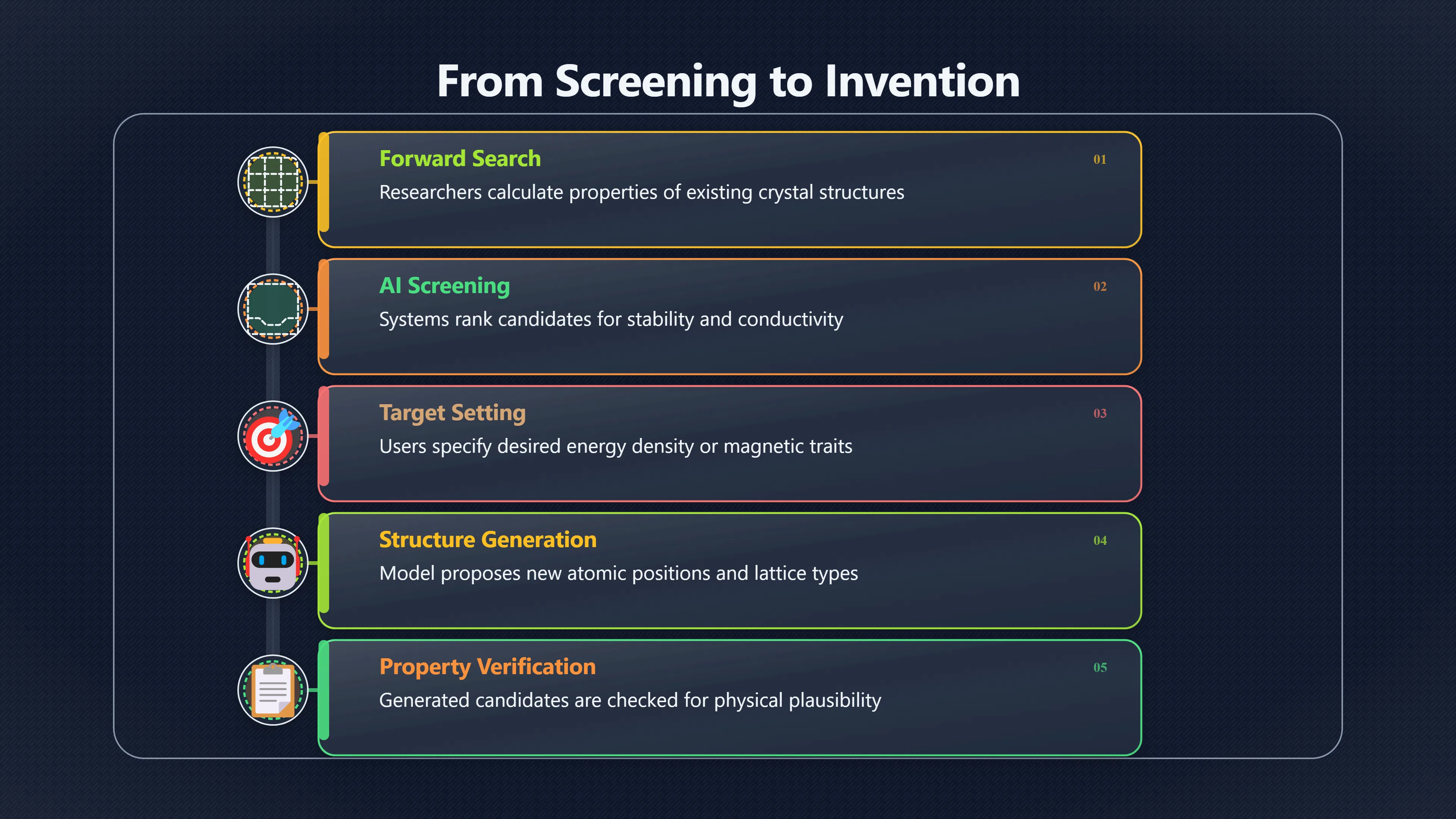
Traditional computational materials science largely works in a forward direction. Researchers propose a crystal structure or chemical composition and then calculate or estimate its properties. The challenge is that the space of possible materials is vast. Even restricting attention to inorganic crystals leaves an effectively enormous search problem.
For years, machine learning mainly helped by speeding up screening. Systems could estimate whether a material might be stable, conductive, magnetic or otherwise useful, allowing researchers to rank candidates more efficiently. Google’s GNoME project is a prominent example. It searched through large regions of chemical space and predicted hundreds of thousands of potentially stable materials that merit further investigation.[Google DeepMind]deepmind.googleGoogle Deep Mind Millions of new materials discovered with deep learningGoogle DeepMindMillions of new materials discovered with deep learningNovember 29, 2023 — 29 Nov 2023 — AI tool GNoME finds 2.2 million n… GitHub Inverse design aims at a different question. Instead of asking:[github.com]github.comGit Hubgoogle-deepmind/materials_discoverygoogle-deepmind/materials_discovery - GNoMEGraph Networks for Materials Science (GNoME) is a project centered around scaling machine lear…
What properties does this structure have?
it asks:
What structure could produce these properties?
That sounds like a subtle change, but it reverses the entire workflow. Researchers specify targets such as:
- high energy density for batteries
- specific magnetic characteristics
- strong but lightweight structures
- catalysts that accelerate chemical reactions
- materials that avoid scarce or geopolitically risky elements
The AI system then attempts to generate candidate structures that satisfy those constraints. In principle, this is closer to how people use image generators: the user specifies desired outcomes, and the model proposes new possibilities. The difference is that the outputs must obey chemistry and physics rather than visual plausibility.[arXiv]arxiv.orgarXiv Matter Gen: a generative model for inorganic materials designMatterGen: a generative model for inorganic materials designDecember 6, 2023… Microsoft For the broader AI bloom argument[microsoft.com]microsoft.commattergen a new paradigm of materials design with generative aiMatterGen: A new paradigm of materials design with…16 Jan 2025 — MatterGen enables a new paradigm of generative AI-assisted m…, this is an important distinction. Scientific abundance may depend less on searching faster through existing knowledge and more on expanding the space of things humanity can realistically discover.
What MatterGen suggests about generative design
MatterGen is a diffusion-based generative model for inorganic materials. Diffusion models became famous through AI image generation, where a system gradually transforms noise into coherent images. MatterGen adapts a related idea to crystalline materials, progressively generating atomic positions, chemical elements and crystal lattice structures.[arXiv]arxiv.orgarXiv Matter Gen: a generative model for inorganic materials designMatterGen: a generative model for inorganic materials designDecember 6, 2023…[Materials Science and Engineering]mse.stanford.eduMaterials Science and EngineeringMatterGen: a generative model for inorganic materials designIn this talk, we present MatterGen, a genera…
The technical achievement is not merely that it creates crystal structures. Researchers have been generating candidate materials computationally for years. The more significant claim is that MatterGen can be steered towards desired characteristics while still producing materials that appear physically plausible and potentially stable. Nature[PubMed According to the Nature paper]pubmed.ncbi.nlm.nih.govgenerative model for inorganic materials designby C Zeni · 2025 · Cited by 651 — After fine-tuning, MatterGen successfully generates stab…, MatterGen generates structures that are substantially more likely to be both novel and stable than previous generative approaches, while also producing candidates much closer to local energy minima, an important indicator that a structure could actually exist. After fine-tuning, the system was able to generate materials with targeted chemical, electronic, magnetic and mechanical properties. Nature PubMed One especially revealing demonstration involved competing objectives. Real-world engineering rarely seeks a single ideal property. A battery[pubmed.ncbi.nlm.nih.gov]pubmed.ncbi.nlm.nih.govgenerative model for inorganic materials designby C Zeni · 2025 · Cited by 651 — After fine-tuning, MatterGen successfully generates stab… material might need to be powerful, affordable, durable and manufacturable simultaneously. MatterGen demonstrated the ability to search for materials combining high magnetic density with lower supply-chain risk, illustrating how generative systems may eventually help navigate trade-offs rather than optimise only one variable at a time.[arXiv]arxiv.orgarXiv Matter Gen: a generative model for inorganic materials designMatterGen: a generative model for inorganic materials designDecember 6, 2023…
This is where the comparison with AlphaFold becomes interesting. AlphaFold predicts structures that already exist in biology. MatterGen attempts to generate structures that may not yet exist at all. It therefore sits further along the spectrum from prediction towards invention. Nature[PubMed]pubmed.ncbi.nlm.nih.govgenerative model for inorganic materials designby C Zeni · 2025 · Cited by 651 — After fine-tuning, MatterGen successfully generates stab…
Why materials matter for an AI-enabled abundance economy
Materials science is easy to overlook because the effects are indirect. Most people never interact directly with a crystal structure database. Yet many large-scale constraints on civilisation are ultimately materials problems.
Energy systems depend on batteries, catalysts, superconductors and photovoltaic materials. Computing depends on semiconductors, thermal management and specialised magnetic materials. Climate technologies depend on membranes, carbon-capture materials and industrial catalysts. Medical technologies depend on implants, sensors and biocompatible compounds.[Anglia Ruskin University]aru.ac.ukhow ai is transforming the search for new materialsAnglia Ruskin UniversityHow AI is transforming the search for new materials6 Mar 2025 — AI tools can help researchers design and identify…
A recurring theme in technological history is that breakthroughs often arrive when new materials unlock capabilities that were previously impossible or prohibitively expensive. Silicon transformed computing. Lithium-ion chemistry transformed portable electronics and electric vehicles. New alloys enabled jet engines and spaceflight.
The optimistic interpretation of systems like MatterGen is that they could compress the time required to find such enabling materials. Instead of decades of incremental experimentation, researchers might explore much larger design spaces computationally before committing scarce laboratory resources to synthesis and testing.[Microsoft]microsoft.comMatterGen: Property-guided materials design7 Dec 2023 — MatterGen can directly generate materials satisfying desired magnetic, e…[Microsoft]microsoft.comAccelerating Materials Design with AIMatterGen is a generative AI model that operates similarly to text-to-image and text-to- video AI mo…
In the strongest version of the AI bloom thesis, intelligence itself becomes a scalable resource inside scientific discovery. Materials design is one of the clearest places where that idea can be tested because the search spaces are enormous and the economic consequences of success can be profound.
The most important bottleneck is still reality
The excitement around inverse design sometimes creates a misleading impression that AI can simply generate a desired material and move directly to industrial deployment. The actual process remains much harder.
A generated crystal structure is fundamentally a hypothesis. Researchers must still determine whether it can be synthesised in practice, whether it remains stable under real conditions, whether manufacturing is economical and whether unexpected behaviours emerge during testing.[ACS Publications]pubs.acs.orgPublications Artificial Intelligence Driving Materials Discovery?AK Cheetham · 2024 · Cited by 169 — The tools of artificial intelligence and machine learning (AI/ML) to propose new co… 2arXiv
This validation problem appears repeatedly across the field.
Several limitations remain significant:
- Thermodynamic stability is not enough. A material may be theoretically stable yet difficult or impossible to manufacture at scale.
- Data quality remains uneven. Models learn from existing databases, which contain biases towards materials already studied by researchers.
- Multi-property optimisation is difficult. Real applications often require balancing dozens of interacting constraints.
- Laboratory throughput remains limited. Physical synthesis and testing still consume time, expertise and equipment.
- Industrial adoption introduces new constraints. Cost, regulation, supply chains and environmental impact matter as much as theoretical performance.[arXiv]arxiv.orgarXiv Matter Gen: a generative model for inorganic materials designMatterGen: a generative model for inorganic materials designDecember 6, 2023…
The Nature paper behind MatterGen included experimental validation efforts, including synthesis work on a generated material, but this should be understood as an early proof of principle rather than evidence that automated materials invention has been solved.[Scribd]scribd.comMatterGen: Inorganic Materials Design Model | PDFValidation through experimental measurements and DFT We have successfully synthesi…
The broader lesson is similar to what happened after AlphaFold. Prediction improves rapidly, but the physical world still demands experiments.
Where inverse design still hits physical limits
One reason materials science remains difficult is that matter is not language.
Large language models operate in environments where outputs can be evaluated instantly. Materials design operates in a world governed by quantum mechanics, thermodynamics, defects, manufacturing constraints and long causal chains. A crystal that looks promising computationally may fail because of factors that only emerge during synthesis or operation.[arXiv]arxiv.orgarXiv Matter Gen: a generative model for inorganic materials designMatterGen: a generative model for inorganic materials designDecember 6, 2023…
There is also a deeper scientific question. Generative systems may become extremely good at proposing candidates without necessarily providing human-understandable explanations for why those candidates work. This could create a future where discovery accelerates faster than theoretical understanding.
That trade-off is not necessarily bad. Many technologies historically arrived before complete scientific explanations. But it raises questions about trust, verification and the degree to which science becomes dependent on increasingly opaque computational systems.
Another limit is that materials innovation alone does not guarantee broad human flourishing. Better batteries or catalysts could help reduce energy costs, improve climate technologies and expand industrial capacity. Yet the benefits depend on manufacturing, governance, access and distribution. A discovery confined to a proprietary platform does not automatically become civilisational abundance.
A glimpse of a larger discovery stack
MatterGen is best understood not as a standalone miracle but as one component of a potential scientific discovery stack.
A future research workflow might combine:
- generative systems that propose candidate materials[microsoft.com]microsoft.commattergen a new paradigm of materials design with generative aiMatterGen: A new paradigm of materials design with…16 Jan 2025 — MatterGen enables a new paradigm of generative AI-assisted m…
- predictive models that estimate performance
- automated laboratories that synthesise compounds
- robotic testing platforms
- AI systems that analyse results and propose new experiments
Each layer reduces a different bottleneck. Together they could compress the cycle between idea and validation.[Microsoft]microsoft.comMatterGen: A Generative Model for Materials DesignTian Xie introduces MatterGen, a generative model that creates new inorganic materials…[Microsoft]microsoft.comMicrosoft ResearchMatterGen is a diffusion model specifically designed for generating stable inorganic materials across the periodic tabl…
This is why inverse design attracts attention within discussions of long-term AI-driven scientific acceleration. The significance is not that MatterGen has already transformed industry. It is that it offers an early example of AI moving beyond recognising patterns in existing knowledge towards proposing genuinely new physical possibilities.
Whether that eventually produces better batteries, cheaper clean energy, advanced medical materials or technologies not yet imagined remains uncertain. But the underlying shift is clear. Instead of merely helping scientists search through the catalogue of known matter, generative systems are beginning to ask what other forms of matter might be possible. Nature[PubMed]pubmed.ncbi.nlm.nih.govgenerative model for inorganic materials designby C Zeni · 2025 · Cited by 651 — After fine-tuning, MatterGen successfully generates stab…

Amazon book picks
Further Reading
Books and field guides related to Can AI design materials backwards?. Use these as the next step if you want deeper reading beyond the article.
Human Compatible
Explores how powerful AI could advance humanity if aligned with human values.
The Age of A. I.
Examines how AI may reshape science, society, governance and human flourishing.
The Coming Wave
Directly addresses whether advanced AI can deliver broad civilisational benefits while remaining governable.
eBay marketplace picks
Marketplace Samples
Example marketplace items related to this page. Use the search link to explore similar finds on eBay.


Endnotes
1.
Source: nature.com
Link:https://www.nature.com/articles/s41586-025-08628-5
Source snippet
A generative model for inorganic materials designby C Zeni · 2025 · Cited by 669 — The broad conditioning abilities of MatterGen en...
2.
Source: microsoft.com
Title: mattergen a new paradigm of materials design with generative ai
Link:https://www.microsoft.com/en-us/research/blog/mattergen-a-new-paradigm-of-materials-design-with-generative-ai/
Source snippet
MatterGen: A new paradigm of materials design with...16 Jan 2025 — MatterGen enables a new paradigm of generative AI-assisted m...
3.
Source: deepmind.google
Title: Google Deep Mind Millions of new materials discovered with deep learning
Link:https://deepmind.google/blog/millions-of-new-materials-discovered-with-deep-learning/
Source snippet
Google DeepMindMillions of new materials discovered with deep learningNovember 29, 2023 — 29 Nov 2023 — AI tool GNoME finds 2.2 million n...
Published: November 29, 2023
4.
Source: github.com
Title: Git Hubgoogle-deepmind/materials_discovery
Link:https://github.com/google-deepmind/materials_discovery
Source snippet
google-deepmind/materials_discovery - GNoMEGraph Networks for Materials Science (GNoME) is a project centered around scaling machine lear...
5.
Source: time.com
Link:https://time.com/6340681/deepmind-gnome-ai-materials/
Source snippet
Their AI tool, GNoME, was trained with data from the Materials Project and has accurately predicted 381,000 stable materials, significant...
6.
Source: arxiv.org
Title: arXiv Matter Gen: a generative model for inorganic materials design
Link:https://arxiv.org/abs/2312.03687
Source snippet
MatterGen: a generative model for inorganic materials designDecember 6, 2023...
Published: December 6, 2023
7.
Source: microsoft.com
Link:https://www.microsoft.com/en-us/research/blog/mattergen-property-guided-materials-design/
Source snippet
MatterGen: Property-guided materials design7 Dec 2023 — MatterGen can directly generate materials satisfying desired magnetic, e...
8.
Source: microsoft.com
Link:https://www.microsoft.com/en-us/research/wp-content/uploads/2025/01/WEF-2025_Leave-Behind_Accelerating-Materials-Design-with-AI.pdf
Source snippet
Accelerating Materials Design with AIMatterGen is a generative AI model that operates similarly to text-to-image and text-to- video AI mo...
9.
Source: nature.com
Link:https://www.nature.com/articles/s41586-025-08628-5_reference.pdf
Source snippet
A generative model for inorganic materials designby C Zeni · 2025 · Cited by 609 — After fine-tuning, MatterGen suc- cessfully generates...
10.
Source: pubs.acs.org
Title: Publications Artificial Intelligence Driving Materials Discovery?
Link:https://pubs.acs.org/doi/10.1021/acs.chemmater.4c00643
Source snippet
AK Cheetham · 2024 · Cited by 169 — The tools of artificial intelligence and machine learning (AI/ML) to propose new co...
11.
Source: pubs.acs.org
Link:https://pubs.acs.org/doi/10.1021/acssuschemeng.6c01084
Source snippet
ACS PublicationsArtificial Intelligence-Driven Materials Design for Next...Mar 5, 2026 — Although generative AI models like MatterGen sh...
12.
Source: arxiv.org
Title: arXiv AI-driven inverse design of materials: Past, present and future
Link:https://arxiv.org/abs/2411.09429
13.
Source: arxiv.org
Title: arXiv Generative deep learning for the inverse design of materials
Link:https://arxiv.org/abs/2409.19124
14.
Source: scribd.com
Link:https://www.scribd.com/document/865267299/A-generative-model-for-inorganic-materials-design-Peer-Review-Report
Source snippet
MatterGen: Inorganic Materials Design Model | PDFValidation through experimental measurements and DFT We have successfully synthesi...
15.
Source: microsoft.com
Link:https://www.microsoft.com/en-us/research/video/mattergen-a-generative-model-for-materials-design/
Source snippet
MatterGen: A Generative Model for Materials DesignTian Xie introduces MatterGen, a generative model that creates new inorganic materials...
16.
Source: microsoft.com
Link:https://www.microsoft.com/en-us/research/project/materials/
Source snippet
Microsoft ResearchMatterGen is a diffusion model specifically designed for generating stable inorganic materials across the periodic tabl...
17.
Source: arxiv.org
Link:https://arxiv.org/html/2411.09429v1
Source snippet
AI-driven inverse design of materials: Past, present and future14 Nov 2024 — This survey provides the latest overview of AI-driven invers...
18.
Source: github.com
Link:https://github.com/microsoft/mattergen
19.
Source: scribd.com
Link:https://www.scribd.com/document/913315357/A-generative-model-for-inorganic-materials-design-2025
Source snippet
MatterGen: Advancing Inorganic Materials Design | PDFThe article introduces MatterGen, a generative model designed for the creation of st...
20.
Source: scribd.com
Link:https://www.scribd.com/document/812372012/MatterGen-6
Source snippet
latent diffusion model to overcome these limitations.Read more...
21.
Source: pubmed.ncbi.nlm.nih.gov
Link:https://pubmed.ncbi.nlm.nih.gov/39821164/
Source snippet
generative model for inorganic materials designby C Zeni · 2025 · Cited by 651 — After fine-tuning, MatterGen successfully generates stab...
22.
Source: mse.stanford.edu
Link:https://mse.stanford.edu/events/rising-stars-colloquium/mattergen-generative-model-inorganic-materials-design
Source snippet
Materials Science and EngineeringMatterGen: a generative model for inorganic materials designIn this talk, we present MatterGen, a genera...
23.
Source: huggingface.co
Link:https://huggingface.co/microsoft/mattergen
Source snippet
microsoft/mattergen · Hugging FaceMatterGen is a generative model for inorganic materials design. It is a diffusion model which jointly p...
24.
Source: aru.ac.uk
Title: how ai is transforming the search for new materials
Link:https://www.aru.ac.uk/news/how-ai-is-transforming-the-search-for-new-materials
Source snippet
Anglia Ruskin UniversityHow AI is transforming the search for new materials6 Mar 2025 — AI tools can help researchers design and identify...
25.
Source: hyper.ai
Title: Directly Design Target Property Materials!
Link:https://hyper.ai/en/news/37442
Source snippet
Microsoft MatterGen...Microsoft's MatterGen model was officially published in Nature, confirming the huge potential of generative AI in...
26.
Source: huggingface.co
Link:https://huggingface.co/microsoft/mattergen/blob/936638f93cd5ff6bba6593aeadddcb07b4e0558d/README.md
Source snippet
· microsoft/mattergen at...27 Jan 2025 — Generate inorganic materials candidates with target property, e.g., bulk modulus, chemical syst...
27.
Source: researchmatters.in
Title: microsofts mattergen could be ai revolution materials discovery
Link:https://researchmatters.in/news/microsofts-mattergen-could-be-ai-revolution-materials-discovery
Source snippet
Microsoft's MatterGen could be the AI Revolution in Materials...20 Jan 2025 — MatterGen is a generative model created by researchers to...
28.
Source: reddit.com
Link:https://www.reddit.com/r/singularity/comments/1i2ompg/microsoft_researchers_introduce_mattergen_a_model/
Source snippet
Microsoft researchers introduce MatterGen, a model that...Microsoft researchers introduce MatterGen, a model that can discover new mater...
Additional References
29.
Source: medium.com
Link:https://medium.com/data-science-at-microsoft/five-ways-ai-is-transforming-discovery-and-design-in-materials-science-3cc34d9b7381
Source snippet
Five ways AI is transforming discovery and design in...By achieving materials twice as stable and novel as prior models, MatterGen exemp...
30.
Source: medium.com
Link:https://medium.com/%40musicalchemist/how-ai-is-revolutionizing-material-discovery-meet-mattergen-ceb7d3156128
Source snippet
How AI is Revolutionizing Material DiscoveryMatterGen is a diffusion-based generative model tailored to handle the complexity of crystall...
31.
Source: linkedin.com
Link:https://www.linkedin.com/posts/txie-93_excited-to-finally-announce-the-publication-activity-7285599087683354625-43EJ
Source snippet
Tian Xie's PostExcited to finally announce the publication of MatterGen on Nature. MatterGen represents a new paradigm of materials desig...
32.
Source: linkedin.com
Link:https://www.linkedin.com/posts/satyanadella_today-in-nature-magazine-our-mattergen-model-activity-7285726218019057664-AYIl
Source snippet
Today in Nature Magazine: Our MatterGen model...MatterGen uses generative AI to create novel compounds with tailor-made properties - ima...
33.
Source: modelscope.cn
Link:https://modelscope.cn/models/microsoft/mattergen
Source snippet
mattergenMatterGen is a generative model for inorganic materials design. It is a diffusion model which jointly predicts a material's atom...
34.
Source: linkedin.com
Link:https://www.linkedin.com/posts/csrc-tech_ai-materialsscience-machinelearning-activity-7308155334613684226-2xPC
Source snippet
AI in Materials Science: GNoME and MatterGen ComparedMatterGen vs. GNoME: AI Is Changing Materials Science—But in Very Different Ways At...
35.
Source: youtube.com
Link:https://www.youtube.com/watch?v=yWXPV3bsC2c
Source snippet
MatterGen: A Generative Model for Materials Design...Tian Xie introduces MatterGen, a generative model that creates new inorganic materi...
36.
Source: dspace.ewha.ac.kr
Link:https://dspace.ewha.ac.kr/bitstream/2015.oak/269226/1/1-s2.0-S259023852400242X-main.pdf
Source snippet
and discovery ranging from the sampling of latent space in a VAE to text sequence...Read more...
37.
Source: researchgate.net
Title: 388093762 A generative model for inorganic materials design
Link:https://www.researchgate.net/publication/388093762_A_generative_model_for_inorganic_materials_design
Source snippet
(PDF) A generative model for inorganic materials design16 Jan 2025 — Here we present MatterGen, a model that generates stable, diverse in...
38.
Source: dwih-tokyo.org
Title: Crivello D1 WS GenAI 241125
Link:https://www.dwih-tokyo.org/files/2024/11/Crivello_D1_WS-GenAI_241125.pdf
Source snippet
Generative Approaches in Material Sciences20 Nov 2024 — Gen-AI in Materials Science. 4. Limitations of AI... A New Era in Material Disco...
Topic Tree