Within AI Tutoring
When Better Answers Hide Weaker Learning
AI can improve today's work while weakening tomorrow's independent performance when it replaces retrieval, reasoning and productive struggle.
On this page
- Why task performance can exceed real understanding
- How cognitive outsourcing creates false confidence
- Ways to test durable learning without AI
Page outline Jump by section
Introduction
AI tutors can make learning feel easier than ever before. They explain difficult ideas in seconds, generate worked examples, answer questions patiently and adapt to individual learners. That is a genuine educational opportunity and one reason AI could eventually make high-quality instruction far more widely available. But there is an important distinction between performing well with AI and genuinely learning from it.

The central risk is an illusion of learning: students appear fluent while the AI is present but struggle to recall, explain or apply the same knowledge independently later. Cognitive psychologists have long shown that people often mistake familiarity for understanding, and generative AI can amplify this tendency by removing the mental effort that normally strengthens memory. The result is a paradox. AI may improve immediate task performance while weakening the very learning processes needed for lasting cognitive empowerment if it replaces rather than supports human thinking. This distinction matters for any vision of AI-enabled human flourishing, because abundant instruction only becomes abundant learning when knowledge remains with the learner after the tool is gone.[Sage Journals]journals.sagepub.comSage JournalsEffects of Generative Artificial Intelligence on K-12 and Higher Education Students’ Learning Outcomes: A Meta-Analysis - Xi…
Why task performance can exceed real understanding
One of the easiest mistakes in education is assuming that completing a task proves that learning has occurred. In reality, these are different outcomes.
A student can solve a mathematics problem because an AI suggested the next step. They can write a convincing essay because the chatbot proposed a structure and examples. They can answer revision questions because the AI continually supplies hints. During these activities, performance looks strong. Yet if the same student sits an exam without assistance, much of that apparent competence may disappear.
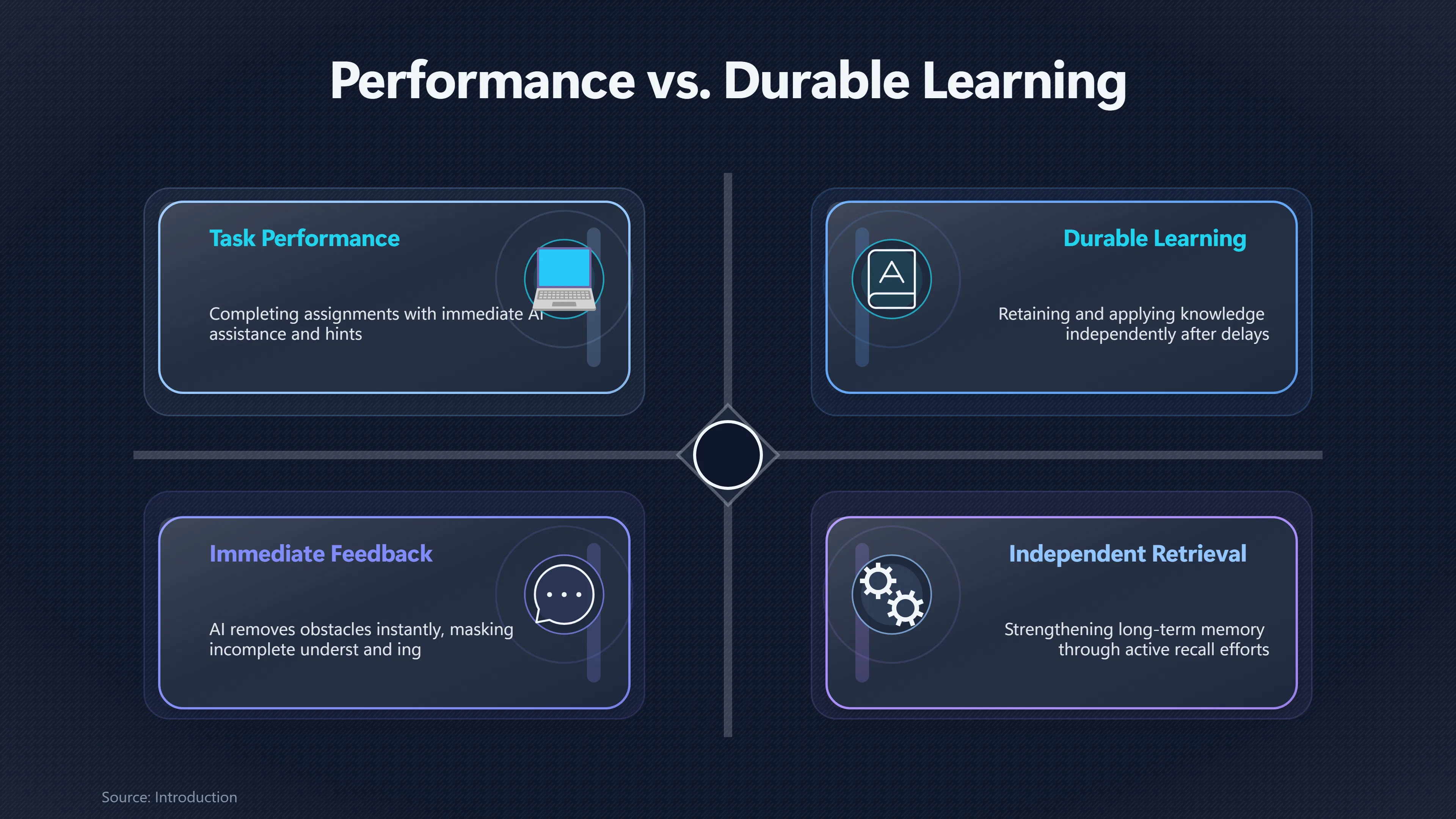
Educational psychology distinguishes between performance—what someone can do under current conditions—and learning—a relatively durable change in knowledge or skill that transfers to new situations. Durable learning is only demonstrated when people can retrieve and use knowledge independently after delays or in unfamiliar contexts. This distinction underpins decades of research on memory, retrieval practice and transfer, and remains just as relevant in the age of AI.[PubMed]pubmed.ncbi.nlm.nih.govWhy Desirable Difficulties 'Work': A Review of the Evidence From Cognitive and Educational Psychology and Some Caveats for the Heal…
The danger is not that AI always reduces learning. Rather, AI can mask whether learning has happened at all. When every obstacle is immediately removed, learners receive fewer opportunities to discover what they actually know and where their understanding remains incomplete.
How cognitive outsourcing creates false confidence
Generative AI makes cognitive outsourcing remarkably easy. Instead of recalling information, planning an argument or debugging a problem, users can delegate much of the thinking to the system.
This is not inherently harmful. Humans have always relied on calculators, maps and search engines. The question is whether the outsourced activity is one the learner still needs to master personally.
Several mechanisms contribute to false mastery:
- Reduced retrieval. Long-term memory strengthens when people actively recall information rather than merely reread or recognise it. If AI continually supplies answers before retrieval begins, that strengthening process is weakened.[PubMed]pubmed.ncbi.nlm.nih.govWhy Desirable Difficulties 'Work': A Review of the Evidence From Cognitive and Educational Psychology and Some Caveats for the Heal…
- Recognition mistaken for recall. Reading an AI explanation often creates a feeling of familiarity. Familiarity is not the same as being able to reconstruct the idea from memory.
- Short-circuiting productive struggle. Working through confusion is uncomfortable but often essential for building flexible understanding. Instant solutions remove some of that beneficial difficulty.
- External rather than internal knowledge. Students may learn where to ask rather than what they know. The chatbot becomes the memory store instead of the learner.
- Inflated confidence. Easy task completion encourages people to overestimate what they could achieve independently. Emerging research suggests AI assistance can increase confidence even when objective accuracy or later retention does not improve proportionately.[Academy of Management Journals]journals.aom.orgAcademy of Management Journals Generative AIAcademy of Management JournalsGenerative AI - Enhancing Student Confidence but Undermining Accuracy in Decision-Making | Academy of Manag…
These mechanisms explain why learners sometimes feel they have mastered a topic immediately after an AI-assisted session but discover substantial gaps when the assistance disappears.
Why desirable difficulty still matters
Good learning is often less comfortable than good performance.
Cognitive psychologists use the term desirable difficulties for learning activities that feel harder in the short term but improve long-term retention. These include retrieving information from memory, spacing practice across time, interleaving different problem types and explaining ideas in one’s own words.
Generative AI naturally pushes in the opposite direction. Its purpose is to reduce friction by providing rapid answers, correcting mistakes immediately and simplifying difficult tasks. Those are valuable capabilities, but they can unintentionally eliminate the effort that makes learning durable.
The implication is not that AI should deliberately frustrate students. Instead, effective AI tutoring should preserve productive mental work. Rather than supplying complete solutions immediately, it may be more educational to ask guiding questions, reveal hints gradually or require learners to attempt explanations before receiving feedback. These approaches retain the benefits of personalisation without removing the cognitive work that builds expertise.[PubMed]pubmed.ncbi.nlm.nih.govWhy Desirable Difficulties 'Work': A Review of the Evidence From Cognitive and Educational Psychology and Some Caveats for the Heal…

The evidence is more nuanced than simple optimism or pessimism
Current research does not support either extreme claim—that AI inevitably destroys learning or that it automatically transforms education.
Recent meta-analyses generally find positive average effects of generative AI on learning achievement and motivation. However, those averages conceal important differences in implementation. AI tends to perform best when integrated into structured teaching, when learners remain cognitively active and when teachers deliberately design activities that require reasoning rather than copying.[Sage Journals]journals.sagepub.comSage JournalsEffects of Generative Artificial Intelligence on K-12 and Higher Education Students’ Learning Outcomes: A Meta-Analysis - Xi…
Other studies and reviews identify consistent risks of over-reliance, superficial engagement and declining independent problem-solving when AI becomes a substitute rather than a scaffold. Educational researchers increasingly distinguish productivity gains from learning gains because the two do not always move together. A student who completes assignments twice as fast has not necessarily learned twice as much—or even as much at all.[microsoft.com]microsoft.comLearning outcomes with Gen AI in the classroom: A review of empirical evidenceLearning outcomes with GenAI in the classroom: A review of empirical evidence - Microsoft Research…
This distinction becomes particularly important in education because the objective is not simply to finish today’s task but to expand tomorrow’s independent capabilities.
Ways to test durable learning without AI
The simplest way to detect the illusion of learning is to remove the AI temporarily.
Students, teachers and educational systems can ask whether knowledge survives independent use rather than judging success solely by AI-assisted performance.
Useful checks include:
- Explain the concept from memory without opening the chatbot or notes.
- Solve a similar problem independently rather than repeating the assisted example.
- Delay the test by a day or a week to see what remains.
- Apply the idea in a new context, where memorised wording is less useful than genuine understanding.
- Teach someone else, since explanation often exposes hidden misunderstandings.
- Alternate AI-assisted and AI-free practice, ensuring that support does not become permanent dependence.
These methods measure what learners carry with them rather than what they can accomplish while continuously connected to an assistant.
Why this mechanism matters for AI Bloom
The optimistic vision of AI Bloom depends on humanity becoming more capable, not merely more assisted.
If AI allows billions of people to access personalised tutoring that genuinely strengthens reasoning, memory and creativity, it could greatly expand human intellectual potential. Better education would become one pathway towards broader scientific discovery, innovation and long-term flourishing.
If, however, educational systems optimise primarily for convenience and immediate productivity, AI could produce impressive-looking performance without equivalent growth in independent human capability. Society would possess increasingly capable machines without correspondingly more capable people.
The challenge is therefore not simply to make instruction cheaper. It is to design AI tutors that preserve retrieval, reflection, curiosity and productive struggle while removing unnecessary barriers. The most valuable educational AI may not be the system that gives the fastest answers, but the one that knows when not to answer—because helping learners think for themselves is ultimately more important than helping them finish quickly.
Amazon book picks
Further Reading
Books and field guides related to When Better Answers Hide Weaker Learning. Use these as the next step if you want deeper reading beyond the article.
Make It Stick
To most of us, learning something "the hard way" implies wasted time and effort. Good teaching, we believe, should be creatively tailored...
Thinking, Fast and Slow
Why is there more chance we'll believe something if it's in a bold type face? Why are judges more likely to deny parole before lunch? Why...
Peak
A survey of the psychology of expertise, providing techniques for developing mastery of any skill, drawn from the authors' extensive, pat...
How We Learn
In the tradition of The Power of Habit and Thinking, Fast and Slow comes a practical, playful, and endlessly fascinating guide to what we...
eBay marketplace picks
Marketplace Samples
Live-tested eBay searches with available results related to this page.
Selected frombrain poster oneBay.co.uk.

Endnotes
1.
Source: link.springer.com
Link:https://link.springer.com/article/10.1007/s10639-025-13686-3
Source snippet
Generative AI as a learning assistant in ICT education: student perspectives and educational implications | Education and Informa...
2.
Source: microsoft.com
Title: Learning outcomes with Gen AI in the classroom: A review of empirical evidence
Link:https://www.microsoft.com/en-us/research/publication/learning-outcomes-with-genai-in-the-classroom-a-review-of-empirical-evidence/?lang=fr-ca
Source snippet
Learning outcomes with GenAI in the classroom: A review of empirical evidence - Microsoft Research...
3.
Source: link.springer.com
Link:https://link.springer.com/article/10.1007/s11251-026-09807-1
Source snippet
processes moderate the effectiveness of complex desirable difficulty tasks | Instructional Science | Springer Nature LinkJune 3, 2026 — G...
Published: June 3, 2026
4.
Source: link.springer.com
Link:https://link.springer.com/article/10.1007/s10639-026-13915-3
5.
Source: journals.sagepub.com
Link:https://journals.sagepub.com/doi/full/10.1177/07356331251329185
Source snippet
Sage JournalsEffects of Generative Artificial Intelligence on K-12 and Higher Education Students’ Learning Outcomes: A Meta-Analysis - Xi...
6.
Source: pubmed.ncbi.nlm.nih.gov
Link:https://pubmed.ncbi.nlm.nih.gov/41508718/
Source snippet
Why Desirable Difficulties 'Work': A Review of the Evidence From Cognitive and Educational Psychology and Some Caveats for the Heal...
7.
Source: journals.aom.org
Title: Academy of Management Journals Generative AI
Link:https://journals.aom.org/doi/10.5465/AMPROC.2025.15987abstract
Source snippet
Academy of Management JournalsGenerative AI - Enhancing Student Confidence but Undermining Accuracy in Decision-Making | Academy of Manag...
8.
Source: pubmed.ncbi.nlm.nih.gov
Link:https://pubmed.ncbi.nlm.nih.gov/41769797/
9.
Source: journals.sagepub.com
Link:https://journals.sagepub.com/doi/10.1177/07356331251329185
10.
Source: journals.sagepub.com
Link:https://journals.sagepub.com/doi/10.1177/10711813241275509
11.
Source: journals.sagepub.com
Link:https://journals.sagepub.com/doi/full/10.1177/10711813241275509
12.
Source: journals.sagepub.com
Link:https://journals.sagepub.com/doi/pdf/10.1177/10711813241275509?download=true
13.
Source: journals.sagepub.com
Link:https://journals.sagepub.com/doi/abs/10.1177/10711813241275509
14.
Source: pmc.ncbi.nlm.nih.gov
Link:https://pmc.ncbi.nlm.nih.gov/articles/PMC11125466/
15.
Source: pubmed.ncbi.nlm.nih.gov
Link:https://pubmed.ncbi.nlm.nih.gov/35950522/
16.
Source: doi.org
Link:https://doi.org/10.1111/medu.14916
Additional References
17.
Source: mdpi.com
Link:https://www.mdpi.com/2227-7102/16/8/1179
Source snippet
CONCEPTUAL REVIEW APPROACH This conceptual paper was developed through a targeted narrative synthesis of literature on retrieval practice...
18.
Source: nature.com
Link:https://www.nature.com/articles/s41598-025-08697-6
Source snippet
iven approach | Scientific Reports...
19.
Source: youtube.com
Title: Shattering Illusions of Competence | Michael Corayer | TEDx Youth@SHSID
Link:https://www.youtube.com/watch?v=sJkUJOUbTGY
Source snippet
Dr. Dan Robertson - "Tasks Desirably Difficult vs. Reducing Extraneous Cognitive Load"...
20.
Source: youtube.com
Title: Using Desirable Difficulties to Enhance Learning, Dr. Robert Bjork
Link:https://www.youtube.com/watch?v=XPllm-gtrMM
Source snippet
Shattering Illusions of Competence | Michael Corayer | TEDxYouth@SHSID...
21.
Source: nature.com
Link:https://www.nature.com/articles/s41598-025-97652-6
22.
Source: eric.ed.gov
Link:https://eric.ed.gov/?id=EJ1479032
Source snippet
EJ1479032 - Exploring the Impact of Generative Artificial Intelligence on Students' Learning Outcomes: A Meta-Analysis, Education and Inf...
23.
Source: openpraxis.org
Link:https://openpraxis.org/articles/10.55982/openpraxis.17.2.772
24.
Source: sciencedirect.com
Link:https://www.sciencedirect.com/science/article/pii/S2590291125004796
25.
Source: frontiersin.org
Link:https://www.frontiersin.org/journals/psychology/articles/10.3389/fpsyg.2018.01483/full
26.
Source: sciencedirect.com
Link:https://www.sciencedirect.com/science/article/pii/S1471595326001496