Within Robotics
How AI Robots Are Reducing Risk in Dangerous Industries
Explores how robots are deployed to handle high-risk industrial environments like oil rigs, mines, and construction sites.
On this page
- Inspection and remote operation technologies
- Wearable and collaborative robotics for worker support
- Case studies of industrial deployments
Page outline Jump by section
Introduction
Artificial intelligence is beginning to change one of the oldest realities of industrial civilisation: the expectation that some people must regularly place themselves in dangerous environments so energy systems, mines, construction projects and heavy infrastructure can function. AI-enabled robots are not eliminating risk altogether, but they are increasingly shifting who — or what — enters hazardous spaces first.
 The most important change is not simply automation. It is the combination of advanced sensors, machine vision, autonomous navigation and remote operation. Robots can now inspect chemical plants for gas leaks, survey unstable mine walls, enter confined industrial spaces, climb difficult terrain and monitor equipment continuously. In the most optimistic version of the AI abundance story, this is an early example of a broader transition in which dangerous, dirty and physically punishing labour becomes increasingly optional rather than economically necessary. Yet that outcome depends on reliability, regulation, worker retraining and whether the benefits are shared rather than captured by a small number of firms.
Why Hazardous Industries Became an Early Robotics Test Ground
Many industrial environments are unusually well suited to robotics because the economic incentives and safety incentives point in the same direction.
A refinery shutdown can cost millions. A mining accident can kill workers and halt production. Offshore inspections often require exposing people to heights, toxic chemicals, explosive atmospheres or severe weather. In these settings, even modest improvements in safety and uptime can justify expensive robotic systems.
The industries adopting AI-enabled robotics most aggressively tend to share several characteristics:
- Dangerous environments that humans would rather avoid.
- Repetitive inspection routines that generate large amounts of sensor data.
- Large physical assets whose failure is costly.
- Remote locations where staffing is difficult.
- Existing digital infrastructure that robots can connect to.
This explains why mining, oil and gas, power generation, chemical processing and major construction projects have become some of the earliest real-world laboratories for industrial AI robotics.
Inspection Robots Are Often the First Step
The most widespread industrial deployments today are not humanoid robots replacing entire workforces. They are inspection systems that extend human awareness into places people would prefer not to enter.
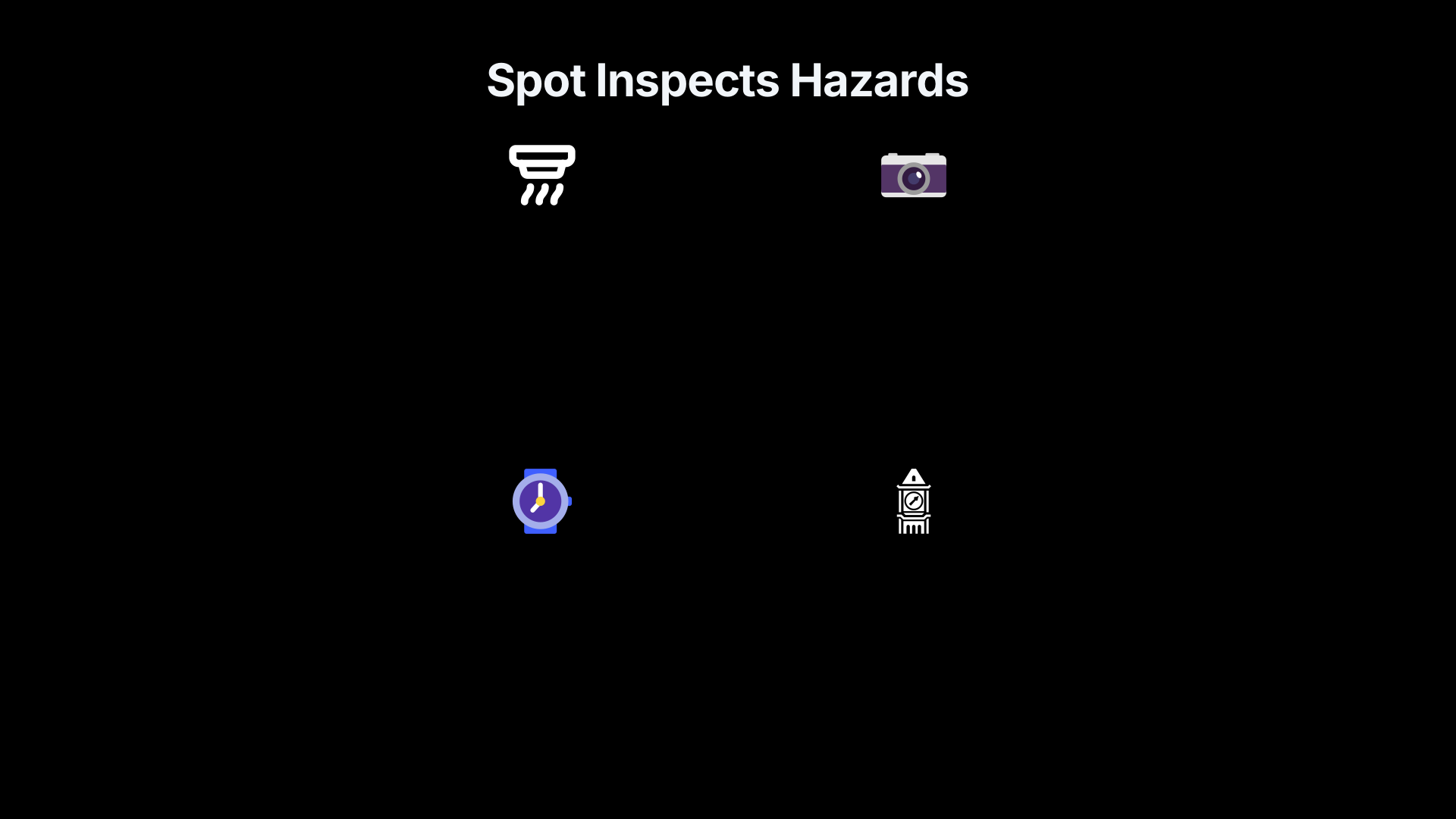
Modern inspection robots combine cameras, thermal imaging, acoustic sensors, gas detectors and AI software capable of recognising anomalies. Rather than merely collecting footage, these systems can flag unusual temperatures, detect leaks, read gauges and compare current conditions against historical baselines. This moves inspection work from periodic human observation toward continuous monitoring.
Boston Dynamics’ quadruped robot Spot has become one of the most visible examples. Energy companies including bp and Chevron have deployed Spot-based systems for inspections in refineries and offshore environments, using robots to identify hazards and collect operational data while reducing human exposure to dangerous conditions.[Boston Dynamics]bostondynamics.comploy Spot offshore…[Boston Dynamics]bostondynamics.comploy Spot offshore…
At Cargill’s Amsterdam facility, Spot performs routine inspections and safety checks as part of a broader effort to develop more autonomous industrial operations. Workers remain involved, but increasingly focus on maintenance planning and higher-level decision-making rather than walking repetitive inspection routes.[Boston Dynamics]bostondynamics.comploy Spot offshore…
The broader pattern is significant. AI does not merely replace a worker’s physical movement through a facility. It increasingly performs the cognitive task of noticing what matters.
Detecting Hazards Humans Might Miss
Industrial inspection has traditionally relied heavily on visual observation and manual reporting. AI systems increasingly add another layer: automated anomaly detection.
In oil and gas facilities, mobile robots equipped with specialised sensors can identify combustible gas leaks during autonomous inspection rounds. These systems are designed to detect small leaks before they become larger safety threats.[Boston Dynamics]bostondynamics.comploy Spot offshore…
The practical benefit is not only that workers spend less time in hazardous zones. Continuous monitoring can catch problems between scheduled inspections, potentially reducing the chance of catastrophic failures.
This is one reason industrial robotics matters within the larger AI bloom narrative. Advanced AI could eventually make large physical systems safer and more reliable than periodic human supervision allows, creating infrastructure that continuously watches itself.
Mining Shows What Large-Scale Automation Looks Like
Mining provides one of the clearest examples of hazardous work being partially transferred from humans to machines.
Heavy vehicle accidents remain one of the leading causes of mining fatalities. Research from the US National Institute for Occupational Safety and Health has found that powered haulage equipment accounts for roughly half of mining fatalities in many years.[CDC Archive]archive.cdc.govCDC ArchiveHaul Truck Research Roadmap Report 2020 | MiningRecently, 50% (14 of 28) of the fatal accidents in 2017 and 48% (13 of 27) in…
Because of this, autonomous haulage systems have become a major focus.
These systems use AI, GPS, sensors and centralised fleet management software to operate massive mining trucks with reduced or eliminated onboard human drivers. Instead of navigating dangerous routes through dust, poor visibility and heavy traffic, workers increasingly supervise fleets remotely.
Rio Tinto reported that its autonomous haul truck operations had recorded zero injuries attributable to the autonomous trucks after deployment, while continuing to expand its fleet.[globalminingreview.com]globalminingreview.comRio Tinto reaches autonomous truck milestone30 Jan 2018 — There have been zero injuries attributed to autonomous haul trucks since deploy…
Komatsu announced in 2026 that its FrontRunner Autonomous Haulage System had surpassed 1,000 commissioned autonomous ultra-class trucks, highlighting both productivity and safety improvements as major drivers of adoption. [コマツ 企業サイト]
Academic and industry studies consistently identify the same mechanism: reducing the number of people physically present around large moving equipment lowers exposure to some of the most dangerous hazards in mining.[Springer]link.springer.comA Juxtaposition of Autonomous Haulage Systems in China…by X Chen · 2025 · Cited by 1 — Enhancing Mine Safety: By reducing huma…[2scholarlyreview.org]scholarlyreview.orgThe impact of autonomous vehicles on mining operationsby D Kaur · Cited by 4 — human intervention, significantly reducing the risk to wor…
From Remote Control to Autonomous Mining
Mining automation is progressing through several stages:
- Remote operation – humans directly control machinery from safer locations.
- Teleoperation with AI assistance – software helps with navigation and hazard detection.
- Full autonomous operation – machines perform predefined tasks with limited human intervention.
- Multi-robot coordination – fleets of machines coordinate extraction, transport and inspection.
Researchers are increasingly exploring multi-robot systems capable of operating in abandoned or structurally unstable underground environments that would be difficult or dangerous for human workers to access.[arXiv]arxiv.orgarXiv Underground Multi-robot Systems at Work: a revolution in miningUnderground Multi-robot Systems at Work: a revolution in miningSeptember 18, 2025…
If these systems mature, they could make previously inaccessible resources reachable while reducing human exposure to cave-ins, toxic atmospheres and confined spaces.
Construction Remains Harder Than Factories
Construction is one of the world’s most dangerous industries, yet it is also one of the hardest to automate.
Unlike factories, construction sites constantly change. Obstacles move, layouts evolve and environmental conditions vary daily. This makes reliable autonomy much more difficult.
As a result, current construction robotics often focuses on inspection and support rather than full automation.
Quadruped robots and drones are increasingly used to:
- Survey difficult terrain.
- Inspect elevated structures.
- Generate digital site maps.
- Compare construction progress against design models.
- Identify safety hazards.[aibusiness.com]aibusiness.comboston dynamics robot dog spot inspects for safety hazardsBoston Dynamics Robot Dog Spot Inspects for Safety…Jun 24, 2025 — The updated system expands Spot's ability to identify potential safe…
AI research is also moving toward automated safety inspections. Recent work has demonstrated systems that combine autonomous navigation, vision-language models and large language models to identify hazards and generate inspection reports based on safety regulations.[arXiv]arxiv.orgarXiv Underground Multi-robot Systems at Work: a revolution in miningUnderground Multi-robot Systems at Work: a revolution in miningSeptember 18, 2025…
The significance extends beyond efficiency. Construction safety inspections are often reactive and labour-intensive. AI-enabled robotic inspection could eventually allow sites to identify risks continuously rather than only during scheduled reviews.
Wearable and Collaborative Robotics Keep Humans in the Loop
Not every dangerous task can be handed entirely to a machine.
Many industrial environments still require human judgement, dexterity and situational awareness. Instead of replacing workers, another branch of industrial robotics focuses on augmenting them.
Exoskeletons and Physical Support
Industrial exoskeletons are wearable systems designed to reduce strain on workers performing lifting, overhead work or repetitive motions.
The goal is not superhuman strength. It is reducing cumulative physical damage.
Construction workers, warehouse staff, maintenance crews and industrial technicians often experience musculoskeletal injuries after years of repetitive labour. Wearable robotic assistance can reduce physical stress while allowing people to remain directly involved in tasks that still require human judgement.
This represents a different vision of automation from full replacement. Instead of removing humans from work, it changes the physical limits under which they operate.
Collaborative Robots
Collaborative robots, or cobots, are designed to work alongside people rather than behind safety barriers.
AI-driven sensing allows these systems to monitor human movement and adapt their behaviour in real time. In industrial settings they can assist with heavy handling, repetitive operations and precision work while humans supervise more complex decisions.
For dangerous industries, the value is often risk reduction rather than labour elimination. The robot handles the hazardous component while the worker remains responsible for coordination, diagnosis or exception handling.
The Technical Challenge: Reliability Matters More Than Intelligence
Industrial robotics faces a different challenge from many consumer AI applications.
A chatbot that makes a mistake may produce a misleading answer. A robot that makes a mistake near heavy equipment, explosive chemicals or unstable structures can create a serious safety incident.
This means industrial adoption depends heavily on reliability rather than headline AI capability.
Key technical requirements include:
- Robust navigation in changing environments.
- Reliable operation despite dust, heat, vibration and weather.
- Accurate detection of hazards.
- Safe interaction with workers.
- Secure communication systems.
- Predictable behaviour during failures.
Projects such as AutoInspect have focused specifically on long-duration autonomous inspections in industrial facilities including chemical plants, mines and nuclear environments, demonstrating the importance of sustained reliability rather than short demonstrations.[arXiv]arxiv.orgarXiv Underground Multi-robot Systems at Work: a revolution in miningUnderground Multi-robot Systems at Work: a revolution in miningSeptember 18, 2025…
This is one reason why industrial robotics often advances more slowly than public AI hype suggests. Physical reality is unforgiving.
What Industrial Robotics Means for Human Flourishing
The deepest significance of industrial robotics is not that robots can climb stairs, inspect valves or drive trucks.
It is that civilisation may gradually gain the ability to separate economic production from routine human exposure to danger.
Historically, many essential goods required workers to endure significant physical risk. Energy extraction, mining, heavy construction and industrial maintenance all depended on large numbers of people operating close to hazards.
If advanced AI and robotics continue improving, future generations may view some forms of dangerous labour much as many societies now view child labour: once common, economically useful, but increasingly unnecessary.
That possibility connects directly to the broader AI bloom vision. Human flourishing is not only about greater wealth. It is also about expanding freedom from preventable suffering, injury and drudgery.
Industrial robotics alone will not create a post-scarcity future. Mines will still need to operate, infrastructure will still require maintenance and physical work will remain necessary. But reducing the number of people required to enter hazardous environments offers a concrete example of how AI could make civilisation both more productive and more humane.
The Unresolved Questions
The optimistic story remains incomplete.
Several important concerns remain unresolved:
- Workers displaced from hazardous roles may not automatically gain access to higher-skilled jobs.
- Autonomous systems can introduce new forms of risk, including software failures and cybersecurity vulnerabilities.
- Companies may prioritise productivity gains over worker welfare.
- The economic benefits of automation may become concentrated among firms that own the technology.
- Heavy automation could reduce practical expertise among frontline workers if too much operational knowledge becomes embedded in software.
These issues matter because the value of AI-enabled robotics cannot be measured solely by accident statistics or output gains.
The larger question is whether automation helps create a society where technological progress expands human capability and wellbeing broadly, or one where physical danger declines but economic power becomes increasingly concentrated.
Industrial robotics already demonstrates that machines can perform some dangerous tasks once considered inseparable from human labour. Whether that becomes a foundation for wider human flourishing depends less on the robots themselves than on the institutions, incentives and social choices that shape how the technology is deployed.
Amazon book picks
Further Reading
Books and field guides related to How AI Robots Are Reducing Risk in Dangerous Industries. Use these as the next step if you want deeper reading beyond the article.
Human Compatible
Explores how powerful AI could advance humanity if aligned with human values.
The Coming Wave
Directly addresses whether advanced AI can deliver broad civilisational benefits while remaining governable.
Power and Progress
Explores how societies can share gains from transformative technologies.
eBay marketplace picks
Marketplace Samples
Example marketplace items related to this page. Use the search link to explore similar finds on eBay.


Endnotes
1.
Source: archive.cdc.gov
Link:https://archive.cdc.gov/www_cdc_gov/niosh/mining/strategicplan/HaulTruckRoadmap2020.html
Source snippet
CDC ArchiveHaul Truck Research Roadmap Report 2020 | MiningRecently, 50% (14 of 28) of the fatal accidents in 2017 and 48% (13 of 27) in...
2.
Source: globalminingreview.com
Link:https://www.globalminingreview.com/mining/30012018/rio-tinto-reaches-autonomous-truck-fleet-milestone/
Source snippet
Rio Tinto reaches autonomous truck milestone30 Jan 2018 — There have been zero injuries attributed to autonomous haul trucks since deploy...
3.
Source: komatsu.jp
Link:https://www.komatsu.jp/en/newsroom/2026/20260422
Source snippet
コマツ 企業サイト- FrontRunner Autonomous Haulage System continues to...22 Apr 2026 — - FrontRunner Autonomous Haulage System continues to creat...
4.
Source: link.springer.com
Link:https://link.springer.com/article/10.1007/s42461-025-01394-y
Source snippet
A Juxtaposition of Autonomous Haulage Systems in China...by X Chen · 2025 · Cited by 1 — Enhancing Mine Safety: By reducing huma...
5.
Source: scholarlyreview.org
Link:https://www.scholarlyreview.org/article/124875-the-impact-of-autonomous-vehicles-on-mining-operations-enhancing-safety-and-productivity-through-technological-advancements.pdf
Source snippet
The impact of autonomous vehicles on mining operationsby D Kaur · Cited by 4 — human intervention, significantly reducing the risk to wor...
6.
Source: arxiv.org
Title: arXiv Underground Multi-robot Systems at Work: a revolution in mining
Link:https://arxiv.org/abs/2509.16267
Source snippet
Underground Multi-robot Systems at Work: a revolution in miningSeptember 18, 2025...
Published: September 18, 2025
7.
Source: arxiv.org
Link:https://arxiv.org/abs/2512.13974
Source snippet
Autonomous Construction-Site Safety Inspection Using Mobile Robots: A Multilayer VLM-LLM PipelineDecember 16, 2025...
Published: December 16, 2025
8.
Source: arxiv.org
Title: arXiv Auto Inspect: Towards Long-Term Autonomous Industrial Inspection
Link:https://arxiv.org/abs/2404.12785
Source snippet
AutoInspect: Towards Long-Term Autonomous Industrial InspectionApril 19, 2024...
Published: April 19, 2024
9.
Source: boston.com
Link:https://www.boston.com/
Source snippet
Local breaking news, sports, weather, and things...What Boston cares about right now: Get breaking updates on news, sports, and weather...
10.
Source: boston.com
Link:https://www.boston.com/news/local-news/2026/05/20/how-hot-are-boston-public-school-classrooms-today/
11.
Source: stacks.cdc.gov
Title: cdc 148735 DS1
Link:https://stacks.cdc.gov/view/cdc/148735/cdc_148735_DS1.pdf
Source snippet
A hybrid or combination...Read more...
12.
Source: automate.org
Title: the role of robotics in improving safety and efficiency in mining operations 70
Link:https://www.automate.org/robotics/news/the-role-of-robotics-in-improving-safety-and-efficiency-in-mining-operations-70
Source snippet
The role of robotics in improving safety and efficiency...24 Mar 2025 — Autonomous robots help humans avoid risky mining activities by p...
13.
Source: bostondynamics.com
Link:https://bostondynamics.com/case-studies/bp/
Source snippet
ploy Spot offshore...
14.
Source: bostondynamics.com
Link:https://bostondynamics.com/case-studies/meet-chevrons-new-energy-watchdog/
Source snippet
Meet Chevron's New Energy WatchdogThe new safety feature allows Chevron to use Spot autonomously in hazardous locations and electrically...
15.
Source: bostondynamics.com
Title: spot at cargill
Link:https://bostondynamics.com/case-studies/spot-at-cargill/
Source snippet
Boston DynamicsSpot at Cargill10 Jun 2025 — Cargill Amsterdam Multiseed enlists Spot to inspect machines, conduct safety checks as part o...
16.
Source: bostondynamics.com
Link:https://bostondynamics.com/blog/autonomous-detection-of-combustible-gas-leaks/
Source snippet
Boston DynamicsAutonomous Detection of Combustible Gas LeaksAutonomously detecting pinhole leaks as part of Spot's routine maintenance ro...
17.
Source: bostondynamics.com
Link:https://bostondynamics.com/case-studies/spot-makes-austrias-largest-power-plant-safer/
Source snippet
It is the first quadruped robot used in Europe for routine power plant...Read more...
18.
Source: bostondynamics.com
Link:https://bostondynamics.com/solutions/inspection/
Source snippet
Industrial Inspection SolutionsSpot is the new standard for industrial inspection. Automate both routine and hazardous inspections, power...
19.
Source: bostondynamics.com
Link:https://bostondynamics.com/video/predictably-spot-on-industrial-inspection/
Source snippet
Predictably Spot-On Industrial InspectionIn this keynote presentation, our product experts share the details of Orbit fleet management so...
20.
Source: bostondynamics.com
Link:https://bostondynamics.com/case-studies/
Source snippet
Case StudiesDiscover robotics case studies on our solutions at work. Our customers share success stories from starting out to scaling rob...
21.
Source: bostondynamics.com
Link:https://bostondynamics.com/case-studies/woodside-energy-integrates-spot-for-enhanced-safety-at-lng-facility/
Source snippet
Woodside Energy Integrates Spot at LNG FacilityThe program uses Boston Dynamics' Spot robot to conduct routine inspections at Pluto LNG...
Additional References
22.
Source: pmc.ncbi.nlm.nih.gov
Link:https://pmc.ncbi.nlm.nih.gov/articles/PMC12783740/
Source snippet
challenges and roadmap for humanoid robots in...by T Uthai · 2025 · Cited by 4 — The construction industry faces pressing challenges, in...
23.
Source: academia.edu
Link:https://www.academia.edu/143679539/The_Role_of_Robotics_and_Automation_in_Enhancing_Safety_and_Efficiency_in_Mining
Source snippet
afety by reducing the exposure of the miner to hazardous conditions and enhance...Read more...
24.
Source: aibusiness.com
Title: boston dynamics robot dog spot inspects for safety hazards
Link:https://aibusiness.com/automation/boston-dynamics-robot-dog-spot-inspects-for-safety-hazards
Source snippet
Boston Dynamics Robot Dog Spot Inspects for Safety...Jun 24, 2025 — The updated system expands Spot's ability to identify potential safe...
25.
Source: beamdata.ai
Title: ai mineral exploration autonomous mining labor automation
Link:https://beamdata.ai/ai-mineral-exploration-autonomous-mining-labor-automation/
Source snippet
Bridging the Labor Gap in Mining with AI-Powered...14 Jul 2025 — Discover how AI-powered autonomous equipment and digital are changing A...
26.
Source: botasys.com
Title: robots doing dangerous jobs
Link:https://botasys.com/post/robots-doing-dangerous-jobs/
Source snippet
10 Real-World Examples31 Mar 2025 — Robots are taking on hazardous jobs like bomb disposal and mining, keeping workers safe while improvi...
27.
Source: buildingpointsoutheast.com
Link:https://www.buildingpointsoutheast.com/blog/robotics-for-safety-and-risk-mitigation
Source snippet
Using Robotics in Hazardous Construction TasksExplore the use of robotics in hazardous construction tasks. Learn how robots improve safet...
28.
Source: discoveryalert.com.au
Title: revolutionizing mining autonomous technologies 2025 safety productivity
Link:https://discoveryalert.com.au/revolutionizing-mining-autonomous-technologies-2025-safety-productivity/
Source snippet
Autonomous Mining: Transforming Trucks and Drilling...14 Oct 2025 — Discover how autonomous trucks and drilling systems in mining are re...
29.
Source: dronesplusrobotics.com
Title: heavy industry robotics ai safety
Link:https://www.dronesplusrobotics.com/post/heavy-industry-robotics-ai-safety
Source snippet
Why Safer Machines...12 May 2026 — Robots improve safety in heavy industry by entering hazardous areas first, inspecting unstable or con...
Published: May 2026
30.
Source: eaconmining.com.au
Title: details126 493
Link:https://www.eaconmining.com.au/content/details126_493.html
Source snippet
The Global Rise of Autonomous Mining12 Mar 2026 — Rio Tinto took a major step towards large-scale automation in 2012 with the introductio...
31.
Source: energy-robotics.com
Link:https://www.energy-robotics.com/industries/inspection-oil-gas
Source snippet
Robotic Inspection in the Oil & Gas IndustryRevolutionize your oil and gas inspections with autonomous robots and drones at on-and offsho...
Topic Tree