Within AI Bloom
Could AI Compress Decades of Scientific Progress?
Massively parallel AI researchers could shorten the cycle from hypothesis to experiment, provided their work remains testable and reproducible.
On this page
- The research loop AI could accelerate
- Automated laboratories and parallel experimentation
- Hallucinations, weak data and reproducibility
Page outline Jump by section
Introduction
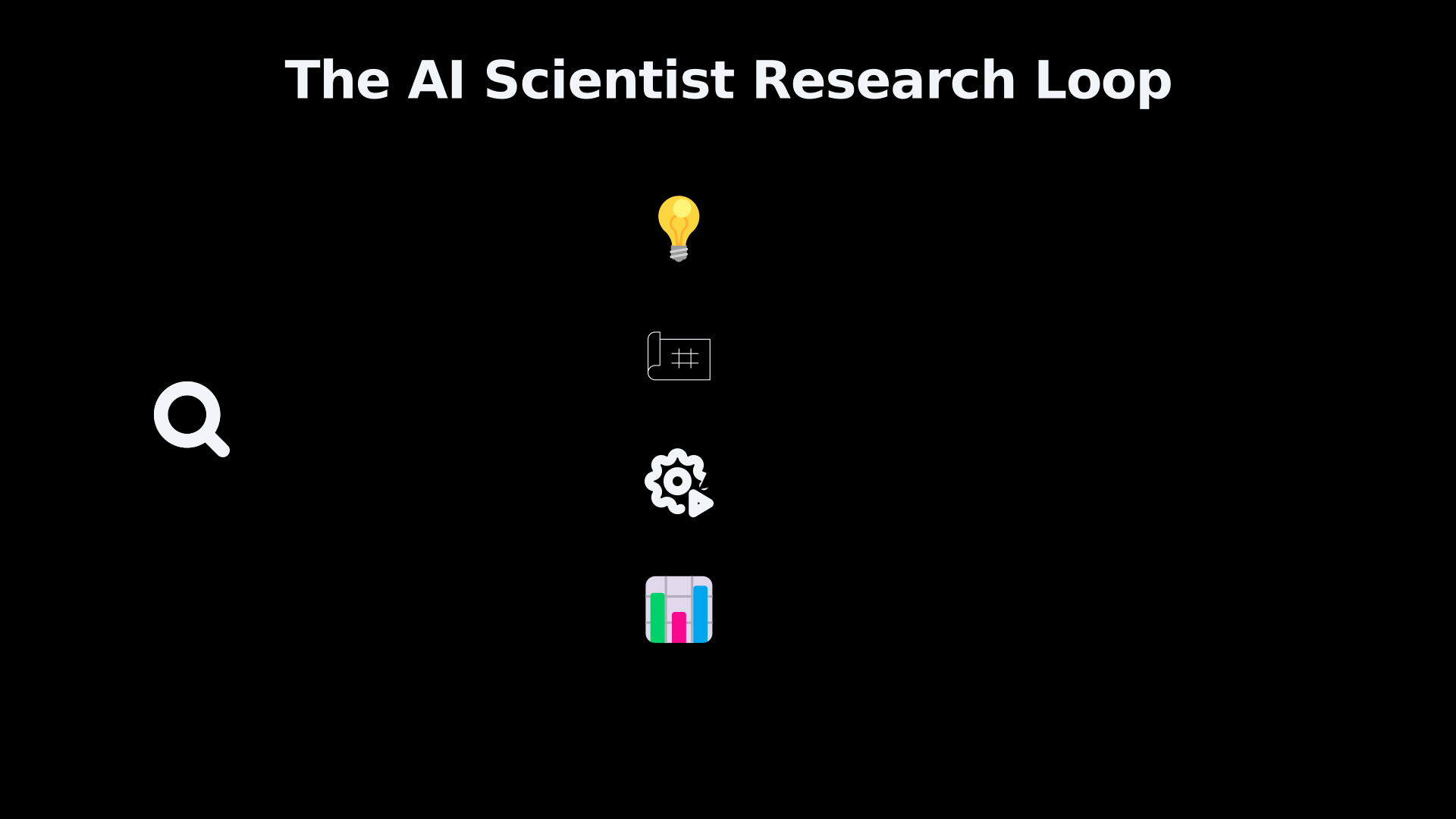
Advanced AI could compress years or even decades of scientific work by increasing the number of hypotheses researchers can examine, shortening the cycle from idea to experiment, and allowing many lines of inquiry to run in parallel. The strongest version of this possibility is not simply an AI assistant that writes summaries. It is an AI scientist: a system that can search the literature, propose testable explanations, design experiments, analyse results, notice failures and decide what to try next.
Early systems already perform parts of this loop. AI agents can generate research proposals, write and run code, operate laboratory equipment and refine experiments using incoming data. Autonomous laboratories have synthesised new materials and improved enzymes with limited human intervention. Yet the gap between producing plausible-looking research and producing reliable knowledge remains large. Hallucinated references, weak novelty judgements, coding errors, poor data and inadequate validation can make automated science faster without making it better. The real prize is therefore not rapid paper production, but rapid, reproducible discovery.[research.google]research.googleGoogle Research Accelerating scientific breakthroughs with an AI co-scientistGoogle ResearchAccelerating scientific breakthroughs with an AI co-scientistFebruary 19, 2025 — Accelerating scientific breakthroughs wit…
The research loop AI could accelerate
Scientific progress is often pictured as a flash of insight followed by a decisive experiment. In practice, much of research consists of slower, repetitive loops: reading hundreds of papers, reconciling inconsistent terminology, cleaning data, selecting experimental conditions, writing analysis code, troubleshooting equipment and deciding which result deserves another attempt. AI could accelerate discovery by reducing the delay at each stage rather than by replacing a single moment of human genius.
A capable AI research system might:
- search papers, databases and experimental records;
- identify unresolved questions or contradictory findings;
- generate several possible hypotheses;
- turn them into protocols or computational tests;
- run simulations, code or physical experiments;
- compare predictions with observed results;
- reject, revise or combine hypotheses;
- record the evidence and launch the next round.
This closed loop matters more than isolated benchmark performance. A model that proposes clever ideas but cannot test them contributes suggestions, not discoveries. A robot that performs experiments but cannot interpret unexpected results is advanced automation, not a scientist. The potentially transformative system combines reasoning, tools, data and experimentation so that each result changes what happens next. Reviews of emerging “AI scientist” systems therefore distinguish between automating individual research tasks and integrating the whole cycle into an adaptive process.[arXiv]arxiv.orgA Survey of AI Scientists: Surveying the automatic Scientists and Researchtransition from automation—where AI assists pre-defined st…
Google’s AI co-scientist illustrates the reasoning side of this approach. The system uses specialised agents to generate, criticise, rank and refine hypotheses, rather than relying on one model response. Researchers can supply a scientific goal, seed ideas or feedback, while the system consults external tools and repeatedly improves its proposals. Early biomedical tests included hypotheses related to liver fibrosis and antimicrobial resistance, although Google itself presented these findings as preliminary and called for broader validation.[Google Research]research.googleGoogle Research Accelerating scientific breakthroughs with an AI co-scientistGoogle ResearchAccelerating scientific breakthroughs with an AI co-scientistFebruary 19, 2025 — Accelerating scientific breakthroughs wit…
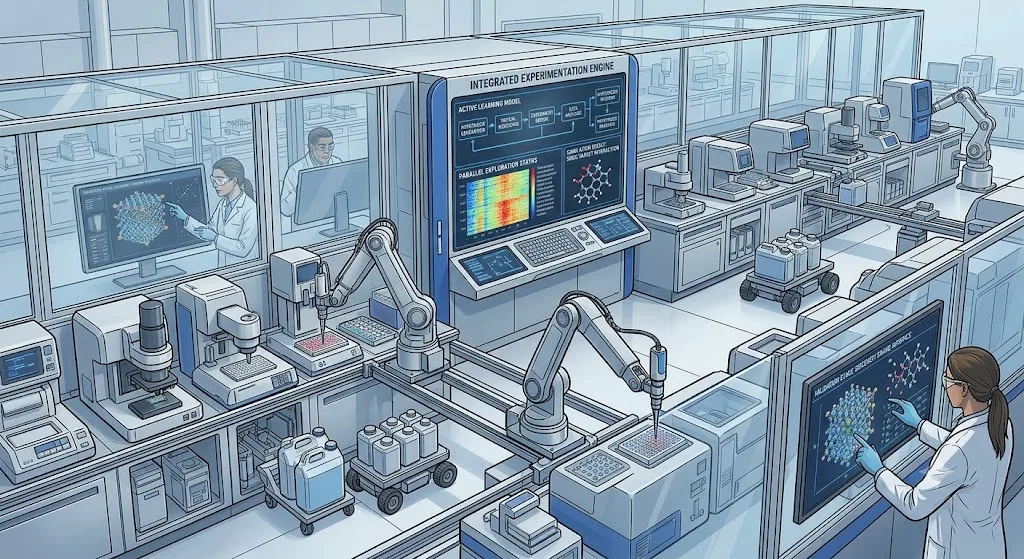
The important mechanism is parallelism. Human laboratories normally pursue a limited number of ideas because expert attention is scarce. Software agents can explore thousands of candidate explanations, parameter combinations or molecular structures simultaneously. Most candidates may be useless, but AI can rank them before expensive experiments begin. This changes discovery from a narrow sequence of human-selected bets into a broader search followed by increasingly selective testing.
Parallel exploration could be especially valuable where the possible search space is enormous. The number of potential molecules, materials, protein variants and experimental combinations far exceeds what scientists could test individually. Machine-learning systems can use existing evidence to select informative candidates, update their predictions after each experiment and avoid spending equal resources on every possibility. This method, often called active learning, asks which next experiment is likely to reduce uncertainty or improve a desired result most efficiently.[nature.com]nature.comHere we present the A-Lab, an autonomous laboratory that integrates robotics with the use of ab initio databases, ML-driven data interpre…
The most credible near-term vision is therefore not a lone machine making incomprehensible breakthroughs. It is a research organisation in which human scientists set goals, challenge assumptions and judge significance, while AI systems conduct literature searches, simulations, optimisation and routine experimental cycles at much greater scale. Over time, the boundary could shift as systems become better at generating explanations and designing decisive tests. But even advanced systems would operate within goals, instruments and standards created by scientific communities.
Automated laboratories and parallel experimentation
The physical laboratory is where ambitious claims about AI discovery meet material reality. Molecules do not care whether a model’s argument sounds persuasive. Reagents may be impure, equipment can drift out of calibration, samples become contaminated and apparently promising reactions fail when conditions change. Connecting AI to robotics is therefore difficult, but it also offers the most direct route from generated ideas to testable evidence.
A self-driving laboratory combines automated equipment with software that chooses experiments, interprets the measurements and selects the next trial. Unlike a conventional high-throughput facility, which may run a large fixed batch of experiments, a self-driving laboratory can change course while the campaign is under way. Failed results become information for the next decision rather than merely entries in a final spreadsheet.[nature.com]nature.comOpen source on nature.com.
Berkeley’s A-Lab provides one of the clearest demonstrations. The system combined robotic synthesis, calculations of material stability, recipes extracted from scientific papers, automated interpretation and active learning. In its reported campaign, it attempted to produce predicted inorganic materials and adjusted unsuccessful recipes using what it learnt from previous trials. The work achieved a reported target-yield success rate of 63 per cent, demonstrating that an autonomous system could move beyond virtual screening and actually make novel compounds.[nature.com]nature.comHere we present the A-Lab, an autonomous laboratory that integrates robotics with the use of ab initio databases, ML-driven data interpre…
A similar loop has been used in protein engineering. Researchers built an automated platform that designed protein variants, produced and tested them, and then used the measurements to choose the next generation. Nature described the system as successfully re-engineering enzymes with little human input beyond occasional hardware intervention. Such platforms can run repeated design-build-test-learn cycles without waiting for a researcher to inspect every intermediate result.[nature.com]nature.comA ‘self-driving’ laboratory comprising robotic equipment directed by a simple artificial intelligence (AI) model successfully reengineere…
Autonomy can also make better use of scarce facilities. Instruments such as advanced microscopes, particle accelerators and synchrotron beamlines generate more data than researchers can always analyse during their limited access time. AI systems can interpret results as they arrive and redirect the experiment immediately, rather than discovering weeks later that crucial measurements were missing. Argonne National Laboratory is developing systems that connect robotics, real-time analysis, high-performance computing and experimental equipment for this purpose.[anl.gov]rpl.cels.anl.govOpen source on anl.gov.
The long-run opportunity is a network of laboratories working in parallel. One AI system could coordinate simulations, chemical synthesis, microscopy and biological testing across different facilities. Results from one site could determine what another site tests next. Laboratories might operate continuously, sharing machine-readable protocols and data rather than waiting for papers to be written and read.
That possibility would make scientific capacity more abundant, but only if access is broad. Automated laboratories require expensive instruments, reliable robotics, computing infrastructure and highly structured data. Without public facilities, open standards and shared platforms, the most capable research loops could be concentrated within a small number of technology companies, pharmaceutical groups and wealthy states. Proposals for shared self-driving laboratories and open-source laboratory software are therefore not peripheral to scientific acceleration; they help determine who can pose questions and who owns the resulting knowledge.[frontiersin.org]frontiersin.orgOpen source on frontiersin.org.
Why faster research does not automatically mean faster progress
The quantity of scientific output is a poor measure of discovery. A system can generate hundreds of hypotheses, experiments or papers while adding little reliable knowledge. Scientific progress occurs when results survive serious attempts at verification, connect to prior evidence and prove useful beyond the original setting.
This distinction is visible in evaluations of autonomous research agents. Sakana AI’s original AI Scientist could generate ideas, write code, conduct computational experiments and produce complete machine-learning papers at very low cost. That was a significant demonstration of workflow automation. But an independent evaluation found that the system often misjudged whether ideas were novel, struggled to execute experiments and sometimes reported flawed or hallucinated results. Forty-two per cent of the evaluated experimental runs failed because of coding errors, while the generated papers were frequently weakly sourced or structurally incomplete.[arXiv]arxiv.orgarXiv The AI Scientist: Towards Fully Automated Open-Ended Scientific DiscoveryarXiv The AI Scientist: Towards Fully Automated Open-Ended Scientific Discovery
More recent benchmarks reach a similar general conclusion. AstaBench, which evaluates agents across thousands of scientific-research tasks, found meaningful progress on individual capabilities but judged current systems far from solving scientific research assistance as a whole. Another benchmark designed around reproducing machine-learning research reported that no tested autonomous system reliably produced publication-ready work under human evaluation; reviewers found fabricated or unsupported claims in many outputs that automated evaluation had accepted.[arXiv]arxiv.orgOpen source on arxiv.org.
This does not mean automated science is a dead end. It means that scaling idea generation is easier than scaling trustworthy evaluation. If AI systems create hypotheses much faster than laboratories can test them, science may develop a new bottleneck: an immense queue of plausible but unverified claims. The useful output of an AI scientist should therefore be measured not by papers per day, but by results independently reproduced, uncertainty reduced, useful mechanisms discovered and real-world performance improved.
Hallucinations, weak data and reproducibility
Plausible language is not evidence
Large language models are trained to produce likely continuations of text, not to guarantee that every claim is true. In scientific work, this can lead to invented references, inaccurate summaries and explanations that fit familiar patterns without matching the underlying evidence. The danger is greater than in ordinary conversation because a polished research report can cause later scientists to waste time, repeat errors or treat a fictional result as established knowledge.
Recent audits show that fabricated or corrupted references can survive ordinary academic checking. A 2026 study of peer-reviewed machine-learning conference papers found hallucinated references across every research category it examined, including papers in areas whose authors were likely to be familiar with large language models. The authors argued that citation verification is technically inexpensive, suggesting that some serious failures could be reduced through routine automated checks rather than relying solely on reviewers’ attention.[arXiv]arxiv.orgOpen source on arxiv.org.
An AI scientist should therefore never be trusted merely because it supplies a citation or produces a detailed protocol. References need to resolve to real sources; data provenance must be preserved; calculations should be rerunnable; and claims should be linked to the exact experiments that support them. Systems that retrieve verified papers and databases are safer than models asked to reconstruct scientific knowledge from memory, but retrieval alone cannot determine whether a source is relevant, reliable or correctly interpreted.
Weak data can automate weak conclusions
Scientific AI inherits the limitations of its training and experimental data. If published research overrepresents successful experiments, particular populations, well-funded diseases or easily measured outcomes, an AI system may recommend work that reproduces those imbalances. Inconsistent laboratory methods can also make superficially similar datasets difficult to combine.
Physical experiments introduce further problems. Two machines may measure the same sample differently because of calibration, environmental conditions or proprietary software. A laboratory that automates an unreliable assay can generate bad data at unprecedented speed. Autonomous experimentation therefore needs reference materials, instrument logs, uncertainty estimates, error detection and procedures for recognising when the apparatus itself has failed. Reviews of self-driving laboratories repeatedly identify robustness, standardisation and the ability to handle unexpected errors as central bottlenecks.[nature.com]nature.comOpen source on nature.com.
Data should also record negative results. A failed synthesis or disproved hypothesis may be scientifically valuable because it narrows the search space. Yet negative results are often omitted from publications. Closed-loop laboratories will work better if they can learn from complete experimental histories rather than from a literature biased towards success.
Reproducibility must be built into the loop
AI could improve reproducibility as well as threaten it. Automated systems can record every instrument setting, software version, reagent batch and analysis step more consistently than hurried human researchers. The same protocol can be repeated across many samples or facilities, while software can flag departures from the planned method.
But these benefits appear only when reproducibility is treated as a design requirement. A credible AI-science platform should preserve raw data, executable code, model versions, prompts or agent actions, equipment metadata and a complete decision trail. It should distinguish exploratory analysis from confirmatory testing and reserve fresh data for independent validation. Where results have serious medical, environmental or safety implications, separate laboratories should reproduce them before deployment.
Human oversight must also be substantive rather than ceremonial. Scientists need the authority, time and expertise to question why the system selected an experiment, inspect anomalous results and stop unsafe or meaningless work. “Human in the loop” has little value if one researcher is expected to approve thousands of machine-generated claims.
Could discovery really be compressed by decades?
The answer depends on what kind of science is being attempted. AI is most likely to produce dramatic gains where experiments are cheap, fast, measurable and highly automatable. Computational research, molecular screening, materials optimisation and some forms of protein engineering fit this pattern. Thousands of variants can be evaluated, the result can be scored quickly, and the next experiment can be chosen automatically.
Progress will be slower where experiments take years, require large clinical trials, depend on rare natural events or involve social systems that cannot be reset and rerun. AI may identify a promising drug candidate rapidly, but toxicology, manufacturing and human trials still take time. It may design a better battery material, but scaling production and proving durability under real conditions remain physical and industrial challenges. Scientific acceleration therefore does not eliminate the distinction between discovering an idea and establishing that it works reliably in the world.
Even so, large improvements at the research stage could compound. Better materials could improve laboratory equipment and energy systems. Faster biological discovery could create better experimental tools. AI-designed software and hardware could increase the capabilities of later AI scientists. Millions of specialised agents could also transfer techniques between fields, noticing that a method developed for one problem applies elsewhere. This is the route by which scientific acceleration could become a central mechanism of an AI bloom: progress in one domain improves humanity’s ability to make progress in many others.
Claims that decades of discovery will be compressed should remain conditional. They require AI systems that generate genuinely novel and testable ideas, laboratories capable of evaluating them at scale, reliable data, strong verification and institutions that share useful knowledge. Without these conditions, abundance of machine-generated research could overwhelm journals, reviewers and laboratories rather than accelerating understanding.
What would make AI scientists serve human flourishing?
The most valuable AI scientists would not simply maximise publication counts or commercial patent portfolios. Their goals would need to reflect human priorities: reducing disease, expanding clean energy, improving resilience, protecting ecosystems and developing technologies that are broadly useful and safe.
Several implementation choices would make that outcome more likely:
- Testability before eloquence. Systems should prefer hypotheses that produce clear, discriminating experiments over explanations that merely sound sophisticated.
- Verification before scale. Automated generation should expand only alongside automated checks, replication capacity and independent human review.
- Open records and standards. Machine-readable protocols, interoperable equipment and complete provenance would allow results to be inspected and repeated.
- Shared scientific infrastructure. Universities, public laboratories and lower-income countries need access to compute, models and automated facilities, rather than depending entirely on a few private platforms.
- Plural goals and oversight. Decisions about which diseases, materials or environmental problems receive attention should not be determined solely by profitability or the priorities of system owners.
- Clear human accountability. Institutions and named researchers must remain responsible for safety, integrity and decisions to publish or deploy findings.
The optimistic case is powerful because science is upstream of so many forms of abundance. Faster discovery could improve medicine, energy, agriculture, climate adaptation and the tools used for further research. But the essential unit of progress is not the generated hypothesis, the completed experiment or the finished paper. It is a result that can be checked, reproduced and converted into a genuine expansion of human capability. AI scientists could greatly shorten the path to such results, but only if scientific institutions make truth-seeking—not output volume—the organising principle of automation.

Amazon book picks
Further Reading
Books and field guides related to Could AI Compress Decades of Scientific Progress?. Use these as the next step if you want deeper reading beyond the article.
Life 3.0
'This is the most important conversation of our time, and Tegmark's thought-provoking book will help you join it' Stephen Hawking THE INT...
The Coming Wave
"We are approaching a critical threshold in the history of our species. Everything is about to change. Soon you will live surrounded by A...
The Age of Em
Robots may one day rule the world, but what is a robot-ruled Earth like? Many think the first truly smart robots will be brain emulations...
The AI Revolution in Medicine
AI is about to transform medicine. Here's what you need to know right now. ''The development of AI is as fundamental as the creation of t...
eBay marketplace picks
Marketplace Samples
Live-tested eBay searches with available results related to this page.
Selected fromscience laboratory poster oneBay.co.uk.
Current eBay listing
Laboratory Life Science Framed Wall Art Poster Canvas Print Picture
Current eBay listing
MARS SCIENCE LABORATORY Framed Wall Art Poster Canvas Print Picture

Current eBay listing
Science laboratory joke Framed Wall Art Poster Canvas Print Picture
Endnotes
1.
Source: nature.com
Link:https://www.nature.com/articles/s41586-023-06734-w
Source snippet
Here we present the A-Lab, an autonomous laboratory that integrates robotics with the use of ab initio databases, ML-driven data interpre...
2.
Source: nature.com
Link:https://www.nature.com/articles/d41586-024-00093-w
Source snippet
A ‘self-driving’ laboratory comprising robotic equipment directed by a simple artificial intelligence (AI) model successfully reengineere...
3.
Source: arxiv.org
Link:https://arxiv.org/abs/2502.14297
Source snippet
Evaluating Sakana's AI Scientist for Autonomous Research: Wishful Thinking or an Emerging Reality Towards 'Artificial Research Intel...
4.
Source: arxiv.org
Link:https://arxiv.org/pdf/2510.23045v1
Source snippet
A Survey of AI Scientists: Surveying the automatic Scientists and Researchtransition from automation—where AI assists pre-defined st...
5.
Source: arxiv.org
Link:https://arxiv.org/pdf/2510.23045v2
Source snippet
We begin by deconstructing the end-to-end scientific process into six distinct methodological stages. This class...
6.
Source: arxiv.org
Title: arXiv The Need for Verification in AI-Driven Scientific Discovery
Link:https://arxiv.org/abs/2509.01398
7.
Source: nature.com
Link:https://www.nature.com/articles/s41578-023-00588-4
8.
Source: nature.com
Link:https://www.nature.com/articles/s44160-022-00231-0
9.
Source: nature.com
Link:https://www.nature.com/articles/s44286-023-00002-4
10.
Source: rpl.cels.anl.gov
Link:https://rpl.cels.anl.gov/
11.
Source: anl.gov
Link:https://www.anl.gov/nexus-connect/about
12.
Source: aps.anl.gov
Link:https://www.aps.anl.gov/APS-News/2026-04-02/real-time-ai-engine-poised-to-revolutionize-large-scale-imaging-data-at
13.
Source: aps.anl.gov
Link:https://www.aps.anl.gov/APS-Events/2025-02-03/the-autonomous-formulation-laboratory-saxssans-ai-driven-discovery-for
14.
Source: arxiv.org
Title: arXiv The AI Scientist: Towards Fully Automated Open-Ended Scientific Discovery
Link:https://arxiv.org/abs/2408.06292
15.
Source: arxiv.org
Link:https://arxiv.org/abs/2510.21652
16.
Source: arxiv.org
Link:https://arxiv.org/pdf/2605.16616
17.
Source: arxiv.org
Link:https://arxiv.org/html/2607.00738
18.
Source: arxiv.org
Link:https://arxiv.org/html/2607.00738v2
19.
Source: arxiv.org
Link:https://arxiv.org/abs/2501.06847
20.
Source: arxiv.org
Link:https://arxiv.org/abs/2607.00738
21.
Source: nature.com
Title: Accelerating scientific discovery with Co-Scientist | Nature
Link:https://www.nature.com/articles/s41586-026-10644-y
22.
Source: arxiv.org
Link:https://arxiv.org/abs/2605.16616v1
23.
Source: arxiv.org
Link:https://arxiv.org/abs/2605.07723
24.
Source: arxiv.org
Link:https://arxiv.org/html/2604.03173v1
25.
Source: sakana.ai
Link:https://sakana.ai/ai-scientist-nature/
26.
Source: arxiv.org
Link:https://arxiv.org/html/2603.07287
27.
Source: arxiv.org
Link:https://arxiv.org/abs/2602.06718v1
28.
Source: nature.com
Link:https://www.nature.com/articles/s44222-025-00386-3
29.
Source: arxiv.org
Title: A Survey of AI Scientists
Link:https://arxiv.org/html/2510.23045v4
30.
Source: arxiv.org
Link:https://arxiv.org/abs/2510.23045v2
31.
Source: arxiv.org
Link:https://arxiv.org/pdf/2502.14297v3
32.
Source: arxiv.org
Link:https://arxiv.org/html/2502.14297
33.
Source: arxiv.org
Link:https://arxiv.org/html/2502.14297v3
34.
Source: arxiv.org
Link:https://arxiv.org/abs/2508.14111v2
35.
Source: nature.com
Link:https://www.nature.com/articles/s44387-025-00018-6
36.
Source: nature.com
Link:https://www.nature.com/articles/s44387-025-00019-5
37.
Source: arxiv.org
Link:https://arxiv.org/abs/2505.13259
38.
Source: nature.com
Link:https://www.nature.com/articles/s41598-025-93794-9
39.
Source: rpl.cels.anl.gov
Link:https://rpl.cels.anl.gov/2025/03/19/pse-cnm-a-self-driving-laboratory-for-precise-and-efficient-inverse-design-of-functional-polymers/
40.
Source: sakana.ai
Title: The AI Scientist Generates its First Peer-Reviewed Scientific Publication
Link:https://sakana.ai/ai-scientist-first-publication/
41.
Source: ar5iv.labs.arxiv.org
Link:https://ar5iv.labs.arxiv.org/html/2502.18864
42.
Source: arxiv.org
Link:https://arxiv.org/abs/2502.18864
43.
Source: arxiv.org
Link:https://arxiv.org/html/2501.06847v1
44.
Source: nature.com
Title: Self-Driving Laboratories for Chemistry and Materials Science
Link:https://www.nature.com/collections/eiiadfbbhb
45.
Source: nature.com
Link:https://www.nature.com/collections/eiiadfbbhb/collection-policies
46.
Source: nature.com
Link:https://www.nature.com/collections/eiiadfbbhb/guest-editor
47.
Source: nature.com
Title: How to submit | Self-Driving Laboratories for Chemistry and Materials Science
Link:https://www.nature.com/collections/eiiadfbbhb/how-to-submit
48.
Source: nature.com
Link:https://www.nature.com/articles/d41586-024-01538-y
49.
Source: alcf.anl.gov
Title: scientists develop autonomous robotic method studying liquids suspended air
Link:https://www.alcf.anl.gov/news/scientists-develop-autonomous-robotic-method-studying-liquids-suspended-air
50.
Source: nature.com
Title: Google AI and robots join forces to build new materials
Link:https://www.nature.com/articles/d41586-023-03745-5
51.
Source: alcf.anl.gov
Link:https://www.alcf.anl.gov/news/argonne-s-self-driving-lab-accelerates-discovery-process-materials-multiple-applications
52.
Source: aps.anl.gov
Link:https://www.aps.anl.gov/APS-Events/2023-02-13/aps-scientific-computation-seminar-enlightening-ai-driven-discovery-with-the
53.
Source: nature.com
Link:https://www.nature.com/articles/s41578-022-00513-1
54.
Source: alcf.anl.gov
Title: data platform enable autonomous scientific discovery
Link:https://www.alcf.anl.gov/events/data-platform-enable-autonomous-scientific-discovery
55.
Source: cnm.anl.gov
Link:https://cnm.anl.gov/pages/polybot
56.
Source: rpl.cels.anl.gov
Title: rpl voices
Link:https://rpl.cels.anl.gov/people/rpl-voices/
57.
Source: cnm.anl.gov
Title: awards and recognition
Link:https://cnm.anl.gov/pages/awards-and-recognition
58.
Source: nature.com
Title: Accelerating scientific discovery with Co-Scientist
Link:https://www.nature.com/articles/s41586-026-10644-y.pdf
59.
Source: nature.com
Title: Towards end-to-end automation of AI research
Link:https://www.nature.com/articles/s41586-026-10265-5.pdf
60.
Source: nature.com
Title: Rethinking the scientific method in the age of AI
Link:https://www.nature.com/articles/s44222-025-00386-3.pdf
61.
Source: nature.com
Link:https://www.nature.com/articles/s41598-025-93794-9.pdf
62.
Source: nature.com
Title: A I challenges science to reinvent itself
Link:https://www.nature.com/articles/s44222-025-00398-z.pdf
63.
Source: nature.com
Link:https://www.nature.com/articles/s41592-026-03037-6.pdf
64.
Source: nature.com
Link:https://www.nature.com/articles/d41586-026-00934-w.pdf
65.
Source: arxiv.org
Link:https://arxiv.org/pdf/2501.06847
66.
Source: arxiv.org
Link:https://arxiv.org/pdf/2510.23045
67.
Source: arxiv.org
Link:https://arxiv.org/pdf/2502.18864v1
68.
Source: arxiv.org
Link:https://arxiv.org/pdf/2502.18864
69.
Source: arxiv.org
Link:https://arxiv.org/pdf/2408.06292
70.
Source: arxiv.org
Link:https://arxiv.org/html/2503.24047v1
71.
Source: arxiv.org
Link:https://arxiv.org/pdf/2508.14111v1
72.
Source: arxiv.org
Link:https://arxiv.org/html/2508.14111
73.
Source: arxiv.org
Link:https://arxiv.org/pdf/2502.14297v2
74.
Source: arxiv.org
Link:https://arxiv.org/pdf/2607.00738v1
75.
Source: arxiv.org
Link:https://arxiv.org/pdf/2605.16616v1
76.
Source: arxiv.org
Link:https://arxiv.org/pdf/2605.07723
77.
Source: arxiv.org
Link:https://arxiv.org/pdf/2510.21652v1
78.
Source: arxiv.org
Link:https://arxiv.org/pdf/2604.16407v1
79.
Source: arxiv.org
Link:https://arxiv.org/pdf/2603.03299
80.
Source: arxiv.org
Link:https://arxiv.org/pdf/2505.18705
81.
Source: arxiv.org
Link:https://arxiv.org/html/2602.06718v1
82.
Source: arxiv.org
Link:https://arxiv.org/pdf/2509.08713
83.
Source: pub.sakana.ai
Link:https://pub.sakana.ai/ai-scientist-v2/paper/paper.pdf
84.
Source: pub.sakana.ai
Link:https://pub.sakana.ai/ai-scientist-v2/paper/paper.pdf?_hsenc=p2ANqtz-8df0wcjHQi07wnLjlqO-_b86bAnPRbdHxgtFMKZFU12FXjnjdrFt2wyiK4YMjAm9VwxEEOEvVtmFzyUMHerEH0uMwpQg&_hsmi=356341083
85.
Source: pub.sakana.ai
Link:https://pub.sakana.ai/ai-scientist-v2/paper/paper.pdf?_hsenc=p2ANqtz-8yJCo_zNXeLXPo3_IA8xQg3dF3XRNlZyAZ1p6vVo6z4E6-rbf8VIMjMdKFrWkq3kZIy-gV
86.
Source: research.google
Title: Google Research Accelerating scientific breakthroughs with an AI co-scientist
Link:https://research.google/blog/accelerating-scientific-breakthroughs-with-an-ai-co-scientist/
Source snippet
Google ResearchAccelerating scientific breakthroughs with an AI co-scientistFebruary 19, 2025 — Accelerating scientific breakthroughs wit...
Published: February 19, 2025
87.
Source: frontiersin.org
Link:https://www.frontiersin.org/journals/artificial-intelligence/articles/10.3389/frai.2025.1649155/full
88.
Source: frontiersin.org
Link:https://www.frontiersin.org/journals/artificial-intelligence/articles/10.3389/frai.2025.1649155/pdf
89.
Source: blog.google
Title: Google Research launches new scientific research tool, AI co-scientist
Link:https://blog.google/feed/google-research-ai-co-scientist/
90.
Source: preview-nature.com
Link:https://preview-www.nature.com/articles/s44222-025-00386-3.pdf
91.
Source: preview-nature.com
Link:https://preview-www.nature.com/articles/s41598-025-93794-9.pdf
92.
Source: preview-nature.com
Link:https://preview-www.nature.com/articles/s41592-026-03037-6.pdf
93.
Source: autonomous-discovery.lbl.gov
Link:https://autonomous-discovery.lbl.gov/material
Additional References
94.
Source: science.org
Link:https://www.science.org/doi/pdf/10.1126/scirobotics.adv7932
95.
Source: spj.science.org
Link:https://spj.science.org/doi/10.34133/research.0406
96.
Source: youtube.com
Title: The AI Scientist: Fully Automated Scientific Discovery
Link:https://www.youtube.com/watch?v=3y5RwwSwVpM
Source snippet
AI Scientist v2: The AI That Writes Scientific Papers Accepted by Peer Review...
97.
Source: lbl.gov
Link:https://www.lbl.gov/research/ai/
98.
Source: newscenter.lbl.gov
Link:https://newscenter.lbl.gov/2026/02/03/berkeley-lab-leads-effort-to-build-ai-assistant-for-energy-materials-discovery/
99.
Source: newscenter.lbl.gov
Link:https://newscenter.lbl.gov/2023/11/29/google-deepmind-new-compounds-materials-project/
100.
Source: lbl.gov
Link:https://www.lbl.gov/genesis-mission-projects/
101.
Source: lbl.gov
Link:https://www.lbl.gov/genesis-mission/
102.
Source: eta.lbl.gov
Link:https://eta.lbl.gov/news/accelerating-discovery-how-materials-project-helping-usher-ai-revolution-materials
103.
Source: youtube.com
Title: Kosmos: An AI Scientist for Autonomous Discovery
Link:https://www.youtube.com/watch?v=9PqWRra7vyw
Source snippet
The AI Scientist: Fully Automated Scientific Discovery...