Within Labour Impacts
Can safer work become worse work?
Automation can reduce injury while making some roles more monitored, monotonous or detached from the practical expertise workers once used.
On this page
- Why physical safety and job quality can diverge
- How supervision roles can become monotonous or over monitored
- Ways to preserve autonomy, mastery and human judgement
Page outline Jump by section
Introduction
Automating dangerous work can remove some of the worst features of industrial life. Fewer workers need to enter unstable mines, handle toxic chemicals, climb hazardous structures or perform physically damaging repetitive labour. For supporters of an AI-enabled future of abundance, that matters because reducing injury, illness and premature death is one of the clearest ways technology can expand human flourishing.
 But safer work is not automatically better work. A factory, warehouse, transport network or energy facility can become physically safer while simultaneously becoming more monitored, more monotonous and less dependent on human judgement. Workers may move from active problem-solving roles into passive supervisory positions where software makes most decisions and humans intervene only when something goes wrong. In extreme cases, people become attendants to machines rather than skilled participants in production.
This creates an important challenge for the broader AI bloom vision. If advanced AI and robotics eliminate dangerous labour but also hollow out autonomy, expertise and meaning, then part of the promised gain is lost. The question is not only whether technology can make work safer. It is whether it can make work safer without stripping away the skills and agency that help people develop competence, status and purpose.
Why physical safety and job quality can diverge
Workplace safety and job quality often improve together, but they are not the same thing.
A mining worker who no longer enters unstable tunnels is clearly safer. A warehouse employee who no longer spends hours lifting heavy loads may face fewer long-term injuries. A remote operator controlling industrial equipment from a control room avoids many physical hazards that earlier generations accepted as normal.
Yet these gains can arrive alongside a different set of losses. The worker may now spend most of the day watching screens, responding to automated alerts and following software-generated instructions. Instead of exercising judgement throughout a task, they may only be permitted to intervene during rare exceptions.
The OECD has repeatedly highlighted this tension. AI can improve occupational safety and some aspects of job quality, while also creating risks around loss of agency, excessive monitoring and reduced worker control.[OECD]oecd.orgartificial intelligence job quality and inclusiveness a713d0adArtificial intelligence, job quality and inclusiveness11 Jul 2023 — This chapter reviews the current empirical evidence of the effect…[OECD]oecd.orgAI and workAI can bring many benefits to the workplace such as higher productivity, improved job quality and stronger occupational safety…
This distinction matters because people generally value more than wages and safety alone. Research on work quality consistently finds that autonomy, skill development, social recognition and the ability to exercise judgement are major contributors to job satisfaction. A role can become physically easier while becoming psychologically thinner.
In the optimistic AI bloom scenario, dangerous labour is not merely removed. Humans are supposed to be freed for more creative, skilled and meaningful activities. Deskilling represents a warning that technological progress does not automatically move in that direction.
How automation can hollow out expertise
Deskilling occurs when technology reduces the need for workers to develop, maintain or exercise skills that were previously central to their role.
Historically, this has appeared in many industries. Skilled crafts were sometimes broken into simpler standardised tasks. Digital systems later automated portions of clerical, technical and professional work. AI extends this process because it can increasingly perform cognitive tasks as well as physical ones.
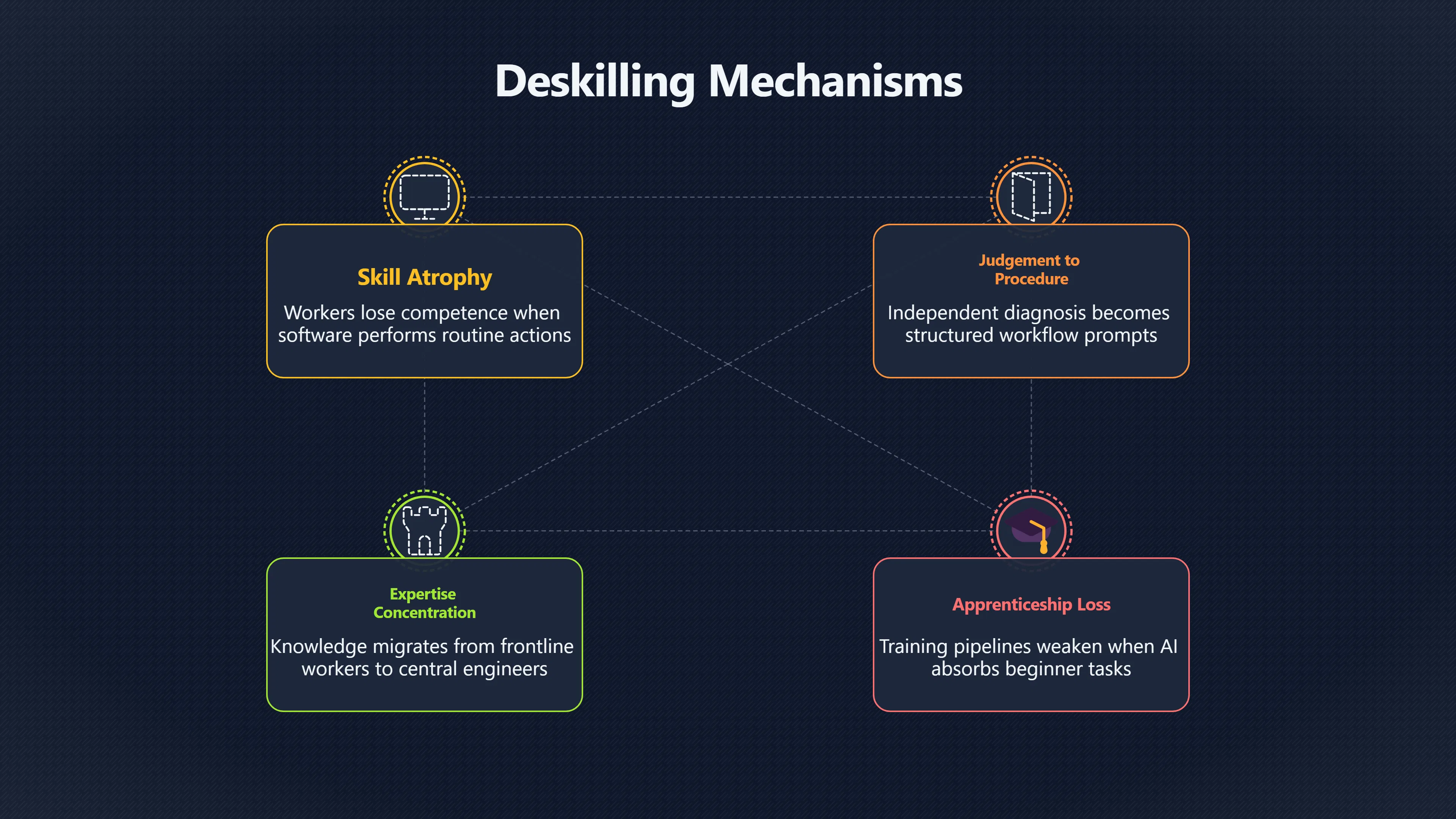
Several mechanisms repeatedly appear.
Skill atrophy through reduced practice. Workers may still possess knowledge in theory, but lose competence because software performs most of the relevant actions. Safety specialists have long warned that automation can leave operators unable to respond effectively when systems fail because they rarely perform the underlying task themselves.[aubreydaniels.com]aubreydaniels.comis deskilling a threat to safety in your workplaceMaybe you've heard the term de-skilling. It refers to the loss of knowledge or skills on…Read more…
Conversion of judgement into procedure. Activities once requiring experience become structured workflows with predefined options. Instead of diagnosing problems independently, workers follow software prompts and escalation rules.
Loss of apprenticeship pathways. Many professions rely on juniors learning through repeated exposure to routine work. When AI or automation absorbs those tasks, training pipelines can weaken. Concerns about disappearing learning opportunities have appeared in fields ranging from law and software development to technical operations.[Medium]zephoria.medium.comDeskilling on the JobDeskilling on the Job - danah boydApril 21, 2023 — We may be fine with deskilling junior lawyers now, but how do we generate future…
Concentration of expertise. Knowledge can migrate from frontline workers into software systems, engineering teams or central management functions. Workers continue operating the system but have less influence over how it functions.
The result is not necessarily unemployment. Many workers remain employed. The concern is that their role becomes narrower, making them easier to replace and less able to develop deeper expertise over time.
The rise of the supervisor who mostly watches
One of the most common outcomes of safety-oriented automation is the creation of monitoring roles.
Instead of directly performing dangerous work, employees supervise robots, inspect dashboards, review camera feeds or monitor sensor networks. This often delivers genuine safety benefits. A worker sitting in a remote operations centre is less likely to be crushed by heavy machinery than a worker standing beside it.
The problem is that monitoring can become psychologically demanding in a different way.
Human attention is poorly suited to long periods of passive vigilance. Decades of research on automation have found that operators often struggle when they are asked to remain alert while systems handle nearly everything automatically. Most of the time there is nothing to do. Then, during a failure, rapid intervention becomes critical.
This creates a paradox. The worker is expected to remain highly skilled, but the job gives few opportunities to exercise those skills.
Industrial control rooms, autonomous vehicle supervision systems and highly automated logistics environments increasingly confront this challenge. When software performs the routine work, humans are left managing exceptions. Yet expertise often develops through routine engagement, not only through emergencies.
The risk is that organisations retain nominal human oversight while gradually eroding the practical competence required for meaningful oversight.
When safer workplaces become surveillance workplaces
Another tension emerges when safety technologies merge with algorithmic management.
Many AI systems introduced for safety purposes also generate detailed data about worker behaviour. Sensors can track movement, location, speed, productivity, fatigue, biometric indicators or compliance with procedures. Employers may argue that such monitoring helps prevent accidents, optimise workflows and identify risks.
Sometimes it does.
However, researchers and labour organisations increasingly warn that the same infrastructure can become a system of continuous surveillance. OECD research on algorithmic management notes both productivity benefits and growing concerns about detrimental effects on workers.[OECD]oecd.orgAI and workAI can bring many benefits to the workplace such as higher productivity, improved job quality and stronger occupational safety…
Studies of workplace monitoring have identified risks including reduced autonomy, increased stress and a perception of constant evaluation.[JRC Publications]publications.jrc.ec.europa.euJRC Publications Electronic Monitoring and Surveillance in the WorkplaceJRC PublicationsElectronic Monitoring and Surveillance in the WorkplaceNovember 22, 2021 — by K BALL · Cited by 200 — When remote working…
The distinction between assistance and control can become blurred.
A wearable device might warn a worker about dangerous fatigue levels. It might also feed performance data into automated disciplinary systems. A route-optimisation tool might reduce driving risks. It might also pressure workers to follow machine-generated schedules with little discretion.
The concern is not simply privacy. It is the transformation of work into a series of measurable outputs where human judgement becomes secondary to compliance with algorithmic instructions.
Several recent analyses of algorithmic management argue that excessive monitoring can contribute to deskilling by reducing workers’ ability to decide how tasks should be performed.[ifow.org]ifow.orgmaking algorithmic management safe for workers new regulation is neededMaking Algorithmic Management safe for workers28 Jul 2023 — AM's automation of tasks can lead to deskilling, where workers see a fall in…[National Employment Law Project]nelp.orgNew Report Details Employers' Harmful Use of Digital…15 Jul 2025 —… dangers posed by digital surveillance and automated decision sy…
The hidden long-term problem: who still knows how the system works?
Deskilling creates a deeper issue that may not become visible until systems fail.
Highly automated environments often rely on a relatively small group of engineers, designers and technical specialists who understand the underlying systems. Frontline workers increasingly interact with interfaces rather than mechanisms.
For routine operations, this may be efficient.
But rare failures can expose the weakness of overly automated organisations. When unusual conditions emerge, workers may lack the practical understanding needed to diagnose problems independently. Instead of skilled operators supported by technology, organisations can end up with workers who are dependent on technology.
This creates a form of fragility.
In safety-critical sectors such as energy infrastructure, transport, healthcare and industrial production, maintaining human expertise is often valuable even when machines perform most routine tasks. Organisations need people who understand why a system behaves as it does, not merely how to follow its outputs.
The issue becomes even more important in a future where advanced AI systems may manage increasingly complex parts of the economy. If human capabilities steadily erode while machine capabilities expand, society could become more dependent on systems that fewer people truly understand.
Critics of AI optimism often point to this possibility. A civilisation may become technologically powerful while losing distributed human competence. The challenge is not only economic. It concerns resilience and human agency.
Ways to preserve autonomy, mastery and human judgement
The existence of deskilling risks does not mean automation inevitably produces worse work.
Many researchers and policymakers now focus on how technology can augment workers rather than merely constrain them. OECD work on AI and the future of work increasingly emphasises worker empowerment, skills and job quality alongside productivity and safety.[OECD AI]oecd.orgalgorithmic management in the workplace 287c13c4 enAlgorithmic management in the workplaceby A Milanez · 2025 · Cited by 48 — Algorithmic management – the use of software, which may in…[OECD]oecd.aialgorithmic management in the workplace6 Feb 2025 — The survey offers unprecedented insights into algorithmic management in the workplace, its perceived impacts and firm-level…
Several design principles appear repeatedly.
Use automation to assist judgement rather than replace it
The strongest augmentation models leave meaningful decisions with humans.
Instead of generating instructions that workers must follow, AI systems can provide analysis, forecasts, risk warnings and recommendations that support decision-making. Workers remain active participants rather than passive recipients of commands.
This approach tends to preserve learning because people continue exercising judgement.
Protect opportunities to build expertise
Training systems often rely on routine work that appears inefficient from a narrow automation perspective.
Removing every beginner task may improve short-term productivity while weakening long-term skill formation. Organisations need deliberate pathways through which workers can acquire practical experience, understand system behaviour and progress toward more advanced roles.
Without these pathways, industries can struggle to reproduce expertise across generations.
Give workers influence over technological design
Research on automation frequently finds better outcomes when workers participate in deployment decisions rather than having systems imposed upon them. Frontline employees often possess knowledge about workflows, failure modes and operational realities that designers overlook.[ACM Digital Library]dl.acm.orgThis, in turnACM Digital LibraryExploring Labor Relations in Workplace Automation and…11 May 2024 — The developers' efforts to exert more control c…
Worker involvement can help ensure that automation removes hazards without unnecessarily removing discretion.
Measure success beyond injury rates
A factory that halves workplace injuries has achieved something valuable. But injury reduction alone should not define success.
Organisations can also track:
- Opportunities for skill development.
- Levels of worker autonomy.
- Employee retention.
- Internal promotion pathways.
- Job satisfaction.
- Ability to respond to unexpected situations.
A safer workplace that leaves workers disengaged, easily replaceable and permanently monitored may solve one problem while creating another.
What this means for the AI bloom vision
The optimistic case for advanced AI is not simply that machines perform more work. It is that humanity gains freedom from drudgery, danger and unnecessary suffering while expanding its capacity for learning, creativity and achievement.
Deskilling sits directly at the centre of that debate.
If automation removes hazardous labour but turns workers into tightly monitored attendants of opaque systems, then technological progress may improve safety while undermining some dimensions of human flourishing. If, instead, AI systems remove the most dangerous and repetitive elements of work while helping people develop higher levels of competence, judgement and creativity, the outcome looks very different.
The distinction matters because abundance is not only about material output. A future with greater wealth, lower injury rates and extraordinary technological capability could still disappoint if most people lose opportunities to exercise skill, develop mastery or shape their own work.
For advocates of an AI-enabled long-term future, the challenge is therefore larger than replacing dangerous jobs. It is designing institutions, workplaces and technologies that preserve meaningful human agency even as machines become dramatically more capable. The success of safer automation may ultimately be judged not only by how many injuries it prevents, but by whether it leaves people with more room to grow rather than less.
Amazon book picks
Further Reading
Books and field guides related to Can safer work become worse work?. Use these as the next step if you want deeper reading beyond the article.
The Glass Cage
Directly addresses how automation can make work safer or easier while eroding human skill and judgement.
Human + Machine
Focuses on designing roles where humans retain judgement and machines provide support.
The Shallows
Supports the theme that convenience can weaken attention, mastery and independent capability.
Automation and the Future of Work
Examines how automation can worsen job quality unless institutions shape the transition.
eBay marketplace picks
Marketplace Samples
Example marketplace items related to this page. Use the search link to explore similar finds on eBay.


Endnotes
1.
Source: oecd.org
Title: artificial [intelligence]({{ ‘intelligence/’ | relative_url }}) job quality and inclusiveness a713d0ad
Link:https://www.oecd.org/en/publications/oecd-employment-outlook-2023_08785bba-en/full-report/artificial-intelligence-job-quality-and-inclusiveness_a713d0ad.html
Source snippet
Artificial intelligence, job quality and inclusiveness11 Jul 2023 — This chapter reviews the current empirical evidence of the effect...
2.
Source: oecd.org
Link:https://www.oecd.org/en/topics/sub-issues/ai-and-work.html
Source snippet
AI and workAI can bring many benefits to the workplace such as higher productivity, improved job quality and stronger occupational safety...
3.
Source: oecd.org
Link:https://www.oecd.org/en/topics/ai-and-work.html
Source snippet
AI and workAI can bring many benefits to the workplace such as higher productivity, improved job quality and stronger occupational safety...
4.
Source: aubreydaniels.com
Title: is deskilling a threat to safety in your workplace
Link:https://www.aubreydaniels.com/blog/is-deskilling-a-threat-to-safety-in-your-workplace
Source snippet
Maybe you've heard the term de-skilling. It refers to the loss of knowledge or skills on...Read more...
5.
Source: zephoria.medium.com
Title: Deskilling on the Job
Link:https://zephoria.medium.com/deskilling-on-the-job-bbd71a74a435
Source snippet
Deskilling on the Job - danah boydApril 21, 2023 — We may be fine with deskilling junior lawyers now, but how do we generate future...
Published: April 21, 2023
6.
Source: oecd.org
Title: algorithmic management in the workplace 287c13c4 en
Link:https://www.oecd.org/en/publications/algorithmic-management-in-the-workplace_287c13c4-en.html
Source snippet
Algorithmic management in the workplaceby A Milanez · 2025 · Cited by 48 — Algorithmic management – the use of software, which may in...
7.
Source: oecd.ai
Title: algorithmic management in the workplace
Link:https://oecd.ai/en/ai-publications/algorithmic-management-in-the-workplace
Source snippet
6 Feb 2025 — The survey offers unprecedented insights into algorithmic management in the workplace, its perceived impacts and firm-level...
8.
Source: ifow.org
Title: making algorithmic management safe for workers new regulation is needed
Link:https://www.ifow.org/news-articles/making-algorithmic-management-safe-for-workers-new-regulation-is-needed
Source snippet
Making Algorithmic Management safe for workers28 Jul 2023 — AM's automation of tasks can lead to deskilling, where workers see a fall in...
9.
Source: oecd.ai
Link:https://oecd.ai/en/working-group-future-of-work
Source snippet
The Future of WorkThe OECD and GPAI's work analyses AI's effects on job markets, workplace practices, and hiring processes while explorin...
10.
Source: oecd.org
Title: making ai work why investing in skills matters
Link:https://www.oecd.org/en/blogs/2026/01/making-ai-work-why-investing-in-skills-matters.html
Source snippet
Making AI Work: Why Investing in Skills Matters2 Feb 2026 — Skills will be a key driver of AI's impact on productivity and growth. This b...
11.
Source: oecd.ai
Link:https://oecd.ai/en/community/gpai-working-group-on-the-future-of-work
Source snippet
The Future of Work Working Group: AI ExpertA focus will be on how workers and employers can prepare for the future of work, and how job...
12.
Source: dl.acm.org
Title: This, in turn
Link:https://dl.acm.org/doi/10.1145/3613904.3642907
Source snippet
ACM Digital LibraryExploring Labor Relations in Workplace Automation and...11 May 2024 — The developers' efforts to exert more control c...
Published: May 2024
13.
Source: oecd.org
Link:https://www.oecd.org/en.html
Source snippet
The Organisation for Economic Co-operation and...The OECD designs international standards and guidelines for development co-operat...
14.
Source: oecd.org
Link:https://www.oecd.org/en/topics/future-of-work.html
Source snippet
Future of workAI can bring many benefits to the workplace such as higher productivity, improved job quality and stronger occupational saf...
15.
Source: oecd.org
Title: full report
Link:https://www.oecd.org/en/publications/how-widespread-is-algorithmic-management-in-workplaces_cda7a114-en/full-report.html
Source snippet
How widespread is algorithmic management in workplaces?Dec 19, 2025 — In most countries, firms are less likely to adopt algorithmic manag...
16.
Source: oecd.org
Link:https://www.oecd.org/en/topics/policy-issues/future-of-work.html
Source snippet
Future of workHowever, there are risks too, such as automation, loss of agency, bias and discrimination, breaches of privacy and a lack o...
17.
Source: oecd.org
Title: 59e89d7f en
Link:https://www.oecd.org/content/dam/oecd/en/publications/reports/2023/03/defining-and-classifying-ai-in-the-workplace_35d2d069/59e89d7f-en.pdf
Source snippet
Defining and classifying AI in the workplaceby M Williams · 2023 · Cited by 27 — AI-enabled monitoring and scheduling tools can negativel...
18.
Source: publications.jrc.ec.europa.eu
Title: JRC Publications Electronic Monitoring and Surveillance in the Workplace
Link:https://publications.jrc.ec.europa.eu/repository/bitstream/JRC125716/jrc125716_electronic_monitoring_and_surveillance_in_the_workplace_final.pdf
Source snippet
JRC PublicationsElectronic Monitoring and Surveillance in the WorkplaceNovember 22, 2021 — by K BALL · Cited by 200 — When remote working...
Published: November 22, 2021
19.
Source: nelp.org
Link:https://www.nelp.org/new-report-details-employers-harmful-use-of-digital-surveillance-and-automated-decision-systems-highlights-urgent-need-for-policy-action/
Source snippet
New Report Details Employers' Harmful Use of Digital...15 Jul 2025 —... dangers posed by digital surveillance and automated decision sy...
Additional References
20.
Source: businessinsider.com
Link:https://www.businessinsider.com/ai-tools-are-deskilling-workers-philosophy-professor
Source snippet
While companies believe AI boosts productivity, Berg argues it's undermining workers' skills, particularly among junior employees. These...
21.
Source: equitablegrowth.org
Link:https://equitablegrowth.org/research-paper/estimating-the-prevalence-of-automated-management-and-surveillance-technologies-at-work-and-their-impact-on-workers-well-being/
Source snippet
work at unsafe speeds, though a judge later cleared Amazon of... While the potential risks posed by automated management and surveillance...
22.
Source: tuac.org
Link:https://tuac.org/news/new-oecd-report-on-algorithmic-management-reveals-urgent-need-for-worker-protections/
Source snippet
New OECD report on algorithmic management reveals urgent...7 Feb 2025 — The OECD Working Paper 'Algorithmic Management in the Workplace'...
23.
Source: uclalawreview.org
Link:https://www.uclalawreview.org/the-consequences-of-automating-and-deskilling-the-police/
Source snippet
The deskilling of the police is inevitable because automation is increasingly becoming a part of...Read more...
24.
Source: GOV.UK
Title: assessment of ai capabilities and the impact on the uk labour market
Link:https://www.gov.uk/government/publications/assessment-of-ai-capabilities-and-the-impact-on-the-uk-labour-market/assessment-of-ai-capabilities-and-the-impact-on-the-uk-labour-market
Source snippet
of AI capabilities and the impact on...28 Jan 2026 — The AI and Future of Work Unit has been established in part to address this gap by...
25.
Source: sciencedirect.com
Link:https://www.sciencedirect.com/science/article/pii/S0925753525000888
Source snippet
Algorithmic management and occupational healthby KH Nilsson · 2025 · Cited by 26 — These risks can result in hazardous work practices, su...
26.
Source: onlabor.org
Title: Training Your Replacement, One Keystroke at a Time2 days ago —
Link:https://onlabor.org/training-your-replacement-one-keystroke-at-a-time/
Source snippet
monitoring, deskilling, or replacing it. As TechCrunch put it, Meta... job to be automated or deskilled. With automated capture, the...
27.
Source: academy.evalcommunity.com
Title: how do oecd ai principles support monitoring and evaluation me
Link:https://academy.evalcommunity.com/how-do-oecd-ai-principles-support-monitoring-and-evaluation-me/
Source snippet
AI Principles in Monitoring and EvaluationFeb 16, 2026 — The OECD AI Principles support monitoring and evaluation (M&E) by establishing g...
28.
Source: inc.com
Title: how ai automation is quietly deskilling white collar workers
Link:https://www.inc.com/andrea-olson/how-ai-automation-is-quietly-deskilling-white-collar-workers/91316067
Source snippet
How AI Automation Is Quietly De-Skilling White-Collar Workers23 Mar 2026 — Economists call it de-skilling—the process by which normally s...
29.
Source: researchgate.net
Title: 376490098 Job Security in the Artificial Intelligence and Automation Era
Link:https://www.researchgate.net/publication/376490098_Job_Security_in_the_Artificial_Intelligence_and_Automation_Era
Source snippet
Deskilling teachers: An excessive... control [100]. Tech dependency risks: Reliance on sophisticated. automation...
Topic Tree