Within AI Bloom
Could AI Make Civilisation Safer and Larger?
Advanced AI could strengthen defences against pandemics, disasters and other existential threats while helping civilisation expand beyond a single fragile
On this page
- Pandemic, disaster and infrastructure resilience
- Better coordination without authoritarian control
- Space settlement and the expansion of conscious life
Page outline Jump by section
Introduction
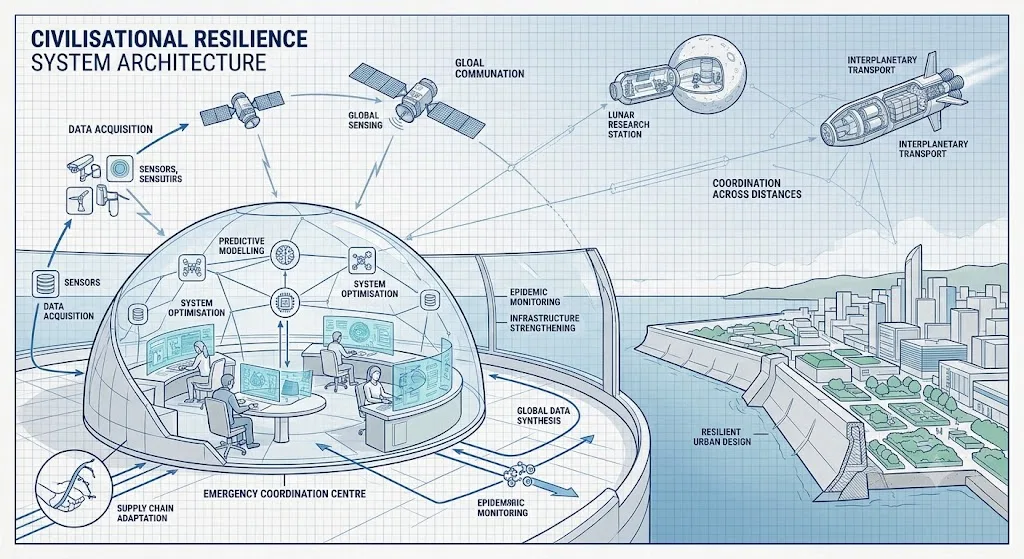
Could AI make civilisation safer and larger? The strongest case is not that artificial intelligence will remove every danger, but that it could expand humanity’s ability to prevent disasters, recover from shocks and extend the reach of intelligent life over very long timescales. Advanced AI could help detect pandemics earlier, design stronger infrastructure, improve scientific understanding of threats and support better coordination between societies. At the same time, the same capabilities could introduce new vulnerabilities: cyber conflict, misinformation, dangerous biological assistance, concentration of power and loss of human control over increasingly capable systems.[GOV.UK]GOV.UK28, 2025…
Within the wider vision of an AI bloom, civilisational resilience is the question of whether greater intelligence can help humanity move from a fragile species dependent on one planet and imperfect institutions towards a more durable, adaptable and expansive civilisation. The optimistic possibility is not simply survival. It is the preservation and enlargement of humanity’s long future: more generations able to live, create, discover and experience the universe.
Why resilience becomes the central AI question
Human civilisation has always faced catastrophic risks, from pandemics and asteroid impacts to wars, ecological disruption and technological accidents. Modern civilisation is more capable than previous societies, but it is also more interconnected and therefore exposed to failures that can spread globally. Researchers studying global catastrophic risks have highlighted that advanced technology can create both new hazards and new tools for managing them.[Global Shield]globalshieldpolicy.orgGlobal Shield How governments can better understand global catastrophic riskGlobal Shield How governments can better understand global catastrophic risk
AI changes this balance because intelligence itself is becoming a technological resource. A society with powerful AI systems could potentially analyse complex threats faster, simulate possible futures, discover solutions and coordinate responses across institutions. The same capability could also amplify mistakes if deployed without adequate safeguards. The long-term question is therefore not whether AI is powerful, but whether that power increases civilisation’s ability to remain stable, adaptable and aligned with human flourishing.
A resilient civilisation would not merely avoid extinction. It would develop the capacity to absorb shocks while continuing to improve. That includes:
- detecting emerging threats before they become crises;
- maintaining essential infrastructure during disasters;
- accelerating scientific responses to disease, climate and environmental challenges;
- reducing dependence on single points of failure;
- creating institutions capable of managing increasingly powerful technologies.
Pandemic, disaster and infrastructure resilience
Could AI help humanity respond before crises escalate?
Pandemics show the importance of speed. A disease outbreak becomes far more dangerous when detection, information sharing and medical response are slow. AI could strengthen each stage of this process by analysing biological data, identifying unusual patterns, helping design medical interventions and improving logistical planning.
The COVID-19 pandemic demonstrated both the value and limits of technological tools. AI methods contributed to areas such as protein analysis, drug research and outbreak modelling, but they did not replace the need for effective public health institutions, reliable data and international cooperation. The lesson for an AI-enabled future is that intelligence tools are most valuable when connected to trustworthy systems.
Future AI systems could contribute to a stronger global health defence network by continuously monitoring disease signals, supporting laboratories and helping researchers investigate pathogens. However, the same technologies create a security challenge because more powerful biological design tools could potentially be misused. The resilience benefit therefore depends on combining scientific capability with careful governance.[UNDRR]undrr.orgThematic Study: Existential risk and rapid technological changeThematic Study: Existential risk and rapid technological change - Advancing risk informed development | UNDRR…
Making infrastructure less fragile
Modern societies rely on vast networks: electricity grids, transport systems, water supplies, communications and food distribution. These systems are becoming more complex while facing pressures from climate change, population growth and extreme weather.
AI could improve resilience by helping operators predict failures, optimise energy systems, strengthen supply chains and plan responses to disasters. Analysis of AI applications in infrastructure suggests that better prediction and optimisation could reduce some future disaster-related losses, although these estimates depend on assumptions about adoption and implementation.[deloitte.com]deloitte.comA I for infrastructure resilience | Deloitte GlobalA I for infrastructure resilience | Deloitte Global
The deeper AI bloom possibility is that civilisation could become more adaptive. Instead of reacting after storms, fires or infrastructure failures occur, AI-supported systems could anticipate problems and continuously improve. A mature AI-enabled civilisation might function less like a machine that occasionally breaks and more like a living system that constantly monitors and repairs itself.
Better coordination without authoritarian control
Can AI help societies cooperate at global scale?
Many of humanity’s largest challenges are coordination problems. Climate change, pandemics, nuclear risks and emerging technologies cross national borders, while political systems often struggle to respond to problems that unfold over decades.
Advanced AI could help by improving forecasting, translating between languages, analysing policy choices and revealing unintended consequences. Governments, researchers and international organisations could use AI systems to understand complex trade-offs more effectively. In principle, better intelligence could help societies make decisions based on wider evidence rather than short-term pressures.
But coordination through AI raises a difficult question: who controls the systems that provide advice and influence decisions? A civilisation that becomes dependent on a small number of powerful AI providers could exchange one form of fragility for another. Concentrated ownership, surveillance capabilities or opaque decision-making could undermine the very freedoms and diversity that make civilisation resilient.
This is why AI governance is not separate from the AI bloom vision. A flourishing future requires institutions that can use powerful tools while preserving accountability, human agency and democratic choice. The debate around frontier AI risks includes both concerns about extreme future loss of control and concerns about more immediate problems such as misuse, concentration of power and inadequate oversight.[GOV.UK]GOV.UK28, 2025…
Resilience requires distributed capability
A robust civilisation would not place all its knowledge, infrastructure or decision-making capacity in one location. AI could support a more distributed future by making expertise available more widely.
For example, advanced AI tutors, scientific assistants and engineering systems could allow smaller communities and less wealthy regions to access capabilities that are currently concentrated in major institutions. This could strengthen global resilience by reducing the gap between places with abundant expertise and places without it.
However, distribution would not happen automatically. AI systems could also deepen inequality if access, computing resources and ownership remain concentrated. The question is therefore political as much as technological: whether AI becomes a shared capability or a strategic advantage controlled by a small number of actors.
Space settlement and the expansion of conscious life
Why leaving Earth matters in the long-term future
One of the most ambitious arguments for AI-enabled civilisation is that humanity could eventually expand beyond Earth. Today, all human life exists on one planet, making civilisation vulnerable to planet-scale events. A sufficiently advanced spacefaring civilisation would have multiple habitats and therefore reduce the risk of a single catastrophe ending the human story.
Space settlement is not a short-term solution to Earth’s problems. Building self-sustaining communities beyond Earth would require major advances in engineering, economics, biology and governance. Mars settlements, orbital habitats or other forms of space infrastructure remain difficult and uncertain.
The relevance of AI is that it could accelerate the capabilities needed for expansion: autonomous robotics, advanced materials research, life-support optimisation, scientific discovery and large-scale engineering. AI systems could operate in environments where human presence is expensive or dangerous, helping construct infrastructure before large populations arrive.
The long-term argument is not simply that humans should move to another planet. It is that intelligence may eventually allow life to become less geographically constrained. A civilisation able to spread beyond Earth would have more opportunities for discovery and survival, while also carrying greater responsibilities for how it uses that power.
The hardest problem: avoiding a more dangerous civilisation
A future with powerful AI is not automatically a safer future. Greater capability can increase both protective capacity and destructive potential. A civilisation with advanced AI could cure diseases, improve disaster response and explore space, but it could also create new pathways for conflict, manipulation or catastrophic accidents.
This is why AI safety and alignment—the challenge of ensuring advanced AI systems pursue goals compatible with human intentions and values—are central to the long-term future debate. The UK government’s discussion of frontier AI risks notes that highly capable systems could pose serious threats if they were inadequately controlled, while also recognising major uncertainty about how such scenarios might unfold.[GOV.UK]GOV.UK28, 2025…
There are also disagreements about which risks deserve the most attention. Some researchers emphasise possible future scenarios involving highly autonomous systems that humans cannot reliably control. Others argue that present-day issues such as misuse, inequality, political instability and weak governance deserve greater focus. A resilient approach does not need certainty about every future scenario; it requires building institutions that perform well across many possible futures.[brookings.edu]brookings.eduAre AI existential risks real—and what should we do about them? | BrookingsAre AI existential risks real—and what should we do about them? | Brookings
What would a resilient AI future require?
An AI-enabled civilisation that genuinely supports humanity’s long future would likely need several conditions:
- Safe development of powerful systems: capabilities must advance alongside methods for evaluation, control and risk reduction.
- Broad access to benefits: intelligence tools should improve lives globally rather than becoming concentrated sources of power.
- Strong institutions: governments and international organisations need the ability to manage technologies that evolve faster than traditional policy cycles.
- Scientific openness with appropriate safeguards: discovery should accelerate while dangerous applications are responsibly managed.
- Long-term thinking: societies must consider not only the next election cycle or economic quarter, but the survival and flourishing of future generations.
The central promise of AI civilisational resilience is therefore larger than protection from disaster. It is the possibility that intelligence itself becomes a tool for making civilisation more capable, more adaptable and more enduring. The long future of humanity may depend not only on reaching greater technological power, but on learning how to use that power wisely.

Amazon book picks
Further Reading
Books and field guides related to Could AI Make Civilisation Safer and Larger?. Use these as the next step if you want deeper reading beyond the article.
Superintelligence
This profoundly ambitious and original book picks its way carefully through a vast tract of forbiddingly difficult intellectual terrain.
Enlightenment Now
Rating: 4.5/5 from 6 Google Books ratings
INSTANT NEW YORK TIMES BESTSELLER A NEW YORK TIMES NOTABLE BOOK OF 2018 ONE OF THE ECONOMIST'S BOOKS OF THE YEAR "My new favorite book of...
Life 3.0
'This is the most important conversation of our time, and Tegmark's thought-provoking book will help you join it' Stephen Hawking THE INT...
The Future of Humanity
"Formerly the domain of fiction, moving human civilization to the stars is increasingly becoming a scientific possibility--and a necessit...
eBay marketplace picks
Marketplace Samples
Live-tested eBay searches with available results related to this page.
Selected fromscience art print oneBay.co.uk.




Endnotes
1.
Source: GOV.UK
Link:https://www.gov.uk/government/publications/frontier-ai-capabilities-and-risks-discussion-paper/future-risks-of-frontier-ai-annex-a
Source snippet
28, 2025...
2.
Source: undrr.org
Title: Thematic Study: Existential risk and rapid technological change
Link:https://www.undrr.org/publication/thematic-study-existential-risk-and-rapid-technological-change-advancing-risk-informed
Source snippet
Thematic Study: Existential risk and rapid technological change - Advancing risk informed development | UNDRR...
3.
Source: deloitte.com
Title: A I for infrastructure resilience | Deloitte Global
Link:https://www.deloitte.com/uk/en/issues/climate/ai-for-infrastructure-resilience.html
4.
Source: brookings.edu
Title: Are AI existential risks real—and what should we do about them? | Brookings
Link:https://www.brookings.edu/articles/are-ai-existential-risks-real-and-what-should-we-do-about-them/
5.
Source: undrr.org
Link:https://www.undrr.org/news/digital-risks-new-report-maps-critical-vulnerabilities-worlds-interconnected-systems
6.
Source: repository.ach.gov.ru
Title: ach.gov.ru A I for infrastructure resilience
Link:https://repository.ach.gov.ru/show/9052/?lang=en
7.
Source: deloitte.com
Link:https://www.deloitte.com/global/en/issues/climate/ai-for-infrastructure-resilience.html
8.
Source: deloitte.com
Link:https://www.deloitte.com/global/en/issues/climate/ai-for-infrastructure-resilience.html?icid=learn_more_content_click
9.
Source: deloitte.com
Link:https://www.deloitte.com/na/en/issues/climate/ai-for-infrastructure-resilience.html
10.
Source: deloitte.com
Link:https://www.deloitte.com/nl/en/issues/climate/ai-for-infrastructure-resilience.html
11.
Source: globalshieldpolicy.org
Title: Global Shield How governments can better understand global catastrophic risk
Link:https://www.globalshieldpolicy.org/report/policy-brief-how-governments-can-better-understand-global-catastrophic-risk/
Additional References
12.
Source: cam.ac.uk
Link:https://www.cam.ac.uk/research/news/governments-are-failing-to-understand-global-catastrophic-risks-and-need-to-take-urgent-action-says
13.
Source: isdc.nss.org
Title: what is space settlement the vision behind isdc
Link:https://isdc.nss.org/sessions/space-settlement/what-is-space-settlement-the-vision-behind-isdc/
Source snippet
The Vision Behind ISDCJune 27, 2026 — WHAT IS SPACE SETTLEMENT? THE VISION BEHIND ISDC Space settlement is the creation of permanent huma...
Published: June 27, 2026
14.
Source: youtube.com
Link:https://www.youtube.com/watch?v=jEIidKTA2yo
Source snippet
Session 2 | Panel: Frontier AI Capabilities & Implications for Policymakers | Athens Roundtable 2025...
15.
Source: youtube.com
Link:https://www.youtube.com/watch?v=stQiLvmgjns
Source snippet
Stop the World: TSD Summit Sessions: Artificial intelligence and catastrophic risk with Connor Leahy...
16.
Source: youtube.com
Title: AI pioneer explains why it poses an existential risk for humanity
Link:https://www.youtube.com/watch?v=w_agSeXwxhU
Source snippet
Godfather of AI WARNS: “Everything Changes By 2027”...
17.
Source: papers.ssrn.com
Link:https://papers.ssrn.com/sol3/papers.cfm?abstract_id=7033960
Source snippet
Maas, Christoph Winter:: SSRNJuly 1, 2026 — THE SCOPE OF GLOBAL CATASTROPHIC RISK AS A GOVERNANCE CHALLENGE (CHAPTER 1 IN: INTERNATIONAL...
Published: July 1, 2026
18.
Source: papers.ssrn.com
Link:https://papers.ssrn.com/sol3/Delivery.cfm/6996738.pdf?abstractid=6996738&mirid=1&type=2
Source snippet
AI and Civilizational Disruption Risk: A Public-source Scenario Analysis of Critical Infrastructure, Strategic Stability, and Recovery Pa...
19.
Source: youtube.com
Link:https://www.youtube.com/watch?v=1UufaK3pQMg
Source snippet
AI pioneer explains why it poses an existential risk for humanity...
20.
Source: researchgate.net
Link:https://www.researchgate.net/publication/389210192_The_Settlement_of_Space_Economical_and_Logistical_Drivers_and_Constraints
21.
Source: doi.org
Link:https://doi.org/10.1111/risa.14123