Within Ethics & Dignity
How Worker Involvement Shapes Robot Automation Ethically
Explores how involving employees in robot deployment preserves dignity, autonomy, and workplace recognition.
On this page
- Benefits of co design in automation
- Mechanisms for meaningful participation
- Case studies of dignity preserving implementation
Page outline Jump by section
Introduction
Robot automation is often presented as a technical or economic decision: a company installs machines, productivity rises, and workers adapt. Yet one of the most important ethical questions is who gets a voice before those decisions are made. Worker participation in robot deployment is not mainly about slowing innovation. It is about whether people affected by automation retain agency, recognition and influence over changes that reshape their daily working lives.
 This matters both in today’s factories, warehouses and service workplaces and in broader discussions about an AI-enabled future. If advanced robotics eventually removes much dangerous, repetitive or physically exhausting labour, that could support a more flourishing society. But the route to that future matters. Automation imposed without consultation can leave workers feeling replaceable and controlled. Automation designed with worker involvement is more likely to preserve dignity, improve trust and produce systems that actually work in practice. Research across human-robot collaboration, workplace governance and occupational safety increasingly suggests that participation is not a peripheral concern. It is part of what makes automation ethically legitimate.[ScienceDirect]sciencedirect.comHuman-robot collaboration at work: A review of workers'…by S Skavron · 2026 · Cited by 2 — At the organisational level, w…[ScienceDirect]sciencedirect.comHuman-robot collaboration at work: A review of workers'…by S Skavron · 2026 · Cited by 2 — At the organisational level, w…
Why Worker Voice Matters Beyond Efficiency
Many debates about automation focus on jobs gained or lost. Workers, however, often raise a different concern: loss of control over how work is organised. A robot may not eliminate a role entirely, yet it can still reduce autonomy if workers are forced to match machine timings, follow rigid instructions or accept decisions made without their input.
Studies of workplace robotics repeatedly find that implementation choices shape workers’ experiences as much as the technology itself. Researchers reviewing human-robot collaboration note that communication practices, implementation strategies and inclusion in decision-making strongly influence whether workers experience automation as supportive or alienating.[ScienceDirect]sciencedirect.comHuman-robot collaboration at work: A review of workers'…by S Skavron · 2026 · Cited by 2 — At the organisational level, w…
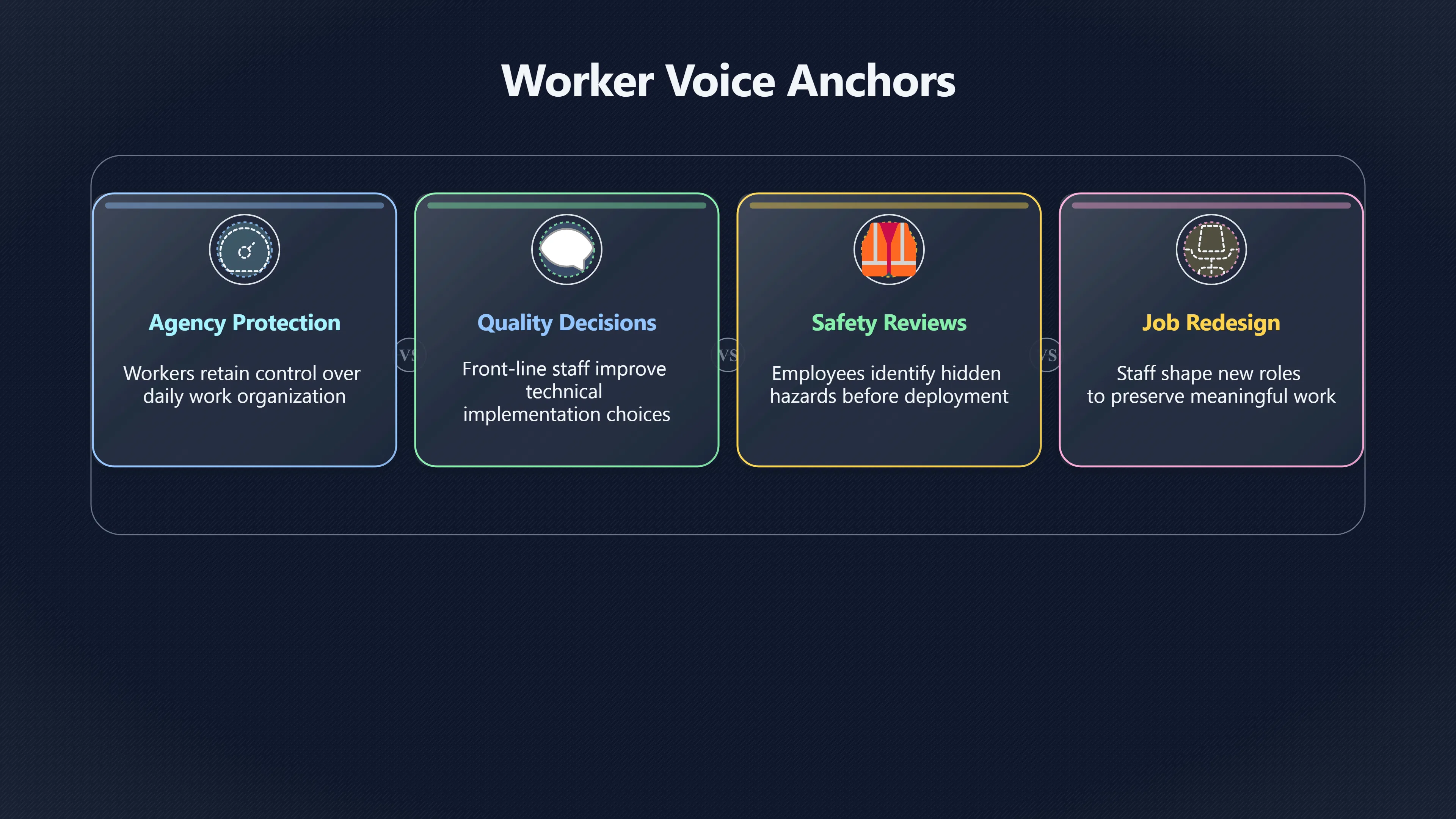
This is especially important because workers possess knowledge that managers and technology vendors often lack. Front-line employees understand informal workflows, bottlenecks, safety risks and practical realities that may not appear in technical specifications. Participation therefore serves two purposes at once:
- It protects worker agency and dignity.
- It improves the quality of automation decisions themselves.
The argument is not that workers should veto every technological change. Rather, meaningful participation treats employees as knowledgeable contributors rather than passive subjects of technological transformation.
What Co-Design Looks Like in Practice
The strongest participation models move beyond consultation after decisions have already been made. Instead, workers help shape deployment from the beginning.
Designing the System With Workers Rather Than For Them
In human-centred robotics, co-design means involving workers in identifying problems, evaluating possible robotic solutions and testing prototypes before full deployment. Researchers studying collaborative robotics increasingly argue that workers should participate in the design and deployment of human-robot work configurations because technical performance, safety and wellbeing are tightly connected.[ScienceDirect]sciencedirect.comHuman-robot collaboration at work: A review of workers'…by S Skavron · 2026 · Cited by 2 — At the organisational level, w…
This can include:
- Workshops where workers identify tasks they find dangerous, exhausting or frustrating.
- Pilot programmes in which employees test robotic systems and provide feedback.
- Joint safety reviews involving operators, engineers and managers.
- Worker representation on automation planning committees.
- Iterative redesign after deployment based on worker experience.
Such approaches recognise that the workplace is a socio-technical system. A robot does not merely perform a task. It changes routines, responsibilities, communication patterns and expectations.
Preventing the “Automation Surprise”
One common source of resistance is what workers sometimes experience as an automation surprise: major technological changes announced after key decisions have already been made.
Evidence from manufacturing studies suggests that successful human-robot collaboration often requires ongoing adaptation rather than a one-off installation process. Researchers examining Industry 5.0 transitions describe implementation as a continuing negotiation between efficiency goals, worker wellbeing and organisational realities rather than a straightforward technical upgrade.[ScienceDirect]sciencedirect.comHuman-robot collaboration at work: A review of workers'…by S Skavron · 2026 · Cited by 2 — At the organisational level, w…
When workers are involved earlier, organisations can identify problems before they become sources of conflict. This may reduce fear, improve adoption and help employees understand how their roles will change.
Mechanisms for Meaningful Participation
Not every participation programme genuinely shifts power. Some initiatives ask workers for feedback but make no changes based on it. Ethical participation requires mechanisms that influence real decisions.
Collective Representation
Trade unions, works councils and employee committees have historically provided channels through which workers can influence technological change. Research on digitalisation and worker voice suggests that institutions representing workers can affect how advanced technologies are introduced and governed.[Econstor]econstor.euGLO DP 1038Robots, Digitalization, and Worker Voiceby F Belloc · 2022 · Cited by 12 — In this paper, we study whether the firm-level adoptio…
Collective representation becomes particularly important when individual workers fear speaking openly about concerns regarding workload, surveillance or job redesign.

Participatory Risk Assessment
Robots are often introduced partly to improve safety. Yet workers frequently notice risks that designers overlook.
European workplace safety research on advanced robotics highlights the importance of involving employees when evaluating occupational safety and health impacts. Case studies show that implementation decisions influence not only productivity but also stress levels, ergonomics and workplace wellbeing.[healthy-workplaces.osha.europa.eu]healthy-workplaces.osha.europa.euAdvanced robotic automation: comparative case study reportMay 29, 2023 — This document summarises the results of 11 case studies on the i…
A participatory assessment typically asks workers:
- Which tasks create the greatest strain?
- Which hazards should automation address first?
- What new risks might the technology create?
- How should responsibilities be divided between people and machines?
This process treats workers as experts in their own work environments.
Influence Over Job Redesign
Participation matters most when automation changes job content.
A robot that removes repetitive lifting may create opportunities for workers to focus on quality control, troubleshooting or customer-facing tasks. But if redesign decisions occur without worker input, employees may instead inherit more monitoring duties, tighter performance targets or less meaningful work.
Research on meaningful work and robotics argues that preserving autonomy, skill development and opportunities for judgement is crucial if automation is to enhance rather than diminish work quality.[Springer Link]link.springer.comSpringer LinkRobots in the Workplace: a Threat to—or Opportunity for…by J Smids · 2020 · Cited by 445 — The paper investigates both wa…
When Participation Improves Human-Robot Collaboration
Several studies of collaborative robots, or “cobots”, illustrate why worker involvement affects outcomes.
Factory Workers Asking for More Adaptive Robots
A study of automotive assembly-line workers using a robotic prototype found that employees often felt constrained by rigid machine behaviour. Workers reported that predefined robotic actions reduced flexibility and interfered with their own preferred working methods. Rather than rejecting automation entirely, they asked for robots that could adapt more effectively to human needs and varying work rhythms.[arXiv]arxiv.orgUser Experience of a Smart Factory Robot: Assembly Line Workers Demand Adaptive RobotsJune 13, 2016…
This is a revealing finding. The problem was not simply the presence of a robot. It was the absence of sufficient worker influence over how the collaboration was designed.

Lessons From Early Cobot Deployments
Research on collaborative robots in manufacturing found that many deployments initially assigned robots narrow repetitive tasks while workers performed loading, unloading and error correction. In these settings, collaboration often remained shallow, limiting opportunities for workers to shape workflows or develop new capabilities.[ResearchGate]researchgate.netResearch Gate Working Together with Collaborative Robots in FlexibleWorking Together with Collaborative Robots in Flexible…April 9, 2020 — 9 Apr 2020 — Cobots were shallowly introduced to pr…
This highlights a broader ethical question. Is automation being used to augment human capabilities or merely to reorganise workers around machine requirements?
The distinction matters because AI bloom narratives often imagine robotics liberating people from drudgery. That promise becomes more credible when workers participate in defining which burdens should be removed and which forms of human contribution remain valuable.
Participation as a Condition for Trust
Trust is frequently discussed as a technical challenge: can workers trust a robot to operate safely? But social trust may be equally important.
Employees are more likely to trust automation when they understand why it is being introduced, how decisions were made and whether their concerns influenced outcomes. Research on technology governance increasingly links trust to procedural fairness rather than technical performance alone.[UC Berkeley Labor Center]laborcenter.berkeley.edudata algorithms at workUC Berkeley Labor CenterData and Algorithms at Work: The Case for Worker…3 Nov 2021 — Ultimately, the goal is that workers fully parti…
A worker may accept substantial workplace change if the process feels fair. Conversely, even a technically successful system can generate resentment if workers feel excluded.
This becomes especially relevant as AI systems increasingly combine robotics with algorithmic management. The International Labour Organization has warned that AI is being used not only to automate tasks but also managerial functions, creating new concerns about surveillance, autonomy and control.[International Labour Organization]ilo.orgrevolutionizing health and safety role ai and digitalization workInternational Labour OrganizationThe role of AI and digitalization at work23 Apr 2025 — Digitalization and automation are transforming mi…[International Labour Organization]ilo.orgrevolutionizing health and safety role ai and digitalization workInternational Labour OrganizationThe role of AI and digitalization at work23 Apr 2025 — Digitalization and automation are transforming mi…
Worker participation can act as a safeguard against these risks by creating opportunities to challenge intrusive monitoring, unrealistic productivity targets or opaque decision-making systems before they become embedded.
Dignity-Preserving Automation in Practice
Organisations that aim to preserve dignity during automation tend to share several characteristics.
They communicate early rather than presenting automation as a completed decision. They explain the goals of deployment, including safety, quality or workload reduction objectives. They provide workers with opportunities to influence implementation details. They invest in retraining and career development rather than treating labour displacement as an external problem. And they evaluate success using measures beyond productivity alone.[healthy-workplaces.osha.europa.eu]healthy-workplaces.osha.europa.euAdvanced robotic automation: comparative case study reportMay 29, 2023 — This document summarises the results of 11 case studies on the i…[ScienceDirect Importantly]sciencedirect.comHuman-robot collaboration at work: A review of workers'…by S Skavron · 2026 · Cited by 2 — At the organisational level, w…, dignity-preserving implementation does not require rejecting automation. In many industries, workers themselves often support robots that remove dangerous lifting, repetitive strain injuries or hazardous exposures. The ethical issue is whether workers participate in defining the terms of that transition.[International Labour Organization]ilo.orgrevolutionizing health and safety role ai and digitalization workInternational Labour OrganizationThe role of AI and digitalization at work23 Apr 2025 — Digitalization and automation are transforming mi…
Why This Question Matters for an AI-Abundant Future
Long-term visions of AI abundance often assume that increasingly capable robots could perform much of the dangerous, monotonous and physically demanding work that humans currently undertake. If realised, that could free people for education, creativity, caregiving, scientific work and other activities that many find more meaningful.
Yet the transition toward such a future is unlikely to be judged solely by output statistics or economic growth rates. It will also be judged by whether people feel respected during the process.
Worker participation is one of the mechanisms that connects technological capability to human flourishing. It helps ensure that automation is not simply something done to workers, but something shaped with them. In that sense, participation is not only a labour-relations issue. It is part of a broader question running through debates about AI bloom: whether increasingly powerful technologies expand human agency or concentrate decision-making in fewer hands.
A future in which robots remove drudgery while workers retain voice, influence and recognition is ethically different from one in which efficiency gains are achieved through exclusion and control. The distinction may prove as important to human flourishing as the technologies themselves.
Amazon book picks
Further Reading
Books and field guides related to How Worker Involvement Shapes Robot Automation Ethically. Use these as the next step if you want deeper reading beyond the article.
Human + Machine
Supports the idea that automation works best when humans are actively included in redesigning processes.
Automation and the Future of Work
Discusses how automation policy can preserve human welfare rather than simply maximise efficiency.
Rise of the Robots
Explains the disruptive labour-market consequences of robotics and AI.
The Technology Trap
Shows how technology adoption affects workers differently depending on institutions and bargaining power.
eBay marketplace picks
Marketplace Samples
Example marketplace items related to this page. Use the search link to explore similar finds on eBay.




Endnotes
1.
Source: sciencedirect.com
Link:https://www.sciencedirect.com/science/article/pii/S2949882126000265
Source snippet
Human-robot collaboration at work: A review of workers'...by S Skavron · 2026 · Cited by 2 — At the organisational level, w...
2.
Source: sciencedirect.com
Title: ScienceDirect Realising human-robot collaboration in manufacturing?
Link:https://www.sciencedirect.com/science/article/pii/S004016252500280X
Source snippet
TC Callari · 2025 · Cited by 22 — To this end, workers should be involved in the effective design and deployment of human-robot w...
3.
Source: laborcenter.berkeley.edu
Title: data algorithms at work
Link:https://laborcenter.berkeley.edu/data-algorithms-at-work/
Source snippet
UC Berkeley Labor CenterData and Algorithms at Work: The Case for Worker...3 Nov 2021 — Ultimately, the goal is that workers fully parti...
4.
Source: econstor.eu
Title: GLO DP 1038
Link:https://www.econstor.eu/bitstream/10419/249341/1/GLO-DP-1038.pdf
Source snippet
Robots, Digitalization, and Worker Voiceby F Belloc · 2022 · Cited by 12 — In this paper, we study whether the firm-level adoptio...
5.
Source: healthy-workplaces.osha.europa.eu
Link:https://healthy-workplaces.osha.europa.eu/sites/hwc/files/hwc/publication/Advanced-robotic-automation-case-studies-summary_en.pdf
Source snippet
Advanced robotic automation: comparative case study reportMay 29, 2023 — This document summarises the results of 11 case studies on the i...
Published: May 29, 2023
6.
Source: link.springer.com
Link:https://link.springer.com/article/10.1007/s13347-019-00377-4
Source snippet
Springer LinkRobots in the Workplace: a Threat to—or Opportunity for...by J Smids · 2020 · Cited by 445 — The paper investigates both wa...
7.
Source: arxiv.org
Link:https://arxiv.org/abs/1606.03846
Source snippet
User Experience of a Smart Factory Robot: Assembly Line Workers Demand Adaptive RobotsJune 13, 2016...
Published: June 13, 2016
8.
Source: researchgate.net
Title: Research Gate Working Together with Collaborative Robots in Flexible
Link:https://www.researchgate.net/publication/340527842_Working_Together_with_Collaborative_Robots_in_Flexible_Manufacturing_Systems_An_Exploratory_Study
Source snippet
Working Together with Collaborative Robots in Flexible...April 9, 2020 — 9 Apr 2020 — Cobots were shallowly introduced to pr...
Published: April 9, 2020
9.
Source: researchgate.net
Link:https://www.researchgate.net/publication/343602742_Employees%27_Perceptions_of_the_Implementation_of_Robotics_Artificial_Intelligence_and_Automation_RAIA_on_Job_Satisfaction_Job_Security_and_Employability
Source snippet
mentation of robotics, artificial [intelligence]({{ 'intelligence/' | relative_url }}) (AI), and automation (RAIA)Read more...
10.
Source: link.springer.com
Title: case-study: One collaborative robot in cooperation with two workers.Read more
Link:https://link.springer.com/article/10.1007/s10845-023-02137-w
Source snippet
robots in manufacturing and assembly systemsby A Keshvarparast · 2024 · Cited by 289 — Refining dynamics identification for co-bots: Case...
11.
Source: sciencedirect.com
Link:https://www.sciencedirect.com/science/article/pii/S0040162524004463
Source snippet
Working with robots: Trends and future directionsby S Wang · 2025 · Cited by 30 — This study aims to review and consolidate the extant li...
12.
Source: ilo.org
Title: revolutionizing health and safety role ai and digitalization work
Link:https://www.ilo.org/publications/revolutionizing-health-and-safety-role-ai-and-digitalization-work
Source snippet
International Labour OrganizationThe role of AI and digitalization at work23 Apr 2025 — Digitalization and automation are transforming mi...
13.
Source: ilo.org
Title: International Labour Organization Artificial intelligence
Link:https://www.ilo.org/topics-and-sectors/artificial-intelligence
Source snippet
International Labour OrganizationArtificial intelligenceApril 23, 2024 — The first is directed at automating tasks that workers perform...
Published: April 23, 2024
14.
Source: webapps.ilo.org
Link:https://webapps.ilo.org/static/english/intserv/working-papers/wp170/index.html
Source snippet
Systems at Work: A Changing Psychosocial...AI Systems at Work. A Changing Psychosocial Work Environment. Tahmina Karimova. Abstract. The...
15.
Source: ilo.org
Title: ai driven intrusive surveillance and loss autonomy work linked psychosocial
Link:https://www.ilo.org/resource/news/ai-driven-intrusive-surveillance-and-loss-autonomy-work-linked-psychosocial
Source snippet
International Labour OrganizationAI-driven intrusive surveillance and loss of autonomy at...30 Apr 2026 — The findings are based on new...
16.
Source: ilo.org
Title: International Labour Organization AI Systems at Work A very short
Link:https://www.ilo.org/sites/default/files/2026-05/9789220434086_PDF_Web_EN.pdf
Source snippet
International Labour OrganizationAI Systems at WorkA very short introduction to advanced robotics, AI-based AM and smart digital systems...
17.
Source: ifr.org
Title: Case Studies
Link:https://ifr.org/case-studies/case-studies-collaborative-robots
Source snippet
Collaborative RobotsCollaborative industrial robots are designed to perform tasks in collaboration with workers in industrial sectors.Rea...
Additional References
18.
Source: humanresourcesonline.net
Link:https://www.humanresourcesonline.net/ilo-details-the-role-of-ai-in-improving-workplace-safety-health-risks-across-industries
Source snippet
ILO details the role of AI in improving workplace safety &...25 Apr 2025 — Automation and advanced robotics are revolutionising workplac...
19.
Source: facebook.com
Title: the report of ilo director general gilbert f houngbo to ilc2026 examines how ai
Link:https://www.facebook.com/ILO.ORG/posts/the-report-of-ilo-director-general-gilbert-f-houngbo-to-ilc2026-examines-how-ai-/1404261365067176/
Source snippet
The report of ILO Director-General Gilbert F Houngbo...The report of ILO Director-General Gilbert F Houngbo to #ILC2026 examines how #AI...
20.
Source: iuk-business-connect.org.uk
Link:https://iuk-business-connect.org.uk/wp-content/uploads/2024/07/NMIS-Findings-Report-July-2024.pdf
Source snippet
alysis based on data from international datasets and workshops conducted from...Read more...
21.
Source: safety4sea.com
Title: ilo how digitalization and automation shape workplaces
Link:https://safety4sea.com/ilo-how-digitalization-and-automation-shape-workplaces/
Source snippet
ILO: How digitalization and automation shape workplaces29 Apr 2025 — A new ILO report examines how AI, digitalization, robotics, and auto...
22.
Source: repositum.tuwien.at
Title: at Collaborative Robotics in Industry 5.0
Link:https://repositum.tuwien.at/bitstream/20.500.12708/17416/1/Doyle-Kent%20Mary%20-%202021%20-%20Collaborative%20robotics%20in%20industry%2050.pdf
Source snippet
by M Doyle-Kent · 2021 · Cited by 32 — Collaborative Robotics in Industry 5.0. Carried out for the purpose of obtaining Dr.-Stud...
23.
Source: tandfonline.com
Link:https://www.tandfonline.com/doi/full/10.1080/09585192.2022.2043925
Source snippet
The role of robotization in work design: a comparative case...by HA Berkers · 2023 · Cited by 77 — In this comparative case study, we ex...
24.
Source: youtube.com
Link:https://www.youtube.com/watch?v=ewmoMwmwq3U
Source snippet
Robots Will Replace Factory Workers by 2028 — No One Voted on It...
25.
Source: youtube.com
Title: Lifelong Robot Adaptation with Task-Driven Co-Design and Integration
Link:https://www.youtube.com/watch?v=Tv4rmWFn0D4
Source snippet
AI, job quality and worker voice: Conditions for mutual gains in the digital economy...
26.
Source: oecd.org
Title: 2247ce58 en
Link:https://www.oecd.org/content/dam/oecd/en/publications/reports/2023/03/the-impact-of-ai-on-the-workplace-evidence-from-oecd-case-studies-of-ai-implementation_b4c2c6ee/2247ce58-en.pdf
Source snippet
Evidence from OECD case studies of AI implementationby A Milanez · 2023 · Cited by 133 — However, across all case studies, there is good...
27.
Source: nature.com
Link:https://www.nature.com/articles/s41598-025-86255-w
Source snippet
Human–robot interactions and experiences of staff...by V Macalupu · 2025 · Cited by 28 — This study investigates how 34 staff interacted...
Topic Tree