Within False Mastery
Why working code can fool learners
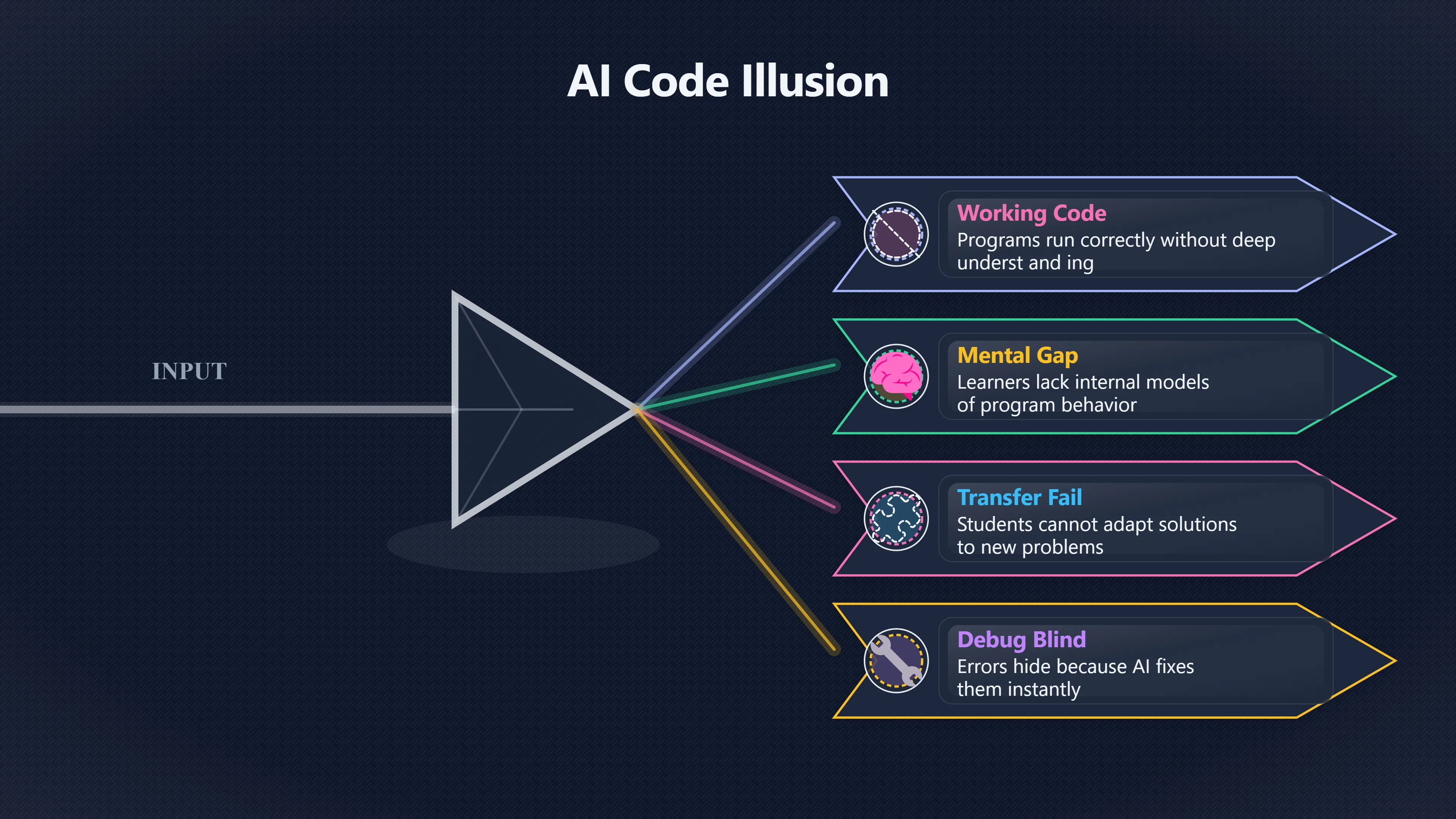
Working code can make students feel fluent while leaving them unable to explain, adapt, or rebuild the solution alone.
On this page
- Why running code feels like proof of skill
- Transfer tests: what happens when help disappears
- How assignments can reward output over understanding
Page outline Jump by section
Introduction
One of the most misleading features of AI-assisted programming is that the code often works. A student asks ChatGPT for help, receives a complete solution, runs it, sees the correct output, and concludes that learning has happened. Sometimes it has. But working software is a poor measure of whether someone can explain the solution, modify it, debug it, or recreate it later without assistance.
 This matters far beyond classroom grades. If AI is to expand human capability on a large scale — helping more people participate in science, engineering, automation, and technological progress — then people need genuine understanding, not just successful outputs. The danger is not that AI-generated code fails. It is that it succeeds so smoothly that weaknesses remain hidden until learners face a new problem, a broken system, or a situation where the AI is unavailable. Researchers increasingly describe this as a form of false mastery: performance that looks impressive while underlying understanding remains fragile.[arXiv]arxiv.orgarXiv Students Struggle to Explain Their Own Program CodeStudents Struggle to Explain Their Own Program CodeApril 14, 2021…
Why running code feels like proof of skill
Programming creates a particularly strong illusion of competence because it provides immediate feedback. Unlike an essay or a philosophical argument, a program often appears to deliver a clear verdict. It either runs or it does not.
For beginners, this can blur two very different achievements:
- Producing a correct result.
- Understanding why the result is correct.
Before AI coding assistants became common, students usually had to bridge this gap themselves. They wrote code, encountered errors, tested assumptions, and gradually built mental models of how programs executed. The process was often frustrating, but it forced learners to connect abstract concepts to actual behaviour.
AI changes this relationship. A student can now obtain a functioning solution before developing the underlying model. The output arrives first; understanding becomes optional.
Programming education research has long emphasised the importance of mental models: the internal representations programmers build to understand how code behaves. Strong mental models help learners transfer knowledge between problems, predict failures, and reason about unfamiliar systems. Weak mental models allow students to complete specific exercises while struggling to explain what the code is actually doing.[ResearchGate]researchgate.netResearchGate(PDF) Self-efficacy and mental models in learning to programSeptember 1, 2004 — This research investigates the effects of stu…
The problem becomes more severe when AI-generated code is clean, convincing, and professionally structured. Students may interpret polished output as evidence that they themselves have mastered the underlying concepts. The psychological reward arrives immediately, while the learning deficit remains invisible.
The hidden gap between recognition and generation
A learner often discovers that understanding code is easier than creating it.
This distinction appears throughout cognitive science. People frequently mistake recognition for mastery. Seeing a solution and following its logic can feel very similar to being able to generate that solution independently. In reality, the second task is much harder.
Programming exposes this difference constantly.
A student may:
- Read an AI-generated function and agree with every step.
- Follow an explanation line by line.
- Correctly answer questions about what the code does.
Yet still fail to write a comparable function from a blank page.
The reason is that explanation and production rely on different cognitive processes. Producing software requires planning, decomposition, abstraction, debugging, and decision-making under uncertainty. Reviewing a finished solution removes much of that difficulty.
Researchers studying novice programmers have repeatedly found that students often overestimate their understanding of code structures and algorithms. Learners may focus on whether a program passes visible test cases rather than whether they understand the principles that produced the solution.[arXiv]arxiv.orgarXiv Students Struggle to Explain Their Own Program CodeStudents Struggle to Explain Their Own Program CodeApril 14, 2021…
AI can amplify this tendency because it dramatically lowers the cost of obtaining apparently correct answers.
Transfer tests reveal what learners actually know
One of the strongest ways to detect false mastery is through transfer.
A transfer test asks whether knowledge gained in one context can be used in another. Instead of repeating the original exercise, learners face a related but slightly different problem.
This is where hidden weaknesses often appear.
A student who completed an assignment with extensive AI assistance may perform well on that exact task. But when asked to:
- Adapt the solution to new requirements.
- Explain the reasoning behind a design choice.
- Debug a similar program.
- Solve the problem without AI support.
Performance can drop sharply.
Studies examining programming education with AI assistance increasingly focus on this distinction between assisted performance and independent capability. Research on programming learners using AI tools has found that many students successfully complete coding tasks with support but encounter difficulties when extending, modifying, or explaining solutions later.[arXiv]arxiv.orgarXiv Students Struggle to Explain Their Own Program CodeStudents Struggle to Explain Their Own Program CodeApril 14, 2021…
A particularly revealing finding comes from work asking students to explain code they themselves submitted. Researchers found that roughly one-third struggled to explain aspects of their own programs despite having successfully completed the exercises. The visible success of the assignment concealed weaknesses that became apparent only when explanation was required.[arXiv]arxiv.orgarXiv Students Struggle to Explain Their Own Program CodeStudents Struggle to Explain Their Own Program CodeApril 14, 2021…
In other words, successful completion and genuine understanding are not the same thing.
Debugging is where weak understanding becomes visible
Many programming educators view debugging as one of the clearest windows into understanding.
When code breaks, students must:
- Form hypotheses.
- Trace execution.
- Predict behaviour.
- Identify incorrect assumptions.
- Reason about cause and effect.
These activities reveal whether someone has built an accurate mental model of the program.
AI can help with debugging. It can explain error messages, suggest fixes, and identify common mistakes. But when learners immediately outsource the diagnosis process, they may bypass the very reasoning that debugging develops.
This matters because real software development rarely involves creating small programs from scratch. Much of professional programming consists of understanding unfamiliar code, tracing failures, and modifying existing systems.
Research on programming education consistently shows that debugging difficulties have downstream consequences for learning. Students who never develop debugging skills often struggle when systems become more complex.[eleanorourke.com]eleanorourke.comdecoding debugging instructionThese struggles can have significant downstream…Read more…
A learner whose code works only because the AI repaired every mistake may appear competent during coursework while remaining poorly prepared for real-world software maintenance.
How assignments can reward output over understanding
Traditional programming assessments were designed in a world where producing functioning code usually required substantial individual effort.
Generative AI changes that assumption.
Many assignments still reward visible outputs:
- Does the program compile?
- Does it pass the tests?
- Does it meet the specification?
These measures are useful, but they increasingly fail to distinguish between independent reasoning and successful AI orchestration.
This creates an incentive problem. If grades depend primarily on completed programs, students may rationally optimise for completion rather than understanding. Under deadline pressure, obtaining a correct answer becomes more attractive than wrestling with uncertainty.
The result can be a widening gap between measured performance and actual capability.
The OECD’s 2026 Digital Education Outlook warned that generative AI can create a “mirage of false mastery” in which high-quality outputs conceal weaknesses in underlying cognitive processes. The report argued that educational systems may need to evaluate reasoning, explanation, and problem-solving processes rather than focusing only on final products.[The Australian]theaustralian.com.auThe report highlights concerns that GenAI fosters a deceptive sense of mastery among students by generating high-quality outputs that mas…
Programming courses are already experimenting with responses:
- Oral code explanations.
- Live coding sessions.
- Debugging-focused assessments.
- Code-reading exercises.[instagram.com]instagram.com, without delivering significant efficiency gains on average.”Read more…
- Reflection prompts requiring students to justify design decisions.
The common goal is to make thinking visible rather than judging only the finished artefact.
Why this matters for the broader AI bloom vision
The optimistic case for AI-assisted education is not merely that more people can produce code. It is that more people can become capable problem-solvers, researchers, engineers, and creators.
Those are different outcomes.
If AI allows learners to reach understanding faster, the implications are profound. Programming could become more accessible. Technical education could scale to larger populations. People with weaker backgrounds could enter fields previously closed to them. Evidence already suggests that AI tools can reduce barriers and accelerate early learning when used as tutors rather than replacements for thought.[arXiv]arxiv.orgarXiv Students Struggle to Explain Their Own Program CodeStudents Struggle to Explain Their Own Program CodeApril 14, 2021…[cambridge]cambridge.orgCambridge University Press & AssessmentGenerative AI in Computer Science Educationby D Franklin · 2025 · Cited by 23 — Generative AI is a… University Press & Assessment
But if educational systems mistake AI-assisted output for genuine skill development, apparent progress may be fragile. A society could appear to have produced more programmers while actually producing fewer people capable of independent reasoning about software systems.
The distinction becomes especially important in a future where AI itself plays a larger role in scientific research, infrastructure management, medicine, and governance. Human understanding may become more valuable, not less, when civilisation depends on increasingly complex technological systems.
The central lesson is simple but easy to overlook: working code demonstrates that a problem has been solved. It does not necessarily demonstrate who understands the solution. The more capable AI becomes at producing software, the more important that distinction may become.
Amazon book picks
Further Reading
Books and field guides related to Why working code can fool learners. Use these as the next step if you want deeper reading beyond the article.
The Pragmatic Programmer
Rating: 4.5/5 from 7 Google Books ratings
Shows that understanding and adaptability matter more than producing code that merely runs.
Think Like a Programmer
Emphasises transferable problem-solving over solution copying.
eBay marketplace picks
Marketplace Samples
Example marketplace items related to this page. Use the search link to explore similar finds on eBay.


Endnotes
1.
Source: arxiv.org
Title: arXiv Students Struggle to Explain Their Own Program Code
Link:https://arxiv.org/abs/2104.06710
Source snippet
Students Struggle to Explain Their Own Program CodeApril 14, 2021...
Published: April 14, 2021
2.
Source: researchgate.net
Link:https://www.researchgate.net/publication/220807692_Self-efficacy_and_mental_models_in_learning_to_program
Source snippet
ResearchGate(PDF) Self-efficacy and mental models in learning to programSeptember 1, 2004 — This research investigates the effects of stu...
Published: September 1, 2004
3.
Source: arxiv.org
Link:https://arxiv.org/abs/2212.07763
4.
Source: arxiv.org
Link:https://arxiv.org/html/2507.22085v2
Source snippet
BOOP: Write Right CodeIn general, students even tend to overestimate their understanding of program constructions [25]. This is ref...
5.
Source: arxiv.org
Title: arXiv Tool or Trouble?
Link:https://arxiv.org/html/2507.22900v1
Source snippet
Exploring Student Attitudes Toward AI...This exploratory study examines how AI code assistants shape novice programmers' experiences dur...
6.
Source: arxiv.org
Link:https://arxiv.org/html/2507.11543v1
Source snippet
A Review of Generative AI in Computer Science Education17 Jun 2025 — This paper surveys the use of Generative AI tools, such as ChatGPT a...
7.
Source: eleanorourke.com
Title: decoding debugging instruction
Link:https://www.eleanorourke.com/papers/decoding_debugging_instruction.pdf
Source snippet
These struggles can have significant downstream...Read more...
8.
Source: oecd.org
Title: 062a7394 en
Link:https://www.oecd.org/content/dam/oecd/en/publications/reports/2026/01/oecd-digital-education-outlook-2026_940e0dd8/062a7394-en.pdf
Source snippet
OECD Digital Education Outlook 2026 (EN)This 2026 edition synthesises evidence and expert insights to show how generative AI has the pote...
9.
Source: arxiv.org
Link:https://arxiv.org/abs/2505.20329
Source snippet
Generative AI in Computer Science Education: Accelerating Python Learning with ChatGPTMay 24, 2025...
Published: May 24, 2025
10.
Source: cambridge.org
Link:https://www.cambridge.org/core/elements/generative-ai-in-computer-science-education/0A22106CBD7FCB391FD120C56E21420F
Source snippet
Cambridge University Press & AssessmentGenerative AI in Computer Science Educationby D Franklin · 2025 · Cited by 23 — Generative AI is a...
11.
Source: researchgate.net
Link:https://www.researchgate.net/publication/399716242_Learning_Behavior_and_Pedagogy_A_Systematic_Review_of_Generative_AI_Use_in_Programming_Education
Source snippet
A Systematic Review of Generative AI Use in Programming...17 Jan 2026 — In programming education, a review of 45 studies reports improve...
12.
Source: researchgate.net
Link:https://www.researchgate.net/publication/398851683_Engaging_Students_with_AI_for_Code_Comprehension_Critique_and_Explanation
Source snippet
(PDF) Engaging Students with AI for Code Comprehension...19 Dec 2025 — This chapter will present a summary of how students learn to code...
13.
Source: theaustralian.com.au
Link:https://www.theaustralian.com.au/higher-education/student-reliance-on-ai-is-a-shortcut-that-masks-a-failure-to-learn-the-oecd-warns/news-story/868d0c5769c42446ba140807e8de8fd4
Source snippet
The report highlights concerns that GenAI fosters a deceptive sense of mastery among students by generating high-quality outputs that mas...
14.
Source: instagram.com
Link:https://www.instagram.com/p/DUYyuCMEsNC/
Source snippet
, without delivering significant efficiency gains on average.”Read more...
Additional References
15.
Source: linkedin.com
Link:https://www.linkedin.com/posts/addyosmani_ai-programming-softwareengineering-activity-7423836698100416513-H0W4
Source snippet
AI Assistance vs Comprehension: Developers Who Ask...AI doesn't make you dumber, but passive reliance does. The difference is asking "wh...
16.
Source: cs.ucr.edu
Link:https://www.cs.ucr.edu/~vahid/pubs/asee2018_errors_struggle.pdf
Source snippet
Computer Science and EngineeringAn Analysis of Common Errors Leading to Excessive Student...by N Alzahrani · Cited by 12 — Ginat suggest...
17.
Source: facebook.com
Link:https://www.facebook.com/vaibhavsisintyofficial/posts/ai-made-you-dumber-overnightanthropic-tested-52-developers-half-used-ai-half-cod/1354799203330866/
18.
Source: scienceinpoland.pl
Link:https://scienceinpoland.pl/en/news/news%2C112183%2Cgenerative-ai-misuse-can-weaken-students-independent-thinking-study-finds.html
Source snippet
Generative AI misuse can weaken students' independent...8 Apr 2026 — Misuse of generative artificial [intelligence]({{ 'intelligence/' | relative_url }}) tools in education can...
19.
Source: medium.com
Title: stop asking ai to do it ask ai to teach you how 8693f1bd93d4
Link:https://medium.com/write-rise/stop-asking-ai-to-do-it-ask-ai-to-teach-you-how-8693f1bd93d4
Source snippet
Stop Asking AI to Do It. Ask AI to Teach You How.A 2025 Tandfonline study on AI-assisted programming education found that students who us...
20.
Source: reddit.com
Link:https://www.reddit.com/r/vibecoding/comments/1qkmavw/lets_be_honest_programmers_who_pride_themselves/
Source snippet
hom think they are superior by not using AI in coding to increase...Read more...
21.
Source: reddit.com
Link:https://www.reddit.com/r/learnprogramming/comments/1f0qu7o/why_do_you_think_some_people_get_it_programming/
Source snippet
t school and university, most people who try it seem to not get it...
22.
Source: open.metu.edu.tr
Title: Hacer Guner Ph DThesis Final Submission
Link:https://open.metu.edu.tr/bitstream/handle/11511/118396/HacerGuner_PhDThesis_Final-Submission.pdf
Source snippet
GENERATIVE AI INTO PROGRAMMING...by E Er · 2026 — This research investigates the effects of different pedagogical approaches to integrat...
23.
Source: youtube.com
Title: The Programmer’s Brain and the Importance of Cognition
Link:https://www.youtube.com/watch?v=62D6fxsJIBM
Source snippet
Stop Watching Tutorials. Do This Instead - YouTube Stop Watching Tutorials. Do This Instead - YouTube...
24.
Source: tandfonline.com
Link:https://www.tandfonline.com/doi/full/10.1080/0144929X.2024.2394886
Source snippet
Taylor & Francis OnlineThe promise and challenges of generative AI in educationby M Giannakos · 2025 · Cited by 688 — GenAI's capabilitie...
Topic Tree