Within Health
Has an AI Designed Drug Passed the Real Test?
Rentosertib shows that an AI-assisted drug can reach patients, but one mid-stage trial cannot prove that drug development has been transformed.
On this page
- How AI helped identify the target and molecule
- What the phase 2 a trial established
- Why one successful trial cannot prove industry wide gains
Page outline Jump by section
Introduction
Rentosertib is one of the strongest pieces of evidence yet that artificial intelligence can contribute to the discovery of genuinely new medicines. It is also a reminder that a successful AI system is only the beginning of the drug-development process, not the end. The drug reached a randomised phase 2a clinical trial for idiopathic pulmonary fibrosis (IPF), a progressive lung-scarring disease with limited treatment options. That means an AI-assisted discovery survived laboratory research, manufacturing, regulatory review and testing in human patients—far beyond the computer simulations that dominate many AI demonstrations.[nature.com]nature.comJune 3, 2025…
However, Rentosertib does not prove that AI has transformed pharmaceutical research. The trial was relatively small and short, designed primarily to assess safety and gather early evidence of effectiveness. Like thousands of conventional drug candidates before it, it must still pass larger and more demanding studies before anyone can conclude that it meaningfully improves patients’ lives. For the broader vision of AI-enabled medical progress, Rentosertib is best understood as an encouraging milestone rather than a final verdict.[nature.com]nature.comJune 3, 2025…
How AI helped identify the target and molecule
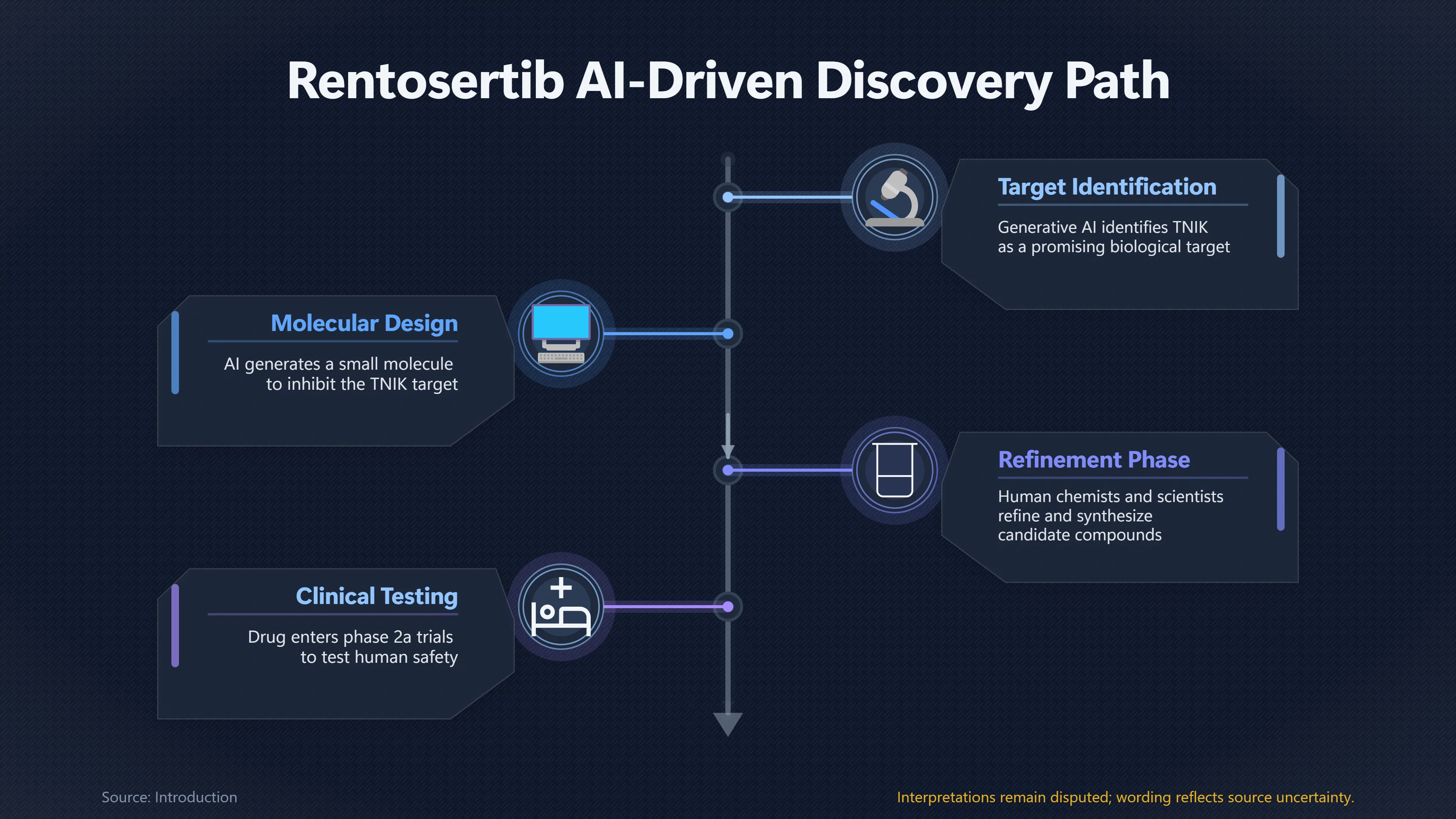
One reason Rentosertib has attracted unusual attention is that AI contributed to two of the hardest stages of drug discovery.
First, generative AI methods were used to identify Traf2- and Nck-interacting kinase (TNIK) as a promising biological target for idiopathic pulmonary fibrosis. Finding the right target is often more difficult than designing the drug itself. Many compounds fail not because they are badly engineered but because they influence the wrong biological process.
Second, AI-assisted molecular design generated a small molecule capable of inhibiting TNIK. Researchers then refined, synthesised and experimentally tested candidate compounds before selecting Rentosertib (formerly ISM001-055) for further development. Human medicinal chemists, laboratory scientists and clinicians remained involved throughout; AI narrowed the search space rather than replacing experimental science.[nature.com]nature.comJune 3, 2025…
This distinction matters. Drug discovery has long used computational tools, but Rentosertib is notable because both the therapeutic target and the candidate molecule were reported as products of a generative AI-driven discovery process before entering conventional preclinical and clinical development. That makes it a stronger test of AI-assisted discovery than simply using machine learning to optimise an already known drug.[nature.com]nature.comJune 3, 2025…
What the phase 2a trial established
The real significance of Rentosertib is not that an algorithm proposed it, but that the proposal survived contact with reality.
The published phase 2a study was a multicentre, double-blind, randomised, placebo-controlled trial involving 71 patients with idiopathic pulmonary fibrosis over 12 weeks. Participants received one of three dosing regimens or placebo. The primary objective was to evaluate safety and tolerability rather than to provide definitive proof of clinical benefit.[nature.com]nature.comJune 3, 2025…
The trial established several important points:
- The drug could be administered safely enough to justify further testing. Rates of treatment-emergent adverse events were broadly similar across treatment and placebo groups, although liver toxicity and diarrhoea contributed to some treatment discontinuations.[nature.com]nature.comJune 3, 2025…
- There were encouraging signs of biological activity. Patients receiving the highest once-daily dose showed an average improvement in forced vital capacity (FVC), a standard measure of lung function, while the placebo group showed a slight average decline during the study period.[nature.com]nature.comJune 3, 2025…
- The results justified larger trials rather than clinical adoption. The investigators concluded that the findings warranted further investigation in larger and longer studies rather than demonstrating that the drug should become routine treatment.[nature.com]nature.comJune 3, 2025…
These outcomes matter because they show that an AI-assisted discovery can survive the transition from computer-generated hypothesis to regulated human testing. Many proposed molecules never reach this point.
Why one successful trial cannot prove industry-wide gains
It is tempting to treat Rentosertib as proof that AI has solved drug discovery. The evidence does not support such a conclusion.
The trial was intentionally modest in size and duration. Phase 2a studies are designed to identify promising signals, optimise dosing and detect common safety problems. They are not intended to provide definitive evidence that patients live longer, experience substantially better quality of life or receive durable clinical benefit.
Several important uncertainties therefore remain.
The sample was small. With only 71 participants divided across four treatment groups, chance variation can influence apparent treatment effects.
The follow-up was brief. Idiopathic pulmonary fibrosis is a chronic disease measured over years, not weeks. A 12-week improvement does not necessarily translate into sustained long-term benefit.
Later-stage failures remain common. Many drugs—whether discovered by humans or AI—produce encouraging early results before failing in larger phase 3 trials because benefits disappear, side effects emerge or performance proves inconsistent across broader patient populations.[nature.com]nature.comJune 3, 2025…
Even the Nature Medicine paper explicitly notes the broader uncertainty. Few AI-discovered drugs have progressed to advanced clinical stages, none had completed phase 3 at the time of publication, and it remains unknown whether AI-derived candidates ultimately outperform conventionally discovered medicines in approval rates or overall development productivity.[DOI]doi.orgA generative AI-discovered TNIK inhibitor for idiopathic pulmonary fibrosis: a randomized phase 2a trial | Nature Medicine…
What Rentosertib means for AI medicine and healthy longevity
Within the broader discussion of AI medicine and healthy longevity, Rentosertib is valuable because it shifts the debate from theoretical capability to measurable evidence.
The strongest claim supported by current evidence is not that AI already delivers better medicines, but that AI can contribute to discovering drug candidates capable of surviving increasingly demanding scientific tests. That is an important milestone because every stage of drug development acts as a filter. A molecule must satisfy chemists, biologists, toxicologists, manufacturers, regulators and clinicians before it can help patients.
If AI consistently increases the number of candidates reaching this stage—or reduces the time and cost required to find them—it could accelerate progress against diseases associated with ageing and chronic illness. Faster discovery would not guarantee medical breakthroughs, but it could allow researchers to explore many more biological hypotheses than traditional methods permit.
Whether that possibility becomes reality depends on evidence still to come. The decisive test is not whether AI can generate convincing molecules on a computer, but whether those molecules repeatedly demonstrate safety and meaningful clinical benefit across large human trials. Rentosertib has crossed one important threshold on that path. It has not yet crossed the last.[nature.com]nature.comJune 3, 2025…
Amazon book picks
Further Reading
Books and field guides related to Has an AI Designed Drug Passed the Real Test?. Use these as the next step if you want deeper reading beyond the article.
The Drug Hunters: The Improbable Quest to Discover New Medicines
The surprising, behind-the-scenes story of how our medicines are discovered, told by a veteran drug hunter. The search to find medicines...
The Billion Dollar Molecule: One Company's Quest for the Perf...
First published 1994. Subjects: Pharmaceutical biotechnology, Pharmaceutical industry, United States, Vertex Pharmaceuticals Incorporated...
The Gene: An Intimate History
Prologue: Families -- "The missing science of heredity" 1865-1935 -- "In the sum of the parts, there are only the parts" 1930-1970 -- "Th...
The Code Breaker: Jennifer Doudna, Gene Editing, and the Futu...
"A gripping account of how the pioneering scientist Jennifer Doudna, along with her colleagues and rivals, launched a revolution that wil...
eBay marketplace picks
Marketplace Samples
Live-tested eBay searches with available results related to this page.
Selected frommolecule model oneBay.co.uk.


Endnotes
1.
Source: nature.com
Link:https://www.nature.com/articles/s41591-025-03743-2
Source snippet
June 3, 2025...
Published: June 3, 2025
2.
Source: doi.org
Link:https://doi.org/10.1038/s41591-025-03743-2
Source snippet
A generative AI-discovered TNIK inhibitor for idiopathic pulmonary fibrosis: a randomized phase 2a trial | Nature Medicine...
3.
Source: rentosertib.net
Link:https://www.rentosertib.net/
Source snippet
Rentosertib Encyclopedia — From Target Discovery and Generative Chemistry to Phase III Clinical TrialsJuly 7, 2026 — EVERYTHING TO KNOW A...
Published: July 7, 2026
5.
Source: nature.com
Link:https://www.nature.com/nature-index/article/10.1038/s41591-025-03743-2
Additional References
6.
Source: pubmed.ncbi.nlm.nih.gov
Link:https://pubmed.ncbi.nlm.nih.gov/40461817/
Source snippet
A generative AI-discovered TNIK inhibitor for idiopathic pulmonary fibrosis: a randomized phase 2a trial - PubMed...
7.
Source: insilico.com
Link:https://insilico.com/news/xmjsn4l091-insilico-initiates-phase-iii-clinical-tr
Source snippet
Insilico Initiates Phase III Clinical Trial for Rentosertib, Its AI-Empowered TNIK Inhibitor for Idiopathic Pulmonary FibrosisJuly 7, 202...
8.
Source: thetimes.co.uk
Link:https://www.thetimes.co.uk/article/even-a-sceptic-can-see-ai-will-transform-the-discovery-of-drugs-80gb8wmh2
Source snippet
Although early trials of ISM001-055 showed modest efficacy, its true significance lies in its AI-driven design by the biotechnology compa...
9.
Source: robofutur.com
Title: Rentosertib: What an AI-Discovered Drug Actually Proves
Link:https://robofutur.com/en/articles/ai-drug-rentosertib-phase-2/
Source snippet
July 18, 2026 — AN AI-DISCOVERED DRUG REACHED PHASE 2: WHAT RENTOSERTIB PROVED — AND DIDN'T By RoboFutur · July 18, 2026 · 3 min read 🩺 M...
Published: July 18, 2026
10.
Source: wired.com
Title: artificial intelligence drug discovery
Link:https://www.wired.com/story/artificial-intelligence-drug-discovery
Source snippet
AI helps narrow down viable molecules more efficiently—Ray’s MALT1 inhibitor, for example, was chosen from just 344 candidates, compared...
11.
Source: youtube.com
Link:https://www.youtube.com/watch?v=RMYkvbhOezo
Source snippet
Insilico Medicine's first AI-discovered antifibrotic drug goes first-in-human...
12.
Source: youtube.com
Title: Insilico Medicine’s first AI-discovered antifibrotic drug goes first-in-human
Link:https://www.youtube.com/watch?v=I5PhN5Y7QHk
Source snippet
PandaOmics 6.0: Hear from Alex Zhavoronkov, PhD, and Frank Pun, PhD...
13.
Source: youtube.com
Title: Story of Rentosertib ISM001-055
Link:https://www.youtube.com/watch?v=KyUDHnePu6M
Source snippet
Coding the Impossible Cure--The First AI-Powered Drug with Safety and Efficacy Proved in Phase IIa...
14.
Source: researchgate.net
Link:https://www.researchgate.net/publication/392366960_A_generative_AI-discovered_TNIK_inhibitor_for_idiopathic_pulmonary_fibrosis_a_randomized_phase_2a_trial
15.
Source: fibrosis-inflammation.com
Link:https://www.fibrosis-inflammation.com/en/insights/drug_rentosertib_tnik