Within Robotics
Managing Risks When Humans and Robots Work Together
Focuses on risks and safety considerations when humans work alongside AI-driven robots in dynamic environments.
On this page
- Physical safety and unexpected contact hazards
- Psychological and trust factors in collaboration
- Standards and training for safe interaction
Page outline Jump by section
Introduction
As robots become more capable and AI‑driven machines enter everyday workplaces—not just isolated factory floors—ensuring that human workers are safe when they work alongside these systems is a core concern. Human–robot interaction (HRI) and workplace safety focuses on the risks and safeguards that matter when people share physical space, tasks or decision‑making with robots and autonomous machines. These issues go well beyond traditional automation safety, which relied on physical separation; they stretch into psychology, trust, design standards, and rigorous risk assessment. Properly managed, human–robot interaction can reduce hazardous labour while supporting humans in higher‑value work; poorly managed, it can introduce new dangers and undermine worker confidence. This page explains the mechanisms, hazards and mitigation strategies that matter in collaborative workplaces.

Physical Safety and Contact Hazards
A central safety question in human–robot interaction is physical contact risk: how to prevent robots from injuring humans when they share space or work together on tasks. In traditional industrial automation, workers were kept away from heavy machinery using fences, light curtains or physical guards, and robots only operated at full speed when humans were not in range. Collaborative robotics—which lets humans and robots work in a shared workspace—breaks this pattern, calling for new risk‑management approaches.[MDPI]
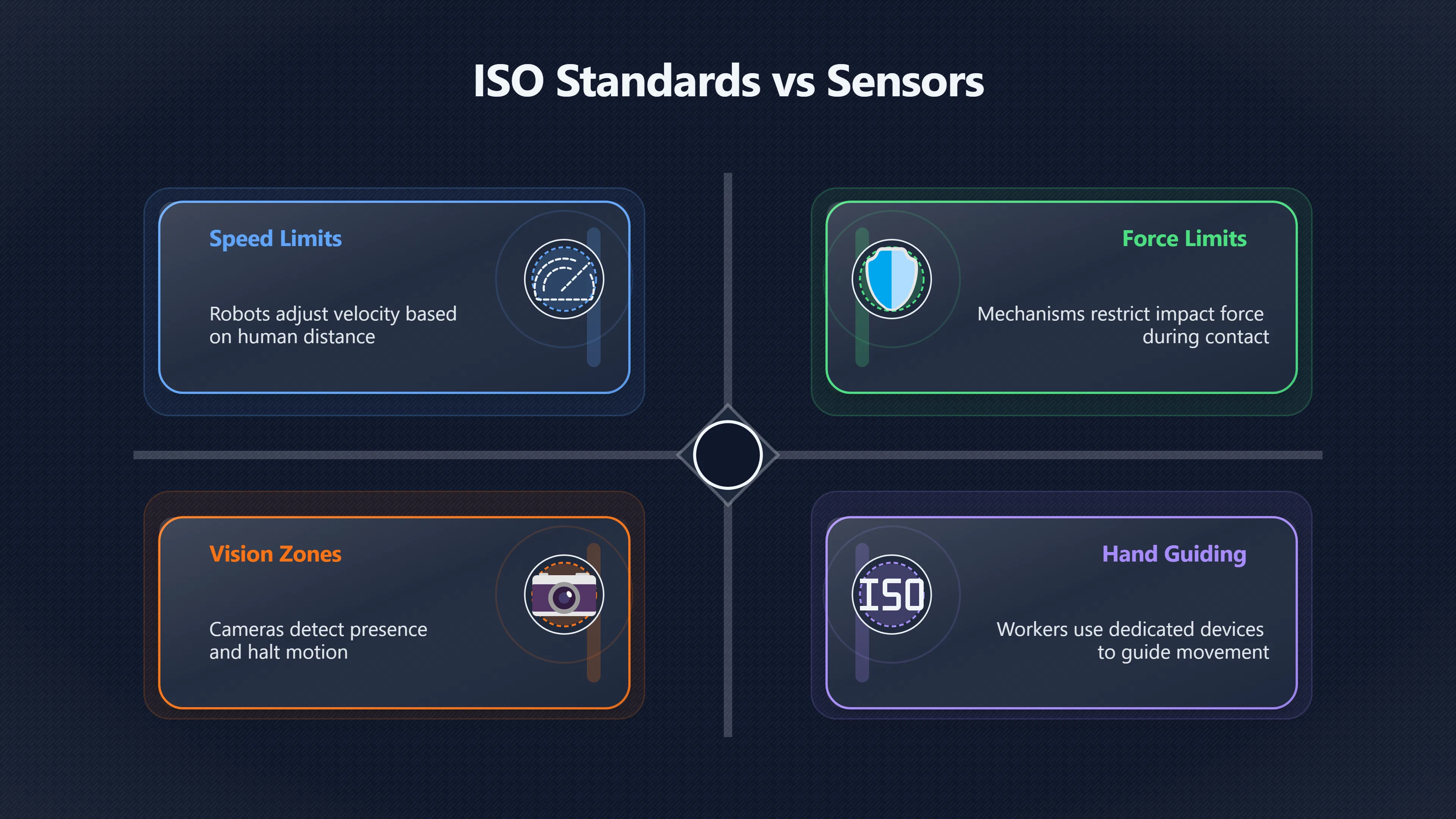
Safety standards and operation modes: International technical specifications such as ISO/TS 15066 and ISO 10218 define how collaborative operations can be carried out safely. These standards describe modes such as safety‑rated monitored stop (halting robot motion when a human enters), hand guiding (where humans use dedicated devices to guide robot movement), speed and separation monitoring (robots adjust speed based on distance from a human) and power and force limiting (robots restrict force applied during contact). These mechanisms set biomechanical limits intended to reduce the severity of any accidental contact based on body region and anticipated interaction.[MDPI]
Sensors and real‑time monitoring: Modern systems use suites of sensors—vision systems, depth cameras and laser scanners—to detect human presence and proactively manage robot motion. Vision‑based safety systems defined zones around robotic workspaces and adjust robot speed or halt motion when a human enters a safety boundary, aiming to ensure that reaction times meet required safety thresholds.[arXiv]arxiv.orgarXiv Vision-Based Safety System for Barrierless Human-Robot CollaborationVision-Based Safety System for Barrierless Human-Robot CollaborationAugust 3, 2022…
Even with these safeguards, inadequate safety measures can still pose risks. Most industrial robots lack innate awareness of their environment, and without appropriate sensors and control logic, collisions remain possible. Rigorous task‑based risk assessment—evaluating every robot’s behaviour, tooling, work cycle and contact scenario before it is deployed—is vital for identifying and mitigating hazards unique to each application.[NIST]nist.govcharacterizing task based human robot collaboration safety manufacturingCharacterizing Task-Based Human-Robot Collaboration Safety in Manufacturing | NISTFebruary 27, 2015…
Psychological Safety and Trust in Collaboration
Physical contact isn’t the only safety concern. How safe workers feel when interacting with robots strongly influences performance, situational awareness and long‑term adoption of collaborative systems. Perceived safety is shaped by robot behaviour, predictability, appearance and communication cues. In research settings, robot approach speed, direction and signalling (such as projected signals or turn indicators) significantly affected workers’ sense of safety and trust. Unpredictable motion or opaque decision‑making can increase psychological stress and erode confidence in the system, even when physical safeguards are in place.[PubMed]pubmed.ncbi.nlm.nih.govA Literature Review on Safety Perception and Trust during Human-Robot Interaction with Autonomous Mobile Robots That Apply to Indus…
Researchers highlight the importance of predictable, interpretable robot actions, intuitive interfaces and clear communication of intent. For example, haptic feedback devices, visual cues on the floor or explicit signalling can help humans anticipate robot actions and maintain situational awareness. Loss of trust can lead to over‑cautious behaviour, under‑engagement with the robot, or even outright rejection of collaborative systems, all of which reduce productivity and undermine safety culture.[PubMed]pubmed.ncbi.nlm.nih.govA Literature Review on Safety Perception and Trust during Human-Robot Interaction with Autonomous Mobile Robots That Apply to Indus…
Cognitive safety complements physical safety: a robot might be physically incapable of harming a human, yet its unpredictable or inexplicable actions could “freeze” workers, distract them or induce stress, which in turn can lead to mistakes or safety lapses. Integrated design must therefore consider both the mechanical safety limits and the human psychological experience of collaboration.[PMC]
Standards, Training and Risk Management
Human–robot safety relies heavily on formal standards, comprehensive training and ongoing risk management. Standards from bodies such as the International Organization for Standardization (ISO), the American National Standards Institute (ANSI) and workplace safety regulators set baseline requirements for design, implementation and verification of robot systems. These standards require employers and integrators to conduct hazard analyses, document safety measures and validate that systems meet performance criteria before allowing human‑robot collaboration.[Robotic Systems Authority]roboticsystemsauthority.comSource details in endnotes.
A risk assessment should be task‑based, meaning it evaluates the specific hazards associated with a particular robot’s task, workspace constraints, human roles and expected interactions. It considers potential tool forces, durations of contact, sensor limitations and environmental variables. Such assessments guide the selection of safeguards, from limiting robot speed to adding proximity sensors or reconfiguring workflows to minimise human exposure to dynamic motion zones.[NIST]nist.govcharacterizing task based human robot collaboration safety manufacturingCharacterizing Task-Based Human-Robot Collaboration Safety in Manufacturing | NISTFebruary 27, 2015…
Training and competency: Workers must understand how robots operate, safety protocols, emergency stop procedures and how to interpret robot signals. Training builds both procedural knowledge and confidence, reducing hesitation and confusion during interactions. Engaging workers in safety planning also ensures that procedures are grounded in real‑world workflows rather than abstract checklists.
Balancing Productivity and Safety
The goal of human–robot interaction in the workplace is not to eliminate human roles but to augment human capabilities safely—allowing robots to take on repetitive, hazardous or physically strenuous tasks while humans focus on judgement, oversight and complex decision‑making. Collaborative systems that are safe and trusted can increase productivity and job satisfaction, reduce injuries and help organisations move toward more adaptive work processes.
However, achieving that balance requires careful engineering, adherence to evolving standards and continuous attention to both physical and psychological safety. As industries push robots into more dynamic, less controlled environments—such as logistics hubs, healthcare or construction—these safety considerations will only become more pivotal. Embracing rigorous design, risk assessment, training and ongoing evaluation allows the promise of safer, more productive human–robot collaboration to be realised without compromising worker wellbeing.
Amazon book picks
Further Reading
Books and field guides related to Managing Risks When Humans and Robots Work Together. Use these as the next step if you want deeper reading beyond the article.
The Coming Wave
Directly addresses whether advanced AI can deliver broad civilisational benefits while remaining governable.
Human Compatible
Explores how powerful AI could advance humanity if aligned with human values.
eBay marketplace picks
Marketplace Samples
Example marketplace items related to this page. Use the search link to explore similar finds on eBay.


Endnotes
1.
Source: mdpi.com
Link:https://www.mdpi.com/2224-2708/10/3/48
Source snippet
Human–Robot Collaboration Trends and Safety Aspects: A Systematic Review | MDPIJuly 13, 2021...
Published: July 13, 2021
2.
Source: arxiv.org
Title: arXiv Vision-Based Safety System for Barrierless Human-Robot Collaboration
Link:https://arxiv.org/abs/2208.02010
Source snippet
Vision-Based Safety System for Barrierless Human-Robot CollaborationAugust 3, 2022...
Published: August 3, 2022
3.
Source: nist.gov
Title: characterizing task based human robot collaboration safety manufacturing
Link:https://www.nist.gov/publications/characterizing-task-based-human-robot-collaboration-safety-manufacturing
Source snippet
Characterizing Task-Based Human-Robot Collaboration Safety in Manufacturing | NISTFebruary 27, 2015...
Published: February 27, 2015
4.
Source: mdpi.com
Link:https://www.mdpi.com/2218-6581/14/3/27
Source snippet
Assessing Safety in Physical Human–Robot Interaction in Industrial Settings: A Systematic Review of Contact Modelling and Impact Measurin...
Published: February 28, 2025
5.
Source: mdpi.com
Title: Validating Safety in Human–Robot Collaboration: Standards and New Perspectives
Link:https://www.mdpi.com/2218-6581/10/2/65
Source snippet
In parallel, the use of robots and robotic devices is increasing in several fields, substituti...
Published: April 29, 2021
6.
Source: mdpi.com
Title: Validating Safety in Human–Robot Collaboration: Standards and New Perspectives
Link:https://www.mdpi.com/2218-6581/10/2/65/html
Source snippet
ROBOT SAFETY: THE REGULATORY FRAMEWORK 2.1. OVERVIEW The main regulation in the European community dealing with robot safety is the Machi...
Published: April 29, 2021
7.
Source: pubmed.ncbi.nlm.nih.gov
Link:https://pubmed.ncbi.nlm.nih.gov/38190192/
Source snippet
A Literature Review on Safety Perception and Trust during Human-Robot Interaction with Autonomous Mobile Robots That Apply to Indus...
Published: January 8, 2024
8.
Source: roboticsystemsauthority.com
Link:https://roboticsystemsauthority.com/human-robot-interaction-and-collaboration
Additional References
9.
Source: pmc.ncbi.nlm.nih.gov
Link:https://pmc.ncbi.nlm.nih.gov/articles/PMC8037017/
Source snippet
PRELIMINARIES Quality, accuracy, reliability, and error rates are characteristics that must be evaluated in safety components. The princi...
Published: April 1, 2021
10.
Source: osha.gov
Title: OSH A Technical Manual (OTM)
Link:https://www.osha.gov/otm/section-4-safety-hazards/chapter-4
Source snippet
Introduction 2. Basic Components of Industrial Robot Systems 1. Manipulator 2. Control System 3. Teach Pendant 4. E...
11.
Source: researchportal.port.ac.uk
Link:https://researchportal.port.ac.uk/en/publications/working-together-a-review-on-safe-human-robot-collaboration-in-in/
Source snippet
together: a review on safe human-robot collaboration in industrial environments - University of PortsmouthNovember 14, 2017 — WORKING TOG...
Published: November 14, 2017
12.
Source: sciencedirect.com
Link:https://www.sciencedirect.com/science/article/pii/S0736584517302168
Source snippet
ROBOTICS AND COMPUTER-INTEGRATED MANUFACTURING Volume 56, April 2019, Pages 233-243 A CYBER PHYSICAL SYSTEM (CPS) APPROACH F...
Published: April 2019
13.
Source: sciencedirect.com
Title: Collaborative robotics: New era of human–robot cooperation in the workplace
Link:https://www.sciencedirect.com/science/article/abs/pii/S0022437520300797
Source snippet
JOURNAL OF SAFETY RESEARCH Volume 74, September 2020, Pages 153-160 Special Issue: NOIRS Collaborative robotics: New era of...
Published: September 2020
14.
Source: sciencedirect.com
Title: Collaborative robotics: New era of human–robot cooperation in the workplace
Link:https://www.sciencedirect.com/science/article/pii/S0022437520300797
Source snippet
September 1, 2020 — JOURNAL OF SAFETY RESEARCH Volume 74, September 2020, Pages 153-160 Special Issue: NOIRS Collaborative r...
Published: September 1, 2020
15.
Source: sciencedirect.com
Link:https://www.sciencedirect.com/science/article/pii/S0925753523002552
Source snippet
January 1, 2024 — OCCUPATIONAL HEALTH AND SAFETY ISSUES IN HUMAN-ROBOT COLLABORATION: STATE OF THE ART AND OPEN CHALLENGES h...
Published: January 1, 2024
16.
Source: sciencedirect.com
Link:https://www.sciencedirect.com/science/article/pii/S0925753520302290
Source snippet
Orienting safety assurance with outcomes of hazard analysis and risk assessment: A review of the ISO 15066 standard for collaborative rob...
Published: September 1, 2020
17.
Source: sciencedirect.com
Title: Safety bounds in human robot interaction: A survey
Link:https://www.sciencedirect.com/science/article/abs/pii/S0925753520300643
Source snippet
"ScienceDirectSAFETY SCIENCE Volume 127, July 2020, 104667 SAFETY BOUNDS IN HUMAN ROBOT INTERACTION: A SURVEY [https://doi.org/10.1016/j.ss..."](https://doi.org/10.1016/j.ss...")...
Published: July 2020
18.
Source: link.springer.com
Link:https://link.springer.com/article/10.1007/s11740
Source snippet
situational and mode awareness for safe human-robot collaboration: case studies on assembly applications | Production Engineering | Sprin...
Published: December 12, 2018
Topic Tree