Within Lab Access
Can Cloud Labs Democratise Automated Science?
Cloud-operated laboratories could let researchers run robotic experiments remotely without owning costly automation systems.
On this page
- How remote experiment access works
- Who benefits and who may still be excluded
- Reliability, security and allocation challenges
Page outline Jump by section
Introduction
Cloud laboratories promise to answer one of the biggest questions surrounding self-driving laboratories: can expensive scientific automation be shared rather than owned? Instead of every university, startup or hospital building its own robotic research facility, a cloud lab allows researchers to design experiments online, upload protocols, ship samples where necessary, and receive structured data back after robotic systems have performed the work. If this model becomes widespread, access to advanced experimentation could begin to resemble access to cloud computing, where users rent capability instead of purchasing infrastructure. That could broaden participation in AI-accelerated science and make the benefits of automated discovery more widely available. Yet democratisation is not automatic. Cost, internet infrastructure, regulation, security, intellectual property and limited laboratory capacity all influence who can participate and who may remain excluded.[nist.gov]nist.govAutonomous laboratories | NISTAutonomous laboratories | NIST…
How remote experiment access works
A cloud laboratory combines robotic equipment, laboratory automation software and secure online interfaces into a service that researchers can access from almost anywhere. Rather than standing beside instruments, scientists specify experimental protocols through software, submit them to a remote facility, and receive measurements, images and other results electronically. Many systems also store every experimental step digitally, making methods easier to reproduce and audit than traditional handwritten laboratory notebooks.[Emerald Cloud Lab]emeraldcloudlab.comOpen source on emeraldcloudlab.com.
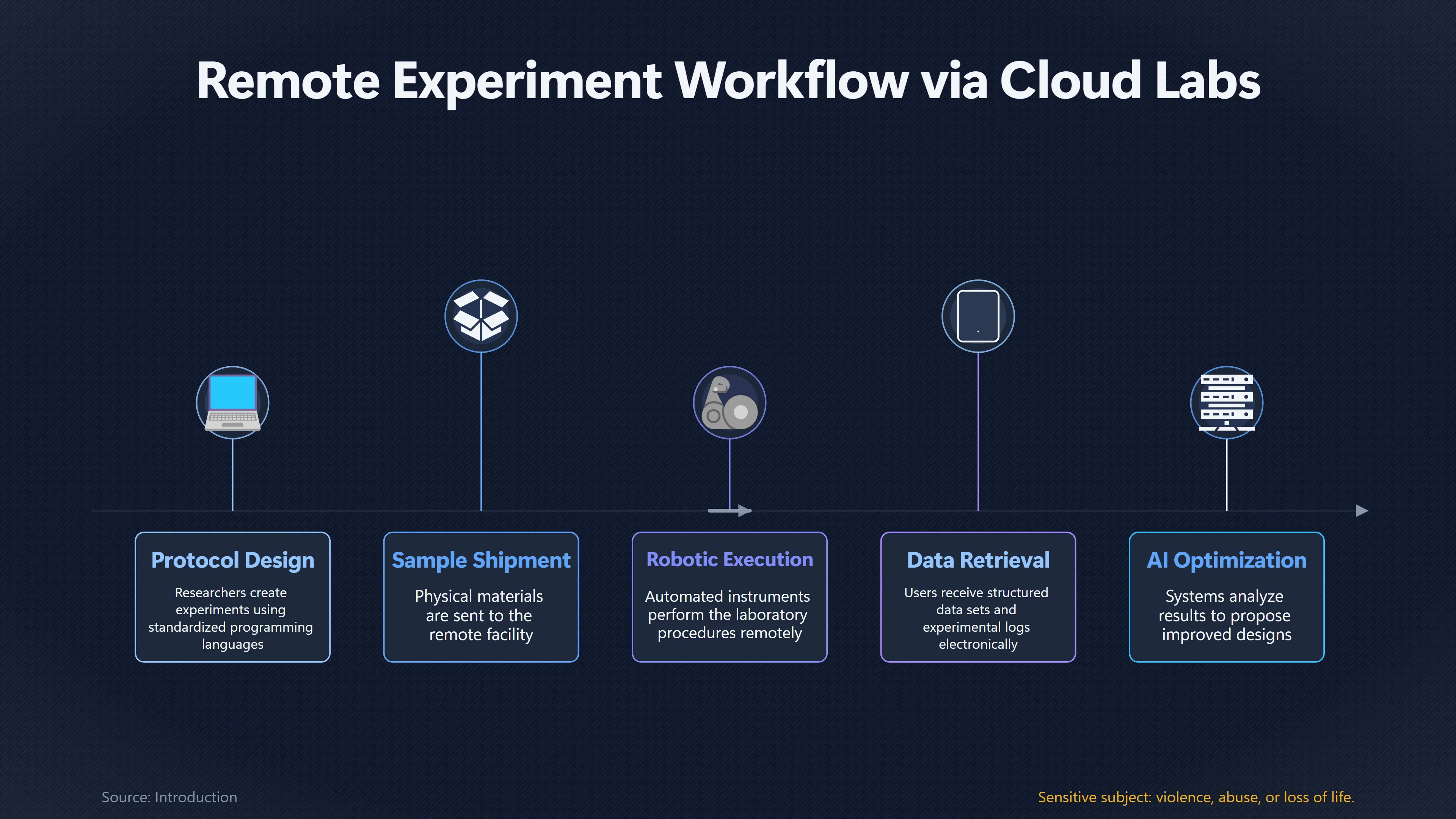
In practice, a typical workflow involves:
- Designing an experiment using standardised software or a laboratory programming language.
- Sending samples to the cloud facility if physical materials are required.
- Scheduling automated execution on robotic instruments.
- Receiving structured datasets, quality-control information and experimental logs.
- Revising the next round of experiments, increasingly with AI systems proposing improved designs.
Because every step is digitally recorded, AI systems can analyse results and suggest follow-up experiments more rapidly than would often be possible in conventional laboratories. This creates the closed feedback loops that underpin many visions of self-driving science.[nist.gov]nist.govAutonomous laboratories | NISTAutonomous laboratories | NIST…
Why cloud access could democratise automated science
The strongest argument for cloud laboratories is economic rather than technical.
A fully autonomous laboratory requires costly robotic liquid handlers, analytical instruments, computing infrastructure, specialist engineers and ongoing maintenance. Many universities, hospitals and companies—particularly outside major research centres—cannot justify these investments.
Cloud access changes that calculation by allowing organisations to purchase experimental capacity instead of entire facilities. This resembles how researchers already access shared supercomputers, synchrotron beamlines or genome sequencing centres. Instead of every institution owning every instrument, they compete for time on shared infrastructure.[NIST]nist.govAutonomous laboratories | NISTAutonomous laboratories | NIST…
Potential beneficiaries include:
- universities with limited laboratory budgets;
- researchers in lower-income countries seeking access to specialised equipment;
- biotechnology startups that cannot yet build comprehensive research facilities;
- clinicians needing occasional access to sophisticated analytical techniques;
- interdisciplinary teams whose work spans many different laboratory methods.
Commercial providers have demonstrated that researchers can remotely control hundreds of different instrument types through unified software interfaces, reducing delays caused by equipment shortages or unavailable expertise.[Emerald Cloud Lab]emeraldcloudlab.comOpen source on emeraldcloudlab.com.
For the broader AI bloom perspective, this matters because scientific progress depends not only on how intelligent AI systems become, but on how many people can combine those systems with physical experimentation. If automated laboratories become widely shareable, scientific capacity could grow much faster than if automation remains concentrated within a handful of elite institutions.
What today’s cloud laboratories already demonstrate
Cloud laboratories are no longer merely theoretical.
Companies including Emerald Cloud Lab and Strateos have operated remote robotic laboratories for years, primarily serving biotechnology companies and pharmaceutical research. Scientists submit experimental workflows electronically while robotic systems execute laboratory procedures continuously, often around the clock.[emeraldcloudlab.com]emeraldcloudlab.comOpen source on emeraldcloudlab.com.
Researchers have identified several practical advantages:
- experiments become easier to reproduce because protocols are encoded digitally rather than interpreted manually;
- instrument utilisation improves because expensive equipment operates continuously;
- collaborations become easier when multiple researchers can access identical experimental workflows;
- AI systems receive cleaner, more structured datasets suitable for optimisation and machine learning.[plos.org]journals.plos.orgSupport academic access to automated cloud labs to improve reproducibility | PLOS Biology…
Academic researchers have also argued that symbolic laboratory languages—standardised digital descriptions of experiments—could eventually allow protocols to be shared much like open-source software. Rather than merely describing methods in journal articles, scientists could publish executable laboratory workflows that other groups rerun remotely with minimal modification.[PLOS]journals.plos.orgSupport academic access to automated cloud labs to improve reproducibility | PLOS Biology…

Who benefits—and who may still be excluded?
Cloud laboratories reduce some barriers while leaving others largely unchanged.
Institutions without automation expertise gain immediate access to sophisticated equipment, but access still depends upon reliable internet connections, shipping logistics, regulatory approvals, technical training and sustainable funding. Biological samples may be difficult or impossible to transport across borders, while some experiments require local handling, hazardous materials or immediate human judgement.
Current pricing also remains a major obstacle. Although cloud laboratories eliminate the capital costs of constructing robotic facilities, commercial offerings have historically been designed for industry customers rather than individual academic research groups. Researchers have argued that existing subscription models and long-term contracts often fit venture-backed biotechnology companies far better than publicly funded universities.[PLOS]journals.plos.orgSupport academic access to automated cloud labs to improve reproducibility | PLOS Biology…
This creates a risk that access shifts from one form of concentration to another:
- wealthy institutions may still purchase substantially more laboratory time;
- commercial priorities may influence which capabilities expand first;
- countries with weak digital infrastructure may remain underrepresented;
- institutions lacking computational expertise may struggle even if laboratory access improves.
Cloud laboratories therefore reduce inequality in infrastructure ownership without necessarily eliminating inequality in scientific opportunity.
Reliability, security and allocation challenges
Making cloud laboratories broadly available requires solving operational problems that receive less attention than AI itself.
Reliability and quality assurance
Remote users must trust that robots are correctly calibrated, instruments are functioning properly and quality-control procedures remain consistent over time. Centralised facilities can improve standardisation because dedicated teams maintain equipment continuously, but any outage affects many users simultaneously.[Emerald Cloud Lab]emeraldcloudlab.comOpen source on emeraldcloudlab.com.
Data security and intellectual property
Many experiments involve commercially valuable discoveries or sensitive biological information. Cloud providers therefore need strong cybersecurity, controlled access to datasets and clear policies governing ownership of experimental outputs. Pharmaceutical companies, universities and public-sector laboratories may all have different legal requirements.
Fair allocation
If demand exceeds capacity, laboratory time becomes a scarce resource.
Governments, research funders and universities may eventually face decisions similar to those made for telescope time or supercomputer allocations:
- should access be purchased commercially?
- should publicly funded facilities reserve capacity for academic researchers?
- should lower-income countries receive dedicated access?
- how should urgent public-health research be prioritised during emergencies?
These allocation rules could substantially influence whether AI-enabled scientific acceleration benefits a broad research community or primarily the best-funded organisations.

What cloud laboratories mean for AI-enabled scientific flourishing
Cloud laboratories are not simply a convenient way to outsource experiments. They represent a possible shift in the economics of scientific infrastructure.
If AI systems become increasingly capable of generating hypotheses while robotic laboratories execute experiments remotely, the limiting factor may become access to experimental capacity rather than access to scientific ideas. Cloud-based sharing offers one plausible route to expanding that capacity without requiring every institution to build its own autonomous facility.[Wiley Online Library]advanced.onlinelibrary.wiley.comWiley Online LibraryThe Risks and Rewards of Embodying Artificial Intelligence with Cloud‐Based Laboratories - Rouleau - 2025 - Advanced…
However, the optimistic vision depends on implementation choices as much as technological progress. Public investment, open technical standards, academic pricing models, international collaboration and secure data governance will all influence whether cloud laboratories become broadly accessible scientific utilities or remain premium commercial services.
Within the wider question of who gets access to self-driving laboratories, cloud laboratories provide one of the clearest mechanisms for widening participation. They demonstrate that the future of AI-accelerated science may depend not only on building increasingly capable autonomous laboratories, but on building institutions that allow many more researchers to use them.
Amazon book picks
Further Reading
Books and field guides related to Can Cloud Labs Democratise Automated Science?. Use these as the next step if you want deeper reading beyond the article.
The Coming Wave
"We are approaching a critical threshold in the history of our species. Everything is about to change. Soon you will live surrounded by A...
Reinventing Discovery
A pioneer of quantum computing describes how the Internet and powerful new online tools are democratising and accelerating scientific dis...
The Cloud Revolution
The conventional wisdom on how technology will change the future is wrong. Mark Mills lays out a radically different and optimistic visio...
The Fourth Paradigm
Foreword. A transformed scientific method. Earth and environment. Health and wellbeing. Scientific infrastructure. Scholarly communication.
eBay marketplace picks
Marketplace Samples
Live-tested eBay searches with available results related to this page.
Selected fromrobotics kit oneBay.co.uk.
Endnotes
1.
Source: nist.gov
Title: Autonomous laboratories | NIST
Link:https://www.nist.gov/autonomous-laboratories
Source snippet
Autonomous laboratories | NIST...
2.
Source: advanced.onlinelibrary.wiley.com
Link:https://advanced.onlinelibrary.wiley.com/doi/10.1002/admt.202400084
Source snippet
Wiley Online LibraryScientific [Discovery]({{ 'discovery/' | relative_url }}) at the Press of a Button: Navigating Emerging Cloud Laboratory Technology - Arias - 2024 - Advan...
3.
Source: nature.com
Title: Cloud labs: where robots do the research | Nature
Link:https://www.nature.com/articles/d41586-022-01618-x
4.
Source: journals.plos.org
Link:https://journals.plos.org/plosbiology/article?id=10.1371%2Fjournal.pbio.3001919
Source snippet
Support academic access to automated cloud labs to improve reproducibility | PLOS Biology...
5.
Source: advanced.onlinelibrary.wiley.com
Link:https://advanced.onlinelibrary.wiley.com/doi/10.1002/aisy.202400193
Source snippet
Wiley Online LibraryThe Risks and Rewards of Embodying Artificial Intelligence with Cloud‐Based Laboratories - Rouleau - 2025 - Advanced...
6.
Source: nccoe.nist.gov
Title: guidelines secure remote access water and wastewater systems
Link:https://www.nccoe.nist.gov/news-insights/nist-guidelines-secure-remote-access-water-and-wastewater-systems
Source snippet
Guidelines for Secure Remote Access in Water and Wastewater Systems | NCCoEJune 24, 2026 — NIST GUIDELINES FOR SECURE REMOTE ACCESS IN WA...
Published: June 24, 2026
7.
Source: nist.gov
Title: [development]({{ ‘build-rights/’ | relative_url }}) standards support modular and autonomous laboratory ecosystem
Link:https://www.nist.gov/programs-projects/development-standards-support-modular-and-autonomous-laboratory-ecosystem
8.
Source: advanced.onlinelibrary.wiley.com
Link:https://advanced.onlinelibrary.wiley.com/doi/abs/10.1002/admt.202400084
9.
Source: nist.gov
Title: autonomous methods
Link:https://www.nist.gov/mml/mmsd/data-and-ai-driven-materials-science-group/autonomous-methods
10.
Source: nist.gov
Title: cyber physical systemsinternet things testbed
Link:https://www.nist.gov/programs-projects/cyber-physical-systemsinternet-things-testbed
11.
Source: nist.gov
Link:https://www.nist.gov/laboratories
12.
Source: nist.gov
Link:https://www.nist.gov/ctl/facilities
13.
Source: math.nist.gov
Link:https://math.nist.gov/mcsd/savg/websubmit/
14.
Source: pages.nist.gov
Link:https://pages.nist.gov/zero-trust-architecture/VolumeB/architecture.html
15.
Source: pages.nist.gov
Link:https://pages.nist.gov/zero-trust-architecture/_sources/VolumeB/architecture.rst
16.
Source: nist.edu
Link:https://www.nist.edu/index.php/campus
17.
Source: youtube.com
Title: CMU Cloud Lab
Link:https://www.youtube.com/watch?v=At8-brZTCMM
Source snippet
Emerald Cloud Lab: Science in the Cloud...
18.
Source: youtube.com
Title: Emerald Cloud Lab: Science in the Cloud
Link:https://www.youtube.com/watch?v=jhExaTRztbM
Source snippet
Inside the Lab Where Robots Run Their Own Experiments...
19.
Source: emeraldcloudlab.com
Link:https://www.emeraldcloudlab.com/
20.
Source: emeraldcloudlab.com
Title: Emerald Cloud Lab On-Demand Access to Scientific Instrumentation
Link:https://www.emeraldcloudlab.com/why-cloud-labs/flexibility/
21.
Source: emeraldcloudlab.com
Title: Emerald Cloud Lab Everything You Need to Do Lab Work from Home
Link:https://www.emeraldcloudlab.com/why-cloud-labs/accessibility/
22.
Source: biology.digital
Title: emerald cloud lab
Link:https://www.biology.digital/products/emerald-cloud-lab
Source snippet
★4.2 0 Remotely operated automated biology laboratory accessible entirely through software commands Visit Website Cate...
23.
Source: emeraldcloudlab.com
Link:https://www.emeraldcloudlab.com/why-cloud-labs/productivity/
Additional References
24.
Source: robotonrails.com
Title: Robot on Rails vs cloud labs
Link:https://www.robotonrails.com/pages/guides/robot-on-rails-vs-cloud-labs.html
Source snippet
running physical AI on your own bench — when each makes sense. By Robot on Rails · Updated 2026-06-23 On this page How a clou...
Published: June 23, 2026
25.
Source: youtube.com
Title: EP 06: DJ Kleinbaum (Co-founder of Emerald Cloud Lab)
Link:https://www.youtube.com/watch?v=rkQjBRB5_4Y
Source snippet
Turning Life Science into Data Science | Mark Fischer-Colbrie from Strateos...
26.
Source: par.nsf.gov
Link:https://par.nsf.gov/biblio/10573763-scientific-discovery-press-button-navigating-emerging-cloud-laboratory-technology
27.
Source: youtube.com
Title: Inside the Lab Where Robots Run Their Own Experiments
Link:https://www.youtube.com/watch?v=L1UgdoP2aeg
Source snippet
EP 06: DJ Kleinbaum (Co-founder of Emerald Cloud Lab)...
28.
Source: researchgate.net
Link:https://www.researchgate.net/publication/380815410_Scientific_Discovery_at_the_Press_of_a_Button_Navigating_Emerging_Cloud_Laboratory_Technology
29.
Source: peer.asee.org
Title: rhlab digital inequalities and equitable access in remote laboratories
Link:https://peer.asee.org/rhlab-digital-inequalities-and-equitable-access-in-remote-laboratories
30.
Source: sciencedirect.com
Title: Using remote laboratories to extend access to science and engineering
Link:https://www.sciencedirect.com/science/article/abs/pii/S036013150100077X
31.
Source: startups.aws.com
Title: how emerald cloud lab is revolutionizing the laboratory using aws
Link:https://startups.aws.com/learn/how-emerald-cloud-lab-is-revolutionizing-the-laboratory-using-aws
32.
Source: youtube.com
Title: Turning Life Science into Data Science | Mark Fischer-Colbrie from Strateos
Link:https://www.youtube.com/watch?v=Cn2ZCOUYB3E
33.
Source: pubmed.ncbi.nlm.nih.gov
Link:https://pubmed.ncbi.nlm.nih.gov/40852582/