Within Robotics
How Automation of Dangerous Work Reshapes Jobs and Wages
Examines how automating high-risk work reshapes jobs, wages, and new roles in robot supervision and maintenance.
On this page
- Task level automation and job redesign
- Emerging roles in robotics supervision and maintenance
- Regional and sectoral labour shifts
Page outline Jump by section
Introduction
Automating dangerous work is often presented as a straightforward win: fewer injuries, fewer deaths, and less time spent in jobs that expose people to toxic chemicals, collapsing structures, explosions, extreme heat, repetitive strain, or chronic physical damage. In many cases, that promise is real. Industrial robots, autonomous vehicles, drones, remote-operated machines and AI-assisted monitoring systems can take over some of the most hazardous tasks in mining, construction, logistics, energy production and manufacturing. Research increasingly finds that robot adoption can reduce workplace accidents and fatalities by removing workers from high-risk environments.[IFR International Federation of Robotics]ifr.orgdo robots save lives and prevent workplace injuriesIFR International Federation of RoboticsDo robots save lives and prevent workplace injuries?22 Apr 2026 — In many production stages, indu…[ScienceDirect]sciencedirect.comRobots as guardians: Industrial automation and workplace…by W Luo · 2025 · Cited by 25 — Industrial robots can improve wo…
 But the labour-market effects are more complicated than “robots replace workers”. Dangerous work is usually embedded inside larger jobs. When hazardous tasks are automated, occupations are often redesigned rather than eliminated. Some workers gain safer conditions and higher-value responsibilities. Others face wage pressure, displacement, retraining demands, or a loss of practical skills. The broader significance for the AI bloom vision is that ending dangerous labour is not just a safety story. It is a test case for whether advanced technology can remove human suffering while also expanding opportunity, capability and economic participation.
Dangerous Tasks Are Often Automated Before Entire Jobs
One of the most important findings in labour-market research is that automation usually targets tasks rather than complete occupations. Early predictions often assumed that whole professions would disappear. More recent work from the OECD and labour economists suggests that jobs are bundles of activities, some easier to automate than others. OECD[World Employment Confederation]wecglobal.org2016 OECD Risk Automation JobsWorld Employment ConfederationThe Risk of Automation for Jobs in OECD Countriesby M Arntz · Cited by 4409 — This paper was commissioned b…
This distinction matters in dangerous industries.
A mining technician may spend part of their day inspecting unstable tunnels. An offshore worker may perform hazardous equipment checks. A warehouse employee may repeatedly lift heavy loads that cause long-term injuries. In many cases, robots can take over the dangerous component while humans continue to handle planning, coordination, troubleshooting and judgement.
This creates several common patterns:
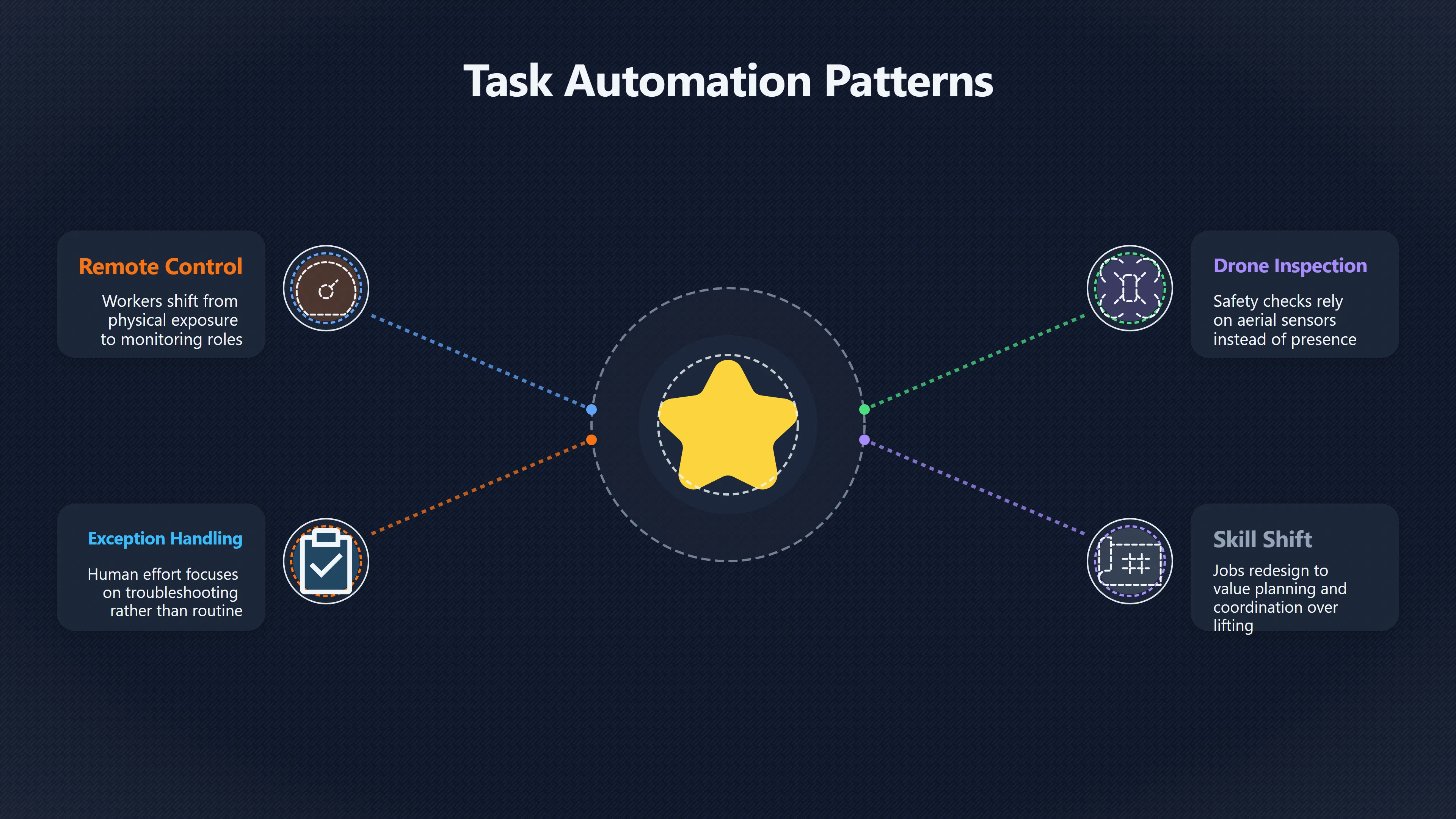
- Workers move from direct physical exposure toward monitoring and control roles.
- Dangerous manual tasks become remote operations performed from control rooms.
- Human effort shifts toward exception handling rather than routine execution.
- Safety inspections increasingly rely on drones, sensors and AI systems rather than direct physical presence.
Evidence from robot adoption across manufacturing and industrial sectors suggests that labour demand often changes through task redesign and reallocation rather than simple one-for-one replacement.[arXiv]arxiv.orgarXiv Generative AI and the Reorganization of Labor DemandGenerative AI and the Reorganization of Labor DemandMay 22, 2026…[stanford]hai.stanford.eduassessing the real impact of automation on jobsStanford HAIAssessing the Real Impact of Automation on Jobs | Stanford HAI9 Jun 2025 — In short, Autor found that automation both replace… For advocates of a long-term AI-enabled abundance economy, this distinction is crucial. The optimistic scenario is not merely fewer workers. It is fewer people spending their lives performing hazardous routines that machines can perform more safely.
Why Safer Work Does Not Automatically Mean Better Jobs
Reducing physical danger and improving job quality are not always the same thing.
Many automated workplaces become safer while introducing new pressures. Workers may no longer face toxic exposure or heavy lifting, but they may experience increased monitoring, reduced autonomy, repetitive oversight duties or anxiety about job security.
Research on robot-heavy workplaces has found mixed effects. Some studies report improvements in physical safety and reductions in injury rates. Others find lower job satisfaction, increased work intensity or concerns about deskilling and surveillance.[Financial Times]ft.comJessica, an Amazon employee, found robot-assisted warehouse work less physically taxing but also monotonous and mentally draining, prompt… [3ScienceDirect 3ScienceDirect]
A recurring problem is what researchers sometimes call “hollowing out” of expertise.
Consider a worker who once performed a difficult physical task requiring accumulated experience. After automation, the worker may mainly supervise machines and intervene only when something goes wrong. The job becomes safer but may also provide fewer opportunities to develop mastery. Similar concerns have appeared in discussions of automated logistics systems, robotic surgery support and industrial process control.[WIRED]wired.comRobots Might Not Take Your Job-But They Will Probably Make It BoringRobots can manage risky tasks like shutting down faulty nuclear reactors and inspecting components, but their presence can lead to boredo…
This creates a tension at the heart of the dangerous-work debate:
- Physical wellbeing may improve.
- Fatalities and injuries may decline.
- Yet some workers may feel less skilled, less autonomous or less connected to their work.
The quality of job redesign therefore matters almost as much as the technology itself.
Wages Depend on Which Tasks Disappear
The effect of automation on wages depends heavily on what kind of work is automated.
Research examining automation and task restructuring suggests that when technology removes simpler or routine tasks, remaining workers can become more specialised and sometimes better paid. But when automation takes over higher-value expert activities, wages may fall because workers are left performing less valuable functions.[MIT Sloan]mitsloan.mit.eduBut whenMIT SloanA new look at how automation changes the value of labor18 Aug 2025 — They found that when simpler tasks disappeared, jobs became…
Dangerous-work automation sits between these two possibilities.
In the best cases:
- Workers are relieved of hazardous duties.
- Productivity rises.
- Firms can pay more for technical oversight and operational expertise.
- Human workers move into higher-skill supervisory positions.
In weaker outcomes:
- Dangerous tasks disappear but few advancement pathways are created.
- A small number of technicians oversee systems that previously required many workers.
- Bargaining power shifts from labour toward capital owners.
- Wage growth fails to keep pace with productivity gains.
Evidence from robot adoption in Europe and elsewhere suggests that employment and wage effects vary substantially by industry, institutional setting, skill level and labour-market structure.[Brookings]brookings.eduWorkers who can work with machines are more productive than those without themUnderstanding the impact of automation on workers, jobs…19 Jan 2022 — Automation often creates as many jobs as it destroys o…[Bruegel]bruegel.orgEuropean Union countries, that make up 85.5 percent of the EU industrial…[IZA]docs.iza.orgIZA DocsThe Impact of Robots on Labour Market Transitions in Europeby R Bachmann · 2022 · Cited by 76 — Our results imply that robot adop…
This is one reason debates about AI abundance increasingly focus on distribution rather than productivity alone. A world where dangerous work largely disappears could still produce unequal outcomes if ownership of automated systems is highly concentrated.
Emerging Roles in Robot Supervision and Maintenance
The most visible new jobs created by dangerous-work automation tend to appear around the machines themselves.
As robotic systems spread, demand grows for workers who can:
- Install and maintain robots.
- Monitor autonomous systems.
- Analyse operational data.
- Manage fleets of industrial machines.
- Handle cybersecurity and system reliability.
- Coordinate human-robot teams.[pmc.ncbi.nlm.nih.gov]pmc.ncbi.nlm.nih.govrelated risks and opportunities for industrial human-robot…by E Heinold · 2023 · Cited by 11 — Even though, modern, interactive roboti…
- Respond to failures and unexpected conditions.
These jobs are often safer than the roles they replace and may require a broader mix of technical and interpersonal skills.
The shift is already visible in sectors such as advanced manufacturing, mining operations, warehouse logistics and energy infrastructure. Automated equipment often reduces demand for some forms of manual labour while increasing demand for maintenance engineers, control-room operators, robotics technicians and systems integrators. OECD[Cambridge University Press & Assessment]cambridge.orgCambridge University Press & AssessmentEffects of Artificial Intelligence and Robotics on Human…by C Intahchomphoo · 2024 · Cited by 1…
The challenge is timing.
A miner cannot automatically become a robotics engineer. A construction labourer does not instantly transition into an autonomous equipment specialist. The benefits of automation therefore depend heavily on training systems, apprenticeships, vocational education and employer investment.
UK government projections suggest substantial growth in AI-related occupations over the coming decade, but whether displaced workers can realistically access those opportunities remains a central policy question.[GOV.UK]GOV.UKAI Skills for Life and Work: Labour market and…January 28, 2026 — 28 Jan 2026 — Jobs directly involving AI activities could rise from…
Regional Winners and Losers
The labour-market effects of dangerous-work automation are rarely evenly distributed.
Regions that depend heavily on mining, heavy manufacturing, oil extraction, shipping or industrial logistics often face the largest disruptions because these sectors contain many tasks that are simultaneously hazardous, repetitive and technically automatable.
Several outcomes can occur at once:
- Workplace injuries decline.[ifr.org]ifr.orgdo robots save lives and prevent workplace injuriesIFR International Federation of RoboticsDo robots save lives and prevent workplace injuries?22 Apr 2026 — In many production stages, indu…
- Productivity increases.
- Some traditional jobs disappear.[ons.gov.uk]ons.gov.ukWhich occupations are at highest risk of being automated?25 Mar 2019 — Around 1.5 million jobs in England are at high risk of some of the…
- New technical jobs emerge elsewhere.
- Local communities experience uneven adjustment.
Research from Europe and emerging economies suggests that robot adoption can increase employment in some contexts while contributing to displacement in others. Outcomes depend on labour costs, industrial structure, educational attainment and the availability of alternative sectors. IZA Docs[2theforum.erf.org.eg]theforum.erf.org.egs of robots on labour displacement and job reallocation…
Mining provides a useful example.
Autonomous haul trucks, remote drilling systems and AI-assisted monitoring can reduce exposure to accidents and hazardous environments. Yet they can also concentrate employment in urban control centres rather than remote extraction regions. A mine may continue operating while employing fewer workers on-site. The safety gains are real, but the economic geography changes.[OECD]oecd.orgthe risk of automation for jobs in oecd countries 5jlz9h56dvq7 enThe Risk of Automation for Jobs in OECD Countriesby M Arntz · 2016 · Cited by 4408 — In recent years, there has been a revival of con…
This raises a broader question for the AI bloom vision: can technological abundance be geographically distributed, or will benefits cluster around a limited number of high-skill regions?

The Strongest Optimistic Case
The strongest argument for automating dangerous work is not simply economic efficiency. It is the possibility of decoupling prosperity from physical risk.
Historically, many industries depended on workers accepting significant danger in exchange for wages. Coal mining, offshore drilling, hazardous chemical handling, waste processing and heavy industrial production often involved a trade-off between economic survival and personal safety.
Advanced robotics offers a different model:
- Hazardous environments remain productive.
- Human exposure falls sharply.
- Workers spend more time supervising and designing systems than enduring physical danger.
- Injury, disability and occupational disease become less common.
Evidence from manufacturing and industrial settings increasingly supports the claim that robots can reduce accident rates and fatalities when deployed effectively.[ScienceDirect]sciencedirect.comRobots as guardians: Industrial automation and workplace…by W Luo · 2025 · Cited by 25 — Industrial robots can improve wo…[IFR International Federation of Robotics]ifr.orgdo robots save lives and prevent workplace injuriesIFR International Federation of RoboticsDo robots save lives and prevent workplace injuries?22 Apr 2026 — In many production stages, indu…
In a broader AI bloom framework, this points toward a civilisation where an increasing share of necessary physical labour is performed by machines rather than human bodies. If combined with abundant energy, advanced manufacturing and effective distribution systems, dangerous work could become an exceptional activity rather than a routine part of earning a living.
The Political Economy Question
Whether this transition produces widespread flourishing depends less on robotics itself than on institutions surrounding it.
Three futures are plausible.
In the first, productivity gains are broadly shared. Workers gain safer jobs, shorter hours, higher wages and access to retraining. Automation becomes a mechanism for expanding human freedom.
In the second, safety improves but economic gains flow primarily to asset owners. Employment becomes more polarised, and displaced workers struggle to access newly created technical roles.
In the third, dangerous work declines in wealthy regions while remaining concentrated among poorer populations and countries that lack access to advanced automation.
Current evidence does not decisively support any single outcome. Labour-market research consistently shows that automation’s effects are shaped by education systems, labour institutions, bargaining power, competition policy and public investment as much as by the technology itself.[Brookings]brookings.eduWorkers who can work with machines are more productive than those without themUnderstanding the impact of automation on workers, jobs…19 Jan 2022 — Automation often creates as many jobs as it destroys o…[OECD]oecd.orgAutomation and occupational wage trendsRoutine-biased technological change has emerged as a leading explanation for the differential wage…
For that reason, the labour-market impact of automating dangerous tasks is one of the clearest examples of a wider question running through debates about AI and humanity’s long future. The technical capability to eliminate dangerous drudgery may arrive before societies decide how the resulting gains should be shared. The difference between a safer but more unequal economy and a genuinely flourishing one may depend less on whether robots can perform dangerous work and more on who benefits when they do.
Amazon book picks
Further Reading
Books and field guides related to How Automation of Dangerous Work Reshapes Jobs and Wages. Use these as the next step if you want deeper reading beyond the article.
The Coming Wave
Directly addresses whether advanced AI can deliver broad civilisational benefits while remaining governable.
Human Compatible
Explores how powerful AI could advance humanity if aligned with human values.
The Age of Scientific Wellness
Centres on earlier warnings, biomarkers and personalised prevention.
eBay marketplace picks
Marketplace Samples
Example marketplace items related to this page. Use the search link to explore similar finds on eBay.




Endnotes
1.
Source: ifr.org
Title: do robots save lives and prevent workplace injuries
Link:https://ifr.org/post/do-robots-save-lives-and-prevent-workplace-injuries
Source snippet
IFR International Federation of RoboticsDo robots save lives and prevent workplace injuries?22 Apr 2026 — In many production stages, indu...
2.
Source: sciencedirect.com
Link:https://www.sciencedirect.com/science/article/abs/pii/S0304387824001305
Source snippet
Robots as guardians: Industrial automation and workplace...by W Luo · 2025 · Cited by 25 — Industrial robots can improve wo...
3.
Source: oecd.org
Title: the risk of automation for jobs in oecd countries 5jlz9h56dvq7 en
Link:https://www.oecd.org/en/publications/the-risk-of-automation-for-jobs-in-oecd-countries_5jlz9h56dvq7-en.html
Source snippet
The Risk of Automation for Jobs in OECD Countriesby M Arntz · 2016 · Cited by 4408 — In recent years, there has been a revival of con...
4.
Source: hai.stanford.edu
Title: assessing the real impact of automation on jobs
Link:https://hai.stanford.edu/news/assessing-the-real-impact-of-automation-on-jobs
Source snippet
Stanford HAIAssessing the Real Impact of Automation on Jobs | Stanford HAI9 Jun 2025 — In short, Autor found that automation both replace...
5.
Source: arxiv.org
Title: arXiv Generative AI and the Reorganization of Labor Demand
Link:https://arxiv.org/abs/2605.23159
Source snippet
Generative AI and the Reorganization of Labor DemandMay 22, 2026...
Published: May 22, 2026
6.
Source: mitsloan.mit.edu
Title: But when
Link:https://mitsloan.mit.edu/ideas-made-to-matter/a-new-look-how-automation-changes-value-labor
Source snippet
MIT SloanA new look at how automation changes the value of labor18 Aug 2025 — They found that when simpler tasks disappeared, jobs became...
7.
Source: sciencedirect.com
Link:https://www.sciencedirect.com/science/article/abs/pii/S092575352100463X
Source snippet
Robot application and occupational injuriesby S Yang · 2022 · Cited by 65 — Recent research argues that robots could replace...
8.
Source: arxiv.org
Link:https://arxiv.org/abs/2208.14248
9.
Source: wired.com
Title: Robots Might Not Take Your Job-But They Will Probably Make It Boring
Link:https://www.wired.com/story/robots-wont-take-your-jobbut-they-might-make-it-boring
Source snippet
Robots can manage risky tasks like shutting down faulty nuclear reactors and inspecting components, but their presence can lead to boredo...
10.
Source: bruegel.org
Link:https://www.bruegel.org/sites/default/files/wp_attachments/Working-Paper-AB_25042018.pdf
Source snippet
European Union countries, that make up 85.5 percent of the EU industrial...
11.
Source: docs.iza.org
Link:https://docs.iza.org/dp15303.pdf
Source snippet
IZA DocsThe Impact of Robots on Labour Market Transitions in Europeby R Bachmann · 2022 · Cited by 76 — Our results imply that robot adop...
12.
Source: oecd.org
Link:https://www.oecd.org/en/publications/automation-and-occupational-wage-trends_596b32ce-en.html
Source snippet
Automation and occupational wage trendsRoutine-biased technological change has emerged as a leading explanation for the differential wage...
13.
Source: brookings.edu
Title: Workers who can work with machines are more productive than those without them
Link:https://www.brookings.edu/articles/understanding-the-impact-of-automation-on-workers-jobs-and-wages/
Source snippet
Understanding the impact of automation on workers, jobs...19 Jan 2022 — Automation often creates as many jobs as it destroys o...
14.
Source: oecd.org
Title: 83325127 en
Link:https://www.oecd.org/content/dam/oecd/en/publications/reports/2024/11/job-creation-and-local-economic-development-2024_01a245c1/83325127-en.pdf
Source snippet
Job Creation and Local Economic Development 2024May 10, 2025 — 13 Nov 2024 — improve worker safety by allowing remote monitoring and...
Published: May 10, 2025
15.
Source: cambridge.org
Link:https://www.cambridge.org/core/journals/legal-information-management/article/effects-of-artificial-[intelligence
Source snippet
Cambridge University Press & AssessmentEffects of Artificial Intelligence and Robotics on Human...by C Intahchomphoo · 2024 · Cited by 1...
16.
Source: GOV.UK
Link:https://www.gov.uk/government/publications/ai-skills-for-life-and-work-labour-market-and-skills-projections/ai-skills-for-life-and-work-labour-market-and-skills-projections
Source snippet
AI Skills for Life and Work: Labour market and...January 28, 2026 — 28 Jan 2026 — Jobs directly involving AI activities could rise from...
Published: January 28, 2026
17.
Source: theforum.erf.org.eg
Link:https://theforum.erf.org.eg/2024/03/04/labour-market-effects-of-robots-evidence-from-turkey/
Source snippet
s of robots on labour displacement and job reallocation...
18.
Source: oecd.org
Link:https://www.oecd.org/content/dam/oecd/en/publications/reports/2022/01/labour-saving-technologies-and-employment-levels_c1bb460f/9ce86ca5-en.pdf
Source snippet
Labour-saving technologies and employment levels (EN)by ARERR MAKING · 2022 · Cited by 22 — beyond traditional repetitive, onerous or eve...
19.
Source: ons.gov.uk
Link:https://www.ons.gov.uk/employmentandlabourmarket/peopleinwork/employmentandemployeetypes/articles/whichoccupationsareathighestriskofbeingautomated/2019
Source snippet
Which occupations are at highest risk of being automated?25 Mar 2019 — Around 1.5 million jobs in England are at high risk of some of the...
20.
Source: wecglobal.org
Title: 2016 OECD Risk Automation Jobs
Link:https://wecglobal.org/uploads/2019/07/2016_OECD_Risk-Automation-Jobs.pdf
Source snippet
World Employment ConfederationThe Risk of Automation for Jobs in OECD Countriesby M Arntz · Cited by 4409 — This paper was commissioned b...
21.
Source: ft.com
Link:https://www.ft.com/content/528e3c25-22c7-4c83-b80a-dd07dae92c5d
Source snippet
Jessica, an Amazon employee, found robot-assisted warehouse work less physically taxing but also monotonous and mentally draining, prompt...
Additional References
22.
Source: ilo.org
Link:https://www.ilo.org/publications/workers%E2%80%99-exposure-ai-what-indicators-tell-us-%E2%80%93-and-what-they-don%E2%80%99t
Source snippet
Workers' exposure to AI: What indicators tell usEarlier computerization and automation measures suggested lower paid-workers in repetitiv...
23.
Source: researchgate.net
Link:https://www.researchgate.net/publication/375897745_The_impact_of_automation_on_labour_market_outcomes_in_emerging_countries
Source snippet
(PDF) The impact of automation on labour market...This paper estimates the effect of local and foreign robots on labour market outcomes...
24.
Source: oreilly.com
Link:https://www.oreilly.com/library/view/smart-manufacturing/9781119846611/b08.xhtml
Source snippet
What constitutes “danger” is the focus of this chapter. Dear. The task is more expensive when performed...Read more...
25.
Source: ilo.org
Link:https://www.ilo.org/sites/default/files/wcmsp5/groups/public/%40ed_dialogue/%40act_emp/documents/publication/wcms_579554.pdf
Source snippet
the dirtiest and most dangerous jobs. While the company has.Read more...
26.
Source: institute.global
Title: the impact of ai on the labour market
Link:https://institute.global/insights/economic-prosperity/the-impact-of-ai-on-the-labour-market
Source snippet
Tony Blair InstituteThe Impact of AI on the Labour Market8 Nov 2024 —... for roles that are exposed to danger, such as physical labour...
27.
Source: ilo.org
Title: Safeday25 Report r8+(2) FULL (1)
Link:https://www.ilo.org/sites/default/files/2025-04/ILO_Safeday25_Report_r8%2B%282%29%20FULL%20%281%29.pdf
Source snippet
International Labour Organizationrevolutionizing health and safety:24 Apr 2025 — Robots are increasingly used to replace workers in dange...
28.
Source: voxchina.org
Link:https://voxchina.org/show-3-444.html
Source snippet
How Automation Has Made Chinese Workplaces Safer3 Feb 2026 — By taking over the most dangerous tasks on factory floors, robots can help s...
29.
Source: standardbots.com
Title: robots doing dangerous jobs
Link:https://standardbots.com/blog/robots-doing-dangerous-jobs
Source snippet
Robots have become essential in hazardous industries, reducing workplace injuries and fatalities.Read more...
30.
Source: youtube.com
Title: Man vs. machine? The ROI of robotics and human-machine synergy | Ujjwal Kumar
Link:https://www.youtube.com/watch?v=60IvU4-r5jE
Source snippet
How is Automation Really Affecting the Labor Market?...
31.
Source: pmc.ncbi.nlm.nih.gov
Link:https://pmc.ncbi.nlm.nih.gov/articles/PMC10642918/
Source snippet
related risks and opportunities for industrial human-robot...by E Heinold · 2023 · Cited by 11 — Even though, modern, interactive roboti...
Topic Tree