Within GNo ME materials
Can robot labs catch up with AI?
Robotic synthesis systems such as A-Lab matter because AI predictions only become valuable when laboratories can test them quickly.
On this page
- Why synthesis became the bottleneck
- What autonomous materials labs can do
- Where human judgement still matters
Page outline Jump by section
Introduction
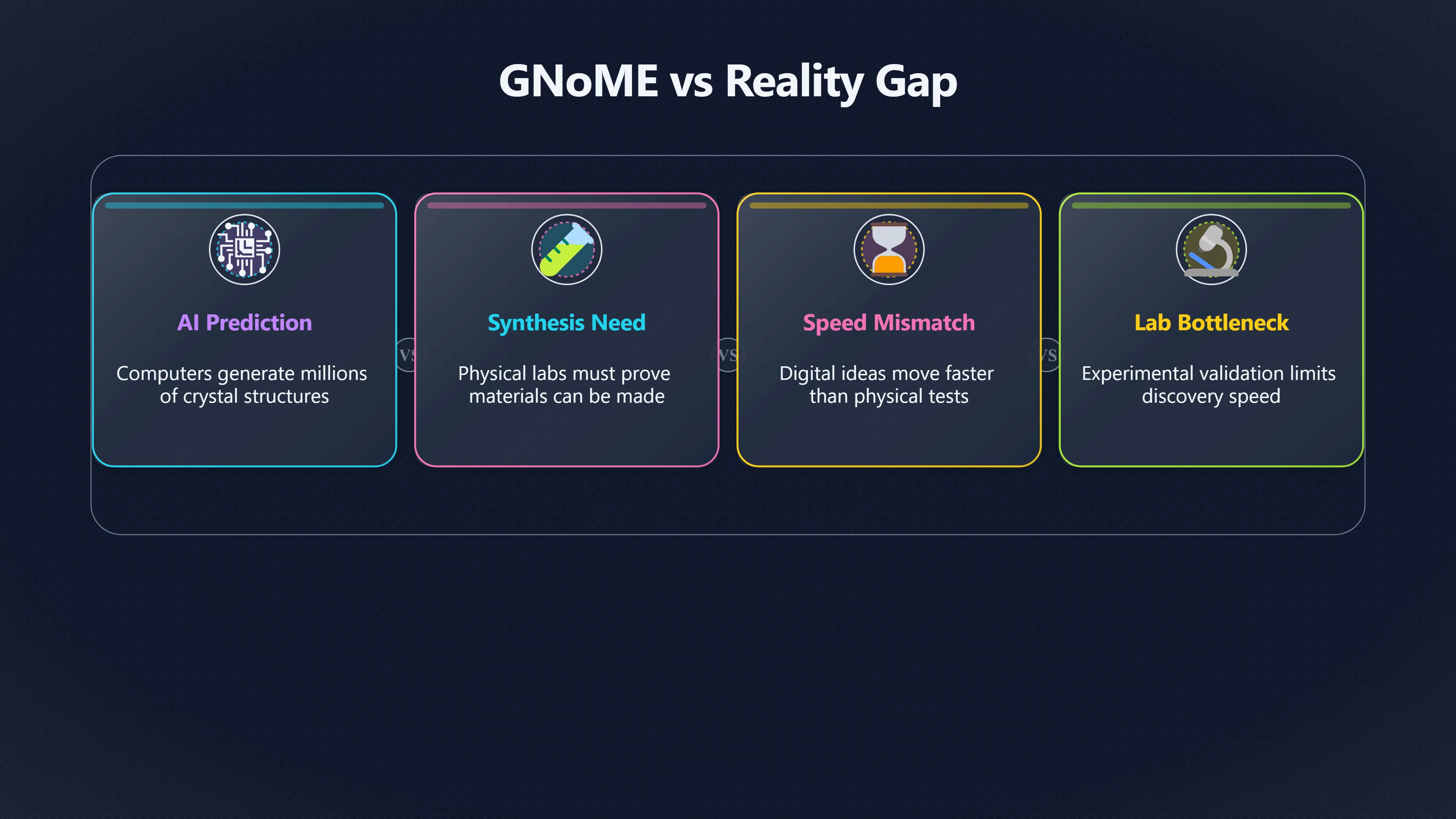
AI systems such as GNoME can now propose enormous numbers of possible new materials. The problem is that prediction has started to move much faster than reality. A computer can generate thousands of promising crystal structures in days, but proving that a material can actually be made in the physical world still requires synthesis, testing, measurement and repeated experimental adjustment. In many areas of materials science, the laboratory has become the bottleneck.
 That is why autonomous laboratories have attracted so much attention. The idea is not simply to automate a few pieces of equipment. It is to create a closed-loop system in which AI proposes experiments, robots perform them, instruments analyse the results, and software decides what to try next. Supporters argue that this could compress years of trial-and-error work into weeks or months, helping turn AI-generated predictions into real batteries, catalysts, semiconductors and energy technologies. Critics argue that the hardest parts of materials science remain stubbornly physical, messy and dependent on human judgement. Both views contain part of the truth.
Why synthesis became the bottleneck
The most important lesson from the GNoME project is that finding candidate materials and creating them are different problems.
For decades, computational materials science was itself a bottleneck. Researchers lacked the computing power and machine-learning systems needed to search vast numbers of possible atomic arrangements. GNoME changed that balance by generating millions of candidate crystal structures and hundreds of thousands of potentially stable materials.[Google DeepMind]deepmind.googlemillions of new materials discovered with deep learningGoogle DeepMindMillions of new materials discovered with deep learning29 Nov 2023 — AI tool GNoME finds 2.2 million new crystals, includi…
But a predicted crystal is not a finished material. Researchers still need to answer questions such as:
- Can the material actually be synthesised?
- What temperature and pressure conditions are required?
- Which precursor chemicals work best?
- Does the material remain stable outside a simulation?
- Can it be manufactured reliably and at scale?
- Does it possess useful properties once produced?
These questions require physical experiments rather than computation.
The mismatch between prediction speed and experimental speed has become increasingly obvious. Researchers behind Berkeley Lab’s A-Lab project explicitly described their goal as closing the gap between rapid computational screening and much slower experimental validation.[Nature]nature.comAn autonomous laboratory for the accelerated synthesis of…29 Nov 2023 — We introduce the A-Lab, an autonomous laboratory for the…
This bottleneck matters far beyond academic curiosity. If AI is supposed to help unlock cleaner energy systems, cheaper batteries, more efficient industrial chemistry or advanced electronics, then the real constraint is not only discovering candidates. It is determining which candidates survive contact with physical reality.
For the broader AI bloom argument, this is an important distinction. Scientific abundance depends not only on intelligence generating ideas but on civilisation gaining the ability to test those ideas quickly enough to matter.
What autonomous materials labs can do
The modern autonomous laboratory combines several technologies that were previously separate.
Robotics handles repetitive physical operations such as weighing powders, mixing ingredients, heating samples, transporting materials between instruments and preparing measurements. Machine-learning systems help choose promising experiments. Analytical instruments generate data. Software coordinates the entire process and updates experimental plans based on results. Researchers often call these systems self-driving laboratories.[ACS Publications]pubs.acs.orgThrough the automation of experimental…[ScienceDirect]sciencedirect.comThe closed-loop approach is a key element to…Read more…
The key concept is the closed loop.
Traditional materials research often follows a slow sequence:
- A scientist proposes an experiment.
- The experiment is run.
- Results are analysed.
- New experiments are planned.
- The cycle repeats.
Each stage can take days or weeks.
In a self-driving laboratory, these steps are connected into an automated feedback loop. Experimental outcomes are immediately fed back into optimisation algorithms, which decide which experiment should happen next. The system continuously updates its understanding of the search space.[ScienceDirect]sciencedirect.comThe closed-loop approach is a key element to…Read more…
This matters because materials science often involves enormous parameter spaces. A battery material, for example, may depend on composition, temperature, pressure, processing conditions, impurities and manufacturing techniques. Exhaustively testing every possibility is impossible.
Instead, autonomous systems try to learn which experiments are most informative.
The A-Lab example
A-Lab at Lawrence Berkeley National Laboratory is one of the highest-profile demonstrations of this approach.
The platform combines robotics, machine learning, historical scientific literature, computational predictions and active learning systems to perform solid-state synthesis of inorganic materials. In a widely discussed Nature paper, the system operated continuously for 17 days and successfully produced dozens of target compounds from a larger candidate set. The recipes were iteratively adjusted based on experimental outcomes rather than remaining fixed from the start. Nature[IDEAS]ideas.repec.orgIDEAS/RePEcAn autonomous laboratory for the accelerated synthesis of inby NJ Szymanski · 2023 · Cited by 1133 — Over 17 days of continuou…[RePEc]ideas.repec.orgIDEAS/RePEcAn autonomous laboratory for the accelerated synthesis of inby NJ Szymanski · 2023 · Cited by 1133 — Over 17 days of continuou…
Importantly, some of the candidate materials came from the same broader ecosystem of computational discovery tools that included GNoME and the Materials Project database.[Berkeley Lab News Center]newscenter.lbl.govgoogle deepmind new compounds materials projectBerkeley Lab News CenterGoogle DeepMind Adds Nearly 400000 New Compounds to…29 Nov 2023 — Some of the computations from GNoME were use…
The significance was not merely that robots mixed chemicals. Laboratories have used automation for years. The notable achievement was the integration of prediction, experimentation and adaptive decision-making into a largely autonomous workflow.
In effect, A-Lab attempted to become a bridge between AI-generated possibilities and experimentally verified materials.

Why closed-loop experimentation matters
The most valuable feature of autonomous laboratories may not be labour savings. It may be their ability to learn from failure.
Materials discovery often advances through negative results. A synthesis attempt fails. A crystal forms incorrectly. An impurity appears. A phase transition occurs unexpectedly.
Human researchers learn from these outcomes, but autonomous systems can potentially process thousands of such feedback signals systematically and continuously.
Several research groups have demonstrated versions of this idea. Autonomous materials platforms have used Bayesian optimisation, active learning and uncertainty-aware machine learning to explore complex parameter spaces while performing only a fraction of the experiments that exhaustive searches would require.[arXiv]arxiv.orgarXiv Autonomous synthesis of metastable materialsAutonomous synthesis of metastable materialsJanuary 19, 2021…
One autonomous phase-diagram project reported a roughly six-fold reduction in required experiments by continuously updating theoretical predictions using experimental feedback.[arXiv]arxiv.orgarXiv Autonomous synthesis of metastable materialsAutonomous synthesis of metastable materialsJanuary 19, 2021…
Another autonomous thin-film synthesis system explored only a tiny fraction of a large experimental parameter space while still identifying promising growth conditions.[arXiv]arxiv.orgarXiv Autonomous synthesis of metastable materialsAutonomous synthesis of metastable materialsJanuary 19, 2021…
This approach starts to resemble a broader pattern appearing across AI-enabled science: intelligence is used not only to generate hypotheses but to guide scarce experimental resources towards the most informative tests.
In a world where computational proposals become abundant, experiment selection may become more valuable than experiment execution.
Where human judgement still matters
Despite the excitement around self-driving laboratories, it would be misleading to imagine fully autonomous scientific discovery arriving overnight.
The A-Lab project itself became the subject of debate shortly after publication. Some researchers questioned whether several reported materials were genuinely novel or whether the evidence was strong enough to support some of the claims. The dispute highlighted a broader point: interpreting experimental outcomes remains difficult, and scientific validation often requires expert judgement beyond what current autonomous systems provide.[Nature]nature.comRobot chemist sparks row with claim it created new materials12 Dec 2023 — The A-Lab produced five new materials by swapping some of…
There are several reasons human expertise remains central.
Defining worthwhile goals
An autonomous system can optimise for objectives that researchers specify. Deciding which objectives matter is a different task.
Scientists still choose which material properties deserve attention, which industrial constraints matter, and which discoveries would be economically or socially valuable.
A system might efficiently discover materials with unusual properties that turn out to have little practical use.

Handling messy reality
Many materials processes remain difficult to automate.
Some involve multiple reaction stages, delicate handling procedures, extreme temperatures, hazardous chemicals or highly specialised equipment. Reviews of self-driving laboratories repeatedly identify these engineering challenges as major obstacles to wider deployment.[ACS Publications]pubs.acs.orgThrough the automation of experimental…[PMC]pmc.ncbi.nlm.nih.govAutonomous 'self-driving' laboratories: a review of technology…by AV Tobias · 2025 · Cited by 63 — This article reviews and provide…
Laboratories are not as standardised as computer chips or cloud servers. Real-world experiments frequently involve unexpected failures, instrument limitations and tacit knowledge accumulated by experienced researchers.
Interpreting surprising results
Some of the most important scientific discoveries emerge when experiments behave unexpectedly.
A machine-learning system can identify statistical anomalies. Understanding whether an anomaly represents a measurement error, a novel phenomenon or a breakthrough insight often requires broader scientific reasoning.
Current autonomous laboratories are becoming increasingly capable at optimisation. They remain much less capable at open-ended scientific interpretation.
Could robot labs change the pace of scientific progress?
The strongest argument for autonomous laboratories is not that they replace scientists. It is that they increase the rate at which ideas can be tested.
Historically, many technological revolutions have depended on improvements in experimentation itself. Better microscopes accelerated biology. Particle accelerators expanded physics. High-throughput DNA sequencing transformed genetics.
Supporters of self-driving laboratories argue that automated experimentation could become a similar enabling technology for chemistry and materials science. Reviews of the field increasingly describe autonomous laboratories as a new research infrastructure rather than a single scientific instrument.[ACS Publications]pubs.acs.orgThrough the automation of experimental…[RSC Publishing]pubs.rsc.orgRSC PublishingToward self-driving laboratory 2.0 for chemistry and…by H Lee · 2026 · Cited by 3 — This review outlines the vision of S…
If AI systems continue generating large numbers of plausible scientific hypotheses, the value of rapid experimental validation will rise. The future bottleneck may increasingly become physical testing capacity rather than idea generation.
That possibility matters for long-term visions of AI-enabled abundance.
Many proposed solutions to energy constraints, climate mitigation, advanced manufacturing and infrastructure depend on materials breakthroughs. Better catalysts could reduce industrial energy consumption. Improved batteries could reshape energy storage. New semiconductors could improve computing efficiency. Novel superconductors could alter power transmission.
None of these outcomes follow automatically from AI predictions. But if autonomous laboratories make experimentation dramatically faster, they could help convert computational discovery into practical technology more quickly than traditional research cycles allow.
The deeper challenge: scaling from discovery to civilisation
Even successful robot laboratories do not eliminate every bottleneck.
A material that works in a laboratory still faces years of engineering, manufacturing, regulation, supply-chain development and economic testing before it changes the world. Estimates for moving from initial materials discovery to large-scale industrial deployment often stretch across decades.[Axios]axios.comThese labs autonomously conduct experiments in a closed-loop system, learning from outcomes to refine future experimentation. The goal is…
This is an important corrective to simplistic AI abundance narratives. Scientific discovery is only one stage in a much larger process.
Yet the existence of downstream bottlenecks does not make upstream acceleration irrelevant. If AI systems and autonomous laboratories substantially increase the rate at which promising materials are identified and validated, they could enlarge the pool of technologies available for development. More experiments can be attempted. More dead ends can be eliminated. More promising paths can be pursued simultaneously.
The broader significance of autonomous laboratories is therefore not that robots are about to run science without humans. It is that they may help solve a growing mismatch between the speed of digital intelligence and the speed of physical experimentation.
GNoME demonstrated that AI can search huge regions of materials space. Autonomous laboratories represent one of the most serious attempts to ensure those discoveries do not remain trapped inside simulations. The question is no longer only whether AI can imagine new materials. It is whether scientific institutions can build enough experimental capacity for reality to keep up.
Amazon book picks
Further Reading
Books and field guides related to Can robot labs catch up with AI?. Use these as the next step if you want deeper reading beyond the article.
The Master Algorithm
Helps readers understand the AI learning methods behind autonomous experiment selection.
Stuff Matters
Explains why turning predicted materials into real physical substances matters.
The Alchemy of Us
Connects materials breakthroughs to wider technological and social change.
The Knowledge Machine
Frames why robot-lab speed still needs experimental validation and human judgement.
eBay marketplace picks
Marketplace Samples
Example marketplace items related to this page. Use the search link to explore similar finds on eBay.



Endnotes
1.
Source: deepmind.google
Title: millions of new materials discovered with deep learning
Link:https://deepmind.google/blog/millions-of-new-materials-discovered-with-deep-learning/
Source snippet
Google DeepMindMillions of new materials discovered with deep learning29 Nov 2023 — AI tool GNoME finds 2.2 million new crystals, includi...
2.
Source: nature.com
Link:https://www.nature.com/articles/s41586-023-06734-w
Source snippet
An autonomous laboratory for the accelerated synthesis of...29 Nov 2023 — We introduce the A-Lab, an autonomous laboratory for the...
3.
Source: pubs.acs.org
Link:https://pubs.acs.org/doi/10.1021/acs.chemrev.4c00055
Source snippet
Through the automation of experimental...
4.
Source: sciencedirect.com
Link:https://www.sciencedirect.com/science/article/abs/pii/S258959741930019X
Source snippet
The closed-loop approach is a key element to...Read more...
5.
Source: ideas.repec.org
Link:https://ideas.repec.org/a/nat/nature/v624y2023i7990d10.1038_s41586-023-06734-w.html
Source snippet
IDEAS/RePEcAn autonomous laboratory for the accelerated synthesis of inby NJ Szymanski · 2023 · Cited by 1133 — Over 17 days of continuou...
6.
Source: arxiv.org
Title: arXiv Autonomous synthesis of metastable materials
Link:https://arxiv.org/abs/2101.07385
Source snippet
Autonomous synthesis of metastable materialsJanuary 19, 2021...
Published: January 19, 2021
7.
Source: arxiv.org
Link:https://arxiv.org/abs/2410.17430
8.
Source: arxiv.org
Link:https://arxiv.org/abs/2308.08700
Source snippet
Autonomous synthesis of thin film materials with pulsed laser deposition enabled by in situ spectroscopy and automationAugust 17, 2023...
Published: August 17, 2023
9.
Source: nature.com
Link:https://www.nature.com/articles/d41586-023-03956-w
Source snippet
Robot chemist sparks row with claim it created new materials12 Dec 2023 — The A-Lab produced five new materials by swapping some of...
10.
Source: pmc.ncbi.nlm.nih.gov
Link:https://pmc.ncbi.nlm.nih.gov/articles/PMC12368842/
Source snippet
Autonomous 'self-driving' laboratories: a review of technology...by AV Tobias · 2025 · Cited by 63 — This article reviews and provide...
11.
Source: axios.com
Link:https://www.axios.com/2024/08/09/ai-self-driving-science-labs-research
Source snippet
These labs autonomously conduct experiments in a closed-loop system, learning from outcomes to refine future experimentation. The goal is...
12.
Source: pubs.rsc.org
Link:https://pubs.rsc.org/en/content/articlelanding/2026/mh/d5mh01984b
Source snippet
RSC PublishingToward self-driving laboratory 2.0 for chemistry and...by H Lee · 2026 · Cited by 3 — This review outlines the vision of S...
13.
Source: google.com
Link:https://www.google.com/
Source snippet
Search the world's information, including webpages, images, videos and more. Google has many special features to help you find exac...
14.
Source: self.inc
Link:https://www.self.inc/
Source snippet
Build Credit, Build Savings and Access CashBuild credit and savings with Self. The Credit Builder Account and Self Visa® Credit Ca...
15.
Source: about.google
Link:https://about.google/
Source snippet
Our products, technology and company...Learn more about Google. Explore our innovative AI products and services, and how we're using tec...
16.
Source: deepmind.google
Link:https://deepmind.google/
Source snippet
Google DeepMindGoogle DeepMind robotics lab tour. Hannah interacts with a new set of robots—those that don't just see, but think, plan, a...
17.
Source: nature.com
Link:https://www.nature.com/articles/d41586-023-03745-5
Source snippet
Google AI and robots join forces to build new materials29 Nov 2023 — Tool from Google DeepMind predicts nearly 400,000 stable substances...
18.
Source: nature.com
Link:https://www.nature.com/articles/s44160-026-01053-0
Source snippet
A flexible and affordable self-driving laboratory for...by S Pilon · 2026 · Cited by 1 — By automating repetitive procedures, SDLs allow...
19.
Source: nature.com
Link:https://www.nature.com/articles/s41586-023-06735-9
Source snippet
Scaling deep learning for materials discoveryby A Merchant · 2023 · Cited by 1878 — Here we show that graph networks trained at scale can...
20.
Source: nature.com
Link:https://www.nature.com/collections/igbhhbedgi
Source snippet
Self-driving labs and automation software for chemistry and...Feb 7, 2024 — This cross-journal collection is dedicated to the developmen...
21.
Source: nature.com
Link:https://www.nature.com/collections/eiiadfbbhb
Source snippet
Self-Driving Laboratories for Chemistry and Materials...8 Oct 2024 — The integration of self-driving laboratories and advanced automatio...
22.
Source: nature.com
Link:https://www.nature.com/articles/s41586-025-09992-y
Source snippet
Author Correction: An autonomous laboratory for the...by NJ Szymanski · 2026 — Author Correction: An autonomous laboratory for the accel...
23.
Source: ceder.berkeley.edu
Title: autonomous experimentation for accelerated materials discovery
Link:https://ceder.berkeley.edu/research-areas/autonomous-experimentation-for-accelerated-materials-discovery/
Source snippet
experimentation for accelerated materials...Figure: The closed loop workflow used to discover and synthesize new materials in the A-Lab...
24.
Source: ceder.berkeley.edu
Title: [a lab]({{ ‘a-lab/’ | relative_url }}) paper published in nature featured in news story
Link:https://ceder.berkeley.edu/news/a-lab-paper-published-in-nature-featured-in-news-story/
Source snippet
berkeley.eduA-Lab paper published in Nature, featured in news stories29 Nov 2023 — Autonomous experimentation for accelerated materials d...
25.
Source: arxiv.org
Link:https://arxiv.org/html/2509.05351v1
Source snippet
Self-Driving Laboratory Optimizes the Lower Critical...Sep 2, 2025 — The results indicate that our integrated robotic and machine learni...
26.
Source: pubs.acs.org
Link:https://pubs.acs.org/doi/abs/10.1021/acs.chemrev.4c00055
Source snippet
acs.orgSelf-Driving Laboratories for Chemistry and Materials Scienceby G Tom · 2024 · Cited by 540 — This review provides an in-depth ana...
27.
Source: cen.acs.org
Link:https://cen.acs.org/research-integrity/Nature-robot-chemist-paper-corrected/104/web/2026/01
Source snippet
acs.org'Nature' robot chemist paper corrected, but some... - C&EN29 Jan 2026 — The Nature study, published in November 2023, attracted...
Published: November 2023
28.
Source: sciencedirect.com
Link:https://www.sciencedirect.com/science/article/pii/S2590238524003229
Source snippet
Navigating self-driving labs in chemical and material...by O Bayley · 2024 · Cited by 70 — Self-driving labs (SDLs) have emerged as effe...
29.
Source: sciencedirect.com
Link:https://www.sciencedirect.com/org/science/article/pii/S2635098X24000846
Source snippet
Review of low-cost self-driving laboratories in chemistry...by S Lo · 2024 · Cited by 95 — This review proposes the concept of a “frugal...
30.
Source: search.google
Title: Google Search
Link:https://search.google/
Source snippet
A new kind of helpExplore a new kind of help for your everyday with breakthroughs in Search intelligence from Google I/O...
31.
Source: newscenter.lbl.gov
Title: google deepmind new compounds materials project
Link:https://newscenter.lbl.gov/2023/11/29/google-deepmind-new-compounds-materials-project/
Source snippet
Berkeley Lab News CenterGoogle DeepMind Adds Nearly 400000 New Compounds to...29 Nov 2023 — Some of the computations from GNoME were use...
32.
Source: Wikipedia
Link:https://en.wikipedia.org/wiki/Self
Source snippet
SelfIn philosophy, the self is an individual's own being, knowledge, and values, and the relationship between these attributes. The fi...
33.
Source: Wikipedia
Link:https://en.wikipedia.org/wiki/Google
Source snippet
GoogleGoogle is the largest provider of search engines, mapping and navigation applications, email services, office suites, online vid...
34.
Source: linkedin.com
Link:https://www.linkedin.com/posts/gennarocuofano_google-deepmind-to-build-materials-science-activity-7404827360908197890-FWoI
Source snippet
Google DeepMind's UK Lab Combines AI with Materials...Google DeepMind's new UK-based automated materials-science lab signals a strategic...
35.
Source: lee-enterprises.com
Title: ai is accelerating materials science discovery and synthesis exponentially
Link:https://lee-enterprises.com/ai-is-accelerating-materials-science-discovery-and-synthesis-exponentially/
Source snippet
AI is Accelerating Materials Science Discovery and...Apr 10, 2024 — An autonomous laboratory for the accelerated synthesis of novel mate...
Additional References
36.
Source: newscenter.lbl.gov
Link:https://newscenter.lbl.gov/2026/01/13/accelerating-discovery-how-the-materials-project-is-helping-to-usher-in-the-ai-revolution-for-materials-science/
Source snippet
Discovery: How the Materials Project Is Helping...Jan 13, 2026 — For example, Google Deepmind — Google's artificial intelligence lab — u...
37.
Source: researchgate.net
Link:https://www.researchgate.net/publication/397193999_The_Bright_Future_of_Materials_Science_with_AI_Self-Driving_Laboratories_and_Closed-Loop_Discovery
Source snippet
The Bright Future of Materials Science with AI: Self-Driving...Nov 3, 2025 — Next-generation autonomous laboratories that combine machin...
38.
Source: github.com
Link:https://github.com/AccelerationConsortium/awesome-self-driving-labs
Source snippet
AccelerationConsortium/awesome-self-driving-labs...A curated list of resources related to self-driving laboratories (SDLs) which combine...
39.
Source: reddit.com
Link:https://www.reddit.com/r/slatestarcodex/comments/1923p07/autonomous_lab_did_not_synthesize_any_new/
Source snippet
Autonomous lab did not synthesize any new materialsThis is a reanalysis of Nature paper An autonomous laboratory for the accelerated synt...
40.
Source: Wikipedia
Link:https://en.wikipedia.org/wiki/GNoME_%28DeepMind%29
Source snippet
GNoME (DeepMind)GNoME is an artificial intelligence system developed by Google DeepMind for materials discovery. It uses graph neural...
41.
Source: youtube.com
Link:https://www.youtube.com/watch?v=CJHu3yDOYGI
42.
Source: thelab.brookesbell.com
Title: googles deepmind ai tool makes material science breakthrough 158802
Link:https://thelab.brookesbell.com/about/news/googles-deepmind-ai-tool-makes-material-science-breakthrough-158802/
Source snippet
brookesbell.comGoogle's DeepMind AI Tool Makes Material Science...14 Dec 2023 — In a further development, the GNoME team has been collab...
43.
Source: academia.edu
Link:https://www.academia.edu/144767196/The_Bright_Future_of_Materials_Science_with_AI_Self_Driving_Laboratories_and_Closed_Loop_Discovery
Source snippet
precise design of nanostructures with tailored optical, electronic, and mechanical...Read more...
44.
Source: pubmed.ncbi.nlm.nih.gov
Link:https://pubmed.ncbi.nlm.nih.gov/38030721/
Source snippet
An autonomous laboratory for the accelerated synthesis of...by NJ Szymanski · 2023 · Cited by 981 — We introduce the A-Lab, an aut...
45.
Source: commons.wikimedia.org
Title: File:Autonomous materials discovery with the A Lab.webp
Link:https://commons.wikimedia.org/wiki/File%3AAutonomous_materials_discovery_with_the_A-Lab.webp
Source snippet
wikimedia.orgFile:Autonomous materials discovery with the A-Lab.webp29 Nov 2023 — These recipes are tested using a robotic laboratory tha...
Topic Tree