Within Discovery
Can AI find the materials abundance needs?
AI can propose millions of new materials, but the hard test is whether any can be made, scaled and used in the real world.
On this page
- What GNo ME changed about crystal search
- Why stability is not the same as usefulness
- The path from predicted material to public benefit
Page outline Jump by section
Introduction
If AI is going to help deliver a world of cleaner energy, cheaper manufacturing, better batteries and less resource-constrained growth, materials science is one of the places where that promise has to become real. Modern civilisation depends on a surprisingly small set of known materials. New battery chemistries, efficient solar cells, advanced semiconductors, catalysts for clean fuels and stronger lightweight alloys all depend on discovering substances with the right physical properties.
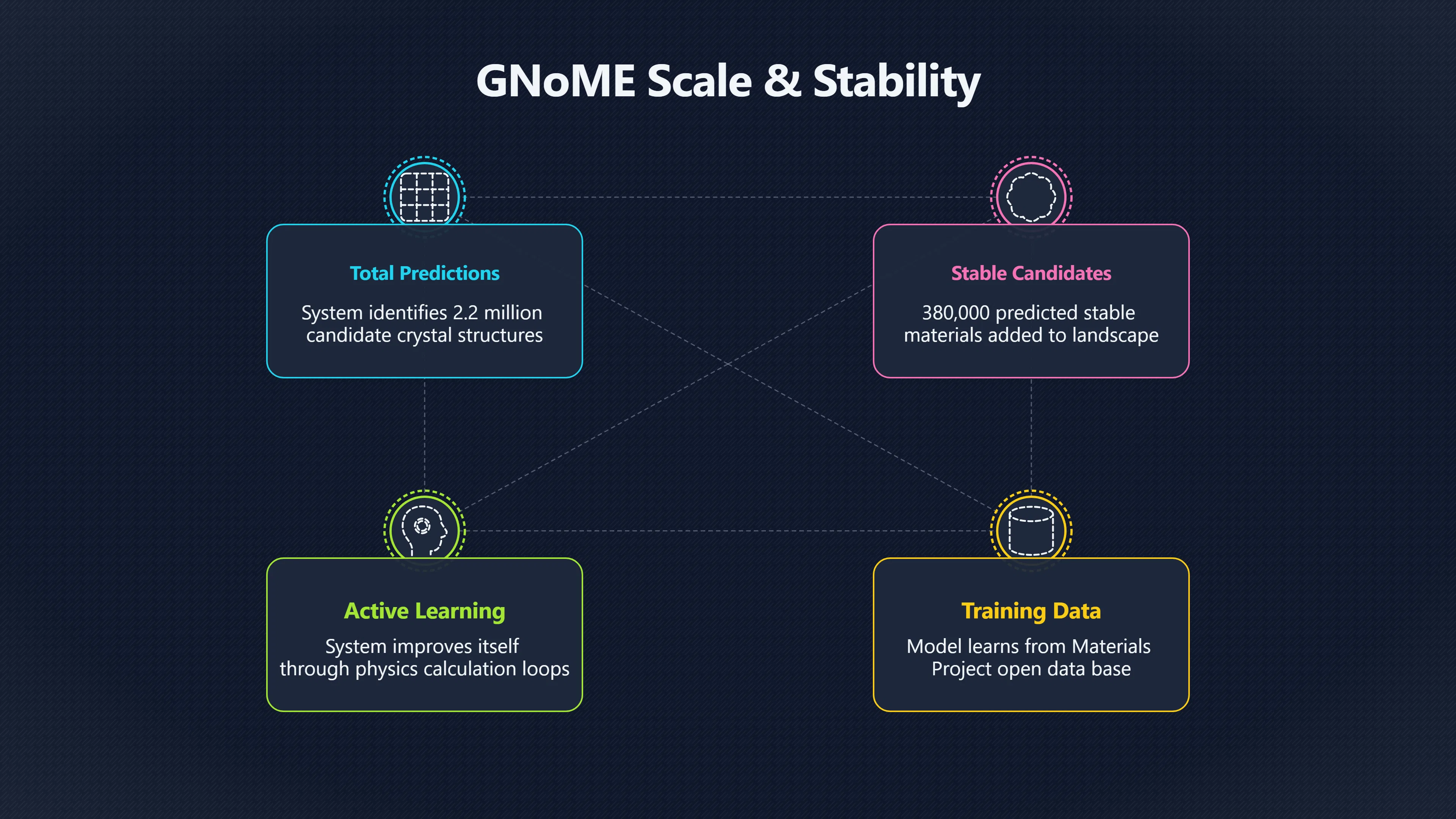
 Google DeepMind’s GNoME system is one of the most ambitious attempts yet to accelerate that search. In 2023, the company reported that GNoME had identified 2.2 million candidate crystal structures, including roughly 380,000 predicted stable materials - a dramatic increase in the known universe of potentially useful inorganic compounds.[Nature]nature.comScaling deep learning for materials discoveryby A Merchant · 2023 · Cited by 1595 — In particular, GNoME models found 2.2 million c…
For advocates of an AI-enabled scientific bloom, the result matters because it suggests that a major research bottleneck may be becoming searchable. But it also exposes another reality: finding a material inside a simulation is not the same thing as turning it into a battery, solar panel, power grid component or industrial product. GNoME shows both the promise of AI-accelerated discovery and the stubborn physical bottlenecks that still stand between prediction and abundance.
What GNoME changed about crystal search
Materials discovery has traditionally been slow because the number of possible atomic arrangements is enormous. Chemists and materials scientists have often relied on a combination of theory, experience and trial-and-error experimentation to identify promising compounds.
GNoME, short for Graph Networks for Materials Exploration, approaches the problem differently. It uses graph neural networks - AI systems that represent atoms and their bonds as connected networks - to predict whether a proposed crystal structure is likely to be stable. The model was trained using data from the Materials Project, a large open database of known and computationally evaluated materials. It then generated new candidate structures and repeatedly improved itself through an active-learning loop that combined machine learning with more computationally expensive physics calculations. Nature[Google DeepMind]biomimicryinnovationlab.comNew materials discovered with deep…Dec 7, 2023 — Of the 2.2 million new crystals predicted by GNoME, 380,000 are the most stable, maki…
The scale of the result was what attracted attention. DeepMind reported that GNoME identified 2.2 million structures predicted to be stable relative to existing databases. Around 381,000 of these appeared on the updated thermodynamic stability landscape known as the convex hull, meaning they were considered especially promising candidates for real materials. Nature[Berkeley Lab News Center]newscenter.lbl.govgoogle deepmind new compounds materials projectBerkeley Lab News CenterGoogle DeepMind Adds Nearly 400000 New Compounds to…Nov 29, 2023 — GNoME researchers ultimately produced 2.2 m…
That matters because stable inorganic materials are the foundation of much modern technology. Researchers hope that among these newly proposed structures could be:
- Better battery materials and solid-state electrolytes.
- Improved catalysts for industrial chemistry.
- New superconductors.
- More efficient photovoltaic materials.[deepmind.google]deepmind.googlemillions of new materials discovered with deep learningGoogle DeepMindMillions of new materials discovered with deep learningNov 29, 2023 — AI tool GNoME finds 2.2 million new crystals, includ…
- Novel semiconductor compounds.
- Stronger and lighter engineering materials.[Google DeepMind]biomimicryinnovationlab.comNew materials discovered with deep…Dec 7, 2023 — Of the 2.2 million new crystals predicted by GNoME, 380,000 are the most stable, maki… Science The broader significance is not any single crystal. It is the possibility that AI can transform discovery from a largely artisanal process in[science.org]science.orgMaterials-predicting AI from DeepMind could revolutionize…Nov 29, 2023 — Researchers report that with a new artificial intelligence (A… to something closer to large-scale search. In the same way that AlphaFold made protein structures dramatically easier to access, GNoME suggests that huge regions of materials space may become computationally explorable rather than remaining effectively invisible.
For the larger AI bloom argument, this is an important pattern. Intelligence is being used not merely to automate existing work but to widen the range of scientific possibilities humans can examine.
Why stability is not the same as usefulness
The most common misunderstanding about GNoME is that it discovered 380,000 immediately useful materials.
It did not.
The key claim is much narrower: the system predicted materials that appear thermodynamically stable according to established computational methods. Stability is a necessary condition for usefulness, but it is far from sufficient. Nature[axios]axios.comTraditionally, materials science relied on tweaking existing stable compounds, whereas GNoME uses deep learning to model atoms and molecu… A material can be stable and still be commercially worthless. What matters in practice depends on many other properties:
- Electrical conductivity.
- Heat resistance.
- Mechanical strength.
- Toxicity.
- Cost of constituent elements.
- Manufacturability.
- Long-term durability.
- Compatibility with existing industrial systems.
A battery electrolyte, for example, must do much more than merely exist. It must conduct ions efficiently, survive repeated charging cycles, remain safe under stress, work across temperatures, and be affordable to manufacture at scale.
This is why materials researchers often describe discovery as a funnel rather than a finish line. Millions of candidates may ultimately yield only a handful of transformative technologies.
Some researchers have also emphasised that AI systems can be much better at predicting stable structures than predicting whether those structures can actually be synthesised in a laboratory. Materials may require highly specific conditions, rare ingredients or difficult processing steps that make them impractical even if they are theoretically stable. ScienceDirect[cypris]cypris.aiHow Generative Models, Graph Neural Networks, and…The Experimental Validation Bottleneck persists as computational predictions f… This distinction matters for public understanding of AI abundance. The optimistic narrative sometimes jumps directly from”millions of new materials” to visions of abundant clean energy and revolutionary manufacturing. The actual path is much longer and more uncertain.
The synthesis bottleneck is now the central problem
If AI can generate candidate materials faster than humans can test them, the bottleneck moves.
The challenge becomes synthesis: actually making the material.
This is where many materials scientists believe the next major acceleration problem lies. Computational prediction has become dramatically faster over the last decade, but laboratory validation remains expensive, time-consuming and dependent on specialised expertise.[arXiv]arxiv.orgAccelerating computational materials discovery with artificial intelligence and cloud high-performance computing: from large-scale s… ScienceDirect The contrast is striking. An AI system can propose thousands of candidates in hours. Producing and characterising a single material may take[sciencedirect.com]sciencedirect.comAdvancing materials discovery through artificial intelligenceby M Otyepka · 2025 · Cited by 23 — The synthesisability, stabi… days, weeks or months.
Researchers at Lawrence Berkeley National Laboratory have been working on this problem through A-Lab, an autonomous materials synthesis system that combines robotics, machine learning and experimental planning. In demonstrations linked to the broader GNoME ecosystem, automated laboratories were able to synthesise substantial numbers of proposed materials without continuous human intervention.[Nature]nature.comGoogle AI and robots join forces to build new materialsNov 29, 2023 — Tool from Google DeepMind predicts nearly 400,000 stable subs…
The importance of this development is easy to miss. If AI-generated scientific hypotheses expand by a factor of one hundred but experimental testing remains unchanged, the real rate of discovery may barely improve. The bottleneck simply shifts from imagination to validation.
For AI bloom scenarios, this is one of the most important lessons from GNoME. Scientific acceleration is unlikely to come from a single breakthrough model. It requires an entire chain:

- AI systems generate hypotheses.
- Simulations filter candidates.
- Automated laboratories test them.
- Researchers interpret results.
- Manufacturing systems scale successful discoveries.
The slowest stage determines the overall speed.
From predicted material to public benefit
Even successful synthesis is only the beginning.
A material that works in a laboratory often faces years of additional development before it affects everyday life. Scaling a material from milligram quantities to industrial production can reveal entirely new problems.
Researchers must determine:
- Whether manufacturing is economical.
- Whether supply chains can support production.
- Whether environmental impacts are acceptable.
- Whether performance remains consistent at scale.
- Whether regulators and customers will accept the technology.
Many apparently promising materials never survive this process.
This is why the strongest case for GNoME is not that it instantly creates abundance. It is that it increases the number of potentially valuable starting points. Instead of searching a tiny fraction of possible compounds, scientists can search a much larger landscape.[Nature]nature.comAI-powered open-source infrastructure for accelerating…by M Salas · 2026 · Cited by 5 — The review further discusses the importance of…
Historically, transformative materials have often arrived unpredictably. Silicon enabled modern computing. Lithium-ion chemistry reshaped portable electronics and electric vehicles. Synthetic fertiliser changed agriculture. New catalysts transformed industrial production.
The difficulty has always been that useful materials are needles hidden in an enormous chemical haystack. GNoME’s contribution is reducing the size of the search problem.

What the early validation evidence actually shows
One reason GNoME attracted attention beyond the AI community is that the work did not stop at computer predictions.
DeepMind and collaborators pointed to hundreds of cases where predicted materials had already been independently synthesised or experimentally validated. Reports around the project noted that more than 700 predicted materials had been confirmed experimentally, while separate work with automated laboratories demonstrated successful synthesis of many AI-proposed compounds.[Venturebeat]venturebeat.comgoogle deepminds materials ai has already discovered 2 2 million new crystalsGoogle DeepMind's materials AI has already discovered…29 Nov 2023 — In 17 days, the AI system was able to identify 2.2 mill… Reddit That evidence is significant because it addresses a common criticism of AI-generated science: that the systems may produce mathematically pla[reddit.com]reddit.comExternal researchers have independently created 736 of GNoME's new materials in the…Read more… usible outputs that fail in the real world.
At the same time, the validation numbers illustrate the scale of the remaining challenge. Hundreds of confirmed materials sounds impressive. Yet it remains a tiny fraction of millions of predictions.
This is not necessarily a failure. Materials discovery has always involved high attrition rates. The point is that AI has dramatically increased the number of possibilities entering the pipeline. Whether society can process that pipeline efficiently becomes the next question.
What GNoME means for the AI bloom argument
GNoME is not proof that AI will create a post-scarcity civilisation. It is evidence for a narrower claim: machine intelligence can sometimes expand the search space of science far faster than traditional methods.
That matters because many of the largest constraints on human flourishing are ultimately physical.
Cleaner energy depends on materials.
Better computing depends on materials.
Advanced robotics depends on materials.
Carbon capture, fusion systems, superconductors, desalination infrastructure and next-generation batteries all depend on finding combinations of atoms that perform better than today’s options.
If AI systems become increasingly capable of exploring those possibilities, scientific progress may become less limited by human trial-and-error. The long-term significance is not that one model discovered millions of crystals. It is that scientific search itself may be becoming more scalable.
Yet GNoME also highlights why abundance is not automatic. The bottlenecks increasingly lie in experimentation, manufacturing, supply chains, institutions and deployment. Intelligence may become abundant before physical implementation does.
That is one reason the strongest versions of the AI bloom thesis focus on systems rather than models. Scientific abundance requires prediction, validation, engineering and diffusion to accelerate together. GNoME provides a glimpse of what happens when one stage of that chain suddenly speeds up. The unanswered question is whether the rest of the chain can keep pace.
Amazon book picks
Further Reading
Books and field guides related to Can AI find the materials abundance needs?. Use these as the next step if you want deeper reading beyond the article.
Human Compatible
Explores how powerful AI could advance humanity if aligned with human values.
The Coming Wave
Directly addresses whether advanced AI can deliver broad civilisational benefits while remaining governable.
Power and Progress
Explains why public institutions matter for distributing technology gains.
eBay marketplace picks
Marketplace Samples
Example marketplace items related to this page. Use the search link to explore similar finds on eBay.


Endnotes
1.
Source: nature.com
Link:https://www.nature.com/articles/s41586-023-06735-9
Source snippet
Scaling deep learning for materials discoveryby A Merchant · 2023 · Cited by 1595 — In particular, GNoME models found 2.2 million c...
2.
Source: deepmind.google
Title: millions of new materials discovered with deep learning
Link:https://deepmind.google/blog/millions-of-new-materials-discovered-with-deep-learning/
Source snippet
Google DeepMindMillions of new materials discovered with deep learningNov 29, 2023 — AI tool GNoME finds 2.2 million new crystals, includ...
3.
Source: time.com
Link:https://time.com/6340681/deepmind-gnome-ai-materials/
Source snippet
Their AI tool, GNoME, was trained with data from the Materials Project and has accurately predicted 381,000 stable materials, significant...
4.
Source: axios.com
Link:https://www.axios.com/2023/12/02/ai-robotics-new-materials
Source snippet
Traditionally, materials science relied on tweaking existing stable compounds, whereas GNoME uses deep learning to model atoms and molecu...
5.
Source: sciencedirect.com
Link:https://www.sciencedirect.com/science/article/pii/S2352940725003981
Source snippet
Advancing materials discovery through artificial intelligenceby M Otyepka · 2025 · Cited by 23 — The synthesisability, stabi...
6.
Source: cypris.ai
Link:https://www.cypris.ai/insights/ai-accelerated-materials-discovery-in-2025-how-generative-models-graph-neural-networks-and-autonomous-labs-are-transforming-r-d
Source snippet
How Generative Models, Graph Neural Networks, and...The Experimental Validation Bottleneck persists as computational predictions f...
7.
Source: arxiv.org
Link:https://arxiv.org/abs/2401.04070
Source snippet
Accelerating computational materials discovery with artificial intelligence and cloud high-performance computing: from large-scale s...
8.
Source: nature.com
Link:https://www.nature.com/articles/d41586-023-03745-5
Source snippet
Google AI and robots join forces to build new materialsNov 29, 2023 — Tool from Google DeepMind predicts nearly 400,000 stable subs...
9.
Source: venturebeat.com
Title: google deepminds materials ai has already discovered 2 2 million new crystals
Link:https://venturebeat.com/ai/google-deepminds-materials-ai-has-already-discovered-2-2-million-new-crystals
Source snippet
Google DeepMind's materials AI has already discovered...29 Nov 2023 — In 17 days, the AI system was able to identify 2.2 mill...
10.
Source: reddit.com
Link:https://www.reddit.com/r/materials/comments/186u1vn/deepmind_millions_of_new_materials_discovered/
Source snippet
External researchers have independently created 736 of GNoME's new materials in the...Read more...
11.
Source: sciencedirect.com
Link:https://www.sciencedirect.com/science/article/pii/S0262407923022145
Source snippet
AI could discover wonder materialsby A Wilkins · 2023 · Cited by 1 — GNoME is a graph neural network, a kind of AI that can learn the rel...
12.
Source: sciencedirect.com
Link:https://www.sciencedirect.com/science/article/pii/S2666546825001375
Source snippet
From this, we identify over 38,500 materials with potential as energy materials forming...
13.
Source: arxiv.org
Link:https://arxiv.org/html/2508.03278v1
Source snippet
Artificial Intelligence and Generative Models for Materials...5 Aug 2025 — This review aims to provide insights for researchers aiming t...
14.
Source: law.berkeley.edu
Link:https://www.law.berkeley.edu/wp-content/uploads/2024/02/Millions-of-new-materials-discovered-with-deep-learning-Google-DeepMind.pdf
Source snippet
of new materials discovered with deep learningNov 29, 2023 — AI tool GNoME nds 2.2 million new crystals, including 380,000 stable materia...
15.
Source: reddit.com
Link:https://www.reddit.com/r/mlscaling/comments/187q6za/gnome_graph_nn_for_discovering_crystals_alab/
Source snippet
GNoME: graph NN for discovering crystals; A-Lab...2.2 million stable crystals claimed. (I'm not sure how this squares with the previous...
16.
Source: reddit.com
Link:https://www.reddit.com/r/singularity/comments/186t59y/deepmind_millions_of_new_materials_discovered/
Source snippet
ion new crystals – equivalent to nearly 800 years' worth of knowledge.Read more...
17.
Source: nature.com
Link:https://www.nature.com/articles/s43246-026-01105-0
Source snippet
AI-powered open-source infrastructure for accelerating...by M Salas · 2026 · Cited by 5 — The review further discusses the importance of...
18.
Source: newscenter.lbl.gov
Title: google deepmind new compounds materials project
Link:https://newscenter.lbl.gov/2023/11/29/google-deepmind-new-compounds-materials-project/
Source snippet
Berkeley Lab News CenterGoogle DeepMind Adds Nearly 400000 New Compounds to...Nov 29, 2023 — GNoME researchers ultimately produced 2.2 m...
19.
Source: science.org
Link:https://www.science.org/content/article/materials-predicting-ai-deepmind-could-revolutionize-electronics-batteries-and-solar
Source snippet
Materials-predicting AI from DeepMind could revolutionize...Nov 29, 2023 — Researchers report that with a new artificial intelligence (A...
20.
Source: wired.com
Title: Google Deep Mind’s AI Dreamed Up 380,000 New Materials
Link:https://www.wired.com/story/an-ai-dreamed-up-380000-new-materials-the-next-challenge-is-making-them
Source snippet
The Next Challenge Is Making ThemGoogle DeepMind developed an AI program, GNoME, which has predicted 380,000 new stable materials, expand...
21.
Source: github.com
Link:https://github.com/google-deepmind/materials_discovery
Source snippet
GNoMEThe Graph Networks for Materials Exploration Database is experimental in nature and provided on an “as is” basis. To the maximum ext...
22.
Source: ft.com
Link:https://www.ft.com/content/f841e9e0-c9c6-49ab-b91c-6d7bea2a3940?syn-25a6b1a6=1
Source snippet
Google DeepMind researchers use AI tool to find 2mn new...29 Nov 2023 — Google DeepMind researchers have discovered 2.2mn crystal struct...
23.
Source: biomimicryinnovationlab.com
Title: Google Deepmind
Link:https://www.biomimicryinnovationlab.com/blog/google-deepmind-new-materials
Source snippet
New materials discovered with deep...Dec 7, 2023 — Of the 2.2 million new crystals predicted by GNoME, 380,000 are the most stable, maki...
Additional References
24.
Source: medium.com
Link:https://medium.com/%40HitachiVentures/ai-is-powering-the-future-of-material-science-from-lab-to-real-world-breakthroughs-2f92cf56ed90
Source snippet
AI is Powering the Future of Material Science: From Lab to...Rather than relying solely on experimentation, researchers can now use mach...
25.
Source: discussion.fool.com
Link:https://discussion.fool.com/t/ot-ai-makes-mistakes-with-duplicate-structures-that-haunt-crystallography-databases/122599
Source snippet
Graph Networks for Materials Exploration (GNoME). Importantly, they claimed that more than 380,000 of the crystals were stable inorganic...
26.
Source: arstechnica.com
Title: googles deepmind finds 2 2m crystal structures in materials science win
Link:https://arstechnica.com/ai/2023/11/googles-deepmind-finds-2-2m-crystal-structures-in-materials-science-win/
Source snippet
Google's DeepMind finds 2.2M crystal structures in...29 Nov 2023 — Google DeepMind researchers have discovered 2.2 million crystal struc...
27.
Source: thelab.brookesbell.com
Title: googles deepmind ai tool makes material science breakthrough 158802
Link:https://thelab.brookesbell.com/about/news/googles-deepmind-ai-tool-makes-material-science-breakthrough-158802/
Source snippet
brookesbell.comGoogle's DeepMind AI Tool Makes Material Science...14 Dec 2023 — Of the 2.2 million new crystals discovered by GNoME appr...
28.
Source: pubs.acs.org
Title: Publications Artificial Intelligence Driving Materials Discovery?
Link:https://pubs.acs.org/doi/10.1021/acs.chemmater.4c00643
Source snippet
AK Cheetham · 2024 · Cited by 164 — In an article in Nature published in November 2023, Merchant et al.... Their appro...
Published: November 2023
29.
Source: mercatus.org
Title: future materials science ai automation and policy strategies
Link:https://www.mercatus.org/research/policy-briefs/future-materials-science-ai-automation-and-policy-strategies
Source snippet
The Future of Materials Science: AI, Automation, and Policy...24 Mar 2025 — This report will focus on what public policy and research ca...
30.
Source: fanaticalfuturist.com
Title: googles deepmind ai just invented 380000 new compounds
Link:https://www.fanaticalfuturist.com/2023/12/googles-deepmind-ai-just-invented-380000-new-compounds/
Source snippet
Google's DeepMind AI just invented 380000 new compoundsDec 17, 2023 — GNoME researchers ultimately produced 2.2 million crystal structure...
31.
Source: freethink.com
Title: google ai discovers 2 2 million new materials
Link:https://www.freethink.com/robots-ai/google-ai-discovers-2-2-million-new-materials
Source snippet
Google AI discovers 2.2 million new materials22 Dec 2023 — Google's AI GNoME has predicted 2.2 million novel inorganic crystal structures...
32.
Source: linkedin.com
Title: google ai discovers new materials 5838108
Link:https://www.linkedin.com/news/story/google-ai-discovers-new-materials-5838108/
Source snippet
Google AI discovers new materials30 Nov 2023 — Dubbed GNoME, the AI predicted the structure of 2.2 million new inorganic crystal substanc...
33.
Source: linkedin.com
Title: ai tool discovers 22m structures 5558185
Link:https://www.linkedin.com/news/story/ai-tool-discovers-22m-structures-5558185/
Source snippet
AI tool discovers 2.2M structuresDec 2, 2023 — Google DeepMind's new tool, called Graph Networks for Materials Exploration (GNoME), has d...
Topic Tree