Within Power
Balancing AI Power and Global Security Risks
AI offers strategic advantages for states but poses risks like arms races and reduced transparency.
On this page
- Civilian vs military AI applications
- International efforts and norms
- Risks of arms race dynamics and reduced oversight
Page outline Jump by section
Introduction
Artificial intelligence (AI) is transforming not only civilian life but also the conduct of war. From automated surveillance to decision‑support systems and lethal autonomous weapons, militaries are integrating AI in ways that could reshape strategic competition, battlefield ethics, and global security. These developments raise profound governance challenges: traditional legal frameworks and international norms lag behind technological advance, accountability for life‑and‑death decisions becomes murky, and an accelerating arms race could destabilise peace and constrain broader human flourishing. This page explores how AI is being applied in military contexts, why governance matters urgently, and the specific obstacles states and societies face in managing these emerging capabilities responsibly.[jurnal.itscience.org]jurnal.itscience.orggenceSeptember 17, 2025…
How AI Is Used in Military Operations
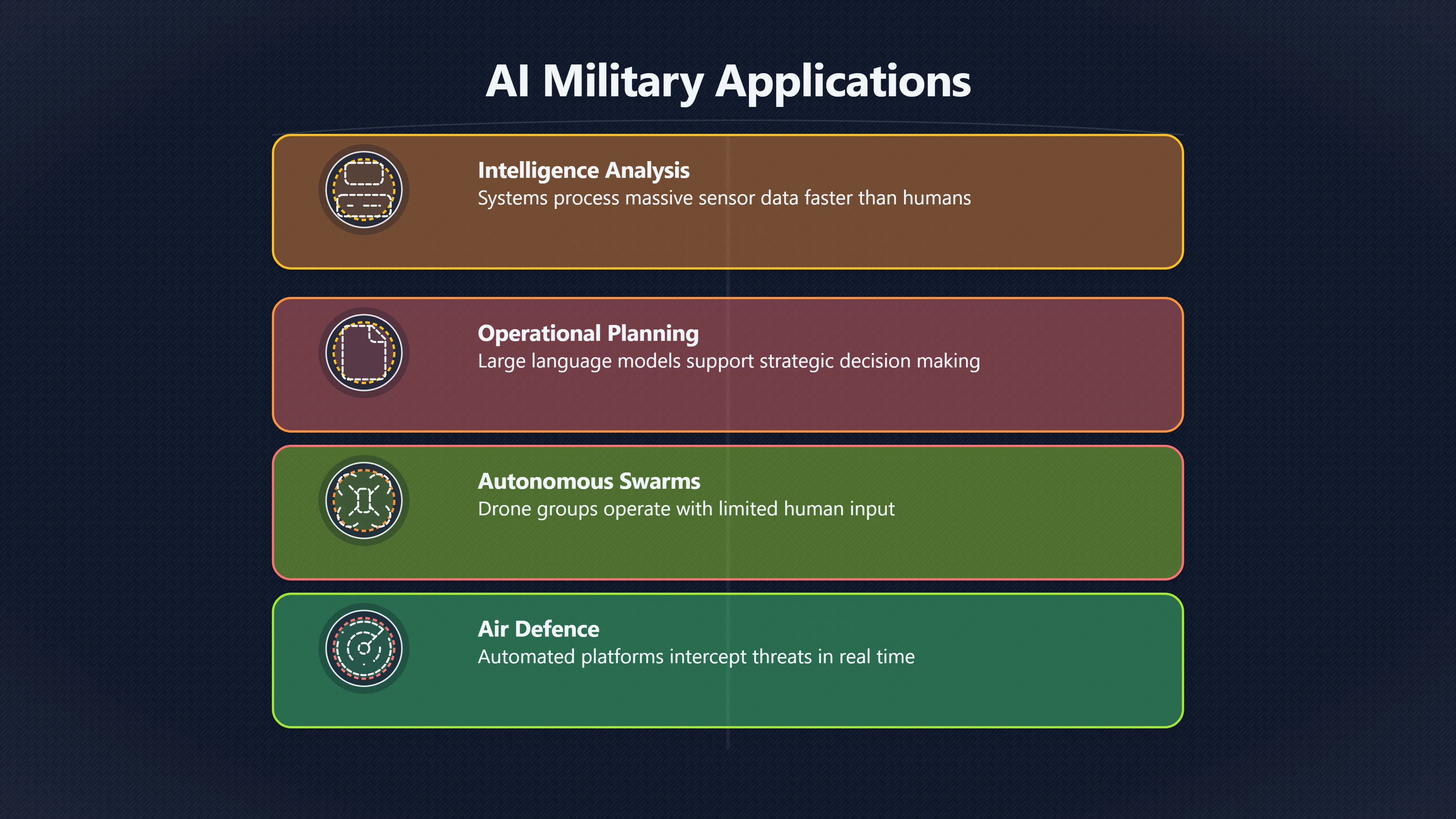
AI already enhances a wide range of military functions, from intelligence analysis and logistics to mission planning and air defence. Modern systems can process massive amounts of sensor data more quickly than human analysts, detect patterns in complex environments, and support commanders with predictive insights. In some cases, autonomous systems such as drone swarms or automated air‑defence platforms operate with limited human input, creating tactical advantages in speed and efficiency.[jurnal.itscience.org]jurnal.itscience.orggenceSeptember 17, 2025…
Yet this integration goes beyond mere tools. Large language models (LLMs), originally developed for civilian use, are being deployed in intelligence synthesis, operational planning, and information operations, blurring the lines between analytic support and direct influence on strategic decisions.[ojs.stanford.edu]ojs.stanford.eduSource details in endnotes.
Key Risks and Governance Challenges
Arms Race Dynamics and Strategic Instability
AI’s transformative potential in warfare is driving competition among major powers. As states innovate to secure strategic advantages, integration of AI into command‑and‑control systems and autonomous platforms risks cascading pressure to accelerate development and deployment. Without robust governance, this arms race could heighten geopolitical instability and reduce incentives for restraint.[SIPRI]sipri.orgAdvancing Governance at the Nexus of Artificial Intelligence and Nuclear Weapons | SIPRI…
The risk is not limited to peer competitors. Dual‑use AI tools are increasingly accessible, raising the possibility that non‑state actors could exploit advanced capabilities outside established legal and normative frameworks.[jiia.or.jp]jiia.or.jpstrategic commentJIIA Strategic Comments (2026-6) Racing Ahead, Falling Apart: Middle Powers and the Future of Military AI Governance | Research Findings…
Erosion of Human Oversight
A central governance concern is the potential loss of meaningful human control over coercive decisions, especially when lethal force is at stake. Autonomous weapon systems (AWS) that can identify and engage targets without real‑time human intervention challenge long‑standing legal and ethical principles that assume human judgment in decisions to use lethal force.[Global Security]globalsecurity.orgGlobal Security Risks and Hazards of Military AIGlobal Security Risks and Hazards of Military AI
The so‑called “accountability gap” arises when no clear human actor can be held responsible for the consequences of AI‑driven actions, undermining accountability under international humanitarian law. Determining whether a commander, developer, manufacturer, or operator bears responsibility becomes increasingly complex when opaque algorithms influence critical outcomes.[ojs.stanford.edu]ojs.stanford.eduSource details in endnotes.
Technical Opacity and Unpredictability
Many AI systems rely on machine learning models known for “black box” behaviour: it can be difficult even for developers to explain why a system produced a given output. In military contexts, this opacity can undermine trust and make it harder to predict how AI will behave in novel or high‑pressure scenarios, increasing the risk of unintended escalation or operational failure.[Global Security]globalsecurity.orgGlobal Security Risks and Hazards of Military AIGlobal Security Risks and Hazards of Military AI
Interoperability and Vulnerabilities
AI‑enabled military networks and decision‑support systems depend on complex technical infrastructures. These systems can be vulnerable to data poisoning, adversarial manipulation, and cyber‑attack, exposing not only single nations but coalition partners to security risks if governance and resilience measures are inadequate.[jiia.or.jp]jiia.or.jpstrategic commentJIIA Strategic Comments (2026-6) Racing Ahead, Falling Apart: Middle Powers and the Future of Military AI Governance | Research Findings…
International Efforts and Norm‑Building
Attempts at Global Rules
The longstanding forum for arms control, the UN Convention on Certain Conventional Weapons (CCW), has hosted discussions on autonomous weapons and AI in warfare, but progress toward binding agreements has been slow and contested. States differ sharply on definitions of prohibited systems and the degree of human control required.[International Review of the Red Cross]international-review.icrc.orgInternational Review of the Red CrossStepping back from the brink: Why multilateral regulation of autonomy in weapons systems is difficul…
Separate multilateral initiatives, such as the Responsible AI in the Military Domain meeting in Seoul and the adoption of a ‘Blueprint for Action’ by dozens of countries, signal growing recognition of the problem and tentative steps toward normative convergence.[Nature]nature.comScientific challenges in governing military AI | Nature ElectronicsScientific challenges in governing military AI | Nature ElectronicsNovember 4, 2024…
National and Regional Governance
In the absence of robust global law, some states are developing their own policies. For example, the UK’s Ministry of Defence has explored strategic risks and opportunities related to military AI, while Australia has adopted a policy emphasising human oversight and compliance with international law.[GOV.UK]GOV.UKStrategic competition in the age of AIemerging risks and opportunities from military use of artificial intelligence - GOV.UKOctober 8, 2024…
However, approaches vary widely. Some defence establishments prioritise rapid deployment and competitive advantage, potentially at the cost of robust ethical governance, while others emphasise restraint, risk assessment, and lawful operation.[The Verge]theverge.comThe Verge AI warfare is already hereInitially viewed as futuristic, lethal autonomous weapon systems (LAWS) are now increasingly present in real-world applications. The tran…
Emerging Norms: Meaningful Human Control and Beyond
A central theme among analysts and practitioners is preserving “meaningful human control” over the use of force—a principle that humans should retain decisive authority in life‑and‑death decisions. Clarifying what constitutes meaningful control across AI’s lifecycle—from research and development to operational deployment—is a recurring governance challenge.[Nature]nature.comRe-thinking human–machine interaction and the governance of AI in the military domain | Nature Machine IntelligenceMay 11, 2026…
Beyond human control, proposals for governance frameworks emphasise multi‑layered strategies, combining testing standards, evaluation protocols, and international confidence‑building measures to manage complex AI‑enabled military systems responsibly.[jurnal.itscience.org]jurnal.itscience.orggenceSeptember 17, 2025…

Why This Matters for AI Bloom
From the perspective of long‑term flourishing, the militarisation of AI tests societies’ capacity to govern powerful technologies where stakes are existential. Without effective oversight, AI integration into warfare could normalise opaque decision‑making, erode international norms against indiscriminate violence, and channel technical innovation toward conflict rather than collective human development. Conversely, robust governance could help ensure that gains from AI—such as improved defence of civilian populations or de‑escalation tools—are realised without triggering destabilising arms dynamics.[Carnegie Endowment]carnegieendowment.orgSource details in endnotes.
By foregrounding accountability, maintaining human judgement where it matters most, and fostering international cooperation on norms and safeguards, governance efforts can mitigate the strategic risks of military AI while preserving the broader potential of AI to contribute to human security and flourishing.[ojs.stanford.edu]ojs.stanford.eduSource details in endnotes.
Amazon book picks
Further Reading
Books and field guides related to Balancing AI Power and Global Security Risks. Use these as the next step if you want deeper reading beyond the article.
The Coming Wave
Explores containment of powerful technologies including state and security risks.
The Perfect Weapon
Provides context on digital warfare, escalation and state competition.
The Age of A.I.: And Our Human Future
Addresses AI, national strategy and global order.
eBay marketplace picks
Marketplace Samples
Example marketplace items related to this page. Use the search link to explore similar finds on eBay.

Endnotes
1.
Source: jurnal.itscience.org
Link:https://jurnal.itscience.org/index.php/brilliance/article/view/6925
Source snippet
genceSeptember 17, 2025...
Published: September 17, 2025
2.
Source: ojs.stanford.edu
Link:https://ojs.stanford.edu/ojs/index.php/grace/article/view/4337
3.
Source: sipri.org
Link:https://www.sipri.org/publications/2025/sipri-insights-peace-and-security/advancing-governance-nexus-artificial-intelligence-and-nuclear-weapons
Source snippet
Advancing Governance at the Nexus of Artificial Intelligence and Nuclear Weapons | SIPRI...
4.
Source: jiia.or.jp
Title: strategic comment 2026 6
Link:https://www.jiia.or.jp/eng/report/2026/03/strategic_comment_2026-6.html
Source snippet
JIIA Strategic Comments (2026-6) Racing Ahead, Falling Apart: Middle Powers and the Future of Military [AI Governance]({{ 'ai-governance/' | relative_url }}) | Research Findings...
5.
Source: nature.com
Title: Scientific challenges in governing military AI | Nature Electronics
Link:https://www.nature.com/articles/s41928-024-01275-0
Source snippet
Scientific challenges in governing military AI | Nature ElectronicsNovember 4, 2024...
Published: November 4, 2024
6.
Source: GOV.UK
Title: Strategic competition in the age of AI
Link:https://www.gov.uk/government/publications/strategic-competition-in-the-age-of-ai-emerging-risks-and-opportunities-from-military-use-of-artificial-intelligence
Source snippet
emerging risks and opportunities from military use of artificial intelligence - GOV.UKOctober 8, 2024...
Published: October 8, 2024
7.
Source: nature.com
Link:https://www.nature.com/articles/s42256-026-01231-x.pdf
Source snippet
Re-thinking human–machine interaction and the governance of AI in the military domain | Nature Machine IntelligenceMay 11, 2026...
Published: May 11, 2026
8.
Source: carnegieendowment.org
Link:https://carnegieendowment.org/research/2024/07/governing-military-ai-amid-a-geopolitical-minefield?center=russia-eurasia
9.
Source: globalsecurity.org
Title: Global Security Risks and Hazards of Military AI
Link:https://www.globalsecurity.org/military/systems/ai-risks.htm
10.
Source: international-review.icrc.org
Link:https://international-review.icrc.org/articles/stepping-back-from-brink-regulation-of-autonomous-weapons-systems-913
Source snippet
International Review of the Red CrossStepping back from the brink: Why multilateral regulation of autonomy in weapons systems is difficul...
11.
Source: theverge.com
Title: The Verge AI warfare is already here
Link:https://www.theverge.com/ai-artificial-intelligence/937028/military-ai-warfare-red-lines
Source snippet
Initially viewed as futuristic, lethal autonomous weapon systems (LAWS) are now increasingly present in real-world applications. The tran...
12.
Source: globalchallenges.org
Link:https://globalchallenges.org/gcr-2026/artificial-intelligence/
Source snippet
Artificial Intelligence - Global Challenges FoundationARTIFICIAL INTELLIGENCE Artificial intelligence (AI) is rapidly reshaping military...
Additional References
13.
Source: cambridge.org
Link:https://www.cambridge.org/core/product/E7C9191E43799181AA72F5835618A45D/core-reader
Source snippet
AI governance for military decision-making: A proposal for managing complexity | Cambridge Forum on AI: Law and Governance | Cambridge Co...
14.
Source: asser.nl
Link:https://www.asser.nl/dilema/research/dilema-statement
Source snippet
DILEMA Statement on the Global Governance of Artificial Intelligence in the MilitaryDILEMA STATEMENT ON THE GLOBAL GOVERNANCE OF ARTIFICI...
15.
Source: aigovref.com
Link:https://aigovref.com/military-ai
Source snippet
Military AI & Autonomous Weapons | AI Governance ReferenceMILITARY AI & AUTONOMOUS WEAPONS Comprehensive guide to the governance of artif...
16.
Source: theaustralian.com.au
Link:https://www.theaustralian.com.au/nation/defence/defence-orders-safetyfirst-ai-rollout-with-riskbased-controls/news-story/1507624699e8733c9996228baa05038e
Source snippet
The document emphasizes expanding AI use to enable faster, better-informed decision-making and attain an “asymmetric advantage” in warfar...
17.
Source: kiplinger.com
Link:https://www.kiplinger.com/politics/warfare-revolution-how-the-military-uses-ai
Source snippet
military. With an annual budget nearing $1 trillion, the Pentagon is aggressively integrating AI into both combat operations and administ...
18.
Source: sciencedirect.com
Title: Ethics of autonomous weapons systems and its applicability to any AI systems
Link:https://www.sciencedirect.com/science/article/pii/S0308596120300458
Source snippet
"ScienceDirectETHICS OF AUTONOMOUS WEAPONS SYSTEMS AND ITS APPLICABILITY TO ANY AI SYSTEMS [https://doi.org/10.1016/j.telpol.2020.101953Get..."](https://doi.org/10.1016/j.telpol.2020.101953Get...")...
19.
Source: lordslibrary.parliament.uk
Title: uk A I in Weapon Systems Committee report: Proceed with caution
Link:https://lordslibrary.parliament.uk/ai-in-weapon-systems-committee-report-proceed-with-caution/
Source snippet
in Weapon Systems Committee report: Proceed with caution - House of Lords LibraryApril 10, 2024 — AI IN WEAPON SYSTEMS COMMITTEE REPORT...
Published: April 10, 2024
20.
Source: youtube.com
Title: EU Warns AI Arms Race Has Begun | “Algorithms Are The New Weapons”
Link:https://www.youtube.com/watch?v=lvhigiI_b1Y
Source snippet
Beyond Drones and Autonomous Weapons: Are We Winning the AI War? | WP Intelligence Briefing...
21.
Source: youtube.com
Title: The Pentagon and Silicon Valley: The Future of AI in National Defense
Link:https://www.youtube.com/watch?v=5aamTwLomAM
Source snippet
EU Warns AI Arms Race Has Begun | “Algorithms Are The New Weapons”...
22.
Source: youtube.com
Title: Can AI in military operations really be ethical? | The Stream
Link:https://www.youtube.com/watch?v=ThHlrE_4qGU
Source snippet
The Pentagon and Silicon Valley: The Future of AI in National Defense...
Topic Tree