Within Pandemic AI
Can Pandemic AI Work With Incomplete Data?
Sparse, delayed and biased reporting can cause outbreak prediction systems to fail when early warning matters most.
On this page
- Why early outbreak data is unreliable
- Bias and missing populations in surveillance
- Improving global disease data infrastructure
Page outline Jump by section
Introduction
Pandemic forecasting AI is often described as a way to see outbreaks coming before hospitals fill, borders close or supply chains break. In the most optimistic versions of the AI abundance story, increasingly powerful systems could help humanity detect emerging diseases early, coordinate responses faster and reduce one of the major threats to long-term human flourishing. But there is a basic constraint that advanced models cannot escape: they can only forecast what they can observe.
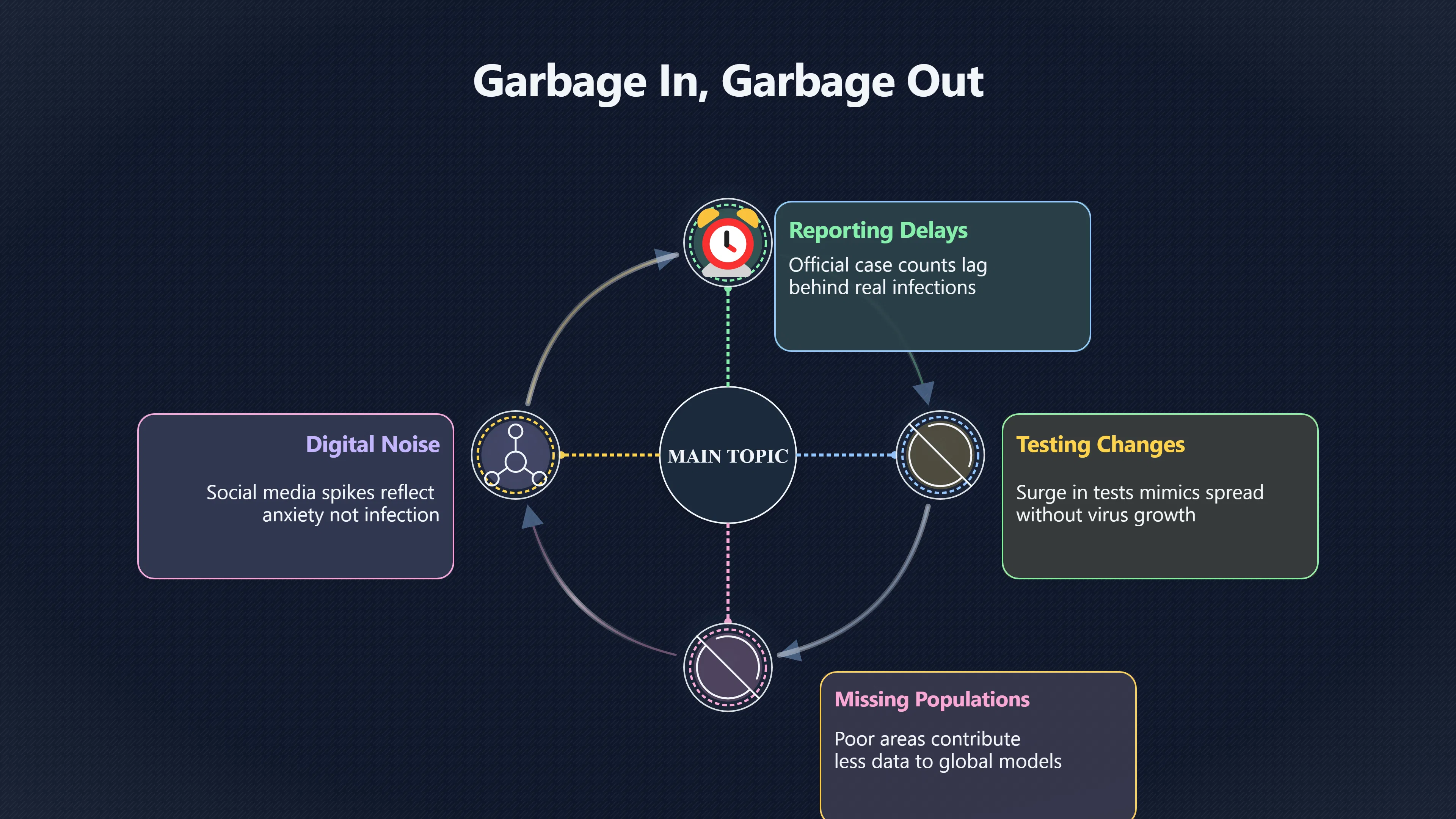
 The hardest period of any outbreak is usually the beginning, when information is sparse, delayed, politically contested or simply missing. The same conditions that make early warning valuable also make reliable prediction difficult. During COVID-19 and many previous epidemics, reporting delays, unequal testing access, undercounted populations and fragmented surveillance systems distorted the data flowing into forecasting models. As a result, AI systems often faced a version of the classic problem of “garbage in, garbage out”: sophisticated algorithms operating on incomplete pictures of reality. PMC[OUP Academic]academic.oup.comOUP AcademicA widely neglected impact factor in COVID-19 forecastsby L Ma · 2024 · Cited by 10 — In our work, through the analysis of the…
For pandemic forecasting to become a serious pillar of civilisational resilience, improvements in AI capability may matter less than many people assume. Equally important is building the global disease-data infrastructure that allows those systems to see what is actually happening.
Can Pandemic AI Work With Incomplete Data?
In principle, machine learning systems are well suited to finding patterns across large, messy datasets. Modern outbreak forecasting can combine clinical reports, mobility data, environmental information, news reports, internet searches and other signals to estimate where disease may be spreading.[PMC]pmc.ncbi.nlm.nih.govReporting delays: A widely neglected impact factor in COVID…by L Ma · 2024 · Cited by 10 — We develop a statistical framework to de…[ScienceDirect]sciencedirect.comThey also enhance risk assessment by…Read more…
The problem is that the first weeks of a new outbreak rarely generate large, reliable datasets.
Several distortions appear simultaneously:
- Cases go undetected because many infected people never receive tests.
- Testing rules change from week to week.
- Different regions report data using different definitions.
- Governments may delay publication.
- Hospitals become overwhelmed and stop reporting consistently.
- Rural and poorer communities often contribute less data.
- New pathogens may produce symptoms that are initially misclassified.
From a machine-learning perspective, these are not minor inconveniences. They alter the underlying distribution of the data itself. A model trained on historical outbreaks assumes that incoming information reflects reality with reasonable consistency. During an emerging epidemic, that assumption can fail dramatically.[PNAS]pnas.orgHere, we detail three regional-scale models for forecasting and assessing the course of…
This creates a paradox. Forecasting systems are usually most accurate when diseases are already well characterised and data collection is stable. Yet the moments when society most needs prediction are the moments when information quality is worst.
Why Early Outbreak Data Is Unreliable
Reporting delays can make outbreaks look smaller than they are
One of the clearest examples comes from COVID-19 reporting delays.
Researchers analysing the first pandemic wave found substantial delays between infections occurring and those infections appearing in official datasets. These delays propagated through forecasting systems, producing distorted estimates of disease growth and epidemic timing. After correcting for reporting delays, forecast errors in some cases fell by as much as 50 percent.[OUP Academic]academic.oup.comOUP AcademicA widely neglected impact factor in COVID-19 forecastsby L Ma · 2024 · Cited by 10 — In our work, through the analysis of the…
For AI systems, delayed data creates a dangerous illusion. The model may appear to be observing real-time conditions when it is actually looking into the past.
Imagine an outbreak doubling every few days. If official case reports lag by a week, a forecasting system may underestimate current spread precisely when intervention decisions are being made. Public-health leaders may conclude that an outbreak remains manageable when transmission has already accelerated beyond that point.
Testing changes can create false trends
COVID-19 also demonstrated how changes in testing behaviour distort forecasts.
When testing expands rapidly, reported cases can rise even if transmission remains stable. When testing contracts, case counts may fall despite worsening spread. Forecasting systems that rely heavily on confirmed case numbers can mistake changes in surveillance intensity for changes in disease dynamics.[arXiv]arxiv.orgDisease Outbreak Detection and Forecasting: A Review of…Statistical and machine learning techniques have been applied to the predictio…
This issue is particularly severe during the opening phase of a pandemic because testing infrastructure is often being built at the same time the disease is spreading.
The resulting data stream does not simply contain noise. It contains systematic bias.
Novel pathogens provide very little training data
Machine learning generally benefits from large historical datasets. Emerging pathogens provide the opposite.
During the early stages of COVID-19, researchers repeatedly noted that forecasting systems had only small numbers of observations available for training. Models therefore had to extrapolate from extremely limited evidence while key epidemiological characteristics remained uncertain.[arXiv]arxiv.orgDisease Outbreak Detection and Forecasting: A Review of…Statistical and machine learning techniques have been applied to the predictio…
This is one reason outbreak prediction often appears more successful in retrospective studies than in real-time deployment. Once a pandemic has generated months or years of observations, patterns become easier to identify. Early warning systems do not have that luxury.
Bias And Missing Populations In Surveillance
The people missing from the data are often the most vulnerable
Disease surveillance is not evenly distributed across society.
Communities with weaker healthcare access, lower testing rates, poorer digital connectivity or limited public-health infrastructure often contribute less data to surveillance systems. Forecasting models may therefore become most accurate for populations that are already relatively visible and least accurate for populations facing the greatest risks.[dpe.gospub.com]dpe.gospub.comArtificial Intelligence for Public Health Surveillanceby GC Ikechukwu · 2026 — Though, actual implementations reveal significant traps: b…
This creates a feedback problem.
If surveillance systems systematically undercount certain populations, forecasts generated from those systems can underestimate disease burden in those same groups. Resources may then be allocated away from areas that need them most, reinforcing the original bias.
For a future in which AI contributes to broad human flourishing rather than concentrating advantages among already well-observed populations, this problem is not peripheral. It is central.
Global blind spots weaken global forecasts
Pandemics do not respect national borders, but disease-data systems remain heavily fragmented.
High-income countries generally produce richer surveillance datasets than low-income countries. Yet outbreaks often emerge or expand in places where laboratory capacity, reporting infrastructure and healthcare coverage are more limited. A forecasting system attempting global prediction may therefore receive its weakest information from regions where early detection is most important.[PMC]pmc.ncbi.nlm.nih.govArtificial intelligence in early warning systems for infectious…by I Villanueva-Miranda · 2025 · Cited by 84 — Using historical dat…
An AI model cannot reliably infer an outbreak that is largely invisible in its input data.
This is one reason many researchers argue that pandemic preparedness is as much an infrastructure challenge as an algorithm challenge. Better models cannot fully compensate for absent observations.
Digital surveillance introduces new biases
Many modern forecasting systems supplement official reports with alternative signals such as news articles, internet searches and social-media activity. These sources can sometimes identify unusual disease activity before formal reporting systems respond. ScienceDirect[2publichealthaihandbook.com]publichealthaihandbook.comAI in Disease Surveillance and Outbreak DetectionAI transforms outbreak detection by analyzing diverse data streams in real-time, using a…
However, these data sources bring their own distortions.
Search activity may reflect public anxiety rather than actual infections. News coverage can spike because of media attention rather than epidemiological change. Social-media participation varies substantially by age, geography and income.
The result is not necessarily bad forecasting. In some cases these signals improve prediction. But they do not eliminate surveillance bias. They often shift it into different forms.
The Wastewater Surveillance Lesson
Wastewater monitoring became one of the most celebrated innovations of the COVID-19 era because it could detect viral activity without requiring individuals to seek testing or medical care. Researchers showed that sewage monitoring could reveal disease circulation before large numbers of clinical cases appeared.[OAE Publishing]oaepublish.comOAE PublishingIntegrated environmental surveillance: the role of…by M Oliveira · 2025 · Cited by 3 — Sewage water analysis allows the…
For AI forecasting systems, wastewater data offered a valuable independent signal.
Yet even this approach has limits.
Recent research suggests that wastewater surveillance can contain its own coverage gaps. Communities lacking sewage infrastructure or comprehensive monitoring may remain underrepresented. Vulnerable populations can therefore continue to disappear from supposedly population-wide datasets.[News-Medical]news-medical.netStudy reveals inequities in wastewater-based diseaseStudy reveals inequities in wastewater-based disease…May 28, 2026 — 4 days ago — Wastewater surveillance was hailed during…
The lesson is broader than wastewater monitoring itself.
There is no perfectly objective surveillance stream. Every dataset captures some aspects of reality while missing others. Effective forecasting increasingly depends on combining multiple imperfect signals rather than relying on a single source of truth.
Why Better AI Alone Cannot Solve The Problem
A common assumption in discussions of advanced AI is that more capable models will eventually overcome data limitations.
To some extent this is true. Modern systems can integrate heterogeneous data sources, identify anomalies, estimate missing values and detect patterns that traditional statistical methods might miss.[PMC]pmc.ncbi.nlm.nih.govInfectious Disease Surveillance in the Era of Big Data and AIby CO Idahor · 2025 · Cited by 13 — This review explores the potential of…[PMC]pmc.ncbi.nlm.nih.govin public health surveillance: An overview of novel…by H Rilkoff · 2024 · Cited by 26 — Wastewater surveillance (WWS) has evolved as a…
But there are hard limits.
If infections are not being tested, reported or observed through alternative surveillance systems, the information may simply not exist in usable form. AI can infer hidden patterns, but it cannot perfectly reconstruct realities that leave almost no measurable trace.
This distinction matters for long-term visions of AI-enabled civilisational resilience.
Forecasting systems may eventually become far more powerful than today’s tools. Yet even highly advanced intelligence requires sensory input. In pandemic forecasting, disease surveillance functions as the sensory layer. Weak surveillance constrains what prediction systems can know.
The bottleneck is therefore partly computational but also institutional, logistical and political.
Improving Global Disease Data Infrastructure
The strongest response to distorted outbreak forecasts is not merely building larger models. It is improving the quality, speed and coverage of disease observation itself.
Several approaches are increasingly important:
Faster reporting systems. Reducing delays between diagnosis and reporting can significantly improve forecast quality and situational awareness.[OUP Academic]academic.oup.comOUP AcademicA widely neglected impact factor in COVID-19 forecastsby L Ma · 2024 · Cited by 10 — In our work, through the analysis of the…
Multi-source surveillance. Combining clinical reports, laboratory testing, wastewater monitoring, environmental sensing and digital signals reduces dependence on any single flawed dataset. OAE Publishing[2publichealthaihandbook.com]publichealthaihandbook.comAI in Disease Surveillance and Outbreak DetectionAI transforms outbreak detection by analyzing diverse data streams in real-time, using a…
Coverage of underserved populations. Forecasts become more reliable when surveillance systems deliberately include regions and groups that are traditionally undercounted.[News-Medical]news-medical.netStudy reveals inequities in wastewater-based diseaseStudy reveals inequities in wastewater-based disease…May 28, 2026 — 4 days ago — Wastewater surveillance was hailed during…
International interoperability. Data standards that allow information sharing across borders can reduce blind spots during rapidly spreading outbreaks.[PMC]pmc.ncbi.nlm.nih.govArtificial intelligence in infection surveillance: Data integration…by JH Li · 2025 · Cited by 10 — AI-driven infection surveillanc…
Uncertainty-aware forecasting. Models should communicate confidence intervals and data limitations rather than presenting precise predictions that imply more certainty than the evidence supports. Researchers increasingly emphasise that outbreak forecasting must account explicitly for missing and delayed information.[PNAS]pnas.orgHere, we detail three regional-scale models for forecasting and assessing the course of…
These investments are less glamorous than visions of superintelligent disease prediction. Yet they may generate larger real-world gains.
What This Means For The AI Bloom Vision
One of the strongest arguments for advanced AI is that it could help humanity become better at anticipation rather than merely reaction. Pandemic forecasting is an important test case.
The experience of COVID-19 suggests that prediction systems can provide useful warning signals and improve public-health decision-making. But it also shows that intelligence alone is not enough. The quality of civilisation’s forecasts depends heavily on the quality of civilisation’s observations.[PMC]pmc.ncbi.nlm.nih.govReporting delays: A widely neglected impact factor in COVID…by L Ma · 2024 · Cited by 10 — We develop a statistical framework to de…[ScienceDirect]sciencedirect.comreporting, timely outbreak detection, and effective response..Read more…
For the broader vision of human flourishing and long-term resilience, this carries a wider lesson. Many future AI systems may be limited not primarily by reasoning power but by the quality of the information flowing into them. Better sensors, better reporting networks, better institutions and broader access to data may prove just as important as better algorithms.
If advanced AI is eventually to help protect humanity from biological threats at global scale, the path is unlikely to be a simple story of smarter models. It is more likely to involve a combination of stronger intelligence and stronger observation: a world where disease surveillance becomes faster, more representative and more trustworthy, giving forecasting systems a chance to see emerging dangers before they become disasters.
Amazon book picks
Further Reading
Books and field guides related to Can Pandemic AI Work With Incomplete Data?. Use these as the next step if you want deeper reading beyond the article.
The Rules of Contagion
Explains how forecasting works when data are noisy or incomplete.
The Premonition
Explores how weak data and institutional blind spots hinder early epidemic response.
Epidemics and Society
Shows how surveillance and information quality shape epidemic understanding.
eBay marketplace picks
Marketplace Samples
Example marketplace items related to this page. Use the search link to explore similar finds on eBay.


Endnotes
1.
Source: pmc.ncbi.nlm.nih.gov
Link:https://pmc.ncbi.nlm.nih.gov/articles/PMC11156234/
Source snippet
Reporting delays: A widely neglected impact factor in COVID...by L Ma · 2024 · Cited by 10 — We develop a statistical framework to de...
2.
Source: academic.oup.com
Link:https://academic.oup.com/pnasnexus/article-pdf/3/6/pgae204/58334731/pgae204.pdf
Source snippet
OUP AcademicA widely neglected impact factor in COVID-19 forecastsby L Ma · 2024 · Cited by 10 — In our work, through the analysis of the...
3.
Source: pnas.org
Link:https://www.pnas.org/doi/10.1073/pnas.2006520117
Source snippet
Here, we detail three regional-scale models for forecasting and assessing the course of...
4.
Source: pmc.ncbi.nlm.nih.gov
Link:https://pmc.ncbi.nlm.nih.gov/articles/PMC12230060/
Source snippet
Artificial intelligence in early warning systems for infectious...by I Villanueva-Miranda · 2025 · Cited by 84 — Using historical dat...
5.
Source: sciencedirect.com
Link:https://www.sciencedirect.com/science/article/pii/S2319417025001039
Source snippet
They also enhance risk assessment by...Read more...
6.
Source: arxiv.org
Link:https://arxiv.org/html/2410.17290v1
Source snippet
Disease Outbreak Detection and Forecasting: A Review of...Statistical and machine learning techniques have been applied to the predictio...
7.
Source: arxiv.org
Link:https://arxiv.org/abs/2010.05079
8.
Source: arxiv.org
Title: arXiv COVID-19: The unreasonable effectiveness of simple models
Link:https://arxiv.org/abs/2005.11085
Source snippet
COVID-19: The unreasonable effectiveness of simple modelsMay 22, 2020...
Published: May 22, 2020
9.
Source: arxiv.org
Link:https://arxiv.org/abs/2003.10776
Source snippet
Finding an Accurate Early Forecasting Model from Small Dataset: A Case of 2019-nCoV Novel Coronavirus OutbreakMarch 24, 2020...
Published: March 24, 2020
10.
Source: arxiv.org
Link:https://arxiv.org/abs/2004.04019
Source snippet
A machine learning methodology for real-time forecasting of the 2019-2020 COVID-19 outbreak using Internet searches, news alerts, an...
11.
Source: dpe.gospub.com
Link:https://dpe.gospub.com/dpe/article/view/13
Source snippet
Artificial Intelligence for Public Health Surveillanceby GC Ikechukwu · 2026 — Though, actual implementations reveal significant traps: b...
12.
Source: pmc.ncbi.nlm.nih.gov
Link:https://pmc.ncbi.nlm.nih.gov/articles/PMC12587752/
Source snippet
Infectious Disease Surveillance in the Era of Big Data and AIby CO Idahor · 2025 · Cited by 13 — This review explores the potential of...
13.
Source: publichealthaihandbook.com
Link:https://publichealthaihandbook.com/applications/surveillance.html
Source snippet
AI in Disease Surveillance and Outbreak DetectionAI transforms outbreak detection by analyzing diverse data streams in real-time, using a...
14.
Source: pmc.ncbi.nlm.nih.gov
Link:https://pmc.ncbi.nlm.nih.gov/articles/PMC11075801/
Source snippet
in public health surveillance: An overview of novel...by H Rilkoff · 2024 · Cited by 26 — Wastewater surveillance (WWS) has evolved as a...
15.
Source: news-medical.net
Title: Study reveals inequities in wastewater-based disease
Link:https://www.news-medical.net/news/20260527/Study-reveals-inequities-in-wastewater-based-disease-outbreak-detection-systems.aspx
Source snippet
Study reveals inequities in wastewater-based disease...May 28, 2026 — 4 days ago — Wastewater surveillance was hailed during...
Published: May 28, 2026
16.
Source: pmc.ncbi.nlm.nih.gov
Link:https://pmc.ncbi.nlm.nih.gov/articles/PMC13091077/
Source snippet
Artificial intelligence in infection surveillance: Data integration...by JH Li · 2025 · Cited by 10 — AI-driven infection surveillanc...
17.
Source: sciencedirect.com
Link:https://www.sciencedirect.com/science/article/pii/S2667193X26000827
Source snippet
reporting, timely outbreak detection, and effective response..Read more...
18.
Source: sciencedirect.com
Link:https://www.sciencedirect.com/science/article/pii/S0010482522001342
Source snippet
Forecasting COVID-19 new cases using deep learning...by L Xu · 2022 · Cited by 130 — In this paper, three deep learning models, includin...
19.
Source: sciencedirect.com
Link:https://www.sciencedirect.com/science/article/pii/S2949924026000066
Source snippet
Artificial intelligence and big data for decoding infectious...by B Michael · 2026 · Cited by 1 — Universal outbreak risk prediction sys...
20.
Source: oaepublish.com
Link:https://www.oaepublish.com/articles/wecn.2024.80
Source snippet
OAE PublishingIntegrated environmental surveillance: the role of...by M Oliveira · 2025 · Cited by 3 — Sewage water analysis allows the...
Additional References
21.
Source: elib.dlr.de
Link:https://elib.dlr.de/219883/1/21621819_1_Selection_of_Robust_Features_for_Gaussian_Process_Regression_to_Predict_COVID_19_Case_Rates.pdf
Source snippet
of Robust Features for Gaussian Process...28 Aug 2025 — Making reliable and accurate short-term predictions for an infectious disease sp...
22.
Source: researchgate.net
Link:https://www.researchgate.net/publication/396264159_Infectious_Disease_Surveillance_in_the_Era_of_Big_Data_and_AI_Opportunities_and_Pitfalls
Source snippet
Infectious Disease Surveillance in the Era of Big Data and AI4 Jan 2026 — This review explores the potential of AI-enabled tools and big...
23.
Source: researchgate.net
Link:https://www.researchgate.net/publication/400355604_Artificial_Intelligence-Driven_Approaches_to_Disease_Surveillance_and_Outbreak_Prediction
Source snippet
January 2026; Open Access Library Journal 13(02):1-16.Read more...
Published: January 2026
24.
Source: facebook.com
Link:https://www.facebook.com/ECDC.EU/posts/%F0%9D%97%AA%F0%9D%97%B5%F0%9D%97%AE%F0%9D%98%81-%F0%9D%97%B0%F0%9D%97%AE%F0%9D%97%BB-%F0%9D%98%84%F0%9D%97%AE%F0%9D%98%80%F0%9D%98%81%F0%9D%97%B2%F0%9D%98%84%F0%9D%97%AE%F0%9D%98%81%F0%9D%97%B2%F0%9D%97%BF-%F0%9D%97%BF%F0%9D%97%B2%F0%9D%98%83%F0%9D%97%B2%F0%9D%97%AE%F0%9D%97%B9-%F0%9D%97%AE%F0%9D%97%AF%F0%9D%97%BC%F0%9D%98%82%F0%9D%98%81-%F0%9D%97%B1%F0%9D%97%B6%F0%9D%98%80%F0%9D%97%B2%F0%9D%97%AE%F0%9D%98%80%F0%9D%97%B2%F0%9D%98%80-%F0%9D%97%AE%F0%9D%97%BB%F0%9D%97%B1-%F0%9D%97%B6%F0%9D%98%80-%F0%9D%97%B6%F0%9D%98%81-%F0%9D%97%BF%F0%9D%97%B2%F0%9D%97%AE%F0%9D%97%B9%F0%9D%97%B9%F0%9D%98%86-%F0%9D%98%81%F0%9D%97%B5%F0%9D%97%B2-%F0%9D%97%9B%F0%9D%97%BC%F0%9D%97%B9%F0%9D%98%86-%F0%9D%97%9A%F0%9D%97%BF%F0%9D%97%AE%F0%9D%97%B6%F0%9D%97%B9-%F0%9D%97%BC%F0%9D%97%B3-%F0%9D%97%B2%F0%9D%97%BD%F0%9D%97%B6/1376463817839442/
Source snippet
lation - including cases that may never be...Read more...
25.
Source: youtube.com
Title: From the Unseen to Foresight: Epidemic Modeling in the Age of Computing and AI
Link:https://www.youtube.com/watch?v=gD0obKGIWVk
Source snippet
Speaker Series N°11 – Building Large Language Models & other AI tools for Public Health Intelligence...
26.
Source: medrxiv.org
Title: 2025.06.24.25330210v1.full text
Link:https://www.medrxiv.org/content/10.1101/2025.06.24.25330210v1.full-text
Source snippet
Machine Learning and Probabilistic Approaches for...24 Jun 2025 — Abstract. Forecasting the effective reproductive number (Rt) and COVID...
27.
Source: youtube.com
Link:https://www.youtube.com/watch?v=Ohs7mnl0tzc
Source snippet
From the Unseen to Foresight: Epidemic Modeling in the Age of Computing and AI...
28.
Source: durableproject.org
Title: A I can strengthen pandemic preparedness
Link:https://durableproject.org/news/ai-can-strengthen-pandemic-preparedness/
Source snippet
Artificial intelligence could be a valuable tool for detecting emerging diseases earlier, researchers...Read more...
29.
Source: nature.com
Link:https://www.nature.com/articles/s41746-025-01606-1
Source snippet
Fine-grained forecasting of COVID-19 trends at the county...by TH Song · 2025 · Cited by 10 — We introduce FIGI-Net (Fine-Grained Infect...
30.
Source: youtube.com
Title: AI, qualitative data, and the case for statistical rigour
Link:https://www.youtube.com/watch?v=IhCTCfW-pdg
Source snippet
Public Health Prediction by Integrating AI, Data, and Scientific Models in Epidemiology...
Topic Tree