Within Robot labs
When faster experiments still need proof
Robot labs only accelerate science if other researchers can verify their results, repeat the experiments and trust the measurements.
On this page
- Why volume can mislead in AI science
- What reproducibility requires from robot labs
- How verification could make automation more valuable
Page outline Jump by section
Introduction
Robot laboratories are often presented as a breakthrough because they can run experiments continuously, generate large datasets and test far more possibilities than a conventional research group. But speed is not the same thing as scientific progress. The real test of an autonomous laboratory is whether other researchers can independently reproduce its results, verify its measurements and trust that the claimed discovery is genuine.
 This matters far beyond any single robotics project. The strongest version of the AI bloom argument depends on scientific acceleration. If AI systems can help humanity discover new medicines, materials, energy technologies and biological insights much faster than before, the long-term effects could be enormous. Yet science advances through reliable knowledge, not through impressive-looking output. A robot lab that produces thousands of findings which cannot be reproduced may create noise rather than progress.
The debate around autonomous materials laboratories, including the widely discussed A-Lab project, exposed this distinction clearly. The question was not whether the machines ran experiments. The question was whether the discoveries would survive independent scrutiny. That is why reproducibility has become the central proof problem for autonomous science.[Nature]nature.comAn autonomous laboratory for the accelerated synthesis of…Nov 29, 2023 — Over 17 days of operation, the A-Lab successfully synth…
Why volume can mislead in AI science
One reason robot labs generate excitement is that they attack a real bottleneck. Many scientific fields face huge search spaces. Researchers may have millions of possible molecules, catalysts, battery materials or biological pathways worth testing, but only limited time and equipment to evaluate them.
Autonomous laboratories promise to change this equation. Systems can operate around the clock, choose new experiments automatically and rapidly generate new candidate discoveries. The headline numbers can be striking. A-Lab reported continuous operation over 17 days and the synthesis of dozens of target inorganic materials through a combination of machine learning, robotics and automated analysis.[Nature]nature.comRobot chemist sparks row with claim it created new materials12 Dec 2023 — Researchers question whether an AI-controlled lab assista…
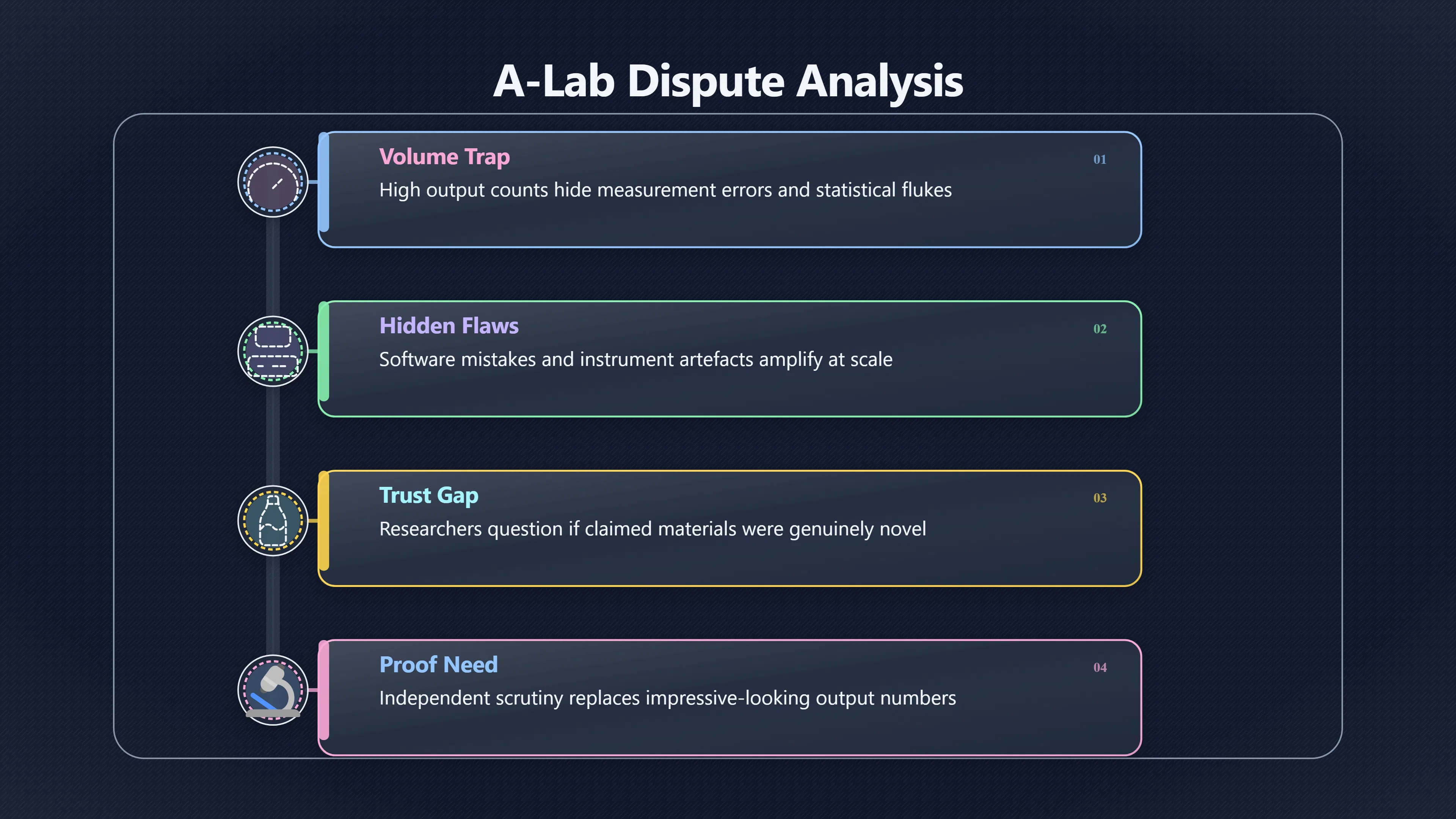
The danger is that experimental volume can create an illusion of progress.
In science, a result only becomes useful knowledge when researchers can establish that it is real. Large numbers of experimental outputs may contain:
- Measurement errors.
- Misidentified compounds.
- Instrument artefacts.
- Statistical flukes.
- Software mistakes.
- Hidden assumptions in the experimental workflow.
Automation can sometimes amplify these problems rather than eliminate them. If a flawed measurement pipeline is repeated thousands of times, the system may generate thousands of flawed results at unprecedented speed.
This is not merely a theoretical concern. Scientific fields have struggled for years with reproducibility problems even before AI entered the picture. Psychology, biology and parts of medicine have all experienced cases where influential findings later proved difficult to replicate. A laboratory capable of producing experiments ten or a hundred times faster does not automatically solve that problem. In some cases it could increase the scale of it.
For that reason, many researchers increasingly argue that autonomous science should be evaluated less by experiment counts and more by verification rates. A machine that generates fewer findings but produces highly reproducible results may contribute more to scientific progress than a system that reports hundreds of uncertain discoveries.
The A-Lab dispute showed what proof actually means
The A-Lab project became important not only because of its technical achievements but because it triggered a public argument about what counts as a successful autonomous discovery.
The original Nature paper reported that the system had successfully synthesised dozens of target materials through an automated workflow that combined computational prediction, literature-derived synthesis recipes, robotics and machine-learning-guided refinement. The work was widely interpreted as evidence that AI-driven laboratories could help bridge the gap between theoretical predictions and real-world material production.[Nature]nature.comAutonomous mobile robots for exploratory synthetic chemistryby T Dai · 2024 · Cited by 277 — Here we show that a synthesis laborato…
Soon after publication, however, researchers began questioning whether some of the claimed materials were genuinely novel or whether the evidence for successful synthesis was strong enough. Nature reported disagreements over whether the robot had truly created new substances and whether the characterisation methods justified the conclusions being drawn.[Nature]nature.comAn autonomous laboratory for the accelerated synthesis of…Nov 29, 2023 — Over 17 days of operation, the A-Lab successfully synth…
The significance of the dispute was larger than the specific materials involved.
If a laboratory claims success because an automated analysis pipeline labels a result as correct, scientists need confidence that the label itself is trustworthy. Verification often requires independent characterisation methods, detailed experimental records and confirmation from researchers outside the original project.
The controversy highlighted a deeper point: autonomous laboratories do not bypass the scientific method. They still depend on it.
A robot can mix chemicals faster than a human. It cannot make reproducibility unnecessary.
What reproducibility requires from robot labs
The most useful autonomous laboratories may ultimately be those that make verification easier rather than merely increasing throughput.
Several requirements are emerging as especially important.
Transparent experimental records
Traditional scientific papers often provide incomplete information about what happened during an experiment. Autonomous systems potentially offer an advantage because every action can be digitally recorded.
Researchers increasingly argue that robot laboratories should maintain detailed logs covering:
- Instrument settings.
- Environmental conditions.
- Sample histories.
- Sensor outputs.
- Decision pathways used by AI systems.
- Software versions and model parameters.
Without such records, independent researchers may struggle to determine why a result occurred or whether it can be reproduced elsewhere. Proposed frameworks for trustworthy autonomous experimentation increasingly emphasise execution tracing and detailed digital records as core infrastructure rather than optional extras.[arXiv]arxiv.orgOpen, Reproducible and Trustworthy Robot-Based Experiments with Virtual Labs and Digital-Twin-Based Execution TracingAugust 15, 2025…
Independent replication
A result reproduced by the same machine under the same conditions is useful, but it is not the strongest form of scientific proof.
The more demanding test is whether another laboratory can achieve the same outcome independently.
This distinction matters because hidden assumptions often exist within a specific experimental setup. Slight differences in equipment calibration, environmental conditions or software implementation can reveal weaknesses that were invisible during the original experiment.
Some researchers in robotics have begun arguing for more formal frameworks around reproduced and replicated experiments precisely because comparable validation remains difficult across different laboratories.[arXiv]arxiv.orgOpen, Reproducible and Trustworthy Robot-Based Experiments with Virtual Labs and Digital-Twin-Based Execution TracingAugust 15, 2025…
Multiple measurement methods
Human scientists rarely trust a major claim based on a single measurement.
A new material, drug candidate or biological result is usually evaluated through several complementary techniques. Different instruments can reveal different failure modes.
Future autonomous laboratories may need similar redundancy. A system that validates its conclusions through multiple independent measurement channels could be substantially more trustworthy than one that relies on a single automated classifier.
This issue already appears in autonomous materials research, where characterisation methods and phase identification often determine whether a claimed discovery is accepted by the wider community.[Nature]nature.comRobot chemist sparks row with claim it created new materials12 Dec 2023 — Researchers question whether an AI-controlled lab assista…
Automation may improve reproducibility as well as threaten it
The reproducibility story is not purely sceptical. Some of the strongest arguments for laboratory automation are actually arguments about reliability.
Human laboratory work contains unavoidable variability.
Researchers become tired. Procedures drift over time. Samples may be labelled inconsistently. Pipetting accuracy changes from person to person. Small deviations can accumulate into meaningful differences.
Automation can reduce many of these sources of variation.
Studies of cloud laboratories and automated biological workflows have argued that standardised robotic execution can improve consistency, create clearer audit trails and make experiments easier to repeat across teams and institutions. Researchers working on automated laboratory operating systems have presented reproducibility as one of the central benefits of large-scale laboratory automation.[ScienceDirect]sciencedirect.comAutonomous experimentation systems for materials…by E Stach · 2021 · Cited by 392 — This review discusses the specific challenges and…[PubMed]pubmed.ncbi.nlm.nih.govAn autonomous laboratory for the accelerated synthesis of…by NJ Szymanski · 2023 · Cited by 1176 — Over 17 days of continuous op…
This creates an interesting tension.
Robot labs can potentially worsen scientific noise if they generate poorly validated results at scale. Yet they can also improve scientific reliability if they execute protocols more consistently than humans and record every step in machine-readable form.
The outcome depends less on whether AI is present and more on how verification is built into the workflow.

How verification could make automation more valuable
The most optimistic vision of autonomous science is not a world where machines simply run more experiments.
It is a world where knowledge becomes more dependable while discovery becomes faster.
Several developments could move robot laboratories in that direction.
Open experimental data. When researchers can inspect raw measurements rather than only final conclusions, errors become easier to identify and correct.
Shared laboratory protocols. Standardised machine-readable procedures make it easier for independent groups to repeat experiments precisely.
Digital twins and execution histories. Detailed records of every robotic action may allow researchers to replay experiments, investigate failures and compare outcomes across institutions.[arXiv]arxiv.orgOpen, Reproducible and Trustworthy Robot-Based Experiments with Virtual Labs and Digital-Twin-Based Execution TracingAugust 15, 2025…
Cross-laboratory validation networks. Multiple autonomous laboratories could attempt the same experiments independently, creating reproducibility checks at unprecedented scale.
Benchmarking based on replication rather than output counts. Instead of rewarding systems for generating the most candidate discoveries, the field could reward systems whose findings survive independent verification most often.
If these practices become common, autonomous laboratories could strengthen one of science’s most important features: its ability to correct itself.
The broader AI bloom question
For people interested in AI-driven scientific acceleration, reproducibility may seem like a technical detail. In reality it sits near the centre of the entire argument.
The long-term case for AI abundance depends on reliable advances accumulating over decades. New medicines must actually work. New materials must perform as claimed. New biological insights must survive independent testing. Civilisation only benefits when discoveries become trusted knowledge.
That is why reproducibility is a more important metric than experiment counts, robotic hours or AI-generated hypotheses.
A future supercharged by autonomous science would not emerge because machines produced vast numbers of results. It would emerge because those results proved true often enough that humanity could confidently build on them.
The real promise of robot laboratories is therefore not merely faster experimentation. It is the possibility of creating a scientific system that is simultaneously faster, more transparent and more reproducible. If autonomous labs can achieve all three, they become far more than a productivity tool. They become part of the infrastructure through which a larger and more capable civilisation learns what is actually true.
Amazon book picks
Further Reading
Books and field guides related to When faster experiments still need proof. Use these as the next step if you want deeper reading beyond the article.
The Knowledge Machine
Directly supports the page’s focus on reproducibility, proof and reliable scientific output.
The Structure of Scientific Revolutions
Helps readers place disputed automated-discovery claims within the history of scientific change.
Failure
Frames robot-lab errors and disputed claims as part of discovery rather than simple failure.
The Half-Life of Facts
Fits concerns about fast AI-generated results needing correction and independent scrutiny.
eBay marketplace picks
Marketplace Samples
Example marketplace items related to this page. Use the search link to explore similar finds on eBay.


Endnotes
1.
Source: nature.com
Link:https://www.nature.com/articles/s41586-023-06734-w
Source snippet
An autonomous laboratory for the accelerated synthesis of...Nov 29, 2023 — Over 17 days of operation, the A-Lab successfully synth...
2.
Source: nature.com
Link:https://www.nature.com/articles/d41586-023-03956-w
Source snippet
Robot chemist sparks row with claim it created new materials12 Dec 2023 — Researchers question whether an AI-controlled lab assista...
3.
Source: arxiv.org
Link:https://arxiv.org/abs/2508.11406
Source snippet
Open, Reproducible and Trustworthy Robot-Based Experiments with Virtual Labs and Digital-Twin-Based Execution TracingAugust 15, 2025...
Published: August 15, 2025
4.
Source: arxiv.org
Link:https://arxiv.org/html/2508.11406v1
Source snippet
Open, Reproducible and Trustworthy Robot-Based...15 Aug 2025 — We envision a future in which autonomous robots conduct scientific experi...
5.
Source: arxiv.org
Link:https://arxiv.org/abs/2408.04736
Source snippet
Towards Using Multiple Iterated, Reproduced, and Replicated Experiments with Robots (MIRRER) for Evaluation and BenchmarkingAugust 8...
6.
Source: nature.com
Link:https://www.nature.com/articles/s41586-024-08173-7
Source snippet
Autonomous mobile robots for exploratory synthetic chemistryby T Dai · 2024 · Cited by 277 — Here we show that a synthesis laborato...
7.
Source: sciencedirect.com
Link:https://www.sciencedirect.com/science/article/pii/S2590238521003064
Source snippet
Autonomous experimentation systems for materials...by E Stach · 2021 · Cited by 392 — This review discusses the specific challenges and...
8.
Source: sciencedirect.com
Link:https://www.sciencedirect.com/science/article/pii/S2472555222125396
Source snippet
Achieving Reproducibility and Closed-Loop Automation in...by B Miles · 2018 · Cited by 65 — A robotic cloud laboratory driv...
9.
Source: pubmed.ncbi.nlm.nih.gov
Link:https://pubmed.ncbi.nlm.nih.gov/38030721/
Source snippet
An autonomous laboratory for the accelerated synthesis of...by NJ Szymanski · 2023 · Cited by 1176 — Over 17 days of continuous op...
10.
Source: pubmed.ncbi.nlm.nih.gov
Link:https://pubmed.ncbi.nlm.nih.gov/30045649/
Source snippet
A robotic cloud laboratory driven by a state-of-the-art unified laboratory operating system integrates automated hardware, humans, and se...
11.
Source: facebook.com
Link:https://www.facebook.com/Nature/posts/nature-research-paper-an-autonomous-laboratory-for-the-accelerated-synthesis-of-/750532913773352/
Source snippet
Nature research paper: An autonomous laboratory for the...Nov 29, 2023 — Over 17 days of continuous operation, the A-Lab realized 41 nov...
Additional References
12.
Source: reddit.com
Link:https://www.reddit.com/r/slatestarcodex/comments/1923p07/autonomous_lab_did_not_synthesize_any_new/
Source snippet
Autonomous lab did not synthesize any new materialsThis is a reanalysis of Nature paper An autonomous laboratory for the accelerated synt...
13.
Source: journals.sagepub.com
Link:https://journals.sagepub.com/doi/abs/10.1177/2472630318784506?journalCode=jlad
Source snippet
Sage JournalsAchieving Reproducibility and Closed-Loop Automation in...This lab of the future system enables researchers to transparentl...
14.
Source: trilo.bio
Link:https://www.trilo.bio/self-driving-labs
Source snippet
Self-Driving Labs for BiologyA Self-Driving Lab (SDL)—also known as an autonomous lab—is a fully automated biology lab that uses AI to co...
15.
Source: mrs.digitellinc.com
Link:https://mrs.digitellinc.com/p/s/ds010302-a-lab-an-autonomous-laboratory-for-the-accelerated-synthesis-of-novel-inorganic-materials-44295
Source snippet
digitellinc.comDS01.03.02: A-Lab—An Autonomous Laboratory for the...Over 17 days of continuous operation, the A-Lab successfully develop...
16.
Source: researchgate.net
Link:https://www.researchgate.net/publication/376043973_An_autonomous_laboratory_for_the_accelerated_synthesis_of_inorganic_materials
Source snippet
An autonomous laboratory for the accelerated synthesis of...29 Nov 2023 — Analysis of the failed syntheses provides direct and actionabl...
17.
Source: dim-materre.fr
Title: an autonomous laboratory for the accelerated synthesis of novel materials
Link:https://www.dim-materre.fr/en/publications/an-autonomous-laboratory-for-the-accelerated-synthesis-of-novel-materials/
Source snippet
An autonomous laboratory for the accelerated synthesis of...Nov 29, 2023 — Over 17 days of continuous operation, the A-Lab realized 41 n...
18.
Source: scinomix.com
Title: achieving scientific reproducibility with laboratory automation systems
Link:https://scinomix.com/news/achieving-scientific-reproducibility-with-laboratory-automation-systems
Source snippet
Achieving Scientific Reproducibility with Laboratory...18 Mar 2024 — Laboratory automation systems are useful tools to achieve scientifi...
19.
Source: oaepublish.com
Link:https://www.oaepublish.com/articles/cs.2025.66
Source snippet
Artificial [intelligence]({{ 'intelligence/' | relative_url }})-driven autonomous laboratory for...Sep 17, 2025 — Over 17 days of continuous operation, A-Lab synthesized 41 of...
20.
Source: frontiersin.org
Link:https://www.frontiersin.org/research-topics/79036/autonomous-and-automated-laboratories-for-closed-loop-drug-discoveryundefined
Source snippet
d strategies that enable closed-loop experimentation spanning robotic sample...Read more...
21.
Source: ceder.berkeley.edu
Title: [a lab]({{ ‘a-lab/’ | relative_url }}) paper published in nature featured in news story
Link:https://ceder.berkeley.edu/news/a-lab-paper-published-in-nature-featured-in-news-story/
Source snippet
materials discovery (GNoME) to synthesize 41 new inorganic materials in 17 days. Both A-lab and GNoME scientific papers were published in...
Topic Tree