Within Long Future
Are Moon and Mars bases the first step?
Moon and Mars bases matter less as instant new worlds than as testbeds for resources, governance and survival systems.
On this page
- What surface bases can test first
- In situ resources and harsh environment engineering
- Why a base is not yet a society
Page outline Jump by section
Introduction
Moon and Mars bases are often presented as the opening chapter of humanity becoming a multi-planet civilisation. In practice, their near-term importance may be less about founding thriving new societies and more about testing whether people can reliably live, work and build beyond Earth for years at a time. The key question is not whether a handful of astronauts can survive on another world. That has already been demonstrated in orbit and through short lunar missions. The harder question is whether off-Earth communities can gradually reduce their dependence on Earth by producing water, oxygen, energy, construction materials and eventually parts of their own infrastructure locally.[NASA]nasa.govoverview in situ resource utilizationOverview: In-Situ Resource Utilization26 Jul 2023 — NASA's Lunar Surface Innovation Initiative will develop and demonstrate technolog…
 Within the broader AI bloom vision, Moon and Mars outposts matter because they are potential proving grounds for technologies and institutions that could support a much larger long-term future. Advanced robotics, autonomous construction, intelligent resource management and closed-loop life-support systems may all be tested under conditions where failure is immediately visible and where resources are scarce. Yet there is also a large gap between a research base and a genuine society. Understanding that gap is one of the most important reasons these projects matter.
What surface bases can test first
The strongest case for early lunar and Martian bases is not that they will quickly become self-sustaining settlements. It is that they provide real-world environments in which critical systems can be tested under extreme constraints.
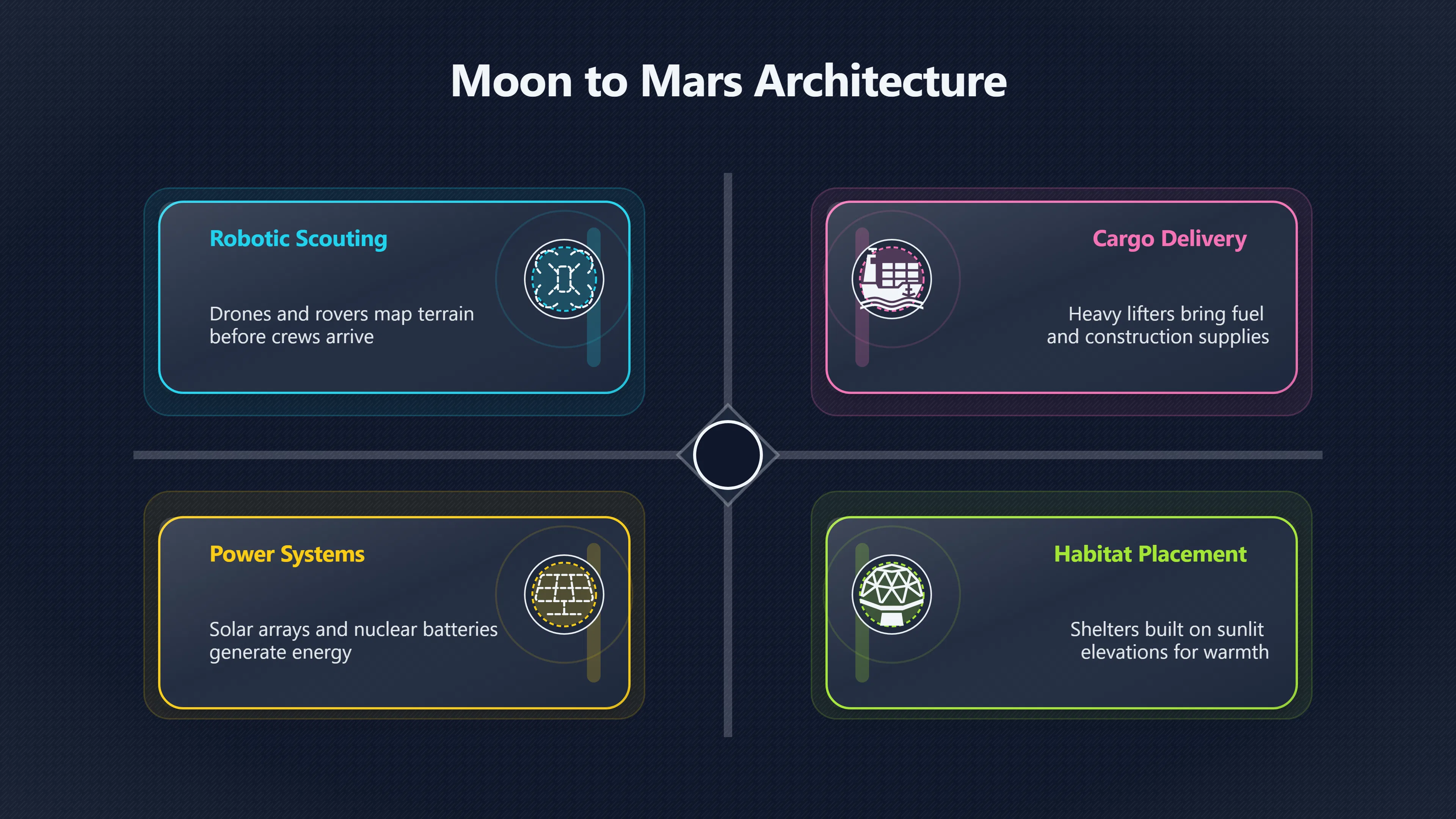
Current plans under NASA’s Artemis programme increasingly frame the lunar south pole as a long-duration operational environment rather than a destination for occasional visits. Recent Moon Base plans envisage robotic scouting, cargo delivery, surface power systems, habitats, rovers and eventually rotating crews living on the surface for extended periods.[WIRED]wired.comNASA Details Its Plan to Build a Lunar Base at the Moon's South PoleThe initiative, which now takes precedence over the previously planned Gateway orbital station, will focus resources on establishing a su…[space]space.comThe sprawling size of the base accommodates various scientific and operational needs, including habitat placement on sunlit elevations, n… Several capabilities can only be meaningfully validated through sustained operation:
- Life-support reliability: recycling air and water for months or years rather than days.
- Remote medical care: handling illness and injury with limited supplies and delayed support.
- Autonomous maintenance: allowing robots and software to monitor equipment and repair faults.
- Surface logistics: moving people, cargo and resources across difficult terrain.
- Psychological resilience: understanding how small groups cope with isolation, confinement and risk.
- Human-machine collaboration: coordinating astronauts, robots and AI systems in hazardous environments.
Mars raises these challenges further because communication delays prevent near-instant support from Earth. Depending on planetary positions, messages can take many minutes to travel each way. That makes Mars an especially valuable testbed for autonomous decision-making and local problem-solving. Researchers increasingly study how AI-assisted operations could help coordinate habitats, equipment and emergency responses when crews cannot rely on immediate terrestrial assistance.[MDPI]mdpi.comAdvancements in Mars Habitation Technologies and…by Y Zhong · 2025 · Cited by 3 — This review examines advancements in Mars habita…
The Moon offers a closer, lower-risk environment for learning similar lessons. A lunar base can be resupplied in days rather than months and evacuated if necessary. For many planners, this makes the Moon a practical training ground before attempting larger Martian settlements.[NASA]ntrs.nasa.govNASA Technical Reports ServerIn Situ Resource Utilization (ISRU) Envisioned Future…by G Sanders · 2022 · Cited by 15 — A major objecti…
In-situ resources and harsh-environment engineering
A settlement that depends entirely on shipments from Earth is not really a settlement. It is an outpost. That is why so much attention focuses on in-situ resource utilisation, usually shortened to ISRU.
ISRU means extracting useful materials from local environments rather than importing everything from Earth. NASA and other organisations regard it as a central requirement for affordable long-term habitation on both the Moon and Mars. NASA[NASA Technical Reports Server]ntrs.nasa.govNASA Technical Reports ServerIn Situ Resource Utilization (ISRU) Envisioned Future…by G Sanders · 2022 · Cited by 15 — A major objecti…
Why water changes everything
Water is the most important local resource under discussion.
On the Moon, evidence suggests substantial ice deposits exist in permanently shadowed regions near the poles. If extracted successfully, that water could support drinking supplies, agriculture, oxygen production and rocket fuel manufacture. NASA’s current lunar planning places major emphasis on south-polar regions partly because of these potential resources.[The Times of India]timesofindia.indiatimes.comThis initiative marks a significant step into a new era of lunar exploration, with the long-term goal of sustaining human presence on the…[3NASA 3Science]assets.science.nasa.gov6 Moon to Mars Architecture TAGGEDnasa.govNASA's Moon to Mars Architecture - Planetary Advisory…Transportation and Habitation Goal: Develop and demonstrate an integrate…
On Mars, water ice appears more widespread. The challenge is not merely finding it but extracting, purifying and distributing it economically under harsh conditions. Long-term Mars concepts generally assume that local water production is indispensable.[PMC]pmc.ncbi.nlm.nih.govMission Architecture Using the SpaceX Starship Vehicle to…by JL Heldmann · 2022 · Cited by 76 — In situ resource utilization (ISRU)…[ScienceDirect]sciencedirect.comDesigning sustainable built environments for Mars habitationby H Sun · 2024 · Cited by 26 — In Situ Resource Utilization (IS…
Building with local materials
Transporting construction materials from Earth is extraordinarily expensive. As a result, many settlement concepts rely on local soil, known as regolith, as a raw material.
Researchers are studying ways to:
- Manufacture bricks or structural components from lunar or Martian soil.
- Use 3D printing techniques for habitat construction.
- Create radiation shielding from local materials.
- Produce oxygen from regolith through chemical processing.
Recent engineering reviews suggest that large-scale lunar infrastructure will likely require extensive local resource use because imported construction systems alone do not scale well to permanent habitation.[ScienceDirect]sciencedirect.comDesigning sustainable built environments for Mars habitationby H Sun · 2024 · Cited by 26 — In Situ Resource Utilization (IS…
Surviving hostile environments
Moon and Mars bases are valuable testbeds precisely because they expose weaknesses quickly.
The Moon experiences extreme temperature swings, abrasive dust, vacuum conditions and radiation exposure. Mars adds global dust storms, reduced sunlight, low atmospheric pressure and long supply chains. Engineers must learn how habitats, power systems and life-support equipment perform over years rather than weeks.[ScienceDirect]sciencedirect.comDesigning sustainable built environments for Mars habitationby H Sun · 2024 · Cited by 26 — In Situ Resource Utilization (IS…
Even seemingly obscure threats matter. Recent modelling of Artemis-era lunar bases estimated tens of thousands of annual micrometeoroid impacts on a base-sized structure, although modern shielding appears capable of reducing dangerous penetrations dramatically. Understanding such risks is part of the settlement-testing process.[arXiv]arxiv.orgSource details in endnotes.
Why AI matters more off Earth than it first appears
The connection between space settlement and AI is often misunderstood. The most important role of advanced AI may not be piloting spacecraft. It may be helping small populations manage enormous complexity.
A remote base must monitor life support, power generation, environmental conditions, equipment health, inventory, communications and scientific operations simultaneously. As settlements grow, the amount of coordination required increases rapidly.
Potential AI contributions include:
- Predictive maintenance for critical systems.
- Autonomous excavation and construction.
- Resource optimisation for water, energy and oxygen.
- Scientific analysis and exploration planning.
- Medical support and diagnosis.
- Coordination of fleets of robots operating in hazardous areas.
These functions matter because future settlements will almost certainly begin with very small populations. A community of dozens or hundreds cannot maintain the industrial depth of a city on Earth. Intelligent automation may help bridge part of that gap by allowing limited human populations to operate much larger technical systems.[MDPI]mdpi.comAdvancements in Mars Habitation Technologies and…by Y Zhong · 2025 · Cited by 3 — This review examines advancements in Mars habita…
This is one reason Moon and Mars bases fit naturally into discussions of AI-enabled human flourishing. They are environments where abundant intelligence, whether human or machine, directly substitutes for scarce labour, scarce expertise and scarce physical infrastructure.
Why a base is not yet a society
Much public discussion jumps from “base” to “colony” as though the difference were mainly one of scale. The distinction is deeper than that.
A scientific base can depend heavily on Earth for supplies, expertise, governance and economic support. A society requires much broader capabilities.
A genuine off-Earth society would need:
- Stable population growth across generations.
- Education systems.
- Healthcare beyond emergency medicine.
- Diverse economic activity.
- Political institutions and dispute resolution.
- Cultural and social life.
- Manufacturing capacity beyond basic maintenance.
- Some ability to survive interruptions in Earth support.
Most current Moon and Mars plans remain far from these thresholds. Even ambitious concepts generally focus first on survival, research and infrastructure rather than social self-sufficiency.[NASA Technical Reports Server]ntrs.nasa.govNASA Technical Reports ServerIn Situ Resource Utilization (ISRU) Envisioned Future…by G Sanders · 2022 · Cited by 15 — A major objecti…[ScienceDirect]sciencedirect.comTowards sustainable horizons: A comprehensive blueprint…by F Neukart · 2024 · Cited by 58 — This paper thoroughly explores the feasibi…
This distinction matters because many technological achievements that enable a base do not automatically create a civilisation. Producing oxygen locally is important. Creating a stable, multi-generational community is a different challenge involving economics, psychology, governance and culture.
Governance questions appear early
Some settlement advocates argue that Mars communities may need substantial local autonomy because communication delays and distance make detailed Earth-based management impractical. Discussions about self-government, legal systems and political legitimacy therefore arise much earlier than many people expect.[The Space Review]thespacereview.comThe Space ReviewA tale of two Martian cities13 Apr 2026 — Mars settlements will, of necessity, be self-governing quite early-on. Given th…
The Moon presents a different governance environment because it is much closer to Earth and likely to remain more tightly integrated with terrestrial institutions. Comparing these models may itself become a valuable experiment in how human communities organise under radically different constraints.
The strongest arguments for and against the testbed approach
Supporters of lunar and Martian bases often emphasise that civilisation-scale capabilities must be learned somewhere. They argue that humanity cannot wait until interplanetary settlement becomes easy before beginning the process of experimentation.
From this perspective, early bases provide:
- Experience with closed ecological systems.
- Knowledge about long-duration habitation.
- Better understanding of human adaptation.
- Development of autonomous infrastructure.
- Greater civilisational resilience over the long run.
Critics counter that these projects may remain permanently dependent on Earth, consume vast resources and distract from urgent terrestrial priorities. Some also argue that true self-sufficiency may be far harder than enthusiasts acknowledge, especially given the industrial complexity modern societies require.[ScienceDirect]sciencedirect.comDesigning sustainable built environments for Mars habitationby H Sun · 2024 · Cited by 26 — In Situ Resource Utilization (IS…
There is also a middle position. Moon and Mars bases may never become fully independent societies, yet still generate technologies with broader value. Advances in recycling, autonomous construction, resource efficiency, remote medicine and resilient infrastructure could feed back into Earth-based systems, particularly in harsh or isolated environments.
What success would actually look like
A useful way to evaluate Moon and Mars programmes is not to ask whether they create flourishing cities within a few decades. That is unlikely. A better question is whether they steadily reduce dependence on Earth while increasing the complexity of what local communities can accomplish.
Key milestones would include:
- Reliable long-duration habitation.
- Local production of water and oxygen.
- Significant use of local construction materials.
- Extensive robotic and AI-assisted operations.
- Growth from temporary crews to permanent populations.
- Increasing economic and institutional autonomy.
If these stages are achieved, lunar and Martian bases could become something historically significant: not fully formed new worlds, but laboratories in which humanity learns how to extend civilisation beyond a single planet.
In the context of AI bloom, that possibility matters less because the Moon or Mars are immediately attractive places to live and more because they test whether intelligence, automation and coordination can support human flourishing in environments far harsher than Earth. If civilisation can learn to build resilient communities there, it may expand the range of futures available to humanity over centuries and millennia.[NASA]nasa.govMoon to Mars ArchitectureComponents25 Mar 2026 — NASA's Moon to Mars Architecture currently comprises four segments: Human Lunar Return, Foundational Exploration…[NASA]nasa.govMoon to Mars ArchitectureNASA's Moon to Mars Architecture defines the elements needed for long-term, human-led scientific discovery i…
Amazon book picks
Further Reading
Books and field guides related to Are Moon and Mars bases the first step?. Use these as the next step if you want deeper reading beyond the article.
The Future of Humanity
Directly covers Moon bases, Mars settlement and humanity beyond Earth.
eBay marketplace picks
Marketplace Samples
Example marketplace items related to this page. Use the search link to explore similar finds on eBay.


Endnotes
1.
Source: nasa.gov
Title: overview in situ resource utilization
Link:https://www.nasa.gov/overview-in-situ-resource-utilization/
Source snippet
Overview: In-Situ Resource Utilization26 Jul 2023 — NASA's Lunar Surface Innovation Initiative will develop and demonstrate technolog...
2.
Source: ntrs.nasa.gov
Link:https://ntrs.nasa.gov/citations/20220004617
Source snippet
NASA Technical Reports ServerIn Situ Resource Utilization (ISRU) Envisioned Future...by G Sanders · 2022 · Cited by 15 — A major objecti...
3.
Source: wired.com
Title: NASA Details Its Plan to Build a Lunar Base at the Moon’s South Pole
Link:https://www.wired.com/story/nasa-details-its-plan-to-build-a-lunar-base-at-the-moons-south-pole
Source snippet
The initiative, which now takes precedence over the previously planned Gateway orbital station, will focus resources on establishing a su...
4.
Source: space.com
Link:https://www.space.com/astronomy/moon/artemis-moon-base-will-cover-hundreds-of-square-miles-with-hopping-drones-and-new-lunar-rovers-nasa-says
Source snippet
The sprawling size of the base accommodates various scientific and operational needs, including habitat placement on sunlit elevations, n...
5.
Source: nasa.gov
Title: Moon to Mars Architecture
Link:https://www.nasa.gov/moontomarsarchitecture-components/
Source snippet
Components25 Mar 2026 — NASA's Moon to Mars Architecture currently comprises four segments: Human Lunar Return, Foundational Exploration...
6.
Source: mdpi.com
Link:https://www.mdpi.com/2226-4310/12/6/510
Source snippet
Advancements in Mars Habitation Technologies and...by Y Zhong · 2025 · Cited by 3 — This review examines advancements in Mars habita...
7.
Source: arxiv.org
Link:https://arxiv.org/abs/2602.13291
8.
Source: nasa.gov
Link:https://www.nasa.gov/moontomarsarchitecture/
Source snippet
Moon to Mars ArchitectureNASA's Moon to Mars Architecture defines the elements needed for long-term, human-led scientific [discovery]({{ 'discovery/' | relative_url }}) i...
9.
Source: nasa.gov
Title: jsc in situ resource utilization
Link:https://www.nasa.gov/reference/jsc-in-situ-resource-utilization/
Source snippet
In-Situ Resource Utilization9 Jun 2023 — JSC specializes in system engineering and integration of In-Situ Resource Utilization (ISRU) sys...
10.
Source: pmc.ncbi.nlm.nih.gov
Link:https://pmc.ncbi.nlm.nih.gov/articles/PMC9527650/
Source snippet
Mission Architecture Using the SpaceX Starship Vehicle to...by JL Heldmann · 2022 · Cited by 76 — In situ resource utilization (ISRU)...
11.
Source: sciencedirect.com
Link:https://www.sciencedirect.com/science/article/pii/S2950160124000287
Source snippet
Designing sustainable built environments for Mars habitationby H Sun · 2024 · Cited by 26 — In Situ Resource Utilization (IS...
12.
Source: sciencedirect.com
Link:https://www.sciencedirect.com/science/article/pii/S2405844024022114
Source snippet
Towards sustainable horizons: A comprehensive blueprint...by F Neukart · 2024 · Cited by 58 — This paper thoroughly explores the feasibi...
13.
Source: sciencedirect.com
Link:https://www.sciencedirect.com/science/article/abs/pii/S0376042125000855
Source snippet
Lunar construction: A state-of-the-art surveyby K Vasudeva · 2026 · Cited by 7 — The construction of lunar infrastructure, o...
14.
Source: arxiv.org
Title: arXiv Micrometeoroid Impact Rate Analysis for an Artemis-Era Lunar Base
Link:https://arxiv.org/abs/2511.04740
Source snippet
Micrometeoroid Impact Rate Analysis for an Artemis-Era Lunar BaseNovember 6, 2025...
Published: November 6, 2025
15.
Source: nasa.gov
Title: jsc surface infrastructure
Link:https://www.nasa.gov/reference/jsc-surface-infrastructure/
Source snippet
Surface InfrastructureJan 22, 2026 — NASA's Simulated Mars Mission Marks 200 Days Inside Habitat. 3 min... infrastructure crucial for es...
16.
Source: ntrs.nasa.gov
Link:https://ntrs.nasa.gov/citations/20230004014
Source snippet
NASA Technical Reports ServerNASA's Habitation Development Status: Current Concepts...by JE Johnson · 2023 · Cited by 4 — NASA's current...
17.
Source: sciencedirect.com
Link:https://www.sciencedirect.com/science/article/pii/S0265964623000577
Source snippet
Moving to Mars: The Feasibility and Desirability of...by MM Puumala · 2023 · Cited by 27 — The on-going space settlement de...
18.
Source: nasa.gov
Link:https://www.nasa.gov/
Source snippet
brings you the latest news, images and videos from America's space agency, pioneering the future in space exploration, scientific discove...
19.
Source: nasa.gov
Link:https://www.nasa.gov/wp-content/uploads/2024/12/acr24-compiled-white-papers.pdf?emrc=f2e28d
Source snippet
Moon to Mars Architecture White PapersNASA's Moon to Mars Objectives call for the demonstration of “…Mars ISRU capabilities to support an...
20.
Source: assets.science.nasa.gov
Title: 6 Moon to Mars Architecture TAGGED
Link:https://assets.science.nasa.gov/content/dam/science/cds/researchers/nac/pac/2025/6-%20Moon%20to%20Mars%20Architecture_TAGGED.pdf
Source snippet
nasa.govNASA's Moon to Mars Architecture - Planetary Advisory...Transportation and Habitation Goal: Develop and demonstrate an integrate...
21.
Source: nasa.gov
Title: 2025 ia workshop architecture updates
Link:https://www.nasa.gov/wp-content/uploads/2025/02/2025-ia-workshop-architecture-updates.pdf?emrc=cb1d59
Source snippet
2025 Moon to Mars Architecture WorkshopsNASA's Moon to Mars Objectives call for the demonstration of “…Mars ISRU capabilities to support...
22.
Source: ntrs.nasa.gov
Link:https://ntrs.nasa.gov/citations/20230008144
Source snippet
nasa.govNASA's Habitation Development Status: Current Concepts...by JE Johnson · 2023 · Cited by 4 — NASA's current architectural concep...
23.
Source: sciencedirect.com
Link:https://www.sciencedirect.com/science/article/abs/pii/S0032063319301862
Source snippet
Sustainable in-situ resource utilization on the moonby A Ellery · 2020 · Cited by 122 — We propose that current in-situ resource utilizat...
24.
Source: sciencedirect.com
Link:https://www.sciencedirect.com/science/article/abs/pii/S0273117721009352
Source snippet
In situ resource utilization of structural material from...by KL Ferrone · 2022 · Cited by 35 — We present a multilayer construct, calle...
25.
Source: sciencedirect.com
Link:https://www.sciencedirect.com/science/article/abs/pii/S0032063319301618
Source snippet
Mars in situ resource utilization: a reviewby SO Starr · 2020 · Cited by 193 — In situ resource utilization (ISRU) is defined as the conv...
26.
Source: spj.science.org
Link:https://spj.science.org/doi/10.34133/space.0037
Source snippet
Science AdvancesOverview of the Lunar In Situ Resource Utilization...by P Zhang · 2023 · Cited by 163 — The water extraction method from...
27.
Source: timesofindia.indiatimes.com
Link:https://timesofindia.indiatimes.com/science/nasas-plans-for-a-giant-moon-base-signal-a-new-era-for-lunar-exploration-at-the-south-pole/articleshow/131365147.cms
Source snippet
This initiative marks a significant step into a new era of lunar exploration, with the long-term goal of sustaining human presence on the...
28.
Source: sciopen.com
Link:https://www.sciopen.com/article/10.34133/space.0037
Source snippet
Overview of the Lunar In Situ Resource Utilization...by P Zhang · 2023 · Cited by 164 — This article provides a comprehensive review of...
29.
Source: thespacereview.com
Link:https://www.thespacereview.com/article/5197/1
Source snippet
The Space ReviewA tale of two Martian cities13 Apr 2026 — Mars settlements will, of necessity, be self-governing quite early-on. Given th...
30.
Source: Wikipedia
Link:https://en.wikipedia.org/wiki/SpaceX_Mars_colonization_program
Source snippet
SpaceX Mars colonization programThe plan is to establish a self-sustaining, large scale settlement and directly democratic, self-gover...
31.
Source: Wikipedia
Link:https://en.wikipedia.org/wiki/NASA
Source snippet
NASAThe National Aeronautics and Space Administration is an independent agency of the U.S. federal government responsible for the Unit...
32.
Source: spaceappschallenge.org
Link:https://www.spaceappschallenge.org/2025/find-a-team/wrc/?tab=project
Source snippet
WRCThe design uses a layered structure that optimizes gravity, stability, and livability, integrating life-support, filtration, ISRU, and...
33.
Source: lockheedmartin.com
Title: A Water-Based Lunar Architecture
Link:https://www.lockheedmartin.com/en-us/capabilities/space/human-space-exploration/water-based-lunar-architecture.html
Source snippet
spaceDiscover Lockheed Martin's vision for how a water-based lunar architecture will help us settle permanently and sustainably on the Moon...
34.
Source: theguardian.com
Link:https://www.theguardian.com/science/nasa
Source snippet
May 2026 · Up to 2cm a month: Nasa keeps track as Mexico City sinks into the ground. May 7 2026 06.00 EDT · Nasa brought crashing down to...
Published: May 2026
Additional References
35.
Source: facebook.com
Link:https://www.facebook.com/groups/775801081313358/posts/1288572516702876/
Source snippet
Building sustainable human settlements on the moon and...Elon Musk and SpaceX have expressed long-term ambitions for building sustainabl...
36.
Source: facebook.com
Link:https://www.facebook.com/unboxfactory/posts/nasa-has-unveiled-plans-to-develop-a-sustainable-human-habitat-on-the-moon-as-pa/995234076160976/
Source snippet
Planned lunar habitat for human missions • Part of NASA's...NASA has unveiled plans to develop a sustainable human habitat on the Moon a...
37.
Source: slsa.ac.uk
Link:https://www.slsa.ac.uk/post/lunar-landowners-questions-regarding-the-ownership-of-lunar-bases-and-the-land-upon-which-they-are
Source snippet
Questions Regarding the Ownership of Lunar Bases and...14 Jul 2025 — At a glance, the Outer Space Treaty prohibits the existence of real...
38.
Source: researchgate.net
Link:https://www.researchgate.net/publication/311665370An_ISRU-Based_Architecture_for_Human_Habitats_on_Mars_the%27Lava_Hive%27_Concept
Source snippet
An ISRU-Based Architecture for Human Habitats on Mars15 Dec 2016 — We detail the overall structural architecture for a Class III Mars hab...
39.
Source: universetoday.com
Title: in situ resource utilization and the importance of lunar ice for artemis iii
Link:https://www.universetoday.com/articles/in-situ-resource-utilization-and-the-importance-of-lunar-ice-for-artemis-iii
Source snippet
In Situ Resource Utilization and the Importance of Lunar...28 Jun 2025 — Artemis III will utilize crew observations, sample return, and...
40.
Source: youtube.com
Link:https://www.youtube.com/watch?v=Kd4nmO222i8
Source snippet
NASA Seeks Input on Moon to Mars ObjectivesWe have set as a goal to create a blueprint for sustained human presence and exploration throu...
41.
Source: nss.org
Link:https://nss.org/milestones-to-space-settlement-an-nss-roadmap-part-4/
Source snippet
and increasingly focused on commercial activities · people moving to the Moon...Read more...
42.
Source: reddit.com
Link:https://www.reddit.com/r/ArtemisProgram/comments/1jna24i/are_we_sure_that_there_is_actually_a_substancial/
Source snippet
and even happier if it goes further, but its ultimate goal (to estabilish a permanent...
43.
Source: medium.com
Link:https://medium.com/%40Architects_Blog/building-beyond-earth-the-architecture-of-mars-and-lunar-habitats-8a5924308738
Source snippet
as lunar base construction timelines crystallize, ask yourself:...Read more...
44.
Source: reddit.com
Title: official nasa sheets on moon to mars architecture
Link:https://www.reddit.com/r/ArtemisProgram/comments/1fhaj4m/official_nasa_sheets_on_moon_to_mars_architecture/
Source snippet
for 2024By 2040 they will be outlining a Moon to Mars plan from 2040-2060. By 2060 we will have witnessed more amazing posters...Read more...
Topic Tree