Within Power
Who Gets the Gains in an AI Enabled Society
Equitable AI benefits depend on policies that prevent gatekeeping and ensure access across society.
On this page
- Public interest AI deployments
- Risks of vendor lock in and pricing
- Policy tools for equitable access
Page outline Jump by section
Introduction
An AI-enabled future could produce extraordinary gains: faster scientific discovery, better healthcare, cheaper education, more productive economies, and potentially a world where many forms of scarcity become far less binding. But one of the most important questions in the entire AI bloom debate is simple: who gets the gains?
 History offers a warning. Technological revolutions often increase total wealth while distributing benefits unevenly. Advanced AI could create enormous value without automatically improving life for everyone. If access to powerful systems, computing infrastructure, data, and capital remains concentrated, the benefits of AI may flow disproportionately to a small number of companies, investors, highly skilled workers, and wealthy countries. Public policy therefore becomes central to whether AI supports broad human flourishing or deepens existing inequalities.[IMF]imf.orgbroadening the gains from generative ai the role of fiscal policies 549639Broadening the Gains from Generative AI: The Role of…11 Jun 2024 — This note discusses how fiscal policies can be employed to steer…
The question is not whether governments should control AI development. It is whether societies can build institutions that allow the productivity gains from increasingly capable systems to spread widely enough that AI abundance becomes a shared resource rather than a gated service.
Why AI gains may not spread automatically
Many discussions of AI assume that if productivity rises, living standards will eventually rise for everyone. That may happen, but the path is not automatic.
The most powerful AI systems depend on expensive inputs: advanced chips, large data centres, electricity, specialised engineering talent, proprietary datasets, and cloud infrastructure. These resources are already concentrated among a relatively small number of firms and countries. OECD research notes that AI development relies on stacked layers of infrastructure and compute, while competition authorities increasingly examine concentration in cloud and AI infrastructure markets because control over these layers can shape who is able to build and deploy advanced systems.[OECD]oecd.orgcomponent 5OECD Digital Economy Outlook 2024 (Volume 1)May 14, 2024 — Computing infrastructure (“AI compute”) is a key component needed for AI d…[OECD]oecd.orgcomponent 6Market features in AI infrastructure: Competition in artificial…Nov 14, 2025 — In the context of AI infrastructure, such competition c…[OECD]oecd.orgcomponent 7Potential competition policy responses in AI infrastructureNov 14, 2025 — The competition issues in the cloud were discussed in more…
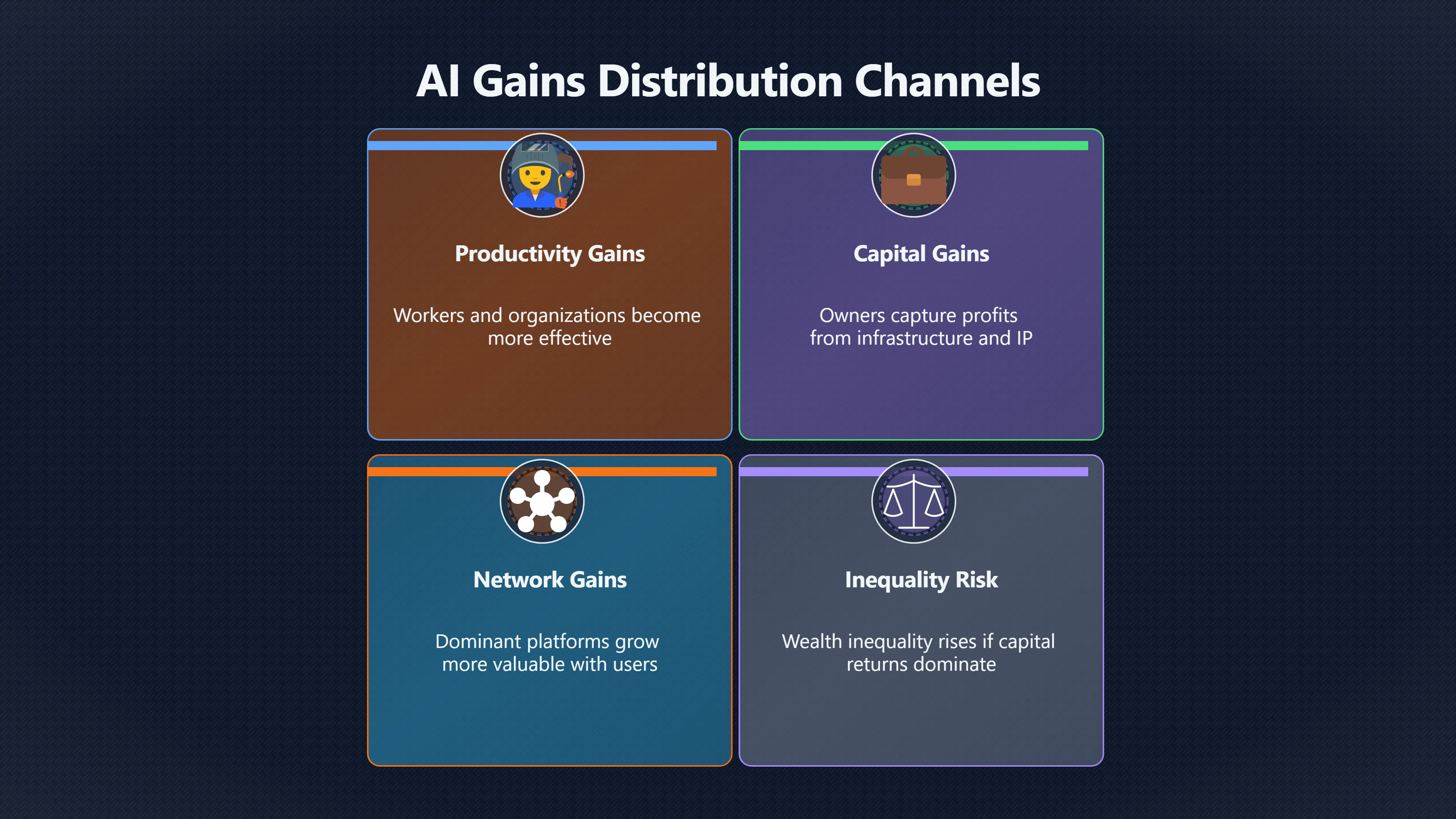
This matters because AI creates at least three different kinds of gains:
- Productivity gains, where workers and organisations become more effective.
- Capital gains, where owners of AI companies, infrastructure, intellectual property, and data capture profits.
- Network gains, where dominant platforms become more valuable as more users depend on them.
The distribution of benefits depends on which of these channels dominates. If AI mainly raises the value of capital ownership, wealth inequality may increase even while overall prosperity grows. IMF research has repeatedly highlighted this possibility, finding that AI could increase wealth inequality through higher returns to capital even in scenarios where wage effects are more mixed.[IMF eLibrary]elibrary.imf.orgIMF eLibraryAI Adoption and Inequality in - IMF eLibraryApr 4, 2025 — We find that while AI may reduce wage inequality by displacing high…[IMF]imf.orgArtificial IntelligenceGenerative AI is already changing how economies function—from public services to labor markets. This technology ma…
The result is that an AI-driven civilisation could become much richer while still leaving large groups feeling excluded from the gains.
Public-interest AI versus private AI platforms
One of the most important policy choices concerns whether advanced AI becomes primarily a commercial platform or also a public resource.
The internet provides a useful comparison. Commercial firms built much of the modern digital economy, but public investment funded core technologies, public universities trained researchers, and governments created shared infrastructure and standards. Most people today benefit from the internet not because they own internet companies but because access became widespread.
A similar question now arises for AI.
Public-interest AI deployments
Governments are increasingly exploring ways to use AI as public infrastructure rather than only as a commercial product.
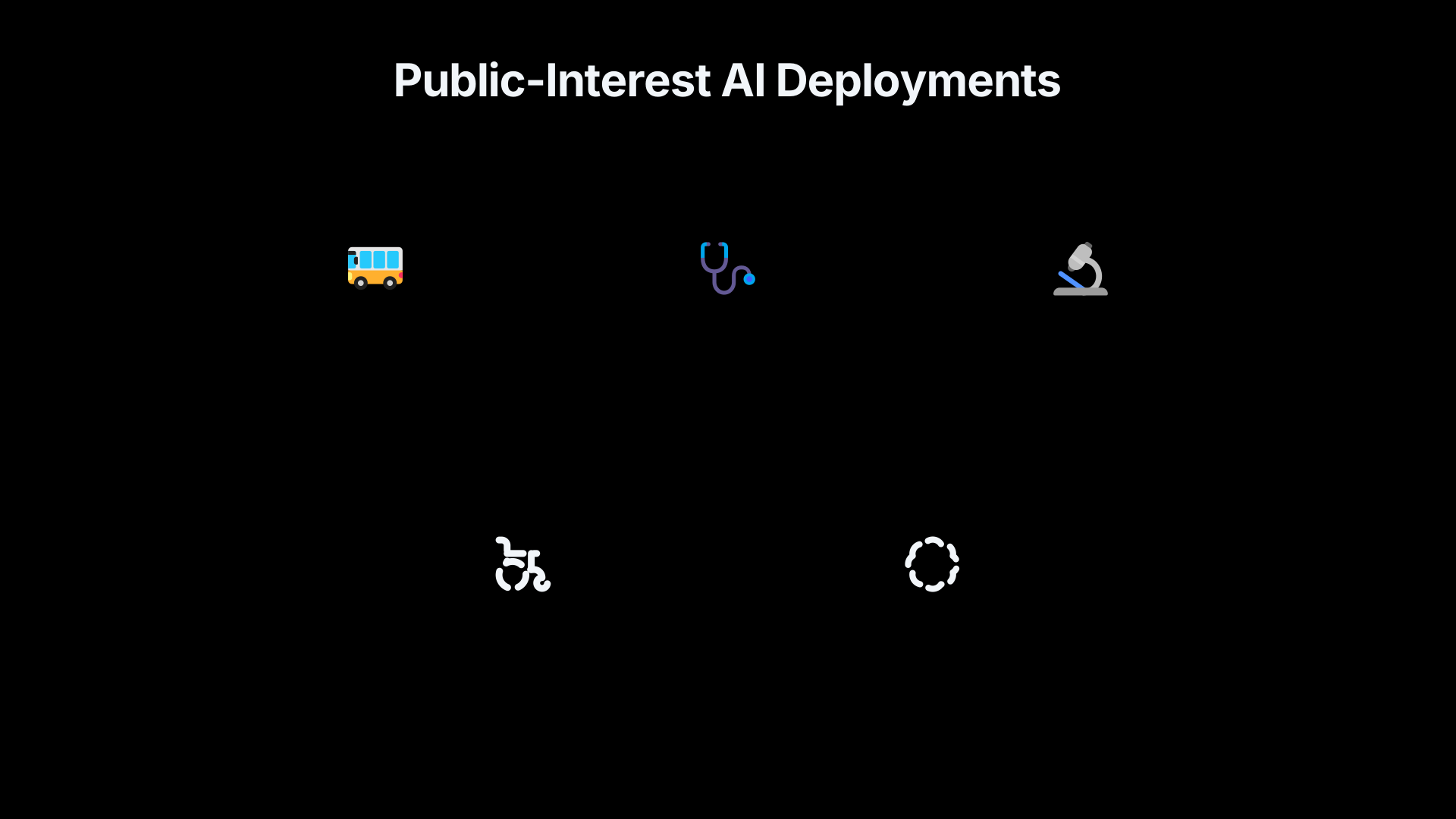
Potential public-interest applications include:
- AI tutors available to every student regardless of income.
- Clinical support systems in national healthcare systems.
- Scientific research assistants available to universities and public laboratories.
- Translation and accessibility tools for disabled users and minority-language communities.
- Public-service assistants that help citizens navigate benefits, legal procedures, and government services.
In these cases, the value comes not from selling AI access to the highest bidder but from increasing society-wide capabilities.
The UK, European countries, and several other governments have explored public-access computing resources and national AI research infrastructure. The Ada Lovelace Institute’s work on public compute argues that access to computing resources is becoming a prerequisite for meaningful participation in advanced AI research and innovation. Without such access, universities, public-interest researchers, and smaller organisations risk becoming dependent on commercial gatekeepers.[Ada Lovelace Institute]adalovelaceinstitute.orgglobal public computeAda Lovelace InstituteMapping global approaches to public compute4 Nov 2024 — Exploration of a National AI Research Resource to provide p…
Public-interest deployment is especially relevant to the broader AI bloom vision because many of the largest potential gains—scientific discovery, healthcare improvements, educational access, and long-term knowledge creation—have characteristics closer to public goods than luxury consumer products.
The case for public compute
As AI models become more capable, access to computing power increasingly determines who can experiment, innovate, and contribute.
Public compute initiatives aim to provide researchers, universities, startups, and civil society organisations with access to advanced computational resources. Supporters argue that this serves several functions simultaneously:
- Reducing dependence on a handful of cloud providers.
- Expanding scientific participation.
- Allowing independent safety and auditing research.
- Supporting open scientific inquiry.
- Helping smaller countries participate in frontier AI development.
The idea is not that governments should replace private AI firms. Rather, public compute attempts to ensure that access to advanced intelligence infrastructure is not restricted solely to organisations with enormous capital budgets.[Ada Lovelace Institute]adalovelaceinstitute.orgglobal public computeAda Lovelace InstituteMapping global approaches to public compute4 Nov 2024 — Exploration of a National AI Research Resource to provide p…
Risks of vendor lock-in and AI gatekeeping
The distribution question is not only about income. It is also about dependency.
If a small number of companies control the most capable models, cloud infrastructure, workplace tools, and application ecosystems simultaneously, users may find themselves locked into private systems that are difficult to leave.
This can occur through several mechanisms:[wp.oecd.ai]wp.oecd.aiResponsible AI SolutionsThis has been shown to occur in predictive models, large language models, and large statistical models amongst ot…
- Proprietary model interfaces that make switching difficult.
- Exclusive cloud partnerships.
- Bundled software ecosystems.
- Long-term enterprise contracts.
- Control over specialised datasets and model training pipelines.
OECD analysis of AI infrastructure and competition has highlighted concerns around bundling, tying, ecosystem effects, and market concentration. These dynamics can reinforce the position of incumbent firms even when new competitors emerge.[OECD]oecd.orgis ai across the stack competitive or concentrated?Mar 4, 2026 — The rapid pace of technological change, the concentration of key inputs like data and computing power, and the growing rol…[OECD]oecd.orgcomponent 4Artificial intelligence and competitive dynamics in…Nov 14, 2025 — This paper examines how the adoption of artificial intelligence (AI…
The long-term concern is not merely high prices. It is that a few organisations could become de facto governors of access to intelligence itself.
If future AI systems become central to medicine, education, research, administration, engineering, and creative work, then decisions about pricing, access, moderation, and deployment become politically significant. Questions that once belonged to public institutions could increasingly be shaped by private contractual arrangements.
This is one reason competition policy is becoming part of AI governance rather than a separate economic issue.
What happens to workers if AI becomes much more capable?
The labour market is one of the most contested parts of the distribution debate.
Optimists argue that AI will act mainly as a tool that enhances workers. In this view, doctors, teachers, engineers, scientists, and many other professionals become more productive, allowing societies to produce more goods and services while maintaining employment.
Critics worry that AI may replace tasks faster than economies create new forms of work.
Both possibilities may occur simultaneously.
IMF analysis suggests that around 40% of jobs worldwide could be affected by AI, with substantially higher exposure in advanced economies. The organisation has repeatedly warned that while some workers may experience productivity gains and higher earnings, others could face displacement, wage pressure, or reduced bargaining power.[IMF]elibrary.imf.orgIMF eLibraryAI Adoption and Inequality in - IMF eLibraryApr 4, 2025 — We find that while AI may reduce wage inequality by displacing high…
Recent labour-market research suggests the adjustment process may be more complex than simple replacement. Firms appear to be reorganising work, redesigning tasks, and altering hiring patterns as AI capabilities spread. Some evidence indicates that senior roles may adapt differently from entry-level positions, raising concerns about career ladders and pathways into skilled professions.[arXiv]arxiv.orgarXiv Generative AI and the Reorganization of Labor DemandGenerative AI and the Reorganization of Labor DemandMay 22, 2026…
For public policy, this creates a practical challenge. Even if AI eventually generates enormous prosperity, periods of disruption can still damage lives and communities. The political legitimacy of an AI-enabled future may depend less on long-run productivity statistics than on whether people experience the transition as fair.

Policy tools for sharing the gains
No single policy guarantees equitable outcomes. Most proposals focus on widening access to capabilities while cushioning disruptions.
Education and capability-building
The most common recommendation is large-scale investment in education, retraining, and lifelong learning.
The goal is not simply teaching people to use chatbots. It is helping workers adapt as tasks, occupations, and industries evolve.
If advanced AI makes expertise cheaper and more accessible, educational systems may need to focus more heavily on judgment, collaboration, creativity, scientific reasoning, and the ability to work alongside increasingly capable systems.
However, education alone may not solve distribution problems if ownership of AI-generated value remains highly concentrated. Many economists therefore view skills policy as necessary but insufficient.[IMF]imf.orgai adoption and inequality 565729AI Adoption and Inequality3 Apr 2025 — Some argue AI will exacerbate economic disparities, while others suggest it could reduce inequalit…
Competition policy
Competition policy attempts to prevent excessive concentration before it becomes entrenched.
Potential approaches include:
- Scrutiny of mergers and exclusive partnerships.
- Interoperability requirements.
- Data portability rules.
- Limits on anti-competitive bundling.
- Measures to reduce dependence on dominant cloud providers.
These policies do not determine who wins technological competition. Instead, they aim to preserve the possibility of future competition and innovation.[OECD]oecd.orgai and the global productivity divide c315ea90 enAI and the global productivity divideDec 8, 2025 — This paper examines the potential of AI to foster productivity growth in Low-Incom…[OECD]oecd.orgAI computeArtificial intelligence promises tremendous benefits but also carries real risks. Some of these risks are already materialising…
Taxation and redistribution
If AI significantly increases returns to capital relative to labour, governments may face pressure to redesign tax systems.
Several IMF analyses argue that stronger taxation of capital income, profits, or wealth may become more important if AI-driven productivity gains concentrate ownership returns. Revenue could then support education, healthcare, transition assistance, public research, and broader access to AI-enabled services.[IMF]imf.orgFiscal Policy Can Help Broaden the Gains of AI to Humanity17 Jun 2024 — Generative-AI, like other types of innovation, can lead to hig…[IMF]imf.orgAI Will Transform the Global EconomyLet's Make Sure It…14 Jan 2024 — In a new analysis, IMF staff examine the potential impact of AI on the global labor market. Many stud…
The debate here is contentious.
Supporters argue that redistribution is necessary to maintain social cohesion and ensure broad participation in technological progress.
Critics worry that excessive taxation could discourage investment and slow innovation.
The central question is not whether redistribution exists, but how much of AI-generated value should remain private versus being recycled into public goods.
Public ownership and sovereign funds
Some proposals go further.
Rather than relying entirely on taxation after profits are earned, governments could hold equity stakes in AI infrastructure, national compute resources, or public investment funds that benefit from technological growth.
This approach resembles existing sovereign wealth funds in some countries, where returns from national assets help finance public services and long-term investments.
Supporters argue that if AI creates extraordinary wealth, broader ownership structures may distribute gains more directly than tax-and-transfer systems alone.
The global distribution problem
The distribution challenge is not only domestic.
Advanced AI capabilities are concentrated heavily in a small number of countries, particularly the United States and China. Many lower-income countries face constraints in computing infrastructure, electricity supply, technical talent, and research funding.
If AI becomes a major driver of productivity growth, countries without access to the technology may fall further behind. OECD work on the global productivity divide highlights the possibility that AI could generate significant cross-country differences in growth depending on access and adoption.[OECD]oecd.orgWe workThe Organisation for Economic Co-operation and…The OECD (Organisation for Economic Co-operation and Development) is a forum and…
Several mechanisms could widen international inequality:
- Limited access to advanced models.
- Dependence on foreign cloud providers.
- Lack of local-language AI systems.
- Talent migration toward richer countries.
- Unequal access to computing infrastructure.[adalovelaceinstitute.org]adalovelaceinstitute.orgglobal public computeAda Lovelace InstituteMapping global approaches to public compute4 Nov 2024 — Exploration of a National AI Research Resource to provide p…
At the same time, AI could also become a powerful development tool.
Low-cost tutoring systems, medical assistants, agricultural advisory tools, translation systems, and scientific research platforms could help countries overcome longstanding shortages of expertise. The same technology that concentrates power could also lower barriers to knowledge and capability if access becomes sufficiently broad.[OECD]oecd.orgAI computeWorldwide venture capital (VC) investments in AI compute related start-ups have boomed, estimated at over USD 19 billion in 202…
The outcome depends heavily on governance choices rather than technical capability alone.
Can abundance coexist with inequality?
One of the deepest disagreements in the AI bloom debate concerns whether abundance itself solves distribution problems.
Some technological optimists argue that if AI makes goods and services dramatically cheaper, living standards could improve broadly even if wealth becomes more concentrated. In this view, what matters most is abundance, not equality.
Others argue that power matters independently of material consumption.
A society where a handful of organisations control essential intelligence infrastructure may still face serious problems even if many goods become cheaper. Political influence, cultural power, scientific direction, and access to opportunities may remain highly unequal.
This distinction matters because AI bloom is ultimately not only about producing more output. It is about expanding human flourishing.
A flourishing civilisation would likely require more than high productivity. It would require meaningful access to knowledge, opportunity, healthcare, education, creativity, and participation in shaping the future. If advanced AI dramatically enlarges humanity’s capabilities while concentrating decision-making in a narrow elite, many people may regard the resulting future as prosperous but not genuinely shared.
The governance challenge behind the bloom vision
The most optimistic visions of AI imagine a future where intelligence becomes abundant enough to accelerate medicine, science, education, environmental restoration, and perhaps even civilisation-scale projects extending far beyond present limits.
But abundance is not a distribution mechanism.
The history of technological progress suggests that institutions play a major role in determining who benefits from new capabilities. Markets, property rights, taxation, public investment, education systems, competition policy, and international cooperation all shape how gains spread through society.
The central public-policy challenge is therefore not simply how to build more capable AI. It is how to ensure that increasingly powerful systems expand the capabilities of entire societies rather than only the organisations that own them.
For the broader AI bloom vision, this may be one of the decisive tests. If advanced AI can help create extraordinary wealth, knowledge, and productive capacity while remaining broadly accessible, it could become a foundation for long-term human flourishing on a scale far beyond present experience. If access remains narrow, the same technological success could produce a future that is richer but more divided, more dependent, and less widely empowering than its advocates hope. IMF[Ada Lovelace Institute]adalovelaceinstitute.orgglobal public computeAda Lovelace InstituteMapping global approaches to public compute4 Nov 2024 — Exploration of a National AI Research Resource to provide p…
Amazon book picks
Further Reading
Books and field guides related to Who Gets the Gains in an AI Enabled Society. Use these as the next step if you want deeper reading beyond the article.
The Age of A.I.: And Our Human Future
Discusses institutional responses to AI-driven change.
eBay marketplace picks
Marketplace Samples
Example marketplace items related to this page. Use the search link to explore similar finds on eBay.



Endnotes
1.
Source: imf.org
Title: broadening the gains from generative ai the role of fiscal policies 549639
Link:https://www.imf.org/en/publications/staff-discussion-notes/issues/2024/06/11/broadening-the-gains-from-generative-ai-the-role-of-fiscal-policies-549639
Source snippet
Broadening the Gains from Generative AI: The Role of...11 Jun 2024 — This note discusses how fiscal policies can be employed to steer...
2.
Source: imf.org
Link:https://www.imf.org/en/topics/artificial-intelligence
Source snippet
Artificial IntelligenceGenerative AI is already changing how economies function—from public services to labor markets. This technology ma...
3.
Source: oecd.org
Title: component 5
Link:https://www.oecd.org/en/publications/2024/05/oecd-digital-economy-outlook-2024-volume-1_d30a04c9/full-report/component-5.html
Source snippet
OECD Digital Economy Outlook 2024 (Volume 1)May 14, 2024 — Computing infrastructure (“AI compute”) is a key component needed for AI d...
Published: May 14, 2024
4.
Source: oecd.org
Title: component 6
Link:https://www.oecd.org/en/publications/competition-in-artificial-intelligence-infrastructure_623d1874-en/full-report/component-6.html
Source snippet
Market features in AI infrastructure: Competition in artificial...Nov 14, 2025 — In the context of AI infrastructure, such competition c...
5.
Source: oecd.org
Title: component 7
Link:https://www.oecd.org/en/publications/competition-in-artificial-intelligence-infrastructure_623d1874-en/full-report/component-7.html
Source snippet
Potential competition policy responses in AI infrastructureNov 14, 2025 — The competition issues in the cloud were discussed in more...
6.
Source: oecd.org
Title: is ai across the stack competitive or concentrated
Link:https://www.oecd.org/en/blogs/2026/03/is-ai-across-the-stack-competitive-or-concentrated.html
Source snippet
?Mar 4, 2026 — The rapid pace of technological change, the concentration of key inputs like data and computing power, and the growing rol...
7.
Source: elibrary.imf.org
Link:https://www.elibrary.imf.org/view/journals/001/2025/068/article-A001-en.xml
Source snippet
IMF eLibraryAI Adoption and Inequality in - IMF eLibraryApr 4, 2025 — We find that while AI may reduce wage inequality by displacing high...
8.
Source: imf.org
Title: ai adoption and inequality 565729
Link:https://www.imf.org/en/publications/wp/issues/2025/04/04/ai-adoption-and-inequality-565729
Source snippet
AI Adoption and Inequality3 Apr 2025 — Some argue AI will exacerbate economic disparities, while others suggest it could reduce inequalit...
9.
Source: imf.org
Link:https://www.imf.org/en/blogs/articles/2024/06/17/fiscal-policy-can-help-broaden-the-gains-of-ai-to-humanity
Source snippet
Fiscal Policy Can Help Broaden the Gains of AI to Humanity17 Jun 2024 — Generative-AI, like other types of innovation, can lead to hig...
10.
Source: institute.global
Title: sovereignty security scale a uk strategy for ai infrastructure
Link:https://institute.global/insights/tech-and-digitalisation/sovereignty-security-scale-a-uk-strategy-for-ai-infrastructure
Source snippet
Tony Blair InstituteSovereignty, Security, Scale: A UK Strategy for AI...29 Jul 2025 — Securing public-access compute: Growth zones can...
11.
Source: oecd.org
Title: component 4
Link:https://www.oecd.org/en/publications/artificial-intelligence-and-competitive-dynamics-in-downstream-markets_ccf0624a-en/full-report/component-4.html
Source snippet
Artificial intelligence and competitive dynamics in...Nov 14, 2025 — This paper examines how the adoption of artificial intelligence (AI...
12.
Source: imf.org
Title: AI Will Transform the Global Economy
Link:https://www.imf.org/en/blogs/articles/2024/01/14/ai-will-transform-the-global-economy-lets-make-sure-it-benefits-humanity
Source snippet
Let's Make Sure It...14 Jan 2024 — In a new analysis, IMF staff examine the potential impact of AI on the global labor market. Many stud...
13.
Source: imf.org
Title: gen ai artificial intelligence and the future of work 542379
Link:https://www.imf.org/en/publications/staff-discussion-notes/issues/2024/01/14/gen-ai-artificial-intelligence-and-the-future-of-work-542379
Source snippet
Gen-AI: Artificial Intelligence and the Future of Work14 Jan 2024 — Artificial Intelligence (AI) has the potential to reshape the global...
14.
Source: arxiv.org
Title: arXiv Generative AI and the Reorganization of Labor Demand
Link:https://arxiv.org/abs/2605.23159
Source snippet
Generative AI and the Reorganization of Labor DemandMay 22, 2026...
Published: May 22, 2026
15.
Source: oecd.org
Title: ai and the global productivity divide c315ea90 en
Link:https://www.oecd.org/en/publications/ai-and-the-global-productivity-divide_c315ea90-en.html
Source snippet
AI and the global productivity divideDec 8, 2025 — This paper examines the potential of AI to foster productivity growth in Low-Incom...
16.
Source: oecd.org
Link:https://www.oecd.org/en/topics/sub-issues/ai-compute.html
Source snippet
AI computeArtificial intelligence promises tremendous benefits but also carries real risks. Some of these risks are already materialising...
17.
Source: oecd.org
Title: We work
Link:https://www.oecd.org/en.html
Source snippet
The Organisation for Economic Co-operation and...The OECD (Organisation for Economic Co-operation and Development) is a forum and...
18.
Source: oecd.org
Link:https://www.oecd.org/en/topics/ai-compute.html
Source snippet
AI computeWorldwide venture capital (VC) investments in AI compute related start-ups have boomed, estimated at over USD 19 billion in 202...
19.
Source: oecd.org
Title: artificial intelligence and wage inequality bf98a45c en
Link:https://www.oecd.org/en/publications/artificial-intelligence-and-wage-inequality_bf98a45c-en.html
Source snippet
It uses a measure of occupational exposure to AI derived from that...
20.
Source: oecd.org
Link:https://www.oecd.org/en/topics/policy-issues/artificial-intelligence.html
Source snippet
Artificial intelligenceThe largest divide is by age, with a gap of 53.6 percentage points, while differences by educational attainment an...
21.
Source: oecd.org
Title: component 5
Link:https://www.oecd.org/en/publications/artificial-intelligence-and-competitive-dynamics-in-downstream-markets_ccf0624a-en/full-report/component-5.html
Source snippet
The impact of AI adoption on market dynamicsNov 14, 2025 — This paper examines how the adoption of artificial intelligence (AI), particul...
22.
Source: oecd.org
Link:https://www.oecd.org/en/about/news/announcements/2026/01/ai-use-by-individuals-surges-across-the-oecd-as-adoption-by-firms-continues-to-expand.html
Source snippet
AI use by individuals surges across the OECD as adoption...Jan 28, 2026 — The largest divide is by age, with a gap of 53.6 percentage po...
23.
Source: oecd.org
Link:https://www.oecd.org/en/publications/competition-in-artificial-intelligence-infrastructure_623d1874-en/full-report/component-5.html
Source snippet
Overview of the AI supply chain: Competition in artificial...Nov 14, 2025 — Training large models like LLMs requires thousands of GPUs t...
24.
Source: oecd.org
Title: full report
Link:https://www.oecd.org/en/publications/venture-capital-investments-in-artificial-intelligence-through-2025_a13752f5-en/full-report.html
Source snippet
Venture capital investments in artificial intelligence through...Feb 17, 2026 — This policy brief examines recent global venture capital...
25.
Source: oecd.org
Title: competition in artificial intelligence infrastructure
Link:https://www.oecd.org/en/events/2025/12/competition-in-artificial-intelligence-infrastructure.html
Source snippet
In December 2025, the OECD held a roundtable discussion to explore potential competition issues arising from the physical infrastructure...
Published: December 2025
26.
Source: imf.org
Link:https://www.imf.org/-/media/files/publications/sdn/2024/english/sdnea2024001.pdf
Source snippet
Gen-AI: Artificial Intelligence and the Future of Workby G Melina · 2024 · Cited by 12 — Labor income inequality may increase if the comp...
27.
Source: imf.org
Link:https://www.imf.org/-/media/files/publications/sdn/2024/english/sdnea2024002.pdf
Source snippet
Adoption of gen AI will likely be uneven, and the size and rapid speed of transformation risk disrupting labor markets.R...
28.
Source: imf.org
Title: wpiea2025068 print pdf
Link:https://www.imf.org/-/media/files/publications/wp/2025/english/wpiea2025068-print-pdf.pdf
Source snippet
AI Adoption and Inequality, WP/25/68, April 2025by E Rockall · 2025 · Cited by 23 — We investigate both theoretically and empiri- cally h...
29.
Source: imf.org
Link:https://www.imf.org/en/publications/sprolls/staff-discussion-notes
Source snippet
Staff Discussion NotesBroadening the Gains from Generative AI: The Role of Fiscal Policies... Labor income inequality may increase if th...
30.
Source: imf.org
Link:https://www.imf.org/-/media/files/publications/sdn/2026/english/sdnea2026001.pdf
Source snippet
New Jobs Creation in the AI Age (SDN/2026/001)by L Li · 2026 — ABSTRACT: The demand and supply of new skills—especially in IT and AI—are...
31.
Source: institute.global
Title: the impact of ai on the labour market
Link:https://institute.global/insights/economic-prosperity/the-impact-of-ai-on-the-labour-market
Source snippet
8 Nov 2024 — Around 40 per cent of global employment is expected to be affected in one way or another by generative AI according to the I...
32.
Source: wp.oecd.ai
Link:https://wp.oecd.ai/app/uploads/2025/05/RAI05-Scaling-Responsible-AI-Solutions-Challenges-and-Opportunities.pdf
Source snippet
Responsible AI SolutionsThis has been shown to occur in predictive models, large language models, and large statistical models amongst ot...
33.
Source: oecd.ai
Title: the geopgraphy of ai compute mapping what is available and where
Link:https://oecd.ai/en/wonk/the-geopgraphy-of-ai-compute-mapping-what-is-available-and-where
Source snippet
The geography of AI compute: Mapping what is available...Oct 29, 2025 — 13 OECD countries hosted public cloud compute relevant to both t...
34.
Source: adalovelaceinstitute.org
Title: global public compute
Link:https://www.adalovelaceinstitute.org/policy-briefing/global-public-compute/
Source snippet
Ada Lovelace InstituteMapping global approaches to public compute4 Nov 2024 — Exploration of a National AI Research Resource to provide p...
35.
Source: diginomica.com
Link:https://diginomica.com/imf-capital-income-and-wealth-inequality-always-increase-ai-adoption
Source snippet
IMF - 'capital income and wealth inequality always increase...16 Jan 2024 — The IMF's report offers balanced - and substantiated - insig...
Additional References
36.
Source: marketwatch.com
Link:https://www.marketwatch.com/story/imf-sees-need-for-tax-changes-more-support-for-unemployed-as-ai-spreads-85d51fbb
Source snippet
The IMF highlights that generative AI could spread faster than previous technologies and has the potential to both displace and create jo...
37.
Source: theguardian.com
Link:https://www.theguardian.com/technology/2026/jan/23/ai-tsunami-labour-market-youth-employment-says-head-of-imf-davos
Source snippet
According to IMF research, AI could affect 60% of jobs in advanced economies—either by enhancing, transforming, or eliminating them—and 4...
38.
Source: aigi.ox.ac.uk
Link:https://aigi.ox.ac.uk/wp-content/uploads/2025/12/Operationalising-AI-Benefit-Sharing-Workshop-02.12.2025.pdf
Source snippet
BENEFIT-SHARING FRAMEWORK: BALANCING...To fill this gap, this paper proposes a framework for AI benefit-sharing – the fair distribution...
39.
Source: linkedin.com
Link:https://www.linkedin.com/posts/jean-d-anglade-5542a6242_oecd-artificial-intelligence-papers-oct-activity-7393647667618422784-JfGs
Source snippet
Fewer than ten global firms (mainly American and Chinese) provide over 70% of the world's AI-capable compute.Read more...
40.
Source: youtube.com
Link:https://www.youtube.com/watch?v=0flRGaHdAG0
Source snippet
IMF Chief Warns AI will Affect 40% of All Jobs | Job Market...IMF Chief Warns AI will Affect 40% of All Jobs | Job Market Crisis | Vanta...
41.
Source: inc.com
Title: imf report on ai raises profound concerns about massive labor disruption
Link:https://www.inc.com/brian-contreras/imf-report-on-ai-raises-profound-concerns-about-massive-labor-disruption.html
Source snippet
IMF Report on AI Raises 'Profound Concerns About Massive...18 Jun 2024 — A report published this week by the International Monetary Fund...
42.
Source: oscarip.co.uk
Link:https://www.oscarip.co.uk/news/latest-news-for-business/archive/news-article/2024/February/artificial-intelligence-will-affect-jobs-and-worsen-inequality-says-imf
Source snippet
the world and deepen inequality, the International Monetary Fund (IMF) has warned.Read more...
43.
Source: rfmiller.com
Link:https://www.rfmiller.com/news/latest-news-for-business/archive/news-article/2024/February/artificial-intelligence-will-affect-jobs-and-worsen-inequality-says-imf
Source snippet
the world and deepen inequality, the International Monetary Fund (IMF) has warned.Read more...
44.
Source: ilo.org
Link:https://www.ilo.org/meetings-and-events/economic-impacts-and-regulation-ai-review-academic-literature-and-policy
Source snippet
ghlighting discrepancies between theoretical predictions and empirical data.Read more...
45.
Source: suerf.org
Title: artificial intelligence labour markets and inflation
Link:https://www.suerf.org/publications/suerf-policy-notes-and-briefs/artificial-intelligence-labour-markets-and-inflation/
Source snippet
Artificial intelligence, labour markets and inflation11 Jul 2024 — In this policy brief we lay out the key mechanisms through which AI ma...
Topic Tree