Within Drug trials
Why phase 2 breaks so many AI drugs
Phase 2 is where promising AI-designed medicines must prove they help real patients, not just work in models or early safety tests.
On this page
- What phase 2 has to prove
- Why biological promise often disappears in patients
- What would count as real progress
Page outline Jump by section
Introduction
AI can now generate drug candidates far faster than traditional pharmaceutical research. Systems trained on biological data can identify targets, propose molecules and predict chemical behaviour in months rather than years. That speed has helped make AI-assisted drug discovery one of the most concrete examples behind the broader idea that advanced AI could accelerate science and eventually extend healthy human life.
 But phase 2 clinical trials remain a harsh reality check. This is the stage where a drug must show that it genuinely helps patients with a disease, not merely that it looks promising in a laboratory or appears safe in a small early study. Many AI-designed medicines reach this point carrying impressive computational predictions, yet they still encounter the same obstacle that has defeated drug candidates for decades: human biology is far more complicated than the models used to represent it. Even supporters of AI-driven medicine increasingly acknowledge that faster molecule design does not automatically translate into better clinical outcomes.[Nature]nature.comEstimation of clinical trial success rates and…Read more…[ScienceDirect]sciencedirect.comLeading artificial intelligence–driven drug discovery platformsby M Dharmasivam · 2025 · Cited by 15 — No late-stage outcome…
The result is an important tension within the larger AI bloom story. If AI is eventually going to help humanity overcome disease at scale, it must do more than accelerate drug discovery. It must help medicines survive the point where theoretical biological promise meets real patients.
What phase 2 has to prove
Phase 1 trials are mainly about safety. Researchers ask whether a drug can be administered to humans without unacceptable side effects and whether the body processes it in a predictable way.
Phase 2 asks a much harder question: does the drug actually improve the disease?
Typically involving dozens to hundreds of patients, phase 2 trials attempt to establish “proof of concept”. Researchers must show that the treatment produces a meaningful benefit, not just a statistically interesting signal. A drug may bind perfectly to its intended target, reach the bloodstream successfully and appear safe, yet still fail because patients do not improve enough.
This is one reason phase 2 has historically been a graveyard for drug development. Analyses of clinical pipelines consistently find that lack of efficacy is among the largest causes of failure, often accounting for around 40–50% of unsuccessful development programmes.[PMC]pmc.ncbi.nlm.nih.govPMCProgress, Pitfalls, and Impact of AI‐Driven Clinical Trialsby D Wilczok · 2024 · Cited by 22 — According to a BiopharmaTrend report published in April 2024, eight leading AI drug discovery comp…
For AI-designed drugs, this creates a fundamental challenge. AI often improves the front end of the process: identifying targets, screening compounds and narrowing candidate lists. Phase 2 tests whether those earlier predictions captured enough of reality to matter clinically.
Why biological promise often disappears in patients
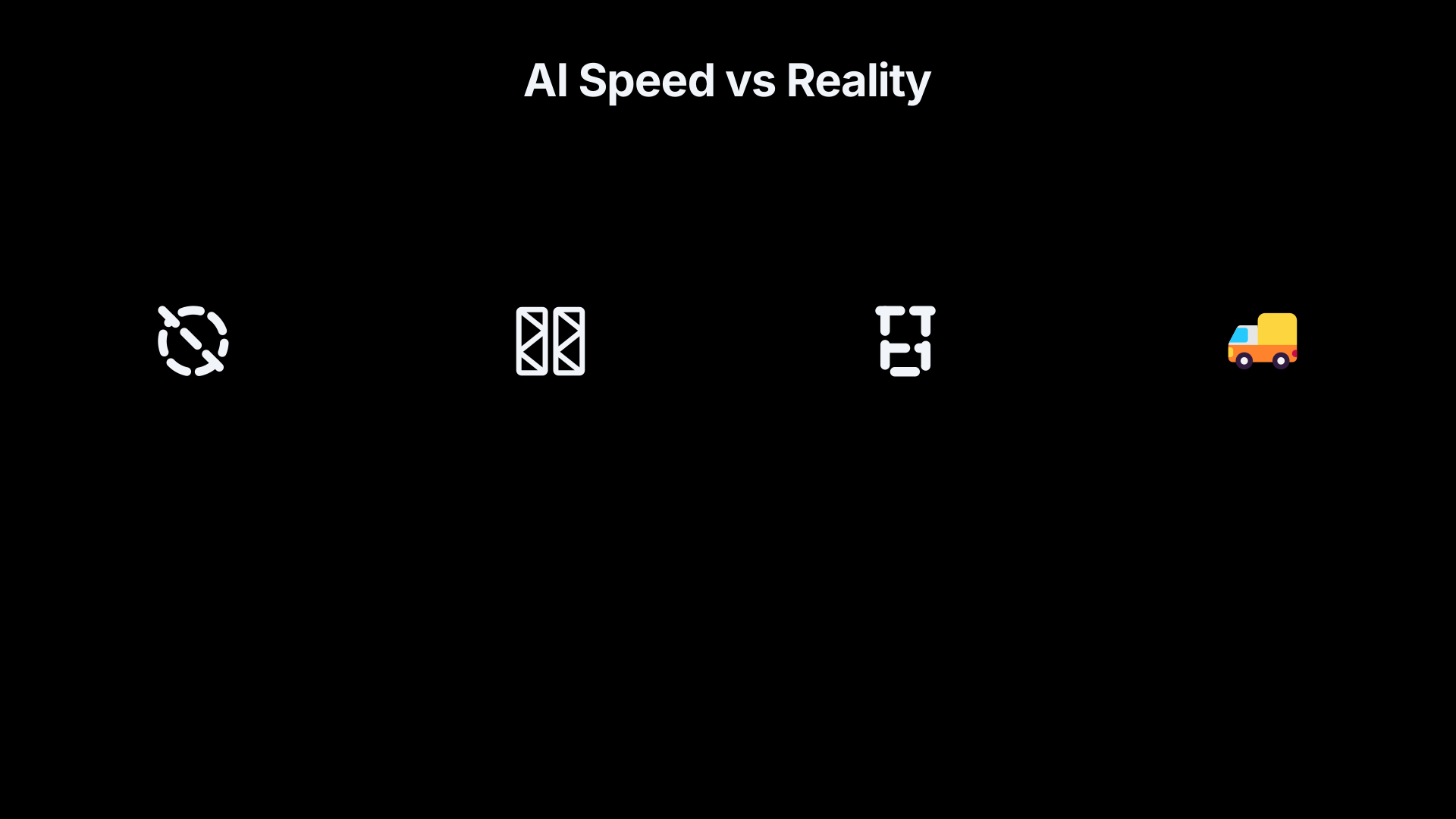
A target can be real without being useful
One of the most common misconceptions is that finding a disease-related biological target automatically leads to an effective medicine.
Many diseases involve proteins, pathways or genes that clearly correlate with illness. AI systems are increasingly good at identifying these relationships by searching enormous biological datasets. Yet correlation is not the same as therapeutic leverage.
A protein may be involved in disease progression without being a practical intervention point. Blocking it may produce little benefit because other biological pathways compensate for the change. The disease may simply route around the intervention.
This problem existed long before AI, but AI can sometimes make it easier to discover plausible targets faster than researchers can truly validate them. A model may identify a statistically compelling relationship while still missing deeper causal biology.[Causaly]causaly.comTackling Drug Discovery Inefficiencies With AIMitigating clinical failures with AI. Overcoming the Toxicity Hurdle… Many precli…
Human diseases are not single-variable systems
Many AI drug platforms operate by identifying patterns within large datasets. That can be powerful, but diseases often emerge from interacting systems rather than isolated molecular mechanisms.
Cancer, autoimmune disorders, neurodegeneration and metabolic diseases all involve layers of complexity:
- Genetics
- Immune responses
- Ageing processes
- Environmental influences
- Lifestyle factors
- Interactions between tissues and organs
A molecule may behave exactly as predicted against its target while producing little real-world benefit because the disease depends on many other factors the model did not capture.
This is one reason protein structure prediction, although transformative, does not solve drug development on its own. Understanding molecular structure is different from understanding the full behaviour of a living organism.[ScienceDirect]sciencedirect.comLeading artificial intelligence–driven drug discovery platformsby M Dharmasivam · 2025 · Cited by 15 — No late-stage outcome…[ScienceDirect]sciencedirect.comdesign insights to explain the failure of drug candidatesThe future of pharmaceuticals: Artificial intelligence in drug…by C Fu · 2025 · Cited by 172 — Many clinical trial failur…
Animal models often give misleading confidence
Many candidate drugs look effective in cells or animals before failing in humans.
AI does not remove this problem. In some cases it may even accelerate the movement of candidates through early research stages, meaning that weaknesses only become visible later.
Mouse models, for example, often capture only limited aspects of human disease. A treatment can appear successful because it improves a laboratory model rather than because it addresses the actual human condition.
Phase 2 is frequently the first moment when a medicine confronts the biological diversity of real patients at meaningful scale.
Drug exposure is harder than molecular binding
A common achievement highlighted by AI drug companies is the prediction of strong binding between a molecule and its target protein.
But successful medicines require far more than binding.
The drug must:
- Reach the correct tissue
- Remain stable in the body
- Avoid rapid breakdown
- Reach therapeutic concentrations
- Avoid harming other systems
Many compounds that look excellent computationally fail because the body never delivers enough active drug to the right location, or because unintended effects emerge elsewhere. Researchers often group these challenges under absorption, distribution, metabolism, excretion and toxicity, sometimes abbreviated as ADMET. Poor ADMET properties remain a major cause of failure.[ScienceDirect]sciencedirect.comLeading artificial intelligence–driven drug discovery platformsby M Dharmasivam · 2025 · Cited by 15 — No late-stage outcome…

Why AI does not automatically solve the clinical trial bottleneck
The strongest claims about AI drug discovery often focus on search efficiency. AI can explore chemical possibilities much faster than human researchers alone.
The difficulty is that phase 2 failure is often not a search problem.
It is a reality problem.
An AI model may correctly identify a molecule with desirable properties according to available data. Yet the available data may not contain enough information to predict how thousands of interacting biological processes will behave inside a diverse patient population.
Several reviews of AI-driven drug development note that although AI has accelerated candidate generation, there is still little evidence that it has fundamentally changed late-stage clinical success rates. Some analyses explicitly note that AI-discovered drugs have so far shown phase 2 failure rates broadly similar to conventional drugs, while none has yet completed a successful phase 3 pathway leading to approval.[Nature]nature.comBy. Heather Bowling; Arianna Cocucci; Da Chen Emily Koo & …Read more…[ScienceDirect]sciencedirect.comKey indicators of phase transition for clinical trials through…by F Feijoo · 2020 · Cited by 79 — At a very basic level, researchers h…
This does not mean AI has failed. It means the easiest part of the pipeline to accelerate may not be the hardest part.
Better predictions still face incomplete data
Machine learning systems depend heavily on training data.
Drug development suffers from several data limitations:
- Failed trials are often underreported.
- Biological datasets may be incomplete.
- Patient populations differ across regions and demographics.
- Rare diseases frequently lack large datasets.
- Many molecular mechanisms remain poorly understood.
If the underlying biological knowledge is limited, AI systems inherit those limitations. They can sometimes identify patterns hidden from human researchers, but they cannot magically extract information that does not exist.
This creates a recurring problem in phase 2. Models may generate highly plausible hypotheses while remaining uncertain about the biological factors most responsible for real patient outcomes.
The first AI-designed drugs are testing the claim
The field is beginning to produce real-world tests rather than theoretical promises.
Insilico Medicine became one of the most closely watched examples after advancing its AI-designed fibrosis treatment into phase 2 trials. The company presented this as evidence that generative AI could move beyond laboratory discovery into clinical validation. Later reports described encouraging phase 2a findings for its fibrosis programme, though the drug still faces the longer path required to establish clinical effectiveness and regulatory approval.[Insilico Medicine]WikipediaInsilico MedicineThe company combines genomics, big data analysis, and deep learning for in silico drug discovery.Read more…[Insilico Medicine]WikipediaInsilico MedicineThe company combines genomics, big data analysis, and deep learning for in silico drug discovery.Read more…
These programmes matter because they are among the first opportunities to answer a question that has lingered over the entire sector: does AI merely generate candidates faster, or does it generate better medicines?
So far, the evidence remains incomplete. Industry reviews note that dozens of AI-discovered compounds have entered human testing, but the number that have progressed through advanced efficacy trials remains small.[PMC]pmc.ncbi.nlm.nih.govby D Sun · 2022 · Cited by 2082 — Since 40%–50% of clinical failure of drug development is due to lack of clinical efficacy, tremendou…
This uncertainty explains why large pharmaceutical companies continue investing heavily in AI while remaining cautious about claims of revolutionary clinical success. Partnerships involving firms such as Eli Lilly and AI-focused drug discovery companies reflect confidence that AI improves parts of the research process, but they do not yet prove that the phase 2 bottleneck has been broken.[Reuters]reuters.comThis agreement builds upon a prior partnership that began with an AI-based software licensing deal in 2023 and a research collaboration i…[Reuters]reuters.compharmaceutical giant Eli Lilly. This partnership could be valued at up to $2.75 billion, including milestone payments. The agreement gran…
What would count as real progress
The strongest evidence for AI-driven medical acceleration would not be faster molecule generation or larger partnership deals.
It would be a sustained improvement in clinical outcomes.
Several developments would represent meaningful progress:
Higher phase 2 success rates. If AI-designed drugs consistently outperform historical averages in proof-of-concept trials, that would suggest the technology is improving biological understanding rather than merely speeding up candidate generation.
Better target selection. Success would increasingly come from identifying disease mechanisms that genuinely matter in patients, not simply from generating large numbers of compounds.
Improved patient matching. AI may prove more valuable in identifying which patients are likely to benefit from a treatment than in designing the treatment itself. More precise trial populations could reveal effects that broad studies miss.
Earlier detection of weak programmes. Even if AI does not dramatically increase success rates, it could still create value by identifying likely failures before companies spend hundreds of millions on large trials.
Clinical validation across multiple diseases. A handful of successes would be encouraging. Repeated success across cancer, fibrosis, neurodegeneration, autoimmune disease and metabolic disorders would be much stronger evidence that AI is changing the underlying economics of drug development.
Why this matters for the larger AI bloom vision
The optimistic case for AI and human flourishing often points to medicine as a central example. If machine intelligence can dramatically accelerate biological discovery, the long-term implications could include healthier lives, reduced disease burdens and potentially major advances in longevity.
Phase 2 remains one of the clearest reminders that scientific acceleration is not the same as scientific completion.
AI may make it vastly easier to generate hypotheses, identify targets and design molecules. Yet the ultimate test is still whether human beings become healthier as a result. The history of drug development shows that nature is full of convincing ideas that fail when tested.
That does not weaken the importance of AI in medicine. It clarifies where the real challenge lies. The future of AI-enabled health breakthroughs depends not only on building systems that can invent drugs, but on building systems that help researchers understand biology deeply enough that more of those inventions survive contact with reality.[Nature]nature.comfailure rate between Phase 1 and BLA. There… AI drugs to face the same failures in the clinic as traditionally developed molecules…[PMC]pmc.ncbi.nlm.nih.govAlgorithms, such as Nearest-NeighbourArtificial intelligence in drug discovery and development - PMCby D Paul · 2020 · Cited by 2415 — Even then, nine out of ten therapeut…
Amazon book picks
Further Reading
Books and field guides related to Why phase 2 breaks so many AI drugs. Use these as the next step if you want deeper reading beyond the article.
Deep Medicine
Frames why AI-generated therapies still need rigorous proof in real patients.
Bad Pharma
Explains why trial design, evidence quality and publication incentives matter for judging drug success.
The Billion-Dollar Molecule
Shows how biological promise can collide with uncertainty, investment pressure and clinical reality.
The Drug Hunters
Directly supports the page's focus on why promising drug candidates struggle in human testing.
eBay marketplace picks
Marketplace Samples
Example marketplace items related to this page. Use the search link to explore similar finds on eBay.


Endnotes
1.
Source: nature.com
Link:https://www.nature.com/articles/s41591-025-03743-2
Source snippet
Estimation of clinical trial success rates and...Read more...
2.
Source: sciencedirect.com
Link:https://www.sciencedirect.com/science/article/abs/pii/S0031699725075118
Source snippet
Leading artificial intelligence–driven drug discovery platformsby M Dharmasivam · 2025 · Cited by 15 — No late-stage outcome...
3.
Source: pmc.ncbi.nlm.nih.gov
Title: PMCProgress, Pitfalls, and Impact of AI‐Driven Clinical Trials
Link:https://pmc.ncbi.nlm.nih.gov/articles/PMC11924158/
Source snippet
by D Wilczok · 2024 · Cited by 22 — According to a BiopharmaTrend report published in April 2024, eight leading AI drug discovery comp...
Published: April 2024
4.
Source: pmc.ncbi.nlm.nih.gov
Link:https://pmc.ncbi.nlm.nih.gov/articles/PMC9293739/
Source snippet
by D Sun · 2022 · Cited by 2082 — Since 40%–50% of clinical failure of drug development is due to lack of clinical efficacy, tremendou...
5.
Source: causaly.com
Link:https://www.causaly.com/blog/tackling-drug-discovery-inefficiencies-with-ai
Source snippet
Tackling Drug Discovery Inefficiencies With AIMitigating clinical failures with AI. Overcoming the Toxicity Hurdle... Many precli...
6.
Source: sciencedirect.com
Title: design insights to explain the failure of drug candidates
Link:https://www.sciencedirect.com/science/article/pii/S2095177925000656
Source snippet
The future of pharmaceuticals: Artificial intelligence in drug...by C Fu · 2025 · Cited by 172 — Many clinical trial failur...
7.
Source: pmc.ncbi.nlm.nih.gov
Title: Algorithms, such as Nearest-Neighbour
Link:https://pmc.ncbi.nlm.nih.gov/articles/PMC7577280/
Source snippet
Artificial intelligence in drug discovery and development - PMCby D Paul · 2020 · Cited by 2415 — Even then, nine out of ten therapeut...
8.
Source: insilico.com
Title: first phase2
Link:https://insilico.com/blog/first_phase2
Source snippet
Insilico MedicineFirst Generative AI Drug Begins Phase II Trials with Patients1 Jul 2023 — Insilico Medicine has achieved a new milestone...
9.
Source: insilico.com
Title: tnik ipf phase2a
Link:https://insilico.com/news/tnik-ipf-phase2a
Source snippet
Insilico MedicineInsilico Medicine announces positive topline results of...Nov 12, 2024 — The results demonstrate that ISM001-055 is saf...
10.
Source: insilico.com
Title: tnrecuxsc1 insilico announces nature medicine publi
Link:https://insilico.com/news/tnrecuxsc1-insilico-announces-nature-medicine-publi
Source snippet
Insilico MedicineInsilico Announces Nature Medicine Publication of Phase...3 Jun 2025 — On June 3, 2025, the industry's first proof-of-c...
Published: June 3, 2025
11.
Source: reuters.com
Link:https://www.reuters.com/business/healthcare-pharmaceuticals/eli-lilly-extends-partnership-with-insilico-medicine-ai-powered-drug-discovery-2026-03-30/
Source snippet
This agreement builds upon a prior partnership that began with an AI-based software licensing deal in 2023 and a research collaboration i...
12.
Source: reuters.com
Link:https://www.reuters.com/business/healthcare-pharmaceuticals/eli-lilly-sign-2-billion-deal-ai-drug-development-with-hong-kongs-insilico-2026-03-29/
Source snippet
pharmaceutical giant Eli Lilly. This partnership could be valued at up to $2.75 billion, including milestone payments. The agreement gran...
13.
Source: insilico.com
Link:https://insilico.com/casestudy
Source snippet
Case Study: Insilico's TransformationWith [Rentosertib]({{ 'rentosertib/' | relative_url }}) now finished Phase IIa clinical trial, this event marks the beginning of numerous m...
14.
Source: insilico.com
Link:https://insilico.com/news/bnj09h4811-pharmaai-spring-kickoff-2026-drive-the-f
Source snippet
Spring Kickoff 2026: Drive the Future of...9 Apr 2026 — PandaOmics is Insilico Medicine's AI-driven platform for therapeutic target disc...
15.
Source: insilico.com
Link:https://insilico.com/phase1
Source snippet
From Start to Phase 1 in 30 MonthsFrom Start to Phase 1 in 30 Months: AI-discovered and AI-designed Anti-fibrotic Drug Enters Phase I Cli...
16.
Source: insilico.com
Link:https://insilico.com/
Source snippet
Insilico Medicine: MainNow, says Dr. Levitt, Insilico Medicine is using AI to create an entirely new AI-driven drug discovery pipeline fr...
17.
Source: insilico.com
Link:https://insilico.com/blog/1112
Source snippet
A Phase 2 Readout Generates Excitement for the Potential...12 Nov 2024 — Another milestone has been reached in Insilico Medicine's AI-po...
18.
Source: insilico.com
Link:https://insilico.com/pipeline
Source snippet
PipelineThe rapid progress of internal pipeline demonstrates the generative-AI driven drug discovery capabilities of our Pharma.AI platfo...
19.
Source: nature.com
Link:https://www.nature.com/articles/d41573-025-00208-6
Source snippet
By. Heather Bowling; Arianna Cocucci; Da Chen Emily Koo & …Read more...
20.
Source: nature.com
Link:https://www.nature.com/articles/s44386-025-00013-6
Source snippet
failure rate between Phase 1 and BLA. There... AI drugs to face the same failures in the clinic as traditionally developed molecules...
21.
Source: sciencedirect.com
Link:https://www.sciencedirect.com/science/article/abs/pii/S1359644620300052
Source snippet
Key indicators of phase transition for clinical trials through...by F Feijoo · 2020 · Cited by 79 — At a very basic level, researchers h...
22.
Source: dictionary.cambridge.org
Link:https://dictionary.cambridge.org/dictionary/english/phase
Source snippet
English meaning - Cambridge Dictionary6 days ago — any stage in a series of events or in a process of development: The project is only...
23.
Source: Wikipedia
Title: Insilico Medicine
Link:https://en.wikipedia.org/wiki/Insilico_Medicine
Source snippet
Insilico MedicineThe company combines genomics, big data analysis, and deep learning for in silico drug discovery.Read more...
24.
Source: Wikipedia
Link:https://en.wikipedia.org/wiki/Phase
Source snippet
PhaseScience · State of matter, or phase, one of the distinct forms in which matter can exist · Phase (matter), a region of space thro...
25.
Source: news-medical.net
Link:https://www.news-medical.net/news/20250307/Insilico-Medicines-AI-driven-drug-Rentosertib-receives-official-generic-name.aspx
Source snippet
Insilico Medicine's AI-driven drug Rentosertib receives...7 Mar 2025 — Rentosertib (formerly known as ISM001-055) – has been granted an...
26.
Source: vocabulary.com
Link:https://www.vocabulary.com/dictionary/phase
Source snippet
Definition, Meaning & SynonymsA phase is a particular period of time, like someone whose "teenage rebellion" phase lasts well into her th...
27.
Source: reruption.com
Link:https://reruption.com/en/knowledge/industry-cases/insilico-medicine-ai-drug-to-phase-ii-in-30-months
28.
Source: clinicaltrialsarena.com
Title: insilico medicine ins018055 ai
Link:https://www.clinicaltrialsarena.com/news/insilico-medicine-ins018055-ai/
Source snippet
Insilico's AI drug enters Phase II IPF trialJun 27, 2023 — Insilico plans to investigate its AI-generated INS018_055 in patients with IPF...
Additional References
29.
Source: communities.springernature.com
Link:https://communities.springernature.com/posts/preliminary-phase-2a-readout-for-a-novel-drug-discovered-and-designed-using-generative-ai-sets-a-major-milestone-in-ai-powered-drug-discovery
Source snippet
Phase 2a Readout for a Novel Drug Discovered and...September 23, 2024 — Insilico Medicine's AI-designed small molecule inhibitor for the...
Published: September 23, 2024
30.
Source: asbmb.org
Link:https://www.asbmb.org/asbmb-today/opinions/031222/90-of-drugs-fail-clinical-trials
Source snippet
90% of drugs fail clinical trialsMy research team and I believe that this unbalanced drug optimization process may skew drug candidate se...
31.
Source: merriam-webster.com
Link:https://www.merriam-webster.com/dictionary/clinical
Source snippet
CLINICAL Definition & MeaningThe meaning of CLINICAL is of, relating to, or conducted in or as if in a clinic. How to use clinical in a s...
32.
Source: investopedia.com
Link:https://www.investopedia.com/eli-lilly-is-diving-deeper-into-ai-drug-discovery-with-expanded-insilico-partnership-11936929
Source snippet
Under the deal, Eli Lilly secures exclusive rights to commercialize any successful drugs from Insilico’s pipeline and will work collabora...
33.
Source: merriam-webster.com
Link:https://www.merriam-webster.com/dictionary/phase
Source snippet
PHASE Definition & MeaningThe meaning of PHASE is a particular appearance or state in a regularly recurring cycle of changes. How to use...
34.
Source: johnlewis.com
Link:https://www.johnlewis.com/brand/phase-eight/_/N-1z13tm6
35.
Source: htworld.co.uk
Title: ai discovered drugs achieved higher success rate than those by humans study
Link:https://www.htworld.co.uk/news/ai/ai-discovered-drugs-achieved-higher-success-rate-than-those-by-humans-study/
Source snippet
AI-discovered drugs achieved higher success rate than...10 May 2024 — AI-discovered drugs in Phase I clinical trials have an 80-90 per c...
Published: May 2024
36.
Source: linkedin.com
Title: ai biotech 2025 trends discoveries game changing technologies 1s3df
Link:https://www.linkedin.com/pulse/ai-biotech-2025-trends-discoveries-game-changing-technologies-1s3df
Source snippet
AI in Biotech: 2025 Trends, Discoveries, and Game...Moreover, there is no significant difference in the Phase 2 trial failure rates betw...
37.
Source: europeanpharmaceuticalreview.com
Title: first ai generated small molecule drug enters phase ii trial
Link:https://www.europeanpharmaceuticalreview.com/news/184106/first-ai-generated-small-molecule-drug-enters-phase-ii-trial/
Source snippet
First AI-generated small molecule drug enters Phase II trial29 Jun 2023 — Phase II clinical trials in the US and China are now underway f...
38.
Source: medium.com
Title: how ai is transforming drug discovery in 2026 0d8c7c600428
Link:https://medium.com/%40unicodeveloper/how-ai-is-transforming-drug-discovery-in-2026-0d8c7c600428
Source snippet
How AI is Transforming Drug Discovery in 2026... 2026. Insilico Medicine's AI-designed drug for idiopathic pulmonary fibrosis completed P...
Topic Tree