Within Longevity
Can AI drugs survive human trials?
AI can help find drug targets and molecules faster, but human trials still decide whether those medicines actually help patients.
On this page
- What AI speeds up in early discovery
- Why phase 2 and phase 3 remain hard
- What success would mean for longevity medicine
Page outline Jump by section
Introduction
AI can now suggest drug targets, generate candidate molecules, predict protein structures and narrow years of laboratory search into months. That has made drug discovery one of the strongest real-world examples behind the broader idea that advanced AI could accelerate science and eventually help extend healthy human life. Yet the hardest question is not whether AI can design molecules. It is whether those molecules survive contact with human biology.
 The central bottleneck remains the clinical trial system. Most experimental medicines fail not because researchers cannot generate ideas, but because treatments that appear promising in cells, animal models or computer simulations often do not help real patients enough to justify approval. AI may compress the search phase of medicine, but phase 2 and phase 3 trials still determine whether a drug is safe, effective and worth using. The future of AI-enabled longevity medicine therefore depends less on producing candidate drugs and more on improving the long, expensive process of proving that they work.
What AI speeds up in early discovery
Traditional drug discovery is partly a search problem. Researchers must identify a biological target, understand how it behaves, design molecules that interact with it and then refine those molecules through repeated rounds of testing. Much of this process has historically involved large amounts of trial and error.
Recent AI systems have become useful because they reduce parts of that blind search.
A major example is AlphaFold, developed by Google DeepMind and collaborators. AlphaFold 2 dramatically improved the prediction of protein structures, while AlphaFold 3 expanded this capability to model interactions involving proteins, DNA, RNA and small molecules. That matters because many diseases involve molecular interactions that are difficult to observe directly. Better structural predictions can help researchers identify potential drug targets and design compounds more efficiently.[Nature]nature.comAccurate structure prediction of biomolecular interactions…by J Abramson · 2024 · Cited by 14582 — Here we describe our AlphaFol…
The practical gains appear in several stages:
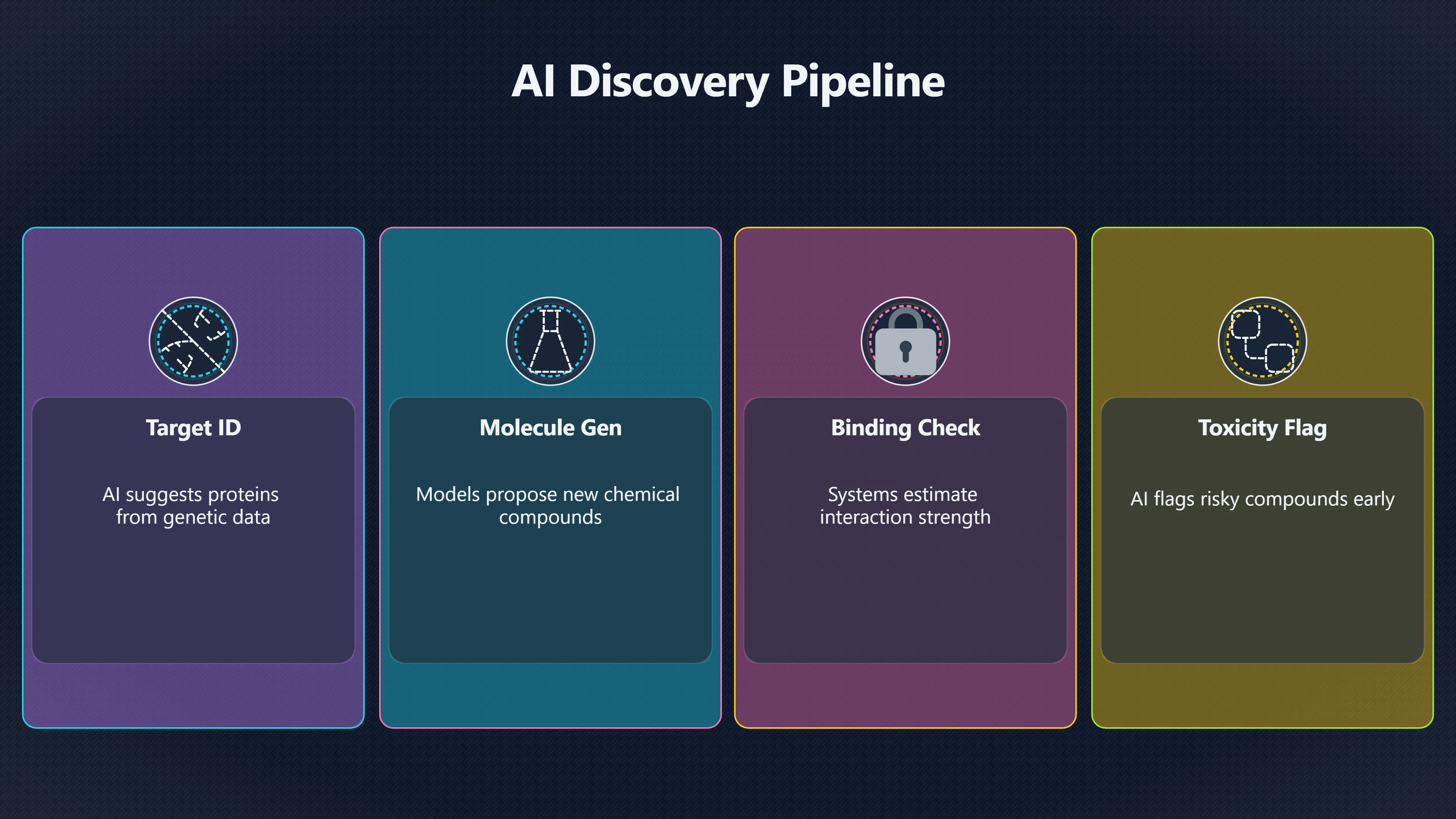
- Target identification: AI systems can analyse genetic, biological and clinical datasets to suggest proteins or pathways involved in disease.
- Molecule generation: Generative models can propose entirely new compounds rather than relying only on existing chemical libraries.
- Binding prediction: Models can estimate how strongly a candidate drug might interact with a target.
- Toxicity screening: AI can help flag compounds that look risky before expensive laboratory work begins.
- Drug repurposing: Existing medicines can be matched to new diseases more quickly.
The attraction is obvious. Drug development often takes more than a decade and costs billions of pounds. If AI can eliminate large numbers of weak candidates earlier, the entire pipeline could become faster and cheaper.
Several companies now claim substantial reductions in discovery timelines. Insilico Medicine, for example, reported moving its idiopathic pulmonary fibrosis drug candidate rentosertib from target identification to clinical testing far faster than conventional timelines. The company argues that AI reduced the time needed to reach a preclinical candidate by helping identify targets and generate molecules more efficiently.[Insilico Medicine]insilico.comInsilico MedicineCase Study: Insilico's TransformationWith Rentosertib now finished Phase IIa clinical trial… A critical bottleneck in…
This is why drug discovery occupies such an important place in the wider AI bloom story. Scientific acceleration is easier to imagine when there is a concrete mechanism: machine intelligence helping researchers search enormous biological possibility spaces that humans alone cannot explore efficiently.
Why phase 2 and phase 3 remain hard
The difficulty is that discovering a molecule and proving a medicine are different problems.
A model may predict that a compound binds strongly to a protein. That does not mean the compound reaches the right tissue in the body, remains stable long enough to work, avoids dangerous side effects, interacts safely with other biological systems or improves patient outcomes.
This gap explains why the industry’s biggest failure rates occur after promising laboratory results.
Biology is messier than prediction
Human bodies are not static molecular diagrams. Diseases involve immune systems, metabolism, genetics, age, lifestyle and environmental influences interacting across many levels.
Even highly accurate structure prediction does not solve these complexities. Researchers have praised AlphaFold 3 as a major advance while also highlighting limitations involving stereochemistry, molecular dynamics and prediction accuracy in genuinely novel biological situations. Nature[Cell]cell.comDrug development in the AI era: AlphaFold 3 is coming!by Y Shi · 2024 · Cited by 24 — We also noticed that AF3 has limitations with r…
A molecule that looks excellent on a computer may behave very differently inside a living patient.
This is especially important for ageing-related diseases. Conditions such as Alzheimer’s disease, fibrosis, cardiovascular disease and many cancers involve multiple interacting biological systems. A drug may successfully affect one target while leaving the broader disease process largely unchanged.
The phase 2 problem
Drug developers often describe phase 2 as the industry’s graveyard.
Phase 1 trials primarily test safety in small groups of people. A drug that survives phase 1 has shown that it can usually be administered without unacceptable immediate toxicity.
Phase 2 is different. Researchers must demonstrate that the treatment actually helps patients.
That requires answering difficult questions:
- Does the biological mechanism matter in humans?
- Is the treatment effect large enough to measure?
- Which patients benefit most?
- Are there delayed side effects?
- Does the apparent signal survive larger datasets?
Many candidate drugs fail at this stage because a promising biological theory turns out not to translate into meaningful clinical improvement.
The emerging evidence suggests that AI-discovered drugs are not exempt from this reality. While AI may improve candidate selection, there is little evidence so far that it has eliminated the fundamental challenge of demonstrating efficacy in humans. Some observers note that AI-originated compounds appear to encounter phase 2 failure rates similar to those seen across the broader pharmaceutical industry.[DeepCeutix]deepceutix.comDeep Ceutix Your AI Can Design a MoleculeIt Can't Formulate a Drug.23 Feb 2026 — AI-discovered compounds show 80-90% Phase I success rates but only ~40% Phase II success, indisti…
Phase 3 is even more demanding
A successful phase 2 result does not guarantee approval.
Phase 3 trials often involve hundreds or thousands of patients across multiple sites. They are designed to answer whether a treatment works reliably in diverse real-world populations.
This stage introduces additional challenges:
- Rare side effects become visible.
- Patient populations become more heterogeneous.
- Manufacturing consistency matters.
- Statistical standards become stricter.
- Regulators require stronger evidence.
An AI-generated molecule faces exactly the same evidential burden as any other medicine.
This explains why many companies that promote AI drug discovery still speak cautiously about timelines. Even firms built around advanced AI platforms continue to measure progress in years rather than months once clinical testing begins. Isomorphic Labs, for example, has repeatedly emphasised the challenge of moving from computational breakthroughs to human trials, delaying its projected clinical timeline while continuing to expand investment in AI-driven discovery.[Reuters]reuters.comGoogle-backed Isomorphic Labs delays clinical trial timelineThis update was shared by founder and CEO Demis Hassabis during the World Economic Forum in Davos, Switzerland. The company, established…

Rentosertib: an early test of the idea
The most closely watched case in this field is rentosertib, previously known as INS018_055, developed by Insilico Medicine for idiopathic pulmonary fibrosis.
The importance of the programme is not simply that AI contributed to its discovery. The significance is that it reached human testing and produced clinical data.
In 2023, the company announced that the drug had entered phase 2 trials, describing it as the first generative-AI-discovered drug to reach that stage.[Insilico Medicine]insilico.comInsilico MedicineCase Study: Insilico's TransformationWith Rentosertib now finished Phase IIa clinical trial… A critical bottleneck in…
More recently, researchers reported results from a randomised phase 2a study suggesting that the AI-discovered target-and-drug combination was safe and showed signs of efficacy in patients with idiopathic pulmonary fibrosis. The study has been widely discussed because it represents one of the clearest attempts to validate an end-to-end AI drug discovery process using clinical evidence rather than laboratory demonstrations.[PubMed]pubmed.ncbi.nlm.nih.govA generative AI-discovered TNIK inhibitor for idiopathic…by Z Xu · 2025 · Cited by 128 — Despite substantial progress in artific…
The key point is not that rentosertib proves AI has solved drug development. It does not.
Instead, it provides a more realistic milestone. AI-generated hypotheses can survive long enough to reach meaningful human testing. That is a stronger claim than saying AI can generate attractive molecular structures.
At the same time, even a successful phase 2a study is not equivalent to regulatory approval. The larger and more difficult stages still lie ahead.
Can AI help with the trial bottleneck itself?
The optimistic case is that AI eventually improves not only discovery but also clinical development.
Several routes are being explored.
Better patient selection
Many trials fail because researchers recruit patients whose disease differs in important ways from the biological mechanism being targeted.
AI systems may help identify subgroups more likely to respond to treatment by analysing genetics, biomarkers, imaging and health records.
In principle, this could make treatment effects easier to detect and reduce the number of patients required for successful studies.
Better prediction before trials begin
Researchers are increasingly exploring multimodal models that combine biological, chemical and clinical information.
Recent work has shown that AI systems can use preclinical data to predict aspects of clinical outcomes, including adverse effects and drug-combination risks. The long-term goal is to identify weak candidates before expensive human trials begin.[arXiv]arxiv.orgMultimodal AI predicts clinical outcomes of drug combinations from preclinical dataMarch 4, 2025…
If such approaches become reliable, they could reduce the number of doomed compounds entering phase 2 and phase 3 studies.
Faster trial operations
Clinical trials generate huge amounts of data.
AI may help:
- Match patients to studies.
- Monitor adverse events.
- Analyse trial outcomes.
- Detect protocol deviations.
- Reduce administrative burdens.
These gains would not remove the need for trials, but they could lower costs and shorten timelines.
The distinction matters. Much public discussion assumes AI will somehow replace clinical testing. A more plausible outcome is that AI makes trials more efficient while leaving the requirement for human evidence intact.
What success would mean for longevity medicine
The strongest longevity implications do not come from a single miracle anti-ageing drug.
Instead, they come from the possibility of compounding improvements across many diseases.
If AI substantially lowers the cost and time required to discover and validate treatments, researchers could explore far more biological hypotheses than today’s pharmaceutical system allows.
That could matter especially for diseases associated with ageing:
- Fibrosis.[reruption.com]reruption.comSource details in endnotes.
- Neurodegenerative disorders.
- Cardiovascular disease.
- Cancer.
- Metabolic diseases.
- Rare diseases that currently attract limited investment.
Many of these areas suffer from a basic economics problem. Testing new ideas is expensive, and the failure rate is high. If AI increases the number of ideas that can be explored and improves the quality of candidates entering trials, the result may be a larger pipeline of therapies rather than one dramatic breakthrough.
In the broader AI bloom framework, this is where the stakes become unusually large. A civilisation that can generate medical knowledge faster may not merely add a few treatments. Over decades, it could build a much richer understanding of ageing, disease and prevention. The gains would accumulate across generations.
But that future depends on solving both halves of the problem. Accelerating discovery alone is not enough. Scientific abundance only reaches patients when evidence, regulation, manufacturing and healthcare systems can keep pace.
The deeper lesson: intelligence is speeding up faster than validation
One emerging pattern across AI is that idea generation is becoming cheaper than verification.
Models can now propose molecules, proteins, hypotheses and experimental directions at unprecedented scale. Yet the physical world still imposes constraints.
A proposed medicine must be synthesised.
A biological mechanism must be tested.
A patient must be treated.
A clinical outcome must be measured.
These steps consume time because reality, unlike a simulation, cannot be parallelised indefinitely.
That makes the clinical trial bottleneck one of the most revealing tests of the wider AI bloom thesis. If advanced AI can genuinely improve both discovery and validation, medicine could become one of the first domains where scientific acceleration translates into longer, healthier lives. If validation remains stubbornly slow, AI may generate far more medical possibilities than society can efficiently prove.
The future of AI-discovered drugs therefore rests on a deceptively simple question: can humanity accelerate the process of learning what actually works in real patients? The answer may determine whether AI’s medical revolution remains a laboratory achievement or becomes a genuine expansion of human health and longevity.
Amazon book picks
Further Reading
Books and field guides related to Can AI drugs survive human trials?. Use these as the next step if you want deeper reading beyond the article.
The AI Revolution in Medicine
Places AI medical tools within clinical workflows and evidence demands.
eBay marketplace picks
Marketplace Samples
Example marketplace items related to this page. Use the search link to explore similar finds on eBay.


Endnotes
1.
Source: nature.com
Link:https://www.nature.com/articles/s41586-024-07487-w
Source snippet
Accurate structure prediction of biomolecular interactions...by J Abramson · 2024 · Cited by 14582 — Here we describe our AlphaFol...
2.
Source: insilico.com
Link:https://insilico.com/casestudy
Source snippet
Insilico MedicineCase Study: Insilico's TransformationWith Rentosertib now finished Phase IIa clinical trial... A critical bottleneck in...
3.
Source: insilico.com
Title: first phase2
Link:https://insilico.com/blog/first_phase2
Source snippet
Insilico MedicineFirst Generative AI Drug Begins Phase II Trials with Patients1 Jul 2023 — Insilico Medicine has achieved a new milestone...
4.
Source: nature.com
Link:https://www.nature.com/articles/d41586-025-00111-5
Source snippet
AlphaFold 3 is great — but it still needs human help to get...by J Holland · 2024 — Major AlphaFold upgrade offers boost for drug...
5.
Source: cell.com
Link:https://www.cell.com/the-innovation/fulltext/S2666-6758%2824%2900123-1
Source snippet
Drug development in the AI era: AlphaFold 3 is coming!by Y Shi · 2024 · Cited by 24 — We also noticed that AF3 has limitations with r...
6.
Source: deepceutix.com
Title: Deep Ceutix Your AI Can Design a Molecule
Link:https://deepceutix.com/insights/ai-formulation-gap
Source snippet
It Can't Formulate a Drug.23 Feb 2026 — AI-discovered compounds show 80-90% Phase I success rates but only ~40% Phase II success, indisti...
7.
Source: reuters.com
Title: Google-backed Isomorphic Labs delays clinical trial timeline
Link:https://www.reuters.com/business/healthcare-pharmaceuticals/google-backed-ai-drug-discovery-startup-isomorphic-labs-delays-clinical-trial-2026-01-20/
Source snippet
This update was shared by founder and CEO Demis Hassabis during the World Economic Forum in Davos, Switzerland. The company, established...
8.
Source: reuters.com
Link:https://www.reuters.com/legal/litigation/google-backed-isomorphic-raises-21-billion-scale-ai-driven-drug-discovery-2026-05-12/
Source snippet
This significant funding aims to scale its AI-powered drug design engine, advancing its mission to address all diseases. The investment c...
9.
Source: arxiv.org
Link:https://arxiv.org/abs/2503.02781
Source snippet
Multimodal AI predicts clinical outcomes of drug combinations from preclinical dataMarch 4, 2025...
Published: March 4, 2025
10.
Source: nature.com
Link:https://www.nature.com/articles/d41586-024-01383-z
Source snippet
Latest version of the AI models how proteins interact with other molecules — but...Read more...
11.
Source: nature.com
Link:https://www.nature.com/articles/d41586-024-01463-0
Source snippet
AlphaFold3 — why did Nature publish it without its code?22 May 2024 — Major AlphaFold upgrade offers boost for drug discovery · AI's pote...
Published: May 2024
12.
Source: pubmed.ncbi.nlm.nih.gov
Link:https://pubmed.ncbi.nlm.nih.gov/40461817/
Source snippet
A generative AI-discovered TNIK inhibitor for idiopathic...by Z Xu · 2025 · Cited by 128 — Despite substantial progress in artific...
13.
Source: reruption.com
Link:https://reruption.com/en/knowledge/industry-cases/insilico-medicine-ai-drug-to-phase-ii-in-30-months
Additional References
14.
Source: researchgate.net
Link:https://www.researchgate.net/publication/392366960_A_generative_AI-discovered_TNIK_inhibitor_for_idiopathic_pulmonary_fibrosis_a_randomized_phase_2a_trial
Source snippet
(PDF) A generative AI-discovered TNIK inhibitor for...3 Jun 2025 — These results suggest that targeting TNIK with rentosertib is safe an...
15.
Source: prescouter.com
Link:https://www.prescouter.com/2024/05/alphafold-3/
Source snippet
AlphaFold 3: Revolutionizing drug discovery and molecular...However, it had limitations in predicting complex multi-protein interactions...
16.
Source: semanticscholar.org
Link:https://www.semanticscholar.org/paper/AI-enabled-drug-discovery-reaches-clinical-Zitnik/bbca07d1a74b4c5311411ff41d354b274d944300
Source snippet
AI-enabled drug discovery reaches clinical milestoneA randomized phase 2a clinical trial of an AI-discovered drug and target combination...
17.
Source: loonbio.com
Link:https://loonbio.com/reflections/ai-drug-discoverys-60-billion-reality-check-hype-failures-and-the-market-access-blindspot
Source snippet
AI Drug Discovery's $60 Billion Reality Check: Hype, Failures...31 Dec 2024 — Of approximately 75 AI-discovered molecules that have ente...
18.
Source: science.org
Title: limits access deepmind s new protein program trigger backlash
Link:https://www.science.org/content/article/limits-access-deepmind-s-new-protein-program-trigger-backlash
Source snippet
Limits on access to DeepMind's new protein program...15 May 2024 — DeepMind and Nature, which published the research, have come under fi...
Published: May 2024
19.
Source: forbes.com
Link:https://www.forbes.com/sites/calumchace/2023/06/30/the-first-ai-developed-drug-reaches-phase-2-clinical-trials-with-alex-zhavoronkov/
Source snippet
The First AI-Developed Drug Reaches Phase 2 Clinical Trials30 Jun 2023 — A number of companies are now using AI to develop drugs faster...
20.
Source: isomorphiclabs.com
Title: alphafold 3 predicts the structure and interactions of all of lifes molecules
Link:https://www.isomorphiclabs.com/articles/alphafold-3-predicts-the-structure-and-interactions-of-all-of-lifes-molecules
Source snippet
AlphaFold 3 predicts the structure and interactions of all...8 May 2024 — For the interactions of proteins with other molecule types we...
Published: May 2024
21.
Source: genengnews.com
Title: alphafold 3 angst limited accessibility stirs outcry from researchers
Link:https://www.genengnews.com/topics/artificial-intelligence/alphafold-3-angst-limited-accessibility-stirs-outcry-from-researchers/
Source snippet
AlphaFold 3 Angst: Limited Accessibility Stirs Outcry from...Jun 13, 2024 — But it does not take you directly to a drug, nor to a better...
22.
Source: linkedin.com
Title: ai enabled clinical trials 2025 evidence engineering framework z3xde
Link:https://www.linkedin.com/pulse/ai-enabled-clinical-trials-2025-evidence-engineering-framework-z3xde
Source snippet
AI-Enabled Clinical Trials: The 2025 Evidence Engineering...In silico drug design: Accelerated discovery; Adaptive clinical trials: Real...
23.
Source: empowerswiss.org
Link:https://empowerswiss.org/en/blog/ai-drug-discovery-breakthroughs-move-from-promise-to-proof-in-2025
Source snippet
In 2025, the drug manufacturing companies have moved several AI-originated molecules...Read more...
Topic Tree