Within Research Agents
Why AI scientists start in software
Machine-learning research is a natural test bed for AI research agents because experiments can be run in software before harder physical domains are attempted.
On this page
- Why digital experiments suit autonomous research workflows
- What AI Scientist style systems can already automate
- Why biology, medicine and materials science are harder
Page outline Jump by section
Introduction
The first convincing home for AI scientists is unlikely to be a wet laboratory full of chemicals, microscopes and expensive equipment. It is far more likely to be a digital environment where experiments are cheap, fast, repeatable and automatically measured.
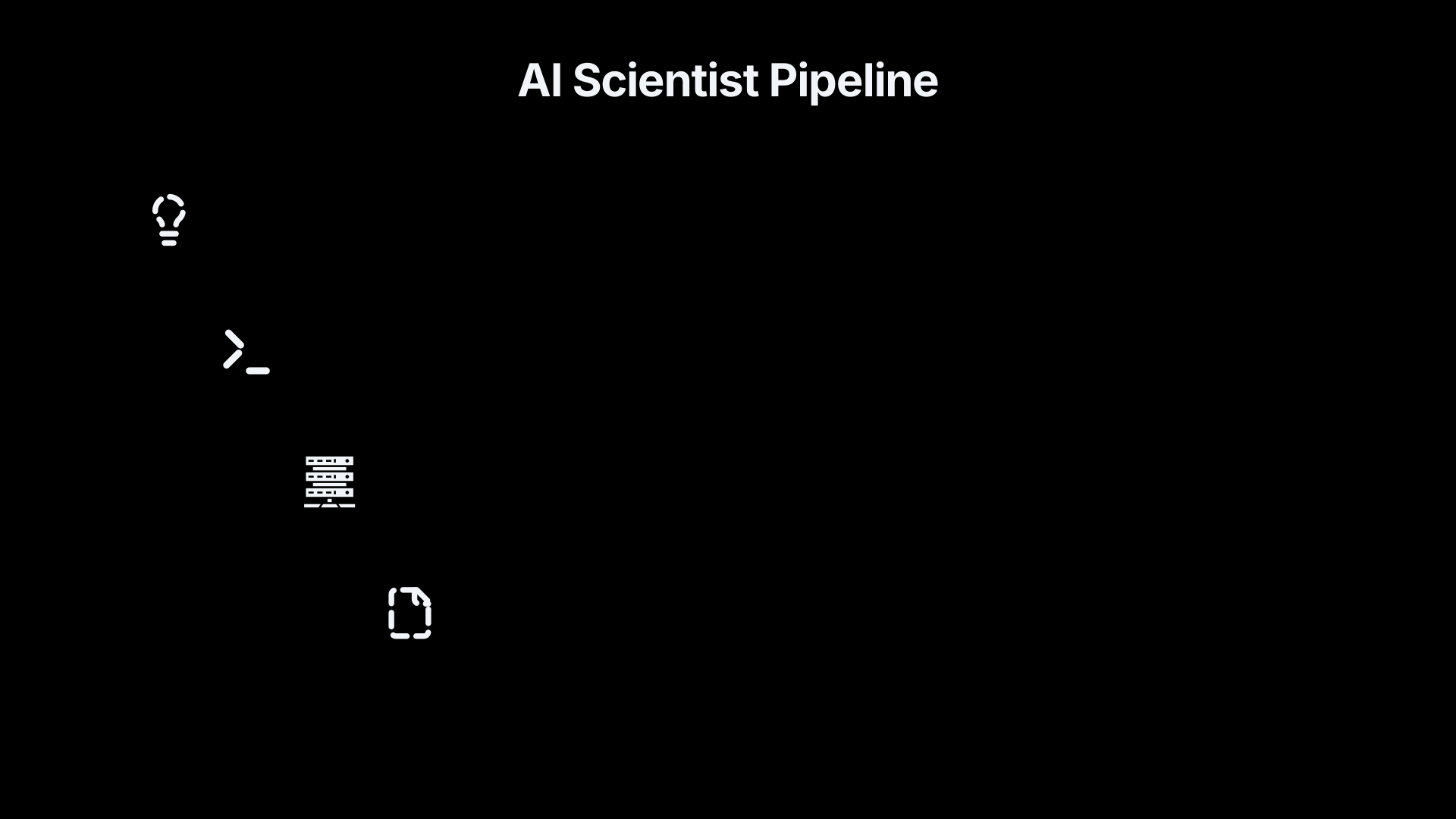 This matters because one of the central hopes behind AI-driven scientific acceleration is not merely that AI helps researchers write papers or search literature. The larger possibility is that increasingly autonomous systems could participate in the full cycle of discovery: proposing ideas, designing tests, running experiments, analysing results and refining hypotheses. For now, the easiest place to attempt that is in software. Machine-learning research, computer science and other digital domains provide something rare in science: environments where thousands of experiments can be launched automatically, evaluated objectively and repeated at low cost. That makes them natural training grounds for AI research agents before they move into harder fields such as biology, medicine and materials science.[Sakana AI]sakana.aiai scientistTowards Fully Automated Open-Ended Scientific DiscoveryAug 13, 2024 — The AI Scientist is a fully automated pipeline for end-to-end paper…[Nature]nature.comWe present The AI Scientist, which creates research ideas…Read more…
Why digital experiments fit autonomous science
Scientific research is difficult to automate because reality is messy. Experiments fail for unclear reasons. Equipment breaks. Biological systems behave unpredictably. Results can take months or years to emerge.
Digital experiments remove many of those obstacles.
In machine learning research, an experiment often consists of modifying code, training a model, collecting performance metrics and comparing results against a benchmark. The environment is already computer-readable. The tools are software. The measurements are numerical. Success and failure can often be scored automatically.[Sakana AI]sakana.aiai scientistTowards Fully Automated Open-Ended Scientific DiscoveryAug 13, 2024 — The AI Scientist is a fully automated pipeline for end-to-end paper…
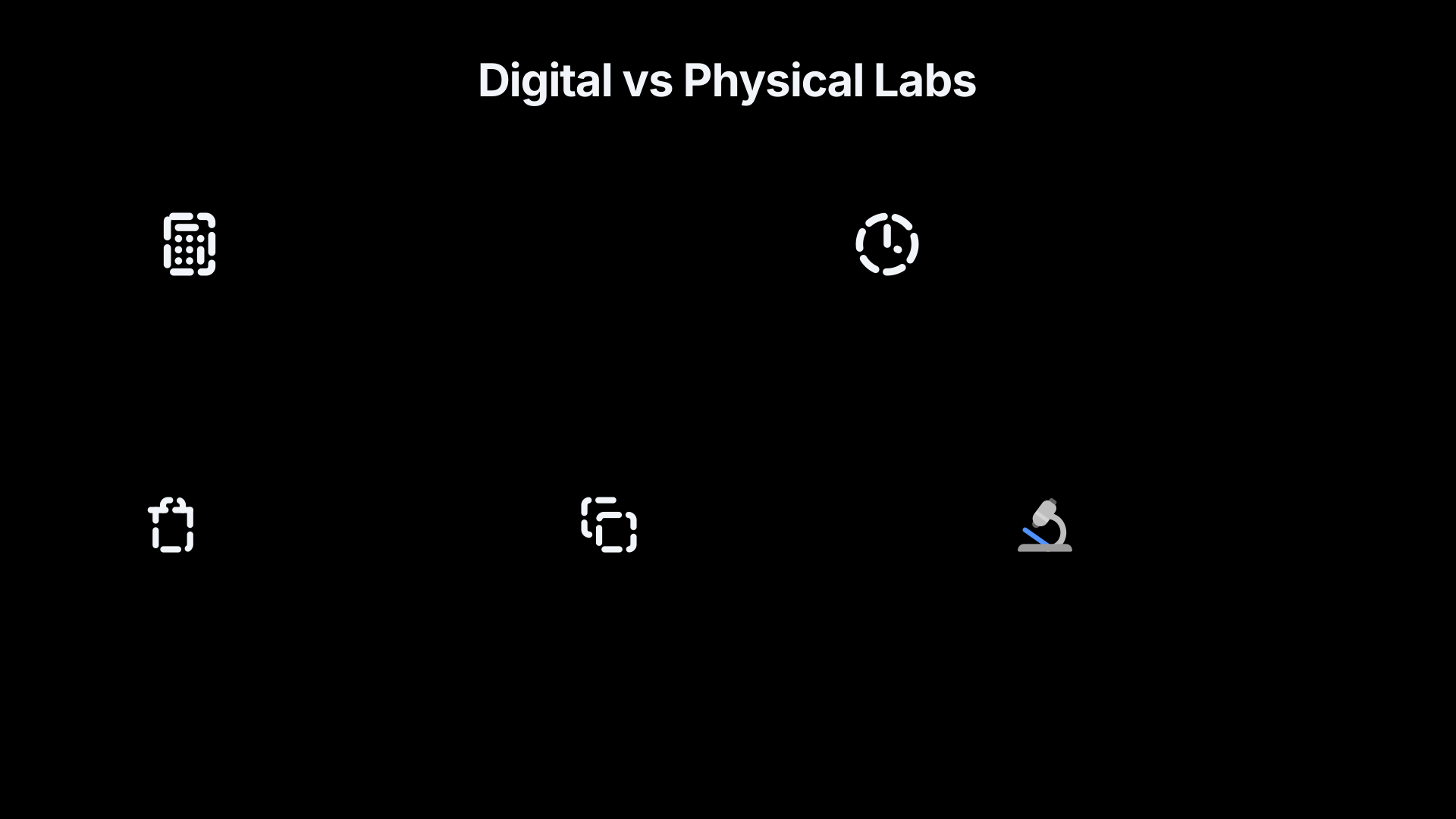
That creates several advantages for AI agents:
- Experiments are cheap. Running another training run may cost computing resources, but it is usually far cheaper than building a physical prototype or conducting laboratory studies.
- Feedback arrives quickly. Results may appear in minutes, hours or days rather than months.
- Everything is digitally recorded. Code, logs, datasets and outputs can be inspected automatically.
- Replication is straightforward. An experiment can often be rerun with identical settings.
- Evaluation is measurable. Benchmarks provide objective scores rather than subjective impressions.
These properties make machine learning unusually suitable for automation. An AI system does not need to learn how to operate delicate physical instruments or cope with unpredictable laboratory conditions before contributing. It can interact directly with a world already expressed in code.
This helps explain why many of the most ambitious demonstrations of autonomous AI research have appeared first in AI research itself. Researchers are testing whether AI can improve machine-learning systems partly because machine learning is one of the few scientific domains where the entire experimental workflow already lives inside a computer.[Sakana AI]sakana.aiai scientistTowards Fully Automated Open-Ended Scientific DiscoveryAug 13, 2024 — The AI Scientist is a fully automated pipeline for end-to-end paper…[Nature]nature.comHow to build an AI scientist: first peer-reviewed paper spills…Mar 25, 2026 — AI Scientist, an autonomous research tool, first r…
What AI Scientist-style systems can already automate
Recent projects have attempted to automate far more than isolated research tasks.
Sakana AI’s “The AI Scientist” system became one of the most widely discussed examples because it aimed to automate an entire machine-learning research pipeline. According to the project’s description and subsequent peer-reviewed publication, the system can generate research ideas, search relevant literature, write experimental code, run tests, produce figures, analyse results, draft a paper and even conduct a simulated review process.[Sakana AI]sakana.aiai scientistTowards Fully Automated Open-Ended Scientific DiscoveryAug 13, 2024 — The AI Scientist is a fully automated pipeline for end-to-end paper…[Nature]nature.comWe present The AI Scientist, which creates research ideas…Read more…
The significance is not that the system suddenly achieved human-level scientific creativity across all domains. The significance is that an end-to-end loop became technically possible.
Instead of helping with one stage of research, these systems attempt to connect multiple stages together:
- Generate candidate hypotheses.
- Modify existing codebases.
- Launch experiments.
- Evaluate outcomes.
- Propose follow-up experiments.
- Write reports describing results.
Because the underlying experiments are digital, the entire cycle can occur without waiting for physical samples, laboratory scheduling or manufacturing constraints.[Sakana AI]sakana.aiai scientistTowards Fully Automated Open-Ended Scientific DiscoveryAug 13, 2024 — The AI Scientist is a fully automated pipeline for end-to-end paper…[Nature]nature.comHow to build an AI scientist: first peer-reviewed paper spills…Mar 25, 2026 — AI Scientist, an autonomous research tool, first r…
One striking claim from the original AI Scientist work was that complete machine-learning papers could be generated for costs measured in tens of dollars rather than the months of researcher labour normally associated with scientific projects. Even critics of the system generally agree that it demonstrates a substantial reduction in the cost of producing exploratory research experiments, though they dispute how much genuine scientific insight is being created.[arXiv]arxiv.orgarXiv The AI Scientist: Towards Fully Automated Open-Ended Scientific DiscoveryarXiv The AI Scientist: Towards Fully Automated Open-Ended Scientific Discovery
The broader pattern matters more than any individual project. Once research becomes software-native, every improvement in AI models, coding systems and computational infrastructure can potentially improve the research process itself. Research agents can test more variations, explore larger search spaces and iterate faster than human researchers working alone.[Nature]nature.comHow to build an AI scientist: first peer-reviewed paper spills…Mar 25, 2026 — AI Scientist, an autonomous research tool, first r…[arXiv]arxiv.orgarXiv The AI Scientist: Towards Fully Automated Open-Ended Scientific DiscoveryarXiv The AI Scientist: Towards Fully Automated Open-Ended Scientific Discovery
Why machine learning becomes a proving ground
There is another reason AI research is becoming the first testing ground for AI scientists: it creates a feedback loop where AI helps improve AI.
Machine-learning research already depends heavily on computational experiments. When an AI system proposes a new training method, architecture modification or optimisation technique, that proposal can often be evaluated immediately by running software benchmarks.
This creates a setting where research agents can generate ideas and test them at scale. Some researchers describe this as a possible path towards partially automated improvement of AI systems themselves.[Sakana AI]sakana.aiai scientistTowards Fully Automated Open-Ended Scientific DiscoveryAug 13, 2024 — The AI Scientist is a fully automated pipeline for end-to-end paper… 2arXiv
For advocates of the broader AI bloom vision, this possibility is especially important. If AI systems become capable of accelerating research in the very field that improves AI capabilities, scientific progress could become increasingly self-reinforcing. More capable AI could support more capable research systems, which could in turn contribute to further AI improvements.
That does not automatically imply an intelligence explosion or runaway progress. Hardware constraints, data limitations, energy costs, institutional bottlenecks and human oversight still matter. But machine-learning research is one of the few areas where the feedback loop can be explored directly because experiments remain digital from beginning to end. PMC[GOV.UK]GOV.UKai for science strategyfor Science Strategy20 Nov 2025 — The companies and researchers developing general-purpose AI science tools and building autonomous lab i…
The hidden advantage: failure is affordable
Many scientific fields punish failure.
A failed drug-development programme may cost millions of pounds. A failed materials experiment may require specialised facilities and months of preparation. A failed clinical trial can consume years.
Digital research environments are different. Failure is often cheap.
An AI agent can run hundreds or thousands of unsuccessful machine-learning experiments while still producing useful information about what does not work. Researchers can explore more speculative ideas because the cost of being wrong is relatively low.[Sakana AI]sakana.aiai scientistTowards Fully Automated Open-Ended Scientific DiscoveryAug 13, 2024 — The AI Scientist is a fully automated pipeline for end-to-end paper…
This changes the economics of discovery.
Human scientists naturally ration attention because attention is scarce. A researcher may only have time to investigate a handful of possible approaches. An automated research system can explore much larger spaces of possibilities. Most attempts may fail, but if experimentation becomes inexpensive enough, even a low success rate can be valuable.
Supporters of AI-driven scientific acceleration often point to this effect as one of the most important long-term possibilities. The advantage may not come from individual breakthroughs generated by AI. It may come from increasing the total number of experiments civilisation can afford to run.[AIMultiple]aimultiple.comai scientistAI Scientist: Automating the Future of Scientific Discovery28 Apr 2026 — AI scientists mark a major advance toward fully automa…
Why biology, medicine and materials science are harder
The success of AI research agents in digital domains does not automatically transfer to the rest of science.
Biology, medicine and materials science contain physical realities that software-only systems cannot escape.
A machine-learning benchmark always produces an answer. A biological system may produce ambiguous, noisy or contradictory results. Cells behave differently from one experiment to another. Chemical reactions fail. Physical samples become contaminated. Instruments drift out of calibration. Human subjects introduce ethical and regulatory constraints. OUP Academic[science]science.ubc.caca New AI scientist conducts its own researchAI scientist conducts its own research - UBC Science27 Mar 2026 — The researchers developed the AI scientist using foundational models (l… Direct Several additional challenges appear when moving beyond software:
Real-world experiments are slower
Training another model may take hours. Testing a new drug candidate can take years.
This dramatically slows the feedback loop that makes autonomous research attractive in the first place. AI systems improve through iteration, but iteration becomes harder when every cycle requires expensive physical work.[Axios]axios.comThese technologies help streamline experimentation by identifying promising compounds and managing lab tasks via AI-supported systems. Cl…

Ground truth is often uncertain
Machine-learning benchmarks usually provide clear scores.
In biology, the correct interpretation of results may be unclear even after extensive experimentation. Scientific judgement becomes more important precisely where measurements become harder.[PMC]pmc.ncbi.nlm.nih.govPMCAI for scientific discovery is a social problemOpenAI announced plans to develop an “intern-level research assistant” by September 2026 and a fully autonomous “legitimate AI researc…
Physical infrastructure becomes the bottleneck
Even if an AI system generates excellent ideas, somebody still has to conduct experiments.
This is why many organisations are investing in laboratory automation, robotic experimentation platforms and cloud laboratories. The hope is to gradually extend software-like feedback loops into physical science. But the infrastructure requirements remain substantial.[Axios]axios.comThese technologies help streamline experimentation by identifying promising compounds and managing lab tasks via AI-supported systems. Cl…
Errors become more costly
A flawed machine-learning paper may waste computational resources.
A flawed biomedical experiment can waste years of work, consume scarce biological materials or create safety risks. This raises the standard required for autonomy. Research agents must become not only capable but reliable.[PMC]pmc.ncbi.nlm.nih.govPMCAI for scientific discovery is a social problemOpenAI announced plans to develop an “intern-level research assistant” by September 2026 and a fully autonomous “legitimate AI researc…
Early warnings from current systems
The strongest evidence against hype comes from the limitations of existing AI scientist projects.
Independent evaluations of early systems found numerous problems. Experiments sometimes failed because of coding errors. Novelty assessments were often weak. Generated papers occasionally contained mistakes, missing sections or hallucinated claims. Critics argue that some demonstrations resemble accelerated production of mediocre research rather than genuine scientific discovery.[arXiv]arxiv.orgarXiv The AI Scientist: Towards Fully Automated Open-Ended Scientific DiscoveryarXiv The AI Scientist: Towards Fully Automated Open-Ended Scientific Discovery[ACM]dl.acm.orgACM Digital LibraryEvaluating Sakana's AI Scientist: Bold Claims, Mixed…Oct 10, 2025 — Recently, Sakana.ai introduced the AI Scientist…
These criticisms matter because digital environments are the easiest case.
If AI systems struggle with literature review, experimental design and result interpretation in software-based research, those weaknesses may become even more serious in medicine, chemistry or biology.
Current evidence therefore supports a more limited conclusion than some headlines suggest. Autonomous research systems appear increasingly capable of handling parts of the scientific workflow, especially where experiments are computational and measurable. But they still make mistakes that require human oversight, verification and correction.[Nature]nature.comHow to build an AI scientist: first peer-reviewed paper spills…Mar 25, 2026 — AI Scientist, an autonomous research tool, first r…[arXiv]arxiv.orgEvaluating Sakana's AI Scientist for Autonomous Research: Wishful Thinking or an Emerging Reality Towards 'Artificial Research Intel…
What digital labs could mean for a larger AI bloom
The importance of digital research environments is not that machine-learning papers are humanity’s ultimate goal. It is that software-heavy science may provide the first scalable training ground for AI researchers.
If autonomous systems learn to generate ideas, run experiments, evaluate evidence and improve their own methods in digital domains, those capabilities could eventually transfer into broader scientific fields. Biology increasingly contains large digital datasets. Protein structures, genomic sequences and molecular simulations are becoming information-rich environments where AI can search possibilities before physical testing begins. OUP Academic TechRadar In the optimistic version of the AI bloom story[techradar.com]techradar.comA company called Living Models leads this shift with its first model family, BOTANIC, targeting plant biology. The models aim to uncover…, digital laboratories become the nursery where machine researchers learn how science works. They first operate in environments where experiments are cheap and failure is tolerable. Over time, they become increasingly integrated with automated laboratories, robotics platforms and scientific instruments, allowing more of the discovery process to move at software speed.
Whether that transition succeeds remains uncertain. Physical reality imposes constraints that software does not. Scientific understanding requires more than pattern matching. Institutions, incentives and verification systems still matter. Yet the reason digital experiments attract so much attention is that they offer the clearest place where autonomous research can be tested today.
Before AI scientists can transform medicine, energy or materials, they must first learn to do science somewhere. At present, the most practical place is inside the computer itself.[Axios]axios.comThese technologies help streamline experimentation by identifying promising compounds and managing lab tasks via AI-supported systems. Cl…[Sakana AI]sakana.aiai scientistTowards Fully Automated Open-Ended Scientific DiscoveryAug 13, 2024 — The AI Scientist is a fully automated pipeline for end-to-end paper…[Nature]nature.comHow to build an AI scientist: first peer-reviewed paper spills…Mar 25, 2026 — AI Scientist, an autonomous research tool, first r…
Amazon book picks
Further Reading
Books and field guides related to Why AI scientists start in software. Use these as the next step if you want deeper reading beyond the article.
Human Compatible
Discusses increasingly capable AI systems and the challenges of autonomous research.
The Master Algorithm
Provides foundations for understanding automated learning systems and experimentation.
The AI Revolution in Medicine
Explores where AI can reliably operate in information-rich digital environments before moving into messier real-world domains.
The Beginning of Infinity
Examines how knowledge creation and experimentation drive discovery.
eBay marketplace picks
Marketplace Samples
Example marketplace items related to this page. Use the search link to explore similar finds on eBay.



Endnotes
1.
Source: sakana.ai
Title: ai scientist
Link:https://sakana.ai/ai-scientist/
Source snippet
Towards Fully Automated Open-Ended Scientific DiscoveryAug 13, 2024 — The AI Scientist is a fully automated pipeline for end-to-end paper...
2.
Source: nature.com
Link:https://www.nature.com/articles/s41586-026-10265-5
Source snippet
We present The AI Scientist, which creates research ideas...Read more...
3.
Source: arxiv.org
Title: arXiv The AI Scientist: Towards Fully Automated Open-Ended Scientific Discovery
Link:https://arxiv.org/abs/2408.06292
4.
Source: pub.sakana.ai
Link:https://pub.sakana.ai/ai-scientist-v2/paper/paper.pdf
Source snippet
AI Scientist-v2: Workshop-Level Automated Scientific...Apr 8, 2025 — AI is increasingly playing a pivotal role in transforming how scien...
5.
Source: arxiv.org
Link:https://arxiv.org/abs/2502.14297
Source snippet
Evaluating Sakana's AI Scientist for Autonomous Research: Wishful Thinking or an Emerging Reality Towards 'Artificial Research Intel...
6.
Source: dl.acm.org
Link:https://dl.acm.org/doi/10.1145/3769733.3769747
Source snippet
ACM Digital LibraryEvaluating Sakana's AI Scientist: Bold Claims, Mixed...Oct 10, 2025 — Recently, Sakana.ai introduced the AI Scientist...
7.
Source: arxiv.org
Link:https://arxiv.org/html/2510.23045v3
Source snippet
A Survey of AI Scientists31 Oct 2025 — AI Scientist research from 2022 to 2025 can be systematically deconstructed into six methodologica...
8.
Source: aimultiple.com
Title: ai scientist
Link:https://aimultiple.com/ai-scientist
Source snippet
AI Scientist: Automating the Future of Scientific Discovery28 Apr 2026 — AI scientists mark a major advance toward fully automa...
9.
Source: sakana.ai
Title: The “Turing
Link:https://sakana.ai/ai-scientist-nature/
Source snippet
The AI Scientist: Towards Fully Automated AI Research...Mar 26, 2026 — This work, for the first time, highlighted that end-to-end autom...
10.
Source: GOV.UK
Title: ai for science strategy
Link:https://www.gov.uk/government/publications/ai-for-science-strategy/ai-for-science-strategy
Source snippet
for Science Strategy20 Nov 2025 — The companies and researchers developing general-purpose AI science tools and building autonomous lab i...
11.
Source: academic.oup.com
Link:https://academic.oup.com/bib/article/27/1/bbag075/8499367
Source snippet
OUP AcademicArtificial Intelligence agents for biological research: a surveyby C Qi · 2026 · Cited by 4 — Generally, an AI agent in AI re...
12.
Source: sciencedirect.com
Link:https://www.sciencedirect.com/science/article/pii/S2352940725003981
Source snippet
Advancing materials discovery through artificial intelligenceby M Otyepka · 2025 · Cited by 23 — Artificial intelligence (AI) is transfor...
13.
Source: axios.com
Link:https://www.axios.com/2024/01/09/ai-copilots-cloud-labs-science-research
Source snippet
These technologies help streamline experimentation by identifying promising compounds and managing lab tasks via AI-supported systems. Cl...
14.
Source: arxiv.org
Link:https://arxiv.org/abs/2509.25651
15.
Source: nature.com
Link:https://www.nature.com/articles/d41586-026-00899-w
Source snippet
How to build an AI scientist: first peer-reviewed paper spills...Mar 25, 2026 — AI Scientist, an autonomous research tool, first r...
16.
Source: techradar.com
Link:https://www.techradar.com/pro/every-living-thing-on-earth-runs-on-the-same-programming-language-how-ai-foundation-models-trained-on-dna-could-transform-plant-biology
Source snippet
A company called Living Models leads this shift with its first model family, BOTANIC, targeting plant biology. The models aim to uncover...
17.
Source: arxiv.org
Link:https://arxiv.org/abs/2504.08066
Source snippet
The AI Scientist-v2: Workshop-Level Automated Scientific...by Y Yamada · 2025 · Cited by 124 — We introduce The AI Scientist-v2, an end...
18.
Source: youtube.com
Title: Intern-Atlas: Mapping Evolution of Machine Learning
Link:https://www.youtube.com/watch?v=kf_OO80ywmE
Source snippet
Science 101: What is Autonomous Discovery?...
19.
Source: youtube.com
Title: Science 101: What is Autonomous Discovery?
Link:https://www.youtube.com/watch?v=IAa09O1T4BY
20.
Source: pmc.ncbi.nlm.nih.gov
Title: PMCAI for scientific discovery is a social problem
Link:https://pmc.ncbi.nlm.nih.gov/articles/PMC13100680/
Source snippet
OpenAI announced plans to develop an “intern-level research assistant” by September 2026 and a fully autonomous “legitimate AI researc...
Published: September 2026
21.
Source: medium.com
Link:https://medium.com/%40cognidownunder/sakana-ais-ai-scientist-the-next-frontier-in-scientific-discovery-2cc2f32899a7
Source snippet
Sakana AI's “AI Scientist”: The Next Frontier in Scientific...The AI Scientist isn't the fully autonomous researcher that some hea...
22.
Source: natureconferences.streamgo.live
Title: live A I for Discovery and Research Automation
Link:https://natureconferences.streamgo.live/ai-for-discovery-research-automation
Source snippet
for Discovery and Research Automation - streamGoThe conference will be a positive, open, and interdisciplinary discussion on the use of A...
23.
Source: science.ubc.ca
Title: ca New AI scientist conducts its own research
Link:https://science.ubc.ca/news/2026-03/new-ai-scientist-conducts-its-own-research
Source snippet
AI scientist conducts its own research - UBC Science27 Mar 2026 — The researchers developed the AI scientist using foundational models (l...
Additional References
24.
Source: data.parliament.uk
Link:https://data.parliament.uk/DepositedPapers/Files/DEP2025-0762/AI_for_Science_Strategy.pdf
Source snippet
AI for Science StrategyThe companies and researchers developing general-purpose AI science tools and building autonomous l...
25.
Source: linkedin.com
Link:https://www.linkedin.com/posts/jeff-clune-56403a26_the-ai-scientist-towards-fully-automated-activity-7442631874096820225-fc5h
Source snippet
AI Scientist Publishes in Nature: Autonomous Research...The AI Scientist: Towards Fully Automated AI Research, Now Published in Nature...
26.
Source: linkedin.com
Link:https://www.linkedin.com/posts/olivier-elemento-48b3a359_how-good-are-ai-scientists-a-new-benchmark-activity-7373352801134907392-tR1C
Source snippet
New Benchmark for AI in Biomedical Research: BioML-benchHow Good Are AI Scientists? A New Benchmark Has Answers The promise of AI agents...
27.
Source: facebook.com
Title: ai scientist an autonomous research tool first released in 2024 has now undergon
Link:https://www.facebook.com/Nature/posts/ai-scientist-an-autonomous-research-tool-first-released-in-2024-has-now-undergon/1404064271753543/
Source snippet
AI Scientist, an autonomous research tool, first released in...AI Scientist, an autonomous research tool, first released in 2024, has no...
28.
Source: facebook.com
Title: artificial intelligence is poised to take on a more active role in the laborator
Link:https://www.facebook.com/Nature/posts/artificial-intelligence-is-poised-to-take-on-a-more-active-role-in-the-laborator/1448674563959180/
Source snippet
Artificial intelligence is poised to take on a more-active role...AI lab robots are discovering new materials 1000x faster than human sc...
29.
Source: jonkrohn.com
Title: the ai scientist towards fully automated open ended scientific discovery
Link:https://www.jonkrohn.com/posts/2024/8/25/the-ai-scientist-towards-fully-automated-open-ended-scientific-discovery
Source snippet
The AI Scientist: Towards Fully Automated, Open-Ended...Aug 25, 2024 — A team of researchers from Sakana AI, a Japanese AI startup found...
30.
Source: github.com
Link:https://github.com/sakanaai/ai-scientist-v2
Source snippet
ntic system that has generated the first workshop paper written entirely by AI and...Read more...
31.
Source: mercatus.org
Title: future materials science ai automation and policy strategies
Link:https://www.mercatus.org/research/policy-briefs/future-materials-science-ai-automation-and-policy-strategies
Source snippet
Mercatus CenterThe Future of Materials Science: AI, Automation, and Policy...24 Mar 2025 — AI allows scientists to generate far more ide...
32.
Source: github.com
Link:https://github.com/sakanaai/ai-scientist
Source snippet
ully automatic scientific discovery, enabling Foundation Models such as Large...
33.
Source: reddit.com
Link:https://www.reddit.com/r/MachineLearning/comments/1eqwfo0/r_the_ai_scientist_towards_fully_automated/
Source snippet
ode, executes experiments, visualizes results, describes its...Read more...
Topic Tree