Within Tutor Co Pilot
What human tutors still do better
Tutor CoPilot shows why AI support may work best when humans keep responsibility for motivation, judgement and context.
On this page
- Why motivation and trust still matter in tutoring
- How humans filtered imperfect AI advice
- The case for amplification over replacement
Page outline Jump by section
Introduction
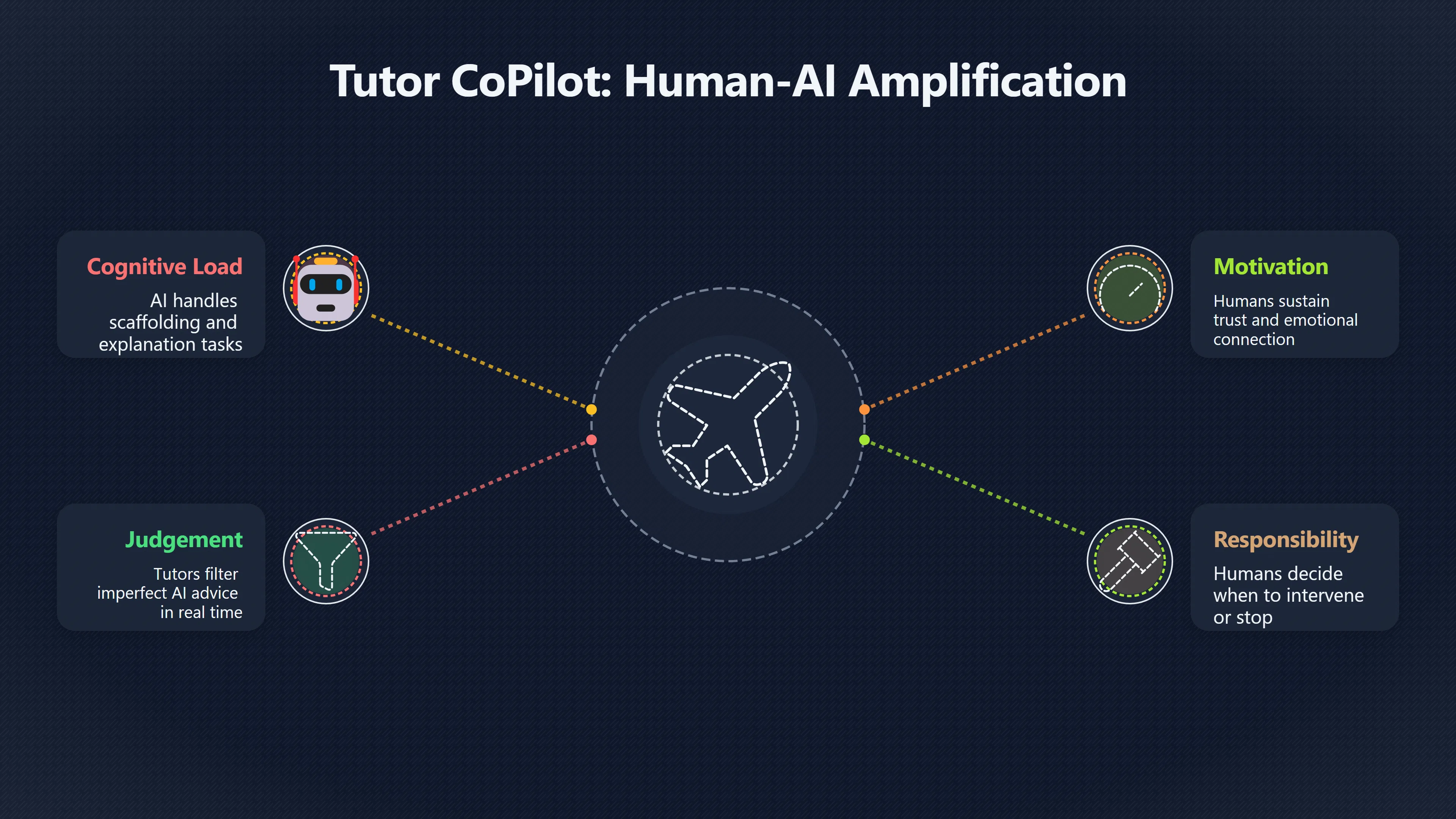
The most important lesson from Tutor CoPilot is not that AI can tutor on its own. It is that some of the most valuable parts of tutoring still depend on human judgement, trust and motivation. In the Stanford-led Tutor CoPilot trial, AI improved outcomes when it acted as a real-time assistant to human tutors rather than replacing them. The system helped tutors ask better questions, give more useful hints and avoid revealing answers too quickly, but human tutors still carried responsibility for understanding the student, building rapport and deciding when AI suggestions made sense.[arXiv]arxiv.orgarXiv Tutor Co Pilot: A Human-AI Approach for Scaling Real-Time ExpertiseTutor CoPilot: A Human-AI Approach for Scaling Real-Time ExpertiseOctober 3, 2024…
 This distinction matters well beyond one tutoring programme. As AI becomes more capable, a central question for the broader AI bloom vision is whether advanced systems will mostly replace human expertise or make it more abundant. Tutor CoPilot offers evidence for an amplification model: AI handles parts of the cognitive workload while humans provide motivation, judgement, context and responsibility. That combination may prove more powerful than either humans or AI working alone.[arXiv]arxiv.orgarXiv Tutor Co Pilot: A Human-AI Approach for Scaling Real-Time ExpertiseTutor CoPilot: A Human-AI Approach for Scaling Real-Time ExpertiseOctober 3, 2024…
Why motivation and trust still matter in tutoring
One of the oldest findings in education research is that learning is not only a matter of information transfer. Students often know less because they are discouraged, distracted, anxious, embarrassed or convinced they are “bad” at a subject. A tutor’s job frequently involves changing those beliefs as much as explaining content.
Current AI systems can simulate encouragement, but they do not genuinely participate in a social relationship. Human tutors can notice subtle signs of frustration, boredom, embarrassment or loss of confidence and respond in ways that draw on shared history, emotional understanding and personal knowledge of the student.
This matters especially for students who have repeatedly struggled in school. A learner who has experienced failure may not need another explanation of fractions or algebra. They may need someone who can recognise when they are close to giving up and persuade them to keep trying.
Researchers involved in Tutor CoPilot found that the AI could help tutors adopt more effective teaching strategies, but interviews also highlighted the continuing importance of human interpretation and adaptation during lessons. The system could suggest actions, but tutors remained responsible for understanding what the student actually needed.[arXiv]arxiv.orgarXiv Tutor Co Pilot: A Human-AI Approach for Scaling Real-Time ExpertiseTutor CoPilot: A Human-AI Approach for Scaling Real-Time ExpertiseOctober 3, 2024…
The same theme appears across broader discussions of AI education. Even advocates of AI tutors frequently argue that motivation, persistence and relationship-building remain areas where humans retain significant advantages.[WIRED]wired.comAI Can't Replace Teaching, but It Can Make It BetterDeveloped by Satya Nitta, Origin integrates AI to help with summoning educational resources and answering student queries quickly and acc…
The difference between explanation and encouragement
A useful way to understand the distinction is that tutoring involves at least two separate functions:
- helping students understand material;
- helping students continue trying when understanding is difficult.
AI is increasingly capable at the first task. The second remains harder.
A student who receives a mathematically correct explanation may still disengage. Human tutors can adjust tone, humour, pacing and expectations in response to an individual’s emotional state. They can remember previous struggles and successes. They can express confidence in a student’s ability in ways that feel socially meaningful rather than procedurally generated.
This is one reason many educators worry that replacing human interaction entirely could reduce some of the motivational benefits that make tutoring effective in the first place.[The Guardian]theguardian.comTwo-thirds of respondents observed a decline in thinking abilities among students, with some noting reliance on voice-to-text tools dimin…
How humans filtered imperfect AI advice
One of the most revealing findings from Tutor CoPilot is that the AI did not need to be perfect to be useful.
The system generated suggestions during live tutoring sessions, but tutors were not required to follow them. Instead, they acted as filters. They could ignore weak advice, adapt useful suggestions or combine them with their own judgement.
This human filtering role is easy to overlook, but it may be one of the most important features of successful educational AI.
Tutor interviews reported cases where Tutor CoPilot generated suggestions that were not appropriate for a student’s grade level or specific situation. Human tutors could recognise those errors and choose not to use them.[arXiv]arxiv.orgarXiv Tutor Co Pilot: A Human-AI Approach for Scaling Real-Time ExpertiseTutor CoPilot: A Human-AI Approach for Scaling Real-Time ExpertiseOctober 3, 2024…
Without that layer of judgement, mistakes become much more dangerous. Large language models can produce plausible but incorrect explanations, misunderstand student intent or recommend teaching strategies that do not fit the learner. Human tutors provide a safety mechanism that catches many of these failures before they affect the student.
In practice, this means the tutor’s role changes rather than disappears. Instead of generating every explanation from scratch, the tutor increasingly becomes:
- an evaluator of AI suggestions;
- a translator between AI output and student needs;
- a quality-control layer;
- a decision-maker responsible for the overall learning process.
The Tutor CoPilot results suggest that this filtering function is especially valuable for less-experienced tutors. The AI supplied ideas and pedagogical guidance, while the human remained responsible for deciding how and when to apply them. Students working with lower-rated tutors benefited particularly strongly from the system, suggesting that AI can narrow expertise gaps without eliminating the need for human judgement.[arXiv]arxiv.orgarXiv Tutor Co Pilot: A Human-AI Approach for Scaling Real-Time ExpertiseTutor CoPilot: A Human-AI Approach for Scaling Real-Time ExpertiseOctober 3, 2024…
Human tutors still understand context in ways AI often misses
A recurring weakness of current AI tutors is that they often operate within a narrow conversational window. They may track the immediate discussion effectively while missing broader contextual information that experienced human tutors naturally incorporate.
For example, a human tutor may know that:
- a student is exhausted after a difficult week;
- family circumstances are affecting concentration;
- confidence has collapsed after a poor test result;
- previous misconceptions continue to influence current mistakes;
- a particular explanation style has repeatedly worked in the past.
Humans routinely integrate these contextual signals into instructional decisions.
Research comparing human tutoring dialogues with AI-generated tutoring conversations suggests that human tutors still produce more diverse and cognitively guided interactions. Human sessions tend to revolve around richer cycles of questioning, feedback and student reasoning, whereas AI-generated tutoring can drift towards simplified explanation and information transfer.[arXiv]arxiv.orgarXiv Tutor Co Pilot: A Human-AI Approach for Scaling Real-Time ExpertiseTutor CoPilot: A Human-AI Approach for Scaling Real-Time ExpertiseOctober 3, 2024…
That difference matters because learning often depends on diagnosing why a student is confused, not merely identifying that confusion exists.
An AI may notice an incorrect answer. A human tutor may recognise that the answer reflects a particular misconception, emotional hesitation or pattern of reasoning that has appeared many times before.
Why responsibility remains a human role
Education is not merely a technical optimisation problem. Decisions about what students should learn, how quickly they should progress, when to intervene and what constitutes genuine understanding involve value judgements as well as factual ones.
Tutor CoPilot was deliberately designed around this principle. The AI offered recommendations, but responsibility remained with the tutor.[arXiv]arxiv.orgarXiv Tutor Co Pilot: A Human-AI Approach for Scaling Real-Time ExpertiseTutor CoPilot: A Human-AI Approach for Scaling Real-Time ExpertiseOctober 3, 2024…
This arrangement reflects a broader pattern likely to appear across many AI-supported professions. The most effective systems may not be those that remove humans entirely but those that keep humans accountable for important decisions while giving them stronger tools.
In tutoring, accountability includes questions such as:
- Is the student truly understanding the material?
- Is the learner becoming over-dependent on hints?
- Is the pace appropriate?
- Are short-term gains coming at the expense of deeper learning?
These judgements often require balancing competing goals rather than simply selecting a correct answer.
Evidence from other AI tutoring studies reinforces this concern. Some research has found that students using generative AI can perform better during assisted practice yet worse on independent assessments, suggesting that apparent learning gains may sometimes conceal dependence on the tool.[Axios]axios.comWhy AI is no substitute for human teachersThis challenges the optimistic vision of AI as a "personal tutor for every student." Although genAI, like Khan Academy’s experimental Kha…
Human tutors are often better positioned to recognise that distinction.

The case for amplification over replacement
The larger significance of Tutor CoPilot is that it offers a different vision of educational AI from the common narrative of full automation.
The conventional replacement story asks whether AI can become as good as a tutor.
The amplification story asks whether AI can help ordinary tutors perform more like expert tutors.
Those are different questions, and they lead to different institutional designs.
Tutor CoPilot’s strongest gains appeared among less-effective tutors, suggesting that AI may be particularly useful for spreading expertise rather than eliminating human involvement.[arXiv]arxiv.orgarXiv Tutor Co Pilot: A Human-AI Approach for Scaling Real-Time ExpertiseTutor CoPilot: A Human-AI Approach for Scaling Real-Time ExpertiseOctober 3, 2024…
For the broader AI bloom perspective, this may be an important pattern. If advanced AI can make expert guidance far more abundant, society may not need to choose between scarce human expertise and fully autonomous systems. Instead, millions of people could gain access to AI-supported versions of high-quality mentorship, coaching and instruction.
In that world, the human contribution does not disappear. It becomes more focused on areas where people still add unique value:
- building trust;
- sustaining motivation;
- exercising judgement under uncertainty;
- interpreting context;
- taking responsibility for outcomes;
- helping learners develop identity, confidence and ambition.
AI handles more of the cognitive scaffolding. Humans concentrate more on the relational and strategic dimensions of learning.
What this suggests about AI and human flourishing
Tutor CoPilot is a small educational experiment, but it points towards a broader question running through debates about AI abundance and long-term human flourishing.
The strongest applications of advanced AI may not always be those that remove humans from the loop. In many domains, the greatest gains could come from making human capabilities more abundant.
A world with vastly more access to expert-level guidance could expand educational opportunity, accelerate skill development and help more people reach levels of competence that previously required years of specialised mentoring. But the Tutor CoPilot results suggest that such systems may work best when humans remain central rather than peripheral.
The lesson is not that AI cannot teach. It is that teaching involves more than delivering information. Human tutors continue to contribute motivation, trust, context and responsibility. AI can strengthen those relationships by making expertise easier to access, but the evidence so far suggests that the relationship itself still matters.[arXiv]arxiv.orgarXiv Tutor Co Pilot: A Human-AI Approach for Scaling Real-Time ExpertiseTutor CoPilot: A Human-AI Approach for Scaling Real-Time ExpertiseOctober 3, 2024…[National Student Support Accelerator]nssa.stanford.eduNational Student Support AcceleratorTutor CoPilot: A Human-AI Approach for Scaling Real-Time…by RE Wang · Cited by 117 — Tutor CoPilot…
Amazon book picks
Further Reading
Books and field guides related to What human tutors still do better. Use these as the next step if you want deeper reading beyond the article.
Why Don't Students Like School?
Explains motivational and cognitive factors in learning.
eBay marketplace picks
Marketplace Samples
Example marketplace items related to this page. Use the search link to explore similar finds on eBay.


Endnotes
1.
Source: arxiv.org
Title: arXiv [Tutor Co Pilot]({{ ‘tutor-co-pilot/’ | relative_url }}): A Human-AI Approach for Scaling Real-Time Expertise
Link:https://arxiv.org/abs/2410.03017
Source snippet
Tutor CoPilot: A Human-AI Approach for Scaling Real-Time ExpertiseOctober 3, 2024...
Published: October 3, 2024
2.
Source: nssa.stanford.edu
Link:https://nssa.stanford.edu/sites/default/files/Tutor_CoPilot.pdf
Source snippet
National Student Support AcceleratorTutor CoPilot: A Human-AI Approach for Scaling Real-Time...by RE Wang · Cited by 117 — Tutor CoPilot...
3.
Source: wired.com
Title: AI Can’t Replace Teaching, but It Can Make It Better
Link:https://www.wired.com/story/what-aspects-of-teaching-should-remain-human
Source snippet
Developed by Satya Nitta, Origin integrates AI to help with summoning educational resources and answering student queries quickly and acc...
4.
Source: arxiv.org
Link:https://arxiv.org/abs/2509.01914
Source snippet
How Real Is AI Tutoring? Comparing Simulated and Human Dialogues in One-on-One InstructionSeptember 2, 2025...
Published: September 2, 2025
5.
Source: edunlp.stanford.edu
Title: tutor copilot
Link:https://edunlp.stanford.edu/projects/tutor-copilot
Source snippet
CoPilot - EduNLP Lab - Stanford UniversityOct 31, 2024 — Tutor CoPilot is an AI system designed to provide expert-level guidance to tutor...
6.
Source: axios.com
Title: Why AI is no substitute for human teachers
Link:https://www.axios.com/2024/08/15/ai-tutors-learning-education-khan-academy-wharton
Source snippet
This challenges the optimistic vision of AI as a "personal tutor for every student." Although genAI, like Khan Academy’s experimental Kha...
7.
Source: nssa.stanford.edu
Title: In a randomized controlled trial
Link:https://nssa.stanford.edu/studies/tutor-copilot-human-ai-approach-scaling-real-time-expertise
Source snippet
CoPilot: A Human-AI Approach for Scaling Real-Time...Dec 15, 2024 — We introduce Tutor CoPilot, a Human-AI system that models expert thi...
8.
Source: scale.stanford.edu
Link:https://scale.stanford.edu/publications/tutor-copilot-human-ai-approach-scaling-real-time-expertise
Source snippet
CoPilot: A Human-AI Approach for Scaling Real-Time...17 Nov 2025 — We introduce Tutor CoPilot, a Human-AI system that models expert thin...
9.
Source: theguardian.com
Link:https://www.theguardian.com/technology/2026/apr/02/pupils-england-losing-thinking-skills-because-of-ai-survey
Source snippet
Two-thirds of respondents observed a decline in thinking abilities among students, with some noting reliance on voice-to-text tools dimin...
Additional References
10.
Source: jsaer.com
Link:https://jsaer.com/download/vol-11-iss-7-2024/JSAER2024-11-7-152-158.pdf
Source snippet
AI Tutors vs Human TeachersHuman interaction can be engaging; class dynamics matter. Students often report higher motivation with AI tuto...
11.
Source: povertyactionlab.org
Link:https://www.povertyactionlab.org/evaluation/human-ai-cooperation-improve-tutoring-united-states
Source snippet
Human-AI Cooperation to Improve Tutoring in the United...The researchers introduced Tutor CoPilot, an AI program designed to improve edu...
12.
Source: overdeck.org
Link:https://overdeck.org/portfolios/spotlight/nssa-tutor-copilot-a-human-ai-approach-for-scaling-real-time-expertise/
Source snippet
NSSA – Tutor CoPilot: A Human-AI Approach for Scaling...Project Description: This study uses an RCT to estimate the impacts of Tutor CoP...
13.
Source: medium.com
Link:https://medium.com/syncedreview/sandford-us-tutor-copilot-transforms-real-time-tutoring-with-ai-driven-expert-guidance-b2a7cf5d5c18
Source snippet
Sandford U's Tutor CoPilot Transforms Real-Time...A Stanford University research team presents Tutor CoPilot, a new model that offers ex...
14.
Source: linkedin.com
Link:https://www.linkedin.com/pulse/stanford-tutor-copilot-human-ai-approach-scaling-real-time-expertise-bx7me
Source snippet
Stanford: Tutor CoPilot – A Human-AI Approach for Scaling...This paper describes the development and evaluation of Tutor CoPilot, a huma...
15.
Source: overdeck.org
Link:https://overdeck.org/research-repository/tutoring/tutor-copilot-a-human-ai-approach-for-scaling-real-time-expertise/
Source snippet
Tutor CoPilot: A Human-AI Approach for Scaling Real-Time...This study uses an RCT to estimate the impacts of Tutor CoPilot—a novel human...
16.
Source: themoonlight.io
Link:https://www.themoonlight.io/en/review/tutor-copilot-a-human-ai-approach-for-scaling-real-time-expertise
Source snippet
[Literature Review] Tutor CoPilot: A Human-AI Approach...The results demonstrate a significant potential for Human-AI systems like Tutor...
17.
Source: edworkingpapers.com
Link:https://edworkingpapers.com/sites/default/files/ai24_1054_v2.pdf
Source snippet
AI-generated guidance—based on expert thinking—can significantly improve tutoring quality, particularly for less experienced...Read more...
18.
Source: researchgate.net
Title: 384680722 Tutor CoPilot A Human AI Approach for Scaling Real Time Expertise
Link:https://www.researchgate.net/publication/384680722_Tutor_CoPilot_A_Human-AI_Approach_for_Scaling_Real-Time_Expertise
Source snippet
(PDF) Tutor CoPilot: A Human-AI Approach for Scaling...3 Oct 2024 — This study is the first randomized controlled trial of a Human-AI sy...
19.
Source: estha.ai
Title: ai tutors vs human tutors complete cost and effectiveness comparison
Link:https://estha.ai/blog/ai-tutors-vs-human-tutors-complete-cost-and-effectiveness-comparison/
Source snippet
AI Tutors vs Human Tutors: Complete Cost and...18 May 2026 — In this comprehensive analysis, we'll examine the real costs of both AI and...
Published: May 2026
Topic Tree