Within Interaction Safety
The safety checklist robots cannot skip
Robot safety standards matter most when they are turned into task-specific checks of tools, work cycles, sensors and human roles.
On this page
- What standards require before collaboration begins
- How task based assessment finds hidden hazards
- Training workers for real shared workspace conditions
Page outline Jump by section
Introduction
Robot safety standards are often described as if they were fixed rules built into a machine. In practice, the most important safety question is not whether a robot meets a standard in isolation, but whether a specific task can be performed safely by a particular robot, tool and worker in a real workplace.
 That is why modern robot safety increasingly depends on task-based assessment. International standards such as ISO 10218 and ISO/TS 15066 do not simply ask whether a robot is certified. They require organisations to examine the exact job being performed: the robot’s movements, the end-of-arm tooling, the materials being handled, the surrounding workspace, the workers involved and the ways people and machines may unexpectedly interact.[ISO]iso.orgISO 10218-2:2025(en), Robotics — Safety requirementsThis document has been created in recognition of the hazards that are presented by…[ISO]iso.orgISO/TS 15066:2016 - Robots and robotic devicesISO/TS 15066:2016 specifies safety requirements for collaborative industrial robot syste…
This approach matters far beyond regulatory compliance. If advanced robotics is to help remove dangerous, exhausting and repetitive labour—a major part of the broader vision of AI-enabled abundance and human flourishing—people must be able to trust that shared workspaces are genuinely safe. Task-based assessment is the mechanism that turns abstract safety principles into practical protections.
The safety checklist robots cannot skip
A common misunderstanding is that collaborative robots, often called cobots, are automatically safe because they are designed to work near people.
Safety specialists generally reject that idea. A robot that is safe in one application may be unsafe in another. The same machine might gently pass components to a worker in one factory, yet create serious hazards if equipped with a sharp tool, a welding attachment, a heavy gripper or a fast-moving payload in another setting. Standards therefore focus on the entire robotic application, not only the robot itself. ScienceDirect[AMD Machines]amdmachines.comrobot safety standards iso 10218 and ts 15066 explainedISO 10218 & ISO/TS 15066 Explained: Robot Safety…Jan 10, 2026 — It covers the safety requirements for the complete robotic system — th…
Modern robot standards treat safety as a system property. Assessors must consider:[cobotsuk.com]cobotsuk.comunderstanding iso10218 2025 robot safety standardsUnderstanding ISO10218:2025 Robot Safety StandardsMar 27, 2026 — The standards now spell out how to safely use the robot's tools (the gri…
- The robot arm and control software.
- End effectors such as grippers, cutters or welding tools.
- Workpieces being moved.
- Conveyor systems and fixtures.
- Human access points.
- Maintenance procedures.
- Emergency stops and safety sensors.
- Normal operation, faults and foreseeable misuse. ISO[AMD Machines]amdmachines.comrobot safety standards iso 10218 and ts 15066 explainedISO 10218 & ISO/TS 15066 Explained: Robot Safety…Jan 10, 2026 — It covers the safety requirements for the complete robotic system — th…
This is why a robot’s technical certification is only the starting point. The larger question is how that robot behaves while carrying out a specific task alongside humans.
What standards require before collaboration begins
The major industrial robot standards require risk assessment before systems are commissioned and deployed. ISO 10218 covers safety requirements for industrial robot systems, while ISO/TS 15066 expands guidance for collaborative workspaces where humans and robots share operating areas.[ISO]iso.orgRobots and humans can work together with new…Mar 8, 2016 — ISO/TS 15066 provides guidelines for the design and implementation of a col…[ISO]iso.orgInternational Organization for StandardizationISO is an independent, non-governmental international organization. It brings global…
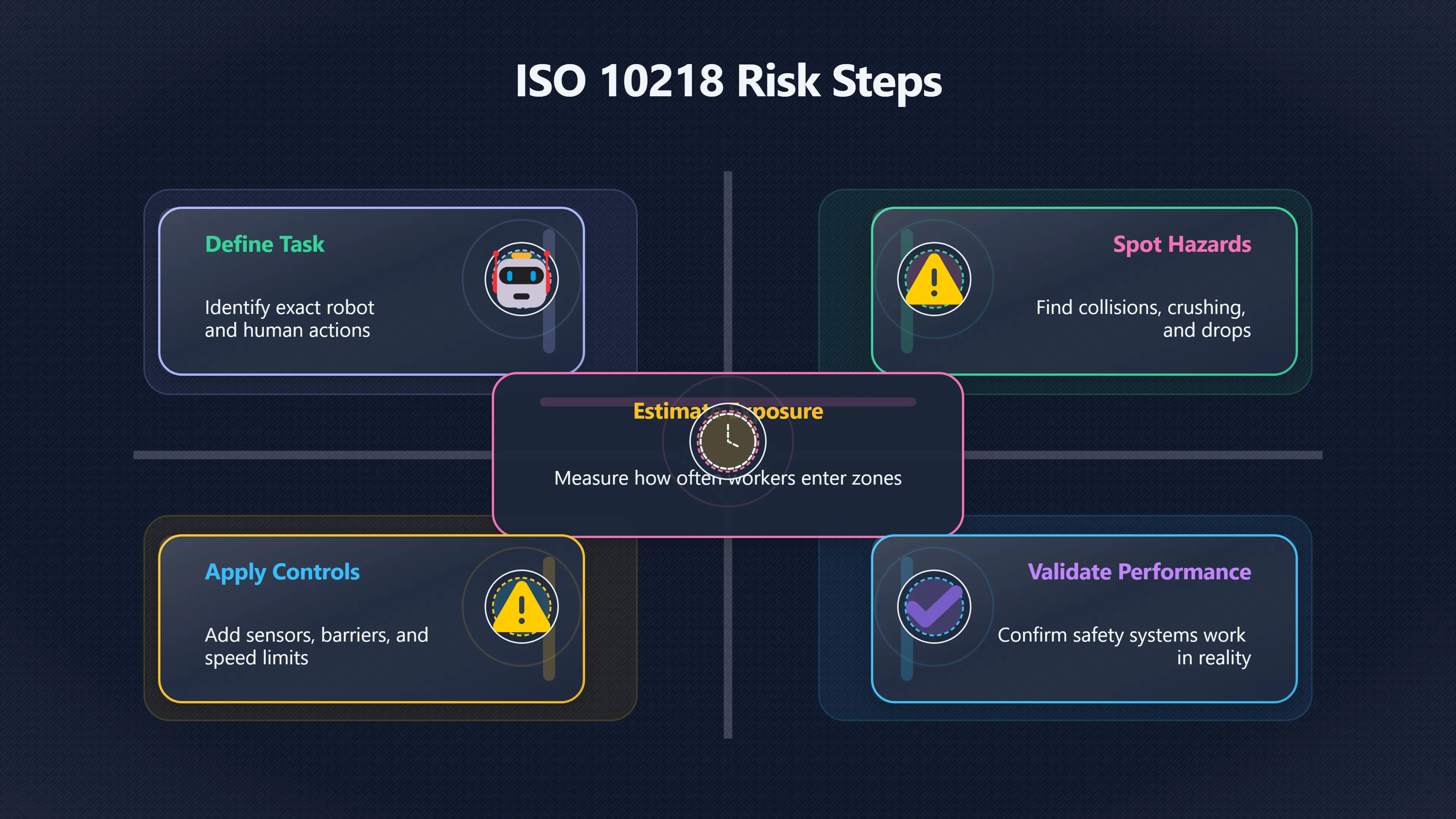
Before collaborative work begins, organisations are expected to identify hazards, estimate risks and implement safeguards appropriate to the application. The process normally includes:
- Defining the task – understanding exactly what the robot and human workers will do.
- Identifying hazards – including collision risks, crushing points, dropped objects, sharp tools and unexpected motion.
- Estimating exposure – assessing how often workers enter hazardous zones and how close interactions occur.
- Applying controls – adding sensors, barriers, speed limits, force limits or redesigned workflows.
- Validating performance – confirming that safety systems actually work under real operating conditions. ScienceDirect 2ISO
Recent revisions of ISO 10218 place even greater emphasis on application-level assessment and validation, reflecting the growing complexity of human–robot collaboration. The Robot Report Automate The logic is straightforward: workers are injured by concrete situations, not by abstract categories. A risk assessment therefore has to examine the actual situations people will encounter.
How task-based assessment finds hidden hazards
Many serious hazards only become visible when assessors examine a complete work cycle.
Consider a robot programmed to move slowly while a worker is nearby. At first glance, this appears safe. A task-based assessment may nevertheless uncover problems such as:
- A heavy metal part slipping from the gripper.
- A worker reaching unexpectedly into the robot’s path.
- A blind spot where sensors cannot reliably detect a person.
- Finger trapping between a workpiece and a fixture.
- Maintenance activities that bypass normal safety controls.
- A robot accelerating after a sensor briefly loses track of a worker. Universal Robots ScienceDirect
These risks often arise from interactions between components rather than from any single machine failure.
Research on human–robot collaboration has repeatedly found that collaborative environments create more complex risk profiles than traditional fenced industrial robots. Assessments based solely on checklists or generic assumptions can miss important interactions between workers, tools and automated systems. ScienceDirect 2ScienceDirect
This complexity increases as AI systems become better at adapting to changing environments. A robot that can alter routes, optimise workflows or respond dynamically to human behaviour may improve productivity, but it also creates more situations that need careful evaluation and monitoring.

Why the tool matters as much as the robot
A striking feature of robot safety standards is how much attention they pay to tooling.
A robot arm may have limited force and speed, yet the attached tool can introduce entirely different risks. A polishing attachment creates different hazards from a welding torch. A vacuum gripper creates different hazards from a mechanical clamp. A robot carrying a fragile glass panel presents different dangers from one carrying a cardboard box.
Recent guidance increasingly highlights end effectors, loading operations and handling procedures because many injuries arise from the interaction between tools, workpieces and human workers rather than from the robot arm alone. Iteh Standards 2CobotKind
This is one reason collaborative robotics has evolved away from simplistic claims that a robot can be labelled inherently safe. Safety depends on the entire application and the specific task being performed. ScienceDirect 2Cobots & Machinery Safety
Measuring distance, speed and contact in the real world
Collaborative robot standards define several operating modes designed to reduce risk. These include speed-and-separation monitoring, safety-rated monitored stops and power-and-force limiting approaches. ISO
Yet implementing these modes requires practical measurement.
For example, a factory using speed-and-separation monitoring must determine:
- How quickly sensors detect a person.
- How fast the robot can stop.
- How close workers may approach.
- Whether the workspace contains obstacles that interfere with detection.
- How different body positions affect visibility. Automate
Similarly, power-and-force limiting systems rely on biomechanical limits intended to reduce injury risk if contact occurs. But those limits must be assessed against the actual contact scenario. A brief contact with an arm may present different risks from sustained pressure against a hand, shoulder or head. Researchers have noted that interpreting collision scenarios can be difficult and that different assessments may reach different conclusions if contact conditions are not carefully analysed. ScienceDirect
Task-based assessment therefore functions as a reality check. It tests whether theoretical safety mechanisms remain effective under workplace conditions.
Training workers for real shared-workspace conditions
Even the best technical safeguards can fail if workers do not understand how the system behaves.
Training in collaborative environments differs from traditional machine-safety training because workers are expected to share space with automation rather than simply stay away from it. They need to understand:
- Robot operating zones.
- Expected movement patterns.
- Sensor limitations.
- Emergency stop procedures.
- Restart sequences after interruptions.
- Safe maintenance and troubleshooting practices.
-
How to recognise unusual robot behaviour. [OSH Wiki](#endnote-27 “Snippet: OSH WikiCollaborating robots - OSHwiki European Agency for Safety…Sep 30, 2013 — EN ISO 10218-1:2011 describes how safe robots may b…”) 2BAuA
Task-based assessment helps shape this training. Instead of teaching generic rules, organisations can prepare workers for the exact situations they are likely to encounter.
For example, a warehouse employee collaborating with mobile robots faces different risks from a technician working beside a robotic welding station. The training must reflect the realities of the task rather than a broad description of robotics.
This also affects psychological safety. Workers who understand how a robot senses, stops and responds are more likely to trust the system appropriately. Uncertainty about robot behaviour can create stress, hesitation or unsafe workarounds even when technical safeguards are present.
Why this matters for an AI-enabled future
One of the strongest arguments for advanced robotics is that machines could increasingly take over dangerous, repetitive, physically exhausting or unhealthy work. Factories, warehouses, hospitals, farms, construction sites and logistics networks could become safer while allowing people to focus more on supervision, creativity, problem-solving and care-oriented tasks.
But this outcome is not automatic.
The history of industrial technology shows that productivity gains alone do not guarantee safe workplaces. The benefits depend on implementation choices, organisational culture, regulation and continuous assessment. Collaborative robots can reduce exposure to lifting injuries, hazardous substances and repetitive strain, yet they can also introduce new forms of risk if deployment outpaces safety practice. ScienceDirect 3EU-OSHA 3EU-OSHA
Task-based assessment is therefore more than a compliance exercise. It is one of the practical institutions that allows advanced automation to expand without treating human workers as an afterthought. As AI-driven robotics becomes more capable, the challenge is not merely building machines that can work alongside people. It is ensuring that every specific task, workflow and workplace has been examined closely enough that collaboration remains safe, predictable and worthy of trust.
Amazon book picks
Further Reading
Books and field guides related to The safety checklist robots cannot skip. Use these as the next step if you want deeper reading beyond the article.
Introduction to Robotics
Explains robot mechanics and control needed to understand task-level risk assessment.
Robotics, Vision and Control
Covers sensing, control and implementation issues behind safe robotic tasks.
The Checklist Manifesto
Supports the page’s emphasis on structured risk assessment and checklists before high-stakes work.
Human + Machine
Shows why work redesign and human-machine roles matter alongside technical safety checks.
eBay marketplace picks
Marketplace Samples
Example marketplace items related to this page. Use the search link to explore similar finds on eBay.


Endnotes
1.
Source: iso.org
Link:https://www.iso.org/obp/ui/en/
Source snippet
ISO 10218-2:2025(en), Robotics — Safety requirementsThis document has been created in recognition of the hazards that are presented by...
2.
Source: iso.org
Link:https://www.iso.org/standard/62996.html
Source snippet
ISO/TS 15066:2016 - Robots and robotic devicesISO/TS 15066:2016 specifies safety requirements for collaborative industrial robot syste...
3.
Source: cdn.standards.iteh.ai
Link:https://cdn.standards.iteh.ai/samples/73934/3578b7f9a402489fb9af1cf1ca03ea68/ISO-10218-2-2025.pdf
Source snippet
Iteh StandardsISO 10218-2:20254.3.2 Risk assessment for contacts between moving parts of the robot application... 5.9.5 End-effectors an...
4.
Source: sciencedirect.com
Link:https://www.sciencedirect.com/science/article/pii/S2590123026015203
Source snippet
2025)...by D Hartmann · 2026 — Implication: Emphasizes that safety is determined not by the robot alone, but by the overall risk assessm...
5.
Source: automate.org
Title: updated iso 10218 faq
Link:https://www.automate.org/robotics/blogs/updated-iso-10218-faq
Source snippet
Updated ISO 10218 | Answers to Frequently Asked...Mar 20, 2025 — ISO 10218 is the foundational safety standard for industrial robots, pr...
6.
Source: osha.gov
Link:https://www.osha.gov/otm/section-4-safety-hazards/chapter-4
Source snippet
OSHA Technical Manual (OTM) - Section IV: Chapter 4This chapter is intended as a guide to robot systems found in industrial applications...
7.
Source: sciencedirect.com
Link:https://www.sciencedirect.com/science/article/abs/pii/S0925753521001338
Source snippet
Risk assessment tools for industrial human-robot...by TP Huck · 2021 · Cited by 88 — According to the standard ISO 10218–2...
8.
Source: universal-robots.com
Link:https://www.universal-robots.com/manuals/EN/HTML/SW5_21/Content/prod-cable40m/risk_assessment.htm
Source snippet
Universal RobotsRisk AssessmentJoint, elbow and tool/end effector position limiting: Used to reduce risks associated with certain body pa...
9.
Source: sciencedirect.com
Link:https://www.sciencedirect.com/science/article/abs/pii/S0360835221007312
Source snippet
Identification and classification of risk factors for human-...by N Berx · 2022 · Cited by 127 — This paper identifies and classifies th...
10.
Source: sciencedirect.com
Link:https://www.sciencedirect.com/science/article/pii/S0925753520302290
Source snippet
A review of the ISO 15066 standard for collaborative robot...by P Chemweno · 2020 · Cited by 166 — This article reviews req...
11.
Source: iso.org
Link:https://www.iso.org/news/2016/03/Ref2057.html
Source snippet
Robots and humans can work together with new...Mar 8, 2016 — ISO/TS 15066 provides guidelines for the design and implementation of a col...
12.
Source: automate.org
Title: iso ts 15066 explained
Link:https://www.automate.org/robotics/tech-papers/iso-ts-15066-explained
Source snippet
Tech Papers: ISO/TS 15066 Explained | RobotiqMay 25, 2016 — ISO/TS 15066 provides guidelines for the design and implementation of...
Published: May 25, 2016
13.
Source: baua.de
Link:https://www.baua.de/EN/Service/Publications/Essays/article3735
Source snippet
more...
14.
Source: sciencedirect.com
Link:https://www.sciencedirect.com/science/article/pii/S0925753523002552
Source snippet
Occupational health and safety issues in human-robot...by A Giallanza · 2024 · Cited by 120 — Numerous safety concerns are open, and eit...
15.
Source: osha.europa.eu
Title: eurofound report explores impact robotic technologies eu workplaces
Link:https://osha.europa.eu/en/oshnews/eurofound-report-explores-impact-robotic-technologies-eu-workplaces
Source snippet
report explores the impact of robotic technologies...26 Jul 2024 — The 'Human–robot interaction: What changes in the workplace?' researc...
16.
Source: iso.org
Link:https://www.iso.org/home.html
Source snippet
International Organization for StandardizationISO is an independent, non-governmental international organization. It brings global...
17.
Source: iso.org
Link:https://www.iso.org/standard/73933.html
Source snippet
ISO 10218-1:2025 - Robotics — Safety requirementsISO 10218-1 is significant as it provides foundational safety guidelines that help mitig...
18.
Source: iso.org
Link:https://www.iso.org/obp/ui
Source snippet
ISO/DIS 10218-1.2(en), Robotics — Safety requirementsThe ISO 10218 series has been created in recognition of the particular hazards that...
19.
Source: sciencedirect.com
Link:https://www.sciencedirect.com/science/article/abs/pii/S0040162525000538
Source snippet
Mitigating safety challenges in human-robot collaborationby K Jung · 2025 · Cited by 13 — This study examines the impact of cobot adoptio...
20.
Source: baua.de
Link:https://www.baua.de/EN/Research/Research-projects/f2526
Source snippet
s and AI- based systems as well as needs for action, and recommendations for OSH...
21.
Source: osha.gov
Link:https://www.osha.gov/robotics/standards
Source snippet
ISO/TR 20218-1, Safety Design for End-effectors. Describes how an industrial robot system should handle and manage end-effectors (end...
22.
Source: universal-robots.com
Title: safety faq
Link:https://www.universal-robots.com/articles/ur/safety/safety-faq/
Source snippet
6 May 2026 — ISO 10218-1 is for robot manufacturers. It defines the safety requirements the robot itself must meet. Universal Robots cert...
Published: May 2026
23.
Source: amdmachines.com
Title: robot safety standards iso 10218 and ts 15066 explained
Link:https://amdmachines.com/blog/robot-safety-standards-iso-10218-and-ts-15066-explained/
Source snippet
ISO 10218 & ISO/TS 15066 Explained: Robot Safety...Jan 10, 2026 — It covers the safety requirements for the complete robotic system — th...
24.
Source: therobotreport.com
Title: iso 10218 industrial robot safety standard receives major overhaul
Link:https://www.therobotreport.com/iso-10218-industrial-robot-safety-standard-receives-major-overhaul/
Source snippet
The Robot ReportISO 10218 industrial robot safety standard receives major...Feb 18, 2025 — ISO 10218 is an international standard that o...
25.
Source: cobotsmachinerysafety.co.uk
Title: bot risk assessments
Link:https://www.cobotsmachinerysafety.co.uk/cobot-risk-assessments
Source snippet
. Key updates...Read more...
26.
Source: cobotsuk.com
Title: understanding iso10218 2025 robot safety standards
Link:https://www.cobotsuk.com/post/understanding-iso10218-2025-robot-safety-standards
Source snippet
Understanding ISO10218:2025 Robot Safety StandardsMar 27, 2026 — The standards now spell out how to safely use the robot's tools (the gri...
27.
Source: oshwiki.osha.europa.eu
Link:https://oshwiki.osha.europa.eu/en/themes/collaborating-robots
Source snippet
OSH WikiCollaborating robots - OSHwiki | European Agency for Safety...Sep 30, 2013 — EN ISO 10218-1:2011 describes how safe robots may b...
28.
Source: osha.europa.eu
Link:https://osha.europa.eu/en/highlights/assembly-lines-hospitals-8-case-studies-integrating-collaborative-robots-worker-safety-mind
Source snippet
EU-OSHA8 case studies on integrating collaborative robots with worker...30 May 2023 — EU-OSHA has analysed the use of robotics and Artif...
Published: May 2023
29.
Source: osha.europa.eu
Link:https://osha.europa.eu/en/themes/digitalisation-work/digitalisation-glossary
Source snippet
Safety and health at work EU-OSHACobot (collaborative robot). A type of robot designed to perform tasks in collaboration with workers i...
Additional References
30.
Source: nist.gov
Link:https://www.nist.gov/
Source snippet
National Institute of Standards and TechnologyNIST promotes U.S. innovation and industrial competitiveness by advancing measurement scien...
31.
Source: researchgate.net
Link:https://www.researchgate.net/publication/384924892_Safety_Evaluation_in_Human-Robot_Collaboration_Through_Risk_Assessment_Matrix_and_Observational_Measurements
Source snippet
Safety Evaluation in Human-Robot Collaboration Through...15 Oct 2024 — This paper highlights the design and implementation of a risk ass...
32.
Source: ul.com
Link:https://www.ul.com/resources/collaborative-robot-safety
Source snippet
Collaborative Robot SafetyCollaborative robots present unique risks and can cause serious injuries if they are not configured and program...
33.
Source: esteri.it
Link:https://www.esteri.it/en/temi/politica_europea/unione_europea/
Source snippet
European UnionThe house of Europe is built on solid foundations. A Parliament elected by universal suffrage ensures the Union's instituti...
34.
Source: machinesafetyspecialists.com
Link:https://www.machinesafetyspecialists.com/mastering-robot-safety-class/
Source snippet
Mastering Robot Safety ClassThis specialized training delivers a comprehensive overview of the latest safety standards for both collabora...
35.
Source: skillaibility.eu
Title: workplace safety in human robot collaborative environments
Link:https://skillaibility.eu/2025/05/05/workplace-safety-in-human-robot-collaborative-environments/
Source snippet
Workplace safety in human-robot collaborative environments5 May 2025 — These technologies are transforming how humans and machines intera...
Published: May 2025
36.
Source: nist.gov
Title: working and growing collaborative robots
Link:https://www.nist.gov/blogs/manufacturing-innovation-blog/working-and-growing-collaborative-robots
Source snippet
Working and Growing with Collaborative Robots | NISTFeb 22, 2019 — The American National Standards Institute (ANSI) adopted ISO/TS 15066...
37.
Source: ibf-solutions.com
Title: new standards for industrial robots en iso 10218 1 and 2
Link:https://www.ibf-solutions.com/en/seminars-and-news/news/new-standards-for-industrial-robots-en-iso-10218-1-and-2
Source snippet
New standards for industrial robots EN ISO 10218-1 and -2The new standards bring significant updates for the safety of industrial robots...
38.
Source: cobotsonline.co.uk
Title: collaborative robot safety understanding iso 10218 2025
Link:https://cobotsonline.co.uk/blog/collaborative-robot-safety-understanding-iso-10218-2025
Source snippet
The New Era of Collaborative Robot SafetyNov 14, 2025 — ISO 10218-2:2025: Focuses on the system integrator's responsibility for the compl...
39.
Source: roboticstomorrow.com
Title: safety for collaborative robots new isots 15066
Link:https://www.roboticstomorrow.com/article/2016/06/safety-for-collaborative-robots-new-isots-15066/8252
Source snippet
Safety for Collaborative Robots: New ISO/TS 15066Jun 2, 2016 — In order to make the introduction of a collaborative robot as safe as poss...
Topic Tree