Within GNo ME materials
What the first tests really prove
Early synthesis results show that some AI-predicted materials can be made, but they do not prove a direct path to abundance.
On this page
- What successful synthesis shows
- What validation still leaves unanswered
- Why abundance needs scale, not just samples
Page outline Jump by section
Introduction
The most important thing early GNoME validation proves is not that AI has already solved materials science. It proves something narrower, but still significant: AI-generated predictions can sometimes survive contact with physical reality.
 That matters because materials discovery has long suffered from a painful gap between theory and experiment. Researchers can generate huge numbers of hypothetical compounds on computers, but many never become real materials in a laboratory. GNoME’s early validation results suggest that at least some of its predicted crystal structures are not merely mathematical artefacts. They correspond to compounds that can actually exist.[Nature]nature.comScaling deep learning for materials discoveryby A Merchant · 2023 · Cited by 1833 — Concurrent to our discovery efforts, researcher…
For advocates of an AI-enabled scientific bloom, this is an encouraging signal. It suggests that advanced AI may help widen the search space of science and identify promising regions humans would otherwise miss. But the validation does not show that hundreds of thousands of useful materials are ready for industry, nor that abundance follows automatically from large prediction counts. The distance between a synthesised crystal and a civilisation-changing technology remains enormous.
What successful synthesis shows
The strongest evidence behind GNoME is not the headline figure of hundreds of thousands of predicted stable materials. It is the smaller set of cases where predictions were independently matched or physically created.
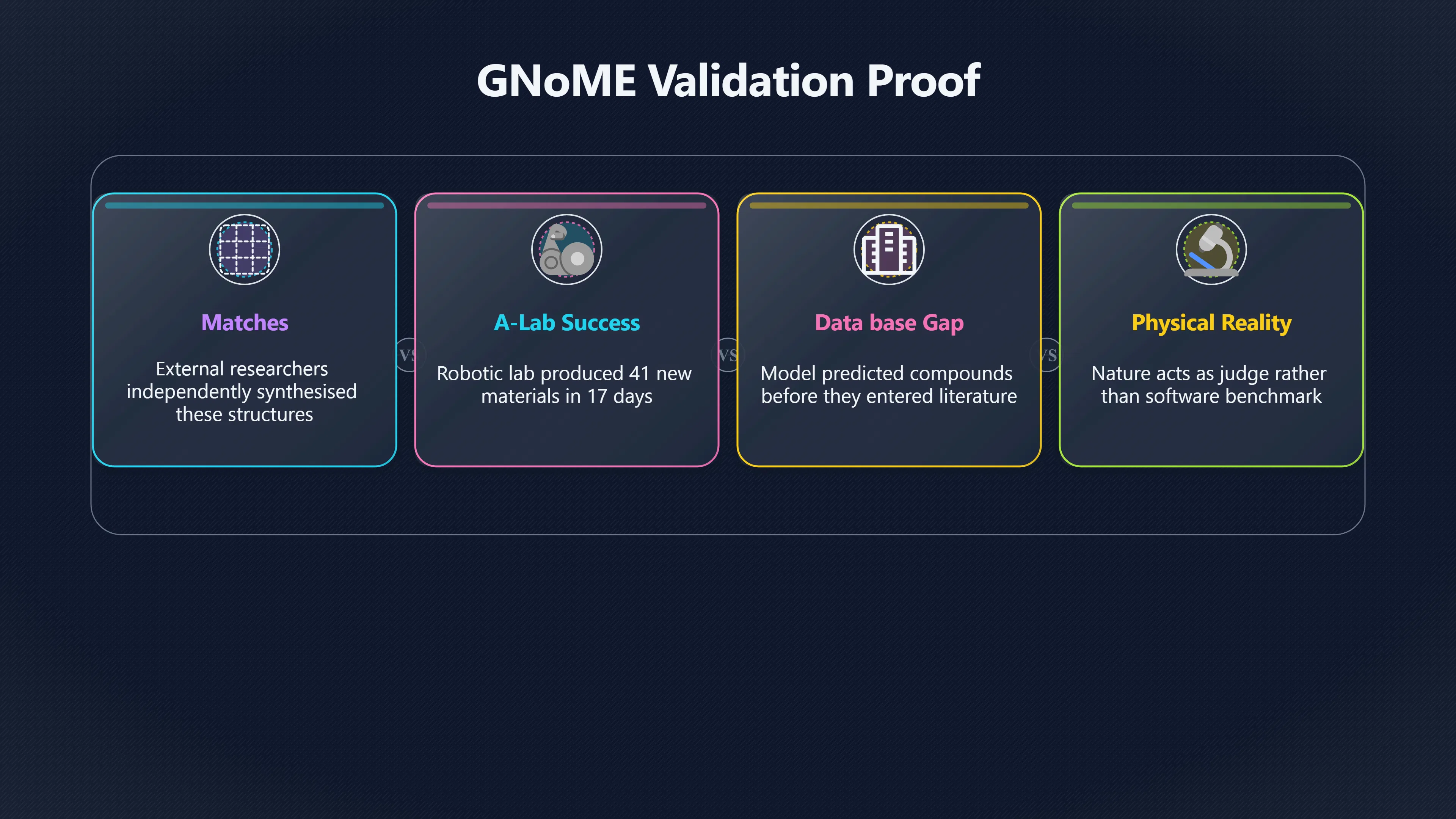
DeepMind reported that 736 structures predicted by GNoME were later found to match materials that experimental researchers had independently synthesised. Because the model was trained on database snapshots from before those discoveries entered the literature, these matches provide evidence that the system was identifying real regions of materials space rather than merely memorising known compounds.[Nature]nature.comAn autonomous laboratory for the accelerated synthesis of…Nov 29, 2023 — We introduce the A-Lab, an autonomous laboratory for th…
An even more concrete test came through collaboration with Berkeley Lab’s autonomous “A-Lab”. In one widely discussed experiment, the robotic laboratory attempted to synthesise 58 candidate materials and successfully produced 41 of them over 17 days. The result demonstrated that a substantial fraction of selected AI-guided targets could be realised experimentally. Nature[Berkeley Lab News Center]newscenter.lbl.govgoogle deepmind new compounds materials projectBerkeley Lab News CenterGoogle DeepMind Adds Nearly 400000 New Compounds to…Nov 29, 2023 — Over 17 days of independent operation, A-La…
These results support several important claims:
- AI can identify previously unknown crystal structures that appear physically achievable.
- Machine learning can help navigate an enormous search space that would be difficult for humans to explore manually.
- Automated laboratories can partially close the gap between computational prediction and experimental testing.
- Materials discovery may become more scalable than traditional trial-and-error approaches.[Nature]nature.comScaling deep learning for materials discoveryby A Merchant · 2023 · Cited by 1833 — Concurrent to our discovery efforts, researcher…[Nature]nature.comAn autonomous laboratory for the accelerated synthesis of…Nov 29, 2023 — We introduce the A-Lab, an autonomous laboratory for th…
For the broader AI bloom argument, this is the key signal. The significance is not any individual crystal. It is evidence that AI systems may increasingly function as engines for generating scientific hypotheses that can be validated in the physical world.
Why this is stronger than a simulation result
Many AI breakthroughs remain entirely digital. A model may perform well on benchmarks while never affecting the physical world.
Materials science is different because reality is unforgiving. A crystal either forms or it does not. Laboratory synthesis provides a harder test than many software benchmarks because nature itself acts as the judge.
This is why the A-Lab experiments attracted attention. They were not simply checking whether GNoME agreed with another computer model. They were testing whether matter would organise itself into the predicted structures under real experimental conditions.[Nature]nature.comAn autonomous laboratory for the accelerated synthesis of…Nov 29, 2023 — We introduce the A-Lab, an autonomous laboratory for th…
That does not mean every successful synthesis validates all of GNoME’s predictions. But it does provide evidence that the overall approach is grounded in genuine physical regularities. The model appears to have learned something useful about which atomic arrangements can exist as stable materials.[Nature]nature.comAn autonomous laboratory for the accelerated synthesis of…Nov 29, 2023 — We introduce the A-Lab, an autonomous laboratory for th…
In that sense, early validation resembles what AlphaFold achieved for protein structures. The important milestone is not that every prediction immediately becomes a medical breakthrough. It is that AI demonstrates a reliable ability to uncover real structures that were previously unknown or difficult to identify.
What validation still leaves unanswered
The most common mistake is to treat successful synthesis as proof of usefulness.
A material can exist without being valuable.
Many predicted compounds may have no commercially important properties. Others may perform worse than existing materials. Some may be impossible to manufacture economically at scale. Others may require rare elements, difficult processing methods or extreme conditions that limit practical deployment.[WIRED]wired.comGoogle Deep Mind's AI Dreamed Up 380,000 New MaterialsThe Next Challenge Is Making ThemGoogle DeepMind developed an AI program, GNoME, which has predicted 380,000 new stable materials, expand…
Even when a material has promising characteristics, researchers must answer additional questions:
- Does it outperform current alternatives?
- Can it be manufactured reliably?
- Is it stable under real operating conditions?
- Can it integrate into existing industrial systems?
- Is it affordable?
- Are the required raw materials available in sufficient quantities?
Battery research provides a useful example. A crystal might appear to have excellent ion-conducting properties on paper. Yet it may react badly with neighbouring materials, degrade rapidly or create manufacturing challenges that make commercial use impractical.[WIRED]wired.comGoogle Deep Mind's AI Dreamed Up 380,000 New MaterialsThe Next Challenge Is Making ThemGoogle DeepMind developed an AI program, GNoME, which has predicted 380,000 new stable materials, expand…
This is why many materials scientists welcomed GNoME while simultaneously warning against overinterpretation. Predicting stability is an important step, but it is only one step in a much longer chain of discovery, optimisation and deployment.[ACS Publications]pubs.acs.orgPublications Artificial Intelligence Driving Materials Discovery?AK Cheetham · 2024 · Cited by 164 — The tools of artificial intelligence and machine learning (AI/ML) to propose new co…
The deeper bottleneck: synthesisable versus merely stable
One lesson emerging from follow-up research is that “stable” and “synthesisable” are not identical concepts.
Many computational methods evaluate thermodynamic stability: whether a structure represents a low-energy state. Real laboratories, however, operate under kinetic constraints, impurities, temperature variations and practical synthesis pathways. Some theoretically attractive materials remain extremely difficult to create in practice.[arXiv]arxiv.orgBridging Theory and Experiment in Materials Discovery: Machine-Learning-Assisted Prediction of Synthesizable StructuresMay 14, 2025…
This has become a growing research area in its own right. Scientists are now developing models that try to predict not merely whether a material should exist, but whether researchers are likely to be able to make it successfully. Recent studies explicitly describe this as an attempt to bridge the gap between computational prediction and experimental realisation.[arXiv]arxiv.orgBridging Theory and Experiment in Materials Discovery: Machine-Learning-Assisted Prediction of Synthesizable StructuresMay 14, 2025…
The emergence of this field highlights an important point about GNoME’s validation. The early successes show that the bridge between AI prediction and reality exists. They do not show that the bridge is complete.
In fact, the appearance of new “synthesisability” models is itself evidence that major bottlenecks remain unresolved.
Why abundance needs scale, not just samples
For the larger vision of AI-enabled abundance, the central question is not whether dozens of new materials can be synthesised.
The question is whether the entire discovery pipeline can accelerate.
A future of dramatically cheaper energy, better batteries, advanced manufacturing or climate-repair technologies would require repeated success across multiple stages:
- Prediction of promising materials.
- Experimental validation.
- Property testing.
- Manufacturing development.
- Industrial scaling.
- Global deployment.
GNoME’s validation addresses mainly the first transition: from prediction to physical existence. It says relatively little about the later stages where costs, regulation, engineering complexity and supply chains become dominant constraints.
This distinction matters because abundance depends on systems, not samples. A single laboratory producing dozens of new compounds is scientifically impressive. A civilisation producing better batteries, cheaper clean energy systems or radically improved industrial materials at global scale is a much larger achievement.
Researchers involved in the field have repeatedly noted that synthesis and testing remain bottlenecks. Even with robotics, the rate at which humans can evaluate and deploy materials still lags far behind the rate at which AI can generate candidates.[WIRED]wired.coman ai dreamed up 380000 new materials the next challenge is making themSome could be useful for everything from batteries to …Read more
The optimistic interpretation is that this bottleneck can itself become increasingly automated. Autonomous laboratories, machine-learning-guided synthesis planning and AI-assisted experimentation all aim to accelerate the slower stages of discovery. Nature[PEPR Diadem]pepr-diadem.frGNoME artificial intelligence and the autonomous A-lab…1 Dec 2023 — This platform uses simulation calculations, existing bibliographic…
The sceptical interpretation is that the physical world remains stubbornly resistant to software-style scaling. Discovering possibilities may become cheap while proving usefulness remains expensive.

What the first tests mean for the AI bloom case
The early validation of GNoME sits in an interesting middle ground between hype and dismissal.
It is stronger evidence than a purely computational result. Real materials were synthesised. Independent experimental matches appeared. The system demonstrated an ability to identify physically meaningful structures beyond the known database it was trained on. Nature[UC Berkeley Law]law.berkeley.eduMillions of new materials discovered with deep learning Google Deep MindUC Berkeley LawMillions of new materials discovered with deep learning29 Nov 2023 — External researchers have independently created 736 o…
At the same time, it does not demonstrate an imminent world of limitless energy, revolutionary batteries or post-scarcity manufacturing. The overwhelming majority of predicted materials remain unevaluated, and even successful synthesis leaves many questions about performance, cost and industrial relevance unanswered. WIRED[ACS Publications]pubs.acs.orgPublications Artificial Intelligence Driving Materials Discovery?AK Cheetham · 2024 · Cited by 164 — The tools of artificial intelligence and machine learning (AI/ML) to propose new co…
What the first tests really prove is that AI can contribute something scientifically valuable before full automation of discovery arrives. They show that machine learning can help generate experimentally credible hypotheses in a domain where the search space is vastly larger than human intuition can comfortably explore.
For the broader AI bloom vision, that is the genuine signal. The promise is not that GNoME has already delivered abundance. The promise is that intelligence itself may be becoming a scalable scientific tool — one capable of expanding the frontier of discoverable knowledge faster than traditional research methods alone. Whether that eventually translates into widespread material abundance depends on everything that comes after the first successful crystal.
Amazon book picks
Further Reading
Books and field guides related to What the first tests really prove. Use these as the next step if you want deeper reading beyond the article.
Stuff Matters
Shows why making and testing materials is different from merely predicting them.
The Knowledge Machine
Directly supports the page’s focus on validation and proof rather than headline counts.
The Alchemy of Us
Places materials discoveries in the longer path from laboratory result to public impact.
The Half-Life of Facts
Fits the theme that early AI materials claims need revision and validation.
eBay marketplace picks
Marketplace Samples
Example marketplace items related to this page. Use the search link to explore similar finds on eBay.


Endnotes
1.
Source: nature.com
Link:https://www.nature.com/articles/s41586-023-06735-9
Source snippet
Scaling deep learning for materials discoveryby A Merchant · 2023 · Cited by 1833 — Concurrent to our discovery efforts, researcher...
2.
Source: deepmind.google
Title: millions of new materials discovered with deep learning
Link:https://deepmind.google/blog/millions-of-new-materials-discovered-with-deep-learning/
Source snippet
29 Nov 2023 — External researchers have independently created 736 of GNoME's new materials in the lab, demonstrating that our model's pre...
3.
Source: law.berkeley.edu
Title: Millions of new materials discovered with deep learning Google Deep Mind
Link:https://www.law.berkeley.edu/wp-content/uploads/2024/02/Millions-of-new-materials-discovered-with-deep-learning-Google-DeepMind.pdf
Source snippet
UC Berkeley LawMillions of new materials discovered with deep learning29 Nov 2023 — External researchers have independently created 736 o...
4.
Source: nature.com
Link:https://www.nature.com/articles/s41586-023-06734-w
Source snippet
An autonomous laboratory for the accelerated synthesis of...Nov 29, 2023 — We introduce the A-Lab, an autonomous laboratory for th...
5.
Source: ceder.berkeley.edu
Title: [a lab]({{ ‘a-lab/’ | relative_url }}) paper published in nature featured in news story
Link:https://ceder.berkeley.edu/news/a-lab-paper-published-in-nature-featured-in-news-story/
Source snippet
Google DeepMind's AI system for novel materials discovery (GNoME) to synthesize 41 new inorganic materials in 17 days. Both A-lab and GNoME...
6.
Source: wired.com
Title: Google Deep Mind’s AI Dreamed Up 380,000 New Materials
Link:https://www.wired.com/story/an-ai-dreamed-up-380000-new-materials-the-next-challenge-is-making-them
Source snippet
The Next Challenge Is Making ThemGoogle DeepMind developed an AI program, GNoME, which has predicted 380,000 new stable materials, expand...
7.
Source: time.com
Link:https://time.com/6340681/deepmind-gnome-ai-materials/
Source snippet
Their AI tool, GNoME, was trained with data from the Materials Project and has accurately predicted 381,000 stable materials, significant...
9.
Source: pubs.acs.org
Title: Publications Artificial Intelligence Driving Materials Discovery?
Link:https://pubs.acs.org/doi/10.1021/acs.chemmater.4c00643
Source snippet
AK Cheetham · 2024 · Cited by 164 — The tools of artificial intelligence and machine learning (AI/ML) to propose new co...
10.
Source: arxiv.org
Link:https://arxiv.org/abs/2505.09161
Source snippet
Bridging Theory and Experiment in Materials Discovery: Machine-Learning-Assisted Prediction of Synthesizable StructuresMay 14, 2025...
Published: May 14, 2025
11.
Source: arxiv.org
Title: arXiv A Synthesizability-Guided Pipeline for Materials Discovery
Link:https://arxiv.org/abs/2511.01790
12.
Source: pepr-diadem.fr
Link:https://www.pepr-diadem.fr/2023/12/01/gnome-artificial-intelligence-and-the-autonomous-a-lab-laboratory-combine-to-discover-new-crystals/
Source snippet
GNoME artificial intelligence and the autonomous A-lab...1 Dec 2023 — This platform uses simulation calculations, existing bibliographic...
13.
Source: arxiv.org
Link:https://arxiv.org/abs/2309.16721
14.
Source: arxiv.org
Link:https://arxiv.org/html/2509.06580v6
Source snippet
AI for Scientific Discovery is a Social ProblemMar 14, 2026 — In materials science, Google DeepMind's GNoME has discovered 2.2 million ne...
15.
Source: newscenter.lbl.gov
Title: google deepmind new compounds materials project
Link:https://newscenter.lbl.gov/2023/11/29/google-deepmind-new-compounds-materials-project/
Source snippet
Berkeley Lab News CenterGoogle DeepMind Adds Nearly 400000 New Compounds to...Nov 29, 2023 — Over 17 days of independent operation, A-La...
Additional References
16.
Source: cypris.ai
Link:https://www.cypris.ai/insights/ai-accelerated-materials-discovery-in-2025-how-generative-models-graph-neural-networks-and-autonomous-labs-are-transforming-r-d
Source snippet
AI-Accelerated Materials DiscoveryGoogle DeepMind released GNoME (Graph Networks for Materials Exploration), predicting 2.4 million stabl...
17.
Source: facebook.com
Link:https://www.facebook.com/groups/1572893699951268/posts/2093645264542773/
Source snippet
Google AI discovers 2.2 million new materialsThe GNoME tool has discovered no less than 2.2 million new inorganic crystals, and identifie...
18.
Source: medium.com
Link:https://medium.com/%40shibilahammad/how-ai-is-supercharging-materials-science-inside-deepminds-breakthrough-materials-discovery-a4515395be88
Source snippet
Inside DeepMind's Breakthrough Materials Discovery Engine.Researchers at Lawrence Berkeley National Lab produced 41 new crystalline mater...
19.
Source: facebook.com
Link:https://www.facebook.com/physorg/posts/crystallographic-[disorder
Source snippet
Limitations of AI-based material predictionCrystallographic disorder poses a significant challenge for AI-based material prediction, ofte...
20.
Source: medium.com
Link:https://medium.com/%40EduardoLarranaga/millions-of-new-materials-discovered-with-deep-learning-d64c56ab226f
Source snippet
Millions of New Materials Discovered with Deep LearningExternal researchers have independently created 736 of GNoME's new materials in th...
21.
Source: singularityhub.com
Link:https://singularityhub.com/2023/11/30/a-google-deepmind-ai-just-discovered-380000-new-materials-this-robot-is-cooking-them-up/
Source snippet
A Google DeepMind AI Just Discovered 380000 New...30 Nov 2023 — Using DeepMind's cookbook, A-Lab ran for 17 days and synthesized 41 out...
22.
Source: scitechdaily.com
Title: google scientists discovered 380000 new materials using artificial intelligence
Link:https://scitechdaily.com/google-scientists-discovered-380000-new-materials-using-artificial-intelligence/
Source snippet
Google Scientists Discovered 380000 New Materials Using...16 Jan 2024 — “External researchers have already verified more than 736 of GNo...
23.
Source: pmc.ncbi.nlm.nih.gov
Title: PMCArtificial Intelligence Driving Materials Discovery?
Link:https://pmc.ncbi.nlm.nih.gov/articles/PMC11044265/
Source snippet
AK Cheetham · 2024 · Cited by 169 — We propose that impactful predictions of new materials should lie somewhere within...
24.
Source: youtube.com
Link:https://www.youtube.com/watch?v=CJHu3yDOYGI
Source snippet
Did Google DeepMind Just Revolutionize Materials Science?Deepmind's GNoME AI has 10x'd the number of known stable materials, and more tha...
25.
Source: thelab.brookesbell.com
Title: googles deepmind ai tool makes material science breakthrough 158802
Link:https://thelab.brookesbell.com/about/news/googles-deepmind-ai-tool-makes-material-science-breakthrough-158802/
Source snippet
brookesbell.comGoogle's DeepMind AI Tool Makes Material Science...14 Dec 2023 — Of the 2.2 million new crystals discovered by GNoME appr...
Topic Tree