Within Who benefits
Who Can Legally Own Land and Resources in Space?
Explores how current treaties allow resource extraction without clear territorial ownership and the implications for settlers.
On this page
- Outer Space Treaty restrictions and loopholes
- Private ownership versus national claims
- Potential conflicts over strategic resources
Page outline Jump by section
Introduction
The legal status of land and resource ownership on the Moon, Mars and other celestial bodies remains one of the most contested and ambiguous areas in space law — particularly as human settlement and commercial activity draw closer to reality. Current international treaties, most notably the 1967 Outer Space Treaty (OST), were negotiated in an era long before viable plans for lunar bases, Martian outposts or asteroid mining existed. They speak in broad principles rather than specific rules about land claims or property rights beyond Earth. As a result, there is no clear, widely accepted legal framework that tells us whether private individuals, companies or even sovereign states can own land or resources on the Moon or Mars in the way property is owned on Earth — and this ambiguity matters not just for investors and entrepreneurs, but for how space settlement governance will influence who benefits from humanity’s expansion into space.[ScienceDirect]sciencedirect.comOuter Space, an Area Recognised as Res Communis Omnium: Limits of National Space Mining Law - ScienceDirect…
How the Outer Space Treaty Shapes Ownership
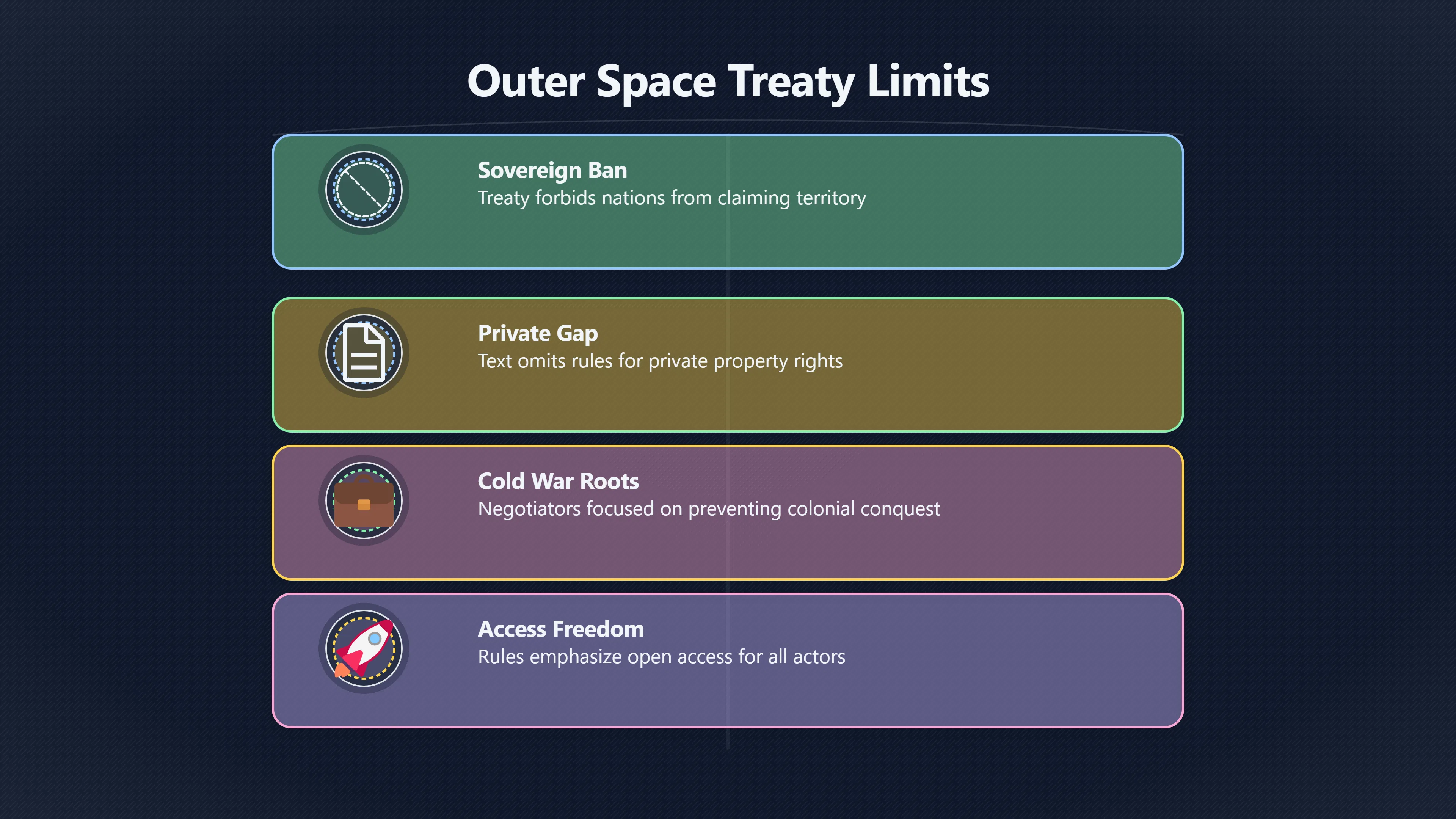
At the centre of the ambiguity over private ownership lies the non‑appropriation principle of the Outer Space Treaty, signed by over 110 countries and forming the backbone of international space law. Article II states that “outer space, including the Moon and other celestial bodies, is not subject to national appropriation by claim of sovereignty, by means of use or occupation, or by any other means.” This wording clearly forbids any nation from territorially claiming a part of the Moon or Mars — a rule designed to avoid colonial‑style land grabs and geopolitical conflict.[Wikipedia]WikipediaOuter Space TreatyOuter Space Treaty
But crucially, the treaty does not explicitly address whether private entities can acquire or hold real property rights in those places. Because the original negotiators were focused on preventing sovereign territorial conquest during the Cold War, they did not articulate a clear rule about land ownership for companies or individuals. This gap has left legal experts divided.[Law On Mars]lawonmars.comLaw On Mars Space Mining Law — Law On MarsLaw On Mars Space Mining Law — Law On Mars
Two Interpretations of “Non‑Appropriation”
The non‑appropriation clause is interpreted in two conflicting ways:
- Strict interpretation: Some legal scholars and practitioners argue that any form of exclusionary control over parts of a celestial body — whether by a state or a private actor — amounts to prohibited “appropriation.” Under this view, even a private company claiming land or carving out a mining zone could breach the OST. This strict reading emphasises freedom of access and use for all.[Canadian Bar Association]cba.orgCanadian Bar AssociationEquity in the Space Frontier: The laws of commercial space mining, and solutions for common benefit and sustainab…
- Narrow interpretation: Others contend that the Treaty’s ban on national appropriation was meant only to bar sovereign territorial claims by states, not to prevent private rights per se. Because the OST does not explicitly ban private ownership, some see room for private property claims based on use and occupation — especially if authorised and supervised by a Treaty signatory state.[The Space Settlement Institute]space-settlement-institute.orgJobes and Alan B. Wasser, The Space Settlement Institute AugLand Claim Recognition - Leveraging the Inherent Value of Lunar LandAugust 18, 2004 — Land Claims Recognition (LCR) Analysis Leveraging t…
This lack of consensus is at the heart of current legal ambiguity: the same treaty text can be read to both prohibit and, by omission, permit private property arrangements.[The Space Settlement Institute]space-settlement-institute.orgJobes and Alan B. Wasser, The Space Settlement Institute AugLand Claim Recognition - Leveraging the Inherent Value of Lunar LandAugust 18, 2004 — Land Claims Recognition (LCR) Analysis Leveraging t…
National Laws and the Push Towards Private Claims
In the absence of clear international consensus, several countries have begun to legislate domestically to fill the gap — and their chosen approaches reflect different assumptions about how space property rights should work.
In 2015, the United States enacted the Commercial Space Launch Competitiveness Act, which grants U.S. citizens and companies the right to extract and own resources they obtain from celestial bodies, even while reaffirming that nations cannot claim sovereignty over those bodies. Luxembourg followed with its own law recognising that “space resources are subject to appropriation.”[Law On Mars]lawonmars.comLaw On Mars Space Mining Law — Law On MarsLaw On Mars Space Mining Law — Law On Mars
These national laws do not create new international property rights; instead, they create domestic legal rights enforceable within the legislating state’s jurisdiction. Whether other states or international bodies would recognise such private claims under the OST remains unresolved.[Wikipedia]WikipediaOuter Space TreatyOuter Space Treaty
The Moon Agreement and Its Limited Reach
The 1979 Agreement Governing the Activities of States on the Moon and Other Celestial Bodies (commonly called the Moon Agreement) attempts to go further by declaring that the Moon and its resources are the “common heritage of mankind” and explicitly prohibits any ownership by states, entities or individuals. However, the treaty has been ratified by very few countries and none of the major spacefaring powers. As a result, it has little practical effect on current legal practice.[ScienceDirect]sciencedirect.comOuter Space, an Area Recognised as Res Communis Omnium: Limits of National Space Mining Law - ScienceDirect…
This divergence between treaties reinforces ambiguity: an international agreement exists that would ban all ownership, but it is effectively dormant; the binding treaty does not.[Wikipedia]WikipediaOuter Space TreatyOuter Space Treaty
What This Means in Practice
The legal uncertainty over private claims on the Moon and Mars carries several real‑world implications:
- Investment and commercial development: Investors seeking to finance lunar mining, Martian agriculture or off‑world manufacturing must weigh the risk that speculative property rights may not be recognised internationally or may become contested years after settlement.[ScienceDirect]sciencedirect.comOuter Space, an Area Recognised as Res Communis Omnium: Limits of National Space Mining Law - ScienceDirect…
- Strategic resource conflicts: If future laws or interpretations allow private or state‑backed commercial entities to control high‑value resources (such as polar ice on the Moon or rare elements on Mars), disputes could arise over who has legal priority, especially if multiple jurisdictions adopt different laws.[Canadian Bar Association]cba.orgCanadian Bar AssociationEquity in the Space Frontier: The laws of commercial space mining, and solutions for common benefit and sustainab…
- Inequality and governance: Depending on how property systems evolve, early movers — wealthy states and corporations — could consolidate control over desirable landing sites, resources and infrastructure, shaping the economic and political landscape of space settlement.[ScienceDirect]sciencedirect.comOuter Space, an Area Recognised as Res Communis Omnium: Limits of National Space Mining Law - ScienceDirect…
- Customary law evolution: Some scholars suggest that ongoing practice and state behaviour could shape a new customary international law on space property if enough states follow similar domestic rules. Whether this would converge on recognition of private rights or reinforce the res communis principle remains to be seen.[SSRN]papers.ssrn.comThe Fragmentation of Property Rights in the Law of Outer Space by Jonathan Tjandra:: SSRNFebruary 23, 2021…
Conclusion of Ambiguity and Its Stakes
In today’s legal landscape, the question “who can own land on the Moon or Mars?” does not have a definitive answer. The foundational Outer Space Treaty prohibits sovereign claims but leaves open — perhaps unintentionally — whether private property rights might be recognised. National laws in the United States, Luxembourg and elsewhere attempt to fill that gap, but without broad international agreement, their reach beyond domestic courts is unclear. As actual settlement and resource extraction draw nearer, resolving these legal ambiguities will become urgent: the way future property rights are defined will shape not just commercial activity but the broader distribution of benefits from humanity’s expansion into space.[Wikipedia]WikipediaOuter Space TreatyOuter Space Treaty
Amazon book picks
Further Reading
Books and field guides related to Who Can Legally Own Land and Resources in Space?. Use these as the next step if you want deeper reading beyond the article.
A City on Mars
Directly discusses space law, property rights and resource ownership beyond Earth.
The Future of Humanity
Provides broad context for Moon, Mars and asteroid resource futures.
The High Frontier
Influential background for debates about off-Earth settlement and resources.
eBay marketplace picks
Marketplace Samples
Example marketplace items related to this page. Use the search link to explore similar finds on eBay.


Endnotes
1.
Source: sciencedirect.com
Link:https://www.sciencedirect.com/science/article/pii/S0265964621000655
Source snippet
Outer Space, an Area Recognised as Res Communis Omnium: Limits of National Space Mining Law - ScienceDirect...
2.
Source: Wikipedia
Title: Outer Space Treaty
Link:https://en.wikipedia.org/wiki/Outer_Space_Treaty
3.
Source: space-settlement-institute.org
Link:https://www.space-settlement-institute.org/article-vi-of-the-outer-space-treaty.html
4.
Source: space-settlement-institute.org
Link:https://www.space-settlement-institute.org/strategy.html
5.
Source: papers.ssrn.com
Link:https://papers.ssrn.com/sol3/papers.cfm?abstract_id=3840765
Source snippet
The Fragmentation of Property Rights in the Law of Outer Space by Jonathan Tjandra:: SSRNFebruary 23, 2021...
Published: February 23, 2021
6.
Source: papers.ssrn.com
Link:https://papers.ssrn.com/sol3/papers.cfm?abstract_id=5000725
Source snippet
Attributed Lawmaking under the Outer Space Treaty of 1967 by Matthew Lively:: SSRNOctober 8, 2024 — Download This Paper Open PDF in Brow...
Published: October 8, 2024
7.
Source: space-settlement-institute.org
Title: Jobes and Alan B. Wasser, The Space Settlement Institute Aug
Link:https://www.space-settlement-institute.org/Articles/LCRbrieftext.htm
Source snippet
Land Claim Recognition - Leveraging the Inherent Value of Lunar LandAugust 18, 2004 — Land Claims Recognition (LCR) Analysis Leveraging t...
Published: August 18, 2004
8.
Source: space-settlement-institute.org
Title: What Does International Law Say About Private Property in Space?
Link:https://www.space-settlement-institute.org/what-does-international-law-say.html
Source snippet
The Space Settlement InstituteFAQ #3: WHAT DOES INTERNATIONAL LAW SAY ABOUT PRIVATE PROPERTY OWNERSHIP IN SPACE? Early in the negotiati...
9.
Source: space-settlement-institute.org
Link:https://www.space-settlement-institute.org/journal-air-law.html
Source snippet
Space Property Rights Published in the Journal of Air Law and Commerce | The Space Settlement InstituteSPACE SETTLEMENTS, PROPERTY RIGHTS...
10.
Source: lawonmars.com
Title: Law On Mars Space Mining Law — Law On Mars
Link:https://www.lawonmars.com/space-mining
11.
Source: cba.org
Link:https://www.cba.org/sections/air-and-space-law/resources/equity-in-the-space-frontier-the-laws-of-commercial-space-mining-and-solutions-for-common-benefit/?lang=en-ca
Source snippet
Canadian Bar AssociationEquity in the Space Frontier: The laws of commercial space mining, and solutions for common benefit and sustainab...
12.
Source: lawonmars.com
Link:https://www.lawonmars.com/moon-settlements
13.
Source: lawonmars.com
Link:https://www.lawonmars.com/colonizing-mars
Additional References
14.
Source: cambridge.org
Link:https://www.cambridge.org/core/journals/leiden-journal-of-international-law/article/legal-status-of-abiotic-resources-in-outer-space-appropriability-ownership-and-access/E0EAE539BEB8193B135FE22B6CA002C7
Source snippet
e CoreAugust 31, 2022 — LEGAL STATUS OF ABIOTIC RESOURCES IN OUTER SPACE: APPROPRIABILITY, OWNERSHIP, AND ACCESS Published online by Camb...
Published: August 31, 2022
15.
Source: nortonrosefulbright.com
Link:https://www.nortonrosefulbright.com/en-nl/knowledge/publications/b34b1f80/outer-space-the-new-frontier-for-restructuring-and-insolvency
Source snippet
Outer space: The new frontier for restructuring and insolvency | Netherlands | Global law firm | Norton Rose FulbrightSeptember 1, 2021 —...
Published: September 1, 2021
16.
Source: somners.com
Link:https://www.somners.com/resources/spacepropertyrights
Source snippet
February 3, 2026 — Image: When Humanity Leaves Earth: What International Law Says About Ownership on the Moon, Mars, and Beyond WH...
Published: February 3, 2026
17.
Source: journals.law.umn.edu
Link:https://journals.law.umn.edu/2016/09/28/westward-and-then-some-expansion-one-theory-of-property-rights-on-the-moon-and-mars/
Source snippet
(And Then Some) Expansion: One Theory of Property Rights on the Moon and Mars | Law JournalsSeptember 28, 2016 — Minnesota Journal of Law...
Published: September 28, 2016
18.
Source: slsa.ac.uk
Title: This treaty was created by the Member States of the United Nations Committe
Link:https://www.slsa.ac.uk/post/lunar-landowners-questions-regarding-the-ownership-of-lunar-bases-and-the-land-upon-which-they-are
Source snippet
Lunar Landowners: Questions Regarding the Ownership of Lunar Bases and the Land upon which they are BuiltJuly 14, 2025 — INTERNATIONAL SP...
Published: July 14, 2025
19.
Source: thespacereview.com
Link:https://www.thespacereview.com/article/4915/1
Source snippet
(credit: ESA) THE (NOT QUITE) DEFINITIVE GUIDE TO THE LEGAL CONSTRUCT OF “SPACE RESOURCES” BY MICHAEL J. LISTNE...
20.
Source: digitalcommons.unl.edu
Title: Back-Impallomeni, University of Padua * S. Hobe, Uni
Link:https://digitalcommons.unl.edu/spacelaw/57/
Source snippet
Estate: Addressing the Issue of “Immovable Property Rights on the Moon”January 1, 2004 — SURREAL ESTATE: ADDRESSING THE ISSUE OF “IMMOVAB...
Published: January 1, 2004
21.
Source: thespacereview.com
Title: The Space Review: The legal aspects of outer space settlers and settlements
Link:https://www.thespacereview.com/article/5183/1
Source snippet
(credit: SpaceX) THE LEGAL ASPECTS OF OUTER SPACE SETTLERS AND SETTLEMENTS BY DENNIS O’BRIEN Monday, M...
22.
Source: ibanet.org
Title: Disputes over space mining on the horizon?
Link:https://www.ibanet.org/disputes-over-space-mining-on-the-horizon
Source snippet
International Bar AssociationJanuary 18, 2023 — DISPUTES OVER SPACE MINING ON THE HORIZON? Wednesday 18 January 2023 Laura Yvonne Zieli...
Published: January 18, 2023
23.
Source: link.springer.com
Link:https://link.springer.com/article/10.1007/s42423-019-00042-0
Source snippet
Ownership for Outer Space Resources | Advances in Astronautics | Springer Nature LinkFebruary 19, 2020 — PARTIAL OWNERSHIP FOR OUTER SPAC...
Published: February 19, 2020
Topic Tree