Within Robotics
Ensuring Human Dignity in Automated Dangerous Work
Addresses how shifting dangerous work to robots affects human dignity, social roles, and public acceptance.
On this page
- Impact on worker identity and social recognition
- Public trust and acceptance of robotics
- Policies for equitable transition and reskilling
Page outline Jump by section
Introduction
In discussions about AI‑enabled automation of dangerous work, public attention often centres on safety, efficiency and economic change. Yet there is a deeper, more subtle debate about human dignity — about what it means for people’s sense of purpose, identity and self‑worth if robots take over tasks that were once central to human labour. Would automation in dangerous, repetitive or physical jobs enhance human flourishing, or risk devaluing the role of work in people’s lives? And how should policy, governance and workplace design protect dignity even as machines do more of the physical risk? This page explores those ethical and dignity considerations, grounded in research on autonomy, meaningful work and labour transitions in an era of robotics and AI.
What Dignity Means in the Context of Work
Human dignity in ethical theory is often understood not merely as a legal right, but as a sense of inherent worth and agency that people experience when their actions matter, when they are recognised by others, and when they exercise skill and autonomy. Philosophers distinguish between inherent dignity — the value every person has simply by being human — and contingent dignity — the value a person earns through participation in socially valued activities like meaningful work. Research on robots in workplaces highlights this nuance: work can be a source of purpose, social relationships, self‑esteem and autonomy, all of which contribute to a person’s dignity and wellbeing.[Springer]
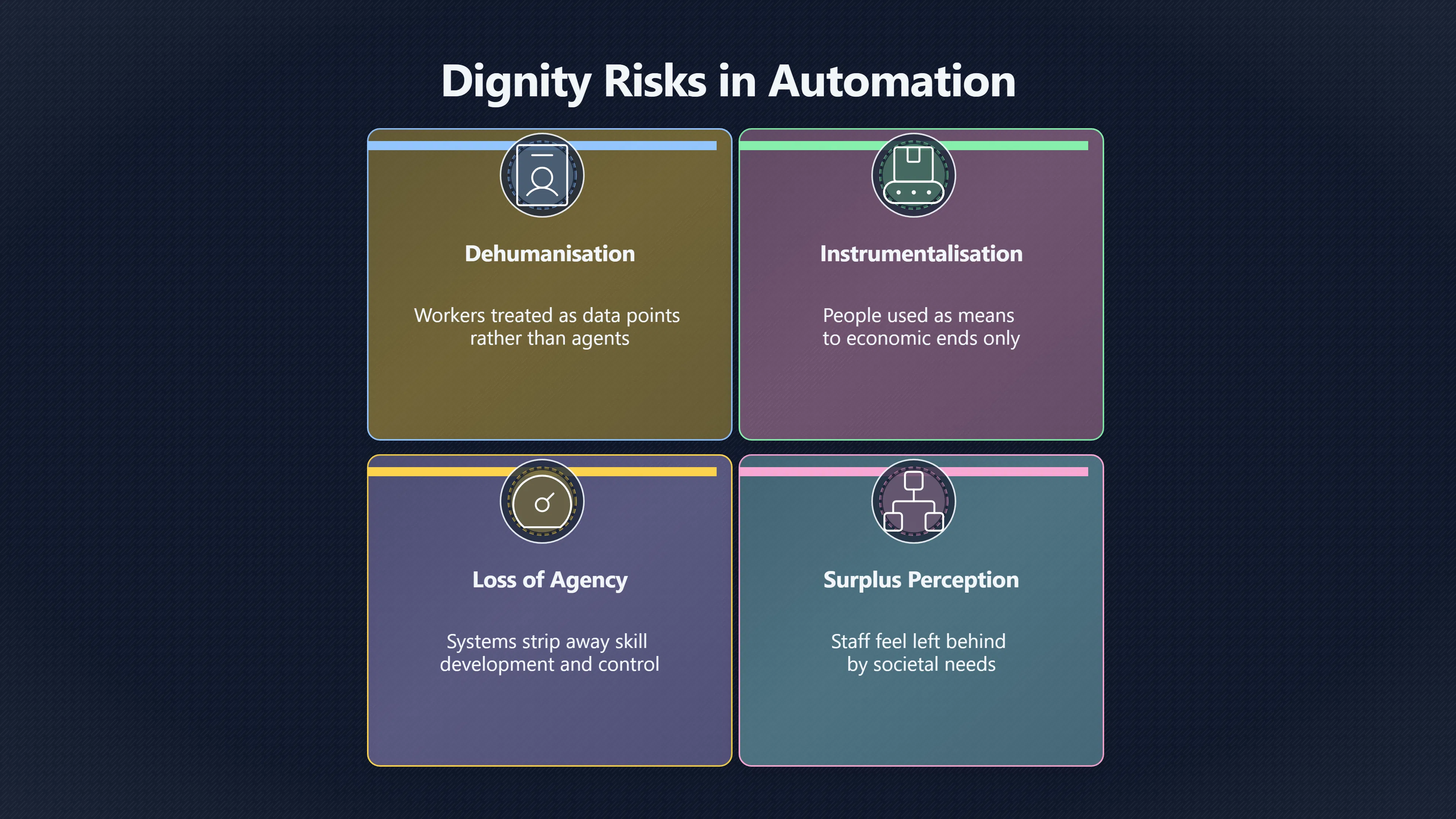
In the shift to automated systems, such as robots handling hazardous tasks or AI systems managing workflows, two major ethical risks to dignity have emerged in scholarly literature:
- Dehumanisation, where workers are treated as data points or inputs into a system rather than as full agents; and
- Instrumentalisation, where individuals are used primarily as means to an economic end without adequate regard for their autonomy and aspirations.[Springer]
Understanding these dynamics helps clarify why dignity — and not just efficiency — should be a central concern in automation policy.
How Automation Can Affect Identity and Recognition
One ethical question is what happens to a person’s sense of self when dangerous or physically demanding work is automated. Historical and philosophical approaches note that the structure of work has long been a source of identity for many people. Introducing robots can help remove risk and drudgery, but it can also disrupt familiar rhythms of social interaction, craftsmanship and contribution to a collective endeavour.
Philosophers argue that robots in the workplace may change the meaningfulness of work by shifting the balance between human and machine contributions. Rather than losing purpose entirely, workers might take on roles that emphasise oversight, strategy, empathy and complex decision‑making — tasks where humans currently excel. However, if automation strips away the tasks that gave people agency, skill development and recognition, it can diminish the sense that their work is meaningful rather than purely supervised by technology.[Springer]
Preserving dignity in this transition involves recognising that meaningful work is not just about avoiding harm or risk; it also involves social relationships, autonomy and skill use, all of which contribute to a person’s sense of agency and self‑worth.

Public Trust and Acceptance of Robotics
Public acceptance of robots in hazardous jobs — from construction to offshore work — ties directly to ethical perceptions of dignity and fairness. People are more likely to embrace automated systems if they see them as tools that enhance human wellbeing rather than replace human worth. High‑profile voices, such as recent commentary from religious and civil society leaders, have emphasised that while AI can help remove dangerous work, it should not be deployed in ways that leave people feeling surplus to society’s needs or undermine their dignity as workers.[The Times of India]timesofindia.indiatimes.comHe stresses that while AI has the potential to enhance safety and efficiency by performing dangerous or repetitive tasks, it must not com…
Transparency and accountability in how automation decisions are made also matter for trust. When workplaces use algorithmic management — systems that assign tasks, evaluate performance or monitor productivity — workers may experience a loss of autonomy and understanding of how decisions about their labour are reached. This can foster perceptions of being objects of optimisation rather than participants in work life. Ethical frameworks drawn from human‑centred design and labour law emphasise that autonomy and clarity about decision processes contribute to trust and dignity in the workplace.

Policy Options for Equitable Transition and Reskilling
Protecting dignity in an automated future requires purposeful policy and workplace governance. Key approaches include:
1. Reskilling and agency‑centred education.
When automation replaces dangerous physical tasks, policy can support workers to transition into roles that emphasise human strengths — such as supervising robots, interpreting complex situations or engaging in creative problem‑solving. Investment in reskilling and lifelong learning helps workers retain agency and meaningful contribution in the economy.
2. Worker participation in automation design.
Involving employees in how automation is deployed — from safety protocols to task reallocation — helps maintain a sense of ownership and respect. Ethical design frameworks argue that systems should be co‑designed with people whose lives they affect, rather than imposed top‑down.
3. Legal and institutional protections.
Governments and labour institutions can enact standards that protect worker dignity through regulation of algorithmic management, requirements for explainability in automated decision‑making, and protections for fair wages and career development opportunities. These measures help prevent scenarios where workers feel like mere inputs to an automated machine.
4. Human‑centred metrics of success.
Organisations may broaden performance metrics beyond productivity and safety to include measures of worker satisfaction, autonomy and wellbeing. Such metrics align automation outcomes with dignity‑affirming goals rather than purely economic ones.
Balancing Automation with Flourishing Futures
Advanced robotics and AI promise a future where dangerous, dull or dirty jobs are no longer necessary for human survival. In the context of AI Bloom — the idea that intelligent systems could help humanity flourish beyond mere economic gain — dignity considerations are a core moral requirement. If automation is guided by policies that enhance human agency, promote meaningful participation, and protect social recognition, then the removal of dangerous work can be part of an abundant, flourishing future. If dignity is overlooked, the opposite risk arises: technologies that improve safety but weaken social bonds, erode purpose and concentrate wealth without broad participation.
Ultimately, dignity in the age of automation is not a side issue — it is a foundational measure of whether new technologies are advancing human flourishing, not just efficiency. Aligning automation with dignity requires intentional design, inclusive governance, and policies that put people’s agency and worth at the centre of technological change.[Springer]
Amazon book picks
Further Reading
Books and field guides related to Ensuring Human Dignity in Automated Dangerous Work. Use these as the next step if you want deeper reading beyond the article.
The Coming Wave
Directly addresses whether advanced AI can deliver broad civilisational benefits while remaining governable.
The Big Nine
Directly discusses power among major AI companies and their strategic influence.
Human Compatible
Explores how powerful AI could advance humanity if aligned with human values.
eBay marketplace picks
Marketplace Samples
Example marketplace items related to this page. Use the search link to explore similar finds on eBay.




Endnotes
1.
Source: link.springer.com
Link:https://link.springer.com/article/10.1007/s13347-019-00377-4
Source snippet
Robots in the Workplace: a Threat to—or Opportunity for—Meaningful Work? | Philosophy & Technology | Springer Nature LinkNovember...
2.
Source: link.springer.com
Link:https://link.springer.com/article/10.1007/s10676-022-09637-y
Source snippet
A Capability Approach to worker dignity under Algorithmic Management | Ethics and Information Technology | Springer Nature LinkFe...
3.
Source: link.springer.com
Link:https://link.springer.com/article/10.1007/s13347-022-00604-5
Source snippet
Ethics and the Future of Work: a Different Voice | Philosophy & Technology | Springer Nature LinkJanuary 26, 2023 — CARE ETHICS AND THE F...
Published: January 26, 2023
4.
Source: link.springer.com
Link:https://link.springer.com/article/10.1007/s11019-021-10054-z
Source snippet
concept of social dignity as a yardstick to delimit ethical use of robotic assistance in the care of older persons | Medicine, Health Car...
5.
Source: link.springer.com
Link:https://link.springer.com/article/10.1007/s11023-019-09514-6
Source snippet
springer.com“Oh, Dignity too?” Said the Robot: Human Dignity as the Basis for the Governance of Robotics | Minds and Machines | Springer...
6.
Source: link.springer.com
Link:https://link.springer.com/article/10.1007/s10676
Source snippet
weapons systems, killer robots and human dignity | Ethics and Information Technology | Springer Nature LinkDecember 6, 2018 — CRITICISMS...
Published: December 6, 2018
7.
Source: timesofindia.indiatimes.com
Link:https://timesofindia.indiatimes.com/technology/tech-news/ai-job-cuts-could-trigger-a-social-calamity-pope-leo-warns-against-unchecked-automation-in-first-encyclical/articleshow/131308505.cms
Source snippet
He stresses that while AI has the potential to enhance safety and efficiency by performing dangerous or repetitive tasks, it must not com...
8.
Source: springerlink.fh-diploma.de
Link:https://springerlink.fh-diploma.de/article/10.1007/s10676
Source snippet
weapons systems, killer robots and human dignity | Ethics and Information Technology | Springer Nature LinkDecember 6, 2018 — AUTONOMOUS...
Published: December 6, 2018
Additional References
9.
Source: sciencedirect.com
Link:https://www.sciencedirect.com/science/article/pii/S0040162521001189
Source snippet
June 1, 2021 — TENSIONS AND ANTAGONISTIC INTERACTIONS OF RISKS AND ETHICS OF USING ROBOTICS AND AUTONOMOUS SYSTEMS IN LONG-T...
Published: June 1, 2021
10.
Source: pureportal.bcu.ac.uk
Link:https://pureportal.bcu.ac.uk/en/publications/human-dignity-in-an-age-of-autonomous-weapons-are-we-in-danger-of/
Source snippet
Birmingham City UniversityDecember 20, 2020 — HUMAN DIGNITY IN AN AGE OF AUTONOMOUS WEAPONS: ARE WE IN DANGER OF LOSING AN 'ELEMENTARY CO...
Published: December 20, 2020
11.
Source: institut-fuer-menschenrechte.de
Link:https://www.institut-fuer-menschenrechte.de/menschenrechtsschutz/datenbanken/datenbank-fuer-menschenrechte-und-behinderung/detail/the-impact-of-assistive-and-robotics-technology-artificial-[intelligence
Source snippet
DIGNITY AND HUMAN RIGHTS 40. Dignity is the founding principle of human rights law and underpins international policy documentson ageing...
12.
Source: paperity.org
Link:https://paperity.org/p/282953512/a-capability-approach-to-worker-dignity-under-algorithmic-management
Source snippet
February 1, 2022 — A CAPABILITY APPROACH TO WORKER DIGNITY UNDER ALGORITHMIC MANAGEMENT Ethics and Information Technology, Feb 2022 > Thi...
Published: February 1, 2022
13.
Source: dspace.library.uu.nl
Link:https://dspace.library.uu.nl/handle/1874/408284
Source snippet
Robots in the Workplace: a Threat to—or Opportunity for—Meaningful Work? Smids, Jilles; Nyholm, Sven; Berkers, Hannah (20...
14.
Source: inters.org
Title: Human dignity, individual freedom and solidarity are foundational to th
Link:https://inters.org/node/1791
Source snippet
Robotisation of Life: Ethics in View of New Challenges | Inters.orgThe existing European legal framework states that work is a human righ...
15.
Source: pure.psu.edu
Title: Wagner * Aerospace Engineering Research ou
Link:https://pure.psu.edu/en/publications/moral-decision-making-in-autonomous-systems-enforcement-moral-emo/
Source snippet
decision making in autonomous systems: Enforcement, moral emotions, dignity, trust, and deception - Penn StateMarch 1, 2012 — MORAL DECIS...
Published: March 1, 2012
16.
Source: pubmed.ncbi.nlm.nih.gov
Link:https://pubmed.ncbi.nlm.nih.gov/35136379/
Source snippet
2022;24(1):10. doi: 10.1007/s10676-022-09637-y. Epub 2022 Feb 3. A CAPABILITY APPROACH TO WORKER DIGNITY UNDER ALGORITHMIC MANAGEMENT Lau...
17.
Source: youtube.com
Link:https://www.youtube.com/watch?v=y6To9x9Dbyk
Source snippet
The social and ethical implications of robotics and AI - Interview with Kate Devlin...
18.
Source: youtube.com
Title: Ethics of Automation and Utopia for Human Flourishing in World Without Work
Link:https://www.youtube.com/watch?v=4cMut0nidrI
Source snippet
Algorithmic Leadership Without Dehumanization: Building Human-Centered Management Systems in the Age of AI...
Topic Tree