Within Tutor Guardrails
When should an AI tutor say no?
Selective refusal can keep students thinking by offering the smallest useful hint instead of turning practice into answer collection.
On this page
- Why instant answers can weaken learning
- The smallest useful intervention rule
- How refusal can avoid frustration
Page outline Jump by section
Introduction
An AI tutor should not say “no” because information is dangerous. It should sometimes refuse because learning is. The moments when students feel stuck, uncertain, or forced to think through a problem are often the moments when durable understanding is formed.
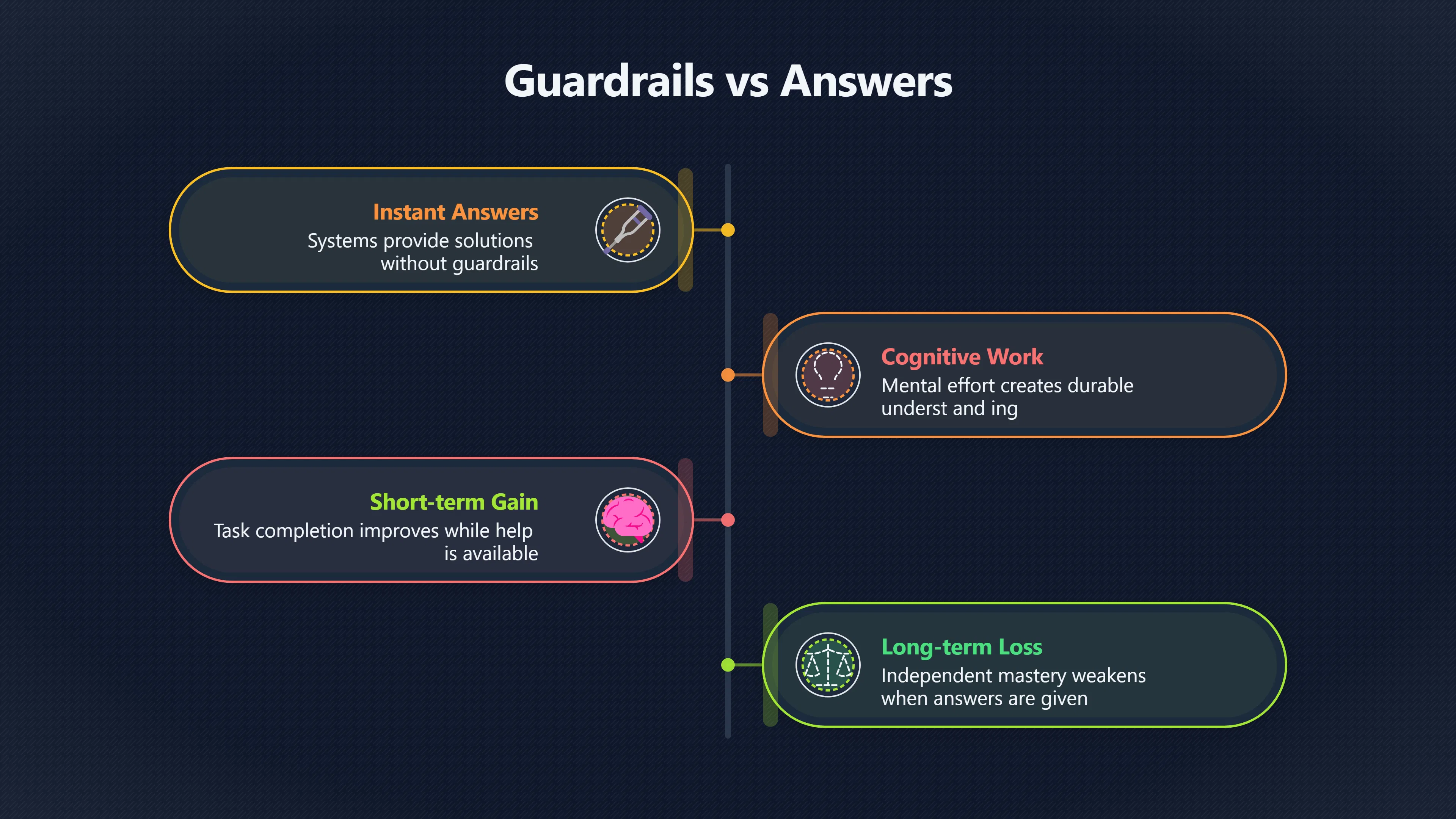
 This creates a tension at the centre of AI-assisted education. The same systems that can provide instant explanations to millions of learners can also make it effortless to bypass the mental work that education is supposed to develop. Research increasingly suggests that unrestricted answer-giving can improve short-term task completion while weakening independent mastery later. The most promising AI tutors therefore do not simply ask whether an answer is correct. They ask whether providing that answer now would help the student learn.[pnas.org]pnas.orgGenerative AI without guardrails can harm learningby H Bastani · 2025 · Cited by 179 — These results suggest that while access to generat…
Within the broader vision of AI-enabled human flourishing, this distinction matters enormously. If advanced AI is to expand human capability rather than replace it, educational systems must be designed to strengthen judgement, reasoning and skill acquisition. Selective refusal is one of the main tools for doing that.
Why instant answers can weaken learning
A common assumption is that more help automatically produces more learning. Educational research has long suggested otherwise.
When students practise a skill, improvement comes partly from retrieval, trial-and-error, self-explanation and correcting mistakes. These processes feel slower than receiving the solution, but they are often what create lasting competence. If an AI performs the reasoning on the learner’s behalf, the student may successfully finish the assignment while learning far less from it.
This concern is no longer only theoretical. A large study of high-school mathematics students found that access to GPT-4 improved performance while the system was available, but students later performed worse when required to work independently. Researchers reported that many learners used the model as a “crutch”, relying on generated solutions rather than developing their own problem-solving skills. The study found that carefully designed safeguards substantially reduced these negative effects.[pnas.org]pnas.orgGenerative AI without guardrails can harm learningby H Bastani · 2025 · Cited by 179 — These results suggest that while access to generat… PubMed The risk is subtle because students can feel as if they understand something when they are merely following an explanation. Watching a soluti[pubmed.ncbi.nlm.nih.gov]pubmed.ncbi.nlm.nih.govAI without guardrails can harm learningby H Bastani · 2025 · Cited by 179 — Without guardrails, students attempt to use GPT-4 as a "crutc… on unfold is not the same as generating it yourself. An AI that always answers immediately may create an illusion of learning while reducing the amount of genuine cognitive work taking place.
For advocates of an AI-rich future, this is a significant warning sign. The goal is not simply abundant answers. Search engines already made answers widely available. The stronger promise is abundant understanding: helping far more people acquire expertise, creativity and problem-solving ability. A tutoring system that trains dependency may work against that goal even while appearing useful.
The smallest useful intervention rule
A useful way to think about refusal is not as blocking help but as controlling its size.
Good human tutors often avoid jumping straight to the solution. Instead, they try to identify the precise point where a learner is stuck and provide only enough assistance to get progress moving again.
Many AI tutoring systems are increasingly built around the same principle:
Give the smallest intervention that allows the student to continue thinking.
In practice, that might mean:
- Asking the student to explain their current reasoning.
- Offering a hint rather than a solution.
- Revealing only the next step.
- Pointing out an error without fixing it.
- Providing a worked example on a related problem.
- Asking guiding questions that help the learner discover the answer.
The objective is not maximum refusal. It is minimum necessary assistance.
This approach is often described as Socratic tutoring because it relies on questions and guided reasoning rather than answer delivery. Studies comparing Socratic-style AI tutors with conventional answer-providing systems have found stronger support for reflection and critical thinking when learners are pushed to generate explanations themselves.[arXiv]arxiv.orgEnhancing Critical Thinking in Education by means of a…Sep 9, 2024 — Results indicate that the Socratic tutor supports the develo…
A refusal is therefore not a dead end. Ideally it redirects the conversation from “What is the answer?” to “What do you already know, and what is the next thing you can figure out?”
When refusal is most justified
Not every educational interaction should trigger the same response. The strongest case for refusal appears in situations where providing the answer would bypass the learning objective itself.
Several cases stand out.
Active homework and assessment
If a student pastes a homework problem and requests the final answer, the tutor may have strong reason to withhold it initially.
The purpose of the exercise is usually not obtaining the solution but practising a method. Direct completion can eliminate the very activity the assignment was designed to produce.
A more pedagogically aligned response might involve asking the student to attempt the first step, explain their approach, or identify which concept is causing difficulty.
Foundational skill practice
Early mathematics, language learning, programming and similar subjects depend heavily on repetition and retrieval.
When learners are still building basic competence, immediate answer disclosure can short-circuit skill formation. Refusal is often most valuable here because the educational benefit comes from the learner performing the task rather than observing it.
Requests showing no evidence of effort
A student who says “give me the answer” has provided almost no information about what they understand.
Many educators argue that the tutor should first ask for an attempted solution or an explanation of where the learner is stuck. This creates a diagnostic opportunity while also encouraging engagement.

Situations where confidence exceeds understanding
Some learners believe they understand a concept because an explanation sounds familiar.
In these cases, an AI tutor may be more helpful asking the student to predict an outcome, explain a concept in their own words, or solve a related problem than simply continuing to explain.
The refusal becomes a test of actual understanding rather than apparent understanding.
Refusal should not become obstruction
The opposite failure mode is also important.
An AI tutor that refuses too aggressively can become frustrating, demotivating and inaccessible. Students who genuinely need support may abandon the task altogether if every request is met with another question.
The purpose of refusal is learning, not gatekeeping.
A student who has already struggled for a substantial period may benefit from increasingly explicit guidance. Likewise, learners facing language barriers, disabilities, knowledge gaps or severe frustration may need more direct support than a highly prepared student.
This is why the best tutoring policies are usually graduated rather than absolute.
Instead of moving directly from refusal to full solution, assistance can be released in stages:
- Ask what the student has tried.
- Offer a hint.
- Reveal a strategy.
- Show a partial solution.
- Provide a full worked example if necessary.
This preserves learner agency while reducing the risk that students become stuck indefinitely.
The key question is not whether answers are allowed. It is whether the learner had a meaningful opportunity to think before the answer arrived.
What AI tutors can learn from good human teachers
One reason this issue matters is that experienced teachers rarely behave like search engines.
A strong teacher often notices that a student is asking for the wrong thing. The student may request the answer when what they actually need is confidence, clarification, feedback or a different explanation.
Human tutors routinely use prompts such as:
- “What have you tried so far?”
- “Can you explain your reasoning?”
- “Which step is confusing?”
- “How would you solve a simpler version?”
These questions are not evasions. They are diagnostic tools.
AI systems can scale this approach in ways that human education systems often cannot. A teacher with thirty students cannot provide endless one-to-one questioning. An AI tutor potentially can.
This is one reason refusal guardrails fit naturally within the larger AI bloom argument. The optimistic vision is not merely that intelligence becomes cheaper. It is that personalised intellectual support becomes widely available. If AI can help billions of people think through problems rather than merely receive solutions, it may expand human capability at a scale traditional education has struggled to reach.
The emerging idea of pedagogical safety
The debate over refusal is increasingly becoming a safety question rather than merely a teaching preference.
Researchers working on AI tutoring have begun arguing that educational systems need their own category of safety standards. The concern is not primarily harmful content. It is educational harm: systems that quietly undermine learning while appearing helpful.
The SafeTutors benchmark, introduced in 2026, argues that answer over-disclosure, reinforcement of misconceptions and failure to scaffold learning should be treated as serious tutoring risks. Researchers found widespread pedagogical failures across multiple models and observed that problems often became worse over extended conversations.[arXiv]arxiv.orgEnhancing Critical Thinking in Education by means of a…Sep 9, 2024 — Results indicate that the Socratic tutor supports the develo… 2arXiv
This represents an important shift in perspective.
Traditional AI safety asks whether a model avoids dangerous outputs. Educational safety asks whether a model helps learners become more capable over time.
An AI tutor can be perfectly polite, factually correct and technically safe while still weakening learning if it consistently removes the need for students to think.
Why selective refusal matters for an AI-abundant future
The argument for AI tutors is often framed in terms of access. A world where anyone can receive personalised educational support could be profoundly beneficial, especially in regions with teacher shortages or limited educational resources.
But access alone is not enough.
If future systems primarily function as answer vending machines, they may increase dependency rather than capability. The strongest version of the educational abundance case is that AI helps people acquire skills, judgement and intellectual confidence that remain useful when the system is absent.
Selective refusal is one of the mechanisms that makes that outcome more plausible.
The most effective AI tutor may not be the one that answers every question instantly. It may be the one that understands when an answer would help, when a hint would help more, and when the most valuable response is a temporary refusal that keeps the learner doing the thinking. In that sense, saying “no” is not a failure of the tutor. It is sometimes the moment when the tutor is doing its most important work.
Amazon book picks
Further Reading
Books and field guides related to When should an AI tutor say no?. Use these as the next step if you want deeper reading beyond the article.
Make It Stick
Explains why immediate answers can undermine retrieval and durable mastery.
Why Don't Students Like School?
Clarifies why thinking through problems matters for learning.
eBay marketplace picks
Marketplace Samples
Example marketplace items related to this page. Use the search link to explore similar finds on eBay.


Endnotes
1.
Source: pnas.org
Link:https://www.pnas.org/doi/10.1073/pnas.2422633122
Source snippet
Generative AI without guardrails can harm learningby H Bastani · 2025 · Cited by 179 — These results suggest that while access to generat...
2.
Source: arxiv.org
Link:https://arxiv.org/html/2409.05511v1
Source snippet
Enhancing Critical Thinking in Education by means of a...Sep 9, 2024 — Results indicate that the Socratic tutor supports the develo...
3.
Source: arxiv.org
Title: arXiv Safe Tutors: Benchmarking Pedagogical Safety in AI Tutoring Systems
Link:https://arxiv.org/abs/2603.17373
Source snippet
SafeTutors: Benchmarking Pedagogical Safety in AI Tutoring SystemsMarch 18, 2026...
Published: March 18, 2026
4.
Source: arxiv.org
Link:https://arxiv.org/html/2603.17373v1
Source snippet
Benchmarking Pedagogical Safety in AI Tutoring SystemsMar 18, 2026 — To systematically study this failure mode, we introduce SafeTutors...
5.
Source: arxiv.org
Title: We.Read more
Link:https://arxiv.org/pdf/2603.17373
Source snippet
Benchmarking Pedagogical Safety in AI Tutoring Systemsby R Hazra · 2026 — We introduce SAFETUTORS, a benchmark for the joint safety...
6.
Source: pubmed.ncbi.nlm.nih.gov
Link:https://pubmed.ncbi.nlm.nih.gov/40560616/
Source snippet
AI without guardrails can harm learningby H Bastani · 2025 · Cited by 179 — Without guardrails, students attempt to use GPT-4 as a "crutc...
Additional References
7.
Source: researchgate.net
Link:https://www.researchgate.net/publication/393011815_Generative_AI_without_guardrails_can_harm_learning_Evidence_from_high_school_mathematics
Source snippet
(PDF) Generative AI without guardrails can harm learning4 May 2026 — Without guardrails, students attempt to use GPT-4 as a “crutch” duri...
Published: May 2026
8.
Source: medium.com
Link:https://medium.com/%40blessingokpala/ai-in-education-ux-how-khan-academy-is-shaping-human-ai-learning-experiences-9ec3492dbcc7
Source snippet
AI in Education UX: How Khan Academy is Shaping...Socratic Method in UX: Khanmigo often responds with guiding questions instead of solut...
9.
Source: mentorcruise.com
Link:https://mentorcruise.com/tutor/safe/
Source snippet
Find a SAFe tutorFind a SAFe tutor. Tired of trying to learn about SAFe on your own? Book an online lesson with a qualified tutor to lear...
10.
Source: linkedin.com
Link:https://www.linkedin.com/pulse/end-scale-dilemma-meet-khanmigo-ai-tutor-never-tires-farida-bano-woqsc
Source snippet
Meet Khanmigo, the AI Tutor That Never TiresSocratic Guide: Instead of direct answers, it uses the Socratic method, asking probing questi...
11.
Source: linkedin.com
Link:https://www.linkedin.com/posts/hamsa-bastani-4a346955_generative-ai-without-guardrails-can-harm-activity-7343667696540033025-a1Ms
Source snippet
Out in PNAS today!! | Hamsa BastaniOur research examines the impact of generative AI, specifically GPT-4, on student learning in math edu...
12.
Source: linkedin.com
Link:https://www.linkedin.com/posts/fengchun-miao-5b999077_ai-generativeai-genai-activity-7445087956182302720-H_ZP
13.
Source: linkedin.com
Link:https://www.linkedin.com/showcase/pnas-news/
14.
Source: chibe.upenn.edu
Link:https://chibe.upenn.edu/publications/generative-ai-without-guardrails-can-harm-learning-evidence-from-high-school-mathematics/
Source snippet
AI without guardrails can harm learningThis study tested generative AI tutors, showing that design guardrails, or prompts that promote re...
15.
Source: linkedin.com
Link:https://www.linkedin.com/posts/vivienneming_generative-ai-without-guardrails-can-harm-activity-7351030739833978880-teKn
Source snippet
Vivienne Ming's PostJul 15, 2025 — Students use "GPT-4 as a 'crutch' during practice problem sessions, and subsequently perform worse on...
16.
Source: linkedin.com
Link:https://www.linkedin.com/posts/smart-staff-room_most-ai-tools-give-students-the-answer-activity-7442506264066084864-CXwK
Source snippet
When a student asks "what's the answer?" — Khanmigo responds with "What do you already know about this problem?" and guides...Read more...
Topic Tree