Within Broad Access
Should AI become a public service?
Governments may need to treat reliable AI assistance like civic infrastructure rather than leaving access entirely to consumer markets.
On this page
- What it means to treat AI as infrastructure
- Public options, standards and procurement routes
- The trade offs between openness, safety and state control
Page outline Jump by section
Introduction
If advanced AI becomes as important to daily life as search engines, smartphones or broadband connections, a new policy question emerges: should access to high-quality AI be treated as a private consumer product, or as part of the infrastructure of a modern society?
 This matters because AI is increasingly becoming a gateway to knowledge, education, administration, professional expertise and economic opportunity. A person with reliable AI assistance can often learn faster, navigate bureaucracy more effectively, write software, analyse information and access specialised knowledge that would otherwise be scarce. If these systems become central to work and public services, then access is no longer only a technology issue. It becomes a question of public policy, distribution and power.
The debate sits near the centre of the broader AI bloom vision. A future of abundant intelligence depends not only on how capable AI becomes, but on whether useful cognitive assistance is broadly available. Public AI infrastructure is one proposed answer: treating at least some AI systems, models, compute resources or services as public goods, public utilities or digital infrastructure rather than leaving access entirely to commercial markets.[OECD.AI]oecd.aipublic ai policies for democratic and sustainable ai infrastructuresPolicies for democratic and sustainable AI infrastructuresDec 5, 2025 — Public AI policies can support sustainable AI infrastructures thr…[Open Future]openfuture.euOpen source on openfuture.eu.
What it means to treat AI as infrastructure
The phrase “public AI” can mean several different things, and many proposals are less radical than full government ownership.
Historically, societies have often treated technologies as infrastructure when they become foundational to participation in economic and civic life. Electricity, roads, water systems, postal services, public libraries, telecommunications networks and public education all involve some combination of public funding, regulation, standards or direct provision.
Advocates of public AI argue that advanced AI may eventually occupy a similar position. Rather than viewing AI solely as a commercial software product, governments could view it as part of a society’s cognitive infrastructure: a layer that helps citizens access information, navigate institutions, learn skills and participate in economic life.[World Economic Forum]weforum.orgpublic ai infrastructure a media leader explainsWorld Economic ForumPublic AI infrastructure: What is it, do we need it and will it…11 Feb 2025 — The notion that governments need to…[Open Future]openfuture.euOpen FutureA Public Option for AI DevelopmentAligning AI advances with broader goals of social progress and sustainability requires publi…
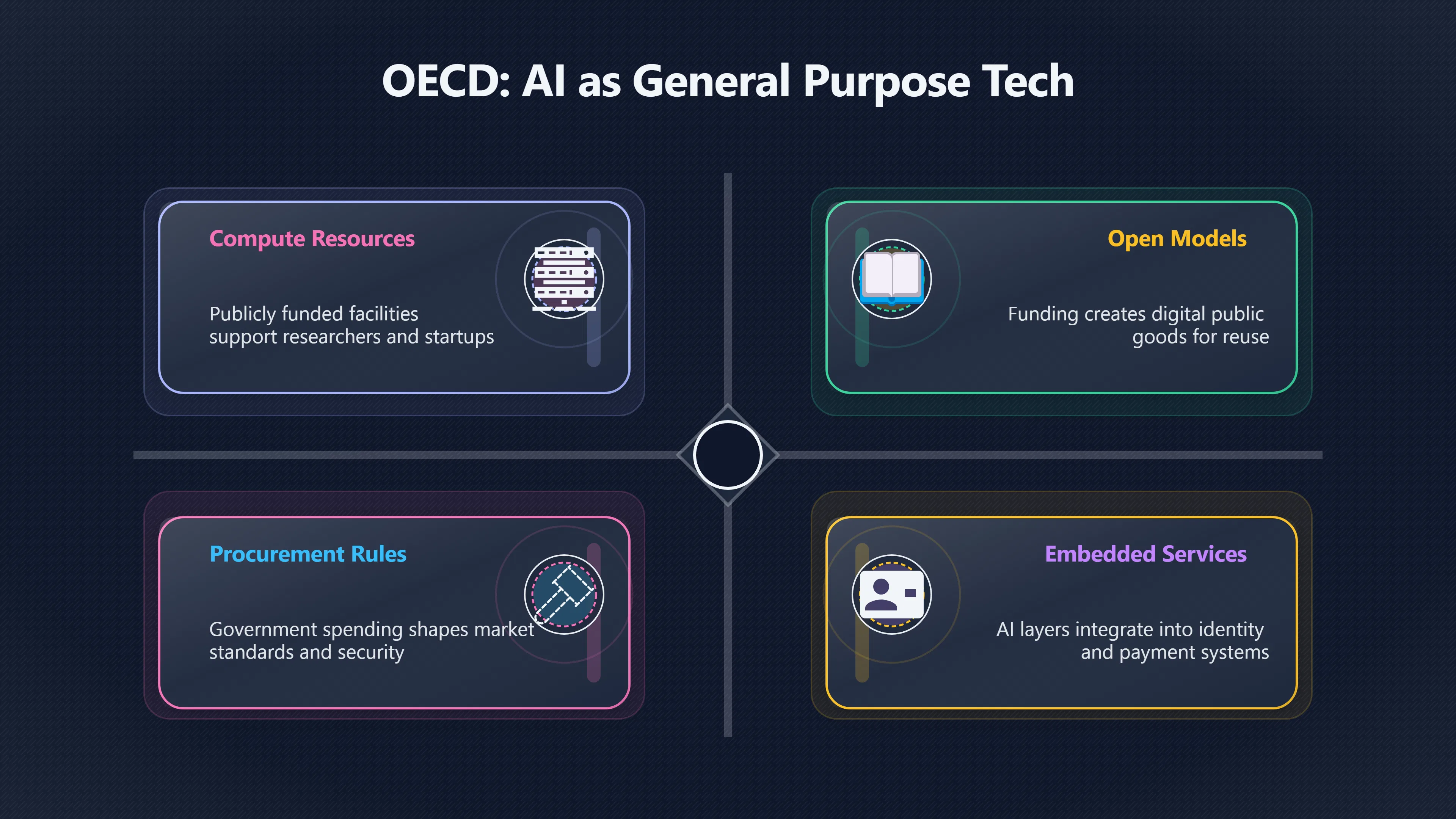
Importantly, treating AI as infrastructure does not necessarily mean building a single state-run chatbot. The infrastructure view can include several layers:
- Publicly funded compute resources available to researchers, universities and startups.
- Open models released as digital public goods.[openfuture.eu]openfuture.euSource details in endnotes.
- AI services embedded in education, healthcare and government systems.
- Shared procurement systems that reduce dependence on a handful of vendors.
- Public-interest standards for transparency, reliability and accessibility.
- National or regional AI infrastructure designed to reduce reliance on foreign providers.
Many proposals focus less on government ownership of every layer and more on preventing a future in which access to intelligence becomes heavily concentrated.[2adalovelaceinstitute.org]adalovelaceinstitute.orgcomputing commons7 Feb 2025 — One final criterion that has been advocated for in relation to compute, and for AI more generally, is public ownership. Comm…
Why governments are starting to consider public AI
The argument for public AI does not begin with ideology. It begins with the observation that AI is becoming increasingly general-purpose.
Economists often describe transformative technologies such as electricity and computing as “general-purpose technologies”: technologies that spread across many sectors and create further innovation. Recent OECD analysis suggests generative AI may fit this pattern because of its broad applicability, continual improvement and ability to generate complementary innovations.[OECD]oecd.orgis generative ai a general purpose technology 704e2d12 enIs generative AI a General Purpose Technology?by F Calvino · 2025 · Cited by 26 — Despite the early evidence, generative AI appears t…
If AI follows that path, governments face several practical concerns.
Education and cognitive opportunity
One motivation is educational access.
A highly capable AI tutor can provide personalised explanations, language support, feedback and learning assistance at a scale that traditional systems struggle to match. If such tools become genuinely effective, unequal access could widen existing educational inequalities.
The public-infrastructure argument is that societies already fund schools, libraries and universities partly because access to knowledge produces broad social benefits. AI tutoring and cognitive assistance may eventually be viewed through a similar lens.
The question is not whether governments should replace teachers with AI. It is whether every student should have access to high-quality cognitive tools, or whether those tools become significantly better for wealthy households than for everyone else.
Access to public services
Governments increasingly see AI as a way to help citizens interact with complex institutions.
Public agencies are experimenting with AI systems for benefits administration, tax services, healthcare support, employment services and government information delivery. OECD research finds that many public employment systems are already deploying AI-based tools to assist jobseekers and employers.[OECD]oecd.orgai in public service design and delivery 09704c1aAI in public service design and delivery: Governing with…18 Sept 2025 — Half of Public Employment Services (PES) in OECD countries…
In theory, a well-designed public AI assistant could help citizens:
- Understand eligibility for services.
- Navigate legal and administrative processes.
- Translate government information into multiple languages.
- Access services outside normal office hours.
- Receive personalised guidance without long waiting times.
For supporters, this resembles the digital extension of public administration. For critics, it raises questions about surveillance, accountability and automated decision-making.
National capability and sovereignty
Governments are also increasingly worried about dependence.
Many of the most powerful AI systems are controlled by a relatively small number of firms. Their infrastructure relies on concentrated supplies of advanced chips, data centres and specialised talent.
As AI becomes integrated into healthcare, education, public administration and economic activity, dependence on external providers starts to resemble dependence on foreign energy infrastructure or telecommunications networks. This concern has helped drive growing interest in sovereign AI capabilities, public compute investments and regional infrastructure programmes.[Global Policy Watch]globalpolicywatch.comBy Carole Maczkovics…Read more…
Public options, standards and procurement routes
The most realistic public AI policies are often less dramatic than nationalising AI companies. In practice, governments have several implementation routes.
Public compute and shared infrastructure
One approach focuses on compute: the specialised computing resources required to train and run advanced models.
Publicly funded compute facilities could provide researchers, universities, nonprofits and smaller companies with access to resources that would otherwise be available only to large firms.
Supporters compare this to publicly funded scientific infrastructure such as national laboratories, telescopes, particle accelerators or supercomputing centres. The goal is not necessarily to replace private investment but to broaden participation in AI development. Discussions around “compute commons” and public compute increasingly frame access to computing resources as a key determinant of who can innovate in AI.[adalovelaceinstitute.org]adalovelaceinstitute.orgcomputing commons7 Feb 2025 — One final criterion that has been advocated for in relation to compute, and for AI more generally, is public ownership. Comm…
Open models and digital public goods
A second approach focuses on open access.
Some public AI proposals emphasise funding open models, open datasets and publicly governed digital resources that can be reused by researchers, startups, schools and public institutions.
Open Future and related public-AI advocates argue that public investment should generate public value rather than creating new dependencies on proprietary systems. Their proposals often draw on the broader idea of digital public goods: infrastructure that remains broadly accessible rather than locked behind exclusive ownership.[Open Future]openfuture.euSource details in endnotes.[Open Future]openfuture.euwhite paper on public ai20 May 2025 — This white paper offers a clear overview of AI systems and infrastructures conceptualized as a stack of interdependent elem…
This model attempts to create a middle ground between complete state ownership and complete market concentration.
Government procurement as a shaping force
Governments are among the world’s largest purchasers of technology.
That purchasing power can influence how AI systems are built and deployed. Procurement rules can require transparency, interoperability, security standards, auditability and accessibility.
Rather than directly building frontier models, governments may shape markets by specifying the conditions under which public money can be spent.
This has happened before. Public procurement has historically influenced standards in transportation, healthcare, defence and digital systems. Similar approaches are increasingly discussed for AI adoption. OECD analysis highlights procurement as one of the key institutional mechanisms through which governments can influence AI deployment.[OECD]oecd.orgcompetition in artificial intelligence infrastructureIn December 2025, the OECD held a discussion on Competition in artificial intelligence infrastructure. This page contains all related mat…[OECD]oecd.orgai in public procurement 2e095543AI in public procurement: Governing with Artificial Intelligence18 Sept 2025 — AI could help public procurement officials to determin…

AI built into digital public infrastructure
Another route treats AI as a layer on top of existing digital public infrastructure.
Countries that already operate large digital identity systems, payment networks or online government platforms may integrate AI services into those systems rather than creating separate AI programmes.
Research on digital public infrastructure increasingly explores how AI can be combined with identity systems, service-delivery platforms and administrative databases to create more responsive public services.[DPI-AI Framework · CDPI]digitalpublicinfrastructure.aiThree elements: AI Blocks,DPI-AI Framework · CDPIDPI-AI Framework — Building AI-Ready Nations through…A practical framework for embedding modular, governable AI…
This model is particularly attractive to governments that already view digital infrastructure as a strategic national asset.
The strongest case for a public AI layer
Supporters of public AI generally make three related arguments.
First, they argue that intelligence is unusually important because it amplifies human capability across many domains simultaneously. Better access to reasoning, learning and expertise can improve outcomes in education, entrepreneurship, science, administration and healthcare at the same time.
Second, they argue that market outcomes alone may not maximise social value. Commercial providers naturally optimise for paying customers. Public-interest uses with large social benefits but weak commercial incentives may receive less attention.
Examples often include:
- Low-income education.
- Minority-language support.
- Accessibility tools.
- Public-interest scientific research.[techradar.com]techradar.comThe primary issue is not the lack of AI tools but how they are integrated into governmental processes. Many AI solutions are used as bolt…
- Rural and underserved communities.
- Civic and legal information services.
Third, supporters argue that concentration itself creates risks. If a small number of firms control the infrastructure through which people access information, learning and decision support, those firms may gain extraordinary influence over economic and social life. Public alternatives can act as a counterweight even if most users continue using commercial systems.[ibl.law.uiowa.edu]ibl.law.uiowa.eduPublic Utility for What?Governing AI DatastructuresEffective AI governance requires an infrastructural turn in thinking about data and, along with it, a revised…[3Open Future 3Open]openfuture.euSource details in endnotes.
In the broader AI bloom framework, this argument is fundamentally about diffusion. If AI truly can accelerate learning, creativity, scientific understanding and economic productivity, then a flourishing future depends partly on ensuring that those gains reach large populations rather than remaining concentrated among elite institutions.
Why critics worry about state-run AI
The public-AI idea has critics across the political spectrum.
Some objections focus on efficiency.
Large government technology projects often struggle with bureaucracy, procurement delays and outdated systems. The challenge is visible even in current public-sector digital transformation efforts. Reviews of government technology systems in the UK and elsewhere frequently identify legacy infrastructure, fragmented data systems and implementation bottlenecks as major barriers.[GOV.UK]GOV.UKstate of digital government review21 Jan 2025 — This rapid review to assess how effectively the public sector uses digital technology to deliver services to people, commun…[The Guardian]theguardian.comEl informe del PAC identificó más de 20 sistemas de TI gubernamentales "heredados" que aún no han recibido financiamiento para su mejora…
Critics argue that governments may be poorly positioned to build frontier AI systems compared with highly specialised private firms.
Others worry about political control.
A government that operates major AI systems could potentially gain new influence over information flows, public discourse and administrative decision-making. Even well-intentioned governments may face pressure to shape outputs, prioritise particular narratives or expand surveillance capabilities.
This creates a paradox. Public AI is often proposed as a response to private concentration of power, yet it can also create new forms of state concentration.
There are also concerns about innovation.
Private-sector competition has been a major driver of recent AI progress. Some analysts worry that heavy public provision could reduce incentives for experimentation or lock systems into slower institutional processes.
As a result, many proposals emphasise pluralism rather than monopoly: multiple providers, open standards, public options and competitive ecosystems rather than a single state-controlled model.
The trade-offs between openness, safety and control
One of the hardest problems is that the goals of openness, safety and public accountability do not always point in the same direction.
Open systems versus misuse risks
Open models can broaden access and reduce dependence on a handful of companies.
However, openness can also make powerful capabilities easier to misuse. Policymakers therefore face difficult questions about which components should be openly available, which should require safeguards and how access should be governed.
The debate becomes more acute if future systems become dramatically more capable than current models.
Transparency versus security
Public institutions often promise transparency and accountability.
Yet AI systems may involve sensitive data, cybersecurity risks or national-security considerations. Full transparency may not always be compatible with protecting infrastructure or preventing misuse.
The result is a continual balancing exercise rather than a simple choice between open and closed systems.
Public accountability versus political influence
Public oversight can improve legitimacy and trust.
But governance mechanisms must also protect AI systems from short-term political manipulation. A public AI institution that changes behaviour whenever governments change could struggle to maintain credibility.
Some proposals therefore envision independent governance structures resembling public broadcasters, central banks, research councils or utility regulators rather than direct ministerial control.[OECD.AI]oecd.orggoverning with artificial intelligence 398fa287Governing with Artificial Intelligence18 Sept 2025 — This report identifies seven key enablers: governance, data, digital infrastructure…
The infrastructure challenge beneath the policy debate
One reason the debate remains unresolved is that AI infrastructure is expensive.
Advanced AI depends on chips, energy, networking, cooling systems, data centres and skilled personnel. Building genuinely independent public infrastructure can therefore require substantial investment.
This creates a tension at the heart of public-AI proposals.
The strongest arguments for public provision often emerge precisely because private infrastructure is concentrated. Yet the cost and complexity of building alternatives can reinforce that concentration.
Recent debates around data-centre capacity, electricity supply, AI growth zones and national compute investments illustrate the problem. Governments may wish to broaden access, but they must first secure the physical infrastructure that makes access possible.[TechRadar]techradar.comThe primary issue is not the lack of AI tools but how they are integrated into governmental processes. Many AI solutions are used as bolt…[The Guardian]theguardian.comThe plan aims to increase AI computing power twentyfold, using it to improve public services such as education and road maintenance. It a…
Some recent research argues that sovereign AI services may be more affordable than commonly assumed, especially for targeted public-service applications rather than frontier-model competition. Even so, scaling public AI remains a significant institutional and financial challenge.[arXiv]arxiv.orgarXiv An Alternative to Regulation: The Case for Public AIarXiv An Alternative to Regulation: The Case for Public AI
The deeper question: who should own abundant intelligence?
The debate over public AI is ultimately a debate about the ownership and governance of intelligence itself.
If AI remains a specialised tool used by a limited number of organisations, market provision may appear sufficient. But if advanced AI becomes a basic layer of education, work, administration, creativity and scientific discovery, the analogy shifts. The question starts to resemble debates about public education, libraries, communications networks and other infrastructures that societies eventually decided were too important to leave entirely to unequal access.
The strongest version of the AI bloom vision assumes that cognitive abundance becomes widespread. People gain access to forms of expertise, learning support and problem-solving capacity that were once scarce. Public AI proposals emerge from a simple concern: abundance only changes society if people can actually reach it.
Whether future societies build public compute networks, open model ecosystems, public-interest AI institutions or merely stronger standards around access, the underlying choice is the same. Advanced AI may become one of the most important infrastructures civilisation has ever built. The policy question is whether that infrastructure is designed primarily as a market product, a strategic asset, a public service, or some combination of all three.
Amazon book picks
Further Reading
Books and field guides related to Should AI become a public service?. Use these as the next step if you want deeper reading beyond the article.
Co-Intelligence
Shows why everyday access to high-quality AI assistance could become socially important enough to merit public-policy attention.
The Coming Wave
Explores whether powerful AI can be governed as it becomes central infrastructure for society.
Power and Progress
Supports the argument that public institutions shape whether transformative tools become broadly beneficial.
Tools and Weapons
Provides a practical platform-governance lens for thinking about AI as public or quasi-public infrastructure.
eBay marketplace picks
Marketplace Samples
Example marketplace items related to this page. Use the search link to explore similar finds on eBay.


Endnotes
1.
Source: oecd.ai
Title: public ai policies for democratic and sustainable ai infrastructures
Link:https://oecd.ai/en/wonk/public-ai-policies-for-democratic-and-sustainable-ai-infrastructures
Source snippet
Policies for democratic and sustainable AI infrastructuresDec 5, 2025 — Public AI policies can support sustainable AI infrastructures thr...
2.
Source: arxiv.org
Title: arXiv An Alternative to Regulation: The Case for Public AI
Link:https://arxiv.org/abs/2311.11350
3.
Source: adalovelaceinstitute.org
Title: computing commons
Link:https://www.adalovelaceinstitute.org/report/computing-commons/
Source snippet
7 Feb 2025 — One final criterion that has been advocated for in relation to compute, and for AI more generally, is public ownership. Comm...
4.
Source: oecd.org
Title: is generative ai a general purpose technology 704e2d12 en
Link:https://www.oecd.org/en/publications/is-generative-ai-a-general-purpose-technology_704e2d12-en.html
Source snippet
Is generative AI a General Purpose Technology?by F Calvino · 2025 · Cited by 26 — Despite the early evidence, generative AI appears t...
5.
Source: oecd.org
Title: ai in public service design and delivery 09704c1a
Link:https://www.oecd.org/en/publications/2025/06/governing-with-artificial-intelligence_398fa287/full-report/ai-in-public-service-design-and-delivery_09704c1a.html
Source snippet
AI in public service design and delivery: Governing with...18 Sept 2025 — Half of Public Employment Services (PES) in OECD countries...
6.
Source: arxiv.org
Title: arXiv Sovereign AI-based Public Services are Viable and Affordable
Link:https://arxiv.org/abs/2603.01869
7.
Source: oecd.org
Title: competition in artificial intelligence infrastructure
Link:https://www.oecd.org/en/events/2025/12/competition-in-artificial-intelligence-infrastructure.html
Source snippet
In December 2025, the OECD held a discussion on Competition in artificial intelligence infrastructure. This page contains all related mat...
Published: December 2025
8.
Source: oecd.org
Title: ai in public procurement 2e095543
Link:https://www.oecd.org/en/publications/governing-with-artificial-intelligence_795de142-en/full-report/ai-in-public-procurement_2e095543.html
Source snippet
AI in public procurement: Governing with Artificial Intelligence18 Sept 2025 — AI could help public procurement officials to determin...
9.
Source: oecd.org
Title: governing with artificial intelligence 398fa287
Link:https://www.oecd.org/en/publications/2025/06/governing-with-artificial-intelligence_398fa287.html
Source snippet
Governing with Artificial Intelligence18 Sept 2025 — This report identifies seven key enablers: governance, data, digital infrastructure...
10.
Source: arxiv.org
Link:https://arxiv.org/abs/2412.05761
11.
Source: ibl.law.uiowa.edu
Title: Public Utility for What?
Link:https://ibl.law.uiowa.edu/public-utility-what-governing-ai-datastructures
Source snippet
Governing AI DatastructuresEffective [AI governance]({{ 'ai-governance/' | relative_url }}) requires an infrastructural turn in thinking about data and, along with it, a revised...
12.
Source: GOV.UK
Title: state of digital government review
Link:https://www.gov.uk/government/publications/state-of-digital-government-review/state-of-digital-government-review
Source snippet
21 Jan 2025 — This rapid review to assess how effectively the public sector uses digital technology to deliver services to people, commun...
13.
Source: techradar.com
Link:https://www.techradar.com/pro/the-uk-public-sector-doesnt-have-an-ai-problem-it-has-an-orchestration-problem
Source snippet
The primary issue is not the lack of AI tools but how they are integrated into governmental processes. Many AI solutions are used as bolt...
14.
Source: techradar.com
Link:https://www.techradar.com/pro/data-center-infrastructure-is-the-unsung-foundation-of-the-governments-ambitious-ai-agenda
Source snippet
Despite heavy investment in AI development, the physical infrastructure—such as data centers, power availability, and sustainability—is l...
15.
Source: oecd.org
Link:https://www.oecd.org/en.html
16.
Source: oecd.org
Link:https://www.oecd.org/en/topics/sub-issues/ai-compute.html
Source snippet
AI computeAt the OECD, countries are studying the best way for governments to assess AI infrastructure needs and develop AI compute plans...
17.
Source: oecd.org
Title: ff525dc8 en
Link:https://www.oecd.org/content/dam/oecd/en/publications/reports/2024/12/digital-public-infrastructure-for-digital-governments_11fe17d9/ff525dc8-en.pdf
Source snippet
Digital public infrastructure for digital governments (EN)12 Dec 2024 — This paper explores the development and impact of digital public...
18.
Source: oecd.org
Link:https://www.oecd.org/en/topics/policy-issues/public-procurement.html
Source snippet
Public procurementPublic procurement refers to the purchase by governments and state-owned enterprises of goods, services and works. It i...
19.
Source: oecd.org
Title: component 4
Link:https://www.oecd.org/en/publications/competition-in-artificial-intelligence-infrastructure_623d1874-en/full-report/component-4.html
Source snippet
Competition in artificial intelligence infrastructure14 Nov 2025 — Training and deploying generative AI services requires an enormous amo...
20.
Source: GOV.UK
Title: artificial intelligence playbook for the uk government html
Link:https://www.gov.uk/government/publications/ai-playbook-for-the-uk-government/artificial-intelligence-playbook-for-the-uk-government-html
Source snippet
Intelligence Playbook for the UK Government...10 Feb 2025 — This updated guidance will help government departments and public sector org...
21.
Source: GOV.UK
Title: white paper
Link:https://www.gov.uk/government/publications/ai-regulation-a-pro-innovation-approach/white-paper
Source snippet
pro-innovation approach to AI regulation3 Aug 2023 — The white paper sets out our commitment to engaging internationally to support inter...
22.
Source: arxiv.org
Link:https://arxiv.org/pdf/2412.05761
Source snippet
Interactions Between Artificial Intelligence and Digital...by S Nagar · 2024 · Cited by 7 — Third, this paper outlines a long-term visio...
23.
Source: oecd.ai
Title: ai procurement in a box
Link:https://oecd.ai/en/catalogue/tools/ai-procurement-in-a-box
Source snippet
2 Mar 2023 — AI Procurement in a Box” is a practical guide that helps governments rethink the procurement of artificial intelligence (AI)...
24.
Source: ofgem.gov.uk
Title: artificial intelligence
Link:https://www.ofgem.gov.uk/energy-regulation/technology-and-innovation/artificial-intelligence
Source snippet
26 Jan 2026 — Details how we will regulate the use of AI within the energy sector to make sure it is used safely and responsibly...
25.
Source: openfuture.eu
Link:https://openfuture.eu/our-work/ai-and-the-commons/
26.
Source: weforum.org
Title: public ai infrastructure a media leader explains
Link:https://www.weforum.org/stories/2025/02/public-ai-infrastructure-a-media-leader-explains/
Source snippet
World Economic ForumPublic AI infrastructure: What is it, do we need it and will it...11 Feb 2025 — The notion that governments need to...
27.
Source: openfuture.eu
Link:https://openfuture.eu/policies-for-the-digital-commons/a-public-option-for-ai-development/
Source snippet
Open FutureA Public Option for AI DevelopmentAligning AI advances with broader goals of social progress and sustainability requires publi...
28.
Source: globalpolicywatch.com
Link:https://www.globalpolicywatch.com/2026/05/important-projects-of-common-european-interest-ipceis-on-artificial-intelligence-and-compute-infrastructure-continuum/
Source snippet
By Carole Maczkovics...Read more...
29.
Source: digitalpublicinfrastructure.ai
Title: Three elements: AI Blocks,
Link:https://digitalpublicinfrastructure.ai/
Source snippet
DPI-AI Framework · CDPIDPI-AI Framework — Building AI-Ready Nations through...A practical framework for embedding modular, governable AI...
30.
Source: theguardian.com
Link:https://www.theguardian.com/technology/2025/mar/26/government-ai-roll-outs-threatened-by-outdated-it-systems
Source snippet
El informe del PAC identificó más de 20 sistemas de TI gubernamentales "heredados" que aún no han recibido financiamiento para su mejora...
31.
Source: theguardian.com
Link:https://www.theguardian.com/politics/2025/jan/12/mainlined-into-uks-veins-labour-announces-huge-public-rollout-of-ai
Source snippet
The plan aims to increase AI computing power twentyfold, using it to improve public services such as education and road maintenance. It a...
32.
Source: Wikipedia
Link:https://en.wikipedia.org/wiki/OECD
Source snippet
OECDIt is a forum whose member countries describe themselves as committed to democracy and the market economy, providing a platform to...
33.
Source: linkedin.com
Link:https://www.linkedin.com/company/organisation-eco-cooperation-development-organisation-cooperation-developpement-eco
Source snippet
OECD - OCDEThe Organisation for Economic Co-operation and Development (OECD) is an international organisation that works to build better...
34.
Source: facebook.com
Title: the OECD
Link:https://www.facebook.com/theOECD/
Source snippet
OECD | ParisThe latest edition of the #OECD FDI In Figures shows that FDI flows increased to USD 1.66 trillion in 2025, up 15% from 2024...
35.
Source: openfuture.eu
Title: white paper on public ai
Link:https://openfuture.eu/publication/white-paper-on-public-ai/
Source snippet
20 May 2025 — This white paper offers a clear overview of AI systems and infrastructures conceptualized as a stack of interdependent elem...
Published: May 2025
36.
Source: openfuture.eu
Link:https://openfuture.eu/our-work/public-digital-infrastructure/
Source snippet
Public Digital InfrastructureOur contribution to the new AI Now collection advocates for a "public digital infrastructure" approach to EU...
37.
Source: verifywise.ai
Link:https://verifywise.ai/ai-governance-library/sector-specific-governance/oecd-ai-public-sector
Source snippet
Why Government AI is Different.Read more...
38.
Source: nrdcompanies.com
Title: The AI Governance Gap.Read more
Link:https://www.nrdcompanies.com/insights/oecd-aieport-insights-and-lessons-you-need-to-know/
Source snippet
OECD AI Report: Insights and Lessons You Need to KnowWhat is missing are the governance frameworks and the digital skills that make AI ad...
Additional References
39.
Source: researchgate.net
Link:https://www.researchgate.net/publication/399504193_AI_AS_PUBLIC_INFRASTRUCTURE_A_CRITICAL_REVIEW_OF_THE_TRANSITION_FROM_TOOL_TO_SOCIETAL_NECESSITY
Source snippet
ai as public infrastructure: a critical review of the transition...7 Jan 2026 — AI systems now shape both productivity and institutional...
40.
Source: oecd-opsi.org
Link:https://oecd-opsi.org/work-areas/ai/
Source snippet
Artificial Intelligence in the Public SectorGovernments use AI to design better policies, make better decisions, enhance relationships wi...
41.
Source: instagram.com
Link:https://www.instagram.com/the_oecd/
42.
Source: x.com
Link:https://x.com/OECD?lang=en
Source snippet
OECD ➡️ Better Policies for Better LivesThe Organisation for Economic Co-operation and Development. Secretary-General: @MathiasCormann. P...
43.
Source: aiforgood.itu.int
Link:https://aiforgood.itu.int/introducing-ai-commons-a-framework-for-collaboration-to-achieve-global-impact/
Source snippet
'AI Commons': A framework for collaboration to...The AI Commons will provide an open framework for collaboration, a decentralized system...
44.
Source: ukgreencitiesandinfrastructure.org
Link:https://ukgreencitiesandinfrastructure.org/resource/the-role-of-artificial-intelligence-in-green-cities-infrastructure-and-energy-useful-resources/
Source snippet
The role of artificial intelligence in green...26 Sept 2025 — AI, tethered to smart grid and meter infrastructure, constantly weighs sup...
45.
Source: kmp.respaweb.eu
Link:https://kmp.respaweb.eu/download/doc/11%20AI%20as%20Public%20Infrastructure%20for%20Citizens%20and%20Businesses.pdf/19f19d53c2abad3ca322a6b85b51ab02.pdf
Source snippet
• AI will generate $2.6-4.4 trillion in annual economic value. • Countries with AI infrastructure will see 15%...Read more...
46.
Source: odi.org
Title: ai in the public sector five lessons from the oecds governing with ai report
Link:https://odi.org/en/insights/ai-in-the-public-sector-five-lessons-from-the-oecds-governing-with-ai-report/
Source snippet
AI in the public sector: five lessons from the OECD's '...3 Dec 2025 — The OECD's latest report makes the idea of AI in the public secto...
47.
Source: csmapnyu.org
Title: the hidden regulators public utility commissions and ai governance
Link:https://csmapnyu.org/impact/policy/the-hidden-regulators-public-utility-commissions-and-ai-governance
Source snippet
The Hidden Regulators: Public Utility Commissions and AI...21 Nov 2025 — This report examines how PUCs are becoming important AI regulat...
48.
Source: ey.com
Title: harnessing ai and digital public infrastructure for viksit bharat
Link:https://www.ey.com/en_in/insights/ai/harnessing-ai-and-digital-public-infrastructure-for-viksit-bharat
Source snippet
AI and Digital Public Infrastructure (DPI) for Viksit BharatDec 19, 2025 — India's AI ecosystem has expanded rapidly due to affordable co...
Topic Tree