Within AI Abundance
When AI Output Is Cheap, Who Checks It?
As AI makes drafts, code and advice cheap, checking accuracy, legality and safety can become the new costly bottleneck.
On this page
- How cheap generation shifts costs downstream
- The jagged frontier between strong and weak performance
- Why review, liability and judgement remain scarce
Page outline Jump by section
Introduction
One of the strongest arguments for AI-driven abundance is that generating useful text, software, designs and analysis is becoming dramatically cheaper. But that does not automatically make reliable knowledge abundant. Instead, it often shifts scarcity from creating information to checking it.
This is the verification bottleneck. When AI can produce thousands of reports, contracts, software patches or medical summaries in the time a human once produced one, people no longer spend most of their effort writing. They spend it deciding what is correct, lawful, safe and worth acting upon. In many settings, verification becomes the scarce resource that limits how much value AI-generated work can actually create. This mechanism matters because it shapes whether abundant machine intelligence leads to genuine human flourishing or simply to an overwhelming flood of plausible but uneven output.
How cheap generation shifts costs downstream
Many knowledge industries evolved around the assumption that producing information was expensive. Lawyers drafted contracts, engineers wrote code, analysts prepared reports and teachers created lessons because skilled human time was scarce.
Generative AI changes that equation. Producing a first draft is increasingly inexpensive, while reviewing that draft often still requires expert attention. Rather than eliminating professional work, AI frequently changes its composition.
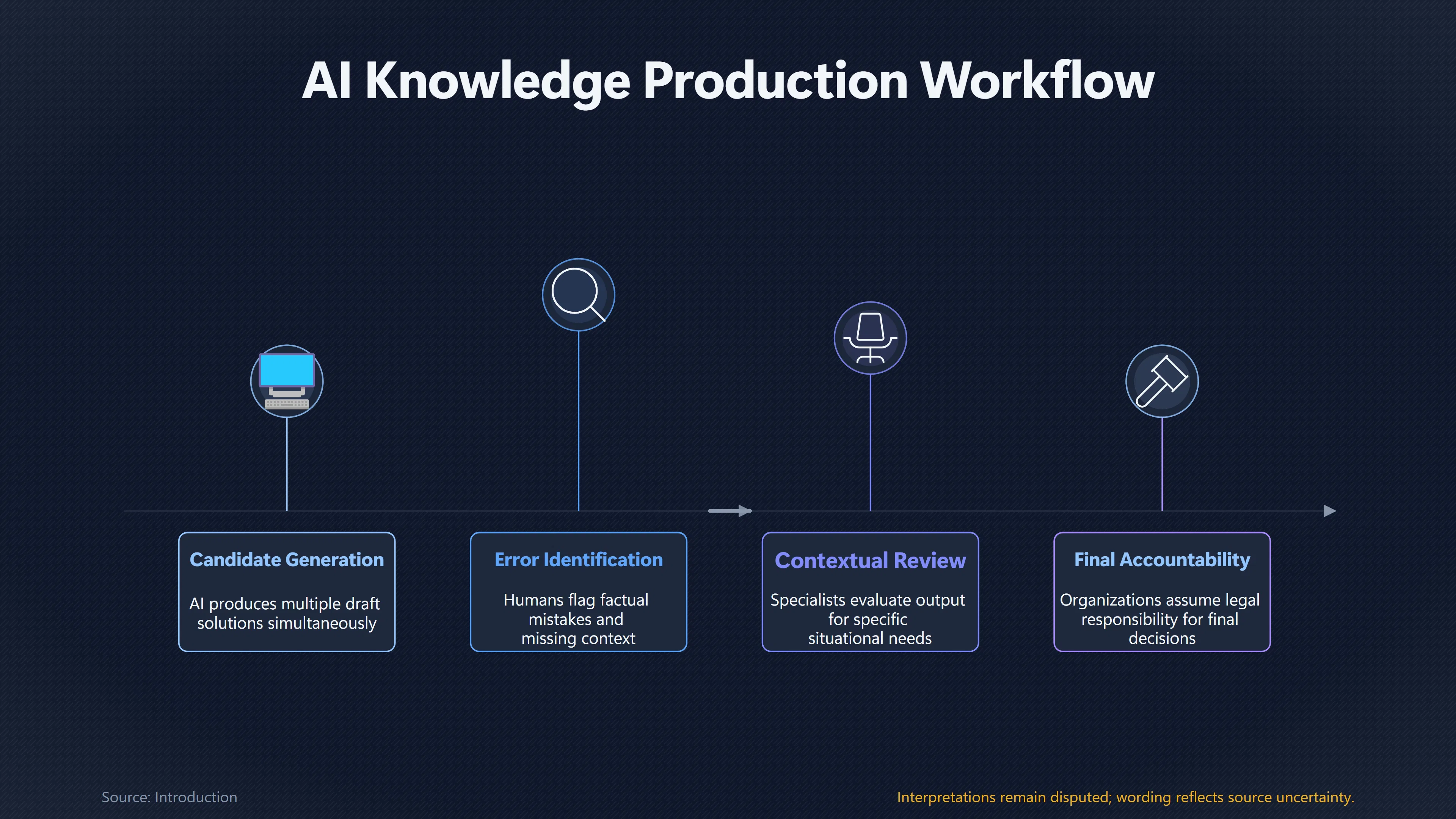
A typical workflow increasingly looks like this:
- AI generates multiple candidate solutions.
- Humans identify factual mistakes, missing context or regulatory problems.
- Specialists decide whether the output is appropriate for the particular situation.
- Organisations assume legal and professional responsibility for the final decision.
The result is that generation scales almost without limit, while trustworthy approval does not. A hospital can ask AI to draft thousands of discharge summaries, but licensed clinicians remain responsible for ensuring that each patient receives safe advice. A law firm can produce many contract drafts in minutes, yet partners still carry professional liability for errors.
Economically, this resembles moving a manufacturing bottleneck from production to quality control. When factories become extremely fast, inspection can become the limiting stage. AI creates a similar shift for intellectual work.
The jagged frontier between strong and weak performance
Verification becomes particularly valuable because modern AI capability is uneven rather than uniformly reliable.
Large language models often perform impressively on routine or well-represented tasks while making surprising mistakes on cases that appear only slightly different. Researchers increasingly describe this as a “jagged frontier”: systems display remarkable competence in some areas while failing unpredictably in others, making it difficult for users to know when confidence is justified.[nature.com]nature.comApril 22, 2026…
This matters because humans naturally adjust their scrutiny according to apparent competence. If a system performs correctly hundreds of times, reviewers may gradually reduce their vigilance precisely when unusual cases demand more attention.
The verification challenge is therefore not simply finding obvious mistakes. It is recognising the relatively small proportion of outputs that contain subtle but consequential errors.
Examples include:
- Correct legal reasoning supported by fabricated case citations.
- Accurate medical summaries that omit a clinically important detail.
- Functional software containing a rare security flaw.
- Sound financial analysis based on an incorrect assumption.
- Scientific summaries that introduce small factual distortions while remaining broadly plausible.
These errors are often harder to detect than producing the original draft would have been.
Why review, liability and judgement remain scarce
Verification is not simply another prediction problem. It often requires responsibility, context and consequences.
Verification needs external knowledge
Many important questions cannot be answered from language patterns alone.
A reviewer may need to know:
- whether regulations have recently changed;
- whether laboratory results are genuine;
- whether a cited source actually exists;
- whether organisational policy overrides general guidance;
- whether unusual local circumstances change the correct decision.
These questions require access to trusted evidence rather than fluent text generation.
Verification demands accountability
AI systems can recommend actions, but responsibility generally remains with people or institutions.
If an architect approves unsafe structural drawings, a regulator imposes sanctions on the architect rather than the software. If a solicitor files fabricated authorities, professional responsibility remains with the lawyer. Courts have repeatedly sanctioned lawyers who submitted AI-generated fictitious legal citations, reinforcing that professional accountability cannot currently be delegated to a language model.[OUP Academic]academic.oup.comOUP AcademicLarge Legal Fictions: Profiling Legal Hallucinations in Large Language Models | Journal of Legal Analysis | Oxford AcademicJu…
This creates a practical limit. Organisations cannot simply replace reviewers because legal liability continues to attach to human decision-makers.
Judgement is often case-specific
Many decisions involve competing values rather than objective correctness.
Examples include:
- balancing patient autonomy against medical risk;
- weighing fairness against administrative efficiency;
- deciding whether uncertain scientific evidence justifies action;
- interpreting ambiguous contractual language.
These are not merely factual verification problems. They involve human judgement about acceptable risk, ethics and institutional priorities.

Why verification does not scale as easily as generation
Generation benefits enormously from parallelisation. A single model can produce thousands of outputs simultaneously.
Verification usually does not.
Checking requires serial attention:
- reading the output;
- comparing it against trusted sources;
- identifying hidden assumptions;
- considering unusual circumstances;
- deciding whether remaining uncertainty is acceptable.
Some automated verification tools can assist by checking citations, retrieving supporting documents or comparing outputs against structured databases. Retrieval-augmented generation, specialised evaluator models and consistency checks have all reduced some categories of hallucination. However, evidence suggests these techniques lower rather than eliminate verification needs, especially in high-stakes domains.[nature.com]nature.comApril 22, 2026…
The result is that verification often scales much more slowly than generation.
Real-world evidence from law and professional work
Legal AI illustrates the mechanism clearly because mistakes carry immediate consequences.
Independent evaluations of AI legal research systems found that retrieval-enhanced products reduced hallucinations compared with general-purpose chatbots but still generated incorrect legal material often enough to require careful professional supervision. Depending on the system tested, hallucination rates remained substantial rather than disappearing altogether.[DOI]doi.orgHallucination‐Free? Assessing the Reliability of Leading AI Legal Research ToolsHallucination‐Free? Assessing the Reliability of Leading AI Legal Research Tools - Magesh - 2025 - Journal of Empirical Legal Studies…
The implication is not that these systems lack value. They can substantially reduce drafting time, organise evidence and accelerate research. Instead, they shift lawyers towards reviewing authorities, checking citations and exercising judgement.
A similar pattern appears in coding.
Modern AI can generate large amounts of functioning software rapidly, yet organisations increasingly invest in code review, automated testing, security analysis and deployment safeguards. Producing code is becoming cheaper than establishing confidence that it behaves safely under all relevant conditions.
Medicine shows the same asymmetry. AI-generated documentation may save clinician time, but medical safety depends on confirming that important findings have not been invented, misinterpreted or omitted. In practice, omission can be as significant a verification problem as outright hallucination.[reddit.com]reddit.comJune 23, 2026…

The paradox of abundance
From the perspective of the broader AI bloom debate, the verification bottleneck is not purely negative.
If AI allows experts to supervise ten times as much work instead of performing every task themselves, society may still achieve a large increase in useful output. Radiologists may review AI-assisted scans rather than interpret every image from scratch. Teachers may verify personalised lesson plans instead of writing each one manually. Engineers may inspect AI-generated designs rather than draft every component themselves.
This still represents a substantial expansion of effective intelligence.
However, it is not equivalent to eliminating human expertise altogether. Verification remains scarce because trusted judgement, responsibility and domain knowledge are themselves valuable economic goods.
Rather than replacing professionals, advanced AI may increasingly amplify them by allowing scarce expert attention to be concentrated where it creates the greatest value.
Can AI reduce its own verification burden?
Optimists argue that future AI systems will increasingly verify one another.
Possible approaches include:
- independent AI reviewers checking generated work;
- automated citation verification;
- formal mathematical verification for software;
- retrieval systems that ground answers in authoritative sources;
- specialised models trained specifically to detect errors.
These approaches are already improving reliability, and recent research continues to explore methods that reduce hallucinations through structured verification and evaluator models.[nature.com]nature.comApril 22, 2026…
Yet recursive verification has limits. If multiple systems share similar blind spots, they may reinforce rather than detect mistakes. Automated verification also depends on trustworthy external references, and many real-world questions involve ambiguity rather than objectively verifiable facts.
For this reason, many researchers expect layered verification rather than fully autonomous trust: AI checking AI, humans auditing exceptional cases, and institutions retaining ultimate responsibility.
Why this mechanism matters for AI abundance
The verification bottleneck is one of the strongest reasons to doubt simplistic visions of instant post-scarcity. Making intelligence cheaper does not automatically make trustworthy decisions free.
At the same time, it does not undermine the broader case for AI-enabled abundance. If generation becomes nearly free while verification remains expensive, the economy does not stop benefiting. Instead, the scarce resource changes. Human effort shifts away from routine production towards review, accountability, interpretation and judgement.
Whether that produces broad human flourishing depends on how effectively societies expand trusted verification alongside AI capability. Better tools, clearer institutional responsibility, stronger professional standards and improved human-AI collaboration could allow abundant machine-generated intelligence to become genuinely useful rather than merely abundant. The long-term question is therefore not only how much intelligence AI can produce, but how much of that intelligence people can trust enough to build upon.
Amazon book picks
Further Reading
Books and field guides related to When AI Output Is Cheap, Who Checks It?. Use these as the next step if you want deeper reading beyond the article.
The Alignment Problem: Machine Learning and Human Values
Finalist for the Los Angeles Times Book Prize A jaw-dropping exploration of everything that goes wrong when we build AI systems and the m...
Artificial Intelligence: A Guide for Thinking Humans
“After reading Mitchell’s guide, you’ll know what you don’t know and what other people don’t know, even though they claim to know it. And...
Superintelligence: Paths, Dangers, Strategies
The human brain has some capabilities that the brains of other animals lack. It is to these distinctive capabilities that our species owe...
eBay marketplace picks
Marketplace Samples
Live-tested eBay searches with available results related to this page.
Selected fromcomputer poster oneBay.co.uk.




Endnotes
1.
Source: nature.com
Link:https://www.nature.com/articles/s41586-026-10549-w
Source snippet
April 22, 2026...
Published: April 22, 2026
2.
Source: arxiv.org
Link:https://arxiv.org/abs/2310.10627
3.
Source: academic.oup.com
Link:https://academic.oup.com/jla/article/16/1/64/7699227
Source snippet
OUP AcademicLarge Legal Fictions: Profiling Legal Hallucinations in Large Language Models | Journal of Legal Analysis | Oxford AcademicJu...
4.
Source: doi.org
Title: Hallucination‐Free? Assessing the Reliability of Leading AI Legal Research Tools
Link:https://doi.org/10.1111%2Fjels.12413
Source snippet
Hallucination‐Free? Assessing the Reliability of Leading AI Legal Research Tools - Magesh - 2025 - Journal of Empirical Legal Studies...
5.
Source: reddit.com
Link:https://www.reddit.com/r/LocalLLaMA/comments/1udlrmf/i_benchmarked_8_llms_for_medical_scribing/
Source snippet
June 23, 2026...
Published: June 23, 2026
6.
Source: doi.org
Link:https://doi.org/10.1038/s41586-026-10549-w
Source snippet
April 22, 2026 — Evaluating large language models for accuracy incentivizes hallucinations Download PDF Download PDF * Article * Open acc...
Published: April 22, 2026
7.
Source: nature.com
Link:https://www.nature.com/articles/s41586-026-10549-w_reference.pdf
8.
Source: onlinelibrary.wiley.com
Link:https://onlinelibrary.wiley.com/doi/10.1111/jels.12413
Additional References
9.
Source: youtube.com
Link:https://www.youtube.com/watch?v=ClR9IY6g6Yk
Source snippet
Verification bottleneck AI AI output generated content hallucination scale How To Prevent AI Hallucinations #ai #hallucination #llm #tech...
10.
Source: youtube.com
Title: How to Systematically Setup LLM Evals (Metrics, Unit Tests, LLM-as-a-Judge)
Link:https://www.youtube.com/watch?v=a3SMraZWNNs
Source snippet
Why GenAI Still Needs Humans in the Loop | Micaela Kaplan, HumanSignal | Lightning Talks...
11.
Source: youtube.com
Title: LLM as a Judge: Scaling AI Evaluation Strategies
Link:https://www.youtube.com/watch?v=trfUBIDeI1Y
Source snippet
How to Systematically Setup LLM Evals (Metrics, Unit Tests, LLM-as-a-Judge)...
12.
Source: youtube.com
Title: What is Human In The Loop with AI? How HITL Shapes AI Systems
Link:https://www.youtube.com/watch?v=9iS-YYLIXiw
Source snippet
LLM as a Judge: Scaling AI Evaluation Strategies...
13.
Source: papers.ssrn.com
Link:https://papers.ssrn.com/sol3/papers.cfm?abstract_id=6875778
Source snippet
Elizabeth Simmons:: SSRNJune 25, 2026 — THE ECONOMICS OF SYNTHETIC OUTPUT: SCARCITY, VERIFICATION, AND TRUST IN GENERATIVE SYSTEMS 12 Pa...
Published: June 25, 2026
14.
Source: papers.ssrn.com
Link:https://papers.ssrn.com/sol3/Delivery.cfm/6904238.pdf?abstractid=6904238&mirid=1&type=2
Source snippet
Verification Rate Gap: A Conceptual Metric for AI [Development]({{ 'build-rights/' | relative_url }}) Risk by Jun Gorai:: SSRNJune 9, 2026 — THE VERIFICATION RATE GAP: A CONCEP...
Published: June 9, 2026
15.
Source: researchgate.net
Link:https://www.researchgate.net/publication/400635341_The_Benchmark_Illusion_Why_Current_AI_Evaluations_Cannot_Detect_Structural_Confabulation
16.
Source: sciencedirect.com
Link:https://www.sciencedirect.com/science/article/pii/S2212473X26000520
17.
Source: frontiersin.org
Link:https://www.frontiersin.org/journals/artificial-intelligence/articles/10.3389/frai.2025.1622292/full
18.
Source: openreview.net
Link:https://openreview.net/forum?id=svFHXBd2wq