Within Closed loops
Why Real Science Still Breaks Automated Labs
Autonomous laboratories work best in structured settings, but messy real-world science still resists full automation.
On this page
- Where closed loop systems succeed today
- Tacit knowledge and fragile experiments
- Why biology remains harder than materials science
Page outline Jump by section
Introduction
Self-driving laboratories are one of the most important tests of the wider AI bloom idea. If advanced AI can help humanity accelerate science, then it must eventually do more than generate theories. It must help turn ideas into reliable discoveries in the physical world.
 In controlled settings, autonomous laboratories have already produced impressive results. AI systems can choose experiments, robotic equipment can run them, and software can analyse outcomes and decide what to test next. In some materials science and chemistry applications, this can compress research cycles from weeks to hours. Yet the most ambitious vision — laboratories that can autonomously navigate the full messiness of real scientific work — remains much harder than many headlines imply. The central obstacle is not computation. It is reality. Scientific environments contain hidden variables, tacit human knowledge, fragile procedures and biological complexity that resist standardisation. The closer automation gets to the real world, the more these difficulties matter.[PubMed]pubmed.ncbi.nlm.nih.govAutonomous 'self-driving' laboratories: a review of…by AV Tobias · 2025 · Cited by 65 — This article reviews and provides perspe…
Where closed-loop systems succeed today
The strongest successes in self-driving laboratories tend to appear in domains where experiments are highly structured, variables are tightly controlled and outcomes can be measured automatically.
Materials science has become a leading example. Researchers have built systems that repeatedly synthesise materials, measure their properties and use machine-learning models to select the next experiment. Closed-loop platforms have explored vast combinations of processing conditions, compositions and structures far faster than conventional trial-and-error approaches.[arXiv]arxiv.orgOn-the-fly Closed-loop Autonomous Materials Discovery via Bayesian Active LearningJune 11, 2020…[ACS]pubs.acs.orgACS PublicationsSelf-Driving Laboratories for Chemistry and Materials Scienceby G Tom · 2024 · Cited by 726 — More advanced SDLs combinin…
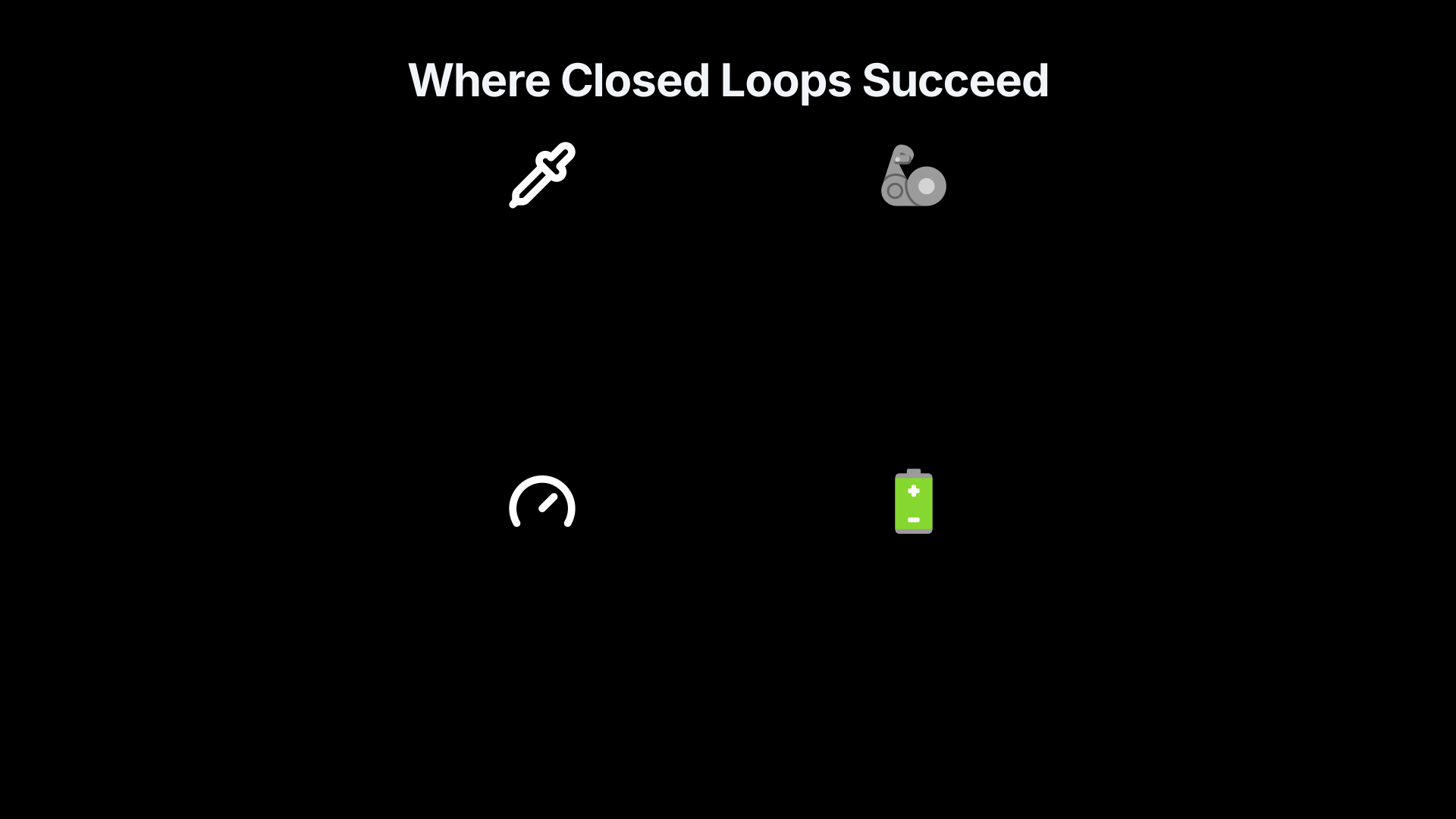
This works particularly well when:
- Experimental inputs can be precisely specified.
- Robotic hardware can execute procedures consistently.
- Sensors provide rapid quantitative feedback.
- The search space is large but structured.
- Success metrics are clear.
Many materials problems fit this pattern. Researchers may be trying to maximise conductivity, stability, catalytic efficiency or another measurable property. Once the optimisation target is defined, active-learning systems can efficiently search through thousands of possibilities.[arXiv]arxiv.orgOn-the-fly Closed-loop Autonomous Materials Discovery via Bayesian Active LearningJune 11, 2020…
This is why many demonstrations of autonomous science focus on batteries, catalysts, thin films, semiconductors and related areas. The laboratory environment is still complex, but the experiment itself is often more repeatable than in biological research. As a result, AI-guided experimentation can generate genuine throughput gains.[Collegium Helveticum]collegium.ethz.chCollegium HelveticumThe Rise of Self-Driving Labs in Chemistry and Materials…This lecture will explore how the convergence of automati…[sheffield]sheffield.ac.ukself driving labs making chemical research faster and smarterSheffield UniversitySelf-driving labs: making chemical research faster and…9 May 2025 — Researchers have built an automated platform… The success of these systems matters for the broader scientific-acceleration story. They show that parts of discovery can already be transformed into high-speed feedback loops between algorithms and physical experiments. But they also reveal an important limitation: many of the easiest domains to automate are not representative of science as a whole.
Tacit knowledge is harder to automate than procedures
One of the most underestimated obstacles is tacit knowledge.
Scientific papers often describe experiments as though they are fully specified recipes. In practice, much laboratory work depends on skills, judgments and contextual knowledge that researchers rarely write down completely.
A protocol may say that a sample should be mixed gently. An experienced scientist knows what “gently” means in a particular context. A robotic system does not. A paper may describe a culture preparation method that technically reproduces a procedure while missing dozens of small practical details that affect results. Experienced researchers often detect problems through subtle observations that are difficult to formalise into software rules.[University of Bristol]research-information.bris.ac.ukTwo Kinds of Science D24 for Po SUniversity of BristolCollins, H., Shrager, J., Bartlett, A., Conley, S., Hale, R., &…by H Collins — “Can Robots Help Solve the Reprodu…
This problem appears repeatedly in discussions of scientific reproducibility. Even when laboratories attempt to follow identical protocols, results can diverge because crucial information never entered the formal record. Automation can improve consistency once a process is fully specified, but many scientific processes are not fully specified to begin with.[crukcambridgecentre.org.uk]crukcambridgecentre.org.uk‘robot scientist’ eve finds less one third scientific results are reproducibleRobot scientist' Eve finds that less than one third of…6 Apr 2022 — Statistically significant evidence for repeatability was found fo…[PMC]pmc.ncbi.nlm.nih.govPMCTesting the reproducibility and robustness of the cancerby K Roper · 2022 · Cited by 27 — Automation makes experimental replication technically easier, as laboratory robotics are more accura…
Human researchers routinely make adjustments based on:
- Unexpected instrument behaviour.
- Minor contamination events.
- Changes in environmental conditions.
- Sample quality differences.
- Intuitive judgments built from years of experience.
These interventions are often invisible in published methods sections. A robotic platform can only automate what has been captured and encoded. When key knowledge exists mainly in people’s heads, automation encounters a hidden wall.[NLR]docs.nlr.govPerspectives for self-driving labs in synthetic biologyPerspectives for self-driving labs in synthetic biologyJanuary 23, 2023 — by D Arnold · 2023 · Cited by 123 — Self-driving labs (SDLs)…
This creates a paradox. The scientific fields that appear most ripe for automation are often those that have already become highly standardised. The more exploratory and uncertain a field becomes, the more tacit knowledge tends to matter.
Fragile experiments break closed loops
Another challenge is that real laboratories are filled with failure modes that are difficult to anticipate.
A closed-loop system assumes that experimental results can be trusted as feedback for future decisions. But many experiments fail for reasons unrelated to the scientific question being studied.
A pipette may clog. A reagent may degrade. A sensor may drift. A culture may become contaminated. A robotic arm may slightly misalign a sample. A measurement may appear valid while quietly incorporating systematic error.
Human scientists often recognise these failures because they understand the broader context of the experiment. They notice unusual smells, colours, textures, timing irregularities or equipment behaviour. Many of these signals remain difficult to capture through automated monitoring systems.[PubMed]pubmed.ncbi.nlm.nih.govAutonomous 'self-driving' laboratories: a review of…by AV Tobias · 2025 · Cited by 65 — This article reviews and provides perspe…
This becomes especially problematic in autonomous systems because errors can propagate. If the AI interprets a faulty measurement as genuine scientific information, it may choose subsequent experiments based on a false signal. The laboratory can then optimise towards artefacts rather than discoveries.
The problem resembles challenges seen in autonomous vehicles. Driving works well on carefully mapped roads under predictable conditions. Edge cases create disproportionate difficulty. Scientific laboratories have their own version of edge cases, except they occur constantly because experimentation is fundamentally about probing the unknown.
Why biology remains harder than materials science
The gap between materials science and biology illustrates the challenge particularly clearly.
Materials systems are often complicated, but they can be relatively stable. Researchers can repeatedly create similar samples and measure similar properties under controlled conditions.
Biology is different.
Living systems are noisy, adaptive and context-dependent. Cells change behaviour over time. Genetic pathways interact with one another. Small environmental differences can produce large effects. Experimental outcomes often depend on factors that researchers do not yet fully understand.[NLR]docs.nlr.govPerspectives for self-driving labs in synthetic biologyPerspectives for self-driving labs in synthetic biologyJanuary 23, 2023 — by D Arnold · 2023 · Cited by 123 — Self-driving labs (SDLs)…
Even supposedly standard biological materials vary. Cell lines drift genetically. Reagents age. Organisms respond differently to environmental conditions. Biological systems contain layers of feedback that make outcomes difficult to predict and difficult to reproduce.[PMC]pmc.ncbi.nlm.nih.govPMCTesting the reproducibility and robustness of the cancerby K Roper · 2022 · Cited by 27 — Automation makes experimental replication technically easier, as laboratory robotics are more accura…
This creates several difficulties for autonomous laboratories:

Measurement is often ambiguous
In materials science, success may be measured through a clear property such as conductivity or strength.
In biology, researchers often care about complex phenomena such as toxicity, immune response, disease progression or cellular differentiation. These outcomes may not have a single straightforward measurement. Multiple competing interpretations can fit the same data.[LinkedIn]linkedin.comAutonomous Labs in Nature Magazine: A New Frontier for…Autonomous systems explore combinatorial space at industrial scale. Sha…
Experimental timescales are longer
Many biological processes unfold over days, weeks or months.
A materials experiment might complete in minutes. A biological experiment may require cell growth, incubation, sequencing, imaging and multiple validation stages. This reduces the speed advantage of closed-loop optimisation.[NLR]docs.nlr.govPerspectives for self-driving labs in synthetic biologyPerspectives for self-driving labs in synthetic biologyJanuary 23, 2023 — by D Arnold · 2023 · Cited by 123 — Self-driving labs (SDLs)…
Translation to the real world is harder
Drug discovery illustrates the problem.
A system may autonomously optimise compounds in cell cultures, yet success in a controlled laboratory environment does not guarantee success in animals or humans. Toxicity, metabolism, side effects and regulatory constraints introduce layers of complexity that cannot be fully captured by a narrow experimental loop.[LinkedIn]linkedin.comAutonomous Labs in Nature Magazine: A New Frontier for…Autonomous systems explore combinatorial space at industrial scale. Sha…
As a result, many impressive autonomous demonstrations solve only a small part of the broader scientific challenge.

The reproducibility problem cuts both ways
Automation is often presented as a solution to science’s reproducibility crisis.
There is truth in this claim. Robots can execute procedures more consistently than humans. Automated systems can log actions in greater detail and reduce variation introduced by individual researchers.[PMC]pmc.ncbi.nlm.nih.govPMCTesting the reproducibility and robustness of the cancerby K Roper · 2022 · Cited by 27 — Automation makes experimental replication technically easier, as laboratory robotics are more accura…
Yet automation also exposes a deeper problem.
If published findings cannot reliably be reproduced even under highly controlled conditions, then autonomous systems inherit a noisy and imperfect scientific record. Models trained on flawed literature may pursue unproductive directions. Closed-loop systems can optimise experimental throughput without necessarily improving scientific validity.[crukcambridgecentre.org.uk]crukcambridgecentre.org.uk‘robot scientist’ eve finds less one third scientific results are reproducibleRobot scientist' Eve finds that less than one third of…6 Apr 2022 — Statistically significant evidence for repeatability was found fo…
The challenge is not merely performing experiments faster. It is ensuring that the information generated remains trustworthy.
This distinction matters for AI-driven scientific acceleration. A future with millions of autonomous experiments per day only improves discovery if those experiments produce reliable knowledge rather than automated noise.
The hardware bottleneck remains stubbornly physical
Much AI progress comes from software scaling.
Laboratories do not scale that way.
Every experiment still requires physical infrastructure: instruments, chemicals, sensors, maintenance, calibration and safety systems. Expanding experimental throughput often means purchasing additional hardware rather than simply allocating more computation.[ScienceDirect]sciencedirect.comDemocratizing self-driving labs: advances in low-cost 3D…by S Doloi · 2025 · Cited by 32 — Laboratory automation through…
Researchers reviewing self-driving laboratories consistently identify hardware integration as one of the hardest engineering challenges. Scientific instruments are frequently designed as standalone devices rather than components in a unified autonomous system. Connecting them into reliable workflows requires substantial custom engineering.[PubMed]pubmed.ncbi.nlm.nih.govAutonomous 'self-driving' laboratories: a review of…by AV Tobias · 2025 · Cited by 65 — This article reviews and provides perspe…
Even highly capable AI systems cannot eliminate these constraints.
A model may generate ten thousand promising hypotheses overnight. The laboratory may still only be capable of physically testing a few hundred. The bottleneck shifts from thinking to acting.
This is one reason many analysts see self-driving laboratories not as a replacement for scientists but as an attempt to rebalance an increasingly uneven system. AI can already generate candidate ideas faster than many laboratories can evaluate them. The challenge is making experimentation scale without assuming that the physical world behaves like software.
What this means for the larger AI bloom vision
The limitations of self-driving laboratories do not invalidate the case for scientific acceleration. In some ways they clarify it.
The strongest version of the AI bloom argument is not that science becomes fully automated overnight. It is that intelligence, robotics, instrumentation and experimental infrastructure gradually become more tightly integrated, allowing civilisation to learn from the physical world much faster than before.
Current autonomous laboratories demonstrate part of that future. They show that closed-loop experimentation can substantially increase throughput in specific domains. They also reveal that real science is not simply a search problem waiting for a larger model. It is a physical process shaped by messy environments, incomplete knowledge, hidden variables and living systems that resist simplification.[ACS Publications]pubs.acs.orgACS PublicationsSelf-Driving Laboratories for Chemistry and Materials Scienceby G Tom · 2024 · Cited by 726 — More advanced SDLs combinin…
The near-term lesson is therefore double-edged. Scientific discovery may become dramatically faster in areas that can be standardised and automated. But the most important breakthroughs in medicine, biology and complex real-world systems may continue to require deep human involvement for longer than many optimistic forecasts assume.
For advocates of long-run human flourishing, that distinction matters. The future may depend less on replacing scientists than on creating richer partnerships between AI systems, robotic laboratories and human researchers who remain uniquely good at navigating uncertainty when reality refuses to follow the protocol.
Amazon book picks
Further Reading
Books and field guides related to Why Real Science Still Breaks Automated Labs. Use these as the next step if you want deeper reading beyond the article.
The Genesis Machine
Relevant to why biology is harder to automate than clean digital workflows.
The Knowledge Machine
Directly supports the page’s theme that automated science must still obey rigorous methods.
A Crack in Creation
Gives real-world context for the complexity and stakes of experimental biology.
Failure
Explains why failed, messy and ambiguous experiments are central to real science.
eBay marketplace picks
Marketplace Samples
Example marketplace items related to this page. Use the search link to explore similar finds on eBay.
Endnotes
1.
Source: pubs.acs.org
Link:https://pubs.acs.org/doi/10.1021/acs.chemrev.4c00055
Source snippet
ACS PublicationsSelf-Driving Laboratories for Chemistry and Materials Scienceby G Tom · 2024 · Cited by 726 — More advanced SDLs combinin...
2.
Source: arxiv.org
Link:https://arxiv.org/abs/2006.06141
Source snippet
On-the-fly Closed-loop Autonomous Materials Discovery via Bayesian Active LearningJune 11, 2020...
Published: June 11, 2020
3.
Source: pmc.ncbi.nlm.nih.gov
Link:https://pmc.ncbi.nlm.nih.gov/articles/PMC12290927/
Source snippet
nih.govSelf-Driving Laboratories: Translating Materials Science from...by AKY Low · 2025 · Cited by 15 — We argue that self-driving labo...
4.
Source: crukcambridgecentre.org.uk
Title: ‘robot scientist’ eve finds less one third scientific results are reproducible
Link:https://crukcambridgecentre.org.uk/news/%E2%80%98robot-scientist%E2%80%99-eve-finds-less-one-third-scientific-results-are-reproducible
Source snippet
'Robot scientist' Eve finds that less than one third of...6 Apr 2022 — Statistically significant evidence for repeatability was found fo...
5.
Source: pmc.ncbi.nlm.nih.gov
Title: PMCTesting the reproducibility and robustness of the cancer
Link:https://pmc.ncbi.nlm.nih.gov/articles/PMC8984295/
Source snippet
by K Roper · 2022 · Cited by 27 — Automation makes experimental replication technically easier, as laboratory robotics are more accura...
6.
Source: docs.nlr.gov
Title: Perspectives for self-driving labs in synthetic biology
Link:https://docs.nlr.gov/docs/fy23osti/84830.pdf
Source snippet
Perspectives for self-driving labs in synthetic biologyJanuary 23, 2023 — by D Arnold · 2023 · Cited by 123 — Self-driving labs (SDLs)...
Published: January 23, 2023
7.
Source: linkedin.com
Link:https://www.linkedin.com/posts/tarselli_will-self-driving-robot-labs-replace-biologists-activity-7430570231183347712-5Cis
Source snippet
Autonomous Labs in Nature Magazine: A New Frontier for...Autonomous systems explore combinatorial space at industrial scale. Sha...
8.
Source: linkedin.com
Link:https://www.linkedin.com/pulse/self-driving-laboratories-drug-discovery-ai-automation-nagesh-nama-lvube
Source snippet
Self-Driving Laboratories in Drug Discovery: AI and AutomatiA self-driving laboratory (SDL) is an automated research platform that uses a...
9.
Source: sciencedirect.com
Link:https://www.sciencedirect.com/org/science/article/pii/S2635098X25000968
Source snippet
Democratizing self-driving labs: advances in low-cost 3D...by S Doloi · 2025 · Cited by 32 — Laboratory automation through...
10.
Source: linkedin.com
Link:https://www.linkedin.com/pulse/has-our-industrial-scientific-communitybeen-acting-little-qyqje
Source snippet
ads or in ad-hoc conversations. Reproducibility was...
11.
Source: youtube.com
Title: An autonomous laboratory for the accelerated synthesis of novel materials
Link:https://www.youtube.com/watch?v=blooHbR5_eM
Source snippet
PMC - NIH...
12.
Source: pubmed.ncbi.nlm.nih.gov
Link:https://pubmed.ncbi.nlm.nih.gov/40852582/
Source snippet
Autonomous 'self-driving' laboratories: a review of...by AV Tobias · 2025 · Cited by 65 — This article reviews and provides perspe...
13.
Source: collegium.ethz.ch
Link:https://collegium.ethz.ch/events/fellow-year-2024-2025/the-rise-of-self-driving-labs-in-chemistry-and-materials-science
Source snippet
Collegium HelveticumThe Rise of Self-Driving Labs in Chemistry and Materials...This lecture will explore how the convergence of automati...
14.
Source: sheffield.ac.uk
Title: self driving labs making chemical research faster and smarter
Link:https://sheffield.ac.uk/cmbe/news/self-driving-labs-making-chemical-research-faster-and-smarter
Source snippet
Sheffield UniversitySelf-driving labs: making chemical research faster and...9 May 2025 — Researchers have built an automated platform...
Published: May 2025
15.
Source: research-information.bris.ac.uk
Title: Two Kinds of Science D24 for Po S
Link:https://research-information.bris.ac.uk/ws/portalfiles/portal/450758294/Two_Kinds_of_Science_D24-for_PoS.pdf
Source snippet
University of BristolCollins, H., Shrager, J., Bartlett, A., Conley, S., Hale, R., &...by H Collins — “Can Robots Help Solve the Reprodu...
16.
Source: nature.com
Link:https://www.nature.com/articles/d41586-026-00974-2
Source snippet
Inside the 'self-driving' lab revolution30 Mar 2026 — Self-driving laboratories, advanced immunotherapies and five more technologies to w...
Additional References
17.
Source: researchgate.net
Link:https://www.researchgate.net/publication/397193999_The_Bright_Future_of_Materials_Science_with_AI_Self-Driving_Laboratories_and_Closed-Loop_Discovery
Source snippet
The Bright Future of Materials Science with AI: Self-Driving...3 Nov 2025 — This review provides a comprehensive overview of self-drivin...
18.
Source: institute.global
Link:https://institute.global/insights/tech-and-digitalisation/a-new-national-purpose-reimagining-uk-science-and-technology-through-lovelace-disruptive-invention-laboratories
Source snippet
A New National Purpose: Reimagining UK Science and...20 Nov 2025 — Lovelace disruptive invention labs would focus on vision-oriented, hi...
19.
Source: cam.ac.uk
Title: opinion the science reproducibility crisis and what can be done about it
Link:https://www.cam.ac.uk/research/news/opinion-the-science-reproducibility-crisis-and-what-can-be-done-about-it
Source snippet
University of CambridgeOpinion: The science 'reproducibility crisis' – and what can...20 Mar 2017 — Reproducibility is the idea that an...
20.
Source: viterbischool.usc.edu
Title: Viterbi | School of Engineering The Reproducibility Crisis in Science
Link:https://viterbischool.usc.edu/news/2022/11/the-reproducibility-crisis-in-science-these-researchers-have-a-fix/
Source snippet
USC Viterbi | School of EngineeringThe Reproducibility Crisis in Science - These Researchers...2 Nov 2022 — A team from USC's Informatio...
21.
Source: synbiobeta.com
Title: briefly bio launches to tackle reproducibility crisis in science
Link:https://www.synbiobeta.com/read/briefly-bio-launches-to-tackle-reproducibility-crisis-in-science
Source snippet
Briefly Bio Launches to Tackle Reproducibility Crisis in...17 Jul 2024 — In a significant step towards addressing the reproducibility cr...
22.
Source: flyingpenguins.io
Title: This isn’t a daring prediction so much as a foregone
Link:https://www.flyingpenguins.io/p/will-ai-make-sciences-reproducibility
Source snippet
Will AI make science's reproducibility crisis worse?5 Feb 2025 — The question “Will AI make the reproducibility crisis worse?” has an obv...
23.
Source: ifp.org
Title: scaling materials discovery with self driving labs
Link:https://ifp.org/scaling-materials-discovery-with-self-driving-labs/
Source snippet
Scaling Materials Discovery with Self-Driving Labs11 Aug 2025 — Self-driving labs — AI-guided, fully automated experimentation platforms...
24.
Source: preprints.org
Title: These systems integrate machine learning, robotic
Link:https://www.preprints.org/manuscript/202509.1369
Source snippet
The Bright Future of Materials Science with AI: Self-Driving...15 Sept 2025 — Autonomous laboratories represent a significant developmen...
25.
Source: royalsocietypublishing.org
Link:https://royalsocietypublishing.org/rsos/article/12/7/250646/235354/Autonomous-self-driving-laboratories-a-review-of
Source snippet
Autonomous 'self-driving' laboratories: a review of technology...by AV Tobias · 2025 · Cited by 65 — This article reviews and provides p...
26.
Source: facebook.com
Link:https://www.facebook.com/NaturePortfolioJournals/posts/a-technology-feature-in-nature-outlines-the-advances-made-to-self-driving-labs-w/1431959458960316/
Source snippet
riving labs" – automated systems that can design, synthesize, and...
Topic Tree