Within Education
Can AI make human tutors better?
Tutor CoPilot shows how AI may raise tutoring quality by coaching tutors in real time rather than replacing them.
On this page
- What Tutor Co Pilot gave tutors during lessons
- Why gains were larger for less experienced tutors
- The case for teacher amplification over replacement
Page outline Jump by section
Introduction
One of the most interesting findings in recent AI education research is that some of the strongest results have not come from replacing tutors with chatbots. They have come from using AI to help human tutors do their jobs better.
 Tutor CoPilot, developed by researchers associated with Stanford University, is an example of this approach. Rather than interacting directly with students as an autonomous tutor, the system acts as a real-time assistant for human tutors during live lessons. It watches the conversation, suggests teaching strategies, proposes questions, and nudges tutors towards more effective instructional methods. In a large randomised controlled trial involving around 900 tutors and 1,800 students, students working with AI-assisted tutors were more likely to master material, with especially large gains for less-experienced tutors.[arXiv]arxiv.orgarXiv Tutor Co Pilot: A Human-AI Approach for Scaling Real-Time ExpertiseTutor CoPilot: A Human-AI Approach for Scaling Real-Time ExpertiseOctober 3, 2024…
For the broader AI bloom debate, Tutor CoPilot matters because it points towards a model of cognitive empowerment rather than pure automation. The question is not simply whether AI can teach. It is whether AI can help millions of ordinary people perform closer to expert level, making scarce expertise more abundant across society.
What Tutor CoPilot gave tutors during lessons
Tutor CoPilot was designed around a simple observation: effective tutoring requires many small decisions that experienced educators make almost automatically. A tutor must notice confusion, ask productive questions, decide when to give hints, judge whether a student genuinely understands a concept, and avoid solving problems for the learner too quickly.
Those skills are difficult to teach at scale. Many tutoring programmes rely on part-time workers, university students, volunteers or newly trained staff who may have strong subject knowledge but limited teaching experience.
Tutor CoPilot attempted to provide expert guidance in real time. During live tutoring sessions, the AI analysed the conversation and generated suggestions for the tutor rather than for the student. These suggestions included prompts such as:
- asking a guiding question instead of giving an answer;
- encouraging a student to explain their reasoning;
- identifying a likely misconception;
- breaking a problem into smaller steps;
- providing conceptual scaffolding before moving on.
The underlying idea was not that the AI knew everything. Instead, researchers tried to capture patterns from experienced tutors and make those patterns available during live interactions. The AI effectively functioned as a second pair of eyes, helping tutors notice opportunities for better teaching.[EduNLP Lab]edunlp.stanford.edututor copilotEduNLP LabTutor CoPilot - EduNLP Lab - Stanford UniversityOct 31, 2024 — Tutor CoPilot is an AI system designed to provide expert-level g…
This distinction is important. Many public discussions about AI education focus on student-facing chatbots. Tutor CoPilot instead explored tutor-facing AI: software that improves the human instructor’s judgement rather than replacing it.
What happened in the trial
The Tutor CoPilot study is notable because it moved beyond demonstrations and anecdotes. Researchers conducted what they described as the first randomised controlled trial of a human-AI system in live tutoring. The study focused on K–12 mathematics tutoring serving historically underserved communities.[arXiv]arxiv.orgarXiv Tutor Co Pilot: A Human-AI Approach for Scaling Real-Time ExpertiseTutor CoPilot: A Human-AI Approach for Scaling Real-Time ExpertiseOctober 3, 2024…
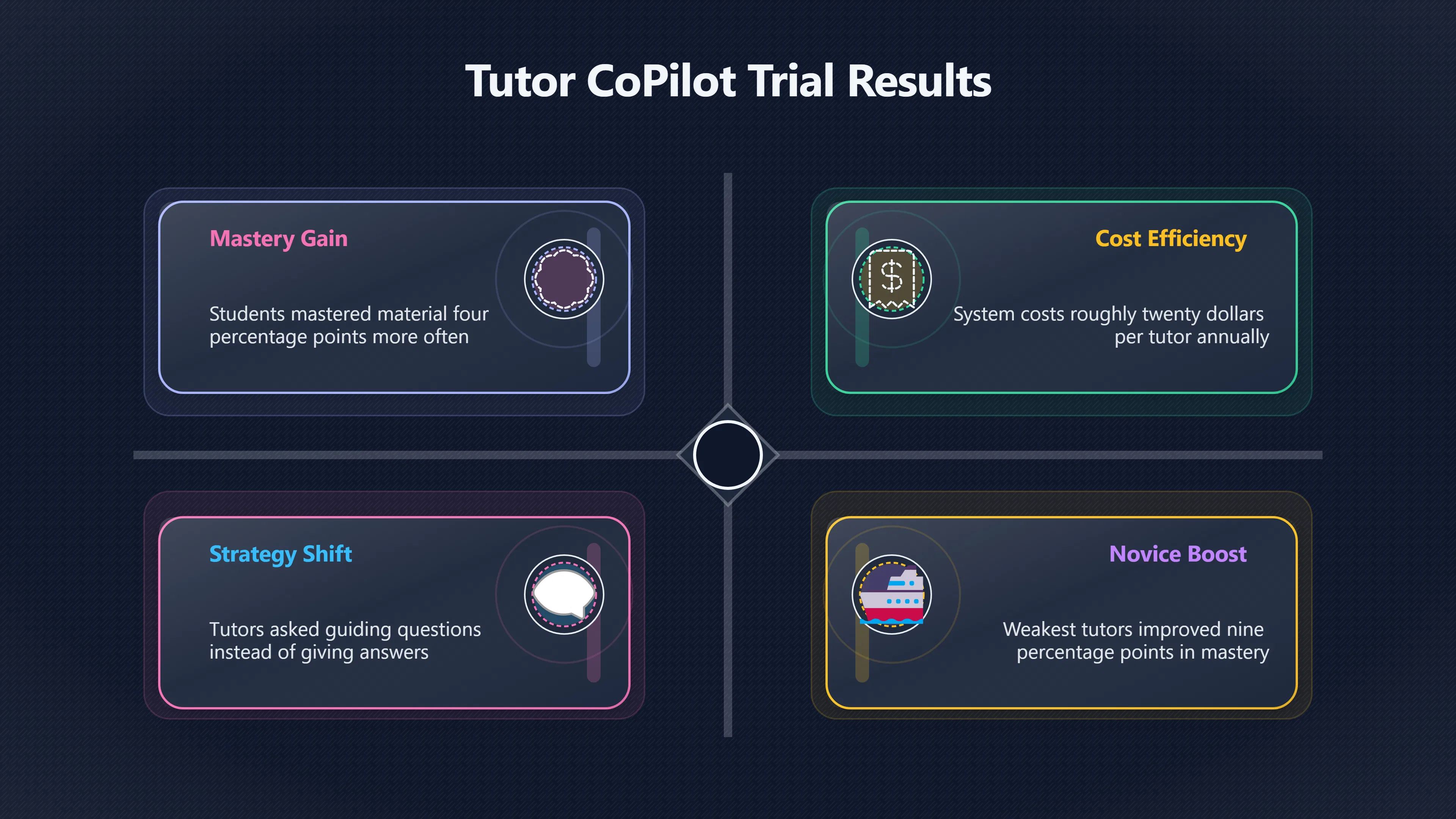
Students whose tutors had access to Tutor CoPilot were around four percentage points more likely to master the material covered during sessions compared with students whose tutors did not receive AI assistance.[arXiv]arxiv.orgarXiv Tutor Co Pilot: A Human-AI Approach for Scaling Real-Time ExpertiseTutor CoPilot: A Human-AI Approach for Scaling Real-Time ExpertiseOctober 3, 2024…[National Student Support Accelerator]nssa.stanford.eduNational Student Support AcceleratorStudy: AI-Assisted Tutoring Boosts Students' Math Skills7 Oct 2024 — And the weakest tutors became ne…
A four-point gain may not sound dramatic at first glance. But in education research, especially for relatively low-cost interventions, even modest improvements can matter when applied across large populations. The researchers estimated that the system’s operating costs were roughly twenty dollars per tutor per year during the study period.[arXiv]arxiv.orgarXiv Tutor Co Pilot: A Human-AI Approach for Scaling Real-Time ExpertiseTutor CoPilot: A Human-AI Approach for Scaling Real-Time ExpertiseOctober 3, 2024…
Just as important was how the gains appeared to occur.
Researchers analysed more than 550,000 messages exchanged during tutoring sessions. Tutors using the AI assistant became more likely to employ recognised teaching strategies associated with learning, including asking guiding questions and encouraging students to work through reasoning processes. They also became less likely to simply provide answers.[arXiv]arxiv.orgarXiv Tutor Co Pilot: A Human-AI Approach for Scaling Real-Time ExpertiseTutor CoPilot: A Human-AI Approach for Scaling Real-Time ExpertiseOctober 3, 2024…
That pattern is significant because one of the major risks of generative AI in education is that it can encourage shortcut-taking. Tutor CoPilot appeared to push behaviour in the opposite direction, steering tutors towards practices that kept students cognitively engaged.
Why gains were larger for less-experienced tutors
Perhaps the most striking finding was that the benefits were not distributed evenly.
Students working with lower-rated tutors saw much larger improvements than students working with already strong tutors. In the study, student mastery increased by roughly nine percentage points for tutors who had previously been rated as less effective. The weakest tutors moved substantially closer to the performance of stronger tutors.[arXiv]arxiv.orgarXiv Tutor Co Pilot: A Human-AI Approach for Scaling Real-Time ExpertiseTutor CoPilot: A Human-AI Approach for Scaling Real-Time ExpertiseOctober 3, 2024…[National Student Support Accelerator]nssa.stanford.eduNational Student Support AcceleratorStudy: AI-Assisted Tutoring Boosts Students' Math Skills7 Oct 2024 — And the weakest tutors became ne…
This pattern helps explain why Tutor CoPilot attracted attention beyond education technology circles.
Many sectors of society face a similar problem. Expert performance exists, but experts are scarce, expensive and difficult to reproduce. Training enough highly skilled professionals takes years. If AI can reliably transfer some aspects of expert judgement to less-experienced workers, then overall quality may rise even without increasing the number of elite experts.
In tutoring, the mechanism is relatively intuitive. Experienced tutors already know when to pause, probe understanding and redirect students. Less-experienced tutors often know the subject but lack pedagogical instincts. An AI system that provides reminders and suggestions at the right moment may therefore help novices more than veterans.
This is one reason Tutor CoPilot fits into broader discussions about AI abundance. The system did not create a world where everyone suddenly became an expert educator. Instead, it made expert-like guidance more available at the point of need.
That distinction matters because many of the most valuable future uses of AI may work in a similar way. Rather than replacing professionals entirely, AI systems may distribute fragments of expertise across much larger populations.
The case for amplification rather than replacement
Tutor CoPilot represents a different vision from the common image of fully autonomous AI tutors.
The replacement model assumes that AI will eventually become so capable that students interact primarily with software. Human teachers and tutors become secondary or disappear entirely.
The amplification model makes a different claim. It suggests that AI’s greatest near-term value may come from strengthening human capability.
Several features of tutoring make amplification attractive:
- Human tutors provide motivation, encouragement and accountability.
- Tutors notice emotional cues and engagement problems.
- Students often trust and respond differently to another person.
- Tutors can adapt to unusual situations that fall outside training data.
- Humans can judge when AI suggestions are inappropriate or misleading.
The Tutor CoPilot researchers reported that tutors generally found the system useful while still maintaining control of the lesson. The AI generated recommendations, but humans decided whether to follow them. Interviews also revealed limitations, including suggestions that were sometimes poorly matched to student age or grade level.[arXiv]arxiv.orgarXiv Tutor Co Pilot: A Human-AI Approach for Scaling Real-Time ExpertiseTutor CoPilot: A Human-AI Approach for Scaling Real-Time ExpertiseOctober 3, 2024…
Those limitations help explain why a human-in-the-loop design may be particularly valuable in education. Teaching is not only about transmitting information. It involves judgement, relationships and contextual understanding that remain difficult to automate reliably.
The broader lesson is that AI assistance and human expertise do not have to be competing models. In many cases they may be complementary.

A possible model for making expertise abundant
The significance of Tutor CoPilot extends beyond tutoring itself.
Many optimistic visions of AI focus on making intelligence more abundant. Yet intelligence is not only about producing answers. It also includes coaching, mentoring, diagnosing problems and helping people develop skills over time.
Historically, access to those forms of expertise has been constrained by the number of trained professionals available. A talented tutor can only work with a limited number of students. An excellent mentor can only advise so many people. A master craftsperson can only supervise so many apprentices.
Tutor CoPilot suggests a potential mechanism for loosening that constraint. Rather than trying to automate expertise completely, AI can act as a multiplier on human experts by spreading some of their techniques and judgement more widely.
In principle, similar systems could eventually support:
- literacy tutors;
- language teachers;
- vocational trainers;
- health coaches;
- career advisers;
- workplace mentors.
The broader bloom argument is not that every human becomes superintelligent. It is that more people gain access to higher-quality guidance, helping them learn faster, avoid mistakes and develop capabilities that would otherwise remain inaccessible.
If such systems became reliable and widely distributed, the cumulative effect on education, workforce training and scientific participation could be substantial over decades.
The objections and unresolved questions
Tutor CoPilot’s results are encouraging, but they do not settle the larger debate.
One obvious limitation is scope. The study focused on a particular tutoring context, specific subjects and a defined intervention. It does not prove that all AI tutor-support systems will work equally well.[arXiv]arxiv.orgarXiv Tutor Co Pilot: A Human-AI Approach for Scaling Real-Time ExpertiseTutor CoPilot: A Human-AI Approach for Scaling Real-Time ExpertiseOctober 3, 2024…
There are also broader concerns.
Better tutoring is not the same as deeper learning
Some educational studies have found that unrestricted use of generative AI can improve short-term performance while weakening long-term retention or independent problem-solving. Critics worry that AI systems may sometimes encourage dependence rather than mastery.[Axios]axios.comWhy AI is no substitute for human teachersThis challenges the optimistic vision of AI as a "personal tutor for every student." Although genAI, like Khan Academy’s experimental Kha…
Tutor CoPilot partly addresses this concern because it assists the tutor rather than the student directly. Even so, researchers still need evidence about long-term outcomes rather than immediate mastery measures alone.

Human judgement remains necessary
The study’s own interviews identified occasions when AI suggestions were not appropriate for the student’s level or context. Human tutors remained necessary to filter recommendations.[arXiv]arxiv.orgarXiv Tutor Co Pilot: A Human-AI Approach for Scaling Real-Time ExpertiseTutor CoPilot: A Human-AI Approach for Scaling Real-Time ExpertiseOctober 3, 2024…
As AI systems become more influential inside classrooms, the quality of that oversight becomes increasingly important.
Access and distribution matter
If AI-assisted expertise becomes genuinely valuable, questions of access become central.
Will the strongest systems be available mainly through wealthy schools, elite tutoring services and well-funded organisations? Or will they become broadly accessible to low-income communities and under-resourced regions?
The Tutor CoPilot study is noteworthy partly because it focused on students from historically underserved communities. That focus aligns closely with the strongest version of the AI bloom argument: not simply raising average capability, but expanding access to high-quality support for people who previously lacked it.[arXiv]arxiv.orgarXiv Tutor Co Pilot: A Human-AI Approach for Scaling Real-Time ExpertiseTutor CoPilot: A Human-AI Approach for Scaling Real-Time ExpertiseOctober 3, 2024…
Why Tutor CoPilot matters in the larger AI bloom story
Tutor CoPilot is a small-scale educational intervention, not a civilisation-transforming breakthrough. Yet it illustrates an important pathway through which advanced AI could contribute to human flourishing.
The system did not replace teachers. It did not create a fully autonomous digital educator. It did something subtler: it helped ordinary tutors perform more like expert tutors.
That may ultimately be one of the most important uses of AI. Many of society’s bottlenecks come from limited access to expertise rather than limited access to information. The internet already made information abundant. Expertise remains scarce.
If AI systems can reliably transfer parts of expert judgement to millions of tutors, teachers, nurses, technicians, researchers and mentors, the result could be a gradual expansion of human capability across entire populations. The gains in the Tutor CoPilot study were modest, but they point towards a larger possibility: a future in which AI acts less as a substitute for human intelligence and more as a tool that helps more humans reach their potential.[arXiv]arxiv.orgarXiv Tutor Co Pilot: A Human-AI Approach for Scaling Real-Time ExpertiseTutor CoPilot: A Human-AI Approach for Scaling Real-Time ExpertiseOctober 3, 2024…[EduNLP Lab]edunlp.stanford.edututor copilotEduNLP LabTutor CoPilot - EduNLP Lab - Stanford UniversityOct 31, 2024 — Tutor CoPilot is an AI system designed to provide expert-level g…
eBay marketplace picks
Marketplace Samples
Example marketplace items related to this page. Use the search link to explore similar finds on eBay.


Endnotes
1.
Source: arxiv.org
Title: arXiv Tutor Co Pilot: A Human-AI Approach for Scaling Real-Time Expertise
Link:https://arxiv.org/abs/2410.03017
Source snippet
Tutor CoPilot: A Human-AI Approach for Scaling Real-Time ExpertiseOctober 3, 2024...
Published: October 3, 2024
2.
Source: nssa.stanford.edu
Link:https://nssa.stanford.edu/news/study-ai-assisted-tutoring-boosts-students-math-skills
Source snippet
National Student Support AcceleratorStudy: AI-Assisted Tutoring Boosts Students' Math Skills7 Oct 2024 — And the weakest tutors became ne...
3.
Source: edunlp.stanford.edu
Title: tutor copilot
Link:https://edunlp.stanford.edu/projects/tutor-copilot
Source snippet
EduNLP LabTutor CoPilot - EduNLP Lab - Stanford UniversityOct 31, 2024 — Tutor CoPilot is an AI system designed to provide expert-level g...
4.
Source: nssa.stanford.edu
Link:https://nssa.stanford.edu/sites/default/files/Tutor_CoPilot.pdf
Source snippet
National Student Support AcceleratorTutor CoPilot: A Human-AI Approach for Scaling Real-Time...by RE Wang · Cited by 109 — This study in...
5.
Source: axios.com
Title: Why AI is no substitute for human teachers
Link:https://www.axios.com/2024/08/15/ai-tutors-learning-education-khan-academy-wharton
Source snippet
This challenges the optimistic vision of AI as a "personal tutor for every student." Although genAI, like Khan Academy’s experimental Kha...
6.
Source: nssa.stanford.edu
Title: research notes two emerging strategies using ai tutoring
Link:https://nssa.stanford.edu/news/research-notes-two-emerging-strategies-using-ai-tutoring
Source snippet
National Student Support AcceleratorTwo Emerging Strategies for Using AI in TutoringFeb 17, 2026 — Two new randomized controlled trials f...
7.
Source: scale.stanford.edu
Link:https://scale.stanford.edu/publications/tutor-copilot-human-ai-approach-scaling-real-time-expertise
Source snippet
CoPilot: A Human-AI Approach for Scaling Real-Time...17 Nov 2025 — We introduce Tutor CoPilot, a Human-AI system that models expert thin...
8.
Source: nssa.stanford.edu
Link:https://nssa.stanford.edu/studies/tutor-copilot-human-ai-approach-scaling-real-time-expertise
Source snippet
CoPilot: A Human-AI Approach for Scaling Real-Time...Dec 15, 2024 — This study is the first of its kind—a randomized controlled trial te...
9.
Source: edunlp.stanford.edu
Title: tutor copilot article
Link:https://edunlp.stanford.edu/news/article/tutor-copilot-article
Source snippet
October 07, 2024. Tutor...Read more...
Published: October 7, 2024
10.
Source: tutor.com
Link:https://www.tutor.com/
Source snippet
ing and Test Prep for K–12, Higher Education, and CareerTutor.com provides 24/7, expert, individualized academic and job support for...
Additional References
11.
Source: gostudent.org
Link:https://www.gostudent.org/en-gb/become-a-tutor/
Source snippet
Become a tutor and start teaching online with GoStudentJoin GoStudent as an online tutor. Set your own hours, teach subjects you love, an...
12.
Source: edworkingpapers.com
Link:https://edworkingpapers.com/sites/default/files/ai24-1054.pdf
Source snippet
Tutor CoPilot: A Human-AI Approach for Scaling Real-Time...by S Loeb — This study presents the first randomized controlled trial of a Hu...
13.
Source: overdeck.org
Link:https://overdeck.org/research-repository/tutoring/tutor-copilot-a-human-ai-approach-for-scaling-real-time-expertise/
Source snippet
Overdeck Family FoundationTutor CoPilot: A Human-AI Approach for Scaling Real-Time...This study uses an RCT to estimate the impacts of T...
14.
Source: linkedin.com
Link:https://www.linkedin.com/top-content/innovation/ai-in-education-innovation/how-ai-tutoring-can-boost-learning-outcomes/
Source snippet
How AI Tutoring Can Boost Learning OutcomesAI tutoring uses intelligent computer systems to provide personalized guidance, interactive fe...
15.
Source: reddit.com
Link:https://www.reddit.com/r/machinelearningnews/comments/1fz9cil/researchers_at_stanford_university_introduce/
Source snippet
Researchers at Stanford University Introduce Tutor CoPilot...Researchers from Stanford University developed Tutor CoPilot, a human-AI co...
16.
Source: medium.com
Link:https://medium.com/syncedreview/sandford-us-tutor-copilot-transforms-real-time-tutoring-with-ai-driven-expert-guidance-b2a7cf5d5c18
Source snippet
Sandford U's Tutor CoPilot Transforms Real-Time...Overall, this study demonstrates Tutor CoPilot's potential as an effective Human-AI so...
17.
Source: linkedin.com
Link:https://www.linkedin.com/pulse/stanford-tutor-copilot-human-ai-approach-scaling-real-time-expertise-bx7me
Source snippet
Stanford: Tutor CoPilot – A Human-AI Approach for Scaling...This paper describes the development and evaluation of Tutor CoPilot, a huma...
18.
Source: semanticscholar.org
Link:https://www.semanticscholar.org/paper/Tutor-CoPilot%3A-A-Human-AI-Approach-for-Scaling-Wang-Ribeiro/69ee881b66e99453314b8a5445ba4a3160f4ed0a
Source snippet
Tutor CoPilot: A Human-AI Approach for Scaling Real-Time...This study is the first randomized controlled trial of a Human-AI system in l...
19.
Source: syncedreview.com
Link:https://syncedreview.com/2024/11/15/self-evolving-prompts-redefining-ai-alignment-with-deepmind-chicago-us-eva-framework-3/
Source snippet
Stanford U's Tutor CoPilot Transforms Real-Time Tutoring with...15 Nov 2024 — Tutor CoPilot aims to enhance K-12 education by providing...
20.
Source: linkedin.com
Link:https://www.linkedin.com/posts/45deg_two-new-randomized-controlled-trials-just-activity-7436264527907913728-MqwR
Source snippet
AI Tutoring Outperforms Human Tutors in RCTs7 Mar 2026 — a separate RCT published in Scientific Reports found AI-assisted learners hit hi...
Topic Tree