Within Civilisation backup
How Many People Are Needed for a Sustainable Space Colony?
Analyzes population size, genetic diversity, and social structures required for off-Earth communities to maintain viable human populations over generations.
On this page
- Minimum population thresholds
- Maintaining genetic diversity
- Social and cultural continuity strategies
Page outline Jump by section
Introduction
If off-Earth settlements are meant to act as a backup for civilisation, one question quickly becomes unavoidable: how many people would actually be needed to keep a human population healthy, stable and self-sustaining across generations?
 The answer is more complicated than simply keeping enough people alive to reproduce. Long-term population viability depends on genetics, demography, social organisation, education, fertility patterns, health, and the ability to cope with unexpected shocks. A settlement that begins with only a few hundred people might survive for decades, but still face serious risks from inbreeding, loss of genetic diversity, labour shortages, cultural fragmentation or demographic collapse. Researchers studying population genetics and multi-generational spaceflight have repeatedly found that the numbers required for long-term resilience may be much larger than early space-colonisation visions assumed.[ScienceDirect]sciencedirect.comEstimation of a genetically viable population for…by CM Smith · 2014 · Cited by 57 — I present several formulae as well a… 2arXiv
Within the broader AI Bloom vision, these questions matter because space settlement is often presented as a way to enlarge and protect humanity’s long-term future. Yet a settlement cannot function as a meaningful civilisational backup if it cannot maintain a viable population over centuries. The demographic problem is therefore not a side issue. It sits at the centre of whether off-Earth communities could ever become genuinely independent branches of human civilisation.
Why Population Size Matters More Than It First Appears
Popular discussions of Mars colonies often focus on rockets, habitats and life-support systems. Population biology introduces a different constraint: even a technologically advanced settlement can fail if its human population becomes too small or too genetically narrow.
Conservation biology uses the concept of a minimum viable population: the smallest population likely to avoid extinction over long periods despite accidents, environmental shocks and genetic decline. While humans differ from endangered animal populations in important ways, the underlying principles still apply. Small populations face heightened risks from random demographic fluctuations, unequal birth rates, disease outbreaks and genetic drift.[Wikipedia]WikipediaMinimum viable populationMinimum viable population
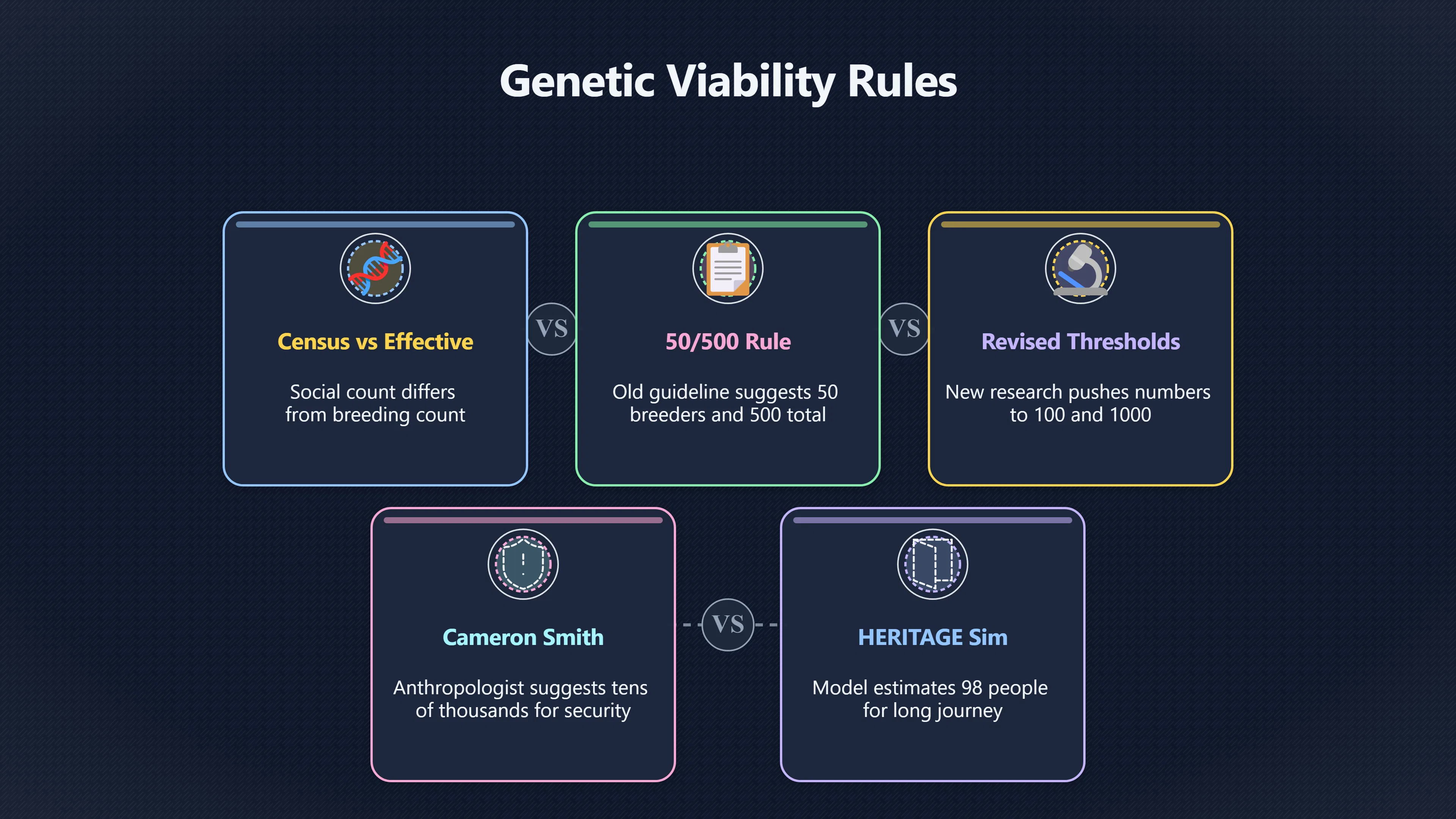
A particularly important distinction is between the census population and the effective population size. A settlement may contain 1,000 people, but if only a fraction reproduce, if some families have many more children than others, or if sex ratios become unbalanced, the effective population can be dramatically smaller. Population geneticists often focus on effective population size because it better predicts long-term genetic health.[PMC]pmc.ncbi.nlm.nih.govDealing With the Complexity of Effective Population Size in…by A Fedorca · 2024 · Cited by 21 — Effective population size (Ne) is d…
This creates a surprising implication: a colony that appears large enough socially may still be too small genetically.
Minimum Population Thresholds: Why Estimates Vary So Widely
One reason debates about space settlement become confusing is that different researchers are answering different questions.
A colony intended to survive for several decades with regular Earth support requires far fewer people than a settlement expected to remain genetically healthy and technologically capable for centuries without assistance.
Several broad estimates appear repeatedly in the literature:
- Traditional conservation genetics proposed the well-known “50/500 rule”, suggesting roughly 50 breeding individuals to reduce immediate inbreeding risk and around 500 to preserve long-term genetic variation. Later work argued these figures were too low and suggested thresholds closer to 100 and 1,000 effective individuals respectively.[ScienceDirect]sciencedirect.comEstimation of a genetically viable population for…by CM Smith · 2014 · Cited by 57 — I present several formulae as well a…
- Research on multi-generational interstellar voyages has produced much larger estimates. Anthropologist Cameron Smith argued that populations of only a few hundred settlers would be insufficient and suggested founding populations in the tens of thousands for robust long-term genetic security.[ScienceDirect]sciencedirect.comEstimation of a genetically viable population for…by CM Smith · 2014 · Cited by 57 — I present several formulae as well a…
- Other simulation-based studies reached lower numbers under highly controlled assumptions. The HERITAGE Monte Carlo simulations estimated that roughly 98 people could maintain a genetically healthy population during a long interstellar journey if strict reproductive management rules were followed.[arXiv]arxiv.orgSource details in endnotes.
- Agent-based models examining Mars settlements have produced even smaller estimates, sometimes around 20–30 initial settlers, but these studies generally focus on operational survival over decades rather than preserving broad human genetic diversity across centuries.[arXiv]arxiv.orgSource details in endnotes.
These numbers are not really contradictions. They describe different goals.
A settlement designed merely to avoid immediate extinction may require dozens or hundreds of people. A settlement intended to preserve humanity’s evolutionary potential, cultural complexity and long-term adaptability may require populations in the thousands or tens of thousands.[ScienceDirect]sciencedirect.comEstimation of a genetically viable population for…by CM Smith · 2014 · Cited by 57 — I present several formulae as well a…[ScienceDirect]sciencedirect.comEstimation of a genetically viable population for…by CM Smith · 2014 · Cited by 57 — I present several formulae as well a…
The Genetic Diversity Problem
The greatest biological challenge for a small isolated settlement is the gradual loss of genetic diversity.
On Earth, large populations constantly exchange genes across regions and continents. A Mars colony or remote orbital habitat would initially have no such luxury. Every birth would draw from a limited founding population.
Inbreeding and Hidden Genetic Risks
All humans carry harmful recessive mutations that rarely cause problems because they are paired with healthy gene variants. In small populations, relatives are more likely to have children together, increasing the chance that harmful mutations become expressed.
This process, known as inbreeding depression, can reduce fertility, increase disease susceptibility and raise the frequency of inherited disorders. Conservation biology has documented these effects across many species, and there is little reason to think humans would be immune to the underlying genetic mechanisms.[ScienceDirect]sciencedirect.comEstimation of a genetically viable population for…by CM Smith · 2014 · Cited by 57 — I present several formulae as well a…
The challenge is magnified by isolation. A terrestrial community suffering from genetic bottlenecks can often recover through migration and intermarriage with neighbouring populations. An autonomous settlement on Mars may have no comparable option for decades or centuries.
Genetic Drift and Loss of Adaptability
Even if serious inherited diseases are avoided, small populations face another threat: genetic drift.
Random chance causes some genetic variants to disappear over generations. As diversity declines, the population becomes less able to adapt to new diseases, environmental changes or unforeseen biological challenges.[PMC]pmc.ncbi.nlm.nih.govDealing With the Complexity of Effective Population Size in…by A Fedorca · 2024 · Cited by 21 — Effective population size (Ne) is d…
This issue matters especially because space environments themselves may introduce novel selective pressures:
- Increased radiation exposure.
- Altered gravity.
- Closed ecological systems.[sciencedirect.com]sciencedirect.comBiodiversity requirements for self-sustaining space coloniesby AR Johnson · 2019 · Cited by 21 — A high degree of biodiversity will be re…
- Different microbial environments.
- Potential long-term physiological changes associated with life off Earth.
Future settlers may need genetic flexibility precisely because their environment differs so dramatically from Earth. A genetically narrow population could find adaptation harder rather than easier.[The MIT Press Reader]thereader.mitpress.mit.eduThe MIT Press ReaderWill Life on Mars Require a Genetic Rewrite?Feb 12, 2026 — What Mason and his researchers know for sure is that settl…
Frozen Embryos, Gene Banks and AI-Assisted Genetics
One reason modern estimates differ from older population calculations is that future settlements may not rely solely on living settlers.
Many researchers have proposed large repositories of frozen sperm, eggs and embryos as a way to expand effective genetic diversity without transporting huge populations. The HERITAGE simulations specifically found that cryogenic genetic banks could substantially improve long-term outcomes for multi-generational missions.[arXiv]arxiv.orgSource details in endnotes.
In principle, a settlement might begin with:
- Several hundred or several thousand living settlers.
- Tens of thousands of stored embryos.
- Extensive genomic databases.
- Advanced reproductive technologies.
This could dramatically expand the available gene pool while reducing launch costs.
The idea becomes even more significant in an AI-accelerated future. Advanced AI systems could potentially assist with:
- Monitoring genetic diversity across generations.
- Predicting inherited disease risks.
- Managing reproductive planning without excessive loss of autonomy.
- Designing safer fertility treatments.
- Preserving genomic archives.
- Modelling long-term population trajectories.
However, this creates difficult ethical questions. Population management rapidly approaches sensitive territory involving reproductive freedom, genetic selection and social control. A technically feasible system may still prove politically or morally unacceptable.
Demography Can Be More Dangerous Than Genetics
A colony does not need a genetic catastrophe to fail.
Simple demographic imbalance can be equally destructive.
Age Structure Problems
A settlement requires a workable distribution of ages.
Too many elderly residents create heavy healthcare and support burdens. Too few children create future labour shortages. Too few working-age adults can undermine maintenance, agriculture, manufacturing and education.
Earth societies already struggle with ageing populations. A small off-Earth settlement would have far less room for error because every demographic cohort matters more.[Nature]nature.comGenetics 163: 429–446. CAS PubMed PubMed…

Fertility and Family Formation
A settlement’s long-term viability depends on people choosing to have children.
This cannot be assumed.
Space settlements may involve:
- Confined living conditions.
- High stress.
- Resource constraints.
- Medical uncertainties.
- Limited privacy.
- Reduced personal freedom.
These factors could reduce fertility rates. A colony that consistently falls below replacement level could shrink even if mortality remains low.
The challenge becomes particularly important for civilisational-backup arguments. A population that survives technically but steadily declines cannot preserve human civilisation indefinitely.
Skill Bottlenecks
Small populations also face a knowledge problem.
A settlement needs:
- Doctors.
- Engineers.
- Farmers.
- Educators.
- Scientists.
- Software specialists.
- Governance institutions.
- Manufacturing expertise.
Modern civilisation depends on extraordinary specialisation. Maintaining enough expertise in a population of only a few hundred people may prove extremely difficult.
This is one reason some analysts argue that genuine independence may require populations far larger than the minimum needed for biological survival. The challenge is not simply preserving human DNA but preserving an entire technological civilisation. Nature[PMC]pmc.ncbi.nlm.nih.govDealing With the Complexity of Effective Population Size in…by A Fedorca · 2024 · Cited by 21 — Effective population size (Ne) is d…
Social and Cultural Continuity May Be the Hardest Problem
Even a genetically healthy population can fail if its social structures break down.
Many discussions of space settlement underestimate how dependent modern societies are on large populations, institutions and cultural networks.
Maintaining Shared Knowledge
A civilisational backup must preserve more than people.
It must preserve:
- Scientific knowledge.
- Technical skills.
- Historical records.
- Languages.
- Educational systems.
- Cultural traditions.
- Political norms.
Small isolated populations can experience cultural drift just as they experience genetic drift. Knowledge may disappear if too few people possess it or if educational systems weaken across generations.
The challenge resembles the problem of preserving a complex library after a societal collapse. Keeping information stored is easier than ensuring future generations can understand and use it.
Social Cohesion Without Stagnation
Long-term settlements need a balance between cohesion and diversity.
Too little cohesion can produce factional conflict in a confined environment where disputes cannot easily be escaped.
Too much cohesion can produce stagnation, conformity and resistance to innovation.
Historical isolated communities on Earth often struggled with these tensions. Future space settlements may face them in more extreme forms because of physical confinement and limited opportunities for migration.
Governance Across Generations
A further complication is legitimacy.
The first generation chooses to settle.
Later generations do not.
People born in a Martian settlement might question governance systems imposed by founders decades earlier. They may develop distinct identities, priorities and cultural values.
A settlement designed as a backup for humanity could gradually become something different: a separate branch of human civilisation with its own interests.
Could AI Reduce Population Viability Constraints?
One of the strongest AI Bloom arguments is that advanced AI could make small populations more capable than they would otherwise be.
Historically, population size was tied closely to productive capacity. Larger societies could support more specialists, produce more knowledge and maintain more complex institutions.
Advanced AI and robotics could weaken that relationship.
Potential benefits include:
- Automated manufacturing reducing labour requirements.
- AI tutors preserving expertise across generations.
- Scientific AI helping small populations solve technical problems.
- Automated healthcare supporting limited medical staff.
- Better forecasting of demographic and genetic risks.
- Digital archives that remain searchable and usable even with small populations.
In principle, a settlement of a few thousand people equipped with highly capable AI might sustain functions that once required hundreds of thousands or millions.
Yet AI does not eliminate the biological constraints entirely. Humans would still need sufficient genetic diversity, stable fertility, functioning families and resilient social institutions. AI may reduce the minimum population needed for technological civilisation, but it cannot entirely remove the challenges of reproduction, adaptation and social continuity.
Why Population Viability Is Central to the Backup-Civilisation Argument
The strongest versions of the off-Earth backup argument often imagine self-sustaining settlements preserving humanity through planetary catastrophes. Population viability is one of the main tests of whether that vision is realistic.
The key lesson from genetics, demography and population modelling is that survival involves more than keeping a few pioneers alive. A genuine backup civilisation must maintain healthy reproduction, preserve genetic diversity, retain specialised knowledge, educate future generations and remain socially stable for centuries.
That does not necessarily require millions of people. But the evidence suggests that the threshold for a robust, independent civilisation is probably far higher than the tiny outposts often depicted in early colonisation scenarios. Whether future advances in biotechnology, reproductive medicine, cryogenic gene storage and AI-assisted governance can lower those thresholds remains an open question.
For advocates of humanity’s long-term future, this makes population viability one of the most important—and least glamorous—constraints on space settlement. Rockets may open the door to other worlds, but demographics determines whether a civilisation can stay there.
Amazon book picks
Further Reading
Books and field guides related to How Many People Are Needed for a Sustainable Space Colony?. Use these as the next step if you want deeper reading beyond the article.
A City on Mars
Directly examines whether large, self-sustaining space populations are realistic.
eBay marketplace picks
Marketplace Samples
Example marketplace items related to this page. Use the search link to explore similar finds on eBay.


Endnotes
1.
Source: sciencedirect.com
Link:https://www.sciencedirect.com/science/article/abs/pii/S0094576513004669
Source snippet
Estimation of a genetically viable population for...by CM Smith · 2014 · Cited by 57 — I present several formulae as well a...
2.
Source: arxiv.org
Link:https://arxiv.org/abs/1806.03856
3.
Source: sciencedirect.com
Link:https://www.sciencedirect.com/science/article/abs/pii/S0006320713004576
Source snippet
Revised recommendations for the 50/500 rules, Red List...by R Frankham · 2014 · Cited by 1349 — Evidence accumulated since...
4.
Source: Wikipedia
Title: Minimum viable population
Link:https://en.wikipedia.org/wiki/Minimum_viable_population
5.
Source: pmc.ncbi.nlm.nih.gov
Link:https://pmc.ncbi.nlm.nih.gov/articles/PMC11645448/
Source snippet
Dealing With the Complexity of Effective Population Size in...by A Fedorca · 2024 · Cited by 21 — Effective population size (Ne) is d...
6.
Source: nature.com
Link:https://www.nature.com/articles/hdy201643
Source snippet
Genetics 163: 429–446. CAS PubMed PubMed...
7.
Source: space.com
Title: 26603 interstellar starship colony population size
Link:https://www.space.com/26603-interstellar-starship-colony-population-size.html
Source snippet
Want to Colonize an Alien Planet? Send 40000 People28 Jul 2014 — Smith's calculations, which combine information from population genetics...
8.
Source: arxiv.org
Link:https://arxiv.org/abs/1708.08649
9.
Source: arxiv.org
Title: arXiv An Exploration of Mars Colonization with Agent-Based Modeling
Link:https://arxiv.org/abs/2308.05916
Source snippet
An Exploration of Mars Colonization with Agent-Based ModelingAugust 11, 2023...
Published: August 11, 2023
10.
Source: thereader.mitpress.mit.edu
Link:https://thereader.mitpress.mit.edu/will-life-on-mars-require-a-genetic-rewrite/
Source snippet
The MIT Press ReaderWill Life on Mars Require a Genetic Rewrite?Feb 12, 2026 — What Mason and his researchers know for sure is that settl...
11.
Source: nature.com
Link:https://www.nature.com/articles/s41598-020-66740-0
Source snippet
Minimum Number of Settlers for Survival on Another Planetby JM Salotti · 2020 · Cited by 23 — A mathematical model can be used to d...
12.
Source: sciencedirect.com
Link:https://www.sciencedirect.com/science/article/abs/pii/S0265964620300308
Source snippet
The Martian: Possible Scenarios for a Future Human...by K Szocik · 2020 · Cited by 40 — The aim of the article is to present a wide rang...
13.
Source: sciencedirect.com
Title: Effective Population Size
Link:https://www.sciencedirect.com/topics/medicine-and-dentistry/effective-population-size
Source snippet
an overviewGenerally, effective population size is a fraction of census population size, reflecting variance in the proportion of individ...
14.
Source: sciencedirect.com
Link:https://www.sciencedirect.com/science/article/abs/pii/S0016328718303045
Source snippet
Biodiversity requirements for self-sustaining space coloniesby AR Johnson · 2019 · Cited by 21 — A high degree of biodiversity will be re...
15.
Source: Wikipedia
Title: Outer space
Link:https://en.wikipedia.org/wiki/Outer_space
Source snippet
Outer spaceOuter space (or simply space) is the expanse that exists beyond Earth's atmosphere and between celestial bodies.Read more...
16.
Source: Wikipedia
Title: Colonization of Mars
Link:https://en.wikipedia.org/wiki/Colonization_of_Mars
Source snippet
Colonization of MarsThe colonization of Mars is the proposed process of establishing permanent human settlements on the planet Mars...
17.
Source: britannica.com
Title: minimum viable population
Link:https://www.britannica.com/science/minimum-viable-population
Source snippet
Encyclopedia BritannicaMinimum viable population (MVP) | Definition, Examples, &...Apr 10, 2026 — They created the “50/500” rule, which...
18.
Source: britannica.com
Title: 50 500 rule
Link:https://www.britannica.com/science/50-500-rule
Source snippet
50/500 rule | biology and population analysis8 Apr 2026 — The "50/500 rule" is a guideline in conservation biology suggesting a minimum p...
19.
Source: marspedia.org
Link:https://marspedia.org/Population
Source snippet
May 11, 2019 — The composition of the Population of a colony on Mars will be subject to several conditions. This article tries to outline...
Published: May 11, 2019
20.
Source: vocabulary.com
Link:https://www.vocabulary.com/dictionary/minimum
Source snippet
Definition, Meaning & SynonymsThe minimum is the lowest or smallest amount possible or acceptable. If you do the minimum amount of work a...
Additional References
21.
Source: smad.com
Link:https://smad.com/wp-content/uploads/2023/01/50-year-Window-to-Establish-a-Space-Faring-Civilization.pdf
Source snippet
physicist Paul Davies pointed out that, "A Martian colony could keep the flame of civilization and culture alive until Earth could be rev...
22.
Source: minimumfashion.com
Link:https://minimumfashion.com/
Source snippet
Minimum Officiel Webshop | Clothing for Men & WomenMinimum Official Webshop | ✓ styles online for men and women ✓ ️Quick delivery ✓ ️High...
23.
Source: merriam-webster.com
Link:https://www.merriam-webster.com/dictionary/minimum
24.
Source: geneticliteracyproject.org
Title: heres what potential mars colonists really need from earth a large gene pool
Link:https://geneticliteracyproject.org/2018/03/16/heres-what-potential-mars-colonists-really-need-from-earth-a-large-gene-pool/
Source snippet
Here's what potential Mars colonists really need from EarthMar 16, 2018 — Establishment of a Mars colony will depend on genetic diversity...
25.
Source: research.fs.usda.gov
Title: (MVP), the population size required to provide some.Read
Link:https://research.fs.usda.gov/treesearch/download/38156.pdf
Source snippet
viable populationsby CH Flather · 2011 · Cited by 326 — To inform conservation policy, recent studies have revived the concept of the min...
26.
Source: worldbuilding.stackexchange.com
Title: what is the minimum human population necessary for a sustainable colony
Link:https://worldbuilding.stackexchange.com/questions/3/what-is-the-minimum-human-population-necessary-for-a-sustainable-colony
Source snippet
is the minimum human population necessary for...16 Sept 2014 — The answer to this is a ~40 based on the Sentinelese tribe(s) that are lo...
27.
Source: pmc.ncbi.nlm.nih.gov
Title: PMCA comprehensive blueprint for Mars colonization
Link:https://pmc.ncbi.nlm.nih.gov/articles/PMC10884476/
Source snippet
comprehensive blueprint for Mars colonization - PMC - NIHby F Neukart · 2024 · Cited by 55 — This paper thoroughly explores the feasibili...
28.
Source: [discovery]({{ ‘discovery/’ | relative_url }}). ucl.ac.uk
Link:https://discovery.ucl.ac.uk/10081208/1/Reiss_AAM_Szocik%2C%20Norman%20%26%20Reiss%202019%20SciEngineerEthics%20Ethical%20challenges%20in%20human%20space%20missions.pdf
Source snippet
he chances for our species' survival, this goal seems likely to trump other competing values.Read more...
29.
Source: space.stackexchange.com
Title: what is the smallest number of humans required for colonization
Link:https://space.stackexchange.com/questions/450/what-is-the-smallest-number-of-humans-required-for-colonization
Source snippet
is the smallest number of humans required for...19 Jul 2013 — There is an estimate at Understanding Genetics that the minimum number of...
30.
Source: universetoday.com
Title: whats the bare minimum number of people for a mars habitat
Link:https://www.universetoday.com/articles/whats-the-bare-minimum-number-of-people-for-a-mars-habitat
Source snippet
What's the Bare Minimum Number of People for a Mars...6 Sept 2023 — But if this most recent study proves accurately that a future Mars c...
Topic Tree