Within Ageing clocks
The promise and limits of dementia warning clocks
AI models using blood proteins show why early dementia prediction is exciting, but also why accuracy must translate into action.
On this page
- How blood protein models search for long range dementia risk
- Why earlier signals could matter for patients and trials
- What still has to be proved before routine use
Page outline Jump by section
Introduction
One of the most striking promises in AI-driven medicine is the idea that disease might be detected years before symptoms appear. Dementia has become an important early test case for that vision. Researchers are increasingly using machine learning systems to analyse hundreds or even thousands of proteins circulating in blood, searching for patterns that appear long before memory loss, confusion, or formal diagnosis. The hope is not simply earlier diagnosis, but a shift towards prevention: identifying high-risk people while there is still time to intervene, enrol them in clinical trials, or slow disease progression. Yet dementia also exposes the hardest question facing AI ageing clocks. A prediction only becomes medically valuable if it leads to actions that improve outcomes. Dementia blood-protein models therefore sit at the intersection of scientific excitement and clinical uncertainty.[PubMed]pubmed.ncbi.nlm.nih.govWe examined this in data from 52645 adults without…[University of Warwick]warwick.ac.ukUniversity of WarwickProtein biomarkers predict dementia 15 years before…12 Feb 2024 — The research, published today in Nature Aging…

How blood-protein models search for long-range dementia risk
Blood contains thousands of proteins produced by the brain, immune system, liver, blood vessels, and other tissues. Some change as neurodegenerative diseases develop. Instead of looking for a single biomarker, newer AI systems analyse large protein panels simultaneously and search for statistical signatures associated with future dementia risk.[PubMed]pubmed.ncbi.nlm.nih.govWe examined this in data from 52645 adults without…[PMC]pmc.ncbi.nlm.nih.govPMCPlasma Proteomic Signatures for Alzheimer's DiseaseProteomic Signatures for Alzheimer's Disease - PMCby M Hu · 2025 — There is growing recognition of the potential of plasma proteomics for…
This is where machine learning becomes important. Dementia is not caused by one simple process. Alzheimer’s disease alone involves amyloid accumulation, tau pathology, inflammation, vascular changes, metabolic disruption, immune responses, and gradual neuronal damage. A human researcher might identify a handful of relevant proteins. An AI model can examine hundreds or thousands at once and identify combinations that together predict future outcomes.[PubMed]pubmed.ncbi.nlm.nih.govWe examined this in data from 52645 adults without… Nature Several proteins appear repeatedly across studies:[nature.com]nature.comPlasma proteomic associations with Alzheimer's disease…by S Afshar · 2025 · Cited by 8 — In this study, we analyzed the plasma p…
- GFAP (glial fibrillary acidic protein), associated with activation of support cells in the brain.
- NfL (neurofilament light chain), a marker of neuronal injury.
- GDF15, linked to stress responses and ageing.
- LTBP2, involved in tissue remodelling and repeatedly associated with future dementia risk.
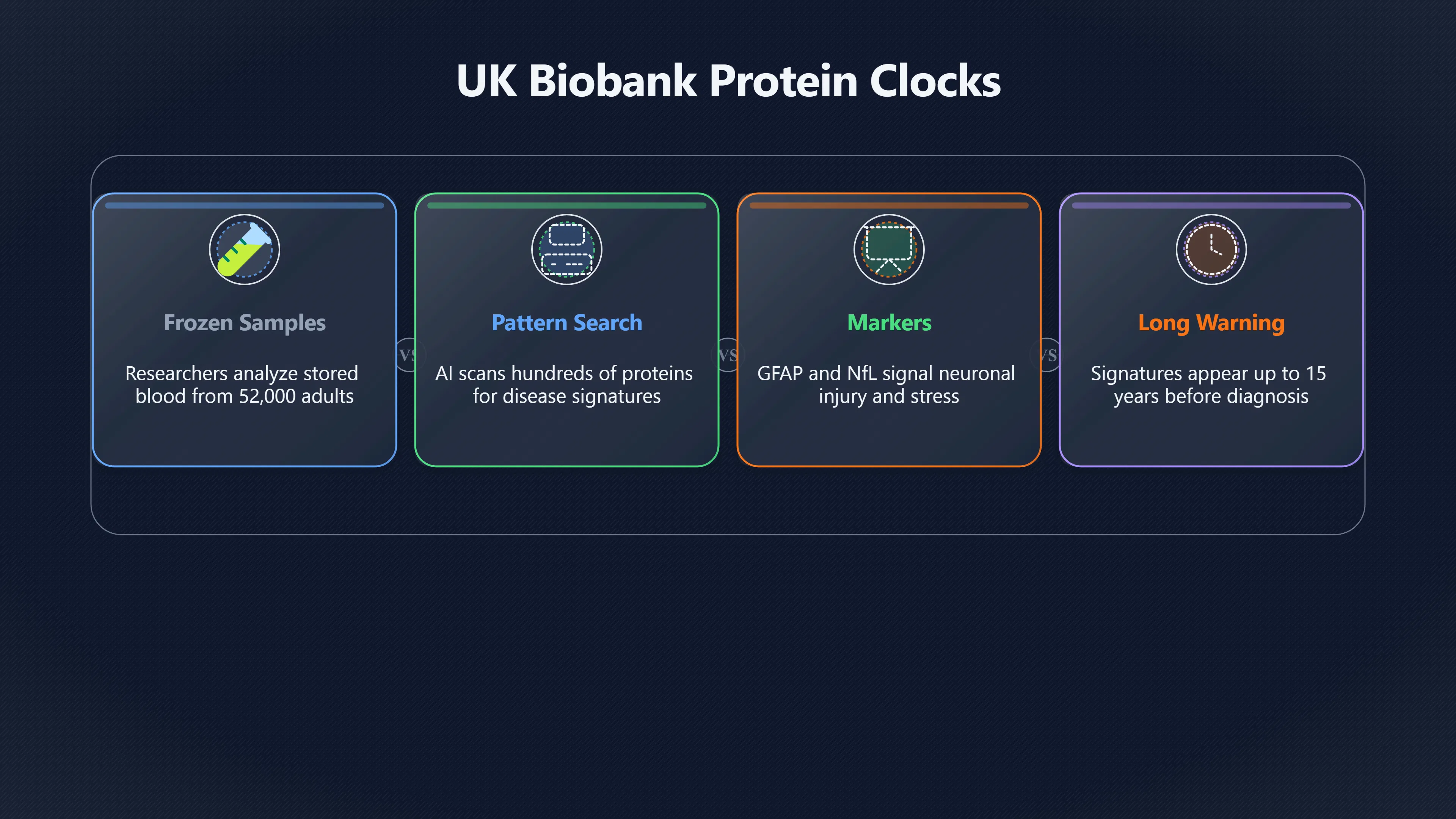
In a large UK Biobank analysis involving more than 52,000 adults, researchers found that these proteins were among the strongest predictors of later dementia across Alzheimer’s disease, vascular dementia, and all-cause dementia outcomes. Participants were followed for more than 14 years, allowing researchers to test whether blood protein patterns appeared long before diagnosis.[PubMed]pubmed.ncbi.nlm.nih.govWe examined this in data from 52645 adults without…
The broader significance extends beyond dementia. Proteomic ageing clocks are increasingly being developed as general measures of biological ageing. Large studies using thousands of blood proteins have shown that proteomic age estimates can predict mortality and a wide range of age-related diseases. Dementia therefore serves as one of the first major attempts to translate these broader ageing-clock ideas into a specific clinical problem.[PMC]pmc.ncbi.nlm.nih.govPMCPlasma Proteomic Signatures for Alzheimer's DiseaseProteomic Signatures for Alzheimer's Disease - PMCby M Hu · 2025 — There is growing recognition of the potential of plasma proteomics for…
Why dementia became such an important test case
Dementia is unusually well suited to early-warning research because the disease process often begins many years before symptoms become obvious.
Brain changes associated with Alzheimer’s disease can accumulate for a decade or more before diagnosis. By the time a patient develops significant memory problems, substantial neuronal damage may already have occurred. This creates a strong incentive to identify risk earlier.[Sky News]news.sky.comSky NewsBlood test could detect Alzheimer's signs 'decades before…2 days ago — 2 days ago — The findings show the disease may be prese…
Researchers have increasingly reported evidence that blood-protein signatures can identify elevated risk well before conventional diagnosis. A major Nature Aging study reported that blood protein profiles could predict dementia up to 15 years before clinical diagnosis. The work analysed stored blood samples and used machine learning methods to identify predictive protein patterns associated with future disease.[University of Warwick]warwick.ac.ukUniversity of WarwickProtein biomarkers predict dementia 15 years before…12 Feb 2024 — The research, published today in Nature Aging…
Other studies have attempted to move beyond simple risk prediction towards estimating disease trajectories. Researchers are now developing “brain ageing” and Alzheimer’s-specific proteomic clocks that attempt to estimate how far a person’s biological brain age differs from their chronological age. Some models combine protein signatures with measures of cognitive performance and disease biomarkers to improve classification of Alzheimer’s risk.[PMC]pmc.ncbi.nlm.nih.govPMCPlasma Proteomic Signatures for Alzheimer's DiseaseProteomic Signatures for Alzheimer's Disease - PMCby M Hu · 2025 — There is growing recognition of the potential of plasma proteomics for…[Alzheimer's Journals]alz-journals.onlinelibrary.wiley.comAlzheimer's JournalsPlasma proteomic Alzheimer's risk score: Biological age clock…by S Liu · 2025 · Cited by 1 — Plasma proteomic agin…
From the perspective of the wider AI bloom argument, dementia matters because it provides a concrete example of how AI might eventually transform medicine from reactive treatment towards long-horizon prevention. If biological warning systems can identify disease processes years before symptoms emerge, healthcare could become increasingly anticipatory rather than crisis-driven. Dementia is one of the first areas where researchers are seriously testing that possibility against real-world data rather than speculative theory.[PubMed]pubmed.ncbi.nlm.nih.govWe examined this in data from 52645 adults without…
Why earlier signals could matter for patients and trials
The strongest immediate argument for dementia prediction models is not that they can cure disease, but that they may make prevention research more effective.
Many Alzheimer’s drug trials fail because participants are enrolled after substantial neurological damage has already occurred. If blood-based AI models can identify people who are biologically entering a disease process years earlier, researchers gain a much larger window for testing interventions.[Nature]nature.comPlasma proteomic associations with Alzheimer's disease…by S Afshar · 2025 · Cited by 8 — In this study, we analyzed the plasma p…
This could make clinical trials:
- Faster, because higher-risk participants can be identified more efficiently.
- Cheaper, because blood tests are less invasive and less expensive than brain scans or spinal-fluid sampling.
- More informative, because researchers can track biological progression before severe symptoms appear.[WashU Medicine]medicine.washu.eduWashU MedicineBlood test “clocks” predict when Alzheimer's symptoms will start19 Feb 2026 — These proteins build up predictably over time…[ScienceDirect]sciencedirect.comPrediction of longitudinal cognitive decline in preclinical Alzheimer disease using plasma biomarkers.Read more…
There are also potential benefits for individual patients.
Blood testing is much easier to scale than PET imaging or lumbar punctures. If reliable prediction becomes possible, people with elevated risk could receive more intensive monitoring, cardiovascular risk management, cognitive assessment, hearing-loss treatment, exercise programmes, or future disease-modifying therapies earlier in life.[ScienceDirect]sciencedirect.comPrediction of longitudinal cognitive decline in preclinical Alzheimer disease using plasma biomarkers.Read more…
This is particularly relevant because dementia prevention increasingly appears connected to broader health systems rather than a single disease mechanism. Many of the proteins associated with future dementia risk are linked not only to brain pathology but also inflammation, immune ageing, vascular health, and systemic biological stress. In practice, a dementia-risk clock may partly function as a window into whole-body ageing.[Nature]nature.comProteomic aging clock predicts mortality and risk of…by MA Argentieri · 2024 · Cited by 307 — Here we developed a proteomic age clock…[Nature]nature.comPlasma proteomic signatures associate with near-future…by J Xi · 2026 — Using SomaScan plasma proteomics in F.ACE cohort, we ide…

The uncomfortable question: what if prediction arrives before prevention?
Dementia prediction also highlights one of the deepest problems facing AI biomarker research.
Knowing risk is not the same thing as changing outcomes.
A model that predicts dementia 15 years early sounds transformative. But if medicine lacks effective interventions, the practical value becomes less obvious. Patients may learn they face elevated risk without receiving treatments capable of substantially altering the disease trajectory.[Science Media Centre]sciencemediacentre.orgexpert reaction to study of potential protein biomarkers for dementia riskScience Media Centreexpert reaction to study of potential protein biomarkers for…Feb 12, 2024 — This new study adds to the growing bod…
This creates several challenges:
- Psychological burden. Learning about elevated dementia risk may create anxiety or alter life decisions.
- Clinical uncertainty. High-risk predictions are probabilistic rather than certain.
- Insurance and employment concerns. Earlier risk information can create difficult governance questions.
- Overdiagnosis. Some people identified as high-risk may never develop disabling disease during their lifetime.[Nature]nature.comBlood biomarkers of Alzheimer's disease and progression…by M Valletta · 2025 · Cited by 5 — Blood biomarkers of Alzheimer's dise…
Researchers increasingly emphasise that biomarker accuracy should not be confused with clinical utility. A model may achieve impressive statistical performance while still failing to improve patient outcomes in practice. Dementia provides a particularly clear demonstration of this distinction because prediction capabilities may advance faster than therapeutic capabilities.[Science Media Centre]sciencemediacentre.orgexpert reaction to study of potential protein biomarkers for dementia riskScience Media Centreexpert reaction to study of potential protein biomarkers for…Feb 12, 2024 — This new study adds to the growing bod…
What still has to be proved before routine use
Despite rapid progress, dementia blood-protein clocks remain far from routine population screening.
One challenge is generalisation. Many models are trained on specific cohorts, often from Europe or North America, and may not perform equally well across different ethnic, genetic, socioeconomic, or healthcare populations. Researchers continue to emphasise the need for larger and more diverse validation datasets.[PMC]pmc.ncbi.nlm.nih.govPMCPlasma Proteomic Signatures for Alzheimer's DiseaseProteomic Signatures for Alzheimer's Disease - PMCby M Hu · 2025 — There is growing recognition of the potential of plasma proteomics for…
Another challenge is distinguishing correlation from causation. A protein may predict dementia without being directly involved in the disease process. Some biomarkers could be measuring downstream consequences of ageing rather than mechanisms that can be targeted therapeutically.[Nature]nature.comPlasma proteomics links brain and immune system aging…by HSH Oh · 2025 · Cited by 73 — These findings support the use of plasma protei…
There is also a growing technical debate over what exactly these clocks measure.
Some models appear to detect Alzheimer’s-specific pathology, particularly proteins linked to amyloid and tau accumulation. Others may be measuring broader brain ageing, vascular decline, immune dysfunction, or general biological deterioration. These distinctions matter because different mechanisms imply different prevention strategies. ScienceDirect[PMC]pmc.ncbi.nlm.nih.govPMCPlasma Proteomic Signatures for Alzheimer's DiseaseProteomic Signatures for Alzheimer's Disease - PMCby M Hu · 2025 — There is growing recognition of the potential of plasma proteomics for…
Finally, researchers still need evidence that acting on these predictions changes outcomes. The key future question is not whether an AI system can identify elevated risk, but whether earlier identification leads to longer healthy cognition, delayed disease onset, reduced disability, or improved quality of life. That requires long-term clinical studies rather than retrospective prediction alone.[Nature]nature.comBlood test holds promise for predicting when Alzheimer's…19 Feb 2026 — Blood test uses 'protein clock' to predict risk of Alzhei…
A revealing early signal for AI-enabled preventive medicine
Dementia blood-protein clocks occupy an unusual position in the broader story of AI, ageing, and human flourishing. They are neither science fiction nor established clinical reality. They are one of the first serious attempts to use large-scale biological data and machine learning to detect disease trajectories long before traditional diagnosis.[PubMed]pubmed.ncbi.nlm.nih.govWe examined this in data from 52645 adults without…
That makes them a revealing early test of a larger idea. The optimistic vision behind AI-assisted longevity is not simply better prediction. It is a future in which earlier biological insight enables earlier intervention, accelerated research, and eventually the prevention of diseases that currently emerge only after irreversible damage has accumulated.
Dementia research shows both sides of that vision. The predictive signals are becoming increasingly impressive. Blood proteins appear capable of revealing meaningful information about future cognitive decline years in advance. Yet the hardest part remains translating those signals into actions that genuinely improve human lives. Whether AI ageing clocks ultimately fulfil their promise will depend not only on prediction accuracy, but on whether medicine can learn to act on what the clocks reveal.[PubMed]pubmed.ncbi.nlm.nih.govWe examined this in data from 52645 adults without…[WashU]medicine.washu.eduWashU MedicineBlood test “clocks” predict when Alzheimer's symptoms will start19 Feb 2026 — These proteins build up predictably over time…
Amazon book picks
Further Reading
Books and field guides related to The promise and limits of dementia warning clocks. Use these as the next step if you want deeper reading beyond the article.
The End of Alzheimer's
Addresses early intervention and prevention, the practical promise behind dementia warning biomarkers.
The Alzheimer's Solution
Helps readers understand why earlier dementia risk signals might matter if linked to actionable prevention.
Lifespan
Places dementia risk clocks within the wider field of ageing biology and prevention.
The Problem of Alzheimer's
Explains the clinical and social difficulty of translating dementia prediction into useful care.
eBay marketplace picks
Marketplace Samples
Example marketplace items related to this page. Use the search link to explore similar finds on eBay.



Endnotes
1.
Source: pmc.ncbi.nlm.nih.gov
Link:https://pmc.ncbi.nlm.nih.gov/articles/PMC11405266/
Source snippet
Proteomic aging clock predicts mortality and risk of common...by MA Argentieri · 2024 · Cited by 307 — Here we developed a proteomic...
2.
Source: pmc.ncbi.nlm.nih.gov
Title: PMCPlasma Proteomic Signatures for Alzheimer’s Disease
Link:https://pmc.ncbi.nlm.nih.gov/articles/PMC12883701/
Source snippet
Proteomic Signatures for Alzheimer's Disease - PMCby M Hu · 2025 — There is growing recognition of the potential of plasma proteomics for...
3.
Source: nature.com
Link:https://www.nature.com/articles/s43587-025-00965-4
Source snippet
Plasma proteomic associations with Alzheimer's disease...by S Afshar · 2025 · Cited by 8 — In this study, we analyzed the plasma p...
4.
Source: nature.com
Link:https://www.nature.com/articles/s41591-024-03164-7
Source snippet
Proteomic aging clock predicts mortality and risk of...by MA Argentieri · 2024 · Cited by 307 — Here we developed a proteomic age clock...
5.
Source: news.sky.com
Link:https://news.sky.com/story/blood-test-could-detect-alzheimers-signs-decades-before-symptoms-appear-study-shows-13548759
Source snippet
Sky NewsBlood test could detect Alzheimer's signs 'decades before...2 days ago — 2 days ago — The findings show the disease may be prese...
6.
Source: sciencedirect.com
Link:https://www.sciencedirect.com/science/article/pii/S1568163726000504
Source snippet
Prediction of longitudinal cognitive decline in preclinical Alzheimer disease using plasma biomarkers.Read more...
7.
Source: pmc.ncbi.nlm.nih.gov
Link:https://pmc.ncbi.nlm.nih.gov/articles/PMC12568774/
Source snippet
Plasma proteomic Alzheimer's risk score: Biological age clock...by S Liu · 2025 · Cited by 1 — Plasma proteomic aging clocks and pseu...
8.
Source: nature.com
Link:https://www.nature.com/articles/s44400-025-00053-9
Source snippet
Plasma proteomic signatures associate with near-future...by J Xi · 2026 — Using SomaScan plasma proteomics in F.ACE cohort, we ide...
9.
Source: medicine.washu.edu
Link:https://medicine.washu.edu/news/blood-test-clocks-predict-when-alzheimers-symptoms-will-start/
Source snippet
WashU MedicineBlood test “clocks” predict when Alzheimer's symptoms will start19 Feb 2026 — These proteins build up predictably over time...
10.
Source: pmc.ncbi.nlm.nih.gov
Link:https://pmc.ncbi.nlm.nih.gov/articles/PMC11634738/
Source snippet
proteomics for risk prediction of Alzheimer's disease in...by S Yang · 2024 · Cited by 14 — We aimed to develop and validate a protein r...
11.
Source: nature.com
Link:https://www.nature.com/articles/s41467-025-66728-2
Source snippet
Blood biomarkers of Alzheimer's disease and progression...by M Valletta · 2025 · Cited by 5 — Blood biomarkers of Alzheimer's dise...
12.
Source: nature.com
Link:https://www.nature.com/articles/s41591-025-03798-1
Source snippet
Plasma proteomics links brain and immune system aging...by HSH Oh · 2025 · Cited by 73 — These findings support the use of plasma protei...
13.
Source: nature.com
Link:https://www.nature.com/articles/d41586-026-00531-x
Source snippet
Blood test holds promise for predicting when Alzheimer's...19 Feb 2026 — Blood test uses 'protein clock' to predict risk of Alzhei...
14.
Source: pmc.ncbi.nlm.nih.gov
Link:https://pmc.ncbi.nlm.nih.gov/articles/PMC12580855/
Source snippet
Proteomic subtyping of Alzheimer's disease CSF links blood...by MC Bangs · 2025 · Cited by 6 — These findings link BBB dysfunction an...
15.
Source: nature.com
Link:https://www.nature.com/articles/s41591-025-03834-0
Source snippet
The Global Neurodegeneration Proteomics Consortiumby F Imam · 2025 · Cited by 86 — More than 57 million people globally suffer from neuro...
16.
Source: sciencedirect.com
Link:https://www.sciencedirect.com/science/article/abs/pii/S0167494324003261
Source snippet
Novel plasma protein biomarkers: A time-dependent...by T Zhuang · 2025 · Cited by 8 — Our research has successfully identified protein s...
17.
Source: sciencedirect.com
Link:https://www.sciencedirect.com/science/article/abs/pii/S019745802500185X
Source snippet
Identifying a proteomics signature of cognitive impairment...by G Torrealba-Acosta · 2025 — Recent advances in proteomics have identifie...
18.
Source: sciencedirect.com
Link:https://www.sciencedirect.com/science/article/abs/pii/S0009898125002761
Source snippet
p-tau217 and Aβ42/40 show high diagnostic accuracy. Machine learning enhances multi-biomarker...Read more...
19.
Source: pubmed.ncbi.nlm.nih.gov
Link:https://pubmed.ncbi.nlm.nih.gov/38347190/
Source snippet
We examined this in data from 52645 adults without...
20.
Source: warwick.ac.uk
Link:https://warwick.ac.uk/news/pressreleases/?newsItem=8a17841a8d79730b018d9e2bbb0e054b
Source snippet
University of WarwickProtein biomarkers predict dementia 15 years before...12 Feb 2024 — The research, published today in Nature Aging...
21.
Source: sciencemediacentre.org
Title: expert reaction to study of potential protein biomarkers for dementia risk
Link:https://www.sciencemediacentre.org/expert-reaction-to-study-of-potential-protein-biomarkers-for-dementia-risk/
Source snippet
Science Media Centreexpert reaction to study of potential protein biomarkers for...Feb 12, 2024 — This new study adds to the growing bod...
22.
Source: alz-journals.onlinelibrary.wiley.com
Link:https://alz-journals.onlinelibrary.wiley.com/doi/abs/10.1002/alz.70851
Source snippet
Alzheimer's JournalsPlasma proteomic Alzheimer's risk score: Biological age clock...by S Liu · 2025 · Cited by 1 — Plasma proteomic agin...
Additional References
23.
Source: jpreventionalzheimer.com
Link:https://www.jpreventionalzheimer.com/8473-multiomics-blood-based-biomarkers-predict-alzheimers-predementia-with-high-specificity-in-a-multicentric-cohort-study.html
Source snippet
MULTIOMICS BLOOD-BASED BIOMARKERS PREDICT...by B Souchet · Cited by 16 — PARTICIPANTS: This study followed 345 cognitively impaired indi...
24.
Source: ukbiobank.ac.uk
Link:https://www.ukbiobank.ac.uk/publications/proteomic-aging-clock-predicts-mortality-and-risk-of-common-age-related-diseases-in-diverse-populations/
Source snippet
Proteomic aging clock predicts mortality and risk of...Nov 19, 2025 — Here we developed a proteomic age clock in the UK Biobank (n = 45...
25.
Source: ukbiobank.ac.uk
Link:https://www.ukbiobank.ac.uk/publications/proteomics-identifies-potential-immunological-drivers-of-postinfection-brain-atrophy-and-cognitive-decline/
Source snippet
Proteomics identifies potential immunological drivers of...19 Nov 2025 — Several of these proteins, including PIK3CG, PACSIN2, and PRKCB...
26.
Source: ukbiobank.ac.uk
Link:https://www.ukbiobank.ac.uk/publications/plasma-proteomics-for-risk-prediction-of-alzheimers-disease-in-the-general-population/
Source snippet
Plasma proteomics for risk prediction of Alzheimer's...19 Nov 2025 — We aimed to develop and validate a protein risk score for predictin...
27.
Source: reuters.com
Title: proteins may predict who will get dementia 10 years later study finds 2024 02 12
Link:https://www.reuters.com/business/healthcare-pharmaceuticals/proteins-may-predict-who-will-get-dementia-10-years-later-study-finds-2024-02-12/
Source snippet
Proteins may predict who will get dementia 10 years later...12 Feb 2024 — A study of frozen blood samples has turned up a trove of prote...
28.
Source: ukbiobank.ac.uk
Title: plasma proteomics identify biomarkers and undulating changes of brain aging
Link:https://www.ukbiobank.ac.uk/publications/plasma-proteomics-identify-biomarkers-and-undulating-changes-of-brain-aging/
Source snippet
Plasma proteomics identify biomarkers and undulating...Jul 2, 2025 — We revealed undulating changes in the plasma proteome across brain...
29.
Source: scientificamerican.com
Title: alzheimers blood tests predict the average age at which the disease may
Link:https://www.scientificamerican.com/article/alzheimers-blood-tests-predict-the-average-age-at-which-the-disease-may/
Source snippet
Alzheimer's blood tests predict the average age at which...19 Feb 2026 — Blood tests that detect a protein involved in Alzheimer's disea...
30.
Source: ukbiobank.ac.uk
Title: plasma proteomic profiles predict future dementia in healthy adults
Link:https://www.ukbiobank.ac.uk/publications/plasma-proteomic-profiles-predict-future-dementia-in-healthy-adults/
Source snippet
Plasma proteomic profiles predict future dementia in...2 Jul 2025 — Our findings strongly highlight GFAP as an optimal biomarker for dem...
31.
Source: silice.csic.es
Title: es Longitudinal plasma proteomics: relation to incident
Link:https://silice.csic.es/publication/501db377-1ea3-485f-9780-faa9ba55b0d5
Source snippet
plasma proteomics: relation to incident...Abstract INTRODUCTION We investigated whether longitudinal changes in plasma proteins were ass...
32.
Source: olink.com
Link:https://olink.com/publication/plasma-proteomic-profiles-predict-future-dementia-in-healthy-adults
Source snippet
We examined this in data from 52,645 adults without dementia in the UK...Read more...
Topic Tree