Within Ethics & Dignity
When AI Management Undermines Worker Dignity
Analyses how automated task assignment and monitoring can reduce worker autonomy and affect perceived self-worth.
On this page
- Examples of algorithmic task allocation
- Psychological impact on employees
- Strategies to preserve autonomy under AI
Page outline Jump by section
Introduction
As artificial intelligence reshapes workplaces, one of the subtler yet pervasive changes comes not from robots on factory floors but from software algorithms that manage human labour. Known as algorithmic management, this technology automatically assigns tasks, monitors performance and enforces rules across vast workforces. While it can boost efficiency and allow organisations to coordinate work at scale, scholars increasingly warn that when algorithmic systems take on managerial roles without careful design, they can erode worker autonomy, self‑worth and dignity. This risk is not about machines replacing humans outright, but about reducing people to data points in optimisation systems where meaningful choice, transparency and recognition are diminished — with consequences for how workers experience purpose, control and respect in their roles. The following sections examine how algorithmic task allocation and oversight can affect dignity, illustrate worker experiences, and point to ways employers and policymakers might preserve human agency even as AI enhances management practices.[Springer Link]link.springer.comSpringer LinkA Capability Approach to worker dignity under Algorithmic Management | Ethics and Information Technology | Springer Nature L…
What Algorithmic Management Means for Autonomy and Dignity
At its core, algorithmic management refers to systems in which software — rather than human supervisors — makes key decisions about hiring, task assignment, evaluation and discipline. These systems are increasingly common across gig platforms, logistics, retail and service industries. They collect data on workers’ locations, behaviour and performance, then use that data to assign tasks and evaluate outcomes.[Springer Link]link.springer.comSpringer LinkA Capability Approach to worker dignity under Algorithmic Management | Ethics and Information Technology | Springer Nature L…
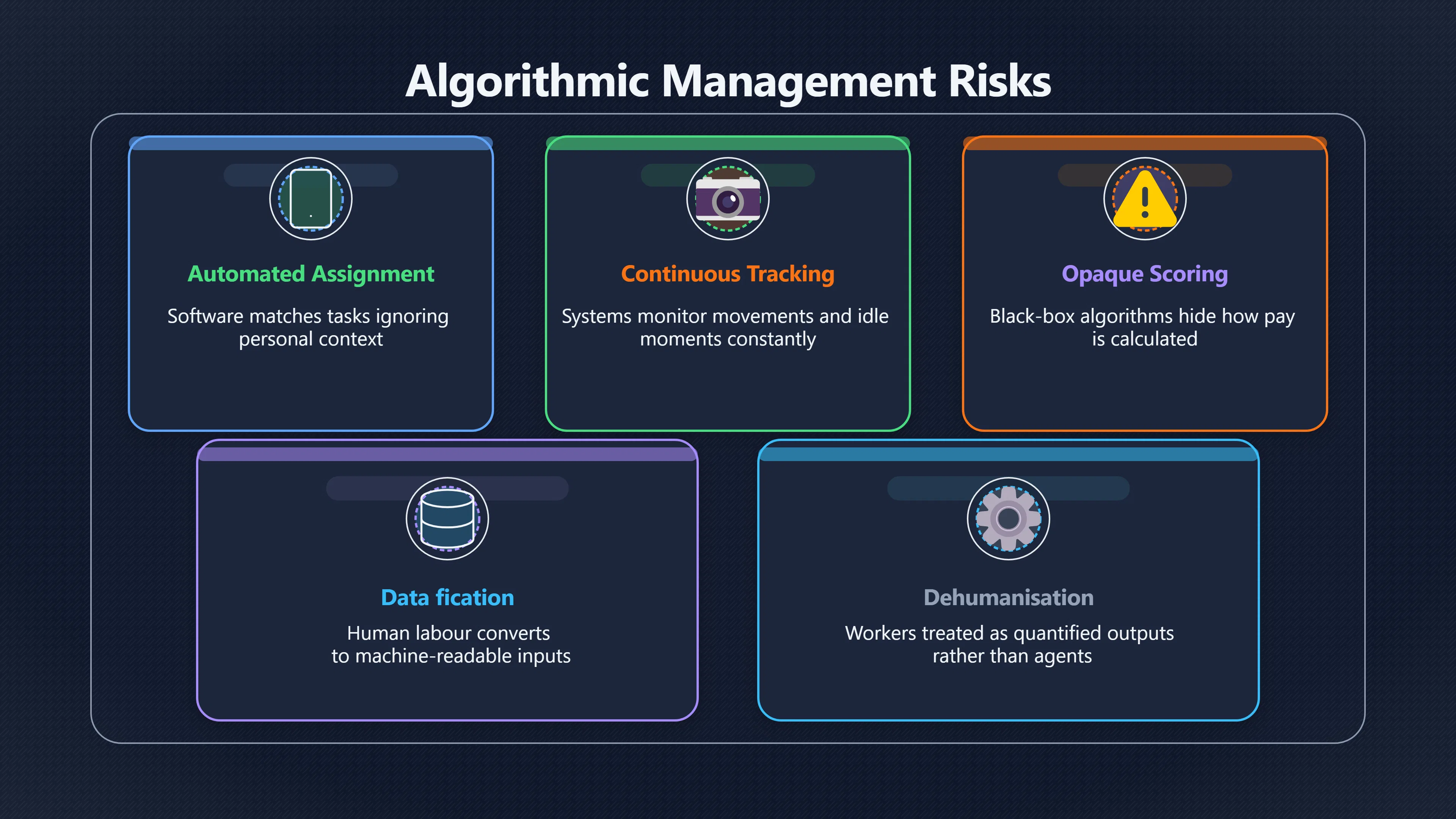
This data‑driven design involves datafication and quantification of human labour — converting subjective experience into machine‑readable inputs that feed through opaque algorithms and yield automated managerial decisions. That transformation can undermine human dignity in at least two ways: by dehumanising workers, treating them as quantified outputs rather than agents, and by instrumentalising them, reducing workers’ role to mere means of economic efficiency rather than recognising their broader capacities, preferences and contributions.[Springer Link]link.springer.comSpringer LinkA Capability Approach to worker dignity under Algorithmic Management | Ethics and Information Technology | Springer Nature L…
In this sense, dignity concerns are not about whether someone has a job at all, but how work feels to the person doing it — especially when choices, feedback and social recognition vanish behind code that prioritises throughput and conformity over human judgement.[Springer Link]link.springer.comSpringer LinkA Capability Approach to worker dignity under Algorithmic Management | Ethics and Information Technology | Springer Nature L…
Examples of Algorithmic Task Allocation and Monitoring
Algorithmic management can take many forms, but a few mechanisms illustrate how it interacts with everyday work:
- Automated task assignment: Workers may be matched to tasks based on algorithms that balance location, speed or predicted performance, leaving little room to choose assignments or negotiate conditions. Algorithms can prioritise efficiency at the expense of personal preferences or context that a human manager might recognise.[Springer Link]link.springer.comSpringer LinkA Capability Approach to worker dignity under Algorithmic Management | Ethics and Information Technology | Springer Nature L…
- Continuous monitoring: Platforms often track movements, task completion times and even idle moments, feeding this data back into performance scores that influence future opportunities or pay. Such pervasive oversight can feel intrusive and reduce workers’ sense of control over their time.[OECD]oecd.org287c13c4 enALGORITHMIC MANAGEMENTApril 18, 2026…
- Opaque evaluation and rewards: Algorithms often lack transparency about how performance is judged, why certain assignments are given or how pay algorithms work, leaving workers uncertain about how to improve or contest outcomes. Lack of procedural justice — fairness in processes — is linked with stress and disengagement.[ScienceDirect]sciencedirect.comThe double-edged sword effect of algorithmic transparency: An empirical study of gig workers’ work disengagement under algor…
Across contexts — whether ride‑hailing apps, delivery platforms or algorithm‑assisted scheduling in traditional workplaces — these features can limit workers’ ability to exercise judgement, influence decisions and understand how they are assessed, shrinking autonomy and undermining workers’ experience of dignity.[OECD]oecd.org287c13c4 enALGORITHMIC MANAGEMENTApril 18, 2026…
Psychological and Wellbeing Impacts on Employees
Research on algorithmic management suggests the effects are complex and vary with design and worker preferences. Some studies highlight dual effects: algorithmic control can be experienced as both enabling and restraining. For example, some workers appreciate flexibility and clarity in task assignment, but the same mechanisms can foster stress and a sense of alienation when workers feel overseen and constrained without meaningful involvement.[PMC]pmc.ncbi.nlm.nih.govFebruary 24, 2023…
Workers in gig‑economy contexts report that algorithmic control offers flexibility and access to work, but also results in social isolation, overwork and exhaustion when held to performance rules they cannot influence. These experiences tie into broader wellbeing concerns, including stress, disengagement and loss of procedural justice when managerial decisions are opaque.[PMC]pmc.ncbi.nlm.nih.govPMCGood Gig, Bad Gig: Autonomy and Algorithmic Control in the Global Gig EconomyFebruary 1, 2019…
Empirical surveys — such as representative data from European workers — also find that strong digital monitoring and algorithmic management correlate with increased monotony and stress at work, suggesting that systems designed for efficiency can have adverse impacts on job quality and worker experience if autonomy and meaningful feedback are absent.[OECD]oecd.org287c13c4 enALGORITHMIC MANAGEMENTApril 18, 2026…

Preserving Autonomy and Human Dignity Under AI‑Led Management
While concerns about dignity are prominent, research also points to design choices and organisational practices that might mitigate risks. Scholars argue that rather than seeing algorithmic management as a monolithic threat, workplaces can blend human and algorithmic decision‑making in ways that preserve choice, oversight and transparent processes.[Springer Link]link.springer.comSpringer LinkA Capability Approach to worker dignity under Algorithmic Management | Ethics and Information Technology | Springer Nature L…
Key strategies include:
- Transparency and explanation: Making clear how algorithms make decisions and what data they use can reduce uncertainty, allow workers to understand performance criteria, and support fair appeal processes, easing stress and disengagement.[ScienceDirect]sciencedirect.comThe double-edged sword effect of algorithmic transparency: An empirical study of gig workers’ work disengagement under algor…
- Human‑in‑the‑loop control: Retaining human oversight over key decisions — especially those affecting evaluations, pay or dismissal — can safeguard procedural justice and allow context‑sensitive judgement that algorithms may overlook.[Sage Journals]journals.sagepub.comSage Journals Regulating algorithmic management: A blueprintSage JournalsRegulating algorithmic management: A blueprint - Jeremias Adams-Prassl, Halefom Abraha, Aislinn Kelly-Lyth, Michael ‘Six’ Si…
- Worker agency and feedback channels: Creating formal avenues for workers to influence scheduling, task rules and performance criteria helps combat feelings of dehumanisation and reinforces workers’ sense of participation in organisational decisions.[Sage Journals]journals.sagepub.comSage Journals Regulating algorithmic management: A blueprintSage JournalsRegulating algorithmic management: A blueprint - Jeremias Adams-Prassl, Halefom Abraha, Aislinn Kelly-Lyth, Michael ‘Six’ Si…
- Capability‑focused design: Drawing on frameworks such as the capability approach, which emphasises what people are actually able to do and be, organisations can evaluate algorithmic systems not just on efficiency but on how they support meaningful work, autonomy and dignity.[Springer Link]link.springer.comSpringer LinkA Capability Approach to worker dignity under Algorithmic Management | Ethics and Information Technology | Springer Nature L…
These approaches align with broader ethical governance debates, emphasising that AI systems should not just be efficient, but also fair, accountable and respectful of human values — central concerns if automation is to contribute to a future where work contributes to human flourishing rather than diminishes it.[Sage Journals]journals.sagepub.comSage Journals Regulating algorithmic management: A blueprintSage JournalsRegulating algorithmic management: A blueprint - Jeremias Adams-Prassl, Halefom Abraha, Aislinn Kelly-Lyth, Michael ‘Six’ Si…
Strategies to Preserve Autonomy Under AI Management
Preserving dignity in algorithmic workplaces is partly a design and governance challenge:
- Embed procedural justice by giving workers clear information on how decisions are made and meaningful ways to contest them.[ScienceDirect]sciencedirect.comThe double-edged sword effect of algorithmic transparency: An empirical study of gig workers’ work disengagement under algor…
- Ensure explainability of algorithmic decisions, avoiding black‑box systems that leave workers uncertain about expectations or consequences.[ScienceDirect]sciencedirect.comThe double-edged sword effect of algorithmic transparency: An empirical study of gig workers’ work disengagement under algor…
- Combine human judgement with automated systems so that algorithms support managers rather than replace all contextualised decision‑making.[Sage Journals]journals.sagepub.comSage Journals Regulating algorithmic management: A blueprintSage JournalsRegulating algorithmic management: A blueprint - Jeremias Adams-Prassl, Halefom Abraha, Aislinn Kelly-Lyth, Michael ‘Six’ Si…
- Create organisational spaces for worker feedback and control, recognising workers as co‑creators of workplace norms and conditions.[Sage Journals]journals.sagepub.comSage Journals Regulating algorithmic management: A blueprintSage JournalsRegulating algorithmic management: A blueprint - Jeremias Adams-Prassl, Halefom Abraha, Aislinn Kelly-Lyth, Michael ‘Six’ Si…
These strategies respond to the concern that autonomy, recognition and purpose are not side benefits of work — they are integral to dignity itself. Thoughtfully designed AI systems can, in principle, enhance coordination and reduce drudgery while respecting these human dimensions, but this requires intentional choices rather than default optimisation.[Springer Link]link.springer.comSpringer LinkA Capability Approach to worker dignity under Algorithmic Management | Ethics and Information Technology | Springer Nature L…
Summary
Algorithmic management is reshaping how work is assigned and supervised, bringing efficiency gains but also posing real risks to worker autonomy and dignity. Through pervasive monitoring, opaque decision‑making and quantified evaluation, these systems can diminish workers’ sense of agency, self‑worth and participation — core components of dignified work. However, by emphasising transparency, human oversight, feedback loops and capability‑centred design, organisations can harness AI’s coordination power without compromising the dignity that underpins meaningful human work.[Springer Link]link.springer.comSpringer LinkA Capability Approach to worker dignity under Algorithmic Management | Ethics and Information Technology | Springer Nature L…
Amazon book picks
Further Reading
Books and field guides related to When AI Management Undermines Worker Dignity. Use these as the next step if you want deeper reading beyond the article.
Your Boss Is an Algorithm
Explains how algorithmic management changes labour rights, autonomy and workplace power.
Automating Inequality
Shows how automated decision systems can reduce people to data points and intensify inequality.
Weapons of Math Destruction
Explains how opaque scoring systems can harm workers and institutions.
The Algorithm
Directly addresses algorithmic hiring, surveillance and management of workers.
eBay marketplace picks
Marketplace Samples
Example marketplace items related to this page. Use the search link to explore similar finds on eBay.




Endnotes
1.
Source: link.springer.com
Link:https://link.springer.com/article/10.1007/s10676-022-09637-y
Source snippet
Springer LinkA Capability Approach to worker dignity under Algorithmic Management | Ethics and Information Technology | Springer Nature L...
2.
Source: oecd.org
Title: 287c13c4 en
Link:https://www.oecd.org/content/dam/oecd/en/publications/reports/2025/02/algorithmic-management-in-the-workplace_3c84ed6d/287c13c4-en.pdf
Source snippet
ALGORITHMIC MANAGEMENTApril 18, 2026...
Published: April 18, 2026
3.
Source: sciencedirect.com
Link:https://www.sciencedirect.com/science/article/abs/pii/S0378720625000035
Source snippet
The double-edged sword effect of algorithmic transparency: An empirical study of gig workers’ work disengagement under algor...
4.
Source: pmc.ncbi.nlm.nih.gov
Link:https://pmc.ncbi.nlm.nih.gov/articles/PMC9998471/
Source snippet
February 24, 2023...
Published: February 24, 2023
5.
Source: pmc.ncbi.nlm.nih.gov
Title: PMCGood Gig, Bad Gig: Autonomy and Algorithmic Control in the Global Gig Economy
Link:https://pmc.ncbi.nlm.nih.gov/articles/PMC6380453/
Source snippet
February 1, 2019...
Published: February 1, 2019
6.
Source: sciencedirect.com
Link:https://www.sciencedirect.com/science/article/pii/S0268401225001264
Source snippet
February 1, 2026 — ALGORITHMIC MANAGEMENT IN THE WORKPLACE: A SYSTEMATIC REVIEW AND TOPIC MODELING INTEGRATION USING BERTOPI...
Published: February 1, 2026
7.
Source: sciencedirect.com
Link:https://www.sciencedirect.com/org/science/article/pii/S0959384522000082
Source snippet
June 24, 2022 — INFORMATION TECHNOLOGY & PEOPLE Volume 36, Issue 8, 24 June 2022, Pages 21-42 Influence of algorithmic manag...
Published: June 24, 2022
8.
Source: journals.sagepub.com
Title: Sage Journals Regulating algorithmic management: A blueprint
Link:https://journals.sagepub.com/doi/10.1177/20319525231167299
Source snippet
Sage JournalsRegulating algorithmic management: A blueprint - Jeremias Adams-Prassl, Halefom Abraha, Aislinn Kelly-Lyth, Michael ‘Six’ Si...
9.
Source: journals.sagepub.com
Link:https://journals.sagepub.com/doi/10.1177/01914537231215680
Source snippet
ithmic counter-tactics - Denise Celentano, 2025November 17, 2023...
Published: November 17, 2023
10.
Source: research.utwente.nl
Title: nl A Capability Approach to worker dignity under Algorithmic Management
Link:https://research.utwente.nl/en/publications/a-capability-approach-to-worker-dignity-under-algorithmic-managem/
Source snippet
Capability Approach to worker dignity under Algorithmic Management - University of Twente Research InformationMarch 1, 2022 — A CAPABILIT...
Published: March 1, 2022
12.
Source: mdpi.com
Link:https://www.mdpi.com/2635020
Source snippet
January 11, 2024 — first_page Download PDF settings Order Article Reprints Font Type: Arial Georgia Verdana Font Size: Aa Aa Aa Line Spac...
Published: January 11, 2024
13.
Source: ouci.dntb.gov.ua
Link:https://ouci.dntb.gov.ua/en/works/4bmBBp17/
Source snippet
Capability Approach to worker dignity under Algorithmic ManagementA CAPABILITY APPROACH TO WORKER DIGNITY UNDER ALGORITHMIC MANAGEMENT GE...
14.
Source: frontiersin.org
Link:https://www.frontiersin.org/journals/artificial-intelligence/articles/10.3389/frai.2024.1441497
Source snippet
Artif. Intell., 25 September 2024 Sec. AI in Business Volume 7 - 2024 | [https://doi.org/10.3389/frai.2024.1441497](https://doi.org/10.3389/frai.2024.1441497) Published in Frontiers...
Published: September 2024
15.
Source: frontiersin.org
Link:https://www.frontiersin.org/journals/artificial-intelligence/articles/10.3389/frai.2024.1441497/full
Source snippet
Artif. Intell., 25 September 2024 Sec. AI in Business Volume 7 - 2024 | [https://doi.org/10.3389/frai.2024.1441497](https://doi.org/10.3389/frai.2024.1441497) Published in Frontiers...
Published: September 2024
16.
Source: philpapers.org
Link:https://philpapers.org/rec/BOOACA-3
Source snippet
A CAPABILITY APPROACH TO WORKER DIGNITY UNDER ALGORITHMIC MANAGEMENT Mieke Boon, Giedo Jansen, Jeroen Meijerink & Laura Lamers...
17.
Source: research.birmingham.ac.uk
Link:https://research.birmingham.ac.uk/en/publications/good-gig-bad-gig-autonomy-and-algorithmic-control-in-the-global-g/
Source snippet
gig, bad gig: autonomy and algorithmic control in the global gig economy - University of BirminghamFebruary 1, 2019 — GOOD GIG, BAD GIG...
Published: February 1, 2019
18.
Source: research.monash.edu
Link:https://research.monash.edu/en/publications/the-rise-of-algorithmic-management-and-implications-for-work-and-
Source snippet
rise of algorithmic management and implications for work and organisations - Monash UniversityTHE RISE OF ALGORITHMIC MANAGEMENT AND IMPL...
19.
Source: pubmed.ncbi.nlm.nih.gov
Link:https://pubmed.ncbi.nlm.nih.gov/35136379/
Source snippet
2022;24(1):10. doi: 10.1007/s10676-022-09637-y. Epub 2022 Feb 3. A CAPABILITY APPROACH TO WORKER DIGNITY UNDER ALGORITHMIC MANAGEMENT Lau...
20.
Source: journals.aom.org
Link:https://journals.aom.org/doi/full/10.5465/AMPROC.2023.14180abstract
Source snippet
Management in the Gig Economy: A Quantitative Review and Research Integration | Academy of Management ProceedingsJuly 24, 2023 — ALGORITH...
Published: July 24, 2023
21.
Source: pmc.ncbi.nlm.nih.gov
Link:https://pmc.ncbi.nlm.nih.gov/articles/PMC8812953/
Source snippet
2022 Feb 3;24(1):10. doi: 10.1007/s10676-022-09637-y A CAPABILITY APPROACH TO WORKER DIGNITY UNDER ALGORITHMIC MANAGEMENT Laura Lamers LA...
Topic Tree