Within Inverse design
Can AI design around scarce elements?
MatterGen's magnet example shows how generative design could search for useful performance while reducing dependence on risky elements.
On this page
- Why material abundance is a supply chain problem
- How Matter Gen combines performance and lower risk
- What industry would still need before adoption
Page outline Jump by section
Introduction
The promise of AI-designed materials is not only that they could make technologies perform better. In some cases, the bigger question is whether they can make crucial technologies less dependent on fragile supply chains.
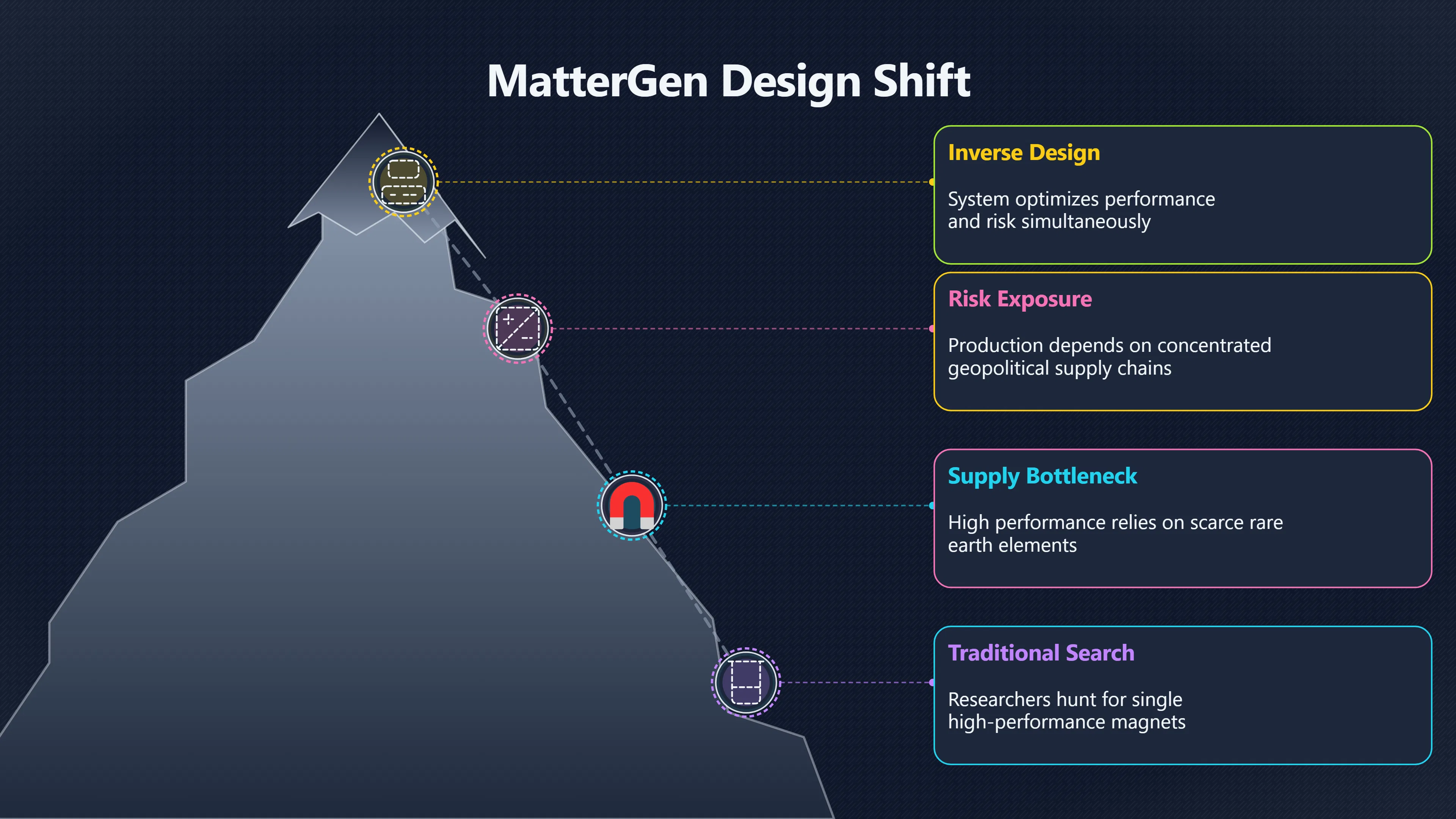
 MatterGen, Microsoft’s generative materials-design system, offers a useful example. One of its showcased goals was not simply finding stronger magnets, but generating magnetic materials that combine useful performance with lower supply-chain risk. That matters because modern clean-energy systems, electric vehicles, robotics, advanced manufacturing equipment, data centres and defence technologies all rely heavily on permanent magnets whose production depends on a small number of countries and difficult-to-substitute elements.[Nature]nature.comA generative model for inorganic materials designby C Zeni · 2025 · Cited by 679 — Although MatterGen can be fine-tuned for any com…[IEA]iea.orgNew projects, partnerships and policies are needed to…Demand for magnet rare earths – notably neodymium, praseodymium, dysprosium a…
For advocates of an AI-enabled age of abundance, this is an important test case. The challenge is not merely inventing something better in a laboratory. It is whether AI can help civilisation escape bottlenecks created by scarce materials, geopolitical concentration, environmental costs and industrial vulnerability. MatterGen suggests one possible route: designing around the constraint itself.
Why material abundance is a supply-chain problem
Many visions of technological abundance assume that once humanity knows how to build something useful, scaling it becomes mostly an engineering challenge. In practice, physical supply chains often become the limiting factor.
Permanent magnets illustrate the problem. High-performance magnets used in electric motors, wind turbines, industrial machinery and many electronics frequently depend on rare earth elements such as neodymium, praseodymium, dysprosium and terbium. Demand for these magnet materials has risen rapidly alongside electrification and clean-energy deployment, with the International Energy Agency reporting that demand for key magnet rare earths has roughly doubled since 2015 and is expected to continue growing strongly.[IEA]iea.orgWith new export controls on critical minerals, supply…Oct 23, 2025 — The new rare earth export controls pose major risks for a range o…
The issue is not simply geology. Rare earth elements exist in many places, but mining, refining and magnet production are concentrated in a small number of locations. China dominates much of the processing and magnet-manufacturing chain, creating concerns about industrial resilience and geopolitical leverage. Multiple analyses estimate that Chinese firms control the majority of global rare-earth processing and magnet production capacity.[IDTechEx]idtechex.comGlobal rare earth mining, separation, refining, and magnet production supplyRare Earth Magnets 2026-2036: Technologies, Supply…This report characterizes rare earth magnet markets, technologies, and pla… Nature Recent export restrictions have turned what was once a largely technical discussion into a strategic one. Industry and policy reports in 2025[nature.com]nature.comA generative model for inorganic materials designby C Zeni · 2025 · Cited by 679 — Although MatterGen can be fine-tuned for any com… and 2026 describe disruptions, licensing delays and growing concern among manufacturers dependent on rare-earth magnets.[S&P Global]spglobal.com012726 rare earth supply bottlenecks set to persist in 2026S&P GlobalRare earth supply bottlenecks set to persist in 202627 Jan 2026 — China's rare-earth export restrictions are set to drive suppl…
This creates a broader question for AI-driven scientific acceleration. If advanced AI helps humanity discover better batteries, motors or energy systems, but all of them depend on vulnerable inputs, then material bottlenecks could slow the wider bloom of abundance. Scientific progress and supply-chain resilience become linked problems rather than separate ones.
How MatterGen combines performance and lower risk
Most materials-discovery systems are asked to optimise performance. MatterGen demonstrates a more ambitious idea: optimising performance and supply-chain characteristics simultaneously.
According to the Nature paper describing the system, researchers fine-tuned MatterGen to generate materials with both strong magnetic properties and lower supply-chain risk. The paper specifically highlights the challenge that many high-performance permanent magnets depend on rare earth elements whose supply chains are considered strategically vulnerable.[Nature]nature.comA generative model for inorganic materials designby C Zeni · 2025 · Cited by 679 — MatterGen is also able to design materials given multi…
This matters because traditional materials research often treats supply-chain concerns as a later-stage problem. A material might first be discovered because it performs well, only for industry to discover years later that it requires expensive, politically sensitive or environmentally difficult ingredients.
Inverse design changes the order of operations.
Instead of asking:
Can we find a high-performance magnetic material?
Researchers can ask:
Can we find a magnetic material that performs well while avoiding high-risk elements?
That sounds simple, but it greatly expands the search challenge. Materials scientists are no longer looking for a single optimum. They are balancing several competing objectives:
- Magnetic strength
- Thermal stability
- Manufacturability
- Cost
- Availability of constituent elements
- Exposure to geopolitical risk[ideas.repec.org]ideas.repec.orgIDEAS/RePEcGeopolitical risk and the global supply of rare earth permanby L Depraiter · 2025 · Cited by 47 — This paper delves deep into…
- Long-term scalability
MatterGen’s significance is that it treats those tradeoffs as design inputs rather than after-the-fact constraints.[Nature]nature.comA generative model for inorganic materials designby C Zeni · 2025 · Cited by 679 — Although MatterGen can be fine-tuned for any com…
In principle, a future generation of materials models could search vast regions of chemical space for solutions that human researchers might never manually investigate. The objective would not necessarily be finding the strongest possible magnet. It would be finding the best overall compromise between performance, resilience and scale.
Why rare-earth-free magnets are so difficult
The challenge is that rare earth magnets became dominant for good reasons.
Neodymium-iron-boron magnets and related technologies achieve extremely high magnetic performance. They are compact, powerful and well suited to electric motors, wind turbines and many advanced applications. Replacing them is not as straightforward as swapping one ingredient for another.[ScienceDirect]sciencedirect.comRare earth permanent magnets for the green energy…by Y Ghorbani · 2025 · Cited by 111 — This review paper provides an ove…
Researchers have spent years exploring alternatives, including ferrites, alnico materials, manganese-based compounds, iron-nitride systems and Heusler alloys. Many of these approaches reduce reliance on critical rare earths, but often at the cost of weaker magnetic performance, more difficult manufacturing requirements or lower durability under real-world conditions.[arXiv]arxiv.orgarXiv Matter Gen: a generative model for inorganic materials designMatterGen: a generative model for inorganic materials designby C Zeni · 2023 · Cited by 230 — We present MatterGen, a model that generate…
This is where AI-assisted design could matter most.
A human researcher might examine thousands of candidate compounds. A generative model can explore vastly larger regions of possibility space and propose unconventional combinations that satisfy multiple constraints simultaneously. That does not guarantee success, but it increases the chance of finding useful compromises.
The broader significance for an AI-bloom worldview is that abundance is frequently blocked by optimisation problems rather than fundamental physical impossibilities. The world may not need a perfect substitute for every scarce material. It may need substitutes that are good enough while being easier to source, manufacture and scale.

The hidden tradeoff: scarcity can move rather than disappear
There is a temptation to assume that removing a risky element automatically solves the supply problem. Reality is usually more complicated.
A magnet designed without dysprosium or terbium may still depend on other materials that have their own supply constraints. It may require more material overall, more energy-intensive processing or more complex manufacturing techniques. A substitute could reduce geopolitical dependence while increasing environmental costs or production expenses.
This is a recurring pattern in energy and materials transitions.
For example:
- A battery chemistry can reduce dependence on cobalt while increasing demand for other minerals.
- A rare-earth-free magnet can lower exposure to one supply chain while creating pressure elsewhere.
- Domestic production can improve resilience but raise costs compared with globalised supply networks.
Researchers studying rare-earth supply systems increasingly emphasise that risk exists at multiple levels: mining, refining, manufacturing, transport and geopolitical relationships. Simply changing the chemistry does not automatically remove all vulnerabilities.[IDEAS]ideas.repec.orgIDEAS/RePEcGeopolitical risk and the global supply of rare earth permanby L Depraiter · 2025 · Cited by 47 — This paper delves deep into…[RePEc]ideas.repec.orgIDEAS/RePEcGeopolitical risk and the global supply of rare earth permanby L Depraiter · 2025 · Cited by 47 — This paper delves deep into…
This is one reason MatterGen’s multi-objective approach is notable. The goal is not merely replacing one element. It is searching for solutions that perform well across several dimensions of risk simultaneously.
What industry would still need before adoption
Even if AI generates promising magnetic materials, several difficult stages remain.
Laboratory validation
Generated materials must first be synthesised and tested. A material that appears stable in simulations may prove difficult to manufacture, expensive to process or unreliable under industrial conditions.
The history of materials science is full of theoretically attractive compounds that never became commercial products because practical realities intervened.
Manufacturing compatibility
Factories represent huge capital investments. A new magnet material must fit into existing production systems or justify the cost of replacing them.
A material that performs slightly better on paper may fail commercially if manufacturers need entirely new equipment, supply contracts or quality-control processes.

Long-term reliability
Magnets used in vehicles, power systems and industrial equipment must operate for years under heat, vibration and mechanical stress.
That means researchers need evidence not only of magnetic performance but also of durability, corrosion resistance and predictable behaviour across long operating periods.
Economic competitiveness
Even strategically valuable materials face cost pressures.
Manufacturers may tolerate higher costs for defence applications or critical infrastructure, but mass-market adoption usually requires attractive economics alongside technical performance.
This creates an important reality check for AI-driven discovery. Generating a candidate material is not the same as transforming an industry. Discovery is only the first step in a chain that includes testing, manufacturing, certification, financing and deployment.
A glimpse of a broader abundance strategy
The magnet example is interesting because it reveals a deeper possibility behind inverse materials design.
Many future technologies may be limited less by ideas than by physical bottlenecks. Clean energy systems require minerals. Advanced computing requires specialised materials. Robotics depends on motors, sensors and industrial inputs. Even ambitious visions of space industry eventually run into questions about matter, manufacturing and supply chains.
MatterGen hints at a future where AI helps search not only for higher performance, but for resilience itself.
If such systems mature, researchers could increasingly specify goals such as:
- Avoid politically concentrated supply chains.
- Reduce dependence on environmentally damaging extraction.
- Use more abundant elements.
- Improve recyclability.
- Lower manufacturing complexity.
- Preserve performance while reducing strategic vulnerability.
That would not eliminate scarcity. Physics, economics and geopolitics would still matter. But it could shift some constraints from fixed limits into engineering problems.
For the larger AI-bloom vision, that distinction is significant. A flourishing future depends not only on creating powerful technologies, but on making them deployable at civilisational scale. The ability to design around bottlenecks may ultimately matter almost as much as the ability to invent new capabilities in the first place. The magnet case is a small but concrete example of how AI-assisted discovery could begin to move from chasing peak performance towards something closer to sustainable abundance.
Amazon book picks
Further Reading
Books and field guides related to Can AI design around scarce elements?. Use these as the next step if you want deeper reading beyond the article.
Human Compatible
Explores how powerful AI could advance humanity if aligned with human values.
The Coming Wave
Directly addresses whether advanced AI can deliver broad civilisational benefits while remaining governable.
eBay marketplace picks
Marketplace Samples
Topic-anchored marketplace searches for visual, collectible, or second-hand items related to this page.


Endnotes
1.
Source: nature.com
Link:https://www.nature.com/articles/s41586-025-08628-5
Source snippet
A generative model for inorganic materials designby C Zeni · 2025 · Cited by 679 — Although MatterGen can be fine-tuned for any com...
2.
Source: iea.org
Link:https://www.iea.org/news/new-projects-partnerships-and-policies-are-needed-to-address-supply-chain-risks-for-rare-earth-elements
Source snippet
New projects, partnerships and policies are needed to...Demand for magnet rare earths – notably neodymium, praseodymium, dysprosium a...
3.
Source: sciencedirect.com
Link:https://www.sciencedirect.com/science/article/pii/S0921344924005573
Source snippet
Rare earth permanent magnets for the green energy...by Y Ghorbani · 2025 · Cited by 111 — This review paper provides an ove...
4.
Source: idtechex.com
Title: Global rare earth mining, separation, refining, and magnet production supply
Link:https://www.idtechex.com/en/research-report/rare-earth-magnets/1112
Source snippet
Rare Earth Magnets 2026-2036: Technologies, Supply...This report characterizes rare earth magnet markets, technologies, and pla...
5.
Source: nature.com
Link:https://www.nature.com/articles/s41586-025-08628-5_reference.pdf
Source snippet
A generative model for inorganic materials designby C Zeni · 2025 · Cited by 679 — MatterGen is also able to design materials given multi...
6.
Source: arxiv.org
Title: arXiv Matter Gen: a generative model for inorganic materials design
Link:https://arxiv.org/abs/2312.03687
Source snippet
MatterGen: a generative model for inorganic materials designby C Zeni · 2023 · Cited by 230 — We present MatterGen, a model that generate...
7.
Source: arxiv.org
Link:https://arxiv.org/abs/1909.03275
Source snippet
Designing rare-earth free permanent magnets in Heusler alloys via interstitial dopingSeptember 7, 2019...
Published: September 7, 2019
8.
Source: arxiv.org
Title: arXiv Permanent Magnets Based on Hard Ferrite Ceramics
Link:https://arxiv.org/abs/2310.02106
9.
Source: ideas.repec.org
Link:https://ideas.repec.org/a/eee/eneeco/v146y2025ics0140988325003202.html
Source snippet
IDEAS/RePEcGeopolitical risk and the global supply of rare earth permanby L Depraiter · 2025 · Cited by 47 — This paper delves deep into...
10.
Source: sciencedirect.com
Link:https://www.sciencedirect.com/science/article/pii/S0140988325003202
Source snippet
Geopolitical risk and the global supply of rare earth...by L Depraiter · 2025 · Cited by 33 — This paper delves deep into the ramificati...
11.
Source: microsoft.com
Title: mattergen a new paradigm of materials design with generative ai
Link:https://www.microsoft.com/en-us/research/blog/mattergen-a-new-paradigm-of-materials-design-with-generative-ai/
Source snippet
MatterGen: A new paradigm of materials design with...16 Jan 2025 — MatterGen enables a new paradigm of generative AI-assisted materials...
12.
Source: microsoft.com
Link:https://www.microsoft.com/en-us/research/video/mattergen-a-generative-model-for-materials-design/
Source snippet
MatterGen: A Generative Model for Materials DesignTian Xie introduces MatterGen, a generative model that creates new inorganic materials...
13.
Source: iea.org
Link:https://www.iea.org/commentaries/with-new-export-controls-on-critical-minerals-supply-concentration-risks-become-reality
Source snippet
With new export controls on critical minerals, supply...Oct 23, 2025 — The new rare earth export controls pose major risks for a range o...
14.
Source: iea.org
Link:https://www.iea.org/reports/rare-earth-elements/executive-summary
Source snippet
summary – Rare Earth Elements – AnalysisIn April 2025, China introduced export controls on seven heavy rare earth elements, related compo...
Published: April 2025
15.
Source: spglobal.com
Title: 012726 rare earth supply bottlenecks set to persist in 2026
Link:https://www.spglobal.com/energy/en/news-research/latest-news/metals/012726-rare-earth-supply-bottlenecks-set-to-persist-in-2026
Source snippet
S&P GlobalRare earth supply bottlenecks set to persist in 202627 Jan 2026 — China's rare-earth export restrictions are set to drive suppl...
Additional References
16.
Source: sheffield.ac.uk
Link:https://sheffield.ac.uk/royce-institute/impact-and-outreach/impact/case-studies/collaboration-rapidly-develops-rare-earth-free-materials
Source snippet
Collaboration rapidly develops rare-earth-free materialsWith an initial focus on magnets, the platform has screened well over 100 million...
17.
Source: iuk-business-connect.org.uk
Link:https://iuk-business-connect.org.uk/wp-content/uploads/2022/06/Final_Magnets-Document_Innovate-UK-KTN.pdf
Source snippet
UK supply chain opportunity in materials for permanent...For high performance applications, which require the highest degree of magnetic...
18.
Source: facebook.com
Link:https://www.facebook.com/microsoftresearch/posts/microsoft-researchers-introduce-mattergen-a-model-that-can-discover-new-material/1040950821397547/
Source snippet
Microsoft researchers introduce MatterGen, a model...Microsoft researchers introduce MatterGen, a model that can discover new materials...
19.
Source: sites.lsa.umich.edu
Link:https://sites.lsa.umich.edu/mje/2026/01/09/market-concentration-of-rare-earth-elements-chinas-dominance-and-the-global-response/
Source snippet
Concentration of Rare Earth Elements: China's...Jan 9, 2026 — Now, China's position in the rare earth industry allows it to influence gl...
20.
Source: globalpolicywatch.com
Link:https://www.globalpolicywatch.com/2026/02/heavy-rare-earth-elements-rising-supply-chain-risks-and-emerging-policy-responses/
Source snippet
Heavy Rare Earth Elements: Rising Supply Chain Risks...1 Feb 2026 — In April, export controls were widened to include alloys containing...
21.
Source: csis.org
Title: chinas new rare earth and magnet restrictions threaten us defense supply chains
Link:https://www.csis.org/analysis/chinas-new-rare-earth-and-magnet-restrictions-threaten-us-defense-supply-chains
Source snippet
China's New Rare Earth and Magnet Restrictions Threaten...Oct 9, 2025 — China has imposed its most stringent rare earth and magnet expor...
22.
Source: sfa-oxford.com
Title: sfa china s rare earth export controls and their impact on global supply chains
Link:https://www.sfa-oxford.com/market-news-and-insights/sfa-china-s-rare-earth-export-controls-and-their-impact-on-global-supply-chains/
Source snippet
China's Rare Earth Export Controls: Impact and Western...Oct 10, 2025 — China's rare earth export controls shift global power, threaten...
23.
Source: advisorpedia.com
Link:https://www.advisorpedia.com/viewpoints/microsofts-mattergen-a-game-changer-in-material-discovery/
Source snippet
Microsoft's MatterGen: A Game-Changer in Material...Rare-Earth-Free magnets: now can be designed from common elements, wow...
24.
Source: youtube.com
Link:https://www.youtube.com/watch?v=Smz1go6_Spo
Source snippet
Materials Project Seminars – Tian Xie "MatterGen: a...Materials Project Seminars – Tian Xie "MatterGen: a generative model for inorganic...
25.
Source: md-one.com
Title: materials nexus discovers new rare earth free magnet using ai algorithm
Link:https://www.md-one.com/news/materials-nexus-discovers-new-rare-earth-free-magnet-using-ai-algorithm
Source snippet
Materials Nexus discovers new rare-earth-free magnet...12 Jun 2024 — MagNex can be produced at 20% of the material cost and a 70% reduct...
Topic Tree