Within Access gap
Will AI prevention become private medicine?
Personalised prevention could extend healthy life, but only if early warnings come with affordable tests, care and follow-up.
On this page
- Why early warning systems favour advantaged patients
- The gap between knowing risk and acting on it
- How public systems could make prevention routine
Page outline Jump by section
Introduction
AI prevention systems promise one of the most attractive parts of the wider AI longevity vision: spotting disease before symptoms appear, helping people stay healthy for longer, and shifting medicine away from crisis treatment towards early intervention. If AI can identify elevated cancer risk, cardiovascular disease, diabetes, dementia, or other chronic conditions years earlier than conventional diagnosis, it could become a major driver of longer healthy lives.
 The problem is that early warning is not the same as prevention. Knowing that someone faces a higher risk of illness only helps if they can obtain tests, specialist care, medication, lifestyle support, and ongoing monitoring. Those resources are already distributed unevenly. Without deliberate policy choices, AI-guided prevention could follow a familiar pattern in medicine: the most powerful tools arrive first for wealthy patients, private clinics, and well-funded health systems, while the people with the highest disease burden gain access much later.
In that scenario, AI still improves health. But it improves it unevenly, creating a risk that longevity gains accumulate fastest among those who are already healthiest and most advantaged.
Why early warning systems favour advantaged patients
Many AI prevention tools depend on large streams of data. Risk prediction models increasingly draw from electronic health records, imaging scans, genetic information, wearable devices, blood tests, pharmacy records, and behavioural data. The patients with the most complete data histories are often those who already engage regularly with healthcare systems.
This creates a structural advantage before any algorithm even makes a prediction.
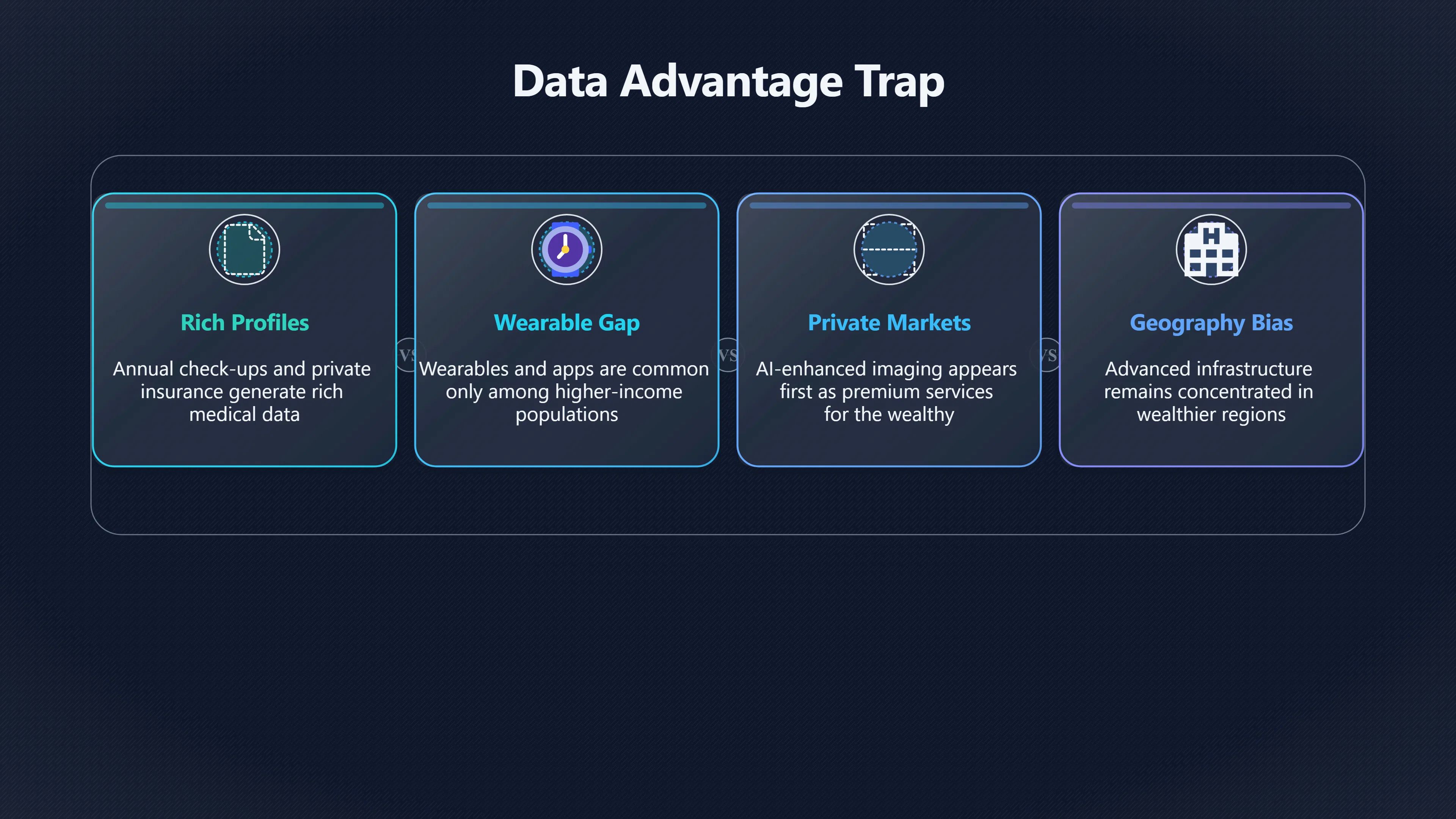
A patient with annual check-ups, private insurance, multiple screenings, continuous wearable monitoring, and easy specialist access generates a rich medical profile. AI systems can often make more confident assessments when they have that information. A patient who rarely sees a doctor, changes jobs frequently, lacks stable insurance, or lives far from specialist services may generate far less usable data.
The result is a preventive system that can become progressively better at serving people who are already visible to healthcare institutions.
Several additional mechanisms reinforce this pattern:
- Private screening markets emerge quickly. AI-enhanced imaging, genomic analysis, and personalised health assessments often appear first as premium services.
- Health literacy matters. People with more education and time are generally better positioned to interpret risk reports and navigate follow-up care.
- Geography matters. Advanced diagnostic infrastructure remains concentrated in wealthier regions and major medical centres.
- Digital participation matters. Wearables, health apps, and remote monitoring systems are more common among higher-income populations.
The concern is not simply that wealthy patients buy better healthcare. It is that AI prevention may amplify cumulative advantages at multiple stages simultaneously: data collection, risk detection, clinical interpretation, treatment access, and long-term monitoring.
The gap between knowing risk and acting on it
One of the most important distinctions in preventive medicine is the difference between prediction and intervention.
Suppose an AI model identifies a person as having elevated cardiovascular risk. The practical value of that warning depends on what happens next.
Can the patient obtain confirmatory testing? Can they see a specialist? Can they afford medication? Do they have safe places to exercise? Do they have stable housing and food security? Can they take time away from work for appointments?
Many of the largest drivers of life expectancy are influenced by social and economic conditions rather than diagnostic knowledge alone.
This means AI can create a strange outcome: more accurate awareness of health risks without corresponding improvements in health outcomes.
Researchers studying health inequalities have repeatedly noted that preventive services often benefit groups with greater resources first, particularly when participation requires time, travel, digital access, or proactive engagement. Public health researchers in the UK have long referred to versions of this pattern as the “inverse care” problem: people who need healthcare most are often least likely to receive it. Preventive AI could unintentionally reproduce the same dynamic if deployment focuses primarily on technological capability rather than practical access.[POST]post.parliament.ukPOSTPublic health: inequalities and preventionJuly 25, 2025 — 25 Jul 2025 — Researchers also highlighted the importance of prevention and early detection healthcare ser…
This is especially important for longevity. Extending healthy life is rarely achieved through a single intervention. It usually requires years of consistent prevention, monitoring, and treatment. The benefits therefore compound most effectively among people who can remain engaged with healthcare systems over long periods.
When the algorithm works better for some groups than others
The inequality problem does not end with access. It can also appear inside the models themselves.
Researchers have documented cases where medical AI systems show different error rates across patient groups. One influential study in Nature Medicine examined chest X-ray diagnostic models and found systematic underdiagnosis bias affecting underserved populations. In practical terms, some groups were more likely to receive false reassurance when disease was actually present.[Nature]nature.comUnderdiagnosis bias of artificial intelligence algorithms…by L Seyyed-Kalantari · 2021 · Cited by 1069 — Here, we perform a syst…
That finding matters because preventive medicine depends heavily on accurate early detection. If AI systems miss disease more often in disadvantaged populations, those groups may receive later diagnoses and later treatment even while the technology appears highly successful overall.
Subsequent work has continued to identify concerns around demographic bias, dataset imbalance, and unequal model performance in healthcare AI. Reviews have warned that biased algorithms can amplify existing disparities across race, ethnicity, age, sex, and socioeconomic status when these issues are not addressed during development and evaluation.[Nature]nature.comArtificial intelligence bias in the prediction and detection of…by A Mihan · 2024 · Cited by 29 — Biased algorithms can perform…[Nature]nature.comNat. Med. 27…Read more…
This creates a double inequality risk:
- Wealthier patients may gain access first.
- Some disadvantaged groups may receive less accurate predictions even after access expands.
A preventive system that performs best for already advantaged populations could widen health gaps despite improving average outcomes.
The private longevity pathway
The most ambitious version of AI-guided prevention goes beyond ordinary screening.
Some companies and clinics are building services around continuous health optimisation: frequent blood testing, genetic analysis, imaging, metabolic monitoring, personalised risk scores, and AI-generated recommendations. The goal is not merely avoiding disease but extending healthy lifespan as much as possible.
These services can be expensive. They often require recurring testing, specialist interpretation, and sustained engagement over many years.
That creates the possibility of a two-track preventive future:
- A premium track, with continuous monitoring, highly personalised risk prediction, rapid referrals, and intensive follow-up.
- A standard track, where patients receive occasional screening and seek treatment after symptoms emerge.
The gap may not look dramatic at first. A few years of earlier diagnosis may seem modest. But longevity effects accumulate over decades. Small differences in prevention can compound into larger differences in healthspan, disability rates, and life expectancy.
This is one reason the distribution question matters so much within the broader AI bloom debate. If AI accelerates medical discovery and disease prevention but the resulting systems remain concentrated among affluent groups, humanity may become healthier overall while also becoming more unequal in who gets to enjoy those gains.
Insurance, incentives, and selective prevention
Another risk is that prevention becomes targeted primarily where it is most profitable.
AI systems are increasingly used to predict future health costs, identify high-risk patients, and allocate healthcare resources. Supporters argue that this can improve efficiency and enable earlier intervention. Critics worry that predictive systems may also create incentives to sort, price, or prioritise patients in ways that reinforce inequality.[OECD]oecd.orgArtificial Intelligence and the health workforce (ENArtificial Intelligence and the health workforce (EN)February 19, 2026 — AI in health also poses risks to patients in several ways in…
The concern is not necessarily overt discrimination. More often it involves subtle differences in who receives outreach, who is invited into preventive programmes, who gains access to specialist services, or whose health risks receive the most attention.
If predictive healthcare becomes tightly linked to commercial incentives, preventive resources may flow disproportionately towards patients who are easiest to reach, easiest to monitor, or most profitable to retain.
That would move AI prevention away from its most ambitious promise: improving health at population scale.
How public systems could make prevention routine
The optimistic case is not that AI prevention automatically becomes equitable. It is that public institutions can use AI to scale prevention far beyond what traditional healthcare systems could manage alone.
The same technologies that support elite personalised medicine can also support population-level screening and outreach.
Several approaches could matter:

AI as a public health tool rather than a luxury service
Instead of reserving advanced risk prediction for premium clinics, health systems can embed it directly into primary care.
A general practitioner could receive automated alerts identifying patients who may benefit from cardiovascular screening, diabetes prevention programmes, cancer checks, or medication reviews. Patients would not need to purchase specialised AI services because preventive support would be integrated into ordinary healthcare.
The long-term significance is large. Prevention reaches more people when it becomes routine infrastructure rather than an optional consumer product.
Building models around underserved populations
Researchers increasingly argue that fairness must be incorporated throughout model development, data collection, validation, and deployment. Better representation in training datasets, continuous auditing, and subgroup performance testing can reduce the risk that preventive systems work well only for already advantaged populations.[ScienceDirect]sciencedirect.comBridging the digital divide: artificial intelligence as a…by A Osonuga · 2025 · Cited by 49 — This comprehensive narrativ…
This is not merely a technical issue. It determines who benefits from early detection.
Connecting prediction to actual care
An AI warning without follow-up support has limited value.
The strongest preventive systems combine prediction with action:
- automatic appointment scheduling
- community outreach
- subsidised testing
- medication access
- preventive coaching
- primary care follow-up[sciencedirect.com]sciencedirect.comBridging the digital divide: artificial intelligence as a…by A Osonuga · 2025 · Cited by 49 — This comprehensive narrativ…
Several public-health-focused studies argue that AI can help identify vulnerable patients earlier, but meaningful benefits depend on integrating those predictions into healthcare delivery rather than treating prediction itself as the outcome.[PMC]pmc.ncbi.nlm.nih.govSocioeconomic impact of artificial intelligence–driven point-of…by S Singh · 2025 · Cited by 5 — AI-driven automated diagnostic mod…[ResearchGate]researchgate.netAdvances in AI-Augmented Patient Triage and Referral…18 May 2025 — This paper explores advances in AI-augmented triage and referral te…
Why this matters for the AI bloom future
The broader AI bloom vision imagines a future in which advanced intelligence helps humanity overcome many of the constraints that currently limit health, knowledge, and flourishing. Radical improvements in prevention could become one of the clearest examples.
But the distribution question cannot be separated from the technological question.
A world where AI helps affluent patients avoid disease for decades longer than everyone else is very different from a world where AI-driven prevention becomes a standard public service available across entire populations.
The distinction matters because longevity is cumulative. Every year of earlier prevention can affect decades of future health. If access remains narrow, the gains from AI medicine may concentrate among people who already possess wealth, education, political influence, and long life expectancy. If access becomes broad, AI prevention could help reduce some of the largest health inequalities that exist today.
The success of AI-guided prevention therefore depends on more than diagnostic accuracy. It depends on whether societies can turn early warning into affordable action, and whether the systems that extend healthy life are built as public infrastructure rather than permanent luxury goods.
Amazon book picks
Further Reading
Books and field guides related to Will AI prevention become private medicine?. Use these as the next step if you want deeper reading beyond the article.
The Age of Scientific Wellness
Centres on earlier warnings, biomarkers and personalised prevention.
eBay marketplace picks
Marketplace Samples
Example marketplace items related to this page. Use the search link to explore similar finds on eBay.




Endnotes
1.
Source: post.parliament.uk
Title: POSTPublic health: inequalities and prevention
Link:https://post.parliament.uk/public-health-inequalities-and-prevention/
Source snippet
July 25, 2025 — 25 Jul 2025 — Researchers also highlighted the importance of prevention and early detection healthcare ser...
Published: July 25, 2025
2.
Source: pmc.ncbi.nlm.nih.gov
Link:https://pmc.ncbi.nlm.nih.gov/articles/PMC12325499/
Source snippet
Socioeconomic impact of artificial intelligence–driven point-of...by S Singh · 2025 · Cited by 5 — AI-driven automated diagnostic mod...
3.
Source: nature.com
Link:https://www.nature.com/articles/s41591-021-01595-0
Source snippet
Underdiagnosis bias of artificial intelligence algorithms...by L Seyyed-Kalantari · 2021 · Cited by 1069 — Here, we perform a syst...
4.
Source: nature.com
Link:https://www.nature.com/articles/s44325-024-00031-9
Source snippet
Artificial intelligence bias in the prediction and detection of...by A Mihan · 2024 · Cited by 29 — Biased algorithms can perform...
5.
Source: nature.com
Link:https://www.nature.com/articles/s41746-023-00858-z
Source snippet
Nat. Med. 27...Read more...
6.
Source: oecd.org
Title: Artificial Intelligence and the health workforce (EN)
Link:https://www.oecd.org/content/dam/oecd/en/publications/reports/2024/11/artificial-intelligence-and-the-health-workforce_c8e4433d/9a31d8af-en.pdf
Source snippet
Artificial Intelligence and the health workforce (EN)February 19, 2026 — AI in health also poses risks to patients in several ways in...
Published: February 19, 2026
7.
Source: sciencedirect.com
Link:https://www.sciencedirect.com/science/article/pii/S1386505625002680
Source snippet
Bridging the digital divide: artificial intelligence as a...by A Osonuga · 2025 · Cited by 49 — This comprehensive narrativ...
8.
Source: pmc.ncbi.nlm.nih.gov
Link:https://pmc.ncbi.nlm.nih.gov/articles/PMC12236417/
Source snippet
Empowering public health: Leveraging AI for early detection...by V Nivethitha · 2025 · Cited by 16 — This scoping review examines AI'...
9.
Source: researchgate.net
Link:https://www.researchgate.net/publication/391837061_Advances_in_AI-Augmented_Patient_Triage_and_Referral_Systems_for_Community-Based_Public_Health_Initiatives
Source snippet
Advances in AI-Augmented Patient Triage and Referral...18 May 2025 — This paper explores advances in AI-augmented triage and referral te...
Published: May 2025
10.
Source: sciencedirect.com
Link:https://www.sciencedirect.com/science/article/pii/S2667102626000203
Source snippet
This review provides a comprehensive overview of AI...
11.
Source: sciencedirect.com
Link:https://www.sciencedirect.com/science/article/abs/pii/S1546144023005070
Source snippet
Underdiagnosis bias of artificial intelligence algorithms applied to chest radiographs in under-served patient populations. Nat Med.Read mo...
12.
Source: iris.who.int
Link:https://iris.who.int/server/api/core/bitstreams/d2913ae3-c8e0-4a46-b6ff-b4b121e936f4/content
Source snippet
Increasing health system efficiencies. Reducing pressure on the health care workforce. Improving patient care and health outcomes...
13.
Source: researchgate.net
Link:https://www.researchgate.net/publication/356949367_Underdiagnosis_bias_of_artificial_intelligence_algorithms_applied_to_chest_radiographs_in_under-served_patient_populations
Source snippet
Underdiagnosis bias of artificial intelligence algorithms...10 Dec 2021 — Studies showing that chest X-ray models can predict patient ra...
14.
Source: researchgate.net
Link:https://www.researchgate.net/publication/390314934_AI_powered_predictive_healthcare_Deep_learning_for_early_diagnosis_personalized_treatment_and_disease_prevention
Source snippet
AI powered predictive healthcare: Deep learning for early...This study explores the role of AI in predictive healthcare, examining its i...
15.
Source: nature.com
Link:https://www.nature.com/articles/s41467-024-52003-3
Source snippet
William Lotter...Read more...
16.
Source: nature.com
Link:https://www.nature.com/articles/s41746-025-01956-w
Source snippet
Quality safety and disparity of an AI chatbot in managing...by Y Si · 2025 · Cited by 7 — Disparities were observed based on patient age...
Additional References
17.
Source: linkedin.com
Link:https://www.linkedin.com/posts/jacreator_aiengineering-responsibleai-fairnessinml-activity-7436094639964573696-5JaE
Source snippet
AI Underdiagnosis Bias in Chest X-rays: Fairness...Spent the last few week diving deep into one of the most important fairness papers in...
18.
Source: racismandtechnology.center
Link:https://racismandtechnology.center/2023/02/18/racist-technology-in-action-the-underdiagnosis-bias-in-ai-algorithms-for-health-chest-radiographs/
Source snippet
The “underdiagnosis bias” in AI algorithms for health...18 Feb 2023 — The authors conducted a systematic study of underdiagnosis bias on...
19.
Source: kff.org
Link:https://www.kff.org/racial-equity-and-health-policy/the-growing-use-of-artificial-intelligence-in-health-care-and-implications-for-disparities/
Source snippet
The Growing Use of Artificial Intelligence in Health Care...30 Apr 2026 — As the use of AI in health care grows, research suggests th...
20.
Source: journalistsresource.org
Link:https://journalistsresource.org/home/research-artificial-intelligence-can-fuel-racial-bias-in-health-care-but-can-mitigate-it-too/
Source snippet
Artificial intelligence exacerbates and mitigates racial bias...11 Jul 2022 — Several studies show it can also propagate racial biases...
21.
Source: aimi.stanford.edu
Title: aimi journal club underdiagnosis bias artificial intelligence algorithms
Link:https://aimi.stanford.edu/events/journal-club/aimi-journal-club-underdiagnosis-bias-artificial-intelligence-algorithms
Source snippet
Journal Club: Underdiagnosis Bias of Artificial...Here, we examine algorithmic underdiagnosis in chest X-ray pathology classification ac...
22.
Source: publications.jrc.ec.europa.eu
Title: jrc122675 aiwatch ai uptake health and healthcare 2020 final wt isbn
Link:https://publications.jrc.ec.europa.eu/repository/bitstream/JRC122675/jrc122675_aiwatch_ai_uptake__health_and_healthcare_2020_final_wt_isbn.pdf
Source snippet
Watch AI Uptake in Health and Healthcare, 2020by NS DE — This publication is a Technical report by the Joint Research Centre (JRC), the E...
23.
Source: appliedradiology.com
Title: ai s diversity problem in radiology addressing algorithm bias
Link:https://appliedradiology.com/Articles/ai-s-diversity-problem-in-radiology-addressing-algorithm-bias
Source snippet
AI's Diversity Problem in Radiology: Addressing Algorithm...by K Reeves · Cited by 1 — Underdiagnosis bias of artificial intelligence al...
24.
Source: itnonline.com
Title: ai chest x ray model analysis reveals race and sex bias
Link:https://www.itnonline.com/content/ai-chest-x-ray-model-analysis-reveals-race-and-sex-bias
Source snippet
AI Chest X-ray Model Analysis Reveals Race and Sex Bias4 Oct 2023 — An AI chest X-ray foundation model for disease detection demonstrated...
25.
Source: pubmed.ncbi.nlm.nih.gov
Link:https://pubmed.ncbi.nlm.nih.gov/34893776/
Source snippet
bias of artificial intelligence algorithms...by L Seyyed-Kalantari · 2021 · Cited by 1069 — Here, we examine algorithmic underdiagnosis...
26.
Source: medrxiv.org
Title: 2024.12.16.24319063v2.full text
Link:https://www.medrxiv.org/content/10.1101/2024.12.16.24319063v2.full-text
Source snippet
Underdiagnosis Bias of Chest Radiograph Diagnostic AI...14 Jan 2025 — Underdiagnosis bias may have significant ramifications such as cau...
Topic Tree