Within Life support
What Closed Ecosystem Experiments Got Wrong
Past closed-ecosystem experiments show why managing the whole habitat may be harder than solving any one subsystem.
On this page
- What BIOS 3 appeared to prove
- Why Biosphere 2 exposed hidden ecosystem risks
- How AI habitat managers could use these lessons
Page outline Jump by section
Introduction
The history of closed ecosystem experiments is often told as a story about engineering ambition. For future space settlements, it is more useful as a warning about complexity. The Soviet BIOS-3 facility and the American Biosphere 2 project were both attempts to create self-contained environments where humans could live while air, water and much of their food were regenerated internally. Yet they produced sharply different results.
 BIOS-3 appeared to show that long-duration human life support with biological recycling was achievable under carefully controlled conditions. Biosphere 2 demonstrated how quickly hidden ecological interactions can overwhelm expectations once a system becomes larger, more diverse and less tightly constrained. Together, they suggest that the hardest problem for future AI-managed habitats may not be operating individual machines. It may be understanding and controlling the behaviour of entire living systems whose interactions remain only partly predictable.
For advocates of long-term human expansion into space, these experiments matter because they provide some of the closest real-world evidence available for what happens when people attempt to build miniature biospheres. They also reveal why advanced AI may become valuable as a monitoring and coordination layer, while simultaneously showing the limits of any assumption that intelligence alone can fully tame ecosystem complexity.
What BIOS-3 Appeared to Prove
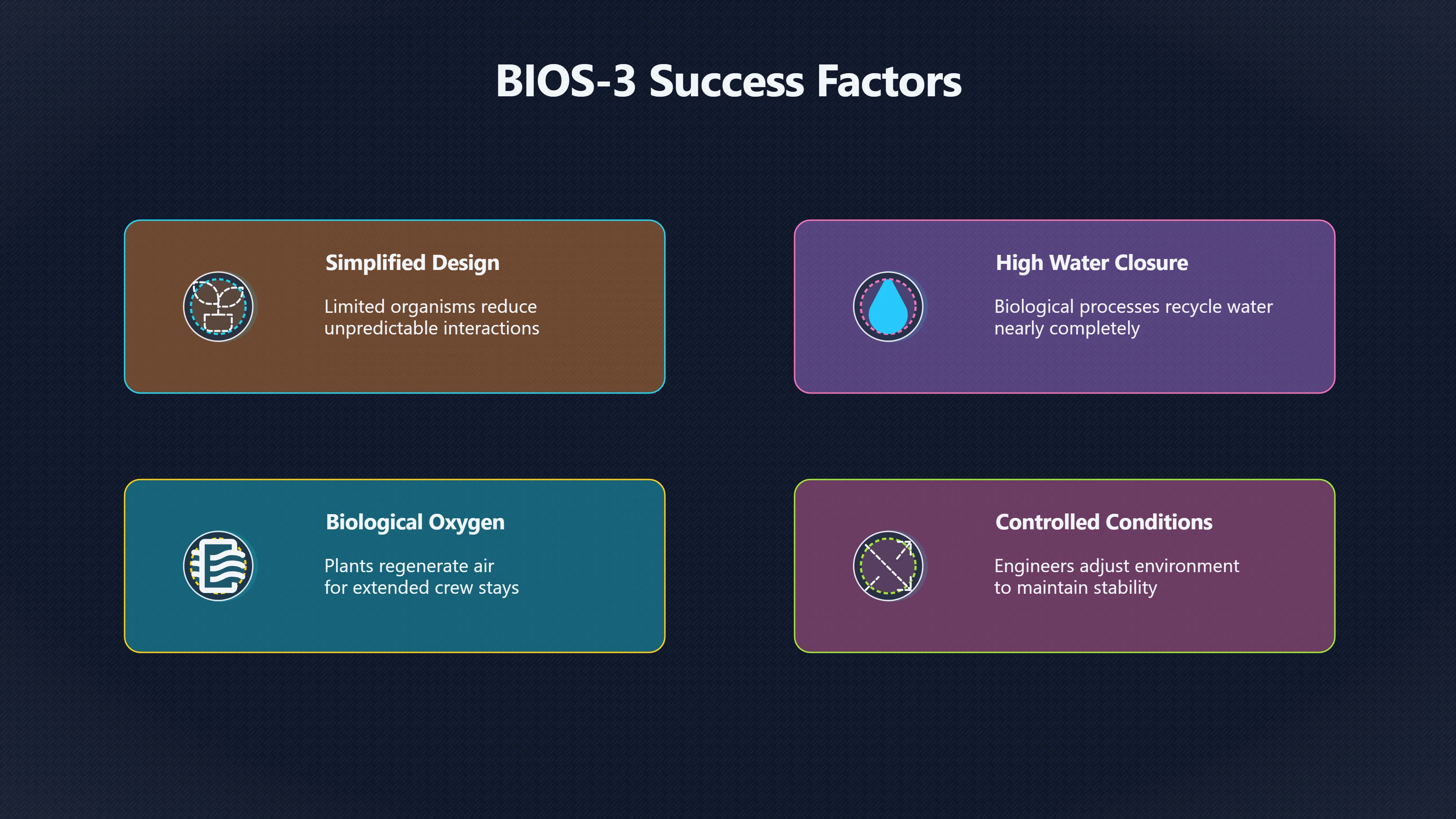
BIOS-3 was developed in Krasnoyarsk in the Soviet Union beginning in the 1960s. Unlike later, more famous projects, it was relatively small and intentionally simplified. The facility relied heavily on algae cultivation and controlled crop production rather than trying to recreate multiple natural ecosystems. Experiments eventually supported crews living inside the sealed environment for months at a time while recycling air and water through biological processes. Food regeneration reached roughly 80–90% of crew requirements depending on the experiment, while atmospheric and water regeneration approached complete closure.[CORE]core.ac.ukCreation of Closed Ecological Life Support SystemsFebruary 4, 2008 — by II Gitelsona · 2008 · Cited by 25 — Bios-3 was the first to m…
The achievement was important because it demonstrated several principles that remain central to modern bioregenerative life-support research:
- Humans can survive for extended periods in environments where oxygen is regenerated biologically.
- Water recycling can reach very high levels of closure.
- Crop production can become an active component of life support rather than merely food supply.
- Long-duration habitation becomes more practical when biological and engineering systems operate together.[CORE]core.ac.ukCreation of Closed Ecological Life Support SystemsFebruary 4, 2008 — by II Gitelsona · 2008 · Cited by 25 — Bios-3 was the first to m…
What made BIOS-3 relatively successful was not that it reproduced Earth’s biosphere. It largely avoided attempting to do so.
The system relied on a comparatively limited set of organisms and carefully controlled environmental conditions. Researchers deliberately reduced ecological complexity wherever possible. Instead of managing thousands of interacting species, they concentrated on maintaining a small number of biological processes that could be measured and adjusted.[CORE]core.ac.ukCreation of Closed Ecological Life Support SystemsFebruary 4, 2008 — by II Gitelsona · 2008 · Cited by 25 — Bios-3 was the first to m…
For future AI habitat designers, this may be one of the most important lessons. Ecological richness is not automatically an advantage. Greater biodiversity can improve resilience in some contexts, but it also creates more interactions, more feedback loops and more opportunities for unexpected behaviour. BIOS-3 succeeded partly because it constrained the problem.
Why Biosphere 2 Exposed Hidden Ecosystem Risks
Biosphere 2 attempted something far more ambitious.
Constructed in Arizona and sealed in 1991, the facility contained multiple miniature biomes including rainforest, ocean, desert and agricultural systems. Eight people lived inside for two years while attempting to operate the structure as a materially closed ecosystem. It remains the largest closed ecological experiment ever built.[Wikipedia]WikipediaBiosphere 2Biosphere 2
The project generated valuable scientific findings, but it also revealed how difficult it is to predict the behaviour of a complex artificial biosphere.
The oxygen crisis nobody expected
The most famous failure involved atmospheric oxygen.
During the first closure experiment, oxygen levels steadily fell from around 21% to roughly 14%, equivalent to conditions at high altitude. Crew members experienced fatigue and other symptoms, and outside oxygen eventually had to be injected to maintain safety.[Science]science.orgBiosphere 2 and Biodiversity–The Lessons So FarBy January 1993, 1.4 years after material closure of Biosphere 2, the oxygen conce…[Wikipedia]WikipediaBiosphereThe biosphere is the global ecological system integrating all living beings and their relationships, including their interact…
What made the episode especially important was that researchers initially struggled to identify the cause.
The straightforward explanation would have been that oxygen loss should correspond to rising carbon dioxide. Yet the measured carbon dioxide increase was insufficient to explain the scale of the oxygen decline. Later analysis revealed that multiple processes were interacting simultaneously. Soil microbes were consuming oxygen while decomposing organic matter, releasing carbon dioxide. Meanwhile, some of that carbon dioxide reacted with exposed concrete surfaces and became locked away as carbonates. The atmosphere therefore concealed part of the underlying oxygen loss.[ScienceDirect]sciencedirect.comOverview of the Biosphere 2 closed systemby B Zabel · 1999 · Cited by 66 — In this paper we emphasize material selection, super-structure…
The lesson is striking. A system can appear stable at the level of individual measurements while important failures develop through interactions between biological, chemical and structural processes.
For future space habitats, this means monitoring oxygen alone would be insufficient. Operators would need to understand how hundreds of linked processes affect one another over time.
Soil microbes became system-level actors
Many early expectations focused on visible organisms such as crops, trees and animals. Instead, some of the most important dynamics emerged from microbial activity in the soil.
Researchers discovered that microbial respiration consumed oxygen faster than anticipated. The amount of carbon stored in soils and the rate at which microbes processed it turned out to be critical variables. The problem was not a malfunctioning machine. It was a living subsystem behaving differently from expectations.[ScienceDirect]sciencedirect.comOverview of the Biosphere 2 closed systemby B Zabel · 1999 · Cited by 66 — In this paper we emphasize material selection, super-structure…[Wikipedia]WikipediaBiosphere 2Biosphere 2
This remains highly relevant for modern habitat concepts.
Future settlements may depend on microbial bioreactors, waste-processing systems and nutrient-recycling loops. These organisms will perform essential work, but they may also become sources of instability if their behaviour changes under altered gravity, radiation exposure, nutrient conditions or long-term ecological drift.
Ecosystems generated surprises beyond engineering models
Biosphere 2 repeatedly produced outcomes that were difficult to forecast.
Carbon dioxide levels fluctuated dramatically across seasons. Species populations changed unexpectedly. Some organisms thrived while others declined. Managing the system required continual intervention and adaptation rather than simple adherence to an original operating plan.[Wikipedia]WikipediaBiosphereThe biosphere is the global ecological system integrating all living beings and their relationships, including their interact…
The broader lesson is that a closed habitat is not merely a machine.
A machine can often be understood by analysing its components individually. Ecosystems generate emergent behaviour: system-level outcomes that arise from interactions among many parts. Biosphere 2 revealed how difficult it is to anticipate those interactions even when researchers have extensive monitoring and direct access to the facility.
The Deeper Warning: Solving Subsystems Is Not Enough
One of the easiest mistakes in discussions of future space settlement is assuming that success in individual technologies automatically adds up to success at the habitat level.
A settlement may possess:
- Excellent water recycling.[universetoday.com]universetoday.comspace and sustainability how the lessons of b2 inspired samc2b2Space and Sustainability: How the Lessons of Biosphere 2…27 Jan 2021 — By 1968, BIOS-3 reached a system efficiency of 99% in terms of…
- Reliable crop production.
- Advanced atmospheric control.
- High-performance robotics.
- Sophisticated environmental sensors.
Yet the habitat can still become unstable if interactions between those systems create feedback loops that nobody anticipated.
Biosphere 2 showed that optimisation of components does not guarantee optimisation of the whole. Oxygen decline emerged from interactions between soils, microbes, plants, atmospheric chemistry and construction materials. No single subsystem failure fully explained the outcome.[Wikipedia]WikipediaBiosphereThe biosphere is the global ecological system integrating all living beings and their relationships, including their interact…
This distinction matters for AI because many current AI successes come from narrow optimisation tasks. Managing a closed biosphere requires something different: understanding system-wide dynamics across biological, chemical and engineering domains simultaneously.
How AI Habitat Managers Could Use These Lessons
The strongest argument for AI in future habitats is not that it removes uncertainty. It is that uncertainty may become too large for human operators alone.
AI as a detector of hidden interactions
Modern machine-learning systems are increasingly effective at finding weak patterns across large datasets.
A future habitat might contain millions of environmental measurements: atmospheric composition, crop health, nutrient flows, microbial populations, equipment performance and crew health indicators. AI systems could search for correlations that humans might overlook.
The Biosphere 2 oxygen decline is a useful example. An advanced monitoring system might have recognised subtle links between soil respiration, atmospheric chemistry and structural materials long before oxygen levels became dangerous. Rather than waiting for a visible crisis, it could flag emerging risk trajectories.[Wikipedia]WikipediaBiosphereThe biosphere is the global ecological system integrating all living beings and their relationships, including their interact…
Digital twins and ecosystem simulation
One likely application is the creation of habitat “digital twins” — continuously updated simulations linked to real-world sensor data.
Instead of merely observing current conditions, AI systems could estimate future states under thousands of possible scenarios:
- Crop failure.
- Equipment breakdown.
- Microbial population shifts.
- Radiation events.
- Changes in crew consumption patterns.
The goal would not be perfect prediction. Ecosystems remain partly unpredictable. Rather, it would allow operators to explore likely outcomes before making interventions.
In effect, AI could help transform habitat management from reactive control into probabilistic forecasting.
Managing trade-offs rather than chasing fixed targets
BIOS-3 demonstrated the value of simplification. Biosphere 2 demonstrated the value of realism. Future habitats will probably require a balance between the two.
AI may help navigate trade-offs such as:
- Productivity versus biodiversity.
- Efficiency versus redundancy.
- Automation versus human oversight.
- Ecological flexibility versus environmental stability.
Instead of attempting to maximise a single variable, habitat managers may need systems that continuously balance competing goals.
This resembles managing an economy or an ecosystem more than operating a spacecraft.
Why These Experiments Matter for the AI Bloom Vision
The broader AI bloom perspective imagines a future in which advanced AI helps humanity expand beyond many current constraints, including those imposed by hostile environments such as space.
Closed ecosystem experiments show both the promise and the difficulty of that vision.
The optimistic interpretation is that AI could eventually coordinate biological, industrial and ecological systems at a scale beyond unaided human cognition. A sufficiently capable system might model nutrient cycles, atmospheric chemistry, agriculture, waste processing and human health as components of a unified habitat. If such capabilities mature, self-sustaining settlements on Mars, in orbital habitats or elsewhere become more plausible.
The cautionary interpretation is equally important. Biosphere 2 revealed that even highly motivated teams operating one of the most ambitious ecological experiments ever built struggled to predict system behaviour. Complexity itself became the central challenge.[Science Advances]spj.science.orgScience AdvancesBiosphere 2's Lessons about Living on Earth and in SpaceBiosphere 2 was important as a first step towards learning how to…
The key lesson is therefore not that AI will effortlessly solve life support. It is that future habitats may require intelligence operating at a systems level because the habitat itself behaves like a living network rather than a collection of machines.
BIOS-3 suggested that carefully constrained biological life support can work. Biosphere 2 demonstrated that realistic ecosystems contain hidden dynamics that become visible only through operation. Together they imply that the future of space settlement may depend less on building larger habitats and more on developing the ability to understand, model and govern complexity itself. For advanced AI, that challenge may be one of the most consequential tests of whether intelligence can genuinely help civilisation flourish beyond Earth.
Amazon book picks
Further Reading
Books and field guides related to What Closed Ecosystem Experiments Got Wrong. Use these as the next step if you want deeper reading beyond the article.
A City on Mars
Directly questions whether closed habitats and settlements can work in practice.
The Future of Humanity
Provides a wider settlement context for lessons from closed-ecosystem experiments.
Packing for Mars
Explores the practical and biological complications of human space habitation.
eBay marketplace picks
Marketplace Samples
Example marketplace items related to this page. Use the search link to explore similar finds on eBay.


Endnotes
1.
Source: core.ac.uk
Link:https://core.ac.uk/download/pdf/38632677.pdf
Source snippet
Creation of Closed Ecological Life Support SystemsFebruary 4, 2008 — by II Gitelsona · 2008 · Cited by 25 — Bios-3 was the first to m...
Published: February 4, 2008
2.
Source: Wikipedia
Title: Biosphere 2
Link:https://en.wikipedia.org/wiki/Biosphere_2
3.
Source: sciencedirect.com
Link:https://www.sciencedirect.com/science/article/abs/pii/S0925857498000913
Source snippet
Overview of the Biosphere 2 closed systemby B Zabel · 1999 · Cited by 66 — In this paper we emphasize material selection, super-structure...
4.
Source: sciencedirect.com
Title: ScienceDirect Biosphere 2
Link:https://www.sciencedirect.com/topics/earth-and-planetary-sciences/biosphere-2
Source snippet
Biosphere 2 - an overviewDuring the first human experiment oxygen concentration in the atmosphere decreased dramatically bec...
5.
Source: Wikipedia
Link:https://en.wikipedia.org/wiki/Biosphere
Source snippet
BiosphereThe biosphere is the global ecological system integrating all living beings and their relationships, including their interact...
6.
Source: biosphere2.org
Link:https://biosphere2.org/sites/default/files/2021-08/B21216_Press_02_Discover02lo.pdf
Source snippet
Life under the bubbleAs oxygen was converted to carbon dioxide, free oxygen in the atmo- sphere declined. By January 1993, Biosphere 2's...
Published: January 1993
7.
Source: biosphere2.org
Link:https://biosphere2.org/
Source snippet
nforest stop absorbing more carbon dioxide from the air...Read more...
8.
Source: biosphere2.org
Link:https://biosphere2.org/research/research-initiatives/tropical-rain-forest
Source snippet
Tropical Rain ForestWe will place particular focus on diverse volatile and nonvolatile carbon metabolites, their role in plant and microb...
9.
Source: biosphere2.org
Link:https://biosphere2.org/sites/default/files/2021-08/B21307_Press_History02lo.pdf
Source snippet
An experiment in place and timeThe main factor contributing to a dramatic imbalance in oxygen and carbon dioxide was the abundant microbe...
10.
Source: sciencedirect.com
Link:https://www.sciencedirect.com/science/article/abs/pii/S0273117703001030
Source snippet
The legacy of biosphere 2 for the study...by JP Allen · 2003 · Cited by 75 — Medical research inside Biosphere 2 included the effects on...
11.
Source: sciencedirect.com
Link:https://www.sciencedirect.com/science/article/abs/pii/S027311770301202X
Source snippet
Light is from 12,000 W of high pressure sodium lamps over planting...Rea...
12.
Source: sciencedirect.com
Link:https://www.sciencedirect.com/science/article/abs/pii/S0016328718303045
Source snippet
m...
13.
Source: sciencedirect.com
Link:https://www.sciencedirect.com/science/article/abs/pii/S0273117713001725
Source snippet
Key ecological challenges for closed systems facilitiesby M Nelson · 2013 · Cited by 38 — These challenges include being able to handle f...
14.
Source: uapress.arizona.edu
Title: what have i gotten myself into insights from biosphere 2
Link:https://uapress.arizona.edu/2018/01/what-have-i-gotten-myself-into-insights-from-biosphere-2
Source snippet
Insights from Biosphere 2Jan 4, 2018 — B1 is our planet's life support system. Biosphere 2 was built to study how biospheres work, creati...
15.
Source: science.org
Link:https://www.science.org/doi/10.1126/science.274.5290.1150
Source snippet
Biosphere 2 and Biodiversity--The Lessons So FarBy January 1993, 1.4 years after material closure of Biosphere 2, the oxygen conce...
Published: January 1993
16.
Source: publish.obsidian.md
Title: Biosphere 2
Link:https://publish.obsidian.md/disruptively-useful/The%2BHeat%2BStrikes/Civil%2BResistance/Case%2BStudies/Biosphere%2B2
Source snippet
2 - disruptively-usefulThe cause—excessive oxygen consumption by microbes—showed how difficult it is to balance all components of a close...
17.
Source: spj.science.org
Link:https://spj.science.org/doi/10.34133/2021/8067539
Source snippet
Science AdvancesBiosphere 2's Lessons about Living on Earth and in SpaceBiosphere 2 was important as a first step towards learning how to...
18.
Source: mynasadata.larc.nasa.gov
Title: about biosphere
Link:https://mynasadata.larc.nasa.gov/basic-page/about-biosphere
Source snippet
The Biosphere | MyNASADataThe Biosphere includes all life on Earth including life living on the Earth's Geosphere and in Hydrosphere, inc...
19.
Source: wired.com
Link:https://www.wired.com/2004/12/biosphere/
Source snippet
10 Lessons from Biosphere 21 Dec 2004 — One lesson: Don't use concrete. It sucks up CO2, which plants need to produce oxygen. 5. Long spa...
20.
Source: edgeeffects.net
Title: biosphere 2
Link:https://edgeeffects.net/biosphere-2/
Source snippet
Why an Eccentric Ecological Experiment Still...Dec 15, 2016 — Crucial lessons were learned about how to engineer large closed systems (t...
21.
Source: thewonderofscience.com
Title: biosphere 2
Link:https://thewonderofscience.com/phenomenon/2018/6/10/biosphere-2
Source snippet
10 Jun 2018 — Plants in the biosphere produced oxygen and food for the inhabitants. The carbon dioxide released during respiration was ta...
Additional References
22.
Source: researchgate.net
Link:https://www.researchgate.net/publication/242368741_Lessons_Learned_from_Biosphere_2_and_Laboratory_Biosphere_Closed_Systems_Experiments_for_the_Mars_On_Earth_Project
Source snippet
(PDF) Lessons Learned from Biosphere 2 and Laboratory...10 Aug 2025 — Key features selected for the Mars On Earth® life support system b...
23.
Source: facebook.com
Link:https://www.facebook.com/groups/isaacarthur/posts/1990739461229253/
Source snippet
Lessons from Biosphere 2 for space habitatsAt first, the researchers could not track down the excess carbon dioxide those microbes should...
24.
Source: simoc.space
Link:https://simoc.space/wp-content/uploads/2023/05/SIMOC-B2_Lesson_Plans.pdf
Source snippet
B2 Lesson PlansMicroorganisms in the soil consumed more O2 and produced more CO2 than expected. 2. Concrete Carbonation. Concrete c...
25.
Source: jstage.jst.go.jp
Link:https://www.jstage.jst.go.jp/article/bss/19/4/19_4_250/_article
Source snippet
Learned from Biosphere 2 and Laboratory...The overall design will address not only the functional requirements for maintaining long term...
26.
Source: bpsscience.weebly.com
Title: 8 biosphere 2 an experiment in isolation (populations and ecosystems – sy16)
Link:https://bpsscience.weebly.com/uploads/2/2/1/3/2213712/8biosphere_2-an_experiment_in_isolation%28populations_and_ecosystems_%E2%80%93_sy16%29.pdf
Source snippet
2: An Experiment In IsolationWhere was the oxygen going? Analysis revealed that the soil in Biosphere. 2 was too rich in organic matter...
27.
Source: universetoday.com
Title: space and sustainability how the lessons of b2 inspired samc2b2
Link:https://www.universetoday.com/articles/space-and-sustainability-how-the-lessons-of-b2-inspired-samc2b2
Source snippet
Space and Sustainability: How the Lessons of Biosphere 2...27 Jan 2021 — By 1968, BIOS-3 reached a system efficiency of 99% in terms of...
28.
Source: pubmed.ncbi.nlm.nih.gov
Link:https://pubmed.ncbi.nlm.nih.gov/14503500/
Source snippet
legacy of Biosphere 2 for the study...by JP Allen · 2003 · Cited by 75 — The many lessons learned from Biosphere 2 are being used by its...
29.
Source: ryestrategy.com
Link:https://www.ryestrategy.com/blog/biosphere-2-learning-from-failure
Source snippet
xide at a much faster rate. This resulted in...Read more...
30.
Source: [education]({{ ‘education/’ | relative_url }}). nationalgeographic.org
Link:https://education.nationalgeographic.org/resource/biosphere/
Source snippet
National Geographic EducationAug 19, 2025 — The biosphere is made up of the parts of Earth where life exists—all ecosystems...
31.
Source: reddit.com
Title: They didn’t need to add oxygen because it failed.Read more
Link:https://www.reddit.com/r/todayilearned/comments/vr6l92/til_biosphere_2_was_a_closed_ecological_system/
Source snippet
TIL "Biosphere 2" was a closed ecological system which...Biosphere 2 failed because it couldn't produce enough, oxygen, food, and water...
Topic Tree