Within Intelligence
Can AI Help Beginners Catch Up?
Early workplace evidence suggests AI assistants may help less experienced workers catch up faster, not just make experts more productive.
On this page
- What customer support studies reveal about productivity gains
- How AI can transfer tacit know how in real time
- Where guidance becomes dependence or surveillance
Page outline Jump by section
Introduction
One of the most interesting early findings from workplace AI is that the biggest gains do not always go to the most talented employees. In several real-world deployments, AI assistants appear to help less experienced workers improve faster than experts. Rather than simply making the best people even better, these systems can sometimes narrow skill gaps by delivering guidance that would previously have required a supervisor, mentor or years of accumulated experience.
 That possibility matters far beyond customer support software. If intelligence becomes more abundant, one of the first visible effects may be that people spend less time waiting for expert attention. Junior staff, workers in smaller firms, employees operating in a second language, and people without elite credentials could gain access to a continuous stream of practical coaching. The larger AI bloom question is whether this pattern can scale: not merely raising productivity, but making valuable know-how less scarce across society.
The evidence remains early and incomplete. Most studies cover specific tasks rather than whole careers, and productivity gains are not the same thing as genuine expertise. Yet the strongest workplace evidence so far suggests that AI assistants may function partly as a mechanism for distributing tacit knowledge that was previously trapped inside organisations or concentrated among top performers.
What customer support studies reveal about productivity gains
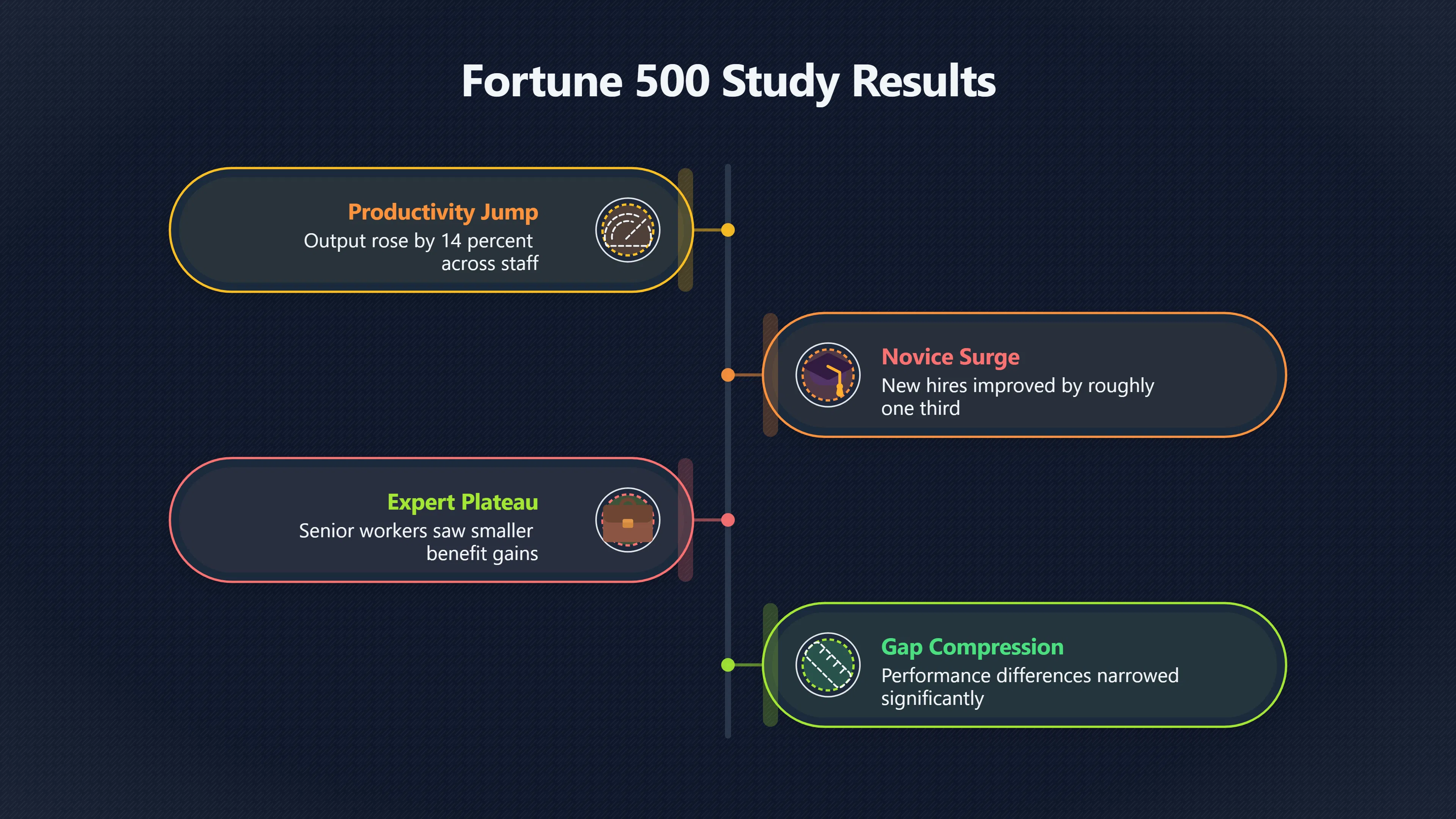
The most widely cited evidence comes from a large study of more than 5,000 customer support agents at a Fortune 500 software company by Erik Brynjolfsson, Danielle Li and Lindsey Raymond. The company introduced a generative AI assistant that suggested responses and guidance during customer interactions. Researchers were able to compare performance before and after adoption across thousands of workers.[stanford]digitaleconomy.stanford.eduDigital Economy Lab Generative AI at WorkStanford Digital Economy LabGenerative AI at Work - Stanford Digital Economy LabAccess to AI assistance increases worker productivity, as…
The headline result was a productivity increase of roughly 14–15%, measured by customer issues resolved per hour. But the average figure was not the most important finding. The largest gains appeared among newer and lower-skilled workers. In several versions of the analysis, novice employees improved by around one-third, while experienced workers saw much smaller benefits.[SSRN]papers.ssrn.comGenerative AI at Work by Erik Brynjolfsson, Danielle…by E Brynjolfsson · 2023 · Cited by 3335 — Access to the tool increases produ…[OUP]academic.oup.comOUP AcademicGenerative AI at Work* | The Quarterly Journal of Economicsby E Brynjolfsson · 2025 · Cited by 3335 — We find that access to…
That pattern matters because it differs from many previous digital technologies. Often, new tools reward people who already possess the strongest skills, deepest knowledge or best education. Economists sometimes describe this as skill-biased technological change. The customer support study suggested something closer to the opposite effect. The AI system compressed performance differences between weaker and stronger workers.[SIEPR]siepr.stanford.eduAuthor(s). Erik Brynjolfsson.Read moreGenerative AI at Work | Stanford Institute for Economic Policy…Our results suggest that access to generative AI can increase prod…
The researchers argued that the system appeared to capture and distribute the behaviours of high-performing agents. Instead of every new employee learning slowly through trial and error, they could receive real-time suggestions based on patterns extracted from thousands of successful interactions. In effect, part of the organisation’s accumulated expertise became available on demand.[SIEPR]siepr.stanford.eduAuthor(s). Erik Brynjolfsson.Read moreGenerative AI at Work | Stanford Institute for Economic Policy…Our results suggest that access to generative AI can increase prod…
Several additional findings reinforced this interpretation:
- Lower-skilled workers improved both speed and quality rather than simply rushing through more cases.[arXiv]arxiv.orgGenerative AI at Workby E Brynjolfsson · 2023 · Cited by 3399 — We find that access to AI assistance increases the productivity of agents…
- International workers appeared to benefit from improved language support and communication assistance.[arXiv]arxiv.orgGenerative AI at Workby E Brynjolfsson · 2023 · Cited by 3399 — We find that access to AI assistance increases the productivity of agents…
- Customer satisfaction remained stable or improved despite faster resolution times.[Stanford Graduate School of Business]gsb.stanford.edugenerative ai can boost productivity without replacing workersStanford Graduate School of BusinessGenerative AI Can Boost Productivity Without Replacing…11 Dec 2023 — Providing workers with a gene…
- Employee retention improved, suggesting that work became less frustrating for some staff.[SIEPR]siepr.stanford.eduAuthor(s). Erik Brynjolfsson.Read moreGenerative AI at Work | Stanford Institute for Economic Policy…Our results suggest that access to generative AI can increase prod…
The study examined one company in one sector, so it cannot prove that every occupation will see similar effects. Nevertheless, it remains one of the strongest pieces of evidence that AI assistants can act as capability levellers rather than merely productivity multipliers.
How AI can transfer tacit know-how in real time
The deeper significance of these findings lies in what organisations normally struggle to transmit.
Most valuable workplace knowledge is not written down in manuals. Experienced employees often develop instincts that are difficult to explain: how to calm an angry customer, which troubleshooting steps usually work first, what warning signs indicate a larger problem, or how to phrase information clearly without escalating conflict.
Economists and management researchers often call this tacit knowledge: practical know-how acquired through experience rather than formal instruction.
In a traditional workplace, tacit knowledge spreads slowly. A new employee watches colleagues, asks questions, makes mistakes and gradually develops judgement. Expert mentoring is powerful but expensive because senior staff have limited time.
AI assistants create a different pathway. Instead of requiring an expert to be physically present, the system can provide suggestions during the task itself.
A customer support agent facing a difficult conversation might receive:
- A recommended explanation.
- A troubleshooting sequence.
- A warning about common errors.
- A suggested tone for the conversation.
- Relevant internal documentation.
The important point is timing. Traditional training happens before work. AI guidance often happens during work.
This changes the economics of expertise distribution. Rather than allocating one mentor to ten junior employees, an organisation can provide a first layer of guidance continuously. The expert remains valuable, but their accumulated knowledge reaches more people simultaneously.
The customer support evidence is consistent with this interpretation. Researchers argued that the AI appeared to disseminate the practices of the company’s most capable workers, helping newer employees move down the learning curve more quickly.[SIEPR]siepr.stanford.eduAuthor(s). Erik Brynjolfsson.Read moreGenerative AI at Work | Stanford Institute for Economic Policy…Our results suggest that access to generative AI can increase prod…
If this mechanism generalises, it could become one of the earliest examples of abundant intelligence in practice: not artificial superintelligence, but a reduction in the scarcity of useful cognitive guidance.
Why narrowing skill gaps matters beyond customer support
The customer support case is important partly because it highlights a broader bottleneck found throughout modern economies.
Many workplaces contain a steep gradient between people who know what they are doing and people who are still learning. Productivity often depends less on raw intelligence than on access to accumulated expertise.
This is especially visible in:
- Small businesses without specialist departments.
- Public-sector organisations facing staff shortages.
- Developing economies with limited access to expert services.
- Remote teams spread across multiple countries.
- Rapidly changing technical fields where documentation lags behind practice.
In these settings, the constraint is frequently not information but interpretation. People can find documents online. The challenge is knowing which document matters, how to apply it, and what to do next.
An effective AI assistant can sometimes act as an intermediary between formal knowledge and practical action. The resulting gains may appear modest when measured as minutes saved per task, but they can become more significant when accumulated across millions of workers who previously lacked access to timely guidance.
This is one reason AI abundance arguments focus on cognitive access rather than merely automation. A world with more widely available expert-like assistance could produce larger gains than a world where only elite organisations can afford specialised knowledge.

Where guidance becomes dependence
The optimistic interpretation has important limits.
A worker who performs better with AI assistance is not necessarily becoming more skilled. They may simply be borrowing competence from the system.
This distinction matters because workplaces are also learning environments. Entry-level jobs often function as apprenticeships where employees develop judgement through repeated practice.
If AI removes too much of that learning process, organisations could create a new problem. Workers might complete tasks successfully while understanding less about why those tasks succeed.
Several observers have warned about the possibility of “cognitive debt”: a situation where employees become increasingly dependent on AI outputs while failing to build the underlying skills themselves. Concerns are especially strong for early-career workers, whose traditional learning pathways may be disrupted if AI handles too much of the routine work that once served as training.[Business Insider]businessinsider.comWorkers increasingly rely on AI for tasks like drafting content, which accelerates processes but bypasses critical, skill-building stages…[The Washington Post]washingtonpost.comThe Washington Post AI is supercharging Gen Z workersYoung professionals like Richard Bedats and Harshvi Shah are using generative AI to streamline data analysis, summarize reports, and brai…
The customer support study itself cannot fully answer this question. It found evidence consistent with worker learning, but it primarily measured operational outcomes rather than long-term expertise development.[SIEPR]siepr.stanford.eduAuthor(s). Erik Brynjolfsson.Read moreGenerative AI at Work | Stanford Institute for Economic Policy…Our results suggest that access to generative AI can increase prod…
A central implementation challenge therefore emerges:
- AI can accelerate performance.
- Organisations also need workers to develop independent judgement.
Those goals overlap but are not identical.
The most successful deployments may be those that combine AI assistance with deliberate training, feedback and opportunities for workers to understand the reasoning behind recommendations.

Where assistance becomes surveillance
Another tension concerns management and monitoring.
Workplace AI systems do not merely provide guidance. They often generate detailed records of employee behaviour, decision-making and performance.
From one perspective, this allows better coaching. Managers can identify where workers struggle and offer targeted support.
From another perspective, it creates new forms of workplace surveillance. Every prompt, recommendation, correction and performance metric can potentially be logged and analysed.
The same systems that narrow skill gaps may also increase managerial visibility into daily work.
This raises questions about:
- Worker autonomy.
- Privacy.
- Performance monitoring.
- Algorithmic evaluation.
- Employer control over knowledge flows.
These concerns are particularly relevant if AI becomes an essential layer of workplace infrastructure. A future where cognitive assistance is abundant could still be one where access to that assistance is controlled by employers, governments or a small number of technology firms.
The broader AI bloom vision depends not only on capability growth but on distribution. An assistant that helps millions of workers learn faster contributes to human flourishing very differently from a system used mainly to intensify monitoring or reduce bargaining power.
A small but significant clue about abundant intelligence
The customer support evidence should not be exaggerated. A productivity gain in one workplace is not proof that AI will eliminate cognitive scarcity across society. Many professions involve deeper judgement, richer context and higher stakes than answering support tickets.
Yet the study remains important because it reveals a mechanism that could matter far beyond customer service.
For centuries, expertise has been constrained by the limited time of experts. The most experienced people could only directly guide a relatively small number of others. The early workplace evidence suggests AI assistants may partially relax that constraint by capturing fragments of expert behaviour and making them available to less experienced workers in real time.[SIEPR]siepr.stanford.eduAuthor(s). Erik Brynjolfsson.Read moreGenerative AI at Work | Stanford Institute for Economic Policy…Our results suggest that access to generative AI can increase prod…
If that pattern extends into education, administration, healthcare support, technical work and scientific collaboration, the long-term significance may not simply be faster work. It may be a world where practical know-how becomes less dependent on proximity to elite institutions, scarce mentors or fortunate career pathways.
That would not end the need for experts. It could, however, reduce the distance between experts and everyone else. In the context of abundant intelligence, that narrowing of skill gaps may be one of the earliest and most measurable signs that cognitive assistance is becoming less scarce.
Amazon book picks
Further Reading
Books and field guides related to Can AI Help Beginners Catch Up?. Use these as the next step if you want deeper reading beyond the article.
Power and Prediction
Explains how AI changes workplace decision-making and productivity.
eBay marketplace picks
Marketplace Samples
Example marketplace items related to this page. Use the search link to explore similar finds on eBay.


Endnotes
1.
Source: digitaleconomy.stanford.edu
Title: Digital Economy Lab Generative AI at Work
Link:https://digitaleconomy.stanford.edu/publication/generative-ai-at-work/
Source snippet
Stanford Digital Economy LabGenerative AI at Work - Stanford Digital Economy LabAccess to AI assistance increases worker productivity, as...
2.
Source: papers.ssrn.com
Link:https://papers.ssrn.com/sol3/papers.cfm?abstract_id=4426942
Source snippet
Generative AI at Work by Erik Brynjolfsson, Danielle...by E Brynjolfsson · 2023 · Cited by 3335 — Access to the tool increases produ...
3.
Source: academic.oup.com
Link:https://academic.oup.com/qje/article/140/2/889/7990658
Source snippet
OUP AcademicGenerative AI at Work* | The Quarterly Journal of Economicsby E Brynjolfsson · 2025 · Cited by 3335 — We find that access to...
4.
Source: arxiv.org
Link:https://arxiv.org/pdf/2304.11771
Source snippet
Generative AI at Workby E Brynjolfsson · 2023 · Cited by 3399 — We find that access to AI assistance increases the productivity of agents...
5.
Source: siepr.stanford.edu
Title: Author(s). Erik Brynjolfsson.Read more
Link:https://siepr.stanford.edu/publications/working-paper/generative-ai-work
Source snippet
Generative AI at Work | Stanford Institute for Economic Policy...Our results suggest that access to generative AI can increase prod...
6.
Source: arxiv.org
Title: arXiv Generative AI at Work
Link:https://arxiv.org/abs/2304.11771
Source snippet
Generative AI at WorkApril 24, 2023...
Published: April 24, 2023
7.
Source: gsb.stanford.edu
Title: generative ai can boost productivity without replacing workers
Link:https://www.gsb.stanford.edu/insights/generative-ai-can-boost-productivity-without-replacing-workers
Source snippet
Stanford Graduate School of BusinessGenerative AI Can Boost Productivity Without Replacing...11 Dec 2023 — Providing workers with a gene...
8.
Source: danielle.li
Title: GENERATIV E AI AT WORK˚
Link:https://danielle.li/assets/docs/GenerativeAIatWork.pdf
Source snippet
GENERATIVE AI AT WORK˚ - Danielle Liby E Brynjolfsson · 2024 · Cited by 2808 — Generative AI could replace lower-skill workers with AI- b...
9.
Source: ideas.repec.org
Link:https://ideas.repec.org/p/nbr/nberwo/31161.html
Source snippet
AI at Workby E Brynjolfsson · 2023 · Cited by 3399 — In this paper, we study the staggered introduction of a generative AI-based conversa...
10.
Source: ideas.repec.org
Link:https://ideas.repec.org/p/ecl/stabus/4141.html
Source snippet
AI at Workby E Brynjolfsson · 2023 · Cited by 3302 — In this paper, we study the staggered introduction of a generative AI-based conversa...
11.
Source: gsb.stanford.edu
Link:https://www.gsb.stanford.edu/faculty-research/working-papers/generative-ai-work
Source snippet
AI at Work - Stanford Graduate School of BusinessIn this paper, we study the staggered introduction of a generative AI-based conversation...
12.
Source: businessinsider.com
Link:https://www.businessinsider.com/ai-making-workers-feel-smarter-but-worse-at-their-jobs
Source snippet
Workers increasingly rely on AI for tasks like drafting content, which accelerates processes but bypasses critical, skill-building stages...
13.
Source: washingtonpost.com
Title: The Washington Post AI is supercharging Gen Z workers
Link:https://www.washingtonpost.com/business/2025/09/08/ai-jobs-loss-entry-level/
Source snippet
Young professionals like Richard Bedats and Harshvi Shah are using generative AI to streamline data analysis, summarize reports, and brai...
14.
Source: Wikipedia
Title: Erik Brynjolfsson
Link:https://en.wikipedia.org/wiki/Erik_Brynjolfsson
Source snippet
Erik BrynjolfssonErik Brynjolfsson is an American academic, author and inventor. He is the Jerry Yang and Akiko Yamazaki Professor and...
Additional References
15.
Source: linkedin.com
Link:https://www.linkedin.com/posts/cobusgreyling_a-new-study-from-yale-on-ai-for-work-activity-7348441807057252353-rHr3
Source snippet
Cobus Greyling's PostWhen AI assistance performance exceeds the threshold, the productivity gap between workers shrinks significantly, su...
16.
Source: linkedin.com
Link:https://www.linkedin.com/posts/erikbrynjolfsson_great-to-see-generative-ai-at-work-my-activity-7297390624809357312-HX0R
Source snippet
Erik Brynjolfsson's PostWe find that an LLM assistant makes customer support agents 14% more productive, improves customer satisfaction...
17.
Source: itif.org
Link:https://itif.org/publications/2023/07/10/customer-support-agents-using-ai-gpt-tool-saw-nearly-14-percent-increase-in-productivity/
Source snippet
Fact of the Week: Customer Support Agents Using an AI...10 Jul 2023 — They found that customer support agents using the AI tool to guide...
18.
Source: cmswire.com
Title: can generative ai boost productivity attitude of customer service agents
Link:https://www.cmswire.com/contact-center/can-generative-ai-boost-productivity-attitude-of-customer-service-agents/
Source snippet
Can Generative AI Boost Productivity, Attitude of Customer...Jun 14, 2023 — A NBER Study reveals customer service agents achieve a big b...
19.
Source: laweconcenter.org
Title: ai productivity and labor markets a review of the empirical evidence
Link:https://laweconcenter.org/resources/ai-productivity-and-labor-markets-a-review-of-the-empirical-evidence/
Source snippet
AI, Productivity, and Labor Markets: A Review of the...5 Feb 2026 — Erik Brynjolfsson, Danielle Li, and Lindsey Raymond (2025) examine a...
20.
Source: cfodive.com
Title: ai boosts productivity nber case study generative workforce
Link:https://www.cfodive.com/news/ai-boosts-productivity-nber-case-study-generative-workforce/649110/
Source snippet
AI boosts productivity 14%: NBER case study1 May 2023 — Generative artificial intelligence boosted worker productivity 13.8% at a Fortune...
Published: May 2023
21.
Source: GOV.UK
Title: ai skills for life and work stakeholder engagement report
Link:https://www.gov.uk/government/publications/ai-skills-for-life-and-work-stakeholder-engagement/ai-skills-for-life-and-work-stakeholder-engagement-report
Source snippet
Skills for Life and Work: Stakeholder Engagement Report28 Jan 2026 — Learning from the customer service side around AI... AI replacing c...
22.
Source: mitsloan.mit.edu
Title: workers less experience gain most generative ai
Link:https://mitsloan.mit.edu/ideas-made-to-matter/workers-less-experience-gain-most-generative-ai
Source snippet
with less experience gain the most from...26 Jun 2023 — Contact center agents with access to an AI assistant were 14% more productive, w...
23.
Source: studocu.com
Title: nber working paper 31161 impact of generative ai on worker productivity
Link:https://www.studocu.com/sg/document/national-university-of-singapore/artificial-intelligence-and-society/nber-working-paper-31161-impact-of-generative-ai-on-worker-productivity/124835599
Source snippet
We find that less-skilled and less-experienced workers improve significantly across all...Read more...
24.
Source: medium.com
Link:https://medium.com/%40adnanmasood/the-future-of-work-evidence-based-insights-into-ai-driven-automation-generative-ai-workforce-6ae4e8d9b76e
Source snippet
oductive on average, with the largest gains seen by junior workers...
Topic Tree