Within Conflict AI
Economic and Social Costs of False Positive Conflict Alerts
This page explores the real-world consequences of false positive conflict predictions on communities and governments.
On this page
- Investor and business reactions
- Community trust and political consequences
- Security responses and unintended escalation
Page outline Jump by section
Introduction
Conflict forecasting systems are often presented as tools that can give governments, aid organisations and international institutions more time to prevent violence. In the most optimistic versions of the AI-enabled future, increasingly powerful prediction systems could help societies anticipate crises, coordinate responses and avoid wars that destroy lives, infrastructure and scientific progress. Yet prediction systems create a difficult trade-off: reducing the chance of missing a real conflict often increases the number of false alarms.
 A false positive conflict forecast does not simply produce a technical error on a dashboard. It can affect investment decisions, insurance costs, political behaviour, public trust and security policy. Communities may be labelled as dangerous despite remaining peaceful. Governments may divert resources in response to risks that never materialise. International actors may overreact to statistical warnings. Understanding these costs is essential because conflict forecasting systems are increasingly becoming part of broader efforts to use AI for civilisational resilience and long-term human flourishing. A forecasting system that repeatedly generates false alarms can undermine the very trust and coordination that effective prevention depends upon.[ScienceDirect]sciencedirect.comA review and comparison of conflict early warning systemsby EG Rød · 2024 · Cited by 53 — We review and compare conflict ear…[Stability Journal]stabilityjournal.orgReflections on the Evolution of Conflict Early Warningby R Muggah · 2022 · Cited by 33 — This article offers a descriptive review of the…
Why False Alarms Matter Even When Models Are Useful
Conflict prediction systems rarely claim certainty. Most generate probability estimates, highlighting regions where violence appears more likely than usual. The challenge is that armed conflict remains comparatively rare and influenced by unpredictable political decisions. Even a statistically strong model can therefore produce many warnings that never lead to violence.[ScienceDirect]sciencedirect.comA review and comparison of conflict early warning systemsby EG Rød · 2024 · Cited by 53 — We review and compare conflict ear…[Observatory of Public Sector Innovation]oecd-opsi.orgObservatory of Public Sector Innovation Vi EWSObservatory of Public Sector InnovationViEWS - The Political Violence Early-Warning System23 Jan 2023 — ViEWS is a publicly available dat…
Researchers reviewing conflict early-warning systems have noted substantial variation between forecasting models and considerable uncertainty in how risks should be interpreted. Different systems may identify different areas as high-risk, while political actors often struggle to determine how strongly they should respond.[ScienceDirect]sciencedirect.comA review and comparison of conflict early warning systemsby EG Rød · 2024 · Cited by 53 — We review and compare conflict ear…
This creates a familiar dilemma seen in many early-warning systems. Lowering the threshold for warnings may catch more genuine dangers but also increases false positives. Raising the threshold reduces unnecessary alarms but risks missing real crises. Similar trade-offs appear in disaster forecasting, financial crisis prediction and other early-warning domains.[World Bank]documents1.worldbank.orgWorld BankCosts and benefits of early warning systemsby D Rogers · Cited by 170 — However, with longer lead times comes greater risk of f…[European Central Bank]ecb.europa.euEuropean Central BankComparing different early warning systemsOver the recent decades researchers in academia and central banks have deve…
The economic and social consequences of these mistakes are often less visible than the costs of a missed warning, but they can accumulate over time and affect entire regions.
Investor and Business Reactions
Risk Labels Can Change Economic Behaviour
Markets respond not only to actual violence but also to expectations of violence. If a region becomes associated with elevated conflict risk through widely used forecasting tools, investors may become more cautious even if violence never occurs.
Foreign companies considering factories, infrastructure projects or long-term contracts often incorporate political risk assessments into decision-making. Governments, insurers and multinational firms increasingly rely on quantitative forecasting tools when evaluating exposure to instability. A region repeatedly flagged as dangerous may therefore experience reduced investment, higher financing costs or delayed projects despite remaining peaceful.[HCSS]hcss.nlConflict Early Warning Systems HCSS 2022Practices, Principles and Promises of Conflict Early…by T Sweijs · 2022 · Cited by 9 — This report examines practices, principles…
The mechanism is straightforward:
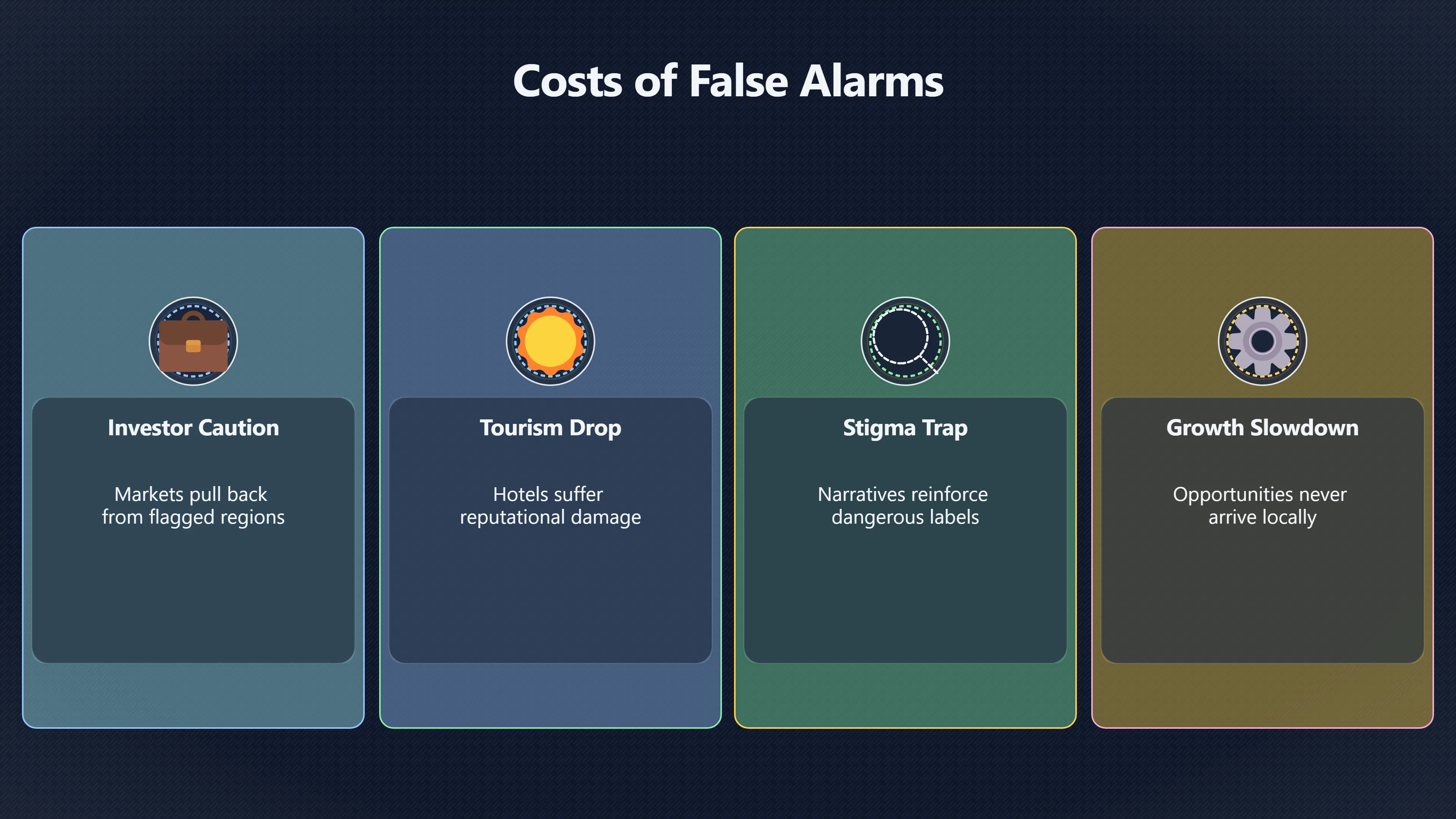
- Investors demand higher returns to compensate for perceived risk.
- Insurance premiums may rise.
- Tourism and hospitality sectors can suffer reputational damage.
- Long-term infrastructure projects may be postponed.
- Local firms face greater uncertainty when seeking external capital.
Unlike visible physical destruction from war, these costs appear as opportunities that never arrive. Economic growth slows because businesses avoid commitments they would otherwise have made.
The Problem of Self-Reinforcing Narratives
False alarms can also become embedded in narratives about a place.
Regions already associated with instability often struggle against international perceptions that they are permanently risky. If predictive systems repeatedly classify such areas as future conflict hotspots, forecasts can reinforce existing stereotypes rather than merely describe objective risk.
This matters because economic expectations are partly social. International lenders, development agencies and corporations often learn about distant regions through reports, rankings and risk assessments rather than direct experience. Once a place becomes known as a likely future conflict zone, reversing that reputation may take years even if forecasts prove wrong.
For lower-income countries attempting to attract investment and develop modern industries, reputational effects can have lasting consequences. The result may be slower economic development in precisely the places where growth and employment could help reduce future conflict risks.
Community Trust and Political Consequences
What Happens When People Are Told They Are At Risk?
Conflict forecasting systems are usually designed for policymakers, but warnings can eventually reach local communities through media coverage, government statements or international reporting.
When residents repeatedly hear that their area is supposedly on the brink of violence and nothing happens, confidence in warning systems can erode. Communities may begin to see forecasts as detached from local realities or driven by outside institutions that do not understand conditions on the ground.
Researchers examining early-warning systems have repeatedly identified trust and communication as central challenges. Warning systems are not merely technical instruments; they operate within political and social environments where legitimacy matters.[gppac.net]gppac.netSeptember 27, 2006 — by A Matveeva · Cited by 80 — This paper is the first in the series of studies into issues in conflict prevention an…[GOV.UK]assets.publishing.service.gov.ukearly warning and early responseby B Rohwerder · 2015 · Cited by 17 — Linking warning and response: The biggest challenge for conflict ea…
Trust can be damaged in several ways:
- Residents may dismiss future warnings, including accurate ones.
- Local leaders may become less willing to cooperate with monitoring efforts.
- Community organisations may view forecasts as externally imposed.
- Citizens may perceive risk assessments as politically motivated.
The paradox is that successful conflict prevention requires cooperation from the very communities that may become sceptical after repeated false alarms.
Political Stigma and Electoral Effects
False positive forecasts can also affect domestic politics.
If particular regions, ethnic groups or political movements become associated with predicted instability, forecasts may influence how they are viewed by national governments or voters. Political opponents may use risk assessments to portray rivals as dangerous or irresponsible. Security agencies may increase surveillance. Public discourse can shift from evidence-based concern towards suspicion and labelling.
In fragile political systems, such effects may deepen existing tensions rather than reduce them.
This risk becomes particularly important as AI systems gain greater authority. Statistical outputs often appear objective, even when they contain substantial uncertainty. Policymakers may treat machine-generated warnings as neutral facts rather than probabilistic assessments with significant margins of error.

The Legitimacy Problem for AI Governance
The broader AI-bloom vision often depends on societies becoming better at coordination, forecasting and long-term planning. Yet false alarms highlight a deeper challenge: prediction alone does not automatically improve governance.
A forecasting system can be technically sophisticated while still damaging institutional legitimacy if people perceive it as opaque, inaccurate or unfair. Reviews of conflict early-warning systems have repeatedly found that transparency and accessibility remain important weaknesses. Communities and decision-makers often struggle to understand how warnings are generated or how much confidence they should place in them.[ScienceDirect]sciencedirect.comA review and comparison of conflict early warning systemsby EG Rød · 2024 · Cited by 53 — We review and compare conflict ear…
For AI systems intended to support civilisation-scale decision-making, maintaining trust may be as important as improving predictive accuracy.
Security Responses and Unintended Escalation
When Precaution Creates New Risks
The most serious concern is that a false warning may trigger actions that increase tensions.
Governments receiving alerts about possible unrest or insurgent activity may deploy additional security forces, increase surveillance, restrict movement or adopt emergency measures. Such actions can be justified if violence is genuinely imminent. However, if the warning is incorrect, the response itself may generate friction between authorities and local populations.
Conflict prevention literature has long recognised that early warning and early response are inseparable. The consequences depend not only on the forecast but also on what institutions do after receiving it.[GOV.UK]assets.publishing.service.gov.ukearly warning and early responseby B Rohwerder · 2015 · Cited by 17 — Linking warning and response: The biggest challenge for conflict ea…[2lse.ac.uk]lse.ac.ukwp49.2conflict early warning and response mechanismsConflict early warning and response' (EWR) was conceived as a means of preventing violent conflict in order to protect…Read more…
Potential unintended effects include:
- Increased perceptions of state repression.
- Heightened fear among civilians.
- Escalation of political grievances.
- Misinterpretation of security deployments by rival groups.
- Deterioration of trust between authorities and communities.
In extreme cases, a response triggered by a false warning can alter behaviour in ways that make instability more likely than it was before.
Feedback Loops Between Predictions and Reality
Conflict forecasts are unusual because they can influence the systems they are trying to predict.
A weather forecast does not usually change the weather itself. Political forecasts, by contrast, can affect human behaviour. Governments, armed groups, investors and citizens may all react to warnings.
This creates the possibility of feedback loops:
- A model predicts elevated conflict risk.
- Authorities implement visible security measures.
- Communities interpret those measures as signs of danger.
- Economic and political behaviour changes.
- Tensions increase because people believe instability is approaching.
The forecast may therefore become part of the causal environment it seeks to analyse.
As predictive systems become more powerful and widely adopted, these reflexive effects may become increasingly important. The challenge is not merely predicting human behaviour but predicting how humans will respond to predictions.

The Hidden Cost of Alert Fatigue
One of the most common effects of repeated false positives in other early-warning fields is “alert fatigue”: the tendency for decision-makers to become desensitised after receiving too many warnings that do not correspond to real events.
Studies of security monitoring systems, medical alerts and other warning environments show that excessive false positives can reduce attention to genuine threats. When people repeatedly investigate alarms that turn out to be harmless, trust in the system declines and critical warnings become easier to ignore.[Stamus Networks]stamus-networks.comLearn how false positives contribute to alert fatigue and how to preventStamus NetworksThe Hidden Risks of False Positives: How to Prevent Alert…7 Mar 2023 — Alert fatigue is one of the leading factors in s…[2threatintelligence.com]threatintelligence.comfalse positivesAre Holding Your Security Back21 Apr 2023 — False positives are a common frustration for security teams, and can undermine the credibilit…
Conflict forecasting faces a similar risk.
Officials responsible for allocating resources have limited time, budgets and political attention. If a forecasting platform repeatedly highlights areas where violence never emerges, users may gradually discount future warnings. The eventual danger is not merely wasted resources but a loss of confidence that causes institutions to miss genuine crises.
This creates a difficult balancing act. Systems must be sensitive enough to detect emerging risks while remaining selective enough that users continue to take alerts seriously.
Can Better Design Reduce the Costs?
The existence of false alarms does not mean conflict forecasting lacks value. Most forecasting systems operate under uncertainty, and some level of false positives is unavoidable. The more important question is how institutions manage those errors.
Several approaches appear increasingly important:
- Probabilistic communication rather than binary warnings, making uncertainty explicit.
- Transparent methodologies that allow users to understand how forecasts are produced.
- Human oversight combining local expertise with statistical outputs.
- Multiple independent models rather than reliance on a single forecast.
- Careful response planning that emphasises proportionate preventive measures rather than heavy-handed interventions.[ScienceDirect]sciencedirect.comA review and comparison of conflict early warning systemsby EG Rød · 2024 · Cited by 53 — We review and compare conflict ear…[HCSS]hcss.nlConflict Early Warning Systems HCSS 2022Practices, Principles and Promises of Conflict Early…by T Sweijs · 2022 · Cited by 9 — This report examines practices, principles…
Many researchers argue that forecasting systems should support human judgement rather than replace it. A model may identify elevated risk, but decisions about resource allocation, diplomacy or security responses still require political and contextual understanding.
Why This Matters for an AI-Enabled Long-Term Future
Within the wider debate about AI and humanity’s long-term future, conflict forecasting illustrates both the promise and the difficulty of predictive intelligence.
The optimistic case is compelling. More accurate forecasting could help prevent wars, reduce displacement, protect scientific institutions and preserve the social stability needed for long-term human flourishing. A civilisation capable of anticipating crises more effectively may be better able to coordinate around shared challenges and avoid catastrophic breakdowns.
False alarms reveal the other side of the equation. Prediction systems operate inside human societies, where expectations, trust and political incentives matter. A technically impressive model can still produce economic losses, social distrust and counterproductive interventions if its outputs are interpreted poorly or acted upon without caution.
The lesson is broader than conflict forecasting alone. As AI systems become more involved in forecasting risks ranging from political instability to pandemics, climate shocks and economic crises, their value will depend not only on predictive accuracy but also on governance. The future benefits of advanced AI may rely as much on designing institutions that handle uncertainty wisely as on improving the algorithms themselves. Predictions can expand humanity’s capacity to anticipate danger, but only if societies learn how to respond without turning every warning into a new source of risk.
Amazon book picks
Further Reading
Books and field guides related to Economic and Social Costs of False Positive Conflict Alerts. Use these as the next step if you want deeper reading beyond the article.
eBay marketplace picks
Marketplace Samples
Example marketplace items related to this page. Use the search link to explore similar finds on eBay.




Endnotes
1.
Source: sciencedirect.com
Link:https://www.sciencedirect.com/science/article/pii/S0169207023000018
Source snippet
A review and comparison of conflict early warning systemsby EG Rød · 2024 · Cited by 53 — We review and compare conflict ear...
2.
Source: hcss.nl
Title: Conflict Early Warning Systems HCSS 2022
Link:https://hcss.nl/wp-content/uploads/2022/02/Conflict-Early-Warning-Systems-HCSS-2022.pdf
Source snippet
Practices, Principles and Promises of Conflict Early...by T Sweijs · 2022 · Cited by 9 — This report examines practices, principles...
3.
Source: gppac.net
Link:https://gppac.net/files/2018-12/Early%20Warning%20and%20Early%20Response.pdf
Source snippet
September 27, 2006 — by A Matveeva · Cited by 80 — This paper is the first in the series of studies into issues in conflict prevention an...
Published: September 27, 2006
4.
Source: assets.publishing.service.gov.uk
Link:https://assets.publishing.service.gov.uk/media/57a08965ed915d622c0001cb/hdq1195.pdf
Source snippet
early warning and early responseby B Rohwerder · 2015 · Cited by 17 — Linking warning and response: The biggest challenge for conflict ea...
5.
Source: lse.ac.uk
Title: wp49.2conflict early warning and response mechanisms
Link:https://www.lse.ac.uk/international-development/Assets/Documents/PDFs/csrc-working-papers-phase-two/wp49.2conflict-early-warning-and-response-mechanisms.pdf
Source snippet
'Conflict early warning and response' (EWR) was conceived as a means of preventing violent conflict in order to protect...Read more...
6.
Source: stamus-networks.com
Title: Learn how false positives contribute to alert fatigue and how to prevent
Link:https://www.stamus-networks.com/blog/the-hidden-risks-of-false-positives-how-to-prevent-alert-fatigue-in-your-organization
Source snippet
Stamus NetworksThe Hidden Risks of False Positives: How to Prevent Alert...7 Mar 2023 — Alert fatigue is one of the leading factors in s...
7.
Source: threatintelligence.com
Title: false positives
Link:https://www.threatintelligence.com/blog/false-positives
Source snippet
Are Holding Your Security Back21 Apr 2023 — False positives are a common frustration for security teams, and can undermine the credibilit...
8.
Source: stabilityjournal.org
Link:https://stabilityjournal.org/articles/10.5334/sta.857
Source snippet
Reflections on the Evolution of Conflict Early Warningby R Muggah · 2022 · Cited by 33 — This article offers a descriptive review of the...
9.
Source: oecd-opsi.org
Title: Observatory of Public Sector Innovation Vi EWS
Link:https://oecd-opsi.org/innovations/views-the-political-violence-early-warning-system/
Source snippet
Observatory of Public Sector InnovationViEWS - The Political Violence Early-Warning System23 Jan 2023 — ViEWS is a publicly available dat...
10.
Source: documents1.worldbank.org
Link:https://documents1.worldbank.org/curated/en/609951468330279598/pdf/693580ESW0P1230aster0Risk0Reduction.pdf
Source snippet
World BankCosts and benefits of early warning systemsby D Rogers · Cited by 170 — However, with longer lead times comes greater risk of f...
11.
Source: ecb.europa.eu
Link:https://www.ecb.europa.eu/events/pdf/conferences/140623/Vasicek-et-al_Comparing-Different-Early-Warning-Systems.pdf?F96bbb525a26071ecf97f9154fb3cc73=
Source snippet
European Central BankComparing different early warning systemsOver the recent decades researchers in academia and central banks have deve...
Additional References
12.
Source: researchgate.net
Link:https://www.researchgate.net/publication/377013074_Conflict_Early_Warning_Systems
Source snippet
(PDF) Conflict Early Warning SystemsConflict Early Warning Systems, or CEWS, are our first example of a sustained systematic PeaceTech in...
13.
Source: researchgate.net
Link:https://www.researchgate.net/publication/327344292_Early_warning_system_in_business_finance_and_economics_Bibliometric_and_topic_analysis
Source snippet
Early warning system in business, finance, and economics1 May 2026 — Early warning systems are used primary for detecting crises before d...
Published: May 2026
14.
Source: checkpoint.com
Link:https://www.checkpoint.com/cyber-hub/cyber-security/understanding-false-positives-in-cybersecurity/
Source snippet
Understanding False Positives in CybersecurityFalse positives in cybersecurity are when a company's cybersecurity system identifies a sus...
15.
Source: pmc.ncbi.nlm.nih.gov
Title: PMCWhy do healthcare professionals fail to escalate as per
Link:https://pmc.ncbi.nlm.nih.gov/articles/PMC7842002/
Source snippet
by SM O’Neill · 2021 · Cited by 94 — Early recognition of clinical deterioration, followed by prompt and effective action, can minimis...
16.
Source: clingendael.org
Link:https://www.clingendael.org/sites/default/files/pdfs/19960000_cru_paper.pdf
Source snippet
of the existence of “early warning” mechanisms in various security organizations...Read more...
17.
Source: ukdataservice.ac.uk
Title: comparing early warning systems for banking crises
Link:https://ukdataservice.ac.uk/case-study/comparing-early-warning-systems-for-banking-crises/
Source snippet
15 Sept 2006 — We developed econometric models using statistical software and IMF and World Bank data to generate probabilities of bankin...
18.
Source: stormshield.com
Title: the issue of false positives in cybersecurity
Link:https://www.stormshield.com/news/the-issue-of-false-positives-in-cybersecurity/
Source snippet
False positives: detection and protection26 Sept 2023 — A false positive is a false alert, notification or reaction to a situation resemb...
19.
Source: learn.microsoft.com
Link:https://learn.microsoft.com/en-us/defender-for-identity/understanding-security-alerts
Source snippet
and Manage security alerts10 Jun 2025 — In the Microsoft Defender portal, go to Incidents & alerts and then to Alerts...
20.
Source: medium.com
Link:https://medium.com/%40tahirbalarabe2/how-to-reduce-false-positive-alerts-in-threat-detection-sharpening-security-detections-d8382b93915a
Source snippet
NIST. False positives are like car alarms in a bad...Read more...
21.
Source: alnap.org
Title: early warning and response to violent conflict eng
Link:https://alnap.org/documents/13642/early-warning-and-response-to-violent-conflict—eng.pdf
Source snippet
It functions to predict conflict trends, alert communities of risk, inform decision- making...Read more...
Topic Tree