Within Grid Delays
Should AI bring its own electricity supply?
Some developers are moving generation closer to data centres, but private power can shift costs, emissions and reliability risks.
On this page
- Why developers consider dedicated gas or local generation
- What on site power changes for emissions and grid planning
- How private power affects public access and local communities
Page outline Jump by section
Introduction
The race to build AI infrastructure is increasingly colliding with a less glamorous constraint: electricity connections. In many regions, the biggest delay facing new AI data centres is not financing, chips, land or even total power supply. It is the wait for grid access. Utilities may need years to expand substations, transmission lines and transformers before a new facility can draw the hundreds of megawatts it requires. As a result, some developers are exploring a different approach: bringing their own electricity supply.[IEA]iea.orgGlobal data centre capacity additions in the Base Case and…3 Apr 2025 — Global data centre capacity additions in the Base Case and…
 This shift matters because the larger vision of AI-enabled abundance depends on enormous growth in computing capacity. If advanced AI is to accelerate science, medicine, engineering and other forms of human progress, the underlying physical infrastructure must expand as well. Dedicated on-site power may help bypass grid bottlenecks, but it also raises difficult questions about emissions, energy planning, public costs and who benefits from scarce electricity infrastructure. The debate is not simply about how to power data centres. It is about whether AI’s infrastructure buildout will strengthen public energy systems or increasingly operate alongside them.
Why developers consider dedicated gas or local generation
The attraction of on-site power is straightforward. A developer can often build generation equipment faster than waiting for major grid upgrades.
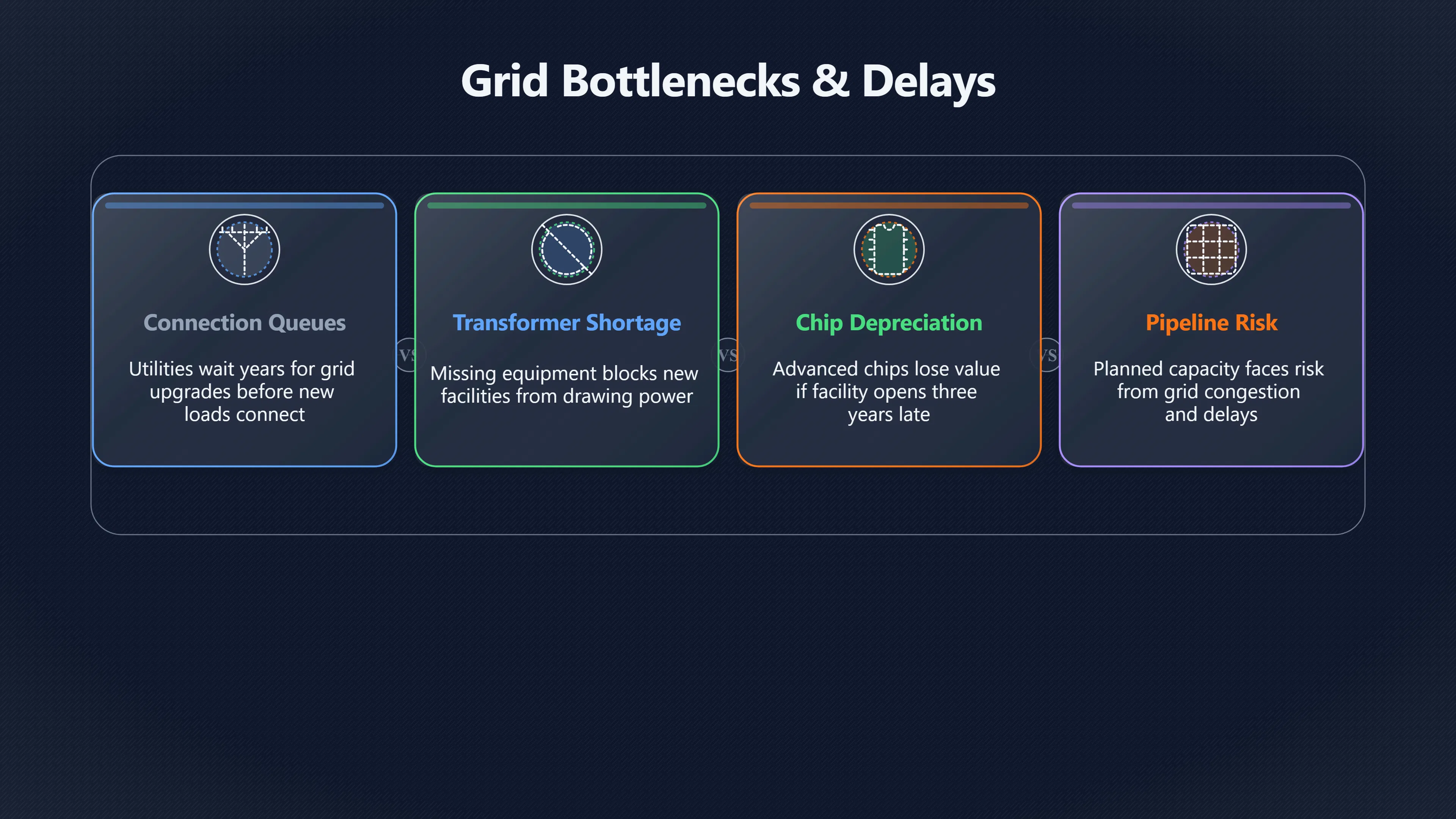
Large AI facilities increasingly require power on the scale of industrial regions or small cities. In many electricity markets, connection queues stretch for years. Grid operators must conduct studies, approve upgrades and secure equipment before new loads can connect. Transformer shortages and transmission constraints add further delays. The International Energy Agency has warned that a significant share of planned data-centre capacity is at risk from grid bottlenecks.[IEA]iea.orgElectricity 2026 – AnalysisA lack of grid capacity is emerging as a critical bottleneck in many regions, driving higher levels of congest…[IEA]iea.orgEnergy supply for AINatural gas and coal together are expected to meet over 40% of the additional electricity demand from data centres…
For companies spending billions on AI hardware, delays can be extraordinarily expensive. Advanced chips depreciate rapidly in strategic value. A facility that opens three years late may miss key technology cycles. This creates strong incentives to secure power independently rather than wait for conventional utility timelines.
The most common proposal is “behind-the-meter” generation. Instead of relying entirely on the public grid, a data-centre campus builds power generation directly on site or adjacent to it. That generation can include:
- Natural-gas turbines.
- Combined heat and power systems.
- Large-scale battery storage.[utilitydive.com]utilitydive.comUtility Dive Utilities are spending billions on the data center boomMar 6, 2026 — The AI data center frenzy is shifting utilities' focus to large-scale generation. But advocates say flexible, distributed e…
- Solar installations paired with storage.
- Microgrids that can operate independently or alongside the wider grid.
- Future proposals involving small modular nuclear reactors, although these remain largely prospective rather than widely deployed.[DataCenterKnowledge]datacenterknowledge.comData Center Knowledge Why Data Centers Are Turning to Behind-the-Meter PowerWhy Data Centers Are Turning to Behind-the-Meter PowerApril 15, 2026 — 15 Apr 2026 — Grid queues, community pressures…
Natural gas has emerged as the dominant near-term option because it can provide continuous power. Unlike wind and solar generation alone, gas turbines can run around the clock and support the high utilisation rates that AI training clusters often require. The IEA reports a growing pipeline of on-site gas projects linked to US data centres, reflecting the urgency of securing reliable power quickly.[IEA]iea.orgPipeline of onsite natural gas power projects for data…Apr 16, 2026 — Pipeline of onsite natural gas power projects for data centre…
This is partly a consequence of how valuable computing capacity has become. If advanced AI systems continue improving rapidly, firms may view years-long grid delays as a larger business risk than the costs of constructing dedicated power infrastructure.
The appeal: faster growth and more reliable computing
Supporters of dedicated generation argue that it offers benefits beyond simply avoiding queues.
First, it can accelerate infrastructure deployment. New data centres may be able to begin operating before transmission upgrades are completed. In a world where AI capability depends heavily on available compute, this can significantly affect development timelines.[DataCenterKnowledge]datacenterknowledge.comData Center Knowledge Why Data Centers Are Turning to Behind-the-Meter PowerWhy Data Centers Are Turning to Behind-the-Meter PowerApril 15, 2026 — 15 Apr 2026 — Grid queues, community pressures…
Second, on-site generation can improve resilience. AI facilities increasingly support cloud services, research systems and critical digital infrastructure. Local generation can reduce exposure to transmission failures, regional shortages or grid instability.
Third, some advocates argue that private generation reduces pressure on existing customers. If technology firms finance their own generation assets rather than drawing entirely from public infrastructure, they may avoid competing directly for limited grid capacity. This logic appears in proposals that large AI projects should “pay their own way” through dedicated generation and grid investments.[Tom's Hardware]tomshardware.comThis move aligns with U.S. policy pressures, especially from former President Trump, requiring tech firms to self-fund infrastructure imp…
There is also a longer-term argument linked to the broader AI bloom thesis. If advanced AI eventually contributes to major gains in scientific discovery, medical research, clean-energy innovation and economic productivity, then delays in compute infrastructure may carry large opportunity costs. From this perspective, faster access to power is not merely a commercial advantage. It could affect how quickly society gains access to potentially transformative capabilities.
The challenge is that the same infrastructure choices that accelerate AI deployment can create new environmental and governance problems.
What on-site power changes for emissions and climate goals
The strongest criticism of dedicated generation is that it can lock in additional fossil-fuel use.
Many technology companies have publicly committed to clean-energy goals. Yet grid constraints are pushing some operators towards gas generation because it is available now and can provide constant power. The IEA expects natural gas and coal to supply a substantial share of additional electricity demand from data centres through 2030.[IEA]iea.orgovercoming energy constraints is key to delivering on europe s data centre goalsOvercoming energy constraints is key to delivering on…16 Nov 2025 — Expensive delays in core markets are prompting data centre inve…
Critics argue that this creates a mismatch between AI’s long-term promise and its near-term energy trajectory. If AI is expected to help accelerate climate science, energy innovation and environmental management, but its infrastructure expansion depends heavily on new fossil-fuel assets, the transition becomes more complicated.
Several concerns appear repeatedly:
- New gas plants can operate for decades, extending fossil-fuel dependence.
- Methane leakage throughout gas supply chains can significantly increase climate impacts.
- Behind-the-meter facilities may be less visible within traditional utility planning frameworks.
- Pressure for rapid deployment may encourage exemptions or weakened environmental review processes.[Grist]grist.orgdata centers natural gas methane behind the meterEarly boosters of the data center boom suggested…Read more… EarthRights Some reporting has highlighted proposals where emissions associated with planned gas-powered data-centre campuses could rival those of entire[earthrights.org]earthrights.orgai data center demand is fueling the pipeline industryEarthRights InternationalAI Data Center Demand is Fueling the Pipeline Industry28 Apr 2026 — 40% of data centers in the US are powered by… countries if replicated at scale. While estimates vary substantially depending on utilisation rates and technology choices, the broader concern is clear: dedicated power can reduce one bottleneck while creating another.[WIRED]wired.comNew Gas-Powered Data Centers Could Emit More…22 Apr 2026 — New gas projects linked to just 11 data center campuses around the US…
At the same time, the picture is not entirely one-sided. A grid connection does not automatically mean low-carbon electricity. In some regions, data centres drawing from the public grid are also consuming power generated by fossil fuels. The relevant comparison is therefore not between perfect renewables and on-site gas, but between different pathways for meeting rapidly growing demand.
Why private generation can complicate grid planning
Electricity systems work best when generation and transmission are planned together. Large-scale movement towards private power can make that harder.
Utilities typically invest in infrastructure based on forecasts of future demand. When large AI projects suddenly announce gigawatt-scale loads, planners must decide whether to build new transmission lines, generation assets and substations. If those data centres later switch to self-generation, demand forecasts can change dramatically.
This creates a coordination problem.
Utilities may invest billions preparing for loads that never fully materialise. Alternatively, they may underinvest if they assume developers will remain self-sufficient, only to discover later that those facilities still require substantial grid support. Analysts increasingly warn about uncertainty surrounding data-centre demand projections and the risks of building infrastructure based on forecasts that may later shift.[Utility Dive]utilitydive.comUtility Dive Utilities are spending billions on the data center boomMar 6, 2026 — The AI data center frenzy is shifting utilities' focus to large-scale generation. But advocates say flexible, distributed e…
Most “off-grid” projects are not truly isolated from the wider system. They often retain grid connections for backup power, trading electricity or reliability support. In practice, many facilities occupy a middle ground between complete independence and full utility dependence.[DataCenterKnowledge]datacenterknowledge.comData Center Knowledge Why Data Centers Are Turning to Behind-the-Meter PowerWhy Data Centers Are Turning to Behind-the-Meter PowerApril 15, 2026 — 15 Apr 2026 — Grid queues, community pressures…
This can create difficult questions about cost allocation:
- Who pays for transmission upgrades?
- Who funds reliability reserves?
- How should backup access be priced?
- What happens if anticipated data-centre demand never appears?
- Should ordinary consumers bear part of the infrastructure cost?[Utility Dive]utilitydive.comUtility Dive Utilities are spending billions on the data center boomMar 6, 2026 — The AI data center frenzy is shifting utilities' focus to large-scale generation. But advocates say flexible, distributed e…
These issues are increasingly becoming regulatory rather than purely technical debates.
How private power affects public access and local communities
The social impact of on-site power often depends on who captures the benefits and who absorbs the costs.
Supporters argue that private generation reduces strain on public infrastructure and can bring investment, jobs and local tax revenue. In regions struggling to attract industry, large AI campuses may be welcomed as major economic projects.
Opponents worry about a different outcome: the emergence of what some observers describe as a parallel energy system built primarily for the largest technology companies.[The Washington Post]washingtonpost.comto power their artificial intelligence infrastructure independently from traditional electricity grids. These projects, like the GW Ranch…
Several concerns drive local resistance:
Air pollution and health effects. Gas generation creates emissions beyond carbon dioxide, including nitrogen oxides and other pollutants. Communities located near industrial facilities may face cumulative environmental burdens.[Reuters]reuters.comAI data centers are forcing dirty 'peaker' power plants back into serviceThese plants, like the eight-unit petroleum-fired Fisk plant in Chicago, are designed to operate only during high demand but are now bein…
Land and infrastructure use. Large campuses can reshape local development patterns, require new pipelines or transmission infrastructure and increase pressure on water resources.
Electricity pricing. Residents often worry that utilities will expand infrastructure to support AI growth while spreading costs across ordinary customers. Regulators increasingly face demands to ensure large technology firms bear the costs associated with their own expansion.[Tom's Hardware]tomshardware.comThis move aligns with U.S. policy pressures, especially from former President Trump, requiring tech firms to self-fund infrastructure imp…
Political influence. Wealthy firms may secure faster access to power, equipment and permitting than smaller businesses or public institutions. Critics argue that this risks concentrating both computing capacity and energy access in the hands of a relatively small number of actors.
These concerns connect to a larger question running through debates about AI abundance. Even if advanced AI dramatically increases productive capacity, who gains access to the resulting benefits? Infrastructure decisions made during the buildout phase can influence whether future gains are broadly shared or concentrated.
Could data centres become flexible energy partners instead?
The choice may not be limited to either traditional grid dependence or permanent self-generation.
An emerging idea is to make AI facilities more flexible consumers of electricity. Certain workloads can potentially be shifted in time, paused temporarily or moved between locations when power systems are under stress. If successful, this could reduce the need for expensive infrastructure upgrades while allowing more facilities to connect sooner.
Field demonstrations have shown that some AI workloads can reduce electricity use during peak periods without severely affecting performance. Researchers and grid operators increasingly describe data centres as potential “grid-interactive” assets rather than purely passive consumers.[arXiv]arxiv.orgTurning AI Data Centers into Grid-Interactive Assets: Results from a Field Demonstration in Phoenix, ArizonaJuly 1, 2025…
This approach does not eliminate the need for more generation and transmission. However, it suggests that part of the bottleneck may be managed through smarter coordination rather than simply building more gas turbines.
In the longer term, developers are also exploring combinations of:
- Co-located renewable generation.
- Large battery systems.
- Flexible workload scheduling.
- Advanced nuclear technologies.
- Regional balancing across multiple data-centre sites.[arXiv]arxiv.orgTurning AI Data Centers into Grid-Interactive Assets: Results from a Field Demonstration in Phoenix, ArizonaJuly 1, 2025…
The practical challenge is timing. Grid expansion can take a decade. AI investment cycles often operate on timescales of months or a few years. Dedicated generation is partly a response to that mismatch.
The deeper question behind on-site power
The debate over dedicated electricity supply is ultimately a debate about how civilisation should build the infrastructure behind advanced AI.
One path prioritises speed. If AI systems can accelerate scientific discovery, medical progress and economic growth, then reducing compute bottlenecks may produce large social benefits. From that perspective, on-site generation is a pragmatic response to slow-moving energy systems.
Another path emphasises integration. Rather than building a parallel energy architecture around AI, it seeks to expand public grids, improve transmission, deploy cleaner generation and ensure infrastructure serves broader social goals alongside AI development.
In practice, most countries will likely end up somewhere between these models. Some dedicated generation will probably be built because grid delays are real and expensive. Yet even the largest technology firms generally still prefer reliable grid connections over complete energy independence. The IEA notes that on-site gas generation is growing, but it does not remove the underlying need to expand and modernise electricity networks.[theenergy.co]theenergy.coai data centres risk becoming victims of their own success iea warnsAI data centres risk becoming victims of their own success…Apr 19, 2026 — “Though uncertainties are high,” the IEA concludes, around 1…
That tension makes on-site power more than a technical workaround. It is an early test of how societies handle a recurring question in the age of advanced AI: when a potentially transformative technology collides with public infrastructure limits, should private actors build around the bottleneck, or should the bottleneck itself be fixed?
Amazon book picks
Further Reading
Books and field guides related to Should AI bring its own electricity supply?. Use these as the next step if you want deeper reading beyond the article.
Human Compatible
Explores how powerful AI could advance humanity if aligned with human values.
The Coming Wave
Directly addresses whether advanced AI can deliver broad civilisational benefits while remaining governable.
The Better Angels of Our Nature
Provides broad context for understanding patterns of violence.
eBay marketplace picks
Marketplace Samples
Example marketplace items related to this page. Use the search link to explore similar finds on eBay.


Endnotes
1.
Source: iea.org
Link:https://www.iea.org/data-and-statistics/charts/global-data-centre-capacity-additions-in-the-base-case-and-capacity-at-risk-of-connection-delay-due-to-grid-constraints
Source snippet
Global data centre capacity additions in the Base Case and...3 Apr 2025 — Global data centre capacity additions in the Base Case and...
2.
Source: iea.org
Link:https://www.iea.org/reports/electricity-2026/grids
Source snippet
Electricity 2026 – AnalysisA lack of grid capacity is emerging as a critical bottleneck in many regions, driving higher levels of congest...
3.
Source: datacenterknowledge.com
Title: Data Center Knowledge Why Data Centers Are Turning to Behind-the-Meter Power
Link:https://www.datacenterknowledge.com/energy-power-supply/why-data-centers-produce-their-own-power
Source snippet
Why Data Centers Are Turning to Behind-the-Meter PowerApril 15, 2026 — 15 Apr 2026 — [Grid queues]({{ 'grid-queues/' | relative_url }}), community pressures...
Published: April 15, 2026
4.
Source: iea.org
Link:https://www.iea.org/reports/energy-and-ai/energy-supply-for-ai
Source snippet
Energy supply for AINatural gas and coal together are expected to meet over 40% of the additional electricity demand from data centres...
5.
Source: iea.org
Link:https://www.iea.org/data-and-statistics/charts/pipeline-of-onsite-natural-gas-power-projects-for-data-centres-in-the-united-states-2026
Source snippet
Pipeline of onsite natural gas power projects for data...Apr 16, 2026 — Pipeline of onsite natural gas power projects for data centre...
6.
Source: theenergy.co
Title: ai data centres risk becoming victims of their own success iea warns
Link:https://theenergy.co/article/ai-data-centres-risk-becoming-victims-of-their-own-success-iea-warns
Source snippet
AI data centres risk becoming victims of their own success...Apr 19, 2026 — “Though uncertainties are high,” the IEA concludes, around 1...
7.
Source: grist.org
Title: data centers natural gas methane behind the meter
Link:https://grist.org/energy/data-centers-natural-gas-methane-behind-the-meter/
Source snippet
Early boosters of the data center boom suggested...Read more...
8.
Source: earthrights.org
Title: ai data center demand is fueling the pipeline industry
Link:https://earthrights.org/blog/ai-data-center-demand-is-fueling-the-pipeline-industry/
Source snippet
EarthRights InternationalAI Data Center Demand is Fueling the Pipeline Industry28 Apr 2026 — 40% of data centers in the US are powered by...
9.
Source: wired.com
Link:https://www.wired.com/story/new-gas-powered-data-centers-could-emit-more-greenhouse-gases-than-entire-nations/
Source snippet
New Gas-Powered Data Centers Could Emit More...22 Apr 2026 — New gas projects linked to just 11 data center campuses around the US...
10.
Source: iea.org
Title: overcoming energy constraints is key to delivering on europe s data centre goals
Link:https://www.iea.org/commentaries/overcoming-energy-constraints-is-key-to-delivering-on-europe-s-data-centre-goals
Source snippet
Overcoming energy constraints is key to delivering on...16 Nov 2025 — Expensive delays in core markets are prompting data centre inve...
11.
Source: reuters.com
Title: AI data centers are forcing dirty ‘peaker’ power plants back into service
Link:https://www.reuters.com/business/energy/ai-data-centers-are-forcing-obsolete-peaker-power-plants-back-into-service-2025-12-23/
Source snippet
These plants, like the eight-unit petroleum-fired Fisk plant in Chicago, are designed to operate only during high demand but are now bein...
12.
Source: arxiv.org
Link:https://arxiv.org/abs/2507.00909
Source snippet
Turning AI Data Centers into Grid-Interactive Assets: Results from a Field Demonstration in Phoenix, ArizonaJuly 1, 2025...
Published: July 1, 2025
13.
Source: arxiv.org
Link:https://arxiv.org/abs/2605.03751
Source snippet
Carbon-Aware Compute--Power Scheduling for AI Data Centers with Microgrid Prosumer OperationsMay 5, 2026...
Published: May 5, 2026
14.
Source: iea.org
Link:https://www.iea.org/news/data-centre-electricity-use-surged-in-2025-even-with-tightening-bottlenecks-driving-a-scramble-for-solutions
Source snippet
Data centre electricity use surged in 2025, even with...16 Apr 2026 — Electricity demand from data centres soared by 17% in 2025, and th...
15.
Source: iea.org
Link:https://www.iea.org/reports/energy-and-ai/energy-demand-from-ai
Source snippet
lectricity demand to less than 2% in 2035.Read more...
16.
Source: iea.org
Link:https://www.iea.org/
Source snippet
International Energy AgencyWe provide authoritative analysis, data, policy recommendations and solutions to ensure energy security...
17.
Source: iea.org
Link:https://www.iea.org/reports/electricity-2026/executive-summary
Source snippet
summary – Electricity 2026 – AnalysisGlobal electricity demand is forecast to increase at a brisk average annual rate of 3.6% over the 20...
18.
Source: iea.org
Link:https://www.iea.org/reports/energy-and-ai/executive-summary
Source snippet
summary – Energy and AI – AnalysisGrid connection queues for both supply and consumption projects, including data centres, are long and c...
19.
Source: datacentremagazine.com
Title: The IEA
Link:https://datacentremagazine.com/news/iea-can-our-power-grids-cope-with-the-age-of-electricity
Source snippet
IEA Warns Grids Must Scale for Data Centre Surge11 Feb 2026 — These delays can slow data centre site development and increase costs, part...
20.
Source: tomshardware.com
Link:https://www.tomshardware.com/tech-industry/artificial-[intelligence
Source snippet
This move aligns with U.S. policy pressures, especially from former President Trump, requiring tech firms to self-fund infrastructure imp...
21.
Source: utilitydive.com
Title: Utility Dive Utilities are spending billions on the data center boom
Link:https://www.utilitydive.com/news/utilities-data-center-risk-buildout-bubble-ai-infrastructure-grid/812781/
Source snippet
Mar 6, 2026 — The AI data center frenzy is shifting utilities' focus to large-scale generation. But advocates say flexible, distributed e...
22.
Source: washingtonpost.com
Link:https://www.washingtonpost.com/business/2026/02/19/data-centers-power-grid-ai/
Source snippet
to power their artificial intelligence infrastructure independently from traditional electricity grids. These projects, like the GW Ranch...
23.
Source: utilitydive.com
Title: gas power plant boom bust data center ai trump
Link:https://www.utilitydive.com/news/gas-power-plant-boom-bust-data-center-ai-trump/801991/
Source snippet
What the last gas boom (and bust) says about today's rush...Nov 4, 2025 — Gas power M&A valuations have doubled since 2024, but new gene...
Additional References
24.
Source: itpro.com
Link:https://www.itpro.com/infrastructure/data-centres/data-center-industry-faces-ticking-power-time-bomb
Source snippet
While new grid infrastructure may take 5 to 10 years to develop, over 90GW of colocated generation is in data center interconnection pipe...
25.
Source: linkedin.com
Link:https://www.linkedin.com/posts/dr-irene-di-martino-88481823_datacenters-ai-energyinfrastructure-activity-7425556038529155072-tORi
Source snippet
IEA Report: Grid Can't Keep Up with AI DemandClose menu. AI data centers will need 90 terawatt-hours of power by 2026. That's a tenfold i...
26.
Source: latitudemedia.com
Link:https://www.latitudemedia.com/news/report-global-grid-congestion-puts-20-of-data-center-projects-at-risk/
Source snippet
Report: Global grid congestion puts 20% of data center projects at riskApril 10, 2025 — A new report released today by the International...
Published: April 10, 2025
27.
Source: GOV.UK
Link:https://www.gov.uk/government/consultations/accelerating-electricity-network-connections-for-strategic-demand/accelerating-electricity-network-connections-for-strategic-demand-accessible-webpage
Source snippet
electricity network connections for strategic...12 Mar 2026 — Amending the connections process to address speculation and prioritise fut...
28.
Source: businessinsider.com
Title: Business Insider Trump wants Big Tech to build its own power plants
Link:https://www.businessinsider.com/data-centers-on-site-power-plants-trump-announces
Source snippet
That's already starting to happen.President Donald Trump has proposed a new mandate requiring data centers to build their own power plant...
29.
Source: theguardian.com
Link:https://www.theguardian.com/technology/2026/may/13/datacentres-electricity-consumption-uk-us-ai
Source snippet
th the growing strain of AI on energy supplies prompting community resistance...Read more...
30.
Source: energy.ec.europa.eu
Title: focus data centres energy hungry challenge 2025 11 17 en
Link:https://energy.ec.europa.eu/news/focus-data-centres-energy-hungry-challenge-2025-11-17_en
Source snippet
focus: Data centres – an energy-hungry challenge17 Nov 2025 — Particularly challenging for the energy system is the rate at which data ce...
31.
Source: brookings.edu
Title: global energy demands within the ai regulatory landscape
Link:https://www.brookings.edu/articles/global-energy-demands-within-the-ai-regulatory-landscape/
Source snippet
2 Apr 2026 — By one estimate, the energy consumption of data centers could approach 1,050 TWh by 2026, which, if data centers were a coun...
32.
Source: troutman.com
Link:https://www.troutman.com/wp-content/uploads/2026/03/Troutman_Tamarindo_Off-Grid-Data-Centers_final.pdf
Source snippet
ters in the U.S., and considers what this means for hyperscalers, energy...Read more...
33.
Source: enkiai.com
Title: gas to power boom ai drives 2026 on site energy shift
Link:https://enkiai.com/data-center/gas-to-power-boom-ai-drives-2026-on-site-energy-shift/
Source snippet
Gas-to-Power Boom: AI Drives 2026 On-Site Energy Shift27 Mar 2026 — In 2026, grid constraints fuel a massive gas-to-power boom for AI dat...
Topic Tree