Within Intelligence
Can AI Make Personal Tutoring Common?
AI tutors could make individual feedback far cheaper, but only if they improve learning without weakening trust, motivation or teacher judgement.
On this page
- Why one to one tutoring has been hard to scale
- What early AI tutor studies do and do not prove
- Risks for teachers, students and unequal access
Page outline Jump by section
Introduction
The strongest argument for AI tutors is simple: personal tutoring works, but most people never receive much of it. Good tutors adapt explanations, spot misunderstandings quickly, provide immediate feedback and adjust to a student’s pace. Those benefits have traditionally been limited by cost and scarcity. If advanced AI can provide some of the same advantages at very low cost, personal learning support could become available to millions more people.
 This possibility sits near the centre of the broader idea of abundant intelligence. Rather than treating high-quality educational attention as a scarce resource, AI systems could make tailored explanations, practice, feedback and coaching available on demand. The optimistic case is not that chatbots can replace schools or teachers. It is that they might help make one of education’s most effective tools — individual guidance — far more widely available. The harder question is whether they can improve learning without weakening judgement, motivation, trust or the human relationships that education depends on.
Why one-to-one tutoring has been hard to scale
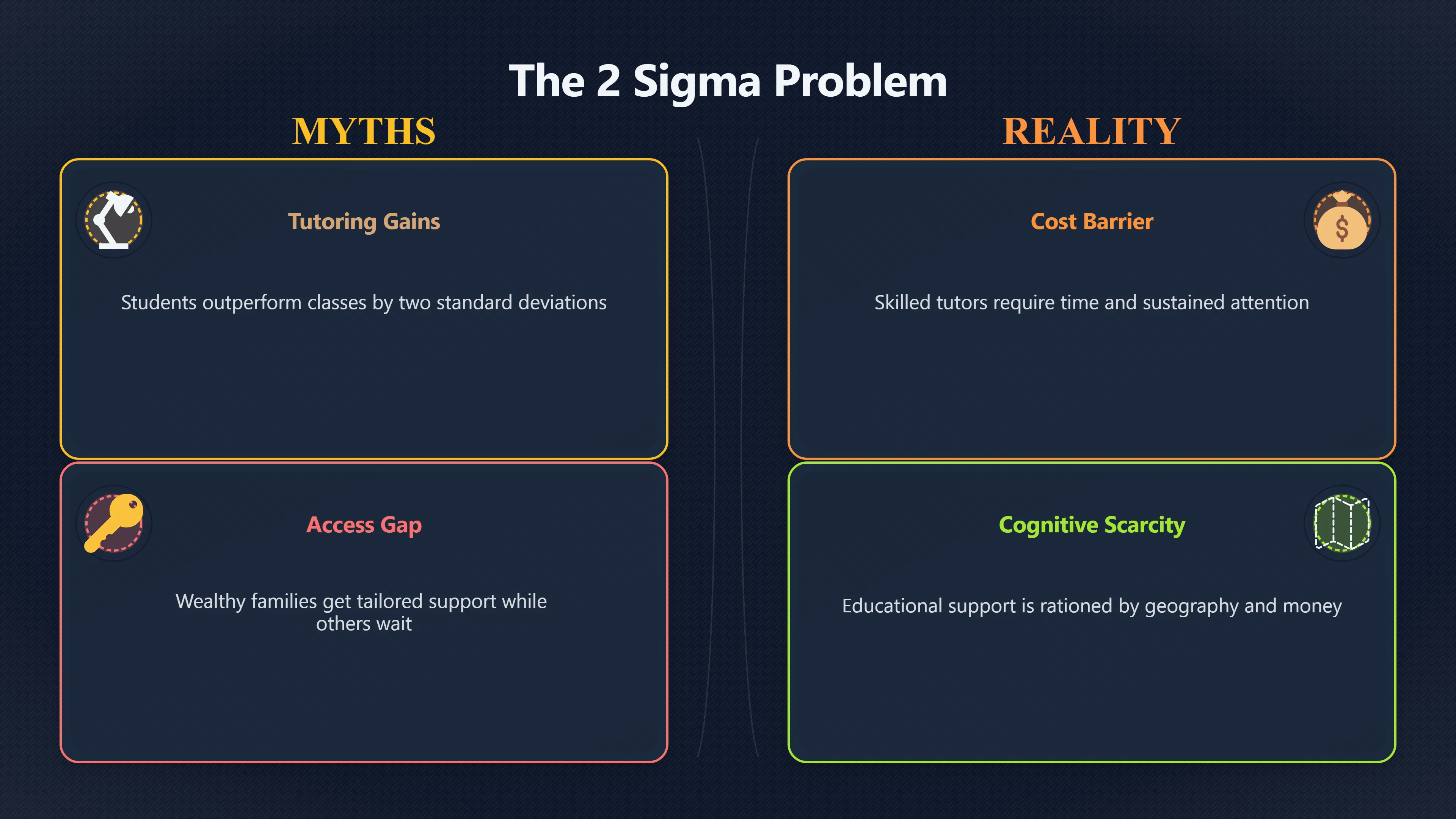
For decades, educational researchers have known that individual tutoring can produce unusually large learning gains. The most famous reference point is educational psychologist Benjamin Bloom’s “2 sigma problem”. Bloom found that students receiving one-to-one tutoring with mastery-learning techniques dramatically outperformed students taught through conventional classroom methods, with average performance roughly two standard deviations higher.[Wikipedia]WikipediaBloom's 2 sigma problemBloom's 2 sigma problem
The problem was never understanding that tutoring helps. The problem was cost.
A skilled tutor can only work with a limited number of students. Personal tutoring requires time, expertise and sustained attention. As a result:
- Wealthier families often have much greater access to tailored support.
- Students in overcrowded schools may receive very little individual feedback.
- Rural and disadvantaged communities frequently face shortages of specialist teachers.
- Adults seeking retraining rarely receive intensive personal guidance.
This creates a form of cognitive scarcity. Educational support exists, but it is rationed by money, geography and institutional capacity.
AI tutors appear attractive because they attack exactly that bottleneck. A software system can theoretically provide explanations, questions, examples and feedback to millions of learners simultaneously. Unlike human tutors, it does not become tired, need scheduling or charge by the hour.
That does not mean AI can reproduce everything that makes human tutoring effective. Human tutors provide encouragement, accountability, emotional judgement and social connection. They recognise confusion that students cannot articulate. They understand family circumstances, classroom dynamics and motivation. The real question is therefore narrower: how much of tutoring’s educational value comes from personalised feedback that software can help provide, and how much depends on uniquely human relationships?
What AI tutors actually do
When people hear “AI tutor”, they often imagine a chatbot answering homework questions. The more ambitious systems attempt something closer to guided learning.
Instead of immediately supplying answers, many educational AI systems are designed to:
- Ask questions before explaining.
- Break problems into smaller steps.
- Detect likely misconceptions.
- Adjust difficulty levels.
- Generate personalised practice exercises.
- Track progress over time.
- Encourage students to explain their reasoning.
This approach resembles older “intelligent tutoring systems” developed long before large language models. Programmes such as Carnegie Learning’s mathematics tutors attempted to simulate aspects of one-to-one instruction through carefully structured interactions. Research generally found positive learning effects, although results rarely approached Bloom’s famous tutoring gains.[ScienceDirect]sciencedirect.comSearching for the two sigma advantage: Evaluating algebra…by KE Sabo · 2013 · Cited by 65 — Intelligent tutors attempt to…
Large language models change the picture because they can converse flexibly rather than following rigid decision trees. Systems such as Khan Academy’s Khanmigo are explicitly built around the idea that AI should guide students toward answers rather than simply providing them.[Khanmigo]khanmigo.aiMeet Khanmigo: Khan Academy's AI-powered teaching…Khanmigo, built by nonprofit Khan Academy, is a top-rated AI for education…
The broader AI bloom argument is that if personalised cognitive assistance becomes extremely cheap, education may become less constrained by teacher-student ratios. A learner struggling with algebra, English grammar or introductory physics could receive continual practice and explanation instead of waiting for limited classroom attention.
What early AI tutor studies do and do not prove
The evidence for AI tutoring is becoming more substantial, but it remains far from definitive.
Several recent studies have reported encouraging results. Researchers at Harvard and other institutions studying an AI physics tutor found that students learned significantly more in less time than students participating in active-learning classroom sessions. Students also reported greater engagement and motivation.[Nature]nature.comAI tutoring outperforms in-class active learningby G Kestin · 2025 · Cited by 130 — We find that students learn significantly more…[PMC]pmc.ncbi.nlm.nih.govgovtackling the two sigma problem with AI in journal clubsby F Umer · 2025 · Cited by 8 — This study explores the development and preliminary evaluation of a RAG-enhanced LLM to support journa…
Another randomised controlled trial in Italian secondary schools found that GPT-4-based interactive homework support improved learning outcomes and student engagement compared with conventional homework. Students reported wanting to continue using the system after the experiment ended.[ACL Anthology]aclanthology.org2025.acl long.1502Trial (RCT) in an Italian high school to understand its effect on students, in terms of the students' ex- periences and…Read more…
Research from Nigeria attracted particular attention because it tested AI-supported after-school learning in a lower-resource setting. Students worked with GPT-4 under teacher supervision, and reported gains that compared favourably with many educational interventions studied in development economics.[VoxDev]voxdev.orgHow AI tutors improved learning in Nigeriaby M De Simone — In an RCT in Nigeria, we tested a six-week after-school programme where…[World]blogs.worldbank.orgFrom chalkboards to chatbots Transforming learning in NigeriaWorld Bank BlogsTransforming learning in Nigeria, one prompt at a time9 Jan 2025 — A pilot that used generative artificial intelligence (…
These findings matter because they suggest that large language models may provide more than novelty or entertainment. Under some conditions, they appear capable of improving measurable learning outcomes.
However, several caveats are important.
Most studies are short
Many AI tutor experiments run for weeks rather than years.
A six-week improvement is encouraging, but education is ultimately concerned with durable understanding. Researchers still know much less about:
- Long-term retention.
- Transfer of knowledge to new situations.
- Effects across entire school careers.
- Dependence on AI support over time.
Students can appear to learn quickly during interventions while retaining less than expected months later.
Good prompting is not the same as good pedagogy
Some of the strongest results come from carefully designed systems built around educational research rather than from unrestricted chatbots.[Nature]nature.comAI tutoring outperforms in-class active learningby G Kestin · 2025 · Cited by 130 — We find that students learn significantly more…
This distinction matters. An AI tutor that asks guiding questions, provides structured hints and encourages reflection may behave very differently from a general-purpose model that instantly supplies solutions.
The educational outcome depends heavily on design choices.
Learning gains are not universal
Evidence also exists that unrestricted AI use can harm learning.
Research discussed by Wharton researchers found that students using generative AI assistance sometimes performed worse on exams when the AI was unavailable, despite appearing to perform better during practice sessions. The concern is that students may mistake assisted performance for genuine understanding.[Axios]axios.comWhy AI is no substitute for human teachersThis challenges the optimistic vision of AI as a "personal tutor for every student." Although genAI, like Khan Academy’s experimental Kha…
This points to one of the central tensions in AI-assisted education: a system can help students complete tasks without necessarily helping them build lasting competence.
The strongest version of the optimistic case
The most ambitious vision is not merely better homework help.
Supporters argue that AI tutors could expand human cognitive development at civilisational scale.
Historically, societies have invested enormous resources in making knowledge available: libraries, universities, schools, textbooks and the internet. Yet access to personalised guidance remains highly unequal. A student who can afford private tutoring often receives far more tailored feedback than a student relying solely on crowded classrooms.
If AI systems become reliable educational companions, several barriers could weaken simultaneously.

More feedback for more people
Feedback is one of education’s scarcest resources.
Students learn partly by discovering where their understanding breaks down. In many classrooms, teachers simply lack enough time to provide detailed feedback to every learner.
An AI tutor can respond immediately, potentially creating thousands of additional moments of correction and explanation over a school year.
Lifelong learning becomes more realistic
Modern economies increasingly require retraining and skill acquisition throughout adulthood.
Most adults cannot afford continuous access to personal coaches or tutors. AI systems could lower the cost of learning new languages, technical skills, professional qualifications or scientific subjects long after formal education ends.
Global educational inequality could narrow
Many regions face severe shortages of qualified teachers, particularly in specialised subjects.
An AI tutor cannot solve every educational problem. It cannot replace school infrastructure, nutrition, political stability or human mentorship. But it could increase access to explanations, exercises and feedback in places where educational resources remain scarce. The Nigerian pilot is often discussed in this context because it explored whether advanced AI could help supplement limited educational capacity rather than simply enhance already well-resourced schools.[VoxDev]voxdev.orgHow AI tutors improved learning in Nigeriaby M De Simone — In an RCT in Nigeria, we tested a six-week after-school programme where…
Human intellectual potential may be less constrained by attention scarcity
The larger AI bloom argument extends beyond test scores.
Many people never discover talents because they lack support at the right moment. Others abandon difficult subjects after repeated frustration. If high-quality guidance becomes abundant, more people may be able to develop advanced skills in science, engineering, medicine, mathematics, writing or the arts.
In that sense, AI tutoring is not just about efficiency. It is about expanding who gets the opportunity to develop their abilities.
Risks for teachers, students and unequal access
The educational promise is substantial, but so are the risks.

Students may outsource thinking
One of the oldest fears about calculators, search engines and educational software is that convenience can reduce effort.
Generative AI intensifies this concern because it can produce complete answers, essays and solutions almost instantly.
Teachers increasingly report worries that students are becoming dependent on AI-generated responses rather than wrestling with difficult concepts themselves. Surveys in England have found widespread concern about declining critical thinking and problem-solving skills linked to inappropriate AI use.[The Guardian]theguardian.comTwo-thirds of respondents observed a decline in thinking abilities among students, with some noting reliance on voice-to-text tools dimin…
The challenge is not merely cheating. It is the possibility that students experience the appearance of understanding without developing the underlying mental models.
Bias and mistakes remain real
Large language models still hallucinate facts, fabricate citations and provide incorrect explanations.
In education, a confident mistake can be particularly damaging because learners often lack the expertise needed to recognise errors.
The most effective AI tutor may therefore be one that openly communicates uncertainty, cites sources and encourages verification rather than projecting false authority.
Access may remain unequal
Advocates often describe AI tutors as democratising education.
That outcome is possible, but not guaranteed.
Advanced educational systems may be concentrated in wealthier schools, richer countries or subscription services. Better devices, faster internet access and more technologically literate households may capture disproportionate benefits.
The history of educational technology offers many examples where innovations initially widened gaps before later becoming more widely distributed.
Teachers may lose influence over learning
Some educators worry that AI tutoring could gradually shift authority away from teachers and schools.
If students increasingly receive explanations, recommendations and feedback from commercial AI systems, important questions emerge:
- Who decides what counts as correct knowledge?
- Which values are embedded in educational models?
- How transparent are the systems?
- Who audits errors and biases?
- How much educational power becomes concentrated in a small number of technology firms?
These are governance questions as much as educational ones.
The most plausible future may be human-AI tutoring rather than AI alone
Some of the most promising research does not replace teachers or tutors. It augments them.
A study called Tutor CoPilot examined AI systems that help human tutors in real time by suggesting effective teaching strategies. Students working with supported tutors showed improved mastery, with particularly large gains among less experienced tutors.[arXiv]arxiv.org2409.15981] GPT-4 as a Homework Tutor can Improve…by A Vanzo · 2024 · Cited by 24 — We developed a prompting strategy that enables GP…
This hybrid model reflects a broader pattern emerging across many professions.
Rather than imagining AI replacing experts, it may be more realistic to think about AI increasing the reach of expert judgement. A skilled teacher supported by powerful educational tools may be able to provide more individual attention than either could achieve alone.
This matters because education is not simply information transfer. Students need motivation, encouragement, social learning, trust and accountability. Human teachers help create those conditions. AI may become valuable not because it replaces those functions, but because it frees more time and attention for them.
The result could be a different educational division of labour:
- AI provides continual practice, explanations and routine feedback.
- Teachers focus more on motivation, judgement, discussion and social learning.
- Human tutors intervene where emotional understanding, mentorship or deeper expertise matter most.
If that model succeeds, the educational significance could extend far beyond schools. It would represent one of the clearest examples of abundant intelligence in practice: using AI to make personalised cognitive support available to vastly more people than traditional institutions could reach on their own.
The promise is therefore real, but still conditional. Early evidence suggests AI tutors can improve learning under some circumstances. It does not yet prove that they can reproduce the full value of human tutoring, nor that benefits will be distributed fairly. Whether AI becomes a genuine educational equaliser or merely another layer of technological inequality will depend less on the existence of capable models than on how schools, governments and societies choose to deploy them.
Amazon book picks
Further Reading
Books and field guides related to Can AI Make Personal Tutoring Common?. Use these as the next step if you want deeper reading beyond the article.
Visible Learning for Teachers
Provides evidence on what teaching methods actually improve learning.
eBay marketplace picks
Marketplace Samples
Example marketplace items related to this page. Use the search link to explore similar finds on eBay.


Endnotes
1.
Source: Wikipedia
Title: Bloom’s 2 sigma problem
Link:https://en.wikipedia.org/wiki/Bloom%27s_2_sigma_problem
2.
Source: sciencedirect.com
Link:https://www.sciencedirect.com/science/article/abs/pii/S0747563213000903
Source snippet
Searching for the two sigma advantage: Evaluating algebra...by KE Sabo · 2013 · Cited by 65 — Intelligent tutors attempt to...
3.
Source: khanmigo.ai
Link:https://www.khanmigo.ai/
Source snippet
Meet Khanmigo: Khan Academy's AI-powered teaching...Khanmigo, built by nonprofit Khan Academy, is a top-rated AI for education...
4.
Source: nature.com
Link:https://www.nature.com/articles/s41598-025-97652-6
Source snippet
AI tutoring outperforms in-class active learningby G Kestin · 2025 · Cited by 130 — We find that students learn significantly more...
5.
Source: arxiv.org
Link:https://arxiv.org/abs/2409.15981
Source snippet
[2409.15981] GPT-4 as a Homework Tutor can Improve...by A Vanzo · 2024 · Cited by 24 — We developed a prompting strategy that enables GP...
6.
Source: voxdev.org
Link:https://voxdev.org/topic/education/how-ai-tutors-improved-learning-nigeria
Source snippet
How AI tutors improved learning in Nigeriaby M De Simone — In an RCT in Nigeria, we tested a six-week after-school programme where...
7.
Source: axios.com
Title: Why AI is no substitute for human teachers
Link:https://www.axios.com/2024/08/15/ai-tutors-learning-education-khan-academy-wharton
Source snippet
This challenges the optimistic vision of AI as a "personal tutor for every student." Although genAI, like Khan Academy’s experimental Kha...
8.
Source: arxiv.org
Title: arXiv [Tutor Co Pilot]({{ ‘tutor-co-pilot/’ | relative_url }}): A Human-AI Approach for Scaling Real-Time Expertise
Link:https://arxiv.org/abs/2410.03017
Source snippet
Tutor CoPilot: A Human-AI Approach for Scaling Real-Time ExpertiseOctober 3, 2024...
Published: October 3, 2024
9.
Source: arxiv.org
Link:https://arxiv.org/html/2409.15981v1
Source snippet
We assess...Read more...
10.
Source: aclanthology.org
Title: 2025.acl long.1502
Link:https://aclanthology.org/2025.acl-long.1502.pdf
Source snippet
Trial (RCT) in an Italian high school to understand its effect on students, in terms of the students' ex- periences and...Read more...
11.
Source: blogs.worldbank.org
Title: From chalkboards to chatbots Transforming learning in Nigeria
Link:https://blogs.worldbank.org/en/education/From-chalkboards-to-chatbots-Transforming-learning-in-Nigeria
Source snippet
World Bank BlogsTransforming learning in Nigeria, one prompt at a time9 Jan 2025 — A pilot that used generative artificial intelligence (...
12.
Source: theguardian.com
Link:https://www.theguardian.com/technology/2026/apr/02/pupils-england-losing-thinking-skills-because-of-ai-survey
Source snippet
Two-thirds of respondents observed a decline in thinking abilities among students, with some noting reliance on voice-to-text tools dimin...
13.
Source: hbs.edu
Title: Khanmigo: Revolutionizing Learning with Gen AI
Link:https://www.hbs.edu/faculty/Pages/item.aspx?num=64929
Source snippet
Khanmigo: Revolutionizing Learning with GenAI - CaseKhan Academy began beta testing Khanmigo, a genAI “guide” and tutor built with ChatGP...
Additional References
14.
Source: linkedin.com
Link:https://www.linkedin.com/posts/emollick_new-randomized-controlled-trial-by-the-world-activity-7285400569274380288-wh50
15.
Source: linkedin.com
Link:https://www.linkedin.com/pulse/from-chatgpt-khanmigo-how-recent-ai-advancements-munir-shah-phd–prpfc
Source snippet
From ChatGPT to Khanmigo: How recent AI advancements...From personalized learning and adaptive tutoring to automated grading and immersi...
16.
Source: edworkingpapers.com
Link:https://edworkingpapers.com/sites/default/files/ai24_1054_v2.pdf
Source snippet
Tutor CoPilot: A Human-AI Approach for Scaling Real-Time...by S Loeb — In a randomized controlled trial involving more than 700 tutors a...
17.
Source: linkedin.com
Link:https://www.linkedin.com/pulse/ai-personalised-tutoring-2-sigma-problem-martin-hall
Source snippet
AI, personalised tutoring and the 2 sigma problemThe Holy Grail of generative AI in schooling is personalised tutoring; Benjamin Bloom's...
18.
Source: resolve.cambridge.org
Title: blooms 2 sigma problem and datadriven approaches for improving student success
Link:https://resolve.cambridge.org/core/services/aop-cambridge-core/content/view/49F7035693DF68EDB8A9B2B72FBCCC9E/9781316811764c8_p212-246_CBO.pdf/blooms_2_sigma_problem_and_datadriven_approaches_for_improving_student_success.pdf
Source snippet
cambridge.orgBloom's 2 Sigma Problem and Data- Driven Approaches...mathematics produced average effect sizes of.78 and.81, respectivel...
19.
Source: pmc.ncbi.nlm.nih.gov
Title: govtackling the two sigma problem with AI in journal clubs
Link:https://pmc.ncbi.nlm.nih.gov/articles/PMC12062218/
Source snippet
by F Umer · 2025 · Cited by 8 — This study explores the development and preliminary evaluation of a RAG-enhanced LLM to support journa...
20.
Source: youtube.com
Link:https://www.youtube.com/watch?v=yEgHrxvLsz0
21.
Source: rickhess99.medium.com
Title: can an ai powered tutor produce meaningful results b67d7376cb51
Link:https://rickhess99.medium.com/can-an-ai-powered-tutor-produce-meaningful-results-b67d7376cb51
Source snippet
an AI-Powered Tutor Produce Meaningful Results?We are continuing to work on bringing new AI technology to the tutoring experience. For in...
22.
Source: educationnext.org
Title: two sigma tutoring separating science fiction from science fact
Link:https://www.educationnext.org/two-sigma-tutoring-separating-science-fiction-from-science-fact/
Source snippet
Two-Sigma Tutoring: Separating Science Fiction from...7 Mar 2024 — Benjamin Bloom's essay “The 2 Sigma Problem,” featuring his famous ha...
23.
Source: researchgate.net
Link:https://www.researchgate.net/publication/382320210_An_Evaluation_of_Khanmigo_a_Generative_AI_Tool_as_a_Computer-Assisted_Language_Learning_App
Source snippet
latform that uses a dialogue format designed to inspire students to think, help...Read more...
Topic Tree