Within AI Concentration
Can anyone leave the AI ecosystem?
Integrated AI ecosystems can make tools easier to use, but they can also trap customers, data and developers inside one provider's stack.
On this page
- How vertical integration creates convenience and dependency
- Why lock in matters for hospitals, universities and governments
- Portability, open standards and auditability as safeguards
Page outline Jump by section
Introduction
Vertically integrated AI ecosystems — where cloud infrastructure, data pipelines, development tools and AI‑native services come from the same provider — offer convenience and technological integration that can accelerate adoption in businesses and public institutions. But this integration also builds powerful switching costs: the real and often hidden expenses, disruptions and strategic barriers that make it difficult or costly for customers — from hospitals and universities to government departments — to leave one provider’s stack for another. These switching costs don’t just slow competition; they can shape who wins access to advanced AI and who bears the long‑term costs of dependency, affecting how broadly and equitably AI‑enabled benefits diffuse across society.[FRANKI T]francescatabor.comTFebruary 4, 2026…

How vertical integration creates convenience and dependency
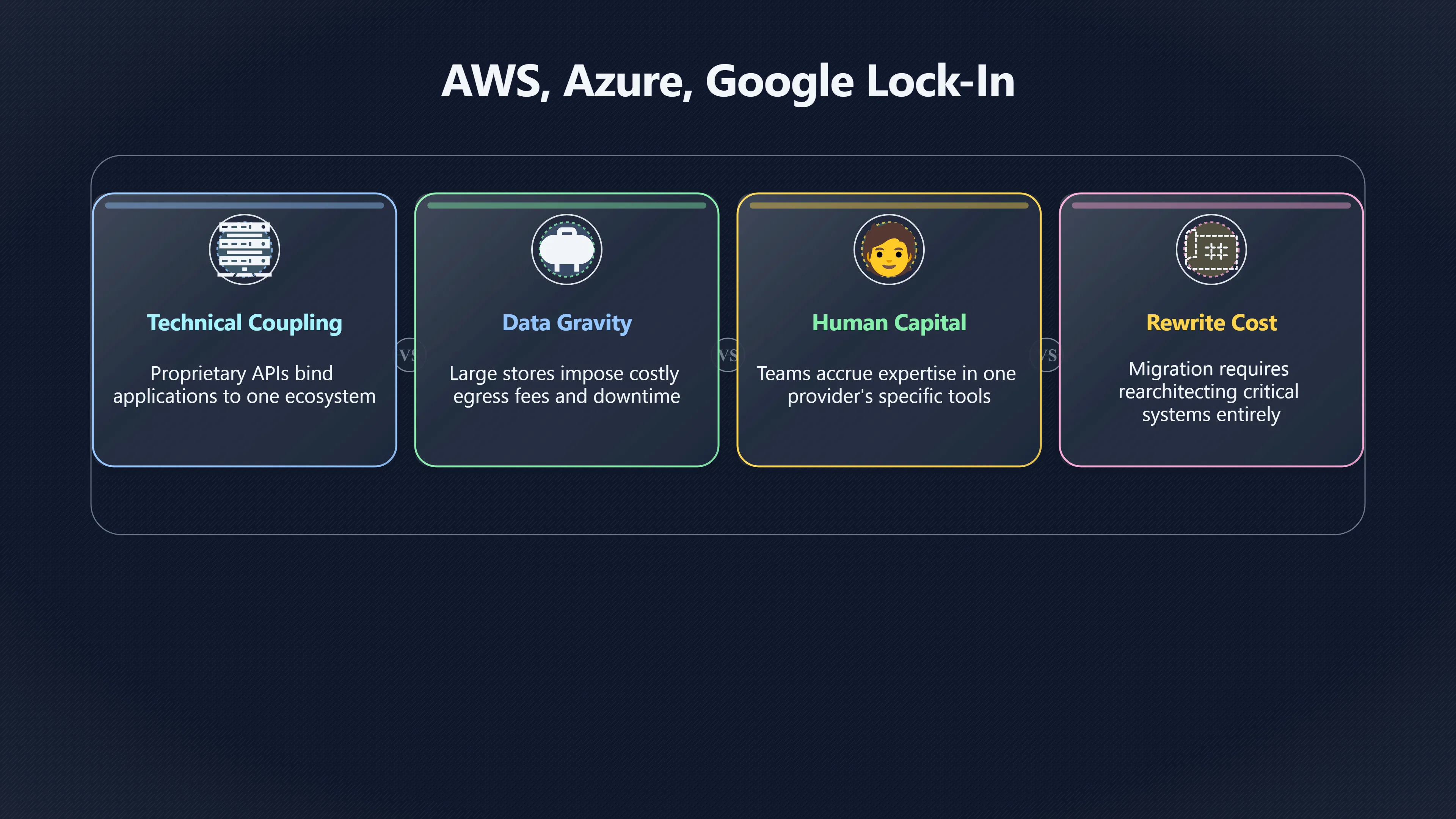
Modern AI stacks are rarely a set of interchangeable parts. Cloud platforms like AWS, Google Cloud and Microsoft Azure increasingly embed AI services — training platforms, managed databases, model hosting, analytics, monitoring and security — into one ecosystem. Initially, this integration lowers barriers to use: organisations can provision infrastructure, spin up AI models, and embed machine learning into workflows from a single control plane. But over time, the interplay of technical, organisational and economic factors turns this convenience into dependency.
Technical coupling: Proprietary APIs, managed services and platform‑specific data formats create tight links between a client’s applications and the provider’s ecosystem. Rewriting these integrations for another provider means not just changing a few lines of code but rearchitecting critical systems. In AI contexts, even embeddings, fine‑tuned models or prompt formats may not transfer cleanly between providers, further “sticking” workloads to one stack.[Grove AI]groveai.ioGrove AIAI Vendor Lock-inDefinition & Guide | Grove AI | Grove AI…
Data gravity: Large data stores — whether feature stores, vector databases or training datasets — are costly and time‑consuming to export. Data stored in proprietary warehouses or formats amplifies this “gravity,” as moving it imposes egress fees, potential service downtime and compliance risks, especially in regulated sectors like healthcare or public administration.[FRANKI T]francescatabor.comTFebruary 4, 2026…
Human capital and organisational investment: Over time, teams accrue expertise in one ecosystem’s tools, workflows and best practices. Switching to a different provider often entails retraining staff, rewriting internal playbooks and absorbing a productivity dip during transition — costs that are real even if they aren’t line‑item charges.[FRANKI T]francescatabor.comTFebruary 4, 2026…
These intertwined dependencies mean that leaving a vertically integrated AI ecosystem is not simply a matter of choosing a different vendor — it can involve rewriting core infrastructure, migrating critical data, and absorbing months of lost engineering focus.
Why lock‑in matters for hospitals, universities and governments
For institutions such as hospitals, universities and government bodies, switching costs are about more than price tags — they carry strategic, operational and governance implications.
Operational risk and continuity: In healthcare or public services, systems often operate under strict regulatory requirements. A migration that risks data integrity, service interruptions or loss of audit history can have material consequences. When data egress fees and migration risks loom large, organisations may tolerate price increases or reduced service quality rather than risk disruption.[GOV.UK]GOV.UKManaging technical lock-in in the cloud17, 2019…
Budgetary implications: As one analysis estimates, migrating an established AI infrastructure could easily run into the hundreds of thousands of pounds for medium‑sized deployments, with 15–20 % of annual infrastructure spend consumed by data transfer, code rewrites, retraining and testing if switching were ever pursued. This creates a sunk cost bias where organisations are financially disincentivised from exploring alternatives even as new, more innovative providers emerge.[CloudKompas]cloudkompas.comCloud Kompas Cloud AI Vendor Lock-In: Build an Exit Plan NowCloud Kompas Cloud AI Vendor Lock-In: Build an Exit Plan Now
Innovation and competitive dynamics: When a hospital research group, university department or government lab is tightly bound to a single ecosystem, it may forego experimentation with emerging models or novel providers. Choice becomes constrained not by technical feasibility, but by the risk and friction of switching — even when alternative tools offer better performance, safety properties or pricing.[Grove AI]groveai.ioGrove AIAI Vendor Lock-inDefinition & Guide | Grove AI | Grove AI…
Governance and accountability: Public institutions are often held to higher standards of transparency and auditability. Proprietary platforms that obscure model behaviour, data provenance or decision logic can complicate oversight. Limited portability means oversight bodies may struggle to verify, compare or challenge systems that have become deeply embedded.[Cloud Computing Authority]cloudcomputingauthority.comSource details in endnotes.
These effects are not hypothetical. Enterprise surveys suggest that almost half of large organisations feel vendor lock‑in has already hindered their ability to adopt better tools, and more than two‑thirds actively aim to avoid single‑provider dependency.[Fin]fin.aiAI Customer Service Vendor Lock-In Risk: How to EvaluateAI Customer Service Vendor Lock-In Risk: How to EvaluateMarch 27, 2026…
Portability, open standards and auditability as safeguards
Reducing switching costs — and thus limiting the power of vertically integrated ecosystems to trap customers — doesn’t mean rejecting integration altogether. Instead, it points to practical strategies and design principles that preserve choice and competitive dynamism:
Open data and model formats: Storing data in non‑proprietary formats (e.g. open columnar or vector standards for embeddings) and requiring models to be exportable in interoperable packaging (e.g. ONNX or standardized model registries) can significantly reduce migration friction.[AI Advisory Practice]aiadvisorypractice.comAI Advisory PracticeAI Vendor Lock-In: How to Avoid the Trap | AI Advisory PracticeJanuary 8, 2026…
API abstraction layers: Introducing a vendor‑agnostic middleware layer between application code and provider APIs limits the amount of rewriting required if a switch becomes necessary. Enterprises using cloud‑agnostic orchestration tools like Kubeflow or Apache Airflow can shift underlying providers with fewer changes to core workflows.[AI Advisory Practice]aiadvisorypractice.comAI Advisory PracticeAI Vendor Lock-In: How to Avoid the Trap | AI Advisory PracticeJanuary 8, 2026…
Contractual safeguards: Procurement strategies can embed data portability guarantees, exit clauses and caps on egress charges into vendor agreements. Clarity on data ownership and rights to exported formats helps ensure that switching costs reflect technical effort, not punitive commercial design.[CloudNuro]cloudnuro.aiVendor Lock-In: Contract Clauses That Make Switching Hard (and How to Prevent It)March 31, 2026…
Auditability and transparency: Platforms that expose behavioural logs, lineage metadata and model governance artefacts in standardised ways ease institutional oversight and permit comparison across different providers. This is especially important for public sector bodies with accountability mandates.[Cloud Computing Authority]cloudcomputingauthority.comSource details in endnotes.
These safeguards do not eliminate the benefits of integrated stacks — the convenience, performance and developer productivity — but they reframe integration as a choice rather than a trap.
Trade‑offs and the emerging competitive landscape
It is important to recognise that switching costs are not purely negative. For many organisations, the short‑term operational simplicity and lower time‑to‑value offered by integrated platforms is a rational trade‑off relative to the cost of bespoke, vendor‑agnostic architecture. However, once those costs are sunk, the balance shifts: the benefits of choice, innovation and cost discipline begin to outweigh the initial gains from tight integration.
Emerging open‑source models and portable stacks signal a shift in competitive dynamics. Organisations architected for portability — with clear separation between data, orchestration and compute — can exploit new innovations faster and with lower switching friction. Over the long run, this reduces the ability of any single vertically integrated provider to extract strategic rents through switching costs alone.[CloudKompas]cloudkompas.comCloud Kompas Cloud AI Vendor Lock-In: Build an Exit Plan NowCloud Kompas Cloud AI Vendor Lock-In: Build an Exit Plan Now
For hospitals, universities and governments aspiring to contribute to and benefit from an “AI bloom” — where access to powerful AI accelerates scientific discovery, healthcare improvements and societal wellbeing — governance choices today matter. How institutions negotiate switching costs and preserve optionality will influence whether AI ecosystems amplify broad human flourishing or reinforce narrow commercial gatekeeping.

Amazon book picks
Further Reading
Books and field guides related to Can anyone leave the AI ecosystem?. Use these as the next step if you want deeper reading beyond the article.
The Master Switch
Directly relevant to technology ecosystem lock-in and concentration.
The Age of Surveillance Capitalism
Examines dependency, power and digital control in platform ecosystems.
Power and Progress
Explores how institutions determine who benefits from technological systems.
eBay marketplace picks
Marketplace Samples
Example marketplace items related to this page. Use the search link to explore similar finds on eBay.


Endnotes
1.
Source: francescatabor.com
Link:https://www.francescatabor.com/articles/2026/2/4/cloud-ecosystem-lock-in-platform-dependency-economics-developer-network-effects-and-switching-costs-in-enterprise-it
Source snippet
TFebruary 4, 2026...
Published: February 4, 2026
2.
Source: GOV.UK
Title: Managing technical lock-in in the cloud
Link:https://www.gov.uk/guidance/managing-technical-lock-in-in-the-cloud
Source snippet
17, 2019...
3.
Source: cloudkompas.com
Title: Cloud Kompas Cloud AI Vendor Lock-In: Build an Exit Plan Now
Link:https://cloudkompas.com/blog/cloud-ai-vendor-lock-in-exit-strategy
4.
Source: fin.ai
Title: AI Customer Service Vendor Lock-In Risk: How to Evaluate
Link:https://fin.ai/learn/evaluate-vendor-lock-in-ai-customer-service
Source snippet
AI Customer Service Vendor Lock-In Risk: How to EvaluateMarch 27, 2026...
Published: March 27, 2026
5.
Source: cloudnuro.ai
Link:https://www.cloudnuro.ai/blog/saas-vendor-lock-in
Source snippet
Vendor Lock-In: Contract Clauses That Make Switching Hard (and How to Prevent It)March 31, 2026...
Published: March 31, 2026
7.
Source: groveai.io
Title: Grove AIAI Vendor Lock-in
Link:https://groveai.io/glossary/ai-vendor-lock-in
Source snippet
Definition & Guide | Grove AI | Grove AI...
8.
Source: cloudcomputingauthority.com
Link:https://cloudcomputingauthority.com/cloud-vendor-lock-in
9.
Source: aiadvisorypractice.com
Link:https://aiadvisorypractice.com/blog/ai-vendor-lock-in-avoid-trap
Source snippet
AI Advisory PracticeAI Vendor Lock-In: How to Avoid the Trap | AI Advisory PracticeJanuary 8, 2026...
Published: January 8, 2026
Additional References
10.
Source: xenoss.io
Link:https://xenoss.io/ai-and-data-glossary/vendor-lock-in
Source snippet
Vendor lock-in occurs when an organization becomes dependent on a single vendor’s proprietary technologies, platforms, or services to the...
11.
Source: roibrief.com
Title: Avoiding AI-Driven Cloud Lock-In: What Enterprise IT Leaders Must Rethink Now
Link:https://roibrief.com/avoiding-ai-driven-cloud-lock-in-what-enterprise-it-leaders-must-rethink-now/
Source snippet
ROI BriefOctober 13, 2025 — ROI Brief Helping enterprises get real ROI from their tech investments AVOIDING AI-DRIVEN CLOUD LOCK-IN: WHAT...
Published: October 13, 2025
12.
Source: getmonetizely.com
Title: Why Are Vertical AI Prices Influenced by Switching Costs?
Link:https://www.getmonetizely.com/articles/why-are-vertical-ai-prices-influenced-by-switching-costs
Source snippet
September 19, 2025 Image: Why Are Vertical AI Prices Influenced by Switching Costs? In today's rapidly evolving AI landscape, specialized v...
Published: September 19, 2025
13.
Source: stack-ai.com
Title: The Hidden Costs of Vendor Lock-In for AI Infrastructure
Link:https://www.stack-ai.com/insights/the-hidden-costs-of-vendor-lock-in-for-ai-infrastructure
Source snippet
StackAI · AI Agents for the EnterpriseFebruary 6, 2026 — Enterprise AI THE HIDDEN COSTS OF VENDOR LOCK-IN FOR AI INFRASTRUCTURE Feb 6, 20...
Published: February 6, 2026
14.
Source: phosailabs.com
Title: Vendor Lock-In Problem By Choosing One AI Platform | Phos AI Labs
Link:https://phosailabs.com/blog/vendor-lock-in-risk-with-one-ai-platform
Source snippet
The risks worth protecting against now are the ones where exit costs exceed six figures or six months. The risks worth monito...
15.
Source: techtarget.com
Title: 7 best practices to avoid AI vendor lock-in | Tech Target
Link:https://www.techtarget.com/searchenterpriseai/tip/Best-practices-to-avoid-AI-vendor-lock-in
Source snippet
Several insidious traps can snag an unsuspecting business, including the following: * Infrastructure. Machine learning (ML) models...
16.
Source: mdpi.com
Title: CV L: A Cloud Vendor Lock-In Prediction Framework
Link:https://www.mdpi.com/2227-7390/12/3/387
Source snippet
VENDOR LOCK-IN Vendor lock-in is a situation in cloud computing where a customer becomes heavily dependent on a specific cloud provider d...
17.
Source: ayedo.de
Title: For years, companies have been discussing how ch
Link:https://ayedo.de/en/posts/vendor-lock-in-in-der-ki-ara/
Source snippet
Vendor Lock-in in the AI Era: | ayedoMarch 9, 2026 — Image: Vendor Lock-in in the AI Era: Katrin Peter • 09.03.2026 • 3 Minuten Lesezeit...
Published: March 9, 2026
18.
Source: youtube.com
Title: No egress fees. No lock-in. That’s cloud freedom
Link:https://www.youtube.com/watch?v=_9_0UND-GTc
Source snippet
EP 24: AI Just Became Digital Electricity | Zero-Day Cyber Threats & the New Enterprise Playbook...
19.
Source: youtube.com
Title: How Cloud Vendors Lock You In Without You Knowing
Link:https://www.youtube.com/watch?v=krkptz7Eslo
Source snippet
The Multi-Cloud AI Trap: Why Redundancy is Bankrupting You...
Topic Tree